Do you use bushings to size your case-necks? Are you assuming that your bushings are actually round on the inside, with a hole that’s centered-up properly? Well you may be in for an unpleasant surprise, based on what our friend Jim de Kort recently discovered. Jim was concerned about the run-out on his brass. His cases went into his bushing-equipped FL die pretty straight, but came out of the die with up to .004″ run-out. “What gives?”, Jim wondered. “Could the problem be the bushings themselves?”
To answer that question, Jim decided to examine his bushings. Using an Accuracy One Wheel-drive concentricity gauge, Jim checked out some of his neck bushings. What he discovered may surprise you…
Neck Bushing Flaws Revealed
Trust no one… — Jim de Kort
Jim writes: “I measured the concentricity of my 6BR rounds today. I noticed they went into the neck-bushing equipped full-length sizing die with less than .001″ deviation but came out with .003-.004″. The culprit, it appears, was the bushing itself. Without it the cases stayed within .0005″ to .001″ deviation, so something was happening with the bushing.
One bushing had .00025″ deviation on the outside, yet almost .003″ on the inside, so it is crooked. But even when using a bushing that is within .001″ I still get .003″ runout after sizing. I repeated the same procedure for my 6×47 and got the same results. When using the bushing, concentricity suffers a lot.”
Before we bash the bushing-makers, we must acknowledge that many different things can contribute to excessive run-out and/or mis-alignment of case-necks. We don’t have all the answers here, and Jim would be the first to say that some mysteries remain. Still, these are interesting results that give all precision hand-loaders something to think about.
Jim Borden of Borden Accuracy also offers this tip: “Check the trueness of the face of the die cap. That has more to do with trueness than the bushing. Also check perpendicularity of hole in bushing to top surface. When I was making dies, the cap was made by threading and facing the threaded tenon in same setup.”
Editor’s Comment: Many people have great results with neck-bushing dies, but Jim isn’t the only fellow who has seen some very odd results. I personally employ honed, non-bushing dies for many of my chamberings. These non-bushing dies (with the necks honed for .002-.003″ neck tension) produce extremely straight ammo, with run-out consistently under .0015″.
Hodgdon/IMR has released a new family of clean-burning shotshell and pistol propellants utilizing “green” technology. This series of five, fast-burn-rate powders will work with an extremely wide range of shotshell and pistol cartridges. Each powder was designed to match current shotshell bushing charts, so hand-loaders will already have the appropriate bushings available for each load.
IMR notes: “This new technology burns clean [and] all of these powders are REACH compliant*, meaning these propellants are not harmful to the environment.”
IMR TARGET:
The first powder in this new family, IMR Target, is a fast-burning pistol powder. This fine-grained, small-flake propellant meters superbly, providing very precise loads in even the smallest pistol cartridges like the .25 ACP!
IMR RED:
The second powder in this new family was designed to be an efficient, clean-burning, 12-gauge target powder. IMR Red also performs nicely in various lead pistol target loads, such as match competition loads and Cowboy reduced loads.
New IMR Red powder is well-suited for light Cowboy Action loads with lead bullets. Photo courtesy Uberti.com.
IMR GREEN:
IMR Green, the third in this new family is slightly slower-burning than IMR Red, making it an ideal Trap Handicap powder and soon a favorite with Sporting Clays enthusiasts.
IMR UNEQUAL:
IMR Unequal combines small-sized flakes for uniform metering in all pistol applications and its burn speed accommodates a wide range of shotshell and pistol cartridges.
For loading pistol cartridges on a progressive press, IMR Unequal is a good choice. Photo courtesy Dillon Precision.
IMR BLUE:
Having the slowest burn speed of the five new propellants, IMR BLUE is well-suited for for heavy 12-gauge 2¾-inch, 3-inch and 3-1/2-inch field loads.
These new IMR powders will be available in January 2017 at quality reloading powder dealers everywhere. IMR Target and IMR Blue will be available in one-pound (1 lb.), four-pound (4 lb.) and eight-pound (8 lb.) containers. IMR Red, IMR Green, and IMR Unequal will be offered in 14-ounce (14 oz.), four-pound (4 lb.) and eight-pound (8 lb.) containers.
Complete load data for these versatile and useful propellants is accessible on the Hodgdon Reloading Data Center at HodgdonReloading.com.
* Registration, Evaluation, Authorization and Restriction of Chemicals (REACH) is a European Union regulation adopted in December 2006. REACH addresses the production and use of chemical substances, and their potential impacts on both human health and the environment.
At the request of our readers, we provide select “Deals of the Week”. Every Monday morning we offer our Bargain selections. Here are some of the best deals on firearms, hardware, reloading components, and shooting accessories. Be aware that sale prices are subject to change, and once clearance inventory is sold, it’s gone for good. You snooze you lose.
1. Bruno Shooters Supply — 5% OFF Almost Everything
The folks at Bruno Shooters Supply have made it simple. Now through 8:00 PM on November 15th, you can get five percent (5%) off everything in stock (except for actions, gunsmithing, and complete rifles). Save on bullets, brass, powder, scopes, barrels, stocks, triggers and much more. This is a great way to stock up on reloading supplies and get quality components (such as barrels and triggers) for your upcoming rifle builds. NOTE: This 5% discount offer applies to online sales only. And don’t delay — this offer runs out at 8:00 pm MST on Tuesday, November 15, 2016.
2. EuroOptic — Schmidt & Bender PMII 5-25x56mm Scope SALE
Our buddy Jason Baney at EuroOptic.com told us about this hot Schmidt & Bender deal. (S&B makes superb scopes, with the best glass you can buy). Prices have been slashed on all new Schmidt & Bender PMII 5-25x56mm riflescopes. For example, the price on the 5-25x56mm DT P4 version has been cut from $3739.00 to $3200.00, a $539.00 savings.
Chosen by the U.S. Special Operations Command as its Precision Sniper Rifle optic, the Schmidt & Bender PMII 5-25x56mm offers high magnification, reticle illumination, and three elevation turret types each offering 26 MRAD of travel. The standard turret is a double-turn non-locking model with locking and non-locking MTC versions also in stock. Available with reticle in either first or second focal plane, the standard configuration is FFP. Reticles include P4Fine, Gen2XR, MSR, H2CMR, H59 and Horus T2. Colors are Black, Pantone, and RAL8000.
3. Amazon — RCBS Partner Press, $65.99
We own and use the compact RCBS Partner press. Small and easy to transport, the RCBS Partner press is great for loading at the range. It also makes a good secondary press in your loading room for depriming cases or seating bullets. That lets you dedicate your bigger, full-size press for heavy-duty chores such as case sizing. At most vendors, the RCBS Partner Press sells for $80.00 or more. Right now it’s on sale at Amazon.com for just $65.99.
4. Stocky’s Stocks — Composite Stock with Bedding Block, $179.99
Here’s a killer deal on a versatile Stocky’s Long Range Stock with aluminum V-block bedding system. For just $179.99, order this for Rem/Rem Clone long actions or short actions, with either narrow or wide (varmint/tactical) barrel channel. This would be a good choice for a varmint rifle. This is also offered with a matte black, tan, or olive baked-on textured finish for $199.99.
5. Amazon — Lyman Case Prep Xpress $94.99
The Lyman Case Prep Xpress lets you chamfer inside and out, brush your necks, clean/uniform primer pockets, and ream military crimps. On sale at Amazon.com with $94.99 Prime pricing, this is a good deal. Lyman’s Case Prep Xpress sells elsewhere for $130.00 or more. Here is a review from a Verified Purchaser: “The unit is quiet, sturdy, and the attachments do what they are supposed to do. It already has made a difference in my reloading speed, and most importantly, my comfort. I highly recommend this unit.” (Strafer, 4/7/14)
6. CDNN Sports — HK 416 .22LR Rimfire Rifle, $379.99
If you are looking for an AR-type .22 LR rifle for cross-training and rimfire tactical matches, the HK 416 is a fine choice. Made by Walther under license, these HK 416 D145RS rimfire rifles are accurate and reliable. This is a good deal at $379.99. The HK 416 normally sells for $550.00 to $600.00. And for a limited time, you can get a FREE, 525-ct box of .22 LR ammo with the purchase of an HK 416 (ammo offer expires 11/14/2016).
One purchaser writes: “Great .22. I have had this gun a couple of months and have put about 500 rounds of 5 different brands of ammo through it. Not one FTE. I have shot other brands that can’t get through one 30-round mag without a failure.” CLICK HERE for Product Details.
7. Grafs.com — Magnetospeed Sporter $179.99
If you have been waiting to get a Magnetospeed… wait no longer. Priced at just $179.99 at Grafs.com, the Magnetospeed Sporter model costs less than half as much as Magnetospeed’s V3 models. This chronograph attaches directly to your barrel so you don’t have to go downrange to position tripods and set up skyscreens. For most people the Sporter Model contains all the features they need. Using Magnetospeed’s XFR adapter (sold separately), data can be transferred easily from the display module to your mobile device. READ Magnetospeed Sporter Review.
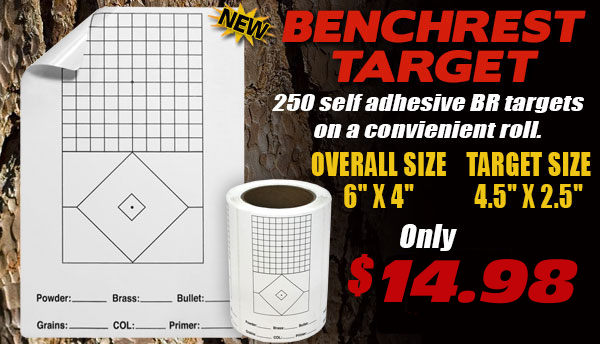
8. Midsouth — Roll of 250 Adhesive Benchrest Targets, $14.98
For under $15.00, you can get 250 self-adhesive Benchrest Targets on a convenient roll. Not just for benchrest competitors, these stick-on targets work great for anyone doing load development. Each target offers a precision 1/4″ grid at the top with diamond aiming box below. This is similar to official targets used in Benechrest matches, with the addition of the upper grid lines which allow you to instantly estimate group size. These targets also include an area to list your load components. Midsouth sells the 250-target roll for $14.98.
9. Natchez — 9mm Luger Steel-cased Ammo, $8.79 per 50ct Box
It’s hard to beat this price for new 9mm Luger ammunition. We’ve found this Tulammo 115gr FMJ to be reliable, and good for general training use. At this price, $8.79 per box, you’re paying less than 18 cents per round. At that rate it’s hard to justify hand-loading your 9mm pistol ammo.
Sinclair International has a helpful, three-part video series on Full-Length Sizing. The full-length sizing die performs multiple important functions: it resizes the case body, resizes the neck, and adjusts the headspace relative to the chamber (it can also eject the spent primer if that was not done previously).
While neck-sizing-only can work with moderate loads (for a couple firings), after repeated firings the case can stretch, becoming too tight to chamber easily. If you shoot cases with high-pressure, near-max loads, you will probably benefit from full-length sizing your cases each reloading cycle. When full-length sizing, you will want to move the shoulder back (i.e. “bump” the shoulder) to provide proper clearance in the chamber. A case that has grown too much will exhibit stiff bolt lift after firing and be hard to chamber if it is not FL-sized during the reloading process.
Sinclair recommends bumping cases .001-.002″ (one to two thousandths) for cases used in bolt-action target-shooting rifles, or .003-.005″ (three to five thousandths) for hunting rifles or semi-auto rifles. To move the shoulder back you screw the FL-sizing die downwards in the press once you’ve determined “just touching” on the shoulder. You don’t have to screw the die down very far! With a normal 14-pitch die, 1/8th turn (45° rotation) yields approximately 0.009″ of downward movement. So it doesn’t take much to add a few thousandths of bump.
Case Sizing Part One — Why We Full-Length Resize
Case Sizing Part Two — How to Set Up Your Sizing Die
Case Sizing Part Three — How to Use a Bump Gauge
NOTE: These FLASH videos may not display on some mobile devices.
Widener’s Reloading & Shooting Supply recently published a helpful introduction to reloading powders. Widener’s online Guide to Smokeless Powders shows the various types of powders, and explains how the differences in powder kernel/flake size and shape, and burn rate affect performance. We recommend you visit Widener’s website and read the Powder Guide in full.
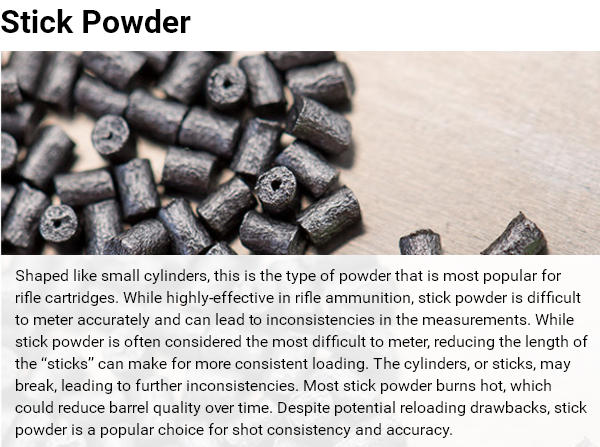
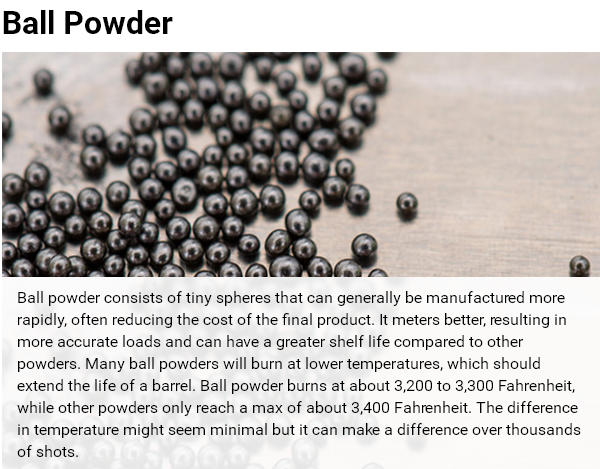
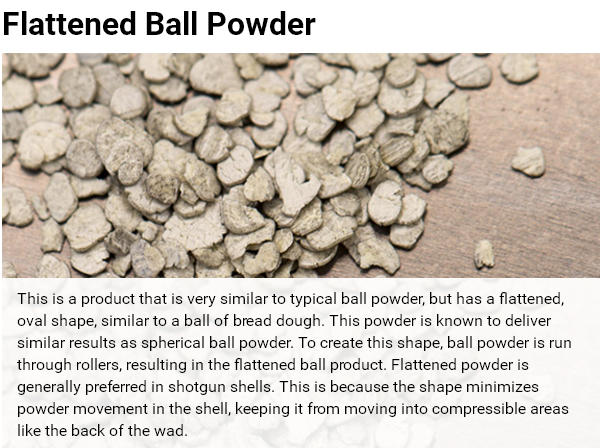
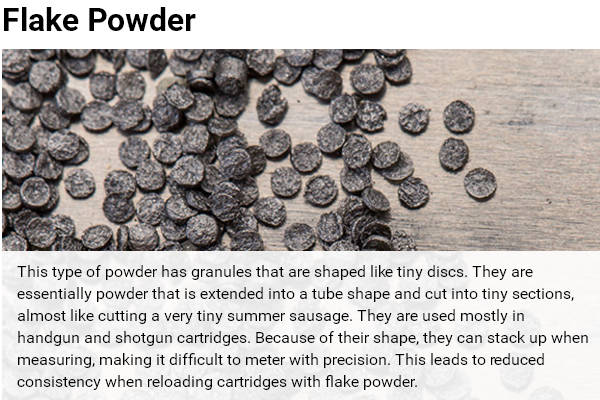
Take a close look at these illustrations which show the key differences between the four main powder types: extruded (stick) powder, ball (spherical) powder, flattened ball powder, and flake powder.
Burn Rate Basics
Widener’s Guide to Smokeless Powders also has a useful discussion of Burn Rate (a confusing topic for many hand-loaders). Wideners explains: “While a gun powder explosion in the cartridge seems instantaneous, if you slow it down you will actually find that each powder has a different ‘burn rate’, or speed at which it ignites.” This video shows powders with two very different burn rates. Watch closely.
Different burn rates suit different cartridge types notes Widener’s: “In general a fast-burning powder is used for light bullets and low-speed pistols and shotguns. Medium-rate powders are used for magnum pistols, while high-velocity, large bore rifle cartridges will need slow powders[.]
It should be noted that burn rate does not have a standardized unit of measurement. In fact, burn rate is really only discussed in comparison to other powders; there is no universal yardstick. Specifics will change by cartridge and bullet types[.]”
We are saddened to report that Mike Dillon, founder of Dillon Precision, has left the range. Mike, whose progressive loaders revolutionized the reloading industry, passed away just before Election Day. His company issued this notice:
“It is with heavy hearts that we announce the passing of Mike Dillon. Mike left us on the morning of November 7th, 2016. He leaves behind a large family including wife Carol, sons Stephen and Christopher, daughter Stephanie, and 9 grandchildren. Mike’s legacy has touched the lives of countless people worldwide. He revolutionized the ammunition reloading industry and made it what it is today. Mike also redesigned and manufactured the M134 Minigun that is now in service in the United States and foreign military forces. As a passionate aviator, he worked for TWA as a Second officer for 13 years and later made a name for himself as a writer for Air Progress Magazine. He is recognized by some as being the one who started the warbird restoration movement in the 1960s.
Mike’s dedication to his family, his customers, and this country was exemplary. We hope to continue the legacy that Mike Dillon worked so hard to build and we will never forget the impact that he has had on us all.
We take comfort knowing he is flying in the blue skies of heaven above.”
Leading figures in the shooting sports mourned Mike’s passing:
“Mike Dillon is a true inventor and pioneer in the shooting community. Shooters everywhere have benefitted from Mike’s affiliation with the best people and listening to their suggestions.” — Michael Voigt
“Since Mike Dillon has been involved with the shooting community, it is impossible to estimate the impact of his incredible ingenuity and generosity.” – Brian Enos
“This is very sad, Mike was a GREAT man. I had the privilege of photographing him in the mid 90s, he was very humble and generous soul. Mike changed the reloading industry FOREVER.” — Yamil Sued
Mike Dillon Content on Facebook
During the coming months Dillon Precision will publish many of Mike’s articles, videos, and photographs on the Dillon Precision Facebook Page. One of the first items released was the classic Machine Gun Magic video, showcasing the M134 Mini-Gun Mike Dillon invented.
At the request of our readers, we provide select “Deals of the Week”. Every Monday morning we offer our Bargain selections. Here are some of the best deals on firearms, hardware, reloading components, and shooting accessories. Be aware that sale prices are subject to change, and once clearance inventory is sold, it’s gone for good. You snooze you lose.
1. Amazon — Howard Leight Electronic Muffs, $26.99
Act quickly — this is a DEAL of the DAY on Amazon! We’ve never seen a lower price on these popular electronic muffs, which are Amazon’s #1 seller in the category. The price goes back up tomorrow! Every shooter should own a pair of electronic muffs, even if you prefer shooting with earplugs and/or standard muffs. Electronic muffs are great when you are doing spotting duties or are working near the firing line. They allow you to hear ordinary conversations while still providing vital hearing protection. Right now Amazon.com has the Howard Leight Impact Sport Electronic Muffs on sale for just $26.99 (Deal of the Day). See All Price Options. NOTE: For regular, sustained shooting we recommend muffs and/or earplugs with a higher NRR rating.
2. CDNN Sports — Ruger American Ranch Rifle (Tan), $349.99
Here’s a nice little varmint rifle from Ruger with good features and performance at a killer price: $349.99. You could pay that much just for a barrel. This .223 Rem rifle features a 16.5″ hammer-forged barrel barrel threaded 1/2″-28 at the muzzle for brake or suppressor. The action, which features a 70° three-lug bolt, and Picatinny-style scope rail, sits in an aluminum bedding block. The crisp trigger adjusts down to 3 pounds. With a weight (before optics) of 6.1 pounds, this is a handy carry-around varminter. We like this rifle. For $349.99 it’s a steal.
3. Amazon — Caldwell Long Range Target Cam System, $329.49
Forum members have purchased this Caldwell Target Cam System and they’ve found that it works reliably, providing a clear signal to any WiFi-enabled mobile device (smartphone, iPad, Laptop). One member specifically tested the unit at 1000 yards and it functioned fine. NOTE: This system does NOT have a zoom camera lens, so you need to position the camera within 10 yards or so of the target. But if you place it to the side a bit, this shouldn’t be a problem. This system comes with a nice, fitted carrying case that holds camera, transceivers, antennas, and stands. You get a very capable system for under $330.00 (Amazon price includes free shipping for Prime members). You can also get this system from Midsouth for $357.02 (shipping extra).
Got patches? Here’s a great deal on 100% cotton flannel patches. There are many sizes available, starting at $8.99 for 800 one-inch “17 Cal” patches. For 6mm rifles, we actually like the 1.25″ round “22/223″ sized patches priced at $11.99 for 800. Choose either round patches or square patches in most sizes. We generally like round patches for use with spire-tip jags, but some shooters prefer to wrap their patches around a jag or brush and square patches work better for wrapping. The large, 2″-square .30 Cal patches cost $17.99 for 800.
5. Amazon — Frankford Quick-N-EZ Case Tumbler, $34.99
Look no further for a great deal on a reliable tumbler. We’ve used this very same machine to tumble both pistol brass and rifle cases. We like the see-through, transparent top and the large capacity — this will hold up to 350 .223 Rem cases. With 1000+ customer reviews on Amazon.com, this Frankford Quick-N-Easy Case Tumbler has earned a 4.5-star rating. If you need a tumbler, you might want to order soon — this is the best price we’ve seen in a while.
6. CDNN Sports — 45 ACP Ruger American Pistol, $399.99
At $399.99, this modern .45 ACP Ruger American Pistol costs hundreds less than premium polymer handguns from Europe. Compared to a Glock 21, it has better sights, a better trigger, and better ergonomics. Compared to an HK USP it has a lower bore axis and is way less expensive. FYI the Ruger’s low bore axis really does reduce felt recoil. The Ruger American pistol has interchangable grip panels so you can adjust the grip to your hand size. Controls are ambidextrous. Bottom line, this is a very good gun that gives up little to Glock, HK, and Walther. Buy American and save hundreds.
The RCBS Rock Chucker remains a classic — a big, strong, versatile press that can handle most reloading chores with ease. And now you can get a genuine Rock Chucker Supreme for $126.99 — a very good deal. The Rock Chucker offers plenty of leverage for case-sizing and the “O” is tall enough for long cartridges. The Rock Chucker has a very strong base and should last a lifetime. We’re not fans of the Rock Chucker’s priming system but most serious reloaders use a separate priming tool.
8. RCBS — Buy Green, Get Green Rebate
RCBS is running a very attractive Rebate Program currently. If you spend $300.00 on qualifying products you get a $75.00 rebate. Spend $50 and get a $10.00 Rebate. This program is limited to one (1) rebate redemption per calendar year, with a maximum of $75.00. CLICK HERE for more information. NOTE: To qualify, you must supply completed RCBS rebate coupon, original UPC barcodes from package, and original cash register receipt and/or dated, itemized sales invoice.
Need quality .22 LR rimfire ammo at an affordable price? Consider Norma. Most folks think Norma only produces centerfire ammo and cartridge brass. As a result, people haven’t been looking for Norma rimfire ammo. Their loss is your gain. Accurate, reliable Norma .22 LR ammunition is in-stock right now at leading online vendors. This is good quality ammo, made in Europe. Bullets.com has Norma Tac-22 ammo in stock at $5.25 per 50-rd box (SKU: BL7819). In addition, Bullets.com offers Norma Match-22 ammunition at $7.50 per 50-rd box (SKU: BL11887).
NOTE: Despite the “BLK” in the name, this is a NOT a black powder substitute. This is a modern smokeless powder suitable for a wide variety of popular cartridges.
Hodgdon has announced a new “faster” variant of its popular CFE 223 powder. That’s good news for shooters of small varmint cartridges. Hodgdon’s new CFE BLK (named after the .300 AAC Blackout cartridge) has a faster burn rate than the original CFE 223. That makes CFE BLK ideal for small cartridges such as the .17 Hornet and .221 Fireball. The original CFE 223 propellant was formulated for reduced copper fouling (“CFE” in the name refers to “Copper Fouling Eraser”). New CFE BLK shares this reduced fouling technology which was developed originally for the U.S. military. Many of our Forum members have tried CFE 223 and confirmed that is performs “as advertised” — with less copper fouling that most other propellants. That’s a big benefit for varmint shooters, who may put hundreds of rounds through a barrel in a single day on the varmint fields.
Optimized for the .300 AAC Blackout cartridge, CFE BLK works great for .300 Blackout loads in AR-type rifles throughout the range of bullet weights. Moreover, CFE BLK is perfect for subsonic, reduced loads. In addition, Hodgdon reports that CFE BLK performs superbly in many smaller-capacity cartridges, in particular varmint cartridges such as the .17 Hornet, .17 Ackley Hornet, .218 Bee, .221 Fireball. CFE BLK is also well-suited for the 6.8 Remington SPC and the 7.62X39 Russian cartridge.
CFE BLK Meters Well and Burns Clean
CFE BLK is a spherical (ball) powder. Hodgdon reports the CFE BLK meters well, allowing reloaders to throw very consistent charges every time: “This fine powder meters like a dream and leaves no copper residue, extending accuracy for longer shooting periods, and making clean-up quick and easy.”
CFE BLK Should Be on Dealers’ Shelves in January 2017
Starting in January, 2017, CFE BLK powder will be available in both one-pound (1-lb.) and eight-pound (8-lb.) containers. Check with leading vendors such as Bruno’s, Midsouth, and Powder Valley. By the end of 2016, you should find complete load data for CFE BLK on the Hodgdon Reloading Data Center at www.HodgdonReloading.com.
When we first ran this story a while back, it generated great interest among readers. By popular request, we’re reprinting this story, in case you missed it the first time around. — Editor
Precision shooters favor premium brass from Lapua, Norma, or RWS. (Lake City also makes quality brass in military calibers.) Premium brass delivers better accuracy, more consistent velocities, and longer life. Shooters understand the importance of good brass, but many of us have no idea how cartridge cases are actually made. Here’s how it’s done.
The process starts with a brass disk stamped from strips of metal. Then, through a series of stages, the brass is extruded or drawn into a cylindrical shape. In the extrusion process the brass is squeezed through a die under tremendous pressure. This is repeated two or three times typically. In the more traditional “draw” process, the case is progressively stretched longer, in 3 to 5 stages, using a series of high-pressure rams forcing the brass into a form die. While extrusion may be more common today, RWS, which makes some of the most uniform brass in the world, still uses the draw process: “It starts with cup drawing after the bands have been punched out. RWS cases are drawn in three ‘stages’ and after each draw they are annealed, pickled, rinsed and subjected to further quality improvement measures. This achieves specific hardening of the brass cases and increases their resistance to extraordinary stresses.” FYI, Lapua also uses a traditional draw process to manufacture most of its cartridge brass (although Lapua employs some proprietary steps that are different from RWS’s methods).
After the cases are extruded or drawn to max length, the cases are trimmed and the neck/shoulder are formed. Then the extractor groove (on rimless cases) is formed or machined, and the primer pocket is created in the base. One way to form the primer pocket is to use a hardened steel plug called a “bunter”. In the photos below you see the stages for forming a 20mm cannon case (courtesy OldAmmo.com), along with bunters used for Lake City rifle brass. This illustrates the draw process (as opposed to extrusion). The process of draw-forming rifle brass is that same as for this 20mm shell, just on a smaller scale.
River Valley Ordnance explains: “When a case is being made, it is drawn to its final draw length, with the diameter being slightly smaller than needed. At this point in its life, the head of the draw is slightly rounded, and there are no provisions for a primer. So the final drawn cases are trimmed to length, then run into the head bunter. A punch, ground to the intended contours for the inside of the case, pushes the draw into a cylindrical die and holds it in place while another punch rams into the case from the other end, mashing the bottom flat. That secondary ram holds the headstamp bunter punch.
The headstamp bunter punch has a protrusion on the end to make the primer pocket, and has raised lettering around the face to form the headstamp writing. This is, of course, all a mirror image of the finished case head. Small cases, such as 5.56×45, can be headed with a single strike. Larger cases, like 7.62×51 and 50 BMG, need to be struck once to form a dent for the primer pocket, then a second strike to finish the pocket, flatten the head, and imprint the writing. This second strike works the brass to harden it so it will support the pressure of firing.”
Thanks to Guy Hildebrand, of the Cartridge Collectors’ Exchange, OldAmmo.com, for providing this 20mm Draw Set photo. Bunter photo from River Valley Ordnance.
If you’re shopping for a heavy-duty, single-stage reloading press, there’s a new option you should consider. MEC, noted for its shotshell reloading machines, has just introduced an all-new, cast-iron press, the MEC Marksman press. This new single-stage press has features we really like. First, the beefy, cast-iron frame is strong enough for the toughest reloading jobs. Second, the MEC Marksman features an OPEN front — that smart design makes it easier to insert and remove cartridge cases during the reloading process. It also makes it much easier to place your bullets during the seating stage. This open-front design makes good sense — note that Hornady’s new LNL single-stage press also has an open-front layout for important reasons. Lastly the MEC Marksman has an innovative, self-centering shell-holder. This patent-pending design should help hand-loaders reload more efficiently.
MEC MARKSMAN
Manufacturer’s Product Description
The MEC Marksman is made from ductile cast iron for superior quality and durability. Our patent-pending self-centering shell holder provides greater accuracy and consistency to every reload. The MEC Marksman is compatible with all 7/8-14 thread dies to change calibers quickly. Reload .22 Hornet to .416 Rigby all with one convenient machine. The MEC Marksman single-stage metallic reloader and accessory products are made in the USA in Mayville, Wisconsin.
In addition to the MEC Marksman, MEC’s new Metallic line of products will include reloading accessories. Powder measure, powder trickler, scale, and calipers will be offered. An additional base is available for easy installation and is compatible with the MEC Jig Fixture mounting system. Case prep tools and components are also available.


 If you are looking for an AR-type .22 LR rifle for cross-training and rimfire tactical matches, the HK 416 is a fine choice. Made by Walther under license, these




 Precision shooters favor premium brass from


 MEC MARKSMAN


