|
|
April 28th, 2007
Interest in the short-action magnums continues to grow among long-range and F-Class shooters. The 7 WSM, and versions made from 270 WSM or 300 WSM brass, have already proven themselves as a 1000-yard rounds. There is new interest in the Rem SAUM now that Norma brass is available. We often get requests for load data for these short magnums. Luckily, data for the WSM and Remington SAUM has been collected by ShortMags.org (now part of NetRifle.com). Click HERE to visit a page that contains collected data from all the major bullet makers and the Powder manufacturers. You’ll also find WSM/SAUM load data from Guns & Ammo magazine, Handloader magazine, and Shooting Times magazine. Most files are in Acrobat (.pdf) format, including bonus ballistics tables and drop charts for the WSM and SAUM.

April 21st, 2007
 We’ve been waiting over a year for the new Norma URP (“Universal Rifle Powder”) to make it to America. This is an extruded powder with a burn rate similar to H4350. URP is available from Powder Valley and Grafs.com, and both companies have plenty in stock. We think this powder may be ideal for use in the 6XC and 6-6.5×47. We suspect it will also work very well for the .284 Winchester. Jason Baney recently received 2 lbs. of URP and he will be doing initial pressure/velocity workups this weekend. We’ve been waiting over a year for the new Norma URP (“Universal Rifle Powder”) to make it to America. This is an extruded powder with a burn rate similar to H4350. URP is available from Powder Valley and Grafs.com, and both companies have plenty in stock. We think this powder may be ideal for use in the 6XC and 6-6.5×47. We suspect it will also work very well for the .284 Winchester. Jason Baney recently received 2 lbs. of URP and he will be doing initial pressure/velocity workups this weekend.
April 19th, 2007
 RCBS has a new, very affordable Vernier Ball Micrometer. This tool measures accurately to .0001″ and is ideal for determining case neck-wall thickness. Ball diameter is 0.185″. If you turn your case-necks, you’ll need a tool like this to set up your cutter and gauge the consistency of your results. And for those who shoot no-turn brass, a Ball Mic allows you to sort cases by neck-wall thickness. Cabela’s has the best price we’ve found on the RCBS tool–just $41.99. To order, please click on the Cabela’s.com link and type “216307” into the product search field at the top of the page. RCBS has a new, very affordable Vernier Ball Micrometer. This tool measures accurately to .0001″ and is ideal for determining case neck-wall thickness. Ball diameter is 0.185″. If you turn your case-necks, you’ll need a tool like this to set up your cutter and gauge the consistency of your results. And for those who shoot no-turn brass, a Ball Mic allows you to sort cases by neck-wall thickness. Cabela’s has the best price we’ve found on the RCBS tool–just $41.99. To order, please click on the Cabela’s.com link and type “216307” into the product search field at the top of the page.

April 7th, 2007
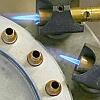 When you look at a new piece of Lapua brass you’ll notice the neck and shoulder area is a darker color. That darker hue comes from the annealing process. You can do this yourself to extend the useful life of your brass. Click HERE to read our Annealing Guide and learn all about annealing methods. After many firings and reloading cycles, brass work-hardens, losing its resiliency or “springiness”. This will affect the consistency of neck tension, a very important factor in accuracy. By annealing your cases regularly you can extend their useful life. Champion 30BR shooter Joe Entrekin anneals his brass very often and his brass is still winning matches after 40+ firings. We normally recommend annealing when you notice the brass has stiffened signficantly, or after 7-8 firings. There are many different methods to anneal brass. You can anneal by hand, or use a machine. It’s a good idea to mark your necks with a temperature-sensitive laquer or Tempil stick so you don’t overheat the cases (which can ruin them). Unless you’re very skilled at manual annealing, the machines normally produce the most consistent results. When you look at a new piece of Lapua brass you’ll notice the neck and shoulder area is a darker color. That darker hue comes from the annealing process. You can do this yourself to extend the useful life of your brass. Click HERE to read our Annealing Guide and learn all about annealing methods. After many firings and reloading cycles, brass work-hardens, losing its resiliency or “springiness”. This will affect the consistency of neck tension, a very important factor in accuracy. By annealing your cases regularly you can extend their useful life. Champion 30BR shooter Joe Entrekin anneals his brass very often and his brass is still winning matches after 40+ firings. We normally recommend annealing when you notice the brass has stiffened signficantly, or after 7-8 firings. There are many different methods to anneal brass. You can anneal by hand, or use a machine. It’s a good idea to mark your necks with a temperature-sensitive laquer or Tempil stick so you don’t overheat the cases (which can ruin them). Unless you’re very skilled at manual annealing, the machines normally produce the most consistent results.
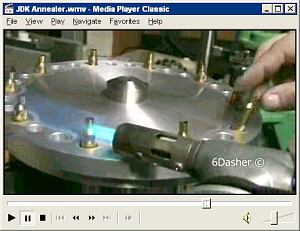
Annealing Video with Home-Built Carousel
Our Dutch friend Jim DeKort created this 2.5 minute video of his annealing machine in action, processing 6BR cases. This carousel unit, similar to Ken Light’s BC 1000, was designed and built by Jim’s father. Currently Jim leaves a gap between each shell to allow more “flame time” per case. But with a second torch he can have a case in each slot. The cartridges spin in their mounting holes while they are rotated clockwise by the shell wheel. Right-Click on Screenshot and “Save As” to download 2.8 megabyte Windows Media video. If you have the video plug-in, you can left-click to watch the video.
March 30th, 2007
There has been much interest in Ultrasonic case cleaning. Here are two tips to achieve the best results:
De-gas the Solvent Before Adding Brass
One of our readers, Eddy M. in Glasgow, Scotland writes: “I have read a couple of articles recently about ultrasonic cleaning of cases and not one has mentioned de-gassing the cleaning liquid before starting to clean items. As an engineer who travelled around for ten years servicing ultrasonic tanks I would like to point out that the cleaning liquid when first put into the tank has invisible disolved air bubbles in it which will absorb ultrasonic energy until the liquid de-gasses. (10 minutes in a powerful industrial tank–longer in a small hobby tank). You must let the tank run on its own for 20 minutes on the first use of the liquid to allow this to happen. Only after the new liquid or re-introduced liquid has been de-gassed will the tank give good results.”
Apply Dry-Lube Inside Case Necks
Jason Baney has found that Ultrasonic cleaning leaves the inside of the case-necks so “squeaky clean” that there is excess friction when seating bullets. On a fired case that has been cleaned conventionally (no ultra-sound), a thin layer of carbon remains to lubricate the bullet entry and exit. To restore that lubricity in cases cleaned with ultrasound, Jason applies a dry lube to the inside of his case necks. Jason prefers the $10.95 moly dry lube kit from Neconos.com. With this kit, small carbon steel balls transfer moly to the neck when you place your brass nose-down in the container.

March 30th, 2007
There have been some questions on our Forum regarding the recommended procedure for flash-hole uniforming on Lapua 220 Russian (PPC parent), PPC and 6BR cases. The factory spec on these cases is 1.5 mm (.059″) for the flash hole. In the past, we found it was normally not necessary to touch the flash holes on Lapua PPC/BR cases. However, with recent lots, a few cases per box will have a little sliver of brass that may obstruct part of the flash hole. It is advisable to remove this–but you don’t want to enlarge the rest of the flash hole in the process. There are a lot of tools on the market to do this job, but we’ve found that some will actually enlarge the flash hole to as much as .067″ which is not good.
The problem with the Lapua brass is a little “quarter-moon” of brass that forms on one side of the flash hole. The objective is to knock that out without increasing the diameter of the flash hole. A simple way to do this is to simply punch out the hole using a #53 or 19/32 pin drill bit in a Pin-Vise (below, about $5). The #53 bit measures .0595″ while a 19/32 is .059375″. You can find pin vises and bits at hobby stores or eHobbyTools.com.

Sinclair Int’l has two flash-hole tools, one that works from the outside (DB 07-3000) and one that works from the inside (DB-2000). The DB-2000 is spec’d to ream a .060″ hole. Depth of cut is set with a conical collar that indexes on the case mouth. Note, this tool can also cut a chamfer or funnel on the top edge of the flash hole. We recommend you set the depth stop so you only clean up the flash hole and do NOT cut a funnel. We also recommend you actually measure the cutter tip to ensure it is the correct diameter–some examples have been oversized–the same problem we found with other brands.

Both Forster and Redding supply dies with a .057.-058″ decapping pin for use with BR and PPC cases. However, the “normal” small decapping pin on some other dies is .0625 (1/16″). Sinclair makes a second tool, DB 07-3000, that cuts to this diameter (.0625″), going in from the bottom side.

Sinclair explains: “This tool was designed specifically to ream small flash holes (.060″) to exactly .0625″. It enlarges the holes just enough for the die maker’s decapping pins to go through without getting stuck… This 3-piece tool has a stainless steel guide that centers the reamer in the primer pocket from the outside.”
Which tool should you use? We prefer to keep the flash-hole as close to factory spec as possible. However, plenty of BR matches have been won with cases reamed to .0625″. The important thing is to remove whatever obstruction may exist in the brass, and make sure all the cases are uniform, whatever hole size you prefer.
March 28th, 2007
Many reloaders like the K&M neck-chamfering tool, because it cuts a very gentle entry angle compared to the typical 45° inside chamferer. The K&M tool is well-made and the cutting flutes are very sharp. However, previous versions tended to rock a little if you weren’t careful, and the cutter was a bit big for the small cases (17s and 20s). K&M has now introduced two new neck chamferers, a small 3-flute tool for 17 Cal to 6mm, and a large 6-flute unit for 6mm to .338 Cal. Both chamferers now feature a center shaft that goes through the flash hole to keep the case in alignment and eliminate cutter wobble. That’s a smart improvement–an example of a toolmaker taking a good product and making it even better. With either tool, the three “fingers” serve as an index stop on the case mouth. You can move the cutter shaft inwards and outwards to adjust the amount of reaming, and then lock the cutter in place with the black knob. This tool is available from Russ Haydon’s Shooters Supply and PrecisionReloading.com for about $24.00. Note: you may have to turn down the tip of the centering shaft to fit unreamed BR and PPC flash-holes.

March 27th, 2007
We spoke to Redding Reloading, and Kurt Nelson confirmed that Redding will be producing sizing and seating dies for Remington’s new 17 FireBall cartridge. Kurt advised that these dies will not be backward-compatible with the 17 Mach 4: “The headspace and the shoulder/neck geometry are different–plus there are variations of the 17 Mach 4 out there.” Redding hopes to have 17 FireBall dies to market in six weeks.
Click HERE for more info on 17 FireBall factory ammo.

March 25th, 2007
 Many die manufacturers use locking rings that require a set-screw to be tightened down on the die threads. That can, eventually, deform the threads. There are some work-arounds, such as placing a piece of plastic between set screw and threads, but there is a better solution. We recommend upgrading your dies with Hornady’s cross-bolt style Sure-Loc Rings. These are made of steel with flats machined in the sides. Here are Sure Loc user reports from MidwayUSA: “Split ring design works better than rings with a set screw that tightens against the die threads. Wrench flats are a big plus–get these rings… and never struggle with your dies again.”-M. Masuda. “All die lock rings should be of the cross bolt design… this ring won’t damage the threads on the die body like factory RCBS and Redding lock rings do.” T. Little. The Hornady Sure-Loc Die Locking ring (mfg. #044000) is available from most major vendors for under $4.00 ($2.99 at PrecisionReloading.com). Many die manufacturers use locking rings that require a set-screw to be tightened down on the die threads. That can, eventually, deform the threads. There are some work-arounds, such as placing a piece of plastic between set screw and threads, but there is a better solution. We recommend upgrading your dies with Hornady’s cross-bolt style Sure-Loc Rings. These are made of steel with flats machined in the sides. Here are Sure Loc user reports from MidwayUSA: “Split ring design works better than rings with a set screw that tightens against the die threads. Wrench flats are a big plus–get these rings… and never struggle with your dies again.”-M. Masuda. “All die lock rings should be of the cross bolt design… this ring won’t damage the threads on the die body like factory RCBS and Redding lock rings do.” T. Little. The Hornady Sure-Loc Die Locking ring (mfg. #044000) is available from most major vendors for under $4.00 ($2.99 at PrecisionReloading.com).
March 25th, 2007
 We’ve learned that, when necking down a 6.5×47 Lapua case to 6mm, it’s best not to simply run the brass into a 6-6.5×47 full-length sizer. Reader “Fireball”, who has worked with both a 6-6.5×47 and a 22-6.5×47, offers this tip: “You don’t want to bring the 6.5mm case all the way down to 6mm in one step–it’s too big of a jump. First, to smooth entry, you should run a 6.5mm expander in the case mouth, and chamfer the outside of the case mouth–be sure to remove all burrs and smooth the case mouth. Apply some lube to the neck. Then, if you have a bushing for a .257, put that in a 6BR bushing neck die, and run the case up. Alternatively, you can use a Redding 6BR body die. The body die will funnel the neck down about half way. Body dies are pretty inexpensive ($22.49 at MidwayUSA, item 458797). After running the brass through the 6BR body die, then you can run the case into the Forster 6-6.5×47 Full-length sizing die. The Forster die is excellent–it sizes a no-turn neck just about perfectly, so long as you do an intermediate step first.” We’ve learned that, when necking down a 6.5×47 Lapua case to 6mm, it’s best not to simply run the brass into a 6-6.5×47 full-length sizer. Reader “Fireball”, who has worked with both a 6-6.5×47 and a 22-6.5×47, offers this tip: “You don’t want to bring the 6.5mm case all the way down to 6mm in one step–it’s too big of a jump. First, to smooth entry, you should run a 6.5mm expander in the case mouth, and chamfer the outside of the case mouth–be sure to remove all burrs and smooth the case mouth. Apply some lube to the neck. Then, if you have a bushing for a .257, put that in a 6BR bushing neck die, and run the case up. Alternatively, you can use a Redding 6BR body die. The body die will funnel the neck down about half way. Body dies are pretty inexpensive ($22.49 at MidwayUSA, item 458797). After running the brass through the 6BR body die, then you can run the case into the Forster 6-6.5×47 Full-length sizing die. The Forster die is excellent–it sizes a no-turn neck just about perfectly, so long as you do an intermediate step first.”
|


