Tumblers and walnut/corncob media are old school. These days many shooters prefer processing brass rapidly with an ultrasonic cleaning machine. When used with the proper solution, a good ultrasonic cleaning machine can quickly remove remove dust, carbon, oil, and powder residue from your cartridge brass. The ultrasonic process will clean the inside of the cases, and even the primer pockets. Tumbling works well too, but for really dirty brass, ultrasonic cleaning may be a wise choice.
Our friend Gavin Gear has evaluated an RCBS Ultrasonic cleaning machine using RCBS Ultrasonic Case Cleaning Solution (RCBS #87058). To provide a real challenge, Gavin used some very dull and greasy milsurp brass: “I bought a huge lot of military once-fired 7.52x51mm brass (fired in a machine gun) that I’ve been slowly prepping for my DPMS LR-308B AR-10 style rifle. Some of this brass was fully prepped (sized/de-primed, trimmed, case mouths chamfered, primer pockets reamed) but it was gunked up with lube and looking dingy.”
UltimateReloader.com Case Cleaning Video (7.5 minutes):
Gavin describes the cleaning exercise step-by-step on UltimateReloader.com. Read Gavin’s Cartridge Cleaning Article to learn how he mixed the solution, activated the heater, and cycled the machine for 30 minutes. As you can see in the video above, the results were impressive. If you have never cleaned brass with ultrasound before, you should definitely watch Gavin’s 7.5-minute video — it provides many useful tips and shows the cleaning operation in progress from start to finish.
Ultra Dry Necks After Ultrasonic Cleaning — Some Suggestions
The Ultrasonic cleaning process gets cartridge brass so “squeaky clean” that increased force may be required to seat your bullets, or they may “grab” as they go in the necks. To reduce bullet-seating effort, you may benefit from adding a little dry case lube inside the case-neck before loading (use a nylon brush). Another trick is adding a teaspoon of Ballistol lube to the cleaning solution. That provides a trace lubricant inside the necks, but does not interfere with powder ignition in any way.
The latest Gen2 RCBS ultrasonic cleaning machine has a large 6.3-quart capacity. That’s nearly 100% larger than the first generation machine in Gavin’s video. The Gen2 machine, $434.52 on Amazon, features a second ceramic heater and transducer to better clean brass cases and firearm parts. The LED is easily programmable, and the timer can be set for up to 30 minutes of cleaning. The original 3.2 quart-capacity RCBS ultrasonic machine, as shown in Gavin’s video, is still available for $213.99 at Midsouth Shooters.
Creedmoor Sports is a leading vendor of products for competitive shooters and serious hand-loaders. Along with great gear, Creedmoor Sports provides informative content for its customers. The Creedmoor InfoZone provides Reloading Tips, Gear Reviews, Shooting News, and basic gunsmithing information.
Bill Gravatt, President of Creedmoor Sports, is an expert on reloading processes and gear. He developed many of the popular tools marketed by Sinclair Int’l, and he brings that expertise to Creedmoor Sports. Bill hosts a series of “how-to” videos produced for the Creedmoor InfoZone.
In this video, Bill Gravatt demonstrates several methods to clean your cases. Bill tells us: “Powder residue should be removed before you insert your cases into your reloading dies. There are several ways to clean your cases. Many shooters use a combination of various methods…”
1. Manual Cleaning — You can use 0000 Steel wool for the outside of the case and a Case Neck brush for the inside. A paper towel can remove any remaining residue. This is a handy way to clean if you load at the range.
2. Vibratory Tumbling — This traditional method works well, particularly for pistol brass. Experiment with both Corn Cob and Walnut media. You can get a brighter shine by putting a small amount of liquid brass polish in the media.
3. Wet Tumbling with Stainless Media — This process can get your brass clean inside and out. Do check to ensure no pins are stuck in the flash-holes. Watch for peening of case mouths that can occur over time.
4. Ultrasonic Cleaning — Ultrasonic cleaning works great for small parts as well as brass. The ultrasonic process removes all carbon and traces of lube, which can leave the inside of case necks too dry. To smooth bullet seating, try putting a tablespoon of Ballistol in the cleaning solution.
Cleaning Reloading Dies
Cleaning your reloading dies is something that many hand-loaders neglect. In this 60-second Tech Tip, Bill Gravatt provides some smart advice on cleaning your dies. Bill notes: “After heavy use, case lube and carbon can build up in your reloading dies. It’s important to keep them clean. Also, with new dies, give them a good cleaning before first use, because they ship with a corrosion inhibitor.”
1. Step 1 — Prior to cleaning, disassemble the die and spray it with a good degreaser. Do this with brand new dies too.
2. Step 2 – Take a patch and run it in the die to remove old lube and gunk. Don’t forget the decapping assembly and other internal parts.
3. Step 3 — After cleaning the die, but before reassembly, spray the die with a good corrosion inhibitor, such as Corrosion-X or Starrett M1.
At the request of our readers, we provide select “Deals of the Week”. Every Sunday afternoon or Monday morning we offer our Best Bargain selections. Here are some of the best deals on firearms, hardware, reloading components, optics, and shooting accessories. Be aware that sale prices are subject to change, and once clearance inventory is sold, it’s gone for good. You snooze you lose.
NOTE: All listed products are for sale to persons 18 years of age or older. No products are intended for use by minors.
1. EuroOptic — Major Vortex Discounts Plus 12% Off Promo
⏺️ » Big savings on all Vortex optics, plus 12% Discount Code
EuroOptic.com is running a major sale right now on Vortex products. You can save a full 12% on nearly all Vortex products including Scopes, Spotting Scopes, Rangefinders, Reflex Optics, Binoculars, Rings and more. Get your 12% Savings by using Code VTX12 during checkout. Along with the 12% discount, many Vortex products have major mark-downs. For example the Vortex Venom 5-25x56mm FFP scope is now just $499.99, a 29% savings, and the Viper HD 3000 Rangefinder is just $399.99, a 33% discount.
2. Palmetto SA — Memorial Day Sale, Save up to 68%
⏺️ » Huge savings on guns, ammo, optics, and more
Palmetto State Armory is running a major Memorial Day Sale this month. You’ll find significant discounts on a wide range of products — rifles, AR lowers, pistols, optics, magazines, ammo and more. From the Memorial Day Sale landing page you can see over 1600 sale items. You can then use the Category tabs on the left (or FILTER button on cellphones) to search by product type.
3. Brownells — FREE $0 HazMat for Powder and Primer Orders
⏺️ » Save $20 to $35 with FREE HazMat now at Brownells
Brownells is currently offering $0 Hazmat Fee on Powder and Primer orders. This is a tempting promo that can save you $20 to $35 on a shipment (compared to fees charged by other vendors). But act soon. This $0 HazMat deal won’t last long. Brownells doesn’t list an end date for the promotion, so it could halt very soon. CLICK HERE for the Brownells Powder and Primers Sale Page.
4. CDNN Sports — HK 416 .22 LR Rimfire, $349.99
⏺️ » Great option for AR cross-training or rimfire gun games, save $200
If you own an AR for Service Rifle competition or 3-Gun matches, here’s a great option for inexpensive rimfire cross-training. An AR-type .22 LR rifle can also be effective in NRL22 matches. Right now you can save $250 on the HK 416 .22 LR rifle. This rifle boasts a 16.1″ barrel, retractable stock, M-LOK rail, and adjustable flip-up sights. With authentic AR dimensions and ergonomics, this is a great cross-trainer.
⏺️ » Great complete system for reloading multiple cartridge types
This Lyman Ultimate Reloading System Kit includes 8-station BrassSmith turret press, Gen 6 Powder Scale/Dispenser, Universal Case Trimmer, Pro 1200 Turbo Tumbler, Case Trimmer, Case Prep Tools, Priming Tool, Calipers, Bullet Puller, Bench Wrench, Case Lube, Reloading Manual and more. This is one of the most complete reloading systems you can buy. With 8 turret stations you can load 3 or 4 different cartridges types, with sizing and seating dies for each. This system is on sale now for $629.99 at MidwayUSA.
⏺️ » Great portable Satellite GPS with Applied Ballistics
The Garmin Foretrex 701 Ballistic Edition device is an amazing bit of technology. This unit combines SATNAV GPS technology with Applied Ballistics software. It’s a great option for ELR and Long-range Tactical Match competitors. It will locate you precisely and also calculate windage and elevation. The Garmin Fortrex is currently $249.99 on Amazon (#ad), 50% off the original asking price.
7. Amazon — KAER Storage Safe, $149.99
⏺️ » Decent secondary safe at super-low price
Here’s a good secondary safe for a garage, work room, or large RV. This KAER gun cabinet hold rifles up to 45″ long. This steel cabinet, now $149.99 on Amazon (#ad) measures 57″ H x 17.7″ W 18″ D and has a handy 18″x9″ inside lockbox. This safe has 3 polymer barrel holders that adjust for height. You can unlock the safe with a touchpad combo or metal key. NOTE: This metal safe comes UNASSEMBLED. You’ll need to put it together with basic tools. This safe is also offered in black for $159.99 on Amazon (#ad).
⏺️ » GREAT Deal on rimfire silhouette steel target 20-Pack
There are few things as fun as plinking with a .22 LR Rimfire rig at steel targets. It’s fun for kids and adults alike and right now you can grab a 20-ct pack of RIMFIRE animal targets in assorted sizes and shapes. They are 1/5 size and made from A36 steel plate. IMPORTANT: These small steel targets work great for rimfire shooting, but should NEVER be used with centerfire rifle cartridges.
9. Amazon — MOZETO Shooting Mat, $39.99
⏺️ » Nice 78″-long padded nylon mat stows conveniently
Whether in the field or at the range, having a comfortable mat to keep you and your gear dry and clean is critical. The Mozeto XL Shooting Mat is made from durable 1000D nylon with EPE padding fabric for long-lasting durability. There is an extra-thick padded section for elbows and knees. This big 78″ x 28.5″ mat has convenient straps and carry handle, plus storage pockets. To transport, just roll it up, fold it over and attach the quick release plastic snap buckles.
10. Locked & Loaded — CCI Blazer 9mm Ammo, $214.99 1000 rds
⏺️ » Quality 9mm brass-cased ammo at a super-low price — $22 cents/round
CCI makes very reliable pistol ammo with reloadable brass cases. Right now you can get 1000 rounds of CCI Blazer 9mm FMJ ammo for just $214.99 at LockedLoaded.com. The price for this 124gr CCI Blazer 9mm ammo works out to just $10.75 per 50-round box — a fantastic price. This very affordable CCI 9x19mm ammo is excellent for practice/training, and it is more reliable than commercial reloads.
⏺️ » Get TWO good compact lock boxes for home or when traveling
Keeping handguns safe from theft or unauthorized use is vital. One good travel option is the TSA-compliant STOPBOX Gun Safe lock box. The button-activated mechanical lock offers quick access to your firearm. This lock box is also padlock-compatible. This $159.00 deal gives you TWO portable handgun safes, each measuring 9.25″ x 7.15″ x 1.75″ inside — big enough to handle full-size pistols. The patented glass-reinforced polycarbonate ABS and steel-reinforced lock boxes pass tough drop tests and come with a limited lifetime warranty.
As an Amazon affiliate, this site can earn revenues through sales commissions.
Do you have a friend who is getting started in hand-loading? Or would you like a refresher course in some of the more important aspects of reloading? Today’s video showcase provides a wealth of information. In these videos, Philip Massaro, Editor-in-Chief of the Gun Digest Annual, explains the techniques handloaders should employ to create safe and accurate pistol and rifle ammunition. These videos are part of an 11-Video Reloading Series from Gun Digest.
After the intro video, there is a video on case resizing, with a focus on full-length sizing. Next Massaro explains how primers work and he demonstrates how to seat primers. There is a video dedicated to bullet choice, followed by a video on bullet seating, both with and without crimping. Today’s video showcase concludes with a helpful video on troubleshooting, showing how to check your ammo and disassemble rounds when something isn’t right.
Basics Of Reloading
What goes into reloading ammo? Here are the five basic handloading steps — removing the primer, resizing the case, inserting a new primer, adding powder, and seating a new bullet. Gun Digest also has a related video on Reloading Tools, explaining the basic tools you’ll need: dies, press, scale, powder measure or powder-dispensing machine, and measuring tools.
Case Prep and Resizing
The reloading process starts with your cartridge brass. You need to remove carbon from the case exterior, check for case damage and signs of incipient separation. And it often makes sense to clean the primer pockets. It’s also wise to check case length, and chamfer/debur the case necks (as needed). Then the cases should be resized before loading. We recommend full-length resizing for rifle rounds.
Primer Types Explained
What is the difference between a large rifle primer and a magnum large rifle primer? Can you use magnum primers in standard cartridges and vice versa? These are among the topics discussed in this video.
Priming Procedures — Using Press or Hand Tool — and Powder Throwing
In this video, Philip Massaro tackles primer installation, the first process of assembly in reloading and case charging. Learn the differences between large and small primers, and how to use a primer cup accessory on a single stage press. Then Massaro shows various methods to dispense the correct powder charge.
Bullets — How to Select the Right Projectile for your Application
Not every bullet is appropriate for every job. Find out what projectile you’ll need to win a shooting match or put meat on the table. Not all bullets are created equal — hunting bullets are different than match bullets and varmint bullets are different than big game projectiles. With this in mind, Phil Massaro examines different bullet designs — including a look at Nosler’s line of projectiles.
Cartridge Completion — Bullet Seating
In this installment, Philip Massaro covers the final step in cartridge assembly, bullet seating. He covers how to use a micrometer seating die for reloading, as well as various ways to crimp handgun bullets. Massaro demonstrates seating bullets for the .357 Mag, .45 ACP, .30-06 Springfield, and .458 Win Magnum cartridges. The video also covers using a roll-crimp and taper crimp.
Reloading Troubleshooting
This is a very important video, that shows how to troubleshoot potential problems with handload ammunition. The host shows how to check for potential case head separation and other brass problems. He shows how to get stuck cases out of dies using the drill and tap procedure. Also covered are collet bullet pullers and inertia hammers for removing seated bullets from cases. This is necessary if you mistakenly seat too deeply or forget to charge the case with powder.
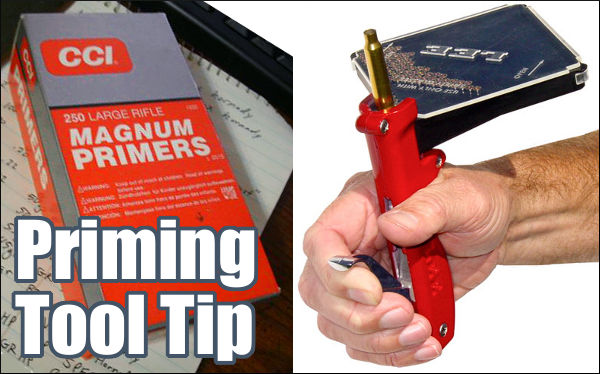
From time to time, we all encounter a primer that doesn’t go off. It’s normal to attribute the problem to a bad primer. But sometimes there are other explanations. George S., one of our Forum members, experienced a couple failures to fire, but he learned that the issue was his priming TOOL, not his primers. Here’s what George told us. There’s a lesson to be learned:
“I had issues with CCI 450s when I had my first 6BR barreled. I had probably three or four out of 20 rounds that failed to fire. the primers were dented but didn’t fire. I called CCI since I had bought a case of them. The tech was decent enough but had the audacity to tell me I was not seating the primers all the way in the pocket. I proceeded to let him know I had been reloading longer than he had been alive and I knew how to seat a primer.
Turns out that I did and I didn’t! I was using the RCBS primer tool I had used for years and the primers felt just fine to me. I finally decided to check the tool and since I had a new one I took the seating pins out and measured them. The seating pin on the tool I had been using for years was shorter by a few thousandths! I then used the pin from the new primer tool and darned if the primers that didn’t seat down to the bottom of the cup.
I switched to a K&M primer tool for seating the CCI primers and have not had a problem since. It was the combination of harder cup and lack of proper seating. I did call the CCI tech back and apologized for being an idiot.”
Another Forum member witnessed a problem cause by misuse of a priming tool: “I did … see a failure to fire on a Rem 9 1/2 primer only a week ago. That was in the new Rem muzzleloader that uses a primed case to ignite the pellets. After watching the muzzleloader’s owner seat his primers, I believe that it was operator error not the primer. He was seating the primer and then squeezing the priming tool so hard that his hands hurt after a few. We got that corrected.”
Bolt Action Reloading is a popular YouTube channel that has amassed 97,000 subscribers. For this Saturday Video Showcase we are featuring seven (7) interesting videos. If you’re getting started in reloading, definitely watch the video on Five Common Mistakes. And all handloaders can benefit from the videos which covers affordable tools, all under $50.00 (at time of filming).
Getting Started in Reloading — Lessons Learned
This is a very helpful video for anyone getting started in reloading. The host summarizes the important lessons he has learned over the years. Here he covers some of the common issues handloaders face and how to avoid problems as you get started. As he notes: “When you are getting started reloading, some things you learn the hard way. In this video I cover things that I wished I knew before I got started [reloading]. There were several things that held me back when I started and in this video we cover 10+ of them.”
Five Common Mistakes Made by Novice Handloaders
This video spotlights five (5) common mistakes made by people when they get started hand-loading ammunition. These are some of the most common errors and misconceptions that affect “newbie” reloaders. Here are the five common problems encountered by folks getting started in handloading:
1. Not Using LOAD DATA from a Reliable Source — Use verified, properly developed load data from a powder maker or bullet maker. Don’t trust private social media posts. And always start conservatively.
2. Inconsistent Case Sizing — this can be the result of sloppy die set-ups or not knowing how to measure cases correctly.
3. Cartridge Overall Length (COAL) Variances — Don’t assume that COAL book values apply to your ammo. You should measure your own cases based on your chamber, headspace, and bullet choice. AccurateShooter.com recommends you use QuickLoad or Gordon’s Reloading Tool software to help adjust loads for different COAL.
4. Hand-Loading Is Not Always a Money-Saver — For a cartridge you don’t shoot much (say a .30-06 for hunting only), hand-loading might not save you money once you count the cost of dies and tools.
5. Reloading Kits Are NOT Complete — Don’t assume that the $500 reloading kit you acquired (with press, powder measure, scale etc.) has all the components and tools you actually need. You will still need dies, comparators, and many other tools.
Primer Pocket Uniforming — Is It Worth the Time and Effort?
With Lapua and Peterson brass we have had very good results — great accuracy and with low ES and SD — using brass that has NOT had the primer pockets uniformed with some kind of cutter. We always do check to make sure there are no flakes or obstructions in the flash holes, but we generally do NOT need to cut into the pockets. But with lesser brands of brass you can benefit from uniforming your primer pockets. And yes there are some top shooters who DO uniform pockets even on premium-brand brass. That is up to you. This video explains the process for primer pocket uniforming and looks at some test results.
Developing a Load — OCW vs. 10-Round Ladder
This video talks about two methods of determining an accurate load. We include this video here because many people are curious about Optimal Charge Weight (OCW) load development. Frankly, however, we believe there are better, more reliable ways to find a good load — many people have wasted many hours and much barrel life on the OCW quest. NOTE: With a good cartridge of known accuracy, such as a 6mmBR or 6mm Creedmoor using top-quality brass, we really do NOT advocate either method described in this video. We suggest you do a search to find the best bullet choice and powder choices. Then, if you are shooting from the bench with a custom barrel, consider starting in the lands, about .003-.005 past first touch. NOT full jam!! If you are shooting in conditions where you may have to unload a round during a match, start .020″ back from first touch. Chronograph every round. Shoot three-shot groups at 100 yards, looking to keep all shots touching. Many people doing OCW waste a ton of time (and barrel life). And one bit of advice for people with average factory barrels — it may be pointless to expect anything much under 1 MOA from that barrel no matter what you do.
Handloading Cool Tools — All Under $50.00
Along with powder measure, dies, and reloading press, there are a wide variety of tools that can help achieve good results when handloading ammo. This Bolt Action Reloading video identifies ten (10) tools that can be acquired for $50.00 or less. Here is the list:
1. Check Weights (00:20) — These help ensure your scale is measuring properly.
2. Digital Calipers (00:57) — You can spend $200+ on calipers, but you can get good results from caliper that cost less than $50.00, and every reloader should have a back-up set of calipers.
3. Comparator Sets (01:26) — These are fittings that attach to calipers. Bullet Comparators are sized to fit a bullet diameter to get reliable base-to-ogive measurements. Case comparators fit the neck of the cartridge, allowing you to measure shoulder bump.
4. Stock Case Remover (02:48) — This allows you to remove a brass case that may be stuck in a die.
5. Imperial Sizing Die Wax (03:20) — There are many types of case lubricants, but Imperial Die Wax is still a popular choice and very affordable.
6. LEE Cutter and Lock Stud (03:44) — This is a cheap way to trim cases. We prefer a Forster trimmer or a deluxe power trimmer but LEE system is inexpensive.
7. Chamfering and Deburring Tools (04:38) — After brass is trimmed to length you need to chamfer and deburr the case necks. Good chamfering/deburring tools are “must have” items for hand-loaders.
8. Case Neck Brushes (05:50) — If you don’t tumble your brass it’s a good idea to brush the inside of your fired cases before seating bullets. A couple swipes is all it takes — and you may find you get more consistent seating if you leave a bit of carbon in the necks.
9. Primer Pocket Swage Gauge (Ballistic Tool) (06:24) — These little tools let you check the dimensions of your primer pockets.
10. Decapping Die (06:57) — The decapping die removes spent primers without sizing the case. This is very handy if you want to remove primers before tumbling brass. NOTE: If your cases have small-diameter flash-holes you need to check the diameter of the decapping rod.
11. Powder Trickler (07:40) — A good trickler is an absolute “must have” when manually weighing each charge. The trickler allows you to add a couple grains at a time.
12. Powder Funnel with Drop Tube (08:45) — While most folks have a basic funnel, a deluxe funnel with a drop tube helps to get a full charge and more consistent powder density.
13. Kinetic Bullet Puller (09:36) — This is like a hammer that holds a loaded round. Using kinetic energy this tool can unseat a bullet with a couple of whacks. However, if you must unload a large quantity of rounds you’ll want a cam-lock bullet puller (09:58) that works with your press.
14. Caliber Specific Reloading Trays (10:28) — These are handy if you are loading specific cartridges. There is less wobble for each round.
Setting Neck Tension with Expanders and/or Bushings
There are three main ways (in addition to collet dies), by which you can set the neck diameter on cartridge brass and thereby control neck tension or the “grip” on the seated bullet. First, the sizing die itself can reduce the neck diameter. This can be a fitted die with the neck honed to a precise diameter. Or, the die can take neck bushings, which allow a range of neck tensions via different bushing internal diameters. Because they allow a wide range of tension settings, bushing dies are popular and effective. You can also have a die that takes the neck dimension down a few thousandths, but then have an expander mandrel that brings the neck inside diameter to an exact dimension. This has the advantage of keeping the INSIDE of the neck perfectly round, with any variances in neck-wall thickness pushed to the outside. This Bolt Action Reloading video explains the use of neck bushings and expander mandrels.
Full-Length-Sizing vs. Neck-Sizing of Cases
NOTE: At AccurateShooter.com we recommend that handloaders always full-length size their brass for many important reasons. Virtually all champion shooters in multiple disciplines full-length size their brass. Full-length sizing can achieve record-setting accuracy, and, importantly, it offers consistent shoulder bump with each loading. But we know that people are curious about neck-sizing, so we are including this video.
This video compares identical charge-weight loads tested with full-length-sized 6.5 Creedmoor brass vs. neck-sized 6.5 Creedmoor brass. The tester states: “I use the 142gr Sierra Match King HPBT loaded with Alliant Reloder 16. There is velocity and group data at 150 yards. FYI, we recommend always full-length sizing most cartridge brass, bumping the shoulder about .003″ (or more if required in a semi-auto).”
Here are two different bullet types, seated to the same CBTO length, but different COAL. Note the shiny scratches on the bullets made by the comparator tool which indicates a point on the bullet ogive near where the ogive will engage the rifling.
Effects Of Cartridge Over All Length (COAL) And Cartridge Base To Ogive (CBTO) – Part 2 by Bryan Litz forBerger Bullets. Part One of this series focused on the importance of COAL in terms of SAAMI standards, magazine lengths, seating depths, and pressure levels. Another measure of length for loaded ammunition is highly important to precision, namely Cartridge Base to Bullet Ogive Length (CBTO).
Figure 2. Chamber throat geometry showing the bullet jump to the rifling or lands.
Look at Figure 2. Suppose the bullet was seated out of the case to the point where the base of the bullet’s nose (ogive) just contacted the beginning of the riflings (the lands) when the bolt was closed. This bullet seating configuration is referred to as touching the lands, or touching the riflings and is a very important measurement to understand for precision hand-loading. Due to the complex dynamics of internal ballistics which happen in the blink of an eye, the distance a bullet moves out of the case before it engages the riflings is highly critical to precision potential. Therefore, in order to systematically optimize the precision of his handloads, it’s critically important that the precision hand-loader understands how to alter bullet seating depth in relation to the barrel rifling. Part of the required knowledge is understanding how to accurately and repeatably measure the Cartridge Base To Ogive (CBTO) dimension. This is explained in the FULL ARTICLE.
Bryan Litz offers an extended discussion on how to measure CBTO using different tools and methods, including the Hornady OAL gauge. You can read this discussion in the full article found on the Berger Bullets website. CLICK HERE to Read Full Article.
Why Not Use CBTO as a SAAMI Standard?
If CBTO is so important to rifle accuracy, you might ask, “Why is it not listed as the SAAMI spec standard in addition to COAL?” There is one primary reason why it is not listed in the standard. This is the lack of uniformity in bullet nose shapes and measuring devices used to determine CBTO.
Benefits of Having a Uniform CBTO
There is another aspect to knowing your CBTO when checking your COAL as it pertains to performance. With good bullets, tooling, and carefully-prepared cases you can easily achieve a CBTO that varies less than +/- .001″ but your COAL can vary as much as .025″ extreme spread (or more with other brands). This is not necessarily bad and it is much better than the other way around. If you have a CBTO dimension that varies but your COAL dimension is tight (within +/- .002″) then it is most likely that your bullet is bottoming out inside the seater cone on the bullet tip. This is very bad and is to be avoided. It is normal for bullets to have precisely the same nose shape and it is also normal for these same bullets to have nose lengths that can vary as much as .025″.
Summary of Cartridge Base To Ogive (CBTO) Discussion
Here are four important considerations regarding bullet seating depth as it relates to CBTO:
1. CBTO is a critical measurement to understand for handloaders because it’s directly related to precision potential, and you control it by simply setting bullet seating depth.
2. Tools and methods for measuring CBTO vary. Most of the measurement techniques have pitfalls (which may give rise to inconsistent results) that you should understand before starting out.
3. A CBTO that produces the best precision in your rifle may not produce the best precision in someone else’s rifle. Even if you have the same rifle, same bullets, same model of comparator gauges, etc. It’s possible that the gauges are not actually the same, and measurements from one don’t translate to the same dimension for another.
4. Once you find the CBTO that produces the best precision in your rifle, it’s important to allow minimal variation in that dimension when producing quality handloads. This is achieved by using quality bullets, tooling, and properly preparing case mouths and necks for consistent seating.
Here’s something you don’t see every day — a reloading press that has loaded over 1,000,000 rounds of ammo. At the NRA Convention in Dallas in 2018, Redding showcased an old Redding T-7 Turret Press delivered to Sierra Bullets decades ago. 0ne of the very first T-7s made by Redding, this “old warrior” was used by Sierra Bullets to load over 1,000,000 rounds of ammunition in Sierra’s ballistics lab.
Redding T-7 Still Within Spec
After all that loading, Redding tested the press and, remarkably, found that it still remained “within spec”. Redding notes: “This press was subjected to real world reloading wear and stress yet remains within ‘new’ spec after this historic test”. When showcased in Dallas, this Redding turret press was fitted with indicators to show “just how good American steel and craftsmanship remains after what, in a normal situation, would represent numerous lifetimes of use.”
About Redding Reloading
Redding Reloading Equipment has crafted quality, American-made products for the precision handloading market since 1946. Along with single-stage and turret presses, Redding makes great dies.
And Redding’s line of tools/accessories includes concentricity gauges, scales, trimmers, powder measures, powder tricklers, cleaning tools, deburring tools, bushings, and many other quality items.
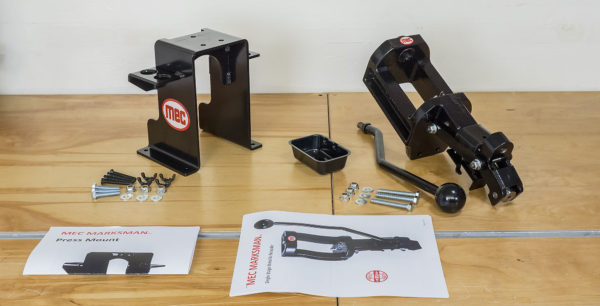
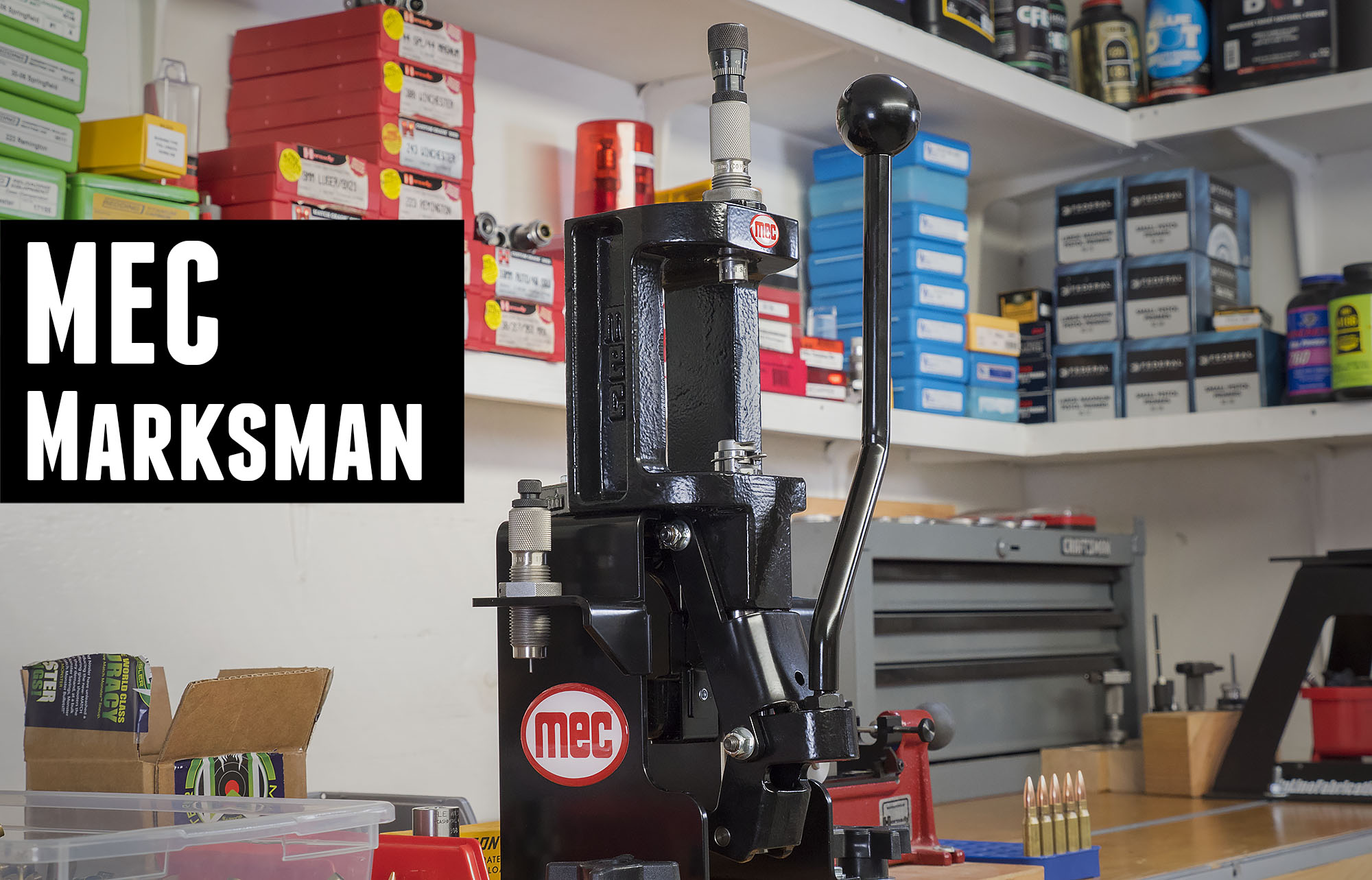
If you need a heavy-duty, single-stage reloading press, definitely look at the MEC Marksman, a beefy black single-stage unit with many impressive features. MEC, noted for its shotshell reloading machines, now offers the cast-iron MEC Marksman press, offering many features we really like. First, the rugged, cast-iron frame is strong enough for the toughest reloading jobs. Second, the Marksman features an OPEN front — that smart design makes it easier to insert and remove cartridge cases. It also makes it much easier to place your bullets during the seating stage.
This open-front design makes good sense — note that Hornady’s LNL single-stage press also has an open-front layout. Importantly, the MEC Marksman has an innovative, self-centering shell-holder. This patented design should help hand-loaders reload more efficiently.
We are impressed with the MEC Marksman press. The Marksman combines a sturdy cast-iron frame with a smart, user-friendly open-front design. The Marksman ($257.54 at MidwayUSA) costs $30 more than an RCBS Rock Chucker ($227.61 at MidwayUSA). However the MEC Marksman offers some distinct advantages — such as the open front plus the patented floating shell-holder system.
MEC Marksman Press Review by Ultimate Reloader
UltimateReloader’s Gavin Gear got his hands on a MEC Marksman press and put it through its paces. He came away impressed with the product, saying it delivers excellent performance, and has many impressive features. Gavin tells us: “Cast iron tools and machines are a lifetime investment. The made-in-USA MEC Marksman features ductile cast-iron construction, an open-front frame design for easy cartridge access, a new floating shell-holder design with a unique retention system, and ambidextrous handle setup.”
Gavin liked the Marksman’s system for holding spent primers. A tray sits behind the ram to catch spent primers exiting from a hole near the bottom of the ram. This is more foolproof than the plastic primer cups on some other single-stage presses. Expect less spent primer “spillage”.
The Marksman is sold as a stand-alone unit. However MEC also offers a very nice steel mount/riser for the Marksman. Gavin tested the Marksman with this riser, and he says it was sturdy and well-built. Gavin liked the riser. He said that elevating the Markman press up above the benchtop made it easier to handle cases and to operate the handle. You also get extra left- and right-side die-holders.
Manufacturer’s Product description: The MEC Marksman® is made from ductile cast iron for superior quality and durability. Our patented shell holder self-centers each cartridge. The MEC Marksman® is compatible with all 7/8-14 thread dies to change calibers quickly. Reloading .22 Hornet to .416 Rigby can all be done with one convenient machine.
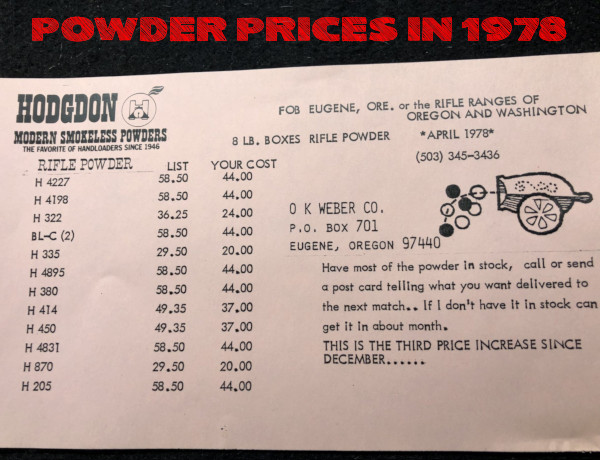
Have inflation (and supply chain shortages) affected the price of powder? You bet. Probably WAY more than you could imagine. Forum member “Two Time HM LR” posted this interesting photo (above) showing Hodgdon powder prices from 1978, as sold by O.K. Weber in Oregon.
Now the prices — $20 to $44 — may not get your attention at first. But take note that these numbers are for EIGHT pound jugs. Yep eight-pounders were all under $45! For example, H4895 was $44 for 8 pounds back in 1978, 45 years ago. And H335 was $20 for eight pounds — that’s just $2.50 per pound!
These days a single pound of a desirable powder such as H4831 might cost $65 at some stores IF you can find it at all. On Hodgdon’s web site, H4831 powder is priced at $62.99 per pound in May 2025. Using that current $62.99/lb figure, H4831 is now over ELEVEN times higher than it was in 1978, when H4831 cost $44 for 8 pounds, i.e. $5.50 per pound.
Here are some comments from our Forum Members:
“Heck those prices are just about the same as current ones, just a little smaller container now.” — Joe
“I’ve got some H4831 in a can marked ‘WWII Surplus Powder’ with a price tag of $2.75. We’ll never see that again either.” Rick in Oregon
“1978 prices and [2025] income would be nice. Unfortunately that doesn’t work. If you compare prices and income, powder cost about the same. You also have to discount the temporary gouging that we are seeing.” — Tmwinds
“So I used to buy gas for 10 cents per gallon and they’d pump it, check the oil, and clean the windshield.” — Pirate Ammo
One comment suggests that the powder price hike actually tracks general U.S. currency inflation over the last four decades. So perhaps powder price increases are not as bad as they seem, when compared to how all prices have risen since 1978:
“Using H4895 [8 lbs.] as a comparison basis at $58.50 (list price) in 1978 calculates it to $287 in today’s money. Looking at … prices it looks like [8 lbs. of H4895 would cost $430] for the same item in today’s money [at Powder Valley], so it really hasn’t gone up [that much as corrected for inflation]. Availability is another issue though[.]” — Drover




 Effects Of Cartridge Over All Length (COAL) And Cartridge Base To Ogive (CBTO) – Part 2

 Redding T-7 Still Within Spec

 If you need a heavy-duty, single-stage reloading press, definitely look at the MEC Marksman, a beefy black single-stage unit with many impressive features. MEC, noted for its shotshell reloading machines, now offers the cast-iron