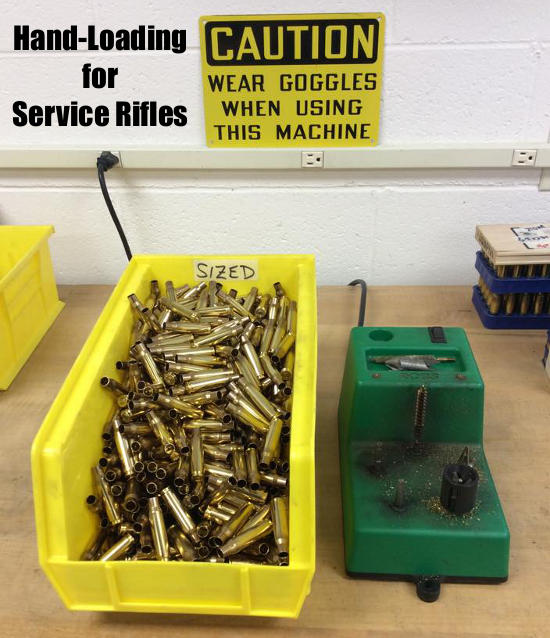
The U.S. Army Marksmanship Unit (USAMU) has published a great series of reloading “how-to” articles on its Facebook Page. This post covers key factors to consider when loading ammunition for Match Rifles and Service Rifles, with a particular focus on self-loading “gas guns”. Visit the USAMU Facebook Page each Wednesday for other, helpful “Handloading Hump-Day” tips.
We offer some “cardinal rules” to help new gas-gun handloaders with safety and efficiency. These address both Match Rifle and Service Rifle versions of the AR15, M1 Garand, M1A, and M110. However, they can also improve safe reloading for many other auto-loaders such as M1 Carbines, FALs, SIGs, etc. The author distilled these principles many years ago to help focus on the essential aspects of these rifles.
RULE ONE: Service Rifles Are Not Benchrest Rifles
Gas-guns require a relatively loose fit between ammunition and chamber (vs. bolt actions) for safe, smooth operation. Many techniques, such as neck sizing and keeping cartridge headspace quite tight, are popular in the extreme bolt gun accuracy realm. However, they are of little value with Service Rifles, and some could even be hazardous. Before adopting a specialized technique, seriously consider whether it is appropriate and beneficial in a gas-gun.
RULE TWO: Never Compromise Safety to Obtain Accuracy
Example: If choosing a brand of great, but ultra-sensitive match primers offers possibly better accuracy at the risk of slam-fires in your design of rifle, don’t do it! You are issued exactly two eyes and ten fingers (best-case scenario). Risking them trying to squeeze 0.25 MOA better accuracy out of an M1A, etc. simply isn’t worth it.
RULE THREE: Tailor the Precision to Your Individual Skill and Your Rifle’s Potential
This has been addressed here before, but bears repeating for newcomers. If you are struggling to break out of the Marksman Class, or using a CMP M1 “As-Issued,” then laboriously turning the necks of your 600-yard brass is a waste of time. Your scores will improve much faster by practicing or dry-firing. On the other hand, if the reigning champions anxiously check your scores each time you fire an event, a little neck-turning might not be so far-fetched.
Verifying Load Improvements — Accuracy hand-loading involves a wide variety of techniques, ranging from basic to rather precise. Carefully select those which offer a good return on investment for your time and labor. In doubt? Do a classic pilot study. Prepare ammo for at least three or four ten-shot groups with your new technique, vs. the same with your standard ammo. Then, pick a calm day and test the ammo as carefully as possible at its full distance (e.g. 200, 300, or 600 yards) to verify a significant improvement. A little testing can save much labor!
RULE FOUR: Be Your Own Efficiency Expert
Serious Service Rifle shooters generally think of ammunition in terms of thousands of rounds, not “boxes”, or even “hundreds”. Analyze, and WRITE DOWN each step in your reloading process. Count the number of times each case is handled. Then, see if any operations can be dropped or changed without reducing safety or accuracy. Eliminating just two operations saves 2000 steps per 1000 rounds loaded. Conversely, carefully consider any measurable benefits before adding a step to your routine.
RULE FIVE: In Searching for Greater Accuracy with Efficiency, Look for System Changes
For example, instead of marking your 300-yard rounds individually to differentiate them from your 200-yard ammo, would a simple change in primers work? If accuracy is maintained, using brass-colored primers for 200 and silver for 300 provides an indelible indicator and eliminates a step! Similarly, rather than spending hours selecting GI surplus brass for weight and neck uniformity, consider splurging on some known, high-quality imported match brass for your 600-yard loads. Results should be excellent, time is saved, and given limited shooting at 600 yards, brass life should be long.
RULE SIX: Check All Your Primers Before Packaging Your Loaded Ammo
This seems simple and even intuitive. However, many slam-fires (which were much more common when M1s and M1As were the standard) are due, at least in part, to “high” primers. Primers should be seated below flush with the case head. The USAMU has addressed this at length in a previous column, but each round should be checked for properly-seated primers before they are packaged for use.
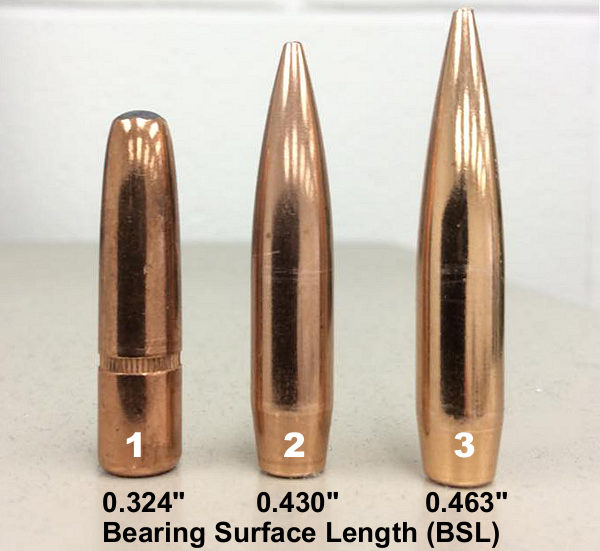
Three near-equal-weight 7mm bullets with different shapes and bearing surface.
This article, from the USAMU Facebook Page, concerns reloading safety. In the relentless quest for more speed and flatter ballistics, some hand-loaders load way too hot, running charges that exceed safe pressure levels. Hint: If you need a mallet to open your bolt, chances are your load is too hot. Stay within safe margins — your equipment will last longer, and you won’t risk an injury caused by over-pressure. In this article, the USAMU explains that you need to account for bullet shape, diameter, and bearing surface when working up a load. Don’t assume that a load which is safe for one bullet will be safe for another even if both bullets are exactly the same weight.
Today, we continue our handloading safety theme, focusing on not inadvertently exceeding the boundaries of known, safe data. Bullet manufacturers’ loading manuals often display three, four, or more similar-weight bullets grouped together with one set of load recipes. The manufacturer has tested these bullets and developed safe data for that group. However, seeing data in this format can tempt loaders — especially new ones — to think that ALL bullets of a given weight and caliber can interchangeably use the same load data. Actually, not so much.
The researchers ensure their data is safe with the bullet yielding the highest pressure. Thus, all others in that group should produce equal or less pressure, and they are safe using this data.
However, bullet designs include many variables such as different bearing surface lengths, hardness, and even slight variations in diameter. In fact, diameters can occasionally range up to 0.001″ by design. Thus, choosing untested bullets of the same weight and caliber, and using them with data not developed for them can yield excess pressures.
This is only one of the countless reasons not to begin at or very near the highest pressure loads during load development. Always begin at the starting load and look for pressure signs as one increases powder charges.
Bullet Bearing Surface and Pressure
Bullet bearing surface length (BSL) is often overlooked when considering maximum safe powder charges and pressures. In Photo 1, note the differences in the bullets’ appearance. All three are 7 mm, and their maximum weight difference is just five grains. Yet, the traditional round nose, flat base design on the left appears to have much more BSL than the sleeker match bullets. All things being equal, based on appearance, the RN/FB bullet seems likely to reach maximum pressure with significantly less powder than the other two designs.
TECH TIP: Bullets of the same weight (and caliber) can generate very different pressure levels due to variances in Bearing Surface Length (BSL).
Bullet 1 (L-R), the RN/FB, has a very slight taper and only reaches its full diameter (0.284 inch) very near the cannelure. This taper is often seen on similar bullets; it helps reduce pressures with good accuracy. The calculated BSL of Bullet 1 was ~0.324″. The BSL of Bullet 2, in the center, was ~0.430″, and Bullet 3’s was ~ 0.463″. Obviously, bullets can be visually deceiving as to BSL!
Some might be tempted to use a bullet ogive comparator (or two) to measure bullets’ true BSL for comparison’s sake. Unfortunately, comparators don’t typically measure maximum bullet diameter and this approach can be deluding.
Note: Due to time constraints, the writer used an approximate, direct measurement approach to assess the bullets’ different BSLs. While fairly repeatable, the results were far from ballistics engineer-grade. Still, they are adequate for this example.
Photo 2: The Perils of Measuring Bearing Surface Length with Comparators
In Photo 2, two 7mm comparators have been installed on a dial caliper in an attempt to measure BSL. Using this approach, the BSLs differed sharply from the original [measurements]. The comparator-measured Bullet 1 BSL was 0.694” vs. 0.324” (original), Bullet 2 was 0.601” (comparator) vs. 0.430” (original), and Bullet 3 (shown in Photo 2) was 0.602” (comparator) vs. 0.463” (original). [Editor’s comment — Note the very large difference for Bullet 1, masking the fact that the true full diameter on this bullet starts very far back. You can use comparators on calipers, but be aware that this method may give you deceptive reading — we’ve seen variances just by reversing the comparators on the calipers, because the comparators, typically, are not perfectly round, nor are they machined to precision tolerances.]
Thanks to the U.S. Army Marksmanship Unit for allowing the reprint of this article.
Useful reloading gear does not have to be costly. Here are ten handy (and very inexpensive) items that belong on your loading bench or in your range kit.
• Magnifying Glass – We use a flat, 2″x2″ pocket 4x-8x magnifier. This folds up on itself. Very handy, we use it to inspect bullets and brass. Use this to check your flash holes for burrs, and check the meplats of your bullets before loading.
• Clear 35mm Film Cannister – Use this to transfer the thrown powder charge to the little measuring cup that sits on your scale. That way you don’t get any kernel splash. Also if the charge weight is obviously off, it’s easy to dump back in the measure. A film canister works pretty well as a trickler too.
• Compressed Air in a Can -- Get these at office supply stores. Use the can (with tube attached) to blow crud out of cases after cleaning the neck with a brush, and blast loose debris out of primer pockets.
• Pin Vise – A simple pin vise with a #53 bit is perfect for deburring Lapua PPC and BR flash holes without reaming the flash-holes any larger. The Lapua PPC/BR flash-hole diameter is 1.5 mm, or 0.059″. Amazon.com sells a handy $8.99 pin vise kit with 10 bits, including the ideal 1.5mm bit. Other vendors offer a #53 pin vise bit that measures .0595″ or .060″ (depending or source). You can find pin vises and bits at hobby stores — here’s an example below with ten bits including 1.5mm. Pin vise sets can be found from $7 to $15.
• Bounce Dryer Sheets – The common dryer sheets eliminate “static cling” on your plastic reloading parts such as powder measure cylinders, powder funnels, and reloading press plastic bins. Thanks to Doc76251 for this tip.
• Ballistol Aerosol – Try using this versatile lubricant/solvent for full-length sizing. Spray some on a patch and you can wipe the carbon off your case necks. Then, continue to apply a very small amount of Ballistol on the case bodies — just thin sheen is all you need. Ballistol is super slippery, and easy to remove. For general full-length sizing (on small cases) it works great and doesn’t leave a gooey, waxy, or chalky residue. For heavier case-forming jobs, we recommend Imperial Die Wax.
• Shotgun Mop – Stick this in the chamber when using Wipe-Out foaming bore cleaner. This will seal off the chamber so the foam doesn’t flow into your action. For long chambers screw on one section of cleaning rod to aid extraction.
• Colored Sharpie Marking Pens – Mark your bullets ahead of the bearing surface, and the color transfers to the target. This way you can shoot multiple loads at the same point of aim and discern which load shoots the tightest. (Recommended for 300 yards and beyond). With colored bullet tips you can test multiple loads “round robin” to equalize wind effects. When testing seating depths for example, you can mark the longer-seated set of bullets red and the shorter-seated set green and shoot them during the same sequence. Just look at the colored marks on the target to see which grouped better.
• Thin Latex Gloves – You should keep a box of inexpensive, disposable latex gloves (the kind doctors use) in your loading room. These will prevent contamination of primers or powder kernels that you handle directly. Also, use the gloves when handling fine blued tools or firearms to prevent transfering body oils and salts that promote rust.
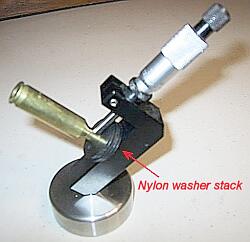
• Plastic Washers for Neck Mic – If you use a Sinclair Neck-wall Micrometer Gauge with integral stand, you can use thin plastic washers to adjust the height of the case on the mandrel. This makes it much easier to measure the same point on the case neck every time. Thanks to MikeCR for this tip (and photo).
On the Applied Ballistics Facebook page a few seasons ago, Ballistician Bryan Litz posed a “Tuesday Trivia” question about ballistics. This being Tuesday we thought we’d bring back this interesting brain-teaser — a true/false question about bullet stabilization. On shooting forums you often find heated arguments about “over-stabilization”. Bryan wants readers to consider the issue of over-stabilization and answer a challenge question…
Is This Statement TRUE or FALSE?
“The problem with ‘over-stabilizing’ a bullet (by shooting it from an excessively fast twist rate) is that the bullet will fly ‘nose high’ on a long range shot. The nose-high orientation induces extra drag and reduces the effective BC of the bullet.”
True or False, and WHY?
Click the “Post Comment” link below to post your reply (and explain your reasoning).
Bullet Movement in Flight — More Complicated Than You May Think
Bullets do not follow a laser beam-like, perfectly straight line to the target, nor does the nose of the bullet always point exactly at the point of aim. Multiple forces are in effect that may cause the bullet to yaw (rotate side to side around its axis), tilt nose-up (pitch), or precess (like a spinning top) in flight. These effects (in exaggerated form) are shown below:
Yaw refers to movement of the nose of the bullet away from the line of flight. Precession is a change in the orientation of the rotational axis of a rotating body. It can be defined as a change in direction of the rotation axis in which the second Euler angle (nutation) is constant. In physics, there are two types of precession: torque-free and torque-induced. Nutation refers to small circular movement at the bullet tip.
Sinclair International has a good article on Case Lubrication which shows the various products and application methods available. Part of Sinclair’s Step-By-Step Reloading series, the article shows how to apply Spray Lube, Die Wax, or conventional lube from a Pad. The story also explains how to use dry lube to slick up the inside of your case necks.
Spray Lubes
High-volume reloaders often turn to spray-on lubricants such as the RCBS Case Slick (#749-001-341WB) or the Hornady One Shot (#749-016-818WB) to quickly lubricate large numbers of cases at once. An indispensable piece of gear that helps make spray lubing easy is a polymer lube rack that holds cases upright and arranged to maximize their exposure to the spray.
Editor’s Note: Ballistol Aerosol is other good spray product for regular full-length sizing (not heavy case-forming). It goes on clear (no chalky residue), it is ultra-slippery, and it will remove the carbon from your case necks as you apply Ballistol with a patch. This is my primary spray lube — but many folks dislike the distinctive Ballistol smell. Try before you buy.
Sizing Die Wax
Over the years, many benchrest shooters have come to trust Imperial Sizing Die Wax (#749-001-052) for their case lube needs. It offers high lubricity and easily wipes off with a paper towel. In fact, its lubricity makes it a popular choice for case forming, for those wildcat folks who need to form their own unique or obsolete cartridges. Unlike lube pads or spray lubes, sizing wax is applied more naturally. You just put a little on your fingers and transfer it to the cases by handling them. As simple and easy as Imperial Sizing Die Wax is to use, it’s probably best for low-volume applications.
Dry Lubricant
Redding’s Imperial Application Media (#749-001-166) is a dry neck lube used to lube the inside of the neck, whether you’re full-length sizing or neck-sizing only. It consists of ceramic spheres coated with a fine graphite-based powder. You simply dip the neck into the container for a second to pick up the right amount of lube. This lube lets the expander ball move smoothly throughout the case neck instead of “grabbing” or “chattering”. That minimizes case neck stretching.
Editor’s Note: Dry Lube is also very useful if you ultrasonically clean your cases. After the ultrasound process, the inside of the case neck can be so “squeaky clean” that bullets don’t seat smoothly. A quick application of dry lube on the insisde of the necks will help bullets slide into the neck easier. As a result, the neck “grip” on the bullets should be more consistent from round-to-round. Consistent neck tension is key to accuracy and uniform velocities.
Tired of spending $15-$25 for a can of spray lube that doesn’t last very long? For about the same price as a single 10 oz. can you can make your own effective spray lube that should last for multiple seasons and lube thousands of cases quickly and easily.
In the YouTube video above Gavin Gear of UltimateReloader.com shows how to make your own case lube using simple, inexpensive ingredients. First recommended by the 6.5 Guys, this Liquid Lanolin + Isopropyl Alcohol mix works well and is very cost-effective. Here’s what you need:
RCBS offers a series of premium MatchMaster Competition Dies. These are available in Full-Length Sizing, Neck Sizing, and Seating configurations. These new MatchMaster dies are notable for four features:
1. The Competition Seating Die has a “view-port” for the bullet.
2. The Competition Seating Die features a self-centering, free-floating bullet-seating stem.
3. Expanders are titanium-nitride coated for reduced friction. Both the Neck-Sizing and FL-Sizing dies come with TiN expanders for smoother case extraction and reduced brass build-up on the expander.
4. RCBS is offering its own precision-machined Neck Bushings.
No More Mashed Fingers When Seating Bullets
RCBS notes: “Reloaders will love that they can end smashed fingers and misaligned bullets with the specially-designed bullet window [on the Seating Die]. And users can fine-tune any load … with the micrometer-adjustable, free-floating, self-centering bullet seating stem.”
RCBS Product Manager Will Hemeyer explained that the new Competition Seater is a game-changer. “What sets the MatchMaster Seating Die apart from the competition is a bullet-seating window with bullet-retaining system. Simply place the bullet in the window and raise the case into the die to seat the bullet. Couple this with a micrometer-adjustable, free-floating, self-centering bullet-seating stem[.]”
Buy MatchMaster Powder Dispenser, Get Free RCBS MatchMaster Die Set plus $100 MidwayUSA Gift Certificate
To make these dies even more attractive, right now, though the end of April, 2021, you can get a FREE set of MatchMaster Dies if you purchase an RCBS MatchMaster electronic powder scale/dispenser.
Right now, with an RCBS Promo, you’ll get both FL sizing die and micrometer seating die for FREE if you buy the $899.00 MatchMaster. The retail value of the die set is $185.95. But wait — it gets even better. If you purchase from MidwayUSA you get a $100 MidwayUSA Gift Certificate. To qualify for the Free Dies deal, the MatchMaster must be purchased 4/1/2021 through 4/30/2021.
Why Use Expander with Bushing Dies?
Some viewers of Gavin’s video asked if an expander is superfluous when using neck-bushing dies. The answer is “it depends”. The bushings reduce neck diameter from the OUTSIDE. The expander should make the INSIDE of the neck perfectly round. Some hand-loaders prefer to take the necks down a couple thousandths below final loading diameter, then finish the job with an expander. That ensures the INSIDE of the case neck is perfectly concentric. This can be particularly useful for brass that has somewhat inconsistent neck-wall thickness. Bottom line, you can run these dies without expanders if you want, but that option is available. The expander is also removable so the assembly can be used for de-capping only.
MactchMaster Neck-Sizing Only Die
The MatchMaster Neck Sizing Die Set also uses RCBS neck bushings to control neck tension while not changing the body dimensions of fired cases. Frankly we strongly recommend that you full-length size your rifle rounds, but we acknowledge that some hand-loaders prefer to neck size for some applications. The MatchMaster Neck Sizing Dies do include a titanium-nitride coated expander, just like the FL-sizing MatchMaster dies.
Outstanding New Powder from Alliant — Reloder TS 15.5 New Product Review by DasherDude
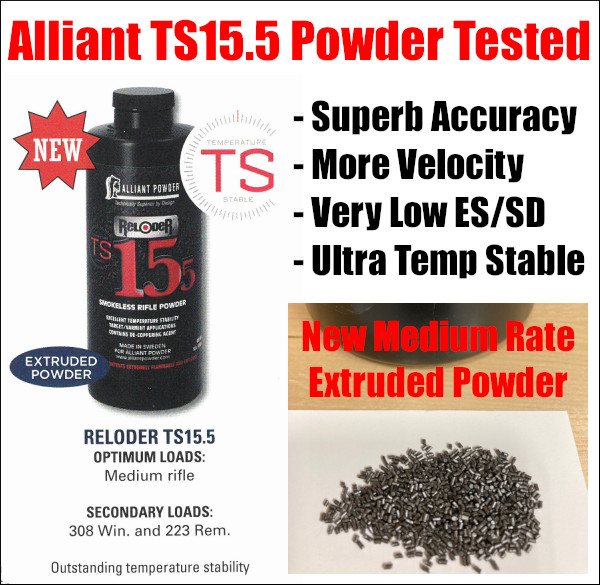
Alliant has devloped a new temperature-stable powder for long range applications. According to Alliant, this is a “slower burning version of the popular RL 15 with TZ technology” and brings some significant advantages over RL 15 and powders in the similar burn rate range (like Varget). The powder is named “Reloder TS 15.5″ (RL TS 15.5) and is created using the same TZ technology used in Reloder 16 (RL 16) and Reloder 23 (RL 23) whereby it manipulates the response of the propellant and resists the natural tendency to generate more pressure at higher temperatures and less pressure at lower temperatures. That makes RL TS 15.5 extremely stable across the full temperature range a shooter may encounter.
When Can You Get This New Alliant RL TS 15.5 Powder?
Alliant tells us that new RL TS 15.5 should start arriving on dealer’s shelves by the end of the month. Officially: “We will be putting it into distribution probably in April 2021 sometime”. Remember you heard about this powder here first.
The burn rate of RL TS 15.5 lies between RL 15 and RL 16 making it ideal for loading heavier bullets in .308 Win, 6.5 Creedmoor, 6mm Creedmoor, .223 Rem, and 6mm wildcats such as the 6mm Dasher or 6 BRA (BR Ackley). Being a bit slower than RL 15, new TS 15.5 offers higher velocities for the same charge weight as well as ability to load heavier charges for additional velocity without generating excessive pressure.
Testing Reloder TS 15.5 in 6 Dasher and .308 Winchester
I got a chance to test a pre-production powder sample of RL TS15.5 from Alliant. In my own tests with my 6mm Dasher and .308 Win, I extensively compared it with Varget that I normally use in these cartridges. In both cases, the results were nothing short of spectacular.
Powder Characteristics and Metering
This is an extruded powder and looks and feels similar to RL 16. The kernels are about 0.03 – 0.04 grains each (with the resolution of A&D FX 120i scale). RL TS 15.5 meters very well, although I had to slightly adjust the AutoTrickler to get it to meter perfectly.
As I found, later in the testing, that the powder compresses before it can generate excessive pressure in the Dasher, a drop tube helps to fill the case more efficiently if higher charges and velocities are desired.
6mm Dasher Test Rifle and Load
For testing I used my 6mm Dasher benchrest match rifle. This has a BAT 3L action, 28″ Krieger barrel, and McMillan stock. I use Lapua brass with CCI 450 primers to propel Berger 105gr Hybrids and this combination shoots quite well.
Test Firearm: 6mm Dasher, Bat 3L, 28″ 6mm HV Krieger Barrel, McMillan Stock.
Components: Lapua fire-formed brass, CCI 450 primers, Berger 105 grain Hybrid
Powder: Alliant Reloder TS 15.5
Load Testing and Velocities
Test in 6mm Dasher — Excellent Velocity, Low ES/SD
The testing comprised of shooting groups at 100 yards with increasing powder charges (OCW method) and then selecting a node. That node was found at 33.4 grains. The accuracy was excellent with remarkably low Extreme Spread and Standard Deviation (ES/SD)
My usual load is 32.9 grains of Hodgdon Varget which runs 2925 fps with an ES of around 12 fps and SD around 5 fps. For comparison, 32.9 grains of RL TS 15.5 delivered a velocity of 3022 fps. That is 97 fps greater than Varget for the same load weight (of RL TS15.5).
When used in the 6 Dasher, RL TS 15.5 had ES of 13 for 28 Shots — Remarkable!
More Velocity Plus Consistent ES/SD With the Dasher since the new node (the sweet spot) was found at 33.4 grains, that resulted in a velocity of 3050 fps (a 125 fps velocity increase) from the same rifle setup. Not only did the velocity increase, but the SD was lowered to 3.6 with an ES of 13 (calculated over 28 shots). You read that right… 13 fps ES over 28 shots!
At 34 grains without any drop tube, the load was compressed. However, there were no pressure signs. That indicates that the 6 Dasher cartridge can be loaded with a higher charge, if a drop tube was used.
.308 Winchester Velocity Results
Similar results (velocity gains) were obtained from my .308 Win with Berger 200.20X bullets. For the same charge of 44.2 grains, I recorded about 100 fps higher velocity with RL TS 15.5, compared to Varget.
Accuracy Results at 100 and 300 Yards — Very Impressive
How does RL TS 15.5 shoot on paper? Very well indeed.
6mm Dasher Load Testing with Various RL TS 15.5 Charge Weights
The groups on paper told similar stories. For the OCW method, I shot groups of increasing charges at 100 yards and then selected 33.4 grains as the optimum charge (incidentally, it was one ragged hole).
While testing at 300 yards, the conditions were very windy but since I was testing for vertical, the point of aim was kept the same for every shot. No attempt was made to correct for wind, so the groups spread horizontally (15 mph, 3 o’clock wind) but the vertical spread of all the groups was under 0.3 MOA. That gives me great hopes for the long-range capabilities of the powder.
Thoughts and Conclusions
For the past year, Alliant powders have been a welcome surprise for this tester and they have found a home in my reloading room. I struggled to find a load for my .284 Win with H4831sc and H4350 before trying out Reloder 16 and voila, it was perfect.
I have used Hodgdon Varget powder for a long time in both my 6mm Dasher and my .308 Winchester. With the .308 Win I’ve used various bullets from 168 to 200 grains. Varget has served me well. I do always need to keep the powder charge in check and so the velocities are held back a bit. Now RL TS 15.5 looks like a very impressive competitor to Varget.
With Reloder TS 15.5, Alliant seems to have delivered a harmonious mix of great accuracy, higher velocities, and lower SDs without creating excessive pressure. All of this is delivered with a very temperature-stable package. The higher velocities may allow some shooters to hit a new, better-performing node. These qualities are highly sought after by long range shooters. Accordingly, I have no qualms in saying that Alliant has created a winner here.
Alliant Official Load Data for Reloder TS 15.5
Along with the cartridge types shown below, Alliant has also released load data for .30-06 Springfield, 7x57mm Mauser, .270 Win, .260 Rem, 6.5 Grendel, .257 Roberts, 22-250 Rem, and 224 Valkyrie. CLICK for all data (larger format).
At the request of our readers, we provide select “Deals of the Week”. Every Sunday afternoon or Monday morning we offer our Best Bargain selections. Here are some of the best deals on firearms, hardware, reloading components, optics, and shooting accessories. Be aware that sale prices are subject to change, and once clearance inventory is sold, it’s gone for good. You snooze you lose.
1. Palmetto SA — Complete PSA Lower with Adj. Magpul FDE Stock — $249.99
⏺ Good assembled lower with nice stock — add upper and you’re good to go
Get that AR lower while you still can. This complete Palmetto State Armory lower with Magpul stock is fully assembled. It will take a standard upper, which you can build or purchase later without an FFL. The lower is the section that much be purchased through an FFL with a background check. This lower features polished hammer and trigger components with nickel-plating for smoother trigger action. This lower is finished with a Magpul MOE Carbine Stock, Magpul MOE Trigger Guard, and Magpul MOE Grip.
⏺ Good press, powder measure plus many tools for crazy-low price
Though reloading tools are in high demand, right now you can get this very complete Lee 50th Anniversary multi-component kit for $199.99. The main attraction is the Lee Breech Lock Challenger Press with quick-change bushing. (We’ve used this press and it functions well.) In addition, you get a Lee Perfect Powder Measure, Safety Scale, Powder Funnel, and Safety Prime. The kit even includes variety of Case Prep tools: Case trimmer, Chamfer Tool, Primer Pocket-Cleaning tool.
3. EuroOptic.com — Vortex Riflescope Close-outs, Save Hundreds
⏺ Great Value on Vortex Viper Series Close-outs
Vortex riflescopes offer great performance for the price with models suited for all shooting disciplines. Right now you can save hundreds on Vortex Viper scopes at EuroOptic.com, such as the 6-24x50mm Viper PST model. If you are looking for a good scope for varminting or fun matches this is an excellent option. And the Vortex Lifetime Warranty is one of the best in the business.
⏺ Current Data with 5000+ loads, good modern resource
The Hodgdon 2021 Annual Reloading Manual contains data for Hodgdon, IMR and Winchester smokeless propellants. There are over 5000 loads listed in the 168-page manual. Along with comprehensive load data, the 2021 Hodgdon Annual Manual offers authoritative articles by leading gun and outdoor industry writers. Shooting Times magazine, the 2021 Hodgdon Annual Reloading Manual is now available on newsstands everywhere, or directly from Hodgdon. This edition has updated data for 33 cartridge types plus NEW data for 6mm ARC, 6.5 WBY RPM, 27 Nosler, and 458 SOCOM.
5. MidwayUSA — Leupold Mark IV 8.5-25x50mm M1, $999.99
⏺ Great value on superb Second Focal Plane scope with great glass
Here is an excellent optic for varmint shooting and local fun matches. This Leupold Mark 4 Long Range Tactical M1 offers optimal 8.5-25X power range for varminting, along with excellent low-light performance. NOTE: This has a Second Focal Plane reticle which we prefer for varmint hunting. The 1/4-MOA clicks are handy. Save $400 (28%) right now on this deal. This scope enjoys over 91% five-star reviews from actual purchasers. Here’s one review: “I purchased 2 of these at the sale price MidwayUSA has on them. At that price they are unbeatable in terms of toughness, clarity, repeatability. Excellent scope for the money!”
6. Cabela’s — BOG Deathgrip Aluminum Tripod, $149.99
⏺ Versatile tripod mounts quickly, securely — use for PRS/NRL or hunting.
This is a great tripod for long-range hunters and PRS/NRL competitors. The Clamp-type head quickly secures to your rifle’s forearm for a secure shooting solution. The BOG Deathgrip Aluminum Tripod is on sale now at Cabela’s for $149.99. If weight is critical, Cabela’s also a lighter carbon fiber BOG model for $249.99. Either can be purchased online with free shipping to a Cabela’s store. NOTE: Natchez also has the BOG Aluminum Deathgrip Tripod for $149.95 (ADD to cart to see price).
7. MidwayUSA — RCBS MatchMaster, FREE Dies + $100 Gift Card
⏺ Buy MatchMaster, get $186 Free Dies plus $100 Gift Certificate
The RCBS MatchMaster Powder Dispenser is a high-tech, programmable scale/dispenser that combines speed and excellent load weight accuracy. And right now, with an RCBS Promo, you’ll get both FL sizing die and micrometer seating die for FREE if you buy the $899.00 MatchMaster. The retail value of the die set is $185.95. But wait — it gets even better. If you purchase from MidwayUSA you get a $100 MidwayUSA Gift Certificate. So, with this deal you pay $899 but get $286 worth of product value. To qualify for the Free Dies deal, the MatchMaster must be purchased 4/1/2021 through 4/30/2021.
⏺ Great Value on versatile security cabinet — good secondary safe
In addition to a heavy, primary gunsafe, many gun-owners can use a smaller security cabinet for another area of the house, for the garage, or even for an RV. If you’re looking for a good basic gun locker, check out the SnapSafe Premium 12-Gun Tactical Cabinet. It has a simple key-lock system and can fit in most closets. Purchasers praised this unit given the low cost: “For a gun case below $200 you can’t get much better than this” and “More of a light-weight gun locker … it is well made and sturdy though, and is much better than I expected for the price.”
9. Amazon — MAXUS Dante Milligram Scale, $16.99
⏺ Great price for nice hunting rifle; many calibers, coated action + barrel
Having a good compact utility scale is great for weighing bullets, primers, and brass. Everyone should have a small battery scale for loading at the range or sorting bullets by weight. Right now you can get a decent digital scale for a mere $16.99. Despite the low price, this MAXUS Dante Milligram Scale has earned good owner reviews. The scale reads up to 771 grains and comes with batteries, check weight, and powder pan.
10. Amazon — 10000mAh Dual USB Battery Packs, $19.99
⏺ Recharge your smartphones and tablets — good for Labradar too
Do you have a cellphone, tablet, LabRadar, barrel cooler or other device that needs mobile power? If so, we found a killer deal on a pair of Miady 10000mAh Dual USB Portable Chargers. Yes you get TWO (2) charging packs for just $19.99 total! Featuring USB and USB-C ports and fast 2 amp charging capability, this pair of portable power banks is one of the best deals we’ve seen.
We all know reloading powder is in VERY short supply these days. And the most popular propellants, such as Varget, H4350, and Reloder 16, are almost impossible to find at reasonable prices. Thankfully, there is a new solution in the works — smaller containers. This should give handloaders a whole new way to source those precious powders needed for a day at the range. And even if the volume is limited, something is ALWAYS better than nothing, right?
The big (and small) news for reloaders is that the major powder suppliers plan to start shipping powders in more compact, easy-to-ship containers. Instead of buying a pound of powder, you will be able to purchase an efficient, handy 1000 grain container. These are light weight (just 1/7th of a pound) so they are convenient to transport and carry. And you’ll never have the problem of over supply. A 1000-grain container with load approximately 33 6mm BR rounds — that should be plenty for a day at the range. We’re blessed to have this new compact powder option thanks to the U.S. Department of Transportation (DOT).
The U.S. Department of Transportation (DOT) recently approved new smaller containers for shipment of smokeless powder. The new containers are designed to hold 1000 grains, exactly one-seventh of a pound. That works out to 2.29 ounces of powder — quite a bit less than you are getting currently with one-pound (16 oz.) containers.
Here how it works out:
7000 grains = 1 pound = 16 ounces
1000 grains = 0.143 pounds = 2.29 ounces
Many products — from cereal boxes to Snickers bars — have been down-sized in recent years. Now downsizing has come to the powder marketplace. The strategy behind the smaller containers is simple. In a market where demand vastly outstrips available supply, the smaller containers allow powder-makers to generate more revenue with a given amount of powder inventory. Will consumers accept the smaller powder containers? Probably so — 1000 grains is enough to load 20-22 rounds of .308 Winchester. In the current marketplace (with many powders virtually impossible to find), most consumers would probably prefer to get 2.3 ounces of their favorite powder, rather than nothing at all. (NOTE: The major powder suppliers will continue to offer popular powders in 1-lb, and 8-lb containers. The new 1000-grain containers will be phased-in over time, as an alternative to the larger containers).
Why the small bottles? One industry spokesman (who asked not to be named) explained: “We’ve had a severe shortage of smokeless powder for nearly two years. The powder production plants are running at full capacity, but there’s only so much finished product to go around. By moving to smaller containers, we can ensure that our customers at least get some powder, even if it’s not as much as they want.”
Why are the new containers 2.3 ounces rather than 8 ounces (half a pound) or 4 ounces (one-quarter pound)? One of the engineers who helped develop the new DOT-approved container explained: “We looked at various sizes. We knew we had to reduce the volume significantly to achieve our unit quantity sales goals. Some of our marketing guys liked the four-ounce option — the ‘Quarter-Pounder’. That had a nice ring to it, but ultimately we decided on the 1000 grain capacity. To the average consumer, one thousand grains sounds like a large amount of powder, even if it’s really only 2.3 ounces. This size also made it much easier to bundle the powder in six-packs. We think the six-packs will be a big hit. You get nearly a pound of powder, but you can mix and match with a variety of different propellants.”
Less Bang for Your Buck?
We’re told the new 2.3-ounce powder bottles will retail for around $11.99, i.e. about $5.21 per ounce. At that price, it may seem like you’re getting less bang for your buck … but hey, something is better than nothing, right?
Currently, when you can find them, quality reloading powders are going for $45-$60 per pound (in 1-lb containers). At $45 per pound, you’re paying $2.81 per ounce. That means that the new mini-containers will be roughly twice as expensive as current one-pounders ($5.21 per ounce vs. $2.81 per ounce).
Along with the 2.3-ounce containers, the DOT has approved “six-pack” consolidated delivery units that will hold six, 1000-grain containers. Some manufacturers plan to offer “variety packs” with a selection of various powders in the 1000-grain bottles. Wouldn’t it be cool to have a six-pack with H322, H4895, Varget, H4350, H4831sc, and Retumbo?
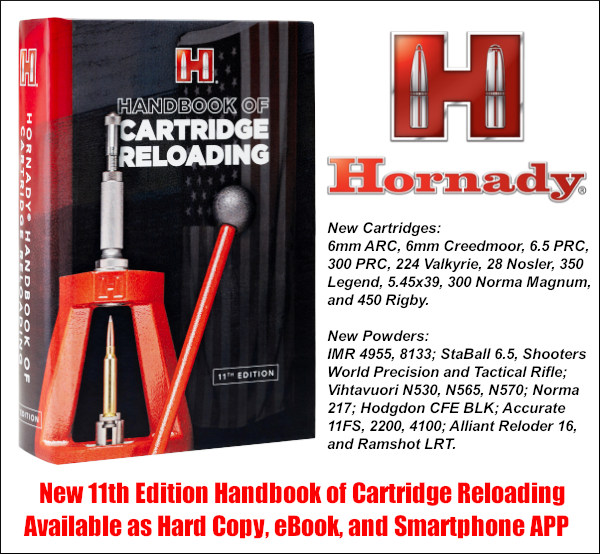
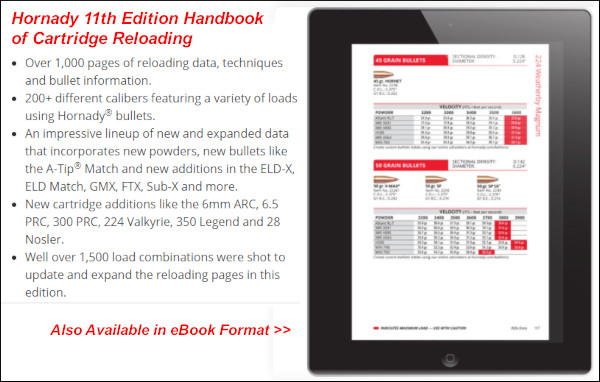
Hornady’s Handbook of Cartridge Reloading (11th Edition) is coming soon. This latest 11th Edition features new bullets, new cartridges, and a significantly expanded range of reloading powders. This is a worthy addition to any hand-loader’s resource collection. You can get a traditional hard-copy bound book, an Apple iBook or an Amazon Kindle version. In addition, the key content in the 11th Edition Handbook will be available in smartphone Apps for both iOS (Apple) and Android.
Along with many hundreds of pages of load data, the 11th Edition Hornady Handbook includes articles on loading techniques and very detailed information on Hornady component bullets. Countless hours of field testing went into this handbook. Hornady says: “Well over 1,500 load combinations were shot to update and expand the reloading pages in this edition.”
New Cartridge Types in 11th Edition
New cartridges covered in the 11th Edition include: 6mm ARC, 6mm Creedmoor, 6.5 PRC, 300 PRC, 224 Valkyrie, 350 Legend, and 28 Nosler. Also added to this edition (for the first time) are the popular 5.45×39, 300 Norma Magnum, and 450 Rigby cartridge types.
New Powders in 11th Edition
Many new or previously not included powders have been added including IMR 4955 & 8133, StaBall 6.5, Shooters World Precision and Tactical Rifle, Vihtavuori N-530, N-565, and N-570, Norma 217, CFE BLK, Accurate No. 11FS, 2200 and 4100, Reloder 16 and Ramshot LRT. Other recent additions like Reloder 23, 26 and 33, Accurate LT-30 and Power Pro 300 MP have been expanded.
New Bullets in 11th Edition
Numerous new bullets make an appearance, including the new A-TIP® Match and new editions in the ELD-X®, ELD® Match, GMX®, FTX®, SUB-X® and more.
Get 11th Edition Handbook as eBook or SmartPhone App
The 11th edition Hornady Handbook of Cartridge Reloading is available as an eBook via the iTunes iBook store as well as a Kindle edition sold through Amazon.com (coming soon). It will also available in App form from the App Store and from Google Play.
“Many unique challenges have arisen between the 10th and 11th edition handbooks. Despite the adversity, our team persisted and after hundreds of hours and thousands of rounds, we are proud to bring you the newest addition to our lineage of reloading handbooks.” said Jason Hornady, Vice President.






 • Magnifying Glass – We use a flat, 2″x2″ pocket 4x-8x magnifier. This folds up on itself. Very handy, we use it to inspect bullets and brass. Use this to check your flash holes for burrs, and check the meplats of your bullets before loading.
 • Ballistol Aerosol – Try using this versatile lubricant/solvent for full-length sizing. Spray some on a patch and you can wipe the carbon off your case necks. Then, continue to apply a very small amount of Ballistol on the case bodies — just thin sheen is all you need. Ballistol is super slippery, and easy to remove. For general full-length sizing (on small cases) it works great and doesn’t leave a gooey, waxy, or chalky residue. For heavier case-forming jobs, we recommend Imperial Die Wax.
 On the


 Sizing Die Wax




 With the Dasher since the new node (the sweet spot) was found at 33.4 grains, that resulted in a velocity of 3050 fps (a 125 fps velocity increase) from the same rifle setup. Not only did the velocity increase, but the SD was lowered to 3.6 with an ES of 13 (calculated over 28 shots). You read that right… 13 fps ES over 28 shots!


 The U.S. Department of Transportation (DOT) recently approved new smaller containers for shipment of smokeless powder. The new containers are designed to hold 1000 grains, exactly one-seventh of a pound. That works out to 2.29 ounces of powder — quite a bit less than you are getting currently with one-pound (16 oz.) containers.
 Currently, when you can find them, quality reloading powders are going for $45-$60 per pound (in 1-lb containers). At $45 per pound, you’re paying $2.81 per ounce. That means that the new mini-containers will be roughly twice as expensive as current one-pounders ($5.21 per ounce vs. $2.81 per ounce).