by Sierra Bullets Ballistic Technician Philip Mahin for Sierra Bullets Blog
A lot of calls that come into the Sierra Customer Service Center are made by shooters [of retirement age]. Most of the time the shooter used to reload back when they were [younger] and stopped in order to raise a family, pursue a career, or both. Maybe their father or grandfather taught them back in the day and they are looking for an answer to the new whatchamacallit they found on the internet. The point is they are coming back to it because it was fun.
Reloading Can Provide Stress Relief
As a father of three, a husband, a brother, a son and son-in-law, and a friend and neighbor, I get pulled in a lot of directions. In all honesty, reloading and shooting has become a stress relief for me even though I work in the shooting industry.
Sometimes, the shooting gets put on hold for other more important things but there will always be another project or repair to accomplish. There are a lot out there that have found a way to balance the work life, the family life, and the play life. I would like to applaud you on your efforts because it is a hard thing to accomplish.
Remember to take time and relieve that stress. Do something fun, especially if it is shooting that special hand-load you just made.
AccurateShooter Comment — Hand-Loading and the Creative Process
Reloading your own precise ammo can be rewarding in many ways. First it allows you a temporary escape from work pressures, “Honey-Dos”, filing your taxes — whatever. It’s just you and Mr. Rockchucker spending quality time in the loading room. Second, hand-loading is a creative process that engages the mind. During load development, you are like an inventor, selecting a powder charge, choosing the bushing size, experimenting with seating depths, working to perfect your load.
Lastly, the process of hand-loading is rewarding because you are building something start to finish. You begin with components — bullets, brass, and powder, and end up with a finished product that (hopefully) is better than the best factory ammo you could buy. It is enormously satisfying to start with piles of bullets and brass and end up with beautiful hand-loads that can deliver great accuracy.
In recent months, Forster Co-Ax® presses have been somewhat hard to find, as demand has out-stripped supply. But they are still worth looking for. The Co-Ax Single Stage Press accepts any standard 7/8″ X 14 reloading die, but Forster suggests using Forster Cross Bolt Lock Rings for best results. As the Co-Ax is currently back-ordered at most vendors, but you can try multiple sources.
If you are not yet familiar with the many unique features of the Forster Co-Ax, we recommend you watch the video embedded below. This shows how the press operates and highlights the design elements which set the Co-Ax apart from every other reloading press on the market.
Video Shows Special Features of Forster Co-Ax Reloading Press
Forster Co-Ax Press Video Review
This is a very thorough review of the Forster Co-Ax done by Rex Roach. This 14-minute video shows the key Co-Ax features, explaining how the floating case-holder jaws work (3:30 time-mark), how the dies are held in place (4:40 time-mark), how spent primers are captured (6:10 time-mark), and how to set the primer seating depth (10:00 time-mark). We’ve used a Co-Ax for years and we still learned a few new things by watching this detailed video. If you are considering purchasing a Co-Ax, definitely watch this video start to finish.
The Co-Ax case-holder features spring-loaded, floating jaws. These jaws have two sets of openings, small and large. This allows the system to adapt to various rim diameters. The jaw plates can simply be reversed to switch from small jaw to large jaw. In the photo above, the Co-Ax is configured with the large jaw openings in the center.
I absolutely love using this press stand. I use it with my Forster Co-Ax as well as my Dillon 550. The stand mounts those presses at the right height to minimize fatigue and maximize torque. Some products I merely review and return but this one is a keeper and won’t be leaving my bench anytime soon. — F-Class John
Lyman Universal Press Stand REVIEW
Product Review by F-Class John
Positioning your press at the optimal height is one of the oldest problems in reloading. Most presses sit low off the edge leading to uncomfortable arm strain or inconsistent pressure being applied while using. Lyman has set out to fix that problem with a reasonably-priced ($54.99 at Midsouth) press riser that works with the vast majority of reloading presses. This unit will raise just about any press up off your bench securely, allowing you to working more comfortably from a standing position. This also frees up vital bench space UNDER the press. Unfortunately this press stand is so popular it is back-ordered at most vendors.
I have used a variety of presses over the years. At times I’ve run into issues mounting a press at a level that doesn’t promote arm or hand strain during normal operations. In the past I’ve used blocks of wood or even tried other brands’ proprietary stands. But I had very limited success with those options. Accordingly, I was very excited to give the Lyman Universal Press Stand a chance.
Lyman’s Universal Press Stand comes complete with side plates, two different top plates, and a large collection of mounting hardware. The two top plates are pre-drilled for numerous popular Single Stage or Progressive presses. Helpful diagrams and instructions show which side of the top plate you need to use. The pre-drilled holes accommodate a variety of presses from RCBS, Dillon, Lyman, Redding, and Hornady. But surprisingly, the plates are not pre-configured for the Forster Co-Ax Press.
CLICK to WATCH VIDEO Showing Lyman Universal Press Stand
Setting up the stand was very simple. The two sides bolt to the lower shelf unit at which point you attach the top plate. All the supplied bolts made this a breeze and once everything was snugged down, I was able to place it on my bench where I wanted it and mark the drill holes to mount it. After securing the stand to my bench it was time to mount my press.
Lyman Universal Press Stand with Dillon 550 Press
Adapting Lyman Universal Press Stand for Forster Co-Ax
At the time of testing I was primarily using a Forster Co-Ax press. With no pre-drilled Co-Ax configuration for either Lyman top plate, I decided to customize the blank side of one of the top plates. I opted to position the mounting holes so that the press could sit 100% on top of the mounting plate and not just off one edge. I found this process simple to execute. Mark your drill holes, then drill the plate. This can easily be done with regular drill bits although using a step-bit worked faster and cleaner to help enlarge the holes just a little when I needed some extra clearance.
Lyman Universal Press Stand Is Stable and Strong
Once set-up, I found the stand to be incredibly stable. The design allows for full force to be applied to the press no matter what the operation. Having used this Lyman Press stand regularly over the past few months with both my Co-Ax and a Dillon 550c, I still find myself loving it. The height is perfect and allows me to load as much as I like without straining my arm or getting fatigued. With an attractive price point (under $55.00 street price) and a simple design, I feel this is a great system for those looking for a secure and raised platform for their reloading presses.
The Universal Press Stand comes with two plates. If you have different presses that fit each plate you could easily swap presses just by changing plates while leaving the presses attached. It’s less functional if you have two presses that share one plate and would require removing one press before installing the next one.
Lyman Press Stand Unboxing and Set-Up (KFW Video Review):
As any handloader knows, popular reloading powders have become difficult to find. And when you do locate the powder you want, the price might be twice what you paid a year ago (or even more on auction sites). Across the nation, shooters are asking “What gives? Why are powder prices so high? And when are the shortages going to end?”
Hodgdon Powder Company (“Hodgdon”), supplier of Hodgdon, IMR, and Winchester powders*, has attempted to answer these questions with a “Powder Update” posted yesterday. Along with addressing the shortage issues, Hodgdon explains the challenges involved in increasing production in the USA and/or increasing imports from overseas. The ultra-popular H4198, H4895, Varget, H4350, and H4831 family of powders are produced by ADI in Australia**. So Hodgdon can’t ship more Varget or H4350 in the USA unless Hodgdon can get more from Australia.
In the Powder Update reprinted below, Hodgdon answers many key questions, and debunks some misconceptions. For example, Hodgdon is NOT selling its powders on auction sites such as Gunbroker. That is completely false.
POWDER UPDATE from Hodgdon Powder Company
WHY CAN’T HODGDON SHIP MORE POWDER?
The current powder situation is due to a record demand for all reloading components and NOT a reduction in the supply of powder. With long-time handloaders looking to stock up and new gun owners looking for ammunition, there is an unprecedented demand for powder and other reloading components. We shipped a record amount of powder in 2020 and will ship even more in 2021. We are doing everything in our power to get the most powder into consumer hands this year. We are running overtime in our facilities, have hired additional staff and have leveraged relationships with shipping partners to add new shipping options.
WHY CAN’T HODGDON BUILD ANOTHER POWDER PLANT?
The “normal” powder demand for the United States would not support an additional plant. Hodgdon, like most companies, cannot afford to build a new production facility then have it sit idle until demand spikes.
WHY IS HODGDON SELLING POWDER TO THE GOVERNMENT?
Hodgdon does NOT sell powder directly to the government. We sell some powder to manufacturers making ammunition for our military, but that is a small part of our business.
WHY IS HODGDON SELLING POWDER TO AMMUNITION MANUFACTURERS?
The heart of our business is smokeless powder for the handloading enthusiast. Yes, we sell some powder to ammo manufacturers, but that is a small part of our business. Every day, we receive calls from potential OEM customers looking for powder to load in ammunition. We politely decline so we can focus on our long-term, handloading customers.
WHY IS HODGDON SELLING POWDER ON AUCTION SITES?
We don’t. Period. We recently began selling a limited amount of powder on our OWN websites but prioritize our shipments to our traditional sales channels to maximize powder availability at sporting goods and gun shops. [Editor: If you see Hodgdon powder on auction sites, that is listed by third party vendors.]
WHY IS THE PRICE OF POWDER SO HIGH ON THE INTERNET?
We do not set sale prices or MSRPs for the price of our powders at retail, nor do we encourage any of our retailers or dealers to sell on auction sites, but we cannot control what happens AFTER we sell to our traditional sales channels.
* Hodgdon also sells certain Ramshot, Accurate, and Blackhorn powders along with Goex black powder.
** Here’s a list of ADI to Hodgdon Powder equivalents from the ADI FAQ Page:
ADI / Hodgdon Propellants Equivalents
ADI Powder
Hodgdon/IMR Name
Trail Boss
AR2207
AR2219
BM2
Bench Mark 8208
AR2206H
AR2208
AR2209
AR2213H/AR2213SC
AR2217
AR2225
AR2218
At the request of our readers, we provide select “Deals of the Week”. Every Sunday afternoon or Monday morning we offer our Best Bargain selections. Here are some of the best deals on firearms, hardware, reloading components, optics, and shooting accessories. Be aware that sale prices are subject to change, and once clearance inventory is sold, it’s gone for good. You snooze you lose.
1. KYGUNCO — Anderson AM-15 (AR) Lower Receiver, $89.99
⏺ More gun control is coming — get an AR lower while you can
With the developments in Washington, it will likely become more difficult to purchase an AR-platform rifle in the future. You may want to get an AR lower now, while you can, at a reasonable price. KYGUNGO (Kentucky Gun Co.) is selling the Anderson AM-15 AR15 Lower Receiver for just $89.99 (cash price) or $92.69 (credit card). This is a mil-spec 7075 T6 Forged aluminum lower, Type 3 Hard Anodized. Flat-Rate Shipping to your FFL is just $11.99. These will probably sell out quickly.
2. Midsouth — Delton AR-15 Lower Parts Kit with Grip, $52.99
⏺ Very complete AR-15 parts kit at low price
Here’s what you need to fill up that AR-15 lower receiver featured above. This Delton Complete Lower Receiver Parts Kit contains all the attachment pins, trigger system parts, and springs you need, along with a classic AR grip. Installation is straight-forward with instructions available online.
3. Amazon — Tipton Best Gun Vise, $84.84
⏺ Versatile, stable, works with all rifles, including ARs
You need a stable platform when cleaning your long guns, but most gun cradles are too light or unstable to do the job properly. If you’re looking upgrade to a better solution, grab the Tipton Best Gun Vise. The vise was designed to accommodate the widest possible array of firearms for cleaning, maintenance, or gunsmithing. This vise is easily configurable to handle bolt-action rifles, break-open shotguns, AR-15s, and handguns. You can also purchase this excellent Gun Vise for $89.99 at Midsouth Shooters.
⏺ Hard to beat bench at this price; swivel seat, 60-lb total weight
The Caldwell® Stable Table, a 60-lb tripod-style bench, offers a 34″L x 23″W top surface with a bench seat that adjusts from 16″ to 22″ in height. The polymer top has two integrated carry handles. These handles double as anchors for two gun-holding forks that can be used when cleaning your rifle. Leg adjustments keep the table and seat parallel even on uneven ground. The overall unit breaks down into seven pieces using a quick-release pin system. Maximum weight capacity is 350 pounds. This bench has earned 80% 5-star reviews from actual purchasers.
⏺ Great deal on easy-to-use, accurate, barrel-attached Chronograph
Priced at just $159.99 at MidwayUSA, the Magnetospeed Sporter model costs less than half as much as Magnetospeed’s V3 models. This chronograph attaches directly to your barrel so you don’t have to go downrange to set up skyscreens. For most people the Sporter Model contains all the features they need. Using Magnetospeed’s XFR adapter (sold separately), data can be transferred easily to your mobile device. READ Magnetospeed Sporter Review. NOTE: You MUST add the item to cart to see the $159.99 SALE price. This typically sells elsewhere for around $180.00.
6. EuroOptic –$100 Rebate on Leupold SX-4 Spotting Scopes
⏺ Instant $100 savings on excellent HD Glass spotting scopes
Get Instant Savings of $100 with the purchase of any SX-4 Pro Guide HD Spotting Scope. Offer valid February 1, 2021 through April 4, 2021, while supplies last. Leupold offers SX-4 HD spotters in 65mm objective and 85mm objective models, with both angled and straight versions. If you can’t find your preferred SX-4 in stock at EuroOptic, this Rebate will be available at other authorized Leupold dealers such as Grafs.com.
7. MidwayUSA — Caldwell Rock BR Rest + Bag, $99.99
⏺ Good inexpensive system for varminters or sight-in duties
Here’s a great bargain for someone looking for a basic functional benchrest set-up. This Caldwell Rock BR Rest and Bag Combo could be a gift to a family member or a junior shooter. Or this $99.99 combo would suffice for someone testing a hunting rifle. The front rest adjusts for both windage and elevation.
⏺ Owners say it is sharp with good features for price
This Sawback Bowie spring-assisted folding knife, just $10.95 on Amazon, has a 3.5″ blade. There is a curved cutting edge with a serrated section near the handle. Actual purchasers state: “This knife is very well made with a tight feel. No play at all. The assisted open is excellent [and] they come very sharp too”, and “This is a good quality knife. It’s solid and a bit heavy, really good looking and comes pretty sharp. Overall its a great knife.”
⏺ Great accessories for safes — light alone is worth the price
This Lockdown Safe Accessory Package includes one Large Organizer, a Vault Light, and a Large Document Holder. The bright LED Vault light runs on AAA batteries so no wiring is needed. The Document holder easily mounts to your safe’s door or sidewall. And the Large 18″x12″ Organizer will secure valuables, knives, and even small handguns. It comes with hooks for carpeted interiors and magnets for metal interiors. This KIT normally sells for $49.99 so it’s a STEAL at $12.99 — that’s 74% OFF.
Yes we miss the good old days… when reloading components were readily available and very affordable. Today, on Gunbroker, a single 1000-count box of primers may sell for well over $300. And some vendors are asking $90 for a single pound of powder that sold for $30 per pound just last year.
We can’t change prices for you, but we can offer a “sentimental journey” back to the “good old days” via a Flashback Thread in our Shooters’ Forum. There, Forum members have posted some items from their collections, with the original prices.
What is the best deal you can remember? How about $1 per pound forty-six years ago — member STS posted: “It was probably 1975 when I bought 100 pounds of H335 from Bruce Hodgdon for $100. It came in cardboard boxes with black trash bags inside. I shot every flake of it at prairie dogs.”
Reloder Powder from Hercules (Now Alliant) for $3.80 per Pound
CCI and Winchester Primers, $16.30 and $13.00 per Thousand
Today some CCI primers are selling for over $300 per thousand on Gunbroker. Member JayHHI6818 said: “Found these the other day in a shoe box in our bedroom closet!”. Nice find Jay!
Hodgdon H4350 for $10.87 per Pound
H4350 remains one of the most popular powders with competitive shooters. It’s ideal for many midsized cartridges, offering great accuracy and temp stability. Today it’s hard to find this powder at ANY price!
Remington 2 1/2 Primers for $1.50 per Hundred
Remington Arms folded. However Remington primers will be produced by Vista Outdoor after the collapse and bankruptcy of Remington Arms. Vista Outdoor, which owns CCI and Federal, will take over the Remington ammunition production facilities.
We’ve found Brownells Discount Codes that can still save you up to 10% on your purchases. These Discount Codes will qualify you for significant savings on guns, ammo, parts, and reloading components at Brownells. Use these Codes during check-out and the savings will reduce your net cost. Get $40 off on a $450 purchase, $20 off $250, or $15 off $150 (10% savings). NOTE: Some of these discount codes expire at the end of February 2021, while others may expire at any time, so don’t hesitate. If one Code doesn’t work, try another.
Coupon Code: MZB — $40 off $450
Expiration date: February 28, 2021
Coupon Code: MZA — $20 off $250
Expiration date: February 28, 2021
Coupon Code: TAG — $15 OFF $150
Expiration date: Unknown expiration
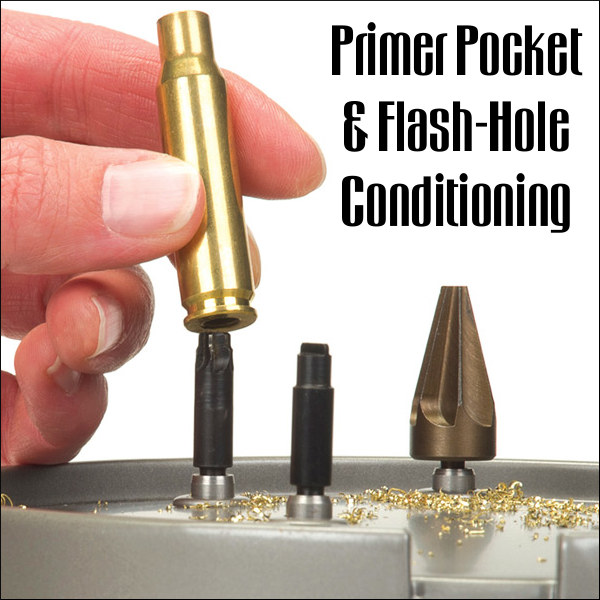
Each Wednesday, the U.S. Army Marksmanship Unit publishes a reloading “how-to” article on the USAMU Facebook page. One “Handloading Hump Day” article covered two basic case prep chores — uniforming primer pockets and deburring flash-holes. Visit the USAMU Facebook page for other tips.
Primer Pocket & Flash-Hole Conditioning
This week, we’ll address a question that frequently arises: “Do you uniform primer pockets and deburr flash-holes?” As we tailor our handloading methods to the specific needs of each instance, the answer, not surprisingly, is “Sometimes!” However, don’t flip that dial just yet, as what determines our approach may be helpful in deciding how to address one’s own techniques. Moreover, we have a buried “Easter Egg” morsel that may bring a chuckle, as well as useful safety information!
Generally, the USAMU Handloading Shop does not uniform primer pockets (PP) or deburr flash holes (FH) of our rifle brass. We’re certainly not against it… Rather, this reflects the very high volume of ammunition we load, the fact that very few cases are ever re-loaded for a second firing, and the types of brass we use. However, as a need is perceived, we DO deburr flash holes. Of interest, we have fired many very small, 1000-yard test groups and aggregates using weight-selected, domestic brass that had not had PPs uniformed or FHs deburred.
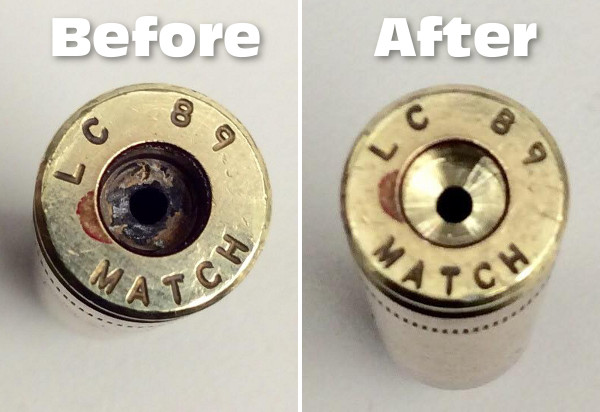
Before and After — On the left is a fired, deprimed 7.62×51 case with primer residue intact. On the right the primer pocket has been uniformed to SAAMI specs. Note the shiny finish at the bottom of the pocket — evidence of the the removal of metal when uniforming the primer pocket.
As to the type cases we use, many thousands of our long-range 5.56mm cases come to us from the arsenal with the primer of our choice pre-installed and staked-in, per usual practice. Obviously, we cannot uniform either FHs or PPs on this live, primed brass. However, after careful sorting, inspection and preparation, we do obtain match-winning results with it.
Shooters who reload their brass several times may decide to uniform PPs and deburr FHs, especially on their “300-yard and beyond” brass. Here, they will use the cases many times, while the uniforming is performed only once. Also, most handloaders only process moderate amounts of brass, compared to our multi-thousand round lots.
Having high quality Long Range (LR) brass helps. Many of the better brass manufacturers [make] their flash holes so that no burrs are created. Still, it does pay to inspect even THESE manufacturer’s products, as occasional slips are inevitable. Very rarely, some of the best makers will have a significant burr in, say, 1 per 1000 or 2000 cases, and it’s worth catching those.
Exceptions can always be found. Recently, we began processing a large lot of match brass from a premier manufacturer. We were startled to find that every case had a significant burr in the FH — something we’d never before seen from this maker. We then broke out the FH deburring tools and went to work.
Some observers have noted that it can be difficult to truly verify the contribution to accuracy of these procedures — particularly when firing from the shoulder, in conditions. Members of this staff, as individual rifle competitors, do often perform these operations on their privately-owned LR rifle brass. One could ascribe this to the old High Power Rifle maxim that “if you think it helps, then it helps.”
However, a World Champion and Olympic Gold/Silver medalist here commented on his own handloading (for International competition, which demands VERY fine accuracy). He noted that he did seem to see a decline in accuracy whenever he did not uniform FHs, deburr FHs and clean primer pockets before each reloading. (One might be tempted to counter that only a truly World Class shooter could reliably detect the difference.) However, with the wisdom of decades experience, our Champion also remarked that “It could have been that I just wasn’t shooting as well that day.”
For those who do opt for these procedures, note that various tool models may have adjustable depth-stops; pay attention to the instructions. Some FH-deburring tools (which enter the case mouth, not the primer pocket) are dependent upon uniform case length for best results.
Above is a flash-hole deburring tool on an RCBS powered case-prep unit. These case prep machines can save a lot of pain and misery, helping one perform various functions quickly and efficiently.
Bill Gravatt has been named President of Creedmoor Sports. Bill has worked in the shooting and reloading industry for over 30 years. His experience includes: former owner and President of Sinclair Int’l and President of Capstone Precision Group (Berger, Lapua, Vihtavuori, and SK). Now that Bill has achieved important goals with Capstone (for whom he continues to serve as a board member), he is taking over as President of Creedmoor Sports, after serving as its Managing Director since the spring of 2020.
Greg Kantorovich, Creedmoor Sports CEO states: “We are excited to have Bill assume the role of President. His innovative leadership will continue to enhance our team’s mission of managed growth through strategic planning. Bill’s wealth of industry knowledge and ‘customer first’ mantra is second to none! This philosophy aligns perfectly with Creedmoor’s passion to serve our customers like family”.
As the President of Creedmoor Sports, Bill will direct operational and marketing activities for the company. He will also help with informational programs. Gravatt has previously served Creedmoor Sports as a Managing Director since the spring of 2020, and served as a consultant before that.
Bill Gravatt told us: “I am joining a great team at Creedmoor Sports. They are all driven in pursuit of exemplary customer service, they create well-made products, passionately participate in the shooting sport, and enjoy the daily satisfaction that comes from helping fellow shooters achieve their best.”
Reloading Procedures with Bill Gravatt
Bill Gravatt has decades of knowledge about reloading tools and procedures. Here are three helpful videos Bill Gravatt created for the Creedmoor Sports InfoZone:
How to Seat Bullets with Inline Press
How to Trim Cases with L.E. Wilson Trimmer
How to Clean Cartridge Cases
About Creedmoor Sports, Inc.
Since 1979, Creedmoor Sports has been supplying the precision rifle shooter with quality equipment. Specializing in competitive centerfire, smallbore, and air rifle accessories, as well as reloading components and tools, Creedmoor seeks to provide their customers with the right gear to help them achieve their personal shooting goals.
With the high cost and reduced availability of factory ammo, more shooters are loading their own ammo. When good 9mm pistol ammo was $10/box, it might be hard to justify handloading. Now that 50 rounds of 9mm can run $40 or more it certainly makes sense to reload. The same is true with rifle ammo if you shoot large quantities, or if you simply can’t find your preferred ammo for sale these days.
To increase productivity when reloading large quantities of ammunition, many shooters are thinking of getting a progressive press. Because multiple operations take place with a single pull of a lever, a progressive press can produce way more ammo in a given period of time than any single stage press. With a progressive, on the ram up-stroke, the multiple stations can simultaneously remove spent primer, full-length size case, drop powder, seat bullet, and crimp (if desired). Most progressives are also set up to prime cases with the ram in the lower position — though some guys prefer to prime manually.
Progressive presses aren’t just for high-output pistol ammo or bulk rifle ammunition. Good progressives can be adapted to do certain reloading tasks for top-on-the line match ammo. You might use a progressive for decapping, priming, and sizing, then throw powder and/or seat bullets separately. Some Champion shooters do use progressives to load their match ammo! For example 5-Time National Long Range Champion John Whidden and 2020 Berger SWN F-Open Champion Jay Christopherson both use progessive presses for some (but not all) operations.
To help you get started with progressive presses, here are five videos from UltimateReloader.com that cover six popular machines, from the elite Mark 7 Evolution to the affordable Lee Loadmaster. With many of these machines you can add separate vertical bullet feeder systems that further increase loading efficiency.