The anvil is the tripod-shaped thin metal piece protruding above the bottom of the primer cup. Getting the primer sitting fully flush on the bottom of the case primer pocket, without crunching it too much, requires some keen feel for the progress of primer seating.
In two informative Midsouth Blog articles, Glen Zediker offers helpful advice on priming. First he examines what happens to the primer itself as it is seated in the cup. Glen explains why some “crush” is important, and why you never want to leave a high primer. Glen also reviews a variety of priming tools, including his favorite — the Forster Co-Ax Bench Primer Seater. Then he offers some key safety tips. Glen provides some “rock-solid” advice about the priming operation. You’ll find more great reloading tips in Glen’s newest book, Top-Grade Ammo, which we recommend.
Priming Precision vs. Speed
Glen writes: “The better priming tools have less leverage. That is so we can feel the progress of that relatively very small span of depth between start and finish. There is also a balance between precision and speed in tool choices, as there so often is.”
Benchtop Priming Tools — The Forster Co-Ax
Glen thinks that the best choice among priming options, considering both “feel” and productivity, may be the benchtop stand-alone priming stations: “They are faster than hand tools, and can be had with more or less leverage engineered into them. I like the one shown below the best because its feeding is reliable and its feel is more than good enough to do a ‘perfect’ primer seat. It’s the best balance I’ve found between speed and precision.”
Load Tuning and Primers
Glen cautions that you should always reduce your load when you switch to a new, not-yet-tested primer type: “The primer is, in my experience, the greatest variable that can change the performance of a load combination, which is mostly to say ‘pressure’. Never (never ever) switch primer brands without backing off the propellant charge and proving to yourself how far to take it back up, or to even back it off more. I back off one full grain of propellant [when I] try a different primer brand.”
Priming Safety Tips by Zediker
1. Get a good primer “flip” tray for use in filling the feeding magazine tubes associated with some systems. Make double-damn sure each primer is fed right side up (or down, depending on your perspective). A common cause of unintentional detonation is attempting to overfill a stuffed feeding tube magazine, so count and watch your progress.
2. Don’t attempt to seat a high primer more deeply on a finished round. The pressure needed to overcome the inertia to re-initiate movement may be enough to detonate it.
3. Don’t punch out a live primer! That can result in an impressive fright. To kill a primer, squirt or spray a little light oil into its open end. That renders the compound inert.
4. Keep the priming tool cup clean. That’s the little piece that the primer sits down into. Any little shard of brass can become a firing pin! It’s happened!
We’re told the 6.5 Creedmoor is now the best-selling chambering in new bolt-action rifles sold in the USA. Accurate, versatile, with moderate recoil, the 6.5 Creedmoor serves hunters, paper punchers, and PRS shooters equally well.
As part of its online Load Data Center, Nosler offers very complete LOAD DATA for the 6.5 Creedmoor cartridge. This medium-sized cartridge has become one of the most popular chamberings for tactical and PRS shooters. The 6.5 Creedmoor combines excellent accuracy, good mag-feeding, good barrel life, moderate recoil, and reasonable component cost. That’s why this cartridge has caught on quickly.
How does barrel length affect 6.5 Creedmoor Muzzle Velocity? CLICK HERE for RifleShooter.com barrel cut-down velocity test.
Origins of the 6.5 Creedmoor Cartridge
According to the Sierra Load Manual: “Developed in 2007 by Dennis DeMille and Dave Emary, the 6.5 Creedmoor is a shortened and improved 30 TC cartridge case that was inspired by the .308 Winchester design. This short action design was created to maximize case capacity and a wide range of loading lengths, while still fitting in standard short action magazines. With the correct twist barrel, the versatile 6.5 Creedmoor can take advantage of the wide range of bullet weights available in 6.5 mm (i.e. .264 caliber).” Reloaders should keep in mind that the 6.5 Creedmoor works best with medium to medium-slow powders such as H4350, Reloder 16, IMR 4451, Varget, and Vihtavuori N150.
Click Each Image to Load PDF File for Listed Bullet Weights
In addition to the data sheets shown above, Nosler offers 6.5 Creedmoor data for 90 grain FB tipped bullets and 100 grain Ballistic Tip and Partition bullets.
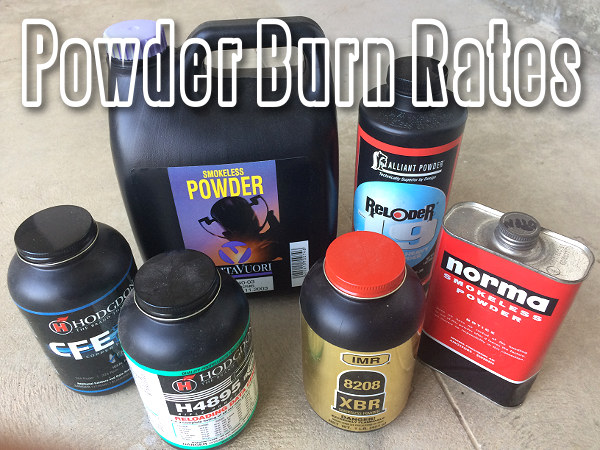
Day after day, one of AccurateShooter’s most-visited web pages is a reference guide featuring a comparative burn rate chart, ranking powders from fastest to slowest. Compiled by Hodgdon Powder Co., this Burn Rate Chart displays the relative burn rates of 163 different powders. Here is the latest table, released by Hodgdon in November of 2019.
You’ll want to download this Powder Burn Rate Table. This table shows the latest IMR powders including the Enduron series (IMR 4166, 4451, 4955, 7977), highlighted in green. This 163-entry comparison table provides vital information for hand-loaders. Note — this invaluable chart is not limited to Hodgdon and IMR propellants. This burn rate chart ranks powders from eight major powder-makers: Accurate, Alliant, Hodgdon, IMR, Norma, Ramshot (Western), Vihtavuori, and Winchester.
This chart provides useful information for all hand-loaders. When doing load development, and testing one powder versus another, it’s generally wise to choose propellants that share the same relative burn rate, as least for starters.
NOTE: Hodgdon powders are blue, IMR Enduron powders are green, IMR standard powders are yellow, and Winchester powders are red. DOWNLOAD Chart HERE.
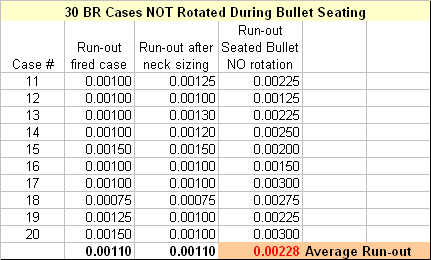
Here is a simple technique that can potentially help you load straighter ammo, with less run-out (as measured on the bullet). This procedure costs nothing and adds only a few seconds to the time needed to load a cartridge. Next time you’re loading ammo with a threaded (screw-in) seating die, try seating the bullet in two stages. Run the cartridge up in the seating die just enough to seat the bullet half way. Then lower the cartridge and rotate it 180° in the shell-holder. Now raise the cartridge up into the die again and finish seating the bullet.
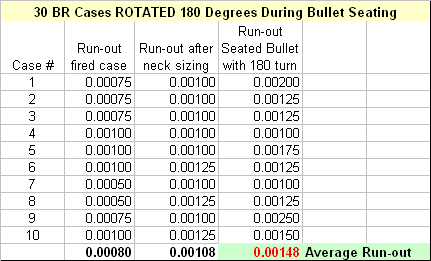
Steve, aka “Short Range”, one of our Forum members, recently inquired about run-out apparently caused by his bullet-seating process. Steve’s 30BR cases were coming out of his neck-sizer with good concentricity, but the run-out nearly doubled after he seated the bullets. At the suggestion of other Forum members, Steve tried the process of rotating his cartridge while seating his bullet. Steve then measured run-out on his loaded rounds. To his surprise there was a noticeable reduction in run-out on the cases which had been rotated during seating. Steve explains: “For the rounds that I loaded yesterday, I seated the bullet half-way, and turned the round 180 degrees, and finished seating the bullet. That reduced the bullet runout by almost half on most rounds compared to the measurements from the first test.”
Steve recorded run-out measurements on his 30 BR brass using both the conventional (one-pass) seating procedure, as well as the two-stage (with 180° rotation) method. Steve’s measurements are collected in the two charts above. As you can see, the run-out was less for the rounds which were rotated during seating. Note, the change is pretty small (less than .001″ on average), but every little bit helps in the accuracy game. If you use a threaded (screw-in) seating die, you might try this two-stage bullet-seating method. Rotating your case in the middle of the seating process won’t cost you a penny, and it just might produce straighter ammo (nothing is guaranteed). If you do NOT see any improvement on the target, you can always go back to seating your bullets in one pass. READ Forum Thread..
Memorial Day is just five days away, and Brownells is running a big Memorial Day Sale right now to mark the occasion. You’ll find dozens of popular products at significant discounts — up to 56% Off. Save on AR Lowers/Uppers, Triggers, Optics, Chassis Systems, Magazines, Tools, Ammo and more. If you are a black rifle fan — this is a great opportunity to pick up AR-platform components and accessories at deep discounts. But you don’t want to delay too long — Brownells Memorial Day Sale runs through 11:59 pm on Monday, May 25, 2020. And take note — inventory may be limited on some of the sale items.
If you load pistol or rifle ammo with a progressive press, we strongly recommend you get a Lock-Out Die from RCBS. This unique reloading die will prevent your progressive press from advancing if the dispensed powder charge is more or less than about 0.3 grains too high or too low. The Lock-Out Die really works. Your Editor uses it on his RCBS 2000 progressive press. I can affirm that a Lock-Out Die has “saved my bacon” a half-dozen times over the years when there was an over-charge (which could cause a Kaboom) or a low charge (which could cause a squib load).
The Lock-Out Die works by using a central die detection rod that sets its vertical position based on the height of the powder column in the case. Through an ingenious design, if the powder column height is too low or too high, the rod locks in place as you start to pull the press handle. This halts the press before the ram can lift and the cartridge plate can advance. Unlike a beeping alarm system (which can be ignored or defeated), the Lock-Out Die physically stops the movement of the press ram and prevents a bullet being seated in the “problem” case.
It takes a bit of tweaking to get the Lock-Out Die detection rod setting just right, but once it is correctly positioned, the Lock-Out Die works smoothly in the background. The Lock-Out Die won’t interfere with the loading process unless it detects a high or low charge — and then it positively stops the progressive loading cycle.
While crafted for use in RCBS progressive presses, the RCBS Lock-Out Die can also be used on a Dillon XL Progressive (see video below) or Hornady Lock-N-Load progressive — though it does take up one station which could otherwise be used for a final crimp die (after the seating die). The RCBS 2000 has one more station than a Dillon 550/650, so it’s an ideal platform for using the Lock-Out Die.
Learn More at UltimateReloader.com
On the UltimateReloader.com website, run by our friend Gavin, you’ll find an excellent two-part series on the function and set-up of the RCBS Lock-Out Die. Part One explains how the Lock-Out Die functions, using cut-away illustrations. Part Two shows how to install and adjust the Lock-Out Die on various progressive presses. The video below shows setup of the RCBS Lock-Out Die on the Dillon XL-650 progressive press.
At the request of our readers, we provide select “Deals of the Week”. Every Sunday afternoon or Monday morning we offer our Best Bargain selections. Here are some of the best deals on firearms, hardware, reloading components, optics, and shooting accessories. Be aware that sale prices are subject to change, and once clearance inventory is sold, it’s gone for good. You snooze you lose.
Hunting season will be here in a few more months. If you need a new hunting rifle check out the Thompson/Center Compass in .270 Win or .30-06 Springfield. On sale now for just $239.97, these T/C rifles feature Free-floated 5R barrel, 3-lug bolt, lightweight synthetic stock with aluminum pillars, adjustable trigger, and 3-position safety. A detachable, rotary magazine is also included. NOTE: Cabela’s also has this rifle in .22-250 Rem for $259.97, still a great deal.
2. Amazon — Frankford Arsenal Intellidropper, $199.95
There are many good digital powder scale/dispensers on the market. But one of the best new-generation machines is the Frankford Arsenal Intellidroper. This offers excellent controls, good drop speed and +/- 0.10 grain accuracy, plus an easy-to-use Mobile App. Right now on Amazon you can get the advanced Intellidropper for under $200! If you’re looking for a new “smart” digital powder dispenser with advanced features, this is an excellent deal. Intellidropper Review HERE.
3. Bruno Shooters Supply — Huge Primer Sale
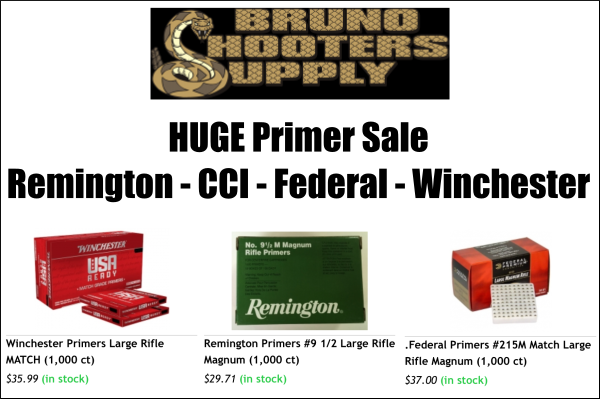
As primers have outstanding long-term shelf life, it makes sense to purchase primers in quantity when they are available at attractive prices. Right now Bruno Shooters Supply is running a huge PRIMER SALE featuring every brand and style in stock. Here’s a great opportunity to get a good supply of primers at attractive prices.
4. Camera Land — Konus 20-60x100mm Spotting Scope, $179.99
Spotting scopes are vital tools for shooters. But they can be pricey, especially those with large front objective lenses. Enter the Konus KonuSpot-100 20-60x100mm. The big 100mm objective gathers more light — good for low-light shooting and observing. For the money, this is a surprisingly good spotter (though don’t expect it to compare with a high-end Kowa, Swaro, or Zeiss). And if you order now you can get a camera adapter, carry case, lens cleaning cloth, and smartphone adapter at no extra charge.
With the stay-at-home orders, many shooters are using their new free time to get started in reloading. For novice reloaders, it makes sense to start with a kit that has most of the tools you need. The very affordable RCBS Partner Press Reloading Kit comes with Press, Powder Scale, Powder Funnel, Loading Block, Lube Tray, Neck Brushes, Dubur Tool, Load Manual and more. These Partner Presses work well for loading at the range, or use the compact Partner as a second press for depriming or bullet seating.
6. 5.11 Tactical Gear — 20% Off Site-Wide
5.11 is one of the top manufacturers of tactical gear. You’ll see 5.11 pants, bags, and shoes on the firing line at matches. And many first responders use 5.11 gear. Right now 5.11 Tactical is running a 20% off EVERYTHING SALE. That’s right — everything on 511tactical.com is on sale! What’s more, there is free shipping on orders over $35. Plus if you use Code ‘TOGETHER’ at checkout, you can get a free keychain multi-tool.
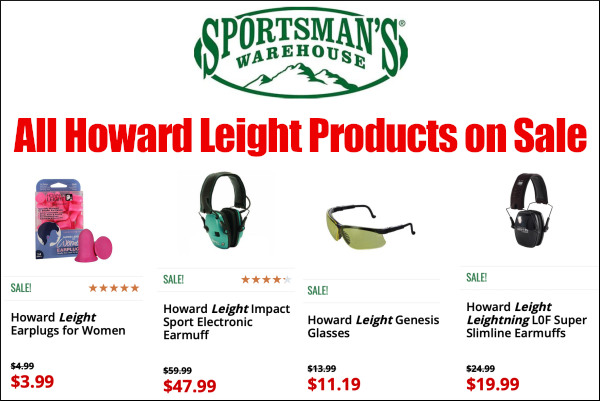
7. Sportsman’s Warehouse — All Howard Leight Products on Sale
Need to upgrade your eye protection and/or hearing protection? Do your current muffs suffer from busted electronics or worn-out ear cups? Well here’s a great opportunity to save big on ear and eye protection. Right now there’s a great Howard Leight SALE at Sportsman’s Warehouse. Get All Howard Leight brand Safety Eyewear and Hearing Protection products at 20% OFF.
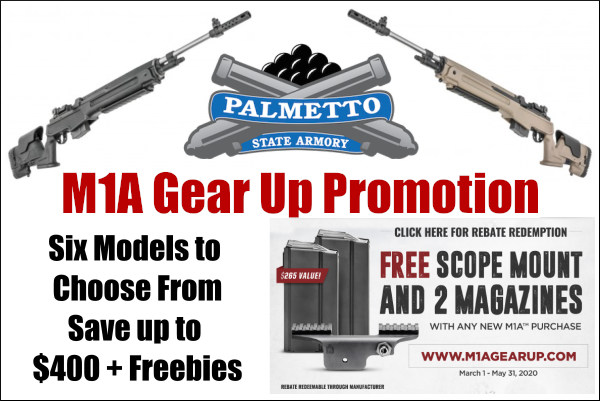
8. Palmetto State Armory — Springfield M1A Sale + Promo
The Springfield M1A has an historic military heritage and is fun to shoot. If you’ve been looking to add an M1A to your collection, check out PSA’s Springfield M1A sale. Many M1A models are significantly discounted. Plus, with Springfield’s current Gear Up Promotion you get two FREE magazines PLUS a scope mount. With the discounts and the free gear, we figure you can get over $600 in value.
9. Amazon — Real Avid Chamber Boss, $29.99
Cleaning AR-platform rifle chambers can be a pain, especially when it comes to removing the carbon. We found the Real Avid Chamber Boss is very effective on those dirty AR chambers and internals. The Chamber Boss includes a carbon scraper specifically designed for the AR chamber extension. This kit also include a chamber brush, and 5 special star-chamber cleaning pads. All these components fit right into the Chamber Boss’s handle, making transport simple and easy.
Here’s a great set of stick-on (adhesive) splatter targets. Shots appear as bright neon yellow halos — providing easy-to-see instant feedback. The $7.99 target packs include 10 sheets of black circles, 3″ in diameter, for shooting out to 300 yards and beyond. In addition, each sheet includes 8 smaller red center bulls plus 22 stick-on black dots. You can shoot the entire target sheet, or peel off one or more circles to stick on a target backer. These also work great indoors with pistols.
COVID-19 stay-at-home orders have created abundant free time at home for millions of Americans. To fill otherwise empty hours, we know many readers have been reloading ammo — LOTS of ammo. And quite a few of you folks are thinking of getting a progressive press to increase output. Because multiple operations take place with a single pull of a lever, a progressive press can produce way more ammo in a given period of time than any single stage press. With a progressive, on the ram up-stroke, the multiple stations can simultaneously remove spent primer, full-length size case, drop powder, seat bullet, and crimp (if desired). Most progressives are also set up to prime cases with the ram in the lower position — though some guys prefer to prime manually.
Progressive presses aren’t just for high-output pistol ammo or bulk rifle ammunition. Good progressives can be adapted to do certain reloading tasks for top-on-the line match ammo. You might use a progressive for decapping, priming, and sizing, then throw powder and/or seat bullets separately. Some Champion shooters do use progressives to load their match ammo! For example 5-Time National Long Range Champion John Whidden and 2020 Berger SWN F-Open Champion Jay Christopherson both use progessive presses for some (but not all) operations.
To help you get started with progressive presses, here are five videos from UltimateReloader.com that cover six popular machines, from the elite Mark 7 Evolution to the inexpensive Lee Pro 1000. With many of these machines you can add separate vertical bullet feeder systems that further increase loading efficiency.
Mark 7 Evolution Press — Distributed by Lyman
Dillon XL-650 vs. Dillon XL-750
RCBS Pro Chucker 7 with Bullet Feeder
Dillon 550C with 6mm Creedmoor and 9x19mm
Lee Pro 1000 Features and Operation
Better Safe Than Sorry — the RCBS Lock-Out Die
RCBS Makes a “Lock-Out Die” that senses the powder charge. This will halt the Progressive press if you have a double charge, or an undercharge. Your Editor has the Lock-Out Die on his RCBS Pro 2000. It has “saved his bacon” a half-dozen times over the years. It can be used on Dillon and Hornady progressives as well as RCBS machines.
At the request of our readers, we provide select “Deals of the Week”. Every Sunday afternoon or Monday morning we offer our Best Bargain selections. Here are some of the best deals on firearms, hardware, reloading components, optics, and shooting accessories. Be aware that sale prices are subject to change, and once clearance inventory is sold, it’s gone for good. You snooze you lose.
1. McMillan Fiberglass Stocks — Big Sale, up to 33% Off
Are you looking for a very high-quality, premium fiberglass stock for your next hunting rifle or tactical rifle project? Now’s a great time to buy — McMillan Fiberglass Stocks is running a Major Stock Sale with substantial savings — up to 33%. Currently 19 popular models are on sale including A3, A4, A5, Z-10, Game Scout, XTR, McMillan Hunter and more. NOTE: While this sale was set to end Monday, May 4, 2020, the McMillan website still lists sale prices for many of the items — but don’t delay. See all sale stocks at McMillanUSA.com.
Here’s a great-looking compact Modern Sporting Rifle Kit for hunters. This is a good value, with Remington R15 Upper and Lower finished in Mossy Oak Breakup Camo. Parts include Bushmaster 2-Stage Match Trigger, Aluminum handguard, and Yankee Hill Flash Hider. Price is great — just $399.89. But take note — this Kit is NOT ready to shoot. This Rem Kit is sold without bolt carrier group, charging handle, and magazine. But those are easy to purchase (or borrow from another AR-platform gun). So remember, buyers must supply their own bolt carrier group, charging handle, and magazine. It’s still an excellent value.
3. EuroOptic — Nikon Riflescope Closeout Sale
Nikon’s decision to stop selling riflescopes has created an amazing opportunity. If you’re in the market for a hunting or tactical scope, check out EuroOptic’s Nikon Closeout Sale. EuroOptic has a big selection — Tactical Closeouts starting at $99, ProStaff Closeouts starting at $109, and Nikon BLACK scopes discounted up to 40% off. Choose MOA or MRAD versions with a variety of reticle options. NOTE: The BLACK FX1000/X1000 Series Nikons are quality tactical scopes proven in PRS/NRL competition. (FX1000s are FFP.) You’d have to pay hundreds more to do much better. At just $449.95, 40% off the original price, the 4-16x50mm FX1000-FFP MRAD is a steal!
4. Midsouth Shooters — Big Rimfire Ammo Sale, All Types
Ranges are starting to open up, so grab your gear and go. It’s always fun to shoot rimfire rifles, as quality training ammo (such as SK or Norma) can be a tenth the cost of factory centerfire ammo — 12 cents/rd vs. $1.20/rd or more. Midsouth Shooters has a wide selection of rimfire ammo from Aguila, CCI, Hornady, Federal, Lapua, Norma, SK, and Winchester. There are many varieties of the most popular rimfire ammo types: .17 HMR, .22 LR, .22 Short, and .22 WMR. Midsouth also has some .17 Mach2 and .17 WSM.
5. Natchez — RCBS ChargeMaster Lite, $219.99
Do you need an electronic powder scale and dispenser? Check out this great deal at Midsouth Shooters Supply. Suggested retail for the ChargeMaster Lite is $299.99. Amazon’s best price for this unit is $289.99. But now you can get it for just $219.99 at Natchez. So you can save $70.00 with this sale! Put the money saved into bullets or powder. The RCBS ChargeMaster Lite is the modern second generation Scale/Dispenser, descended from the original ChargeMaster. The ChargeMaster Lite features an easy-to-use LCD touchscreen. Dispenser precision is plus/minus 0.1 grains. The unit comes with twin check weights and a convenient plastic cover for the powder pan.
We’ve shot the Ruger SR9 9mm pistol and we like the ergonomics MUCH better than a Glock. The SR9 is comfortable with a slim, ergonomic grip, reversible backstrap, and narrow stainless slide. The Ruger SR9 also includes ambidextrous manual safety and magazine release, built-in Picatinny rail, and adjustable high-viz 3-dot sight system. If you are looking for a standard 9x19mm pistol (4.14″ barrel), this is a great value — $249.97 at Sportsman’s Warehouse
7. MidwayUSA — Packs of Sight-In Targets or Spots, $3.74 Each
Here are two target products we really like, both deeply discounted this week. The Caldwell Shooting Spots Combo 12-Pack offers BOTH 1″ diameter and 2″ diameter day-glo orange self-adhesive dots with inner diamonds. You get 36 big dots plus 72 small dots in the 12-Pack for just $3.74. For Load Development we like the Caldwell 9-Diamond Sight-in Target 10-Pack. Each sheet has NINE blue double diamonds inside circles. The 16″ wide paper backer also has boxes for your load data, chronograph values, gun info, and group sizes. You can also get the 9-Diamond 10-Pack for just $3.74.
8. Brownells — Wipeout Foam Cleaner, $14.99
Walking the firing line of the Berger SW Nationals this year, one cleaning product was mentioned over and over again and for good reason. Sharp Shoot R Wipe-Out foaming bore cleaner is a no-nonsense, easy-to-use bore cleaner that does a great job. We get best results with two applications of Wipe-Out after some wet patches. If you’re tired of long brushing sessions, give Wipe-Out a try — it really reduces brushing required. This is a great deal. The same 5 oz. can is $24.95 on Amazon.
Young people are the future of our sport. Every shooter should have an extra pair or two of kid-sized earmuffs for those days when you have the chance to bring a young person to the range. Right now MidwayUSA has a great deal on Caldwell Youth Ear Muffs. For just $11.24, these 23 NRR-rated Youth Muffs are available in three kid-pleasing colors: Hot Coral (Red/Orange), Neon Blue, and Neon Green.
The February 2013 edition of Shooting Sports USA magazine has an interesting feature by Glen Zediker. In this Transporting Success, Part I article, Zediker explains the advantages of loading at the range when your are developing new loads or tuning existing loads. Glen, the author of the popular Handloading for Competition book, discusses the gear you’ll need to bring and he explains his load development procedure. In discussing reloading at the range, Glen focuses on throwing powder and seating bullets, because he normally brings enough sized-and-primed brass to the range with him, so he doesn’t need to de-prime, re-size, and then re-prime his cases.
Zediker writes: “Testing at the range provides the opportunity to be thorough and flexible. You also have the opportunity to do more testing under more similar conditions and, therefore, get results that are more telling. Once you are there, you can stay there until you get the results you want. No more waiting until next time.”
Zediker starts with three-shot groups: “I usually load and fire three samples [with] a new combination. I’ll then increase propellant charge… based on the results of those three rounds, and try three more. I know that three rounds is hardly a test, but if it looks bad on that few, it’s not going to get any better.”
Glen reminds readers to record their data: “Probably the most important piece of equipment is your notebook! No kidding. Write it down. Write it all down.”
There’s More to the Story…
Editor’s Note: In Zediker’s discussion of loading at the range, he only talks about throwing powder and seating bullets. In fact, Glen opines that: “there is little or no need for sizing.” Well, maybe. Presumably, for each subsequent load series, Zediker uses fresh brass that he has previously sized and primed. Thus he doesn’t need to de-prime or resize anything.
That’s one way to develop loads, but it may be more efficient to de-prime, re-size, and load the same cases. That way you don’t need to bring 50, 80, or even 100 primed-and-sized cases to the range. If you plan to reload your fired cases, you’ll need a system for de-priming (and re-priming) the brass, and either neck-sizing or full-length sizing (as you prefer). An arbor press can handle neck-sizing. But if you plan to do full-length sizing, you’ll need to bring a press that can handle case-sizing chores. Such a press need not be large or heavy. Many benchresters use the small but sturdy RCBS Partner Press, on sale now at Amazon for $77.99. You may even get by with the more basic Lee Precision Compact Reloading Press, shown in Zediker’s article. This little Lee press, Lee product #90045, retails for under $35.00.


 In two informative Midsouth Blog articles, Glen Zediker offers helpful advice on priming. First he examines what happens to the primer itself as it is seated in the cup. Glen explains why some “crush” is important, and why you never want to leave a high primer. Glen also reviews a variety of priming tools, including his favorite — the Forster Co-Ax Bench Primer Seater. Then he offers some key safety tips. Glen provides some “rock-solid” advice about the priming operation. You’ll find more great reloading tips in Glen’s newest book, Top-Grade Ammo, which we recommend.






 If you load pistol or rifle ammo with a progressive press, we strongly recommend you get a Lock-Out Die from RCBS. This unique reloading die will prevent your progressive press from advancing if the dispensed powder charge is more or less than about 0.3 grains too high or too low. The Lock-Out Die really works. Your Editor uses it on his RCBS 2000 progressive press. I can affirm that a Lock-Out Die has “saved my bacon” a half-dozen times over the years when there was an over-charge (which could cause a Kaboom) or a low charge (which could cause a squib load).






 There’s More to the Story…


