This mid-December week, there have been big snowfalls in the Northeast — up to three feet in one day! All that snow has caused problems for travelers. But if you want to go shooting this weekend, don’t let a little snowfall stand in your way. Heck, just grab your snow shovel and head to the range. Here’s how Forum Member Nick (aka “ChevyTruck 83″) coped with winter’s fury back in 2012. Never underestimate the resourcefulness of a dedicated AccurateShooter Forum member….
We admire the fortitude of Forum Member Nick who, a few seasons back, braved wintry weather to enjoy a day at the range in his native Pennsylvania. A little snow on the ground couldn’t stop this intrepid shooter, who brought snow shovel and arctic gear to his range session. Folks, here’s a true “hardcore” fan of shooting! Despite the “relentless snow”, Nick reports that “at least it wasn’t windy”. Nick shot a variety of long guns, including his .22 LR rimfires, a .223 Rem, and a .308. Not daunted by the cold, Rick said it was fun to “play like a kid once in a while.” That’s the spirit!
Nick reports: “There was no wind to speak of — just relentless snow. I’ll tell you what — it’s awesome to get out and play like a kid once in a while.”
Nick’s foray into the winter wonderland really puts things in perspective for “fair-weather” shooters. After viewing Nick’s Forum thread about his snowy range session, fellow Forum member DennisH observed: “I will never complain about our super hot sugar cane fields in south Louisiana ever again! We can hold matches 12 months a year. I have NEVER had, owned, or used a snow shovel.”
With the civil unrest happening around the country in Democrat-run cities, more citizens are getting CCW permits and carrying self-defense pistols. With the right to carry come responsibilities of course. You should train with your pistol, and always practice gun safety. In this article, S&W pro shooter Julie Golob offers advice for concealed pistol carry.
Our friend Julie hosts a series of handgun instructional videos for Shooting USA. While Julie uses pistols mostly for competition, this U.S. Army veteran also values handguns for self-defense. In this video series, Julie first talks about important gun safety rules, then she offers training advice for persons who carry concealed handguns. The third video covers options for carry a weapon “off-body”, i.e. not in a normal holster on concealment rig on one’s person.
1. GUN SAFETY — Whether you own 1 gun or 100, gun safety must always be your main priority. Here Smith & Wesson Team Captain Julie Golob covers the basics of gun safety.
2. PRACTICE for CONCEALED CARRY — Engaging a threat from concealment could be the most important skill of your life and it takes practice to be proficient. In this video, S&W’s Julie Golob demonstrates some practice drills for concealed carry.
3. OFF-BODY CONCEALED CARRY OPTIONS — There are instances where carrying a concealed weapon on your body in a holster (or deep cover pouch) is not always practical. Here Julie explains various techniques to carrying a concealed handgun “Off Body”.
Julie — pistol champion, Army veteran, wife and mother, is also an accomplished author, who has written about the shooting sports in many shooting publications, newswires, and internet blogs. Her book, Shoot: Your Guide to Shooting and Competition, serves as both an introduction to firearms for novices and a primer to help experienced shooters improve their skills.
Our friend Ernie Bishop (SEB Rests USA) has been busy in the Wyoming backcountry. Bishop is a big fan of specialty pistols, and one of his favorite XP-100 bolt-action pistols showed its capabilities recently, harvesting a whitetail doe that will provide meat for the Bishop family and friends.
Ernie reports: “Dan Ekstrom and I did some whitetail hunting earlier this week, and tonight our families enjoyed some smoked backstrap and grilled sausage, a bunch of other fixings. We were in the foothills of the Big Horn mountains, outside of Story, Wyoming. Yes, we have whitetail here.”
Ernie’s Remington XP-100 bolt-action pistol features a 14.5″ HS Precision barrel chambered in .308 Winchester, fitted with a Mac’s Gunworks muzzle brake. The scope is a Burris 3-15x50mm XTR2. The field support consists of a BOG Tripod, with the original BOG PSR top and Holland’s small field bag. Ernie reports that, unfortunately, the PSR Top has been discontinued.
The Story of the Successful Whitetail Hunt — Report from the Field Report by Ernie Bishop
My center-grip .308 Winchester XP-100 drew first blood Friday afternoon (12/11/2020). It was a hurried, double-kneeling short shot at around 50-60 yards, using my BOG tripod with PSR top. I was doing the sneaky sneak on my way to place where I was going to sit for the rest of the day (no artificial blind). The doe was either just coming out of cover or was just inside cover. We seemed to discover each other at about the same time. I was in the open though.
Even though I had the XP-100 in one hand and my BOG tripod in the other, I could not get set up quickly enough to make a shot. She turned around and walked back into cover, and then threw up her flag and waved it a few times going away for me and to the left. Now, I need to get about another hundred yards so I can try to get set up on a two-track that’s going to my right and wait there, hoping that she will cross and give me a shot opportunity. As I was walking faster to get to that spot to set up, I look to my right and there she was (or a different one, I’m not quite sure) just inside cover — basically broadside.
Given the spookiness of these deer here this year, I didn’t think I was going to get a shot opportunity. But you don’t know unless you try, so I kneeled, spread the tripod legs and centered up as quick as I could and took the shot. I didn’t range distance before or check afterwards. The whitetail doe dropped on the spot. The 168 grain Hornady A-MAX TAP Precision .308 Win ammo performed admirably.
Ernie’s Tips for Wyoming Whitetail Hunters
There are two different ways that I hunt this area of Wymoming. First is doing the slow sneaky sneak, which has given some good results, but it also ends up with the “just wasn’t able get it done” before they move into cover (which happened more than one time on Thursday and Friday morning). The second way, is to put yourself in a place to where you have a reasonable view, of where you can tell they have crossed, in semi-open areas. I usually am sitting with my back against a tree.
About Ernie Bishop — Specialty Pistol Guru
Ernie tells us: “For those who know of me in the shooting world, you would probably know me in one of two ways — Dealer for SEB Rests or someone who does most of his competing, varminting, and or hunting with specialty pistols. These are typically bolt-action, single-shot rigs that can be used with a bipod. They are similar to a pistol-grip rifle, but without a conventional buttstock. My interest in all things specialty pistols (Remington XP-100, TC Contender, MOA Maximum, Pachmayr Dominator, H-S Precision HSP, etc.) goes back to the early 1980s. Sadly, some of these are no longer made.
What kind of accuracy do you think is possible from a rimfire benchrest rifle? If we said 0.44 MOA you might not be surprised, thinking this was at 50 yards. But how about 0.44 MOA accuracy at TWO HUNDRED yards. Now that’s impressive. Consider this — at 200 yards, a 10 mph crosswind will push that little 40gr bullet 15.3 inches. Here’s the story, which comes from the Land Down-Under, Australia.
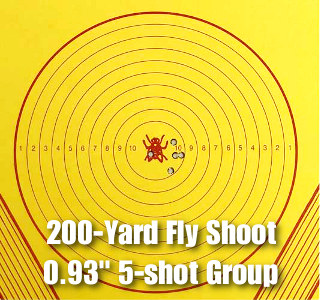
A couple seasons back, Australian John Lavaring shot a group at 200 yards that would make most centerfire shooters proud. The five-shot group, with all shots in the center 10-ring, measured just 0.93 inches. That works out to 0.44 MOA at 200 — mighty impressive for a .22 LR. Recorded at a Rimfire Fly Shoot benchrest event in Canberra, Australia, this 200-yard target set two new Australian SSAA National records! John was using ELEY Tenex ammunition.
Congratulations to John Lavaring for a spectacular demonstration of how well a rimfire rig can shoot — even at 200 yards. We rarely shoot our .22 LR rifles past 50 meters. Maybe it’s time to start a Rimfire ELR series, with targets at 200 or even 300 yards. What do you think of the Rimfire ELR idea? Leave comments below.
Anschutz 54 Benchrest Rig
The rifle was a Anschutz model 54 Match in a custom benchrest stock. John’s record-setting rig features a barrel block, which you can see forward of the action. Scope is a Bausch & Lomb BR model. We don’t have the round count on Lavaring’s barrel, but good rimfire benchrest rifles can often get 10,000 rounds (or more) of accurate life.
Rimfire Ballistics at 200 Yards
Some folks may be wondering about .22 LR ballistics at 200 yards. Well, with a 25-yard zero, the 200-yard drop for John’s 40gr Tenex ammo is 54 inches, assuming 0.145 G1 BC and 1085 fps muzzle velocity per ELEY website. And at 200 yards, a 10 mph crosswind will push that little bullet 15.3 inches! We’re told the winds were pretty tricky when Lavary shot his record group. This makes his achievement all the more impressive — we have to admire John’s wind-reading ability.
This ELEY ammo has proven to be exceptionally accurate. Here is a short video showing TEN rounds of Tenex shot from a machine rest with target at 50 meters.
Lyman’s Auto Advance Target System is an innovative product for rimfire shooters. Shoot more, with less time wasted changing targets. The Auto Advance features a motor-driven roll of targets that can be “refreshed” with a radio remote-control. Here’s how it works — a 50-foot-long target roll is mounted in the top on the target stand. When you’re ready for a new target, push a button and a fresh target rolls into place. The radio remote-control activates a battery-powered electric motor that conveniently rolls a new target into place after the current target is shot out. The remote-control works at distances up to 200 yards. NOTE: This target system is rated for rimfire and air rifle use only — no centerfire.
There are currently four (4) target roll options: Five Bullseye Target, 11-Bull Smallbore Target, Silhouette Target, and Varmint Target. MSRP is $149.95; street price is currently $112.99 on Amazon.
This helpful Lyman video shows all the features of the Auto Advance, with instructions for frame assembly, target-roll loading/removal, and use of the remote control.
Lyman states: “The new Lyman Auto-Advance Target System offers shooters the ability to change targets at up to 200 yards with the press of a button! No more walking downrange to replace targets, or waiting for cease-fires! The Auto-Advance Target System is battery-operated, so there is no need for wires and power outlets, plus it disassembles easily for transportation back and forth to the range. The Auto-Advance Target System has steel protection plates that are rated for use with all rimfire calibers. The Auto-Advance Target System comes with a roll of standard bullseye targets. Additional 50-foot target rolls are available with bullseye, animal and silhouette designs.”
With the current acute shortages of ammo and reloading components (particularly primers), many shooters are doing more dry-fire training. This method allows you to practice your hold, aiming, and trigger-pulling skills without using precious components and/or barrel life. Here are three systems employed for Dry Fire Training. The first device, the Mantis X Series, fits on a Picatinny rail and has a full-featured App that records your sessions and offers training tips. The Strikeman, used primarily by pistol shooters, features an in-chamber laser and a smartphone App that “reads” a proprietary target. The third device, the SCATT MX-02, is favored by top air rifle Olympic shooters and smallbore marksmen, but it can also be effectively used with centerfire rifles also. AND it can work for LIVE-fire as well as dry-fire training.
Mantis Systems — X2 for Dry-Fire, $99.99
Built for dry-fire use only, the Mantis X2 ($99.99) provides real-time, shot-by-shot feedback for both pistol and rifle users. You can track multiple training sessions with data-driven insights, and monitor your progress. This unit has earned high user reviews such as: “As a new gun owner the Mantis X is a game changer for me. I have not been able to get to the range during the lockdowns and being able to practice at home [is great].” And another: “Easy to install[.] The App is free and easy to use. I can’t make it to the range very often so I love being able to improve at home. It holds its charge for a long time.”
Guns America Digest has reviewed the Mantis X2. Tester Edgar Sherman says it offers good functionality for the $99.99 MSRP: “[The X2] is a clip-on attachment you can put on your handgun or rifle to test your accuracy [and see] how much movement you produce when breaking your shot. I use this system for myself to check my grip and trigger press [and] help new shooters eliminate variables. This tool will link up to your phone via Bluetooth and a free [Android App].” The Mantis X2 is a good value. The manufacturer states: “There is nothing at this price point that will give you this level of feedback for dry fire.”
There are actually four Mantis versions for firearms: X2 ($99.99), X3 ($169.99), X7 Shotgun ($199.99) and X10 Elite ($249.99). The X3 adds live fire functionality, allowing you to delve into and compare performance improvements between dry and live fire sessions. The capabilities of each system are found on the Mantis Model Comparison Page. NOTE: If your pistol/rifle lacks a standard accessory rail, Mantis offers a variety of Clamp-on Rail Adapeters.
Strikeman Training System
In this video Dustin Ellerman shows how to use the Strikeman Dry Firing System.
The Strikeman system is designed for dry-fire training primarily with handguns. This $99.99 system has four components: 1) a laser cartridge (similar to a bore-sighter) that fits in your chamber; 2) a special target; 3) a mount for your smartphone; and 4) a smartphone App that records your aiming. During practice, you set up your smartphone to point at the target, and the App record the laser movement, effectively tracking your muzzle movement. The manufacturer explains: “By using our signature target, laser cartridge and smartphone holder in unison with our phone App, you can safely practice your shot in the comfort of your home. The target includes a removable mount and suction cups. Our custom designed smartphone holder allows you to adjust your smartphone effortlessly.” Users seem to like this system, and Strikeman even offers a 15-day sastisfaction guarantee: “The Strikeman Training System is guaranteed to improve your shot accuracy, or your money back. Try it risk free for 15 days!”
The Strikeman is currently offered for seven (7) different cartridge types: .380 ACP, 9x19mm, .357 SIG, .38 SPL, .40 SW, .45 ACP, .223 Rem/5.56. The manufacturer’s video below shows how to place the Strikeman laser cartridge in your pistol and set up your smartphone and the special target:
SCATT MX-02 for Dry-Fire and Live-Fire
The SCATT MX-02 ($1799.99) is an electronic shooter training system that can be used effectively for dry-fire training. However, it it is also capable of operating outdoors with live, centerfire ammunition, at distances from 25 yards to 600 yards. Tony Chow tested this product for AccurateShooter.com. As fitted to his AR-15 Service Rifle, Tony found this is a very useful tool that can help High Power competitors refine their technique and shoot higher scores. CLICK HERE for MX-02 3000-word Review. There is a newer SCATT MX-W2 model ($1899.00) that offers all the same capabilities with a Wireless configuration.
How the SCATT MX-02 Works
The SCATT sensor mounted on the end of the barrel has a digital camera that recognizes the black bullseye in the target, even in broad daylight outdoors. Using the bullseye as a reference, the SCATT software tracks the movement of the muzzle relative to the center of the target. The unit can plot these movements as a continuous trace, which appears on a monitor as a squiggly, colored line. By sensing the exact moment of shot release, the SCATT can also interpolate relative shot placement (for a single shot or series of shots) — but this is not the same as an electronic target which actually records the exact shot impact location on the target.
Emil Praslick III is widely recognized as one of the greatest wind wizards on the planet — a master at identifying wind value and direction, and predicting wind cycles. As coach of the USAMU and top civilian teams, Emil has helped win many high-level championships. In the three videos we feature today, Emil, who works with Capstone Precision Group (Berger, Lapua, SK, Vihtavuori) and Team Applied Ballistics, explains how to determine wind direction and velocity using a variety of indicators. Praslick, now retired from the U.S. Army, was an 18-time National and 2-time World Champion coach with the USAMU.
Video ONE: Wind Theory Basics — Understanding “Wind Values”
In this video from UltimateReloader.com, Emil explains the basics of modern wind theory. To properly understand the effect of the wind you need to know both the velocity of the wind and its angle. The combination of those variables translates to the wind value. Emil also explains that the wind value may not be constant — it can cycle both in speed and velocity. Emil also explains some of the environmental conditions such as mirage that can reveal wind conditions.
Video TWO: Determining the Direction of the Wind
Key Point in Video — Find the Boil
Emil explains how to determine wind direction using optic. The method is to use spotting scope, riflescope, or binoculars to look for the “Boil” — the condition in mirage when the light waves rising straight up. The wind will generate that straight-up, vertical boil in your optics when it is blowing directly at you, or directly from your rear. To identify this, traverse your scope or optics until you see the boil running straight up. When you see that vertical boil, the direction your optic is pointing is aligned with the wind flow (either blowing towards you or from directly behind you).
Video THREE: The No Wind Zero Setting
In this second video, Emil defines the “No-Wind Zero”, and explains why competitive shooters must understand the no-wind zero and have their sights or optics set for a no-wind zero starting point before heading to a match. In order to hit your target, after determining wind speed and direction, says Emil, “you have to have your scope setting dialed to ‘no wind zero’ first.”
Coach of Champions — Emil Praslick III
SFC Emil Praslick III, (U.S. Army, retired) works with Berger Bullets and Applied Ballistics. Emil served as the Head Coach of the U.S. National Long Range Rifle Team and Head Coach of the USAMU for several years. Teams coached by Emil have won 33 Inter-Service Rifle Championships. On top of that, teams he coached set 18 National records and 2 World Records. Overall, in the role of coach, Praslick can be credited with the most team wins of any coach in U.S. Military history.
NOTE: The contest is OVER, so ignore information on the PDF about submitting targets — that’s from back in 2013.
Here’s a target for the holidays that can provide some fun at the range. This Christmas Tree Target was created by Sierra Bullets for a 2013 contest. This contest is now over, but you can still have fun with the target. This tree target is designed to be shot at 15 yards with pistol, or at 100 yards with rifle.
Santa’s Extra Accuracy Challenge
Start with the big circles, and then work your way down to the small circles (7,8,9,10) as you build your confidence. Shoot the gifts for bonus points.
For an extra challenge (with an accurate rifle), try working your way back up to the top, aiming for the X-Marks in the circles and finishing with the small, inset star at the top. Try to hit each X-Mark and then put your final shot in the inner star. Have fun!
Shooting Sports USA has an article of interest to competitive shooters who also enjoy hunting. This article was authored by Josh Honeycutt, a highly-accomplished hunter. To explain how competitive shooting can improve hunting skills, Honeycutt interviewed two leading pro shooters who both hunt: Doug Koenig and Bruce Piatt. The story outlines eight ways competitive shooting can help develop shooting skills and a mental awareness that will help hunters. Thorough the eight points, the article explains how skills learned in competition can help deliver better results during your hunts.
With winter here, many gun enthusiasts are switching to indoor ranges. There are important safety and behavior rules you need to follow when shooting indoors. Sometimes bad range etiquette is simply annoying. Other times poor gun-handling practices can be downright dangerous. The NRA Blog has published a useful article about range safety and “range etiquette”. While these tips were formulated with indoor ranges in mind, most of the points apply equally well to outdoor ranges. You may want to print out this article to provide to novice shooters at your local range or club.
8 Tips for Gun Range Etiquette
Story by Kyle Jillson for NRABlog
Here are eight tips on range etiquette to keep yourself and others safe while enjoying your day [at the range]. Special thanks to NRA Headquarters Range General Manager Michael Johns who assisted with this article.
1. Follow the Three Fundamental Rules for Safe Gun Handling
ALWAYS keep the gun pointed in a safe direction.
ALWAYS keep your finger off the trigger until ready to shoot.
ALWAYS keep the gun unloaded until ready to use.
This Video Covers Basic Gun Range Safety Rules and Etiquette
2. Bring Safety Gear (Eye and Ear Protection)
Eye and Ear protection are MANDATORY for proper safety and health, no matter if “required” by range rules or not. It is the shooter’s responsibility to ensure proper protection is secured and used prior to entering/using any range. Hearing loss can be instantaneous and permanent in some cases. Eyesight can be ruined in an instant with a catastrophic firearm failure.
3. Carry a Gun Bag or Case
Common courtesy and general good behavior dictates that you bring all firearms to a range unloaded and cased and/or covered. No range staff appreciates a stranger walking into a range with a “naked” firearm whose loaded/unloaded condition is not known. You can buy a long gun sock or pistol case for less than $10.
4. Know Your Range’s Rules
Review and understand any and all “range specific” rules/requirements/expectations set forth by your range. What’s the range’s maximum rate of fire? Are you allowed to collect your brass? Are you required to take a test before you can shoot? Don’t be afraid to ask the staff questions or tell them it’s your first time. They’re there to help.
5. Follow ALL Range Officer instructions
ROs are the first and final authority on any range and their decisions are generally final. Arguing/debating with a Range Officer is both in poor taste and may just get you thrown out depending on circumstances.
6. Don’t Bother Others or Touch Their Guns
Respect other shooters’ privacy unless a safety issue arises. Do NOT engage other shooters to correct a perceived safety violation unless absolutely necessary – inform the RO instead. Shooters have the right and responsibility to call for a cease fire should a SERIOUS safety event occur. Handling/touching another shooter’s firearm without their permission is a major breech of protocol. Offering unsolicited “training” or other instructional suggestions to other shooters is also impolite.
7. Know What To Do During a Cease Fire
IMMEDIATELY set down your firearm, pointed downrange, and STEP AWAY from the shooting booth (or bench). The Range Officer(s) on duty will give instructions from that point and/or secure all firearms prior to going downrange if needed. ROs do not want shooters trying to “secure/unload” their firearms in a cease fire situation, possibly in a stressful event; they want the shooters separated from their guns instantly so that they can then control the situation as they see fit.
8. Clean Up After Yourself
Remember to take down your old targets, police your shooting booth, throw away your trash, and return any equipment/chairs, etc. Other people use the range too; no one wants to walk up to a dirty lane.
This NSSF Video Covers Basic Gun Range Safety Rules:
BAD RANGE BEHAVIOR — Five Things NOT to Do at the Range
Here are the five worst behaviors we’ve seen at indoor ranges. These behaviors are both dangerous and inconsiderate. Any one of these behaviors can get you permanently banned from an indoor range.
1. Sweeping other individuals after loading a weapon behind the firing line is very bad. All your weapons should be empty until you reach your shooting station.
2. Turning the handgun sideways while trying to clear a malfunction or insert/remove a magazine. This will point the muzzle at a fellow shooter. Or, after shooting a gun, the shooter fails to clear the weapon and then places the gun somewhere near the shooting station with the muzzle in an unsafe position.
3. Reacting unpredictably when firing a high recoil handgun. We’ve seen people take a second shot by accident with the muzzle way off target.
4. Not obeying range commands — in particular continuing to shoot during called cease-fires.
5. Poorly aimed shooting that hits target frames or carriers, causing ricochets.
Double-Up on Hearing Protection When Shooting Indoors
When shooting pistols indoors we recommend quality muffs with earplugs underneath, offering double protection. When inside an enclosed range, with other shooters blasting away right next to you, you really need effective hearing protection. But you also need to hear range commands and be able to communicate with your fellow shooters. That’s why we recommend electronic muffs with plugs underneath.
For pistol shooting indoors, we like the latest Howard Leight Impact Pro Muffs. These offer an impressive 30 dB Noise Reduction Rating (NRR). In addition, these muffs are pretty comfortable and offer Headphone Functionality so you can connect to your smartphone, MP3 player, or other audio device. These muffs are a good value. They are currently offered for $62.55 on Amazon.com.


 We admire the fortitude of Forum Member Nick who, a few seasons back, braved wintry weather to enjoy a day at the range in his native Pennsylvania. A little snow on the ground couldn’t stop this intrepid shooter, who brought snow shovel and arctic gear to his range session. Folks, here’s a true “hardcore” fan of shooting! Despite the “relentless snow”, Nick reports that “at least it wasn’t windy”. Nick shot a variety of long guns, including his .22 LR rimfires, a .223 Rem, and a .308. Not daunted by the cold, Rick said it was fun to “play like a kid once in a while.” That’s the spirit!


 About Ernie Bishop — Specialty Pistol Guru
 Anschutz 54 Benchrest Rig


 Santa’s Extra Accuracy Challenge


