Enjoy the Shooting Sports USA Archives
With the COVID-19 restrictions we’re all spending more time indoors at home. For some folks that means long sessions in front of the boob tube. Here’s a better idea — there’s a vast resource of great gun-related content available online for FREE. Check out the Shooting Sports USA Articles Archive. SSUSA maintains a vast digital library with hundreds of articles going back to June 2009.
It’s easy to find back issues of Shooting Sports USA magazine. Here’s how: Using the gray toolbar at the top, click on the “ARCHIVES” icon in the upper right area (indicated with red arrow). When you click on “ARCHIVES”, a window will open with a selection of Shooting Sports USA magazine covers/dates in a vertical column.
Next use the vertical scroll bar to go from November 2020 (the latest issue) all the way back to June 2009. Click any issue cover to read.
How to Find and Save Articles
To search through back issues, select “MORE OPTIONS” from the toolbar. Then click the “SEARCH” button. When that opens, select either “Search archives” for ALL back issues or “Search Only this Issue”. When you’ve made your choice, enter your search term(s). For example, you can search for “Camp Perry” or “Palma” or “F-Class Championship”. You can also save any archived issue as a PDF for viewing offline. Just click “SAVE” to download the article you’re currently viewing/reading.
Read Sample Articles
Here are a couple of our favorite SSUSA feature stories from recent years. There are hundreds of other informative articles worth reading.
We created the above target a decade ago. Since then it has been used by tens of thousands of shooters. It has proven very popular as a load development target, since all your load data fits neatly in the boxes under each target. In fact this target is being employed by both rifle-makers and barrel-makers (including Criterion) to test their products. The target was designed for aiming efficiency. The diamonds have 1/2″ sides and you can align your reticle cross-hairs on the horizontal and vertical lines. It is a clean design that is easy to see even at 200 yards with a 20X scope. When we test, we usually crank in a little elevation, setting the point-of-impact higher, so that our shots fall in the gray circles. That way you leave the red diamonds intact for precise aiming. CLICK HERE to download Load Dev target.
We also use these two targets for load development and precision practice. The circle dot target can also be used for informal rimfire competition at 50 yards.
Right-Click Each Target to Download Printable PDFs.
How to Print Your Targets
Most of us have access to a printer at home or at work. That means you can print your own targets. You’ll find hundreds of free target designs online, including dozens of downloadable targets on our AccurateShooter.com Target Page. If you’re feeling creative, you can design your own target with a computer drawing program such as MS Paint.
Paper Stock Is Important
If you want your self-printed targets to show shots cleanly (and not rip when it gets windy), you should use quality paper stock. We recommend card stock — the kind of thick paper used for business cards. Card stock is available in both 65-lb and 110-lb weights in a variety of colors. We generally print black on white. But you might experiment with bright orange or yellow sheets. Forum Member ShootDots report: “They sell cardstock at Fed-Ex Kinko! I use either Orange or Yellow. That makes it easy to see the bullet holes clearly.” NOTE: Test before you use the 110-lb Cardstock. On some printers, with the heavier 110-lb card stock, you will need to have the paper exit through the rear for a straighter run.
Here are some Target-Printing Tips from our Forum members:
“Staples sells a 67-lb heavy stock that I have settled on. I use the light grey or light blue, either of these are easy on the eyes on bright days. I have used the 110-lb card stock as well and it works fine. It’s just a little easier to print the lighter stuff.” (JBarnwell)
“Cardstock, as mentioned, works great for showing bullet holes as it doesn’t tear or rip like the thin, lightweight 20-lb paper. I’ve never had a problem with cardstock feeding in the printer, just don’t stick too many sheets in there. If I need three targets, I load only three card stock sheets”. (MEMilanuk)
“20-lb bond works pretty well for me if I use a spray adhesive and stick the entire back of the paper’s surface to the backer board.” (Lapua40X)
CMP COMPETITION RULES FOR 2020-2021 Are Now Available
CMP Rule Changes are now available as Addenda to 2020 Rules or as complete 2020-21 PDFs (links below). There were not a lot of changes that were approved for 2021. However, most notably, eyewear rules will be more strictly enforced. NOTE: When you open the downloadable PDF files linked below, you will see the new-for-2021 changes displayed in red underlined text. The changes made in 2020 are shown in black underlined text.
Story based on Report by Gary Anderson, DCM Emeritus
CMP Competition Rules for the 2021 competition season have now been approved by the CMP Rules Committee and are posted on the CPM Website. The 2020 competition season was severely impacted by the Covid-19 pandemic and many 2020 events were cancelled, so the CMP still has a substantial inventory of printed 2020 rulebooks. In addition [there were] only a small number of changes for 2021. As a result, the CMP decided not to publish new rulebooks for 2021. 2020 Rulebooks will continue to be used and Errata (Update) sheets are being provided for each rulebook. The rulebooks posted on the CMP website have been updated with 2021 changes are labeled as “2020-2021″ rulebooks. These Rulebooks posted on the CMP website include all 2021 changes. Use the links above to get the latest rules for each discipline.
How to UPDATE Your CMP Rules:
1. If you already have a 2020 rulebook, download the Changes/Updates for that rulebook and note in your 2020 rulebook where those changes apply. (Or use the links above).
2. If you keep your rulebooks on your computer, notebook or cell phone, or want to print your own rulebook, download the Updated 2020-2021 rulebooks from the CMP Website. (Or use the links above).
2020-2021 rulebooks include a diagram showing proper use of eye protection.
When reading the 2020-2021 editions of the rulebooks, note that 2020 rule changes are displayed in black underlined text. 2021 changes are displayed in red underlined text. Those changes do, however, include the addition of a new CMP Service Revolver Match in the Pistol Rules and the addition of F-Class and AR-Tactical Mid- and Long-Range Matches in the Highpower Rifle Rules. The CMP plans to offer competitions in both of these new disciplines in the 2021 National Matches. Another significant change, which has already been announced because it applies this year, is the authorization that competitors may fire a sixth EIC match in years like 2020 when the National Trophy Individual Match is not held.
The 2020 rule requiring Highpower Rifle and Pistol competitors to wear eye and hearing protection while on the firing line has been clarified and strengthened in the 2020-2021 rules.
MANDATORY EYE PROTECTION RULE
One of the most important 2020 rule changes was a requirement that Highpower rifle and pistol competitors must wear eye and hearing protection when they are on firing lines. A big majority of experienced, knowledgeable competitors now agree that protective eyewear is a must for Highpower rifle and pistol shooting, but unfortunately this safety precaution has not been as universally accepted. Incidents involving Highpower rifle and pistol shooting where eye injuries occurred or could have occurred are more common than many realize.
Non-Compliance Results in “No Exceptions” Eye Protection Standards
The CMP Board and staff have carefully evaluated the pros and cons of this safety requirement and have concluded that mandating the wearing of eye and hearing protection is a wise policy. After this rule was introduced, a vast majority of competitors complied with its letter and spirit. Unfortunately, there were a few competitors who did not comply. Some wore shooting glasses to the line and then lowered or removed them while firing. A really strange attempt to evade this rule involved cutting a hole in the part of the shooting glasses lens where the competitor looked while aiming. A few simply refused to comply.
After evaluating experiences with this new safety requirement in 2020, the CMP is taking these additional steps to facilitate compliance in 2021:
— Rule 3.6.2 (both Highpower Rifle and Pistol) has been clarified to clearly require that “two complete lenses” be worn in front of both eyes while firing. Obtaining shooting glasses or prescription eyewear that complies with the ANSI Z87.1 safety standard is “strongly recommended”.
— Pre-match safety briefings in 2021 will include specific instructions about the requirement to wear eye and hearing protection while on the firing line.
— Match officials will give warnings to any competitor who is not in compliance. Refusal to comply with a warning is grounds for disqualification.
— Match sponsors are advised that their match officials need to monitor and enforce this rule and that results from EIC or other matches where this rule was not enforced may not be accepted.
Armageddon Gear Founder Tom Fuller competes in PRS and supervised the 2020 AG Cup.
We know many readers have wondered if Hornady A-Tip bullets are good enough for competition. Well at least in the PRS world, it looks like these aluminum-tipped, high-BC bullets are more than capable of winning. The top four shooters in the 2020 Armageddon Gear Cup all used 110gr 6mm Hornady A-Tips. Of course in PRS/NRL, accuracy standards are different. In the hands of a very good PRS shooter, a half-MOA rifle can win. PRS is not benchrest where you need bullets that can shoot in the “ones”. But still, this is an impressive performance for Hornady’s A-Tips, at least in PRS-type tactical competition.
Hornady A-Tip bullets were used by the first, second, third, and fourth place competitors at the 2020 Armageddon Gear Cup match, held October 30-31 in Blakely, Georgia. Austin Orgain took first place, followed by Robert Brantley (2nd), Tate Streater (3rd), and Dave Preston (4th). All four shooters were using Hornady 6mm 110-grain A-Tips. Winner Austin Orgain stated “A-Tip bullets are the most forgiving bullets I have ever loaded… Combine a high-quality bullet with high BCs, you have a winning combination.”
The Hornady A-Tip was designed as a low drag, high-BC match bullet. The most striking features of A-Tip bullets are the long, aluminum tips. The highly-uniform aluminum tips are precision-machined. Hornady claims that these tips “coupled with highly refined AMP bullet jackets… and optimized boattails” yield reduced drag compared to other bullets of similar weight.
About the Armaggedon Gear Cup Match
2020 marked the second year of the Armageddon Gear (AG) Cup, an invitational match at the 2300-acre Arena Training Facility in Georgia. This year showcased an all-star line-up of tactical talent, with the nation’s top PRS/NRL shooters invited. This is a big money event. In 2019 $41,000 in prize money was up for grabs, with the overall match winner guaranteed twenty thousand ($20,000) in cash and a $1000 prize for the winner of each of the 20 Stages. You can watch last year’s AG Cup on Shooting USA’s Vimeo Channel.
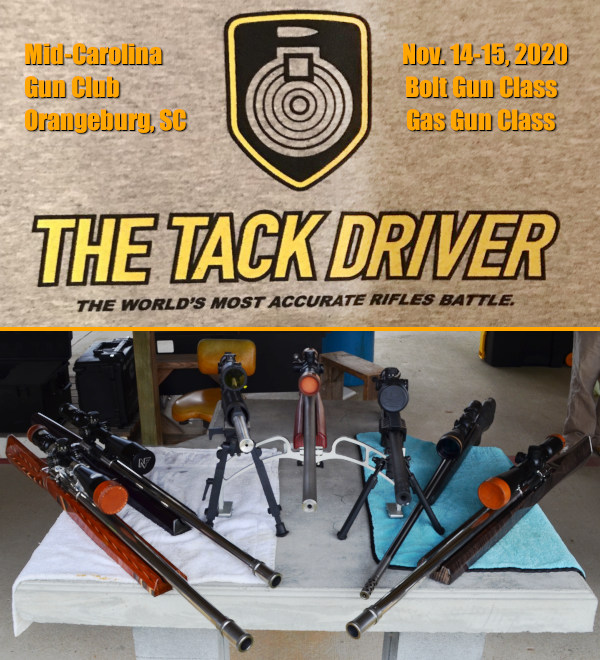
The Tack Driver Showdown is a one-of-a-kind “all comers” rifle match. This match is long overdue — we will finally get to see what rifle types are truly the MOST accurate, at least out to 300 meters. The Tack Driver Showdown match will be held November 14-15, 2020 at the Mid-Carolina Gun Club in Orangeburg, South Carolina. Co-Sponsored by the IBS, the organizers have invited virtually any type of rifle (except railguns) to compete at 300 meters for group and score honors. There are 100+ competitors pre-registered for the event this weekend. No organization membership is required.
Unlike any other rifle match in the world, on the firing line you will see 6 PPC LV/HV rifles, 30 BR score rigs, 17-lb 600-yard and 1000-yard benchrest guns, F-TR rifles, F-Open rifles, Palma rifles, PRS rifles, and maybe even an AR15 or two.
The concept behind the event is to settle the unending arguments about which guns are TRULY the most accurate. The 6PPC is king in 100/200 group competition, the 30BR rules 100/200 score, 6mmBRs and 6BR Improveds dominate in 600-yard Benchrest, the .284 Win is the leading F-Open cartridge, and various 6mms and 6.5mms win PRS matches. It will be interesting to see which chamberings and bullet weights will “rule the roost” at 300 meters. Match Director Jim Cline will post match results throughout the weekend on the AccurateShooter.com Forum.
Tack Driver Showdown targets will be placed at 300 meters (328 yards). That’s not even “mid-range” by benchrest standards, but it should be far enough that the higher BCs of the bullets shot by F-Class and 600/1000-yard benchrest rigs could come into play.
Basic Information on the Tack Driver Shoot:
There are two divisions — bolt-action rifles and semi-auto gas guns. There are no specific design limits other than a 22-lb maximum weight, and a .338 maximum caliber. IBS President Jeff Stover tells us: “We envision the full array of the world’s most accurate rifles on the line: short and long range benchrest rifles, F-Class, AR, other tactical, egg-shoot rifles, whatever…[.]” Key rules are listed below. Semi-autos will need chamber flags, otherwise bolts must be out at all times. You do not have to be a member of the IBS to shoot. The range will be open Friday, November 13th starting at 12:00 noon for practice and flag setting.
Cash Payouts for the Winners in both Group and Score
Match Director Jim Cline tells us: “1st place through 3rd place will be paid in both score, group, and Grand Aggregate finishing positions. Team Cash option also available- 4 man teams $100. The Grand Aggregate team winner takes all.”
2020 Tack Driver Showdown Rules Overview
1. No membership in any organization is required.
2. Any gun .338 caliber and under is legal (other than rail guns), with a 22-pound weight maximum.
3. There are two divisions: 1) Bolt Guns; and 2) Gas Guns.
4. All shooting will be done off benches.
5. Shooters may use bipod, bags, or rest combination but no one-piece rests.
6. You have to shoot the same gun at all targets. If you have a catastrophic failure, you have to continue with a gun of the same caliber and cartridge.
7. No electronic equipment of any type will be allowed on the bench or downrange.
8. No spotting scopes are allowed on the bench.
9. No people may coach or spot for competitors.
10. Chamber flags and brass catchers are required for gas guns.
2020 Tack Driver Showdown Match Course of Fire
1. There will be 5 group targets and 5 IBS 200-yard score targets placed at 300 METERS.
2. Targets will alternate between Score and Group each day: Day 1 Score/Group/Score/Group/Score; Day 2 Group/Score/Group/Score/Group.
3. All relays will be 7-minute matches with one 3-minute sight-in period on Saturday first target only.
4. Benches will be rotated for the second day’s course of fire.
5. Winner will be determined by place of finish at each discipline.
Covered Firing Line at Mid-Carolina Gun Club. Photo from 2019 100/200m Score Nationals.
For more information, including camping/RV details at the Mid-Carolina Gun Club venue, contact Jim Cline at 843-957-6546, or post questions on this Accurateshooter Forum Thread.
You can spend thousands on a rifle, but that expensive hardware won’t perform at its best if you have poor trigger technique. One key element of precision shooting is trigger control. Our friend Kirsten Joy Weiss has produced a good video that shows how to refine your trigger technique for better accuracy. In this video, Kirsten talks about the actual placement of a shooter’s index finger on the trigger. It is important to have the finger positioned optimally. Otherwise you can pull the shot slightly left or slightly right.
Kirsten tells us: “Finger placement on the trigger might not seem like a big deal, but it actually is. The reason for this is because, depending on where your index finger is placed on the trigger, [this] translates to different muscle interactions with the gun.” Watch this video to see Kirsten demonstrate proper finger placement (and explain problems caused by improper finger positioning).
When you pull the trigger, you only want to engage the last section of your finger, in order to avoid unwanted muscle engagement and to achieve a smooth shot. Remember there is a “sweet spot” between the crease (first joint) and the tip of the finger. If you position the trigger in that “sweet spot”, you should see an increase in your accuracy. Don’t make the mistake of putting the trigger in the crease of your finger, as shown below.
Effects of Incorrect Finger Placements
You want to place the trigger shoe between the end of your finger and the first joint. If you place the trigger on the very tip of you finger you’ll tend to push the rear of the rifle to the left when engaging the trigger, causing shots to go right (for a right-handed shooter). On the other hand, if you put the trigger in the crease (first joint), you’ll tend to bring the rear of the rifle to the right, causing shots to fall left. This is illustrated below for a right-handed shooter.
In response to the record number of first-time gun buyers in 2020, the NRA’s Education & Training Division is offering five Online Gun Safety Courses that can be completely online at home. The five NRA Online Gun Safety Courses ARE:
Each course, lasting from one to eight hours, is available online at NRAInstructors.org. To Access the 0nline training options, first CLICK HERE. Then under the Heading “DISTANCE LEARNING”, you will see options. CLICK the small gray box at the left of the title to select the course. IMPORTANT — Next you MUST SCROLL to the bottom of the NRA webpage to SEARCH. Select your state or Zip code, then you will get a list of the moderated online courses in your area.
Here is the Procedure to Follow:
1. CLICK HERE to Access ALL Course Listings
2. Select a “Distance Learning” Course.
3. Scroll Down and SEARCH for your State or Zip Code.
4. Review Course Dates and Times.
For example, here are the listed NRA online training courses for Washington only. Elsewhere (in other states), YOUR list will be different! NOTE: These online courses are NOT FREE. Typical cost ranges from $20 to $150.
“These courses will provide an option for first-time gun owners who don’t have the ability to take an NRA certified instructor-led class at their local shooting range at this time,” said Joe DeBergalis, Exec. Dir. of NRA General Operations. “While there is no replacement for in-person, instructor-led training, our new online classes do provide the basics of firearm safety training for those self-isolating at home.”
Though range time is an important part of the classes, there is still a wealth of knowledge available in the online programs. “The NRA recommends that all new gun owners seek professional training at the range, but that doesn’t mean you can’t get a head start on learning the basics of firearm safety at home. Taking one of these classes moderated by a certified NRA instructor, can only make you safer…” DeBergalis added.
There has been a huge surge in firearm sales this year. October 2020 set a new, all-time record for the month. The October 2020 NSSF-adjusted National Instant Criminal Background Check System (NICS) figure of 1,769,553 is a 60.1% increase over the October 2019 NSSF-adjusted NICS figure of 1,105,335.
Even more telling, the 2020 year-to-date total of 17.2 million background checks shatters the previous annual record of 15.7 million background checks — and we still have two months in 2020! Notably, a high percentage of the purchasers are first-time gun owners. In fact the NSSF believes that nearly 5 million Americans have joined the ranks of gun owners for the first time this year.
Firearm sales are up 95% in 2020. And, according to the NSSF, there were nearly 5 million first-time-ever gun buyers in the USA this year. A NSSF dealer survey estimates that 40% of all gun sales were conducted to purchasers who have never previously owned a firearm. And women accounted for 40.2% of all first-time gun purchases. The NSSF estimates there are approximately 100 million gun owners in America.
Resources for New Gun Owners
With firearm sales continuing to surge across the country, NSSF President/CEO Joe Bartozzi welcomes first-time gun buyers in a new video with tips on how to safely enjoy the shooting sports. Here is the video for new gun owners.
“As a first-time gun owner, you’re going to want to spend time practicing with your new firearm … improving your gun-handling and marksmanship skills … and to educate [yourself] about personal and home protection, and to learn about keeping our guns securely stored…” says Bertozzi.
Firearm safety is every gun owner’s primary responsibility, emphasizes Bartozzi, a lifelong target shooter and hunter. As gun owners, “you and I are responsible for safely handling, transporting, and storing our firearms[.]” Newcomers are encouraged to watch NSSF’s Range Safety and Etiquette videos. You will find these on the NSSF YouTube Channel. Here is a basic safety video:
Where to Shoot Online Resource and Mobile Apps
If you are looking for a good indoor or outdoor shooting range near you, visit Wheretoshoot.org. On that website you can search by city, state, or zip code to find a range near you.
To complement Wheretoshoot.org, the NSSF also offers Where To Shoot Mobile Apps. These iOS and Android Apps quickly locate shooting ranges near you, drawing on North America’s most comprehensive range directory. Users can search by current location, state, or zip code. Once you locate a range, you can view activities offered along with a summary of range facilities. You can even get driving directions.
Annie Oakley Profile by T. Logan Metesh
Annie Oakley learned to shoot at a young age. It started as a skill developed to help feed her family when she was still known as Phoebe Ann Mosey (or possibly “Moses”). Annie began shooting and hunting by age eight, to support her siblings and her widowed mother. She honed her skills, adopted the stage name Annie Oakley, and earned the nickname of “Little Miss Sure Shot” for her expert marksmanship.
Annie Oakley’s trick-shooting and marksmanship skills were so good that she toured the world as part of Buffalo Bill’s Wild West Show for more than a decade and a half. It was rumored that she was one of the highest paid performers in the show. Annie was known for making some truly astounding shots: hitting dimes in midair, aiming backwards through a mirror, and more. She traveled overseas with Buffalo Bill and performed for royalty in England, France, Italy, and Germany. Annie even shot the ashes from a cigarette held by Kaiser Wilhem II!
Biographers say Annie met her husband, Frank Butler, at a shooting competition when she was just 15. Young Annie beat Butler in a one-on-on shooting match, and they later married.*
Here is rare 1894 footage of Annie Oakley shooting, filmed in the Edison Black Maria studio.
“Annie Oakley was arguably America’s first female superstar, touring the U.S. and the world in the late 1800s and early 20th century and demonstrating her legendary Wild West sharp-shooting skills.”
— Tom Slater, Historian for Heritage Auctions.
Annie Oakley’s Favorite Firearms
Annie Oakley’s sharpshooting feats were impressive in their own right, but the equipment she used to accomplish these things made them even more impressive. Annie favored basic, commonly available firearms. She didn’t need modified guns to make her shots.
She enjoyed shooting her Parker Bros double-barrel shotgun, but it wasn’t fancy in appearance. It had just standard grade wood and, aside from the standard scrollwork on the locks, it was just a normal gun.
She also owned a Smith & Wesson Model No. 2 revolver. The gun was nickel-plated and had mother-of-pearl grips, but those were options that anyone could have had on their own revolver. Another one of her pistols, a Stevens single-shot tip-up, was gold-plated and had mother-of-pearl grips, but it had not been modified or accurized in any way to improve its performance. Annie simply didn’t need the help.
Annie’s firearms may not have been modified for trick shooting, but she did own a number of one-off specials. For example, she owned one of the 800 Remington Beals rifles made between 1866 and 1866, but hers is the only known example to bear factory engraving.
Of course, many arms makers saw Annie’s fame as a way to promote their guns, so a large number of engraved and/or gold-plated guns were gifted to her. Some of these include a Winchester Model 1892 carbine and a Stevens Model 44 rifle.
Annie Oakley Continued to Perform at Age 60+ during the 1920s
A consummate performer, Annie continued to wow crowds even as her craft took its toll on her body. A lifetime of exposure to gunpowder residue and smoke led her to experience repeated eye infections. Despite the advent of smokeless powder, she had spent years using blackpowder beforehand. Even if it had all been smokeless, the quality we know today was not the quality they had back then. Plus, the sheer amount of powder she encountered certainly added up.
Her public appearances required lots of travel, which wasn’t without its own dangers. She underwent spinal surgery from a train accident in 1901 while travelling with the Wild West Show. Years later, she had to wear a steel brace on her leg due to a car accident in 1922, but she got back to performing and continued to set records in 1924 at the age of 64. By this time, though, her health had begun to decline. Annie Oakley passed away in 1926 at the age of 66. Her husband, Frank Butler, was so fraught with grief that he stopped eating and died of starvation just 18 days later.
Annie Oakley Championed Women’s Rights
While most of the world remembers Annie for her accomplishments with a firearm, she used her fame in a different way during her lifetime. She was an advocate for women’s rights and shooter education. She is quoted as having said, “I would like to see every woman know how to handle guns as naturally as they know how to handle babies.” It’s believed that she taught some 15,000 women how to shoot during her lifetime. Today, educational shooting experiences geared towards women often use her name to their advantage. After all, what shooter wouldn’t want to be as well regarded as Annie Oakley?
About Author T. Logan Metesh
T. Logan Metesh is a firearms historian and consultant who runs High Caliber History LLC. Logan has more than a decade of experience working for the Smithsonian Institution, the National Park Service, and the NRA Museums. Logan has been a frequent guest on the “Curator’s Corner” program for NRATV and has served as an historic firearms facilitator for American Rifleman TV and other shows.
*On Thanksgiving Day 1875, the Baughman & Butler shooting act was performing in Cincinnati, Ohio. Traveling show marksman and former dog trainer Frank E. Butler, an Irish immigrant, placed a $100 bet per side (equivalent to $2,300 in 2019) with Cincinnati hotel owner Jack Frost that Butler could beat any local fancy shooter. The hotelier arranged a shooting match between Butler and the 15-year-old Annie, saying, “The last opponent Butler expected was a five-foot-tall, 15-year-old girl named Annie.” After missing on his 25th shot, Butler lost the match and the bet. He soon began courting Annie and they married. They did not have children.
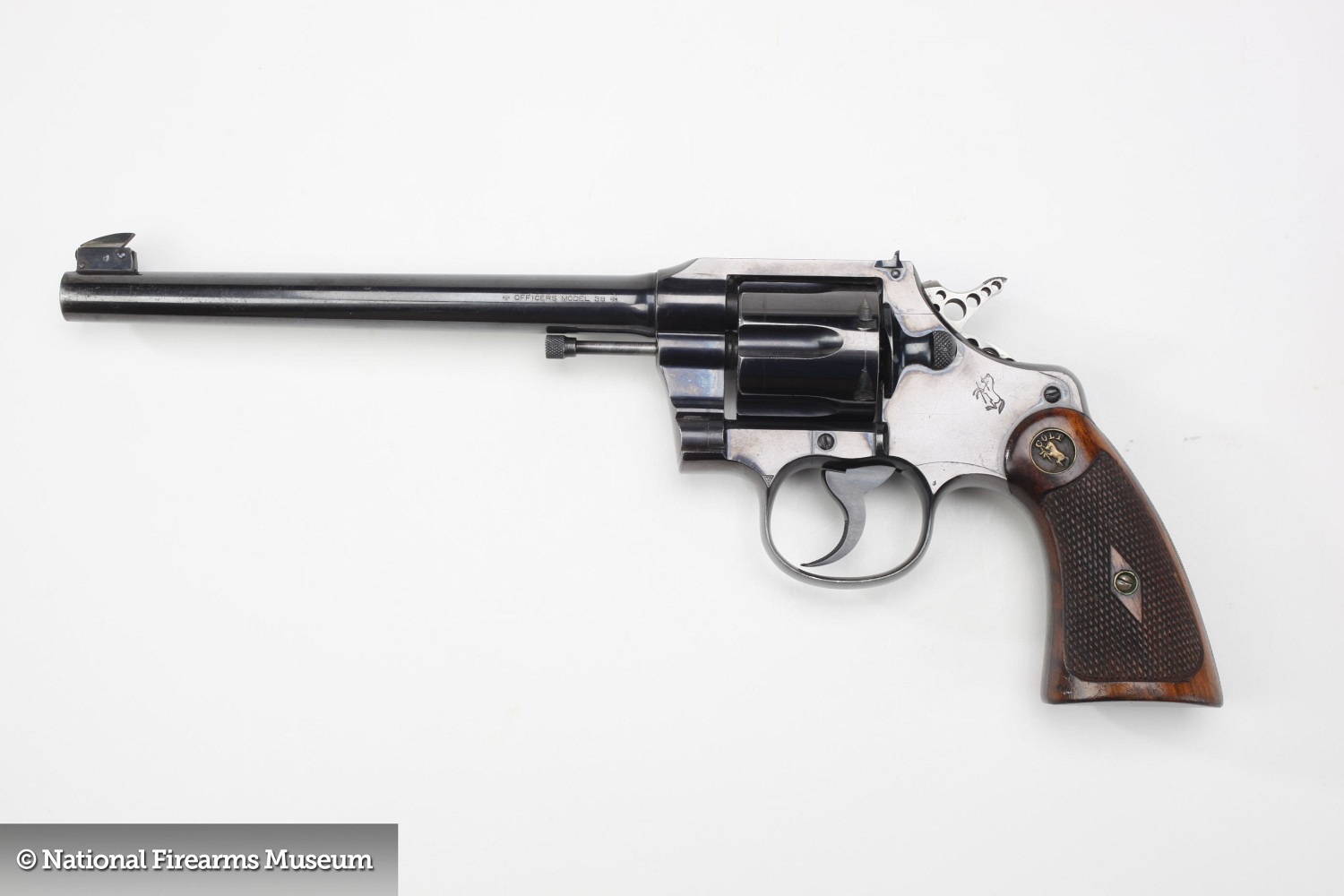
A.P. Lane’s Gold Medal-Winning Colt Revolver
This Colt Officer’s Model revolver, factory-fitted with a skeletonized hammer, belonged to legendary Olympic shooter A. P. Lane, who was known as the “Pistol Wizard”. Lane used this Colt Revolver to win FIVE Olympic Gold Medals — three in 1912 and two in 1920.
A.P. Lane was one of the greatest pistol shooters of his generation. He shot scores that were typically 25-50 points higher than those of his competitors. And he exhibited true Corinthian spirit. At the 1912 Olympics, Lane shared his match ammunition with another competitor who used that ammo to capture the Silver Medal (Lane won the Gold).
This revolver, factory-fitted with a skeletonized hammer, was used by American A.P. Lane in winning five Olympic Gold Medals in the 1912 and 1920 Olympic Games. It’s a .38 caliber, Officer’s Model centerfire revolver from the early 20th century. Olympian A.P. Lane’s Gun can be found in Gallery 13, Firearm Traditions for Today, at the NRA National Firearms Museum in Fairfax, Virginia. The Museum exhibit includes a panoply of Lane pieces – his revolver, his five Gold Medals, and the five Olympic certificates that went along with them.


 It’s easy to find back issues of Shooting Sports USA magazine. Here’s how: Using the gray toolbar at the top, click on the “ARCHIVES” icon in the upper right area (indicated with red arrow). When you click on “ARCHIVES”, a window will open with a selection of Shooting Sports USA magazine covers/dates in a vertical column.


 How to Print Your Targets


 When reading the 2020-2021 editions of the rulebooks, note that 2020 rule changes are displayed in black underlined text. 2021 changes are displayed in red underlined text. Those changes do, however, include the addition of a new CMP Service Revolver Match in the Pistol Rules and the addition of F-Class and AR-Tactical Mid- and Long-Range Matches in the Highpower Rifle Rules. The CMP plans to offer competitions in both of these new disciplines in the 2021 National Matches. Another significant change, which has already been announced because it applies this year, is the authorization that competitors may fire a sixth EIC match in years like 2020 when the National Trophy Individual Match is not held.




 A.P. Lane’s Gold Medal-Winning Colt Revolver