Time flies, even during a pandemic. August is just two days away, and that means it’s time to get ready for National Shooting Sports Month (NSSM). To help grow the ranks of shooters, the National Shooting Sports Foundation (NSSF) asks you to bring a new shooter to the range in August. That’s a good mission — adding to the ranks of shooters is the best way to preserve our Second Amendment rights.
This coast-to-coast celebration spotlights the fun and enjoyment of target shooting. Newcomers can take their first shots, and experienced shooters can invite someone new to the range or help an erstwhile shooter rediscover the fun of target shooting. This month-long event involves all the shooting sports — rifle, pistol, and shotgun.
Find Shooting Sports Events Near You
The NSSF’s ShootingSportsMonth.org website offers a comprehensive, searchable database. This lets you search by state, to find ranges, events, and sales promotions near you. Visit the NSSF online database of NSSM shooting events to find matches, clinics, training sessions, special sales — and much more.
Great FREE Targets for Fun at the Range
To promote National Shooting Sports Month, the NSSF has created a dozen FREE Downloadable Targets. There are regular bullseyes, as well as Darts, Golf, and more. We really like the Billiards target and kids love the Water Balloons target. You can download all 12 targets for free, and then print them out, ideally with a color printer. Have at it!
What Shooters Can Do to Promote National Shooting Sports Month:
The NSSF says: “As shooters, you serve a critical role in the continued growth of gun ownership and shooting sports participation. We urge you to join us this August for National Shooting Sports Month.” There are a variety of ways you can help this August:
— Introduce a family member, friend, or group of friends to the shooting sports by taking them to a local range that’s hosting an event.
— Spread the word to family/friends and encourage them to get out to the range in August.
— Encourage the ranges and retailers near you to host an event this August and add them to the official events calendar at www.ShootingSportsMonth.org.
AccurateShooter’s Target Page provides over 50 FREE downloadable targets. You’ll find all types of targets — sight-in targets, varmint targets, rimfire targets, bullseye targets, tactical targets, load development targets and more. CLICK HERE for all our free targets, including our popular LOAD DEV target.
On this load development target, all your load data fits neatly in the boxes under each target. The diamonds have 1/2″ sides and you can align your cross-hairs on the horizontal and vertical lines. When we test, we crank in a little elevation, setting the point-of-impact higher. That way our shots fall in the gray circles, leaving the red diamonds intact for precise aiming.
Storm Tactical Targets — Hundreds of FREE, Printable Targets
If you want an even greater selection of targets, specialized for PRS and NRL shooters, Storm Tactical offers a vast collection of tactical targets, available in three different versions: MOA, MIL Yards, and MIL Meters. Storm Tactical also has a rimfire target set. This includes side-by-side target blocks for fun, one-on-one competition. Overall there are 299 Storm Tactical Targets in four downloadable sets.
CLICK links to launch each Storm Tactical target collection. Then you can click the download icon to save to your hard drive. OR, you can scroll up and down to select the target(s) you like which you can tell your printer to print. We do recommend downloading the complete archives. File sizes are listed.
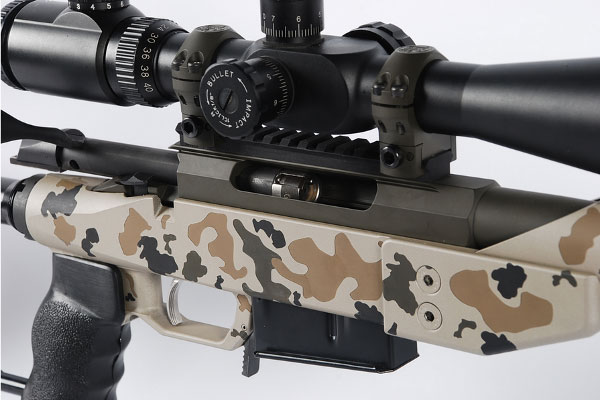
Here’s a Tikka T3 in Third Eye Tactical cerakoted chassis.
Rimfire Twin Target, for One-on-One Shooter Challenges
You’ll find this fun target on the third page of the Rimfire Target Pack. Just download the PDF file and instruct your printer to deliver page three. Or print out all six (6) rimfire targets if you like.
Talented F-Class shooter Peter Johns has been on a tear the last couple years. He won the F-TR Division at the 2020 Berger SW Nationals (SWN), after finishing second in 2019. His SWN win came on the heels of stellar performances in 2019. He won both the mid-range AND long-range Texas State championships last year. Along the way Peter set a new 600-yard NRA National F-TR Record (200-18X), and tied the 600-yard F-TR Aggregate Record with 600-47X. This Sunday GunDay story features Peter and his trophy-grabbing .308 Win F-TR rifle.
How to Campaign a Winning .308 Winchester F-TR Rifle
Report by Peter Johns
I started contemplating F-Class shooting after talking with Darrell Buell at SHOT Show a decade ago. My first F-Class match was with a Savage VLP with a 26″ Shilen 7mm SAUM barrel and a Harris bipod. After that initial match in Texas I knew I had a lot to learn. I decided that F-TR was the place to start. This story follows my development as an F-TR shooter and showcases the rifle that delivered multiple F-TR match wins in 2019 and 2020.
Watch Peter Johns Shoot his .308 Win F-TR Rig
Equipment Showcase — Key Components of Peter’s F-TR Rifle
Omar Alonzo (Alonzo Custom Rifles, (713) 283-4384, Gunbuilder284@gmail.com) does all my gunsmithing. I believe this is one of the major reasons I have been doing so well in the last couple years. He does a phenomenal job with rifle bedding. He also fixed the timing on my action. The first barrel he chambered has really helped me win matches and set records.
In this Video, Peter talks about his key rifle components and gear:
McMillan Kestros BR Stock — I switched to a Kestros BR stock when they first came out. I painted the stock myself. I am very grateful to Kelly McMillan for letting me be one of the first to try them. The Kestros BR tracks better than any stock I have tried. NOTE — the Kestros was so light that I had to add a steel bar under the forearm to get closer to the F-TR weight limit with a 30″ HV barrel. [Editor: That has the advantage of lowering the center of gravity and the bar can slide fore/aft to adjust center of balance]. I use a SEB Bigfoot rear bag with slick ears and 3/4″ spacing. When I got the Kestros I thought the rear bag spacing was too wide but it worked so well I didn’t change.
Kelbly (Stolle) Panda Action and Krieger Barrel — My rig has a Kelbly Panda F-class action with a Bix’N Andy trigger. At the Berger SWN, I used a Krieger 1:10″-twist 30″ HV 4-groove barrel. It is superbly accurate. I have been bouncing between Krieger and Bartlein for barrels for the last few years. The best barrel I have had is a 30″ Krieger 4-groove HV, however the Bartleins have been very good as well.
Duplin Bipod with Articulating Feet — I really liked the Pohlabel articulating feet that are available for the SEB JoyPod so I asked Dan Pohlabel for permission to copy his feet. I bought some aluminum and made the best copy I could. Since SWN, Duplin has coming out with a new bipod with articulating feet which are considerably better than the feet I made. I use a board and a piece of stall mat with carpet glued on it for the bipod to sit on.
Vortex Golden Eagle Scope — I use the 15-60x52mm Vortex Golden Eagle on all my F-Class rifles. I see the mirage better with the Golden Eagle than any other scope and it tracks perfectly. I also use a Vortex Razor spotting scope with long eye relief lens on the line to help watch mirage and flags. I also use the Razor spotting scope to call wind for Team Texas.
Cleaning Procedure — Less is More — No Cleaning During SWN Long Range Event
Peter has learned that he can go for long round counts without cleaning: “I have found that my .308 Win rigs, for the most part, shoot really well dirty. I can usually get 300 or more rounds before cleaning. I cleaned my barrel at the 2020 SWN after the mid-range event and fouled it before the long-range. I did not clean my barrel again until I got home from the match.”
Peter does clean thoroughly when he gets home: “After a big match I clean my rifles with Boretech Eliminator and a bronze brush followed by Iosso until the majority of carbon is removed from the barrel, as verified with a Lyman borescope. After a thorough cleaning, I find that I need to shoot a bunch of foulers. I will usually go to my practice range and shoot a 20-shot practice match and I will see the accuracy tighten up in the back half.”
600-yard practice target on left. On right is 600-yard record match target shot at 2019 TX State Championships (on ShotMarker targets). This 200-18X is a NRA National Record for F-TR division.
Peter’s Match Load and Reloading Methodology
Loading for .308 Win F-TR — Do What Matters
My loading technique has evolved almost full circle from where I started. I went from the basics to doing every step a person could conceive. Then I decided to start testing all the different steps to see what didn’t matter or made things worse. I am now back to almost no steps in my reloading process. I don’t clean brass anymore. I just wipe the case off, lube, size, prime, and load. I anneal when I feel the necks getting inconsistent when seating the bullets. I pre-load all my ammo for matches. I tried seating them at the match but I didn’t find it to matter on the score card and it takes my focus away from conditions.
Peter’s 2020 SWN-winning .308 Win load consists of Berger 200.20X bullets, Lapua Palma brass, Federal 205M primers, and Varget powder. Peter revealed: “The Berger 200-grainers are running in the mid-2600 fps range. I have tried them much faster but found the best consistency at this speed.”
Peter measures powder to the kernel and also weighs/sorts other components. He runs Berger 200.20X bullets slightly off the lands in a 0.170 freebore chamber. Notably he tests a variety of powders, ascertaining each barrel’s particular preference: “In the last few years I have tried N140, N150, H4895, and Varget. I think they are all good powders for F-TR and the 200.20X bullet. This year I was using Varget. At the 2018 SWN I placed 4th with H4895, in 2019 SWN I got 2nd with N140. I find what powder my particular barrel likes best. I also test CCI BR4 and Fed 205M to see which my rifle likes best. This year I was using Fed 205M. I have been using Lapua Palma brass and it seems to last forever.” Peter full-length sizes with a Redding bushing FL die. He seats his Berger bullets with a Wilson inline seater.
Q & A with Peter Johns, F-TR Ace
Q: What was your biggest challenge at the 2020 Berger SW Nationals?
Peter: I think the biggest challenge was staying focused on conditions. I think the hardest thing for me to do is to stop shooting when the wind conditions are out of my ability to call accurately. I focused hard on this aspect of my game this year and it has paid off. This match is super well run and staff does an excellent job which allows the shooters to maintain their focus.
Q: What gear/hardware items give you an edge over the competition?
Peter: The Kestros BR stock (below) is not used by many F-TR shooters and I think it gives me a huge advantage over the competition. This stock fits me perfectly and tracks in such a manner that I can shoot fast and accurately when conditions are right.
Q: What is your advice for newcomers in F-Class and Long Range competition?
Peter: Go to a top gunsmith building F-Class rifles and do what he says. Competition is the best way to get better. So shoot as many matches as you can. Find top shooter rivals and strive to beat them.
Q: Do you have any specific Gun Handling Tips for F-TR shooters?
Peter: I shoot better with a really light grip and cheek pressure. I can shoot well with a heavier grip and cheek pressure but when the tension of a big match is going my pressure will vary and cause poor accuracy. The most consistent I can shoot is with light gun handling. I also focus on trying to watch the bullet hit through the scope to ensure good follow through and this prevents me from jerking the trigger. There are a bunch of ways to hold a rifle that have proven to be successful. I think a shooter needs to test and find what works best for them.
Q: What do you like most about F-Class and Long Range competition?
A. I really like technical things. F-Class is right in my wheel house for technical stuff. Also, the people in the shooting world are top notch. I enjoy talking with other shooters.
Q: Do you prefer individual events or team matches?
Peter: I prefer the team matches by far because it is a social event with collaboration and there is a lot more pressure. I put a lot of effort into learning the wind for the team matches which in the long run helps me with individual matches. [Editor: Below Peter is calling wind for Team Texas at the 2018 F-Class Nationals in Raton, New Mexico.]
Peter Johns calls wind for Team Texas at 2018 F-Class Nationals in Raton.
Overcoming Serious Injury in U.S. Navy to Become a Top-Level Marksman
Peter Johns is a U.S. Navy veteran, rank Chief (E7). In 2006, during his duty aboard the U.S.S. Nimitz, Peter sustained very serious and extensive burns in a massive electrical fire. Showing great strength of character, Peter went through a tough, 4-year program of surgeries and rehab. The photo below shows Peter doing therapy during his recovery process.
Peter tells us: “As many of you know I was badly burned on board the U.S.S. Nimitz in 2006. That has limited me in my ability to compete in physical activities that I used to enjoy but F-Class has filled the gap for my competitive nature. I medically retired from the Navy as a Chief (E7) in 2010 after four years of surgeries and physical therapy. I was very surprised to find how accepting and nice people have been in the shooting community. I think the shooting community is comprised of the best people in the world.”
Want to learn more about Long Range Shooting? Check out the “Elements of Long Range Shooting” videos from the National Shooting Sport Foundation (NSSF). In this multi-part series, Bryan Litz of Applied Ballistics covers a variety of topics of interest to precision shooters. Today we feature three of these videos. There are five other videos in this series. Watch the entire 8-video “Elements of Long Range Shooting” series on the NSSF YouTube Channel.
Atmospherics and Density Altitude
Bryan Litz explains: “An important element in calculating an accurate firing solution for long-range shooting is understanding the effects of atmospherics on a projectile.” Atmospherics include air pressure, air temperature, and humidity. Bryan notes: “Temperature, pressure, and humidity all affect the air density… that the bullet is flying through. You can combine all those factors into one variable called ‘Density Altitude’.” Density Altitude is used by the ballistic solver to account for air density variables that affect bullet flight.
Bullet Ballistic Coefficients
A bullet’s ballistic coefficient (BC) basically expresses how well the bullet flies through the air. Higher BC bullets have less aerodynamic drag than lower BC projectiles. You will see BCs listed as either G1 and G7 numbers. These correspond to different bullet shape models. Generally speaking, the G7 model works better for the long, boat-tail bullets used for long-range shooting. Notably, a bullet’s drag is NOT constant in flight. The true BC can vary over the course of the trajectory as the bullet velocity degrades. In other words, “BC is dynamic”. That said, you can make very accurate drop charts using the BCs provided by major bullet-makers, as plugged into solvers. However, long-range competitors may want to record “real world” drop numbers at various distances. For example, we’ve seen trajectories be higher than predicted at 500 yards, yet lower than predicted at 1000.
Ballistics Solvers — Many Options
Bryan Litz observes: “When we talk about the elements of long range shooting, obviously a very important element is a getting a fire solution, using a ballistic solver. There are a lot of ballistic solvers out there… Applied Ballistics has smartphone Apps. Applied Ballistics has integrated the ballistic solver directly into a Kestral, and the same solver runs (manually) on the Accuracy Solutions Wiz-Wheel. The point is, if it is an Applied Ballistics device it is running the same solutions across the board.”
About Bryan Litz
Bryan began his career as a rocket scientist, quite literally. He then started Applied Ballistics, the leading company focusing on ballistics science for rifle shooting. A past F-TR Long-Range National Champion and Chief Ballistician for Berger Bullets, knows his stuff. His Applied Ballistics squad was the winning team at the 2017 King of 2 Miles event, and Applied Ballistics recently received a major U.S. defense contract to to execute Phase 1 of the Extreme Sniper Strike Operations (ESSO) project.
Rimfire Varmint Adventure
Can you shoot prairie dogs with a .22 LR Rifle? The answer is yes, if you have an accurate rifle, know your drops, and keep your targets within a reasonable distance (inside 240 yards). While the .17 HMR and .17 WSM are much more potent, flat-shooting, and effective P-dog slayers, a talented marksman CAN get good results with a .22 LR rimfire rifle, as ace PRS shooter and gunsmith Jim See recently proved.
Posting on his Facebook Page on 7/9/2020, Jim wrote: “Took out the .22 LR for some LR prairie poodles, there were not many in this town, but it gave me a chance to get some impressive hits. Norma TAC-22 ammo put the smack down on a first-round hit, called head shots at 189 yards. The body-shot dog was a first-round kill at 240 yards. I had one more head shot with a second round hit at 163. The nice part about using the .22 Long Rifle ammo is the [critters] don’t spook too bad, so a follow-up shot with a correction is usually available to get a better wind hold.” Even unsuppressed, a .22 LR rimfire shot makes much less noise than a centerfire round.
NOTE: The Norma TAC-22 .22 LR ammo used by Jim See offers great bang for the buck. It is quite affordable — a 50rd box is just $4.41 at Midsouth Shooters. Some lots have show outstanding accuracy. These target photos (below) come from Champion Shooters Supply which may have gotten an exceptional lot. This vendor tells us: “We have found this to run very well in Ruger rifles, handguns, and target pistols. These are 5-shot groups at 50 yards with an Anschutz 1913 rifle. This is an incredible value.” Jim says the TAC-22 delivers 1″ groups at 100 yards in his rifle.
Free Sierra Varmint Target — Prairie Enemy
Sierra Bullets has introduced a new line of loaded centerfire varmint ammunition, the Prairie Enemy series of cartridges. Sierra currently offers Prairie Enemy ammo for six cartridge types: .204 Ruger, .223 Rem, .224 Valkyrie, .22-250 Rem, .243 Win, and 6.5 Creedmoor. To celebrate this new ammo line, Sierra created a colorful Prairie Enemy P-Dog target. Click the image below to download the PDF target.
“The pessimist complains about the wind; the optimist expects it to change; the realist adjusts the sails.” — William Arthur Ward
Readers often ask us: “Is there a decent, easy-to-comprehend book that can help my wind-reading?” Many of our Forum members have recommended The Wind Book for Rifle Shooters by Linda Miller and Keith Cunningham.
New Edition Released in May 2020
A NEW hardback edition of The Wind Book was released May 26, 2020. This 144-page book, first published in 2007, is a great resource. But you don’t have to take our word for it. If you click this link, you can read book excerpts and decide for yourself. When the Amazon page opens, click the book cover (labeled “Look Inside”) and another screen will appear. This lets you preview the first few chapters, and see some illustrations. Along with the new hardback edition ($22.99), Amazon offers a Kindle (eBook) edition for $14.99.
Other books cover wind reading in a broader discussion of ballistics or long-range shooting, such as Applied Ballistics for Long-Range Shooting by Bryan Litz. But the Miller & Cunningham book is ALL about wind reading from cover to cover, and that is its strength. The book focuses on real world skills that can help you accurately gauge wind angle, wind velocity, and wind cycles.
All other factors being equal, it is your ability to read the wind that will make the most difference in your shooting accuracy. The better you understand the behavior of the wind, the better you will understand the behavior of your bullet. — Wind Book for Rifle Shooters
The Wind Book for Rifle Shooters covers techniques and tactics used by expert wind-readers. There are numerous charts and illustrations. The authors show you how to put together a simple wind-reading “toolbox” for calculating wind speed, direction, deflection and drift. Then they explain how to use these tools to read flags and mirage, record and interpret your observations, and time your shots to compensate for wind. Here are two reviews from actual book buyers:
I believe this is a must-have book if you are a long-range sport shooter. I compete in F-Class Open and when I first purchased this book and read it from cover to cover, it helped me understand wind reading and making accurate scope corrections. Buy this book, read it, put into practice what it tells you, you will not be disappointed. — P. Janzso
If you have one book for wind reading, this should be it. Whether you’re a novice or experienced wind shooter this book has something for you. It covers how to get wind speed and direction from flags, mirage, and natural phenomenon. In my opinion this is the best book for learning to read wind speed and direction. — Muddler
As ranges are starting to open up again, folks are enjoying the opportunity to shoot at long range. But if you like to shoot paper out beyond 400 yards or so, you’ll find that it can be difficult to see bullet holes on paper, even with premium high-magnification spotting scopes. That’s why it’s great to have a high-quality wireless target camera. The systems we like are produced by Longshot Target Camera (aka Targetvision).
With a Longshot camera system, you receive a live WiFi feed from a camera. This comes back to your shooting station on the firing line and you can view the image with a laptop or mobile device. No separate tall antennas or routers are required, and you don’t need internet coverage. Simply place the camera unit next to your target and the receiver unit close to your rifle or bench. (Or, with the 300-yard-rated Marksman you get the WiFi signal directly from the camera — there’s no separate receiver). The Longshot system is completely self-contained. Longshot produces a variety of cameras starting at just $399.00 for the LongShot Marksman. We recommend the $799.00 LR-3 unit which is rated to a whopping two miles.
This Video shows how the Longshot Marksman Wireless Target Camera Works:
Longshot camera systems are excellent. They provide VERY sharp images and the WiFi signal is strong and stable, without the fuzziness you find with lesser systems. And, importantly, Longshot cameras come with integrated shot-marking software that works with your mobile device (phone or tablet). The Longshot mobile Apps can mark all the shots in your group (and you can select colors). In addition you can make your last-fired shot blink on the screen. And, as you’d expect, you can take a screen-shot at any time to record your shot impacts for future review. This kind of functionality makes the Longshot camera system much more sophisticated than any conventional optical spotting scope.
Longshot CEO Clay Rhoden explains: “Longshot target camera systems provide shooters with the opportunity to see their long range impacts as they occur. Acting as your spotting scope downrange you are able to see each impact with clarity. Our wireless target camera systems and camera spotting scopes provide double the resolution and double the possible distance available elsewhere.”
If you purchase a Longshot camera system, we recommend getting the optional “Bulletproof Warranty” for $39.00. This will cover most replacements if you accidentally shoot the camera system placed down-range. That $39.00 buys a lot of peace of mind. If you start with a $399.00 Marksman unit, you can also later upgrade to a full 2 mile-rated LR-3 system.
With the COVID-19 Pandemic, many shooting ranges remain closed or severely restricted. And in some cities there are still stay-at-home orders in place. If you’re an avid rifleman who enjoys shooting regularly, the Pandemic lock-down can bring withdrawal pains. The closure of outdoor ranges can mean months of forced inactivity, unless you have indoor shooting solution — such as this indoor airgun target backer system from Creedmoor Sports.
If you cannot practice at a nearby public range, Creedmoor Sports offers a great solution for those who want to shoot indoors — even in your own basement or garage.
Creedmoor’s patented 10m Air Gun Range provides a target holder and a curtain-type backstop capable of stopping pellets with a muzzle velocity up to 600 fps. The target boxes can be positioned at various heights for prone, kneeling, and standing. Creedmoor says the hardened steel target boxes provide 100% containment for any pellet passing through the target.
Creedmoor’s Air Gun Range is a proven, heavy duty product — the only Air Rifle target system ever tested and approved by the U.S. Military. This system is now being used in more than 800 schools nationwide, as well as the CMP shooting facility in Alabama. The 3-station range easily dis-assembles for transport and storage, fitting inside a 34″ x 10″ x 8″ carry duffle. The one-station range measures 84″ high x 30″ wide when assembled.
The Portable Air Gun Range comes with a durable curtain/ backstop that sets up quickly and easily. Velcro edging allows multiple curtains to be joined together. The curtain provides ample stopping power for air pellets. However, this is NEVER to be used with rimfire or centerfire rounds, or even high-energy pneumatic hunting rifles. This is for standard airguns only. That could be a $100 Crosman, or a $3600.00 Model 9003 S2 Anschutz:
Important news for 1000-yard benchrest competitors! The 2020 IBS 1000-yard National Championships will be held September 5 and 6, 2020 at the Vapor Trail Valley Range in Missouri. Take note — the IBS 1K Nationals were originally going to be held at the Hawks Ridge Range in North Carolina. So the event has moved from NC to Missouri, and will be held later in the year. This change was done because of uncertainties over COVID-19 public health policies/retrictions in North Carolina. Also, moving the Nationals to early fall gives more time to organizers to plan the event.
Forum member David 0306 from North Carolina observed: “As many of you have probably already heard, the 2020 1000-yard IBS Nationals has been cancelled for Hawks Ridge Gun Club in North Carolina. [Due to] uncertainty of what phase the NC Governor will have the state in, and the possibilities of going back into a stay-at-home order, the board at Hawks Ridge decided it was in the best interest of the shooters to cancel and allow another club to host the Nationals if possible. This will also help with travel plans, and getting time off from work. What I do know is Vapor Trail Valley has stepped up to the plate and has agreed to host the Nationals. Thank You Vapor Trail Valley and IBS shooters for your help and support through these difficult times.”
Kirsten Weiss knows a thing about accuracy. She won the 2012 NRA Three-Position Women’s Smallbore Championship, while finishing as the National Overall Woman Champion. She used to shoot with the American team in top-level World Cup competition. Kirsten started shooting fairly late — at age 16. Despite her relatively late start, she earned a place on the University of Nebraska shooting team. That literally opened up a new world for Kirsten: “During the course of my career, I’ve had a lot of success. I’ve gone to World Cups… in Zagreb, Croatia, in Munich, Germany. I’ve won National Championships, and got on to the U.S. Olympic short list, so it’s been a good career.”
In these three videos, Kirsten offers key tips on accurate shooting. In the first video she explains how to get and maintain the proper cheek weld on your rifle. In the second, Kirsten talks about canting error — how having inconsistent side-to-side tilt on your rifle. In the third video, Kirsten explains the importance of proper trigger placement.
Proper Cheek Weld
No matter what your discipline — smallbore, silhouette, High Power, F-Class, or even PRS — it’s vital to have a consistent cheek weld for every shot. You want your head to be in the same position on the stock each time.
In this video, Kirsten explains how to find the best position for your head on the stock, which may require adjusting the cheekpiece and/or length of pull. Then Kirsten demonstrates how to maintain consistent cheek weld shot after shot.
Consistent Rifle Cant (Tilt from Centerline)
Kirsten says most training manuals don’t explain rifle cant: “You won’t find this shooting technique just anywhere. Most shooters don’t even think about it — and they’re missing out. Proper Rifle Cant or Gun Cant (also known as cant error or even scope cant) is a complicated topic, but I’ll explain it simply — and how to simply avoid cant error.”
Want to know how to actually aim a gun right? This accuracy tip covers a crucial aspect of marksmanship. If you cant your rifle inconsistently from shot to shot, the point of impact will change, even with “perfect aim”. This is another episode in Kirsten’s How to Shoot Awesomely video series.
Proper Trigger Finger Technique
Kirsten tells us: “Finger placement on the trigger might not seem like a big deal, but it actually is. The reason for this is because, depending on where your index finger is placed on the trigger, [this] translates to different muscle interactions with the gun.” Watch this video to see Kirsten demonstrate proper finger placement (and explain problems caused by improper finger positioning).
When you pull the trigger, you only want to engage the last section of your finger, in order to avoid unwanted muscle engagement and to achieve a smooth shot. Remember there is a “sweet spot” between the crease (first joint) and the tip of the finger. If you position the trigger in that “sweet spot”, you should see an increase in your accuracy. Don’t make the mistake of putting the trigger in the crease of your finger, as shown below.


 If you want an even greater selection of targets, specialized for PRS and NRL shooters,




 Rimfire Varmint Adventure




 With the COVID-19 Pandemic, many shooting ranges remain closed or severely restricted. And in some cities there are still stay-at-home orders in place. If you’re an avid rifleman who enjoys shooting regularly, the Pandemic lock-down can bring withdrawal pains. The closure of outdoor ranges can mean months of forced inactivity, unless you have indoor shooting solution — such as this indoor airgun target backer system from Creedmoor Sports.


