Kirsten Weiss knows a thing about accuracy. She won the 2012 NRA Three-Position Women’s Smallbore Championship, while finishing as the National Overall Woman Champion. She used to shoot with the American team in top-level World Cup competition. Kirsten started shooting fairly late — at age 16. Despite her relatively late start, she earned a place on the University of Nebraska shooting team. That literally opened up a new world for Kirsten: “During the course of my career, I’ve had a lot of success. I’ve gone to World Cups… in Zagreb, Croatia, in Munich, Germany. I’ve won National Championships, and got on to the U.S. Olympic short list, so it’s been a good career.”
In these three videos, Kirsten offers key tips on accurate shooting. In the first video she explains how to get and maintain the proper cheek weld on your rifle. In the second, Kirsten talks about canting error — how having inconsistent side-to-side tilt on your rifle. In the third video, Kirsten explains the importance of proper trigger placement.
Proper Cheek Weld
No matter what your discipline — smallbore, silhouette, High Power, F-Class, or even PRS — it’s vital to have a consistent cheek weld for every shot. You want your head to be in the same position on the stock each time.
In this video, Kirsten explains how to find the best position for your head on the stock, which may require adjusting the cheekpiece. Then Kirsten demonstrates how to maintain consistent cheek weld shot after shot.
Consistent Rifle Cant (Tilt from Centerline)
Kirsten says most training manuals don’t explain rifle cant: “You won’t find this shooting technique just anywhere. Most shooters don’t even think about it — and they’re missing out. Proper Rifle Cant or Gun Cant (also known as cant error or even scope cant) is a complicated topic, but I’ll explain it simply — and how to simply avoid cant error.”
Want to know how to actually aim a gun right? This accuracy tip covers a crucial aspect of marksmanship. If you cant your rifle inconsistently from shot to shot, the point of impact will change, even with “perfect aim”. This is another episode in Kirsten’s How to Shoot Awesomely video series.
Proper Trigger Finger Technique
Kirsten tells us: “Finger placement on the trigger might not seem like a big deal, but it actually is. The reason for this is because, depending on where your index finger is placed on the trigger, [this] translates to different muscle interactions with the gun.” Watch this video to see Kirsten demonstrate proper finger placement (and explain problems caused by improper finger positioning).
When you pull the trigger, you only want to engage the last section of your finger, in order to avoid unwanted muscle engagement and to achieve a smooth shot. Remember there is a “sweet spot” between the crease (first joint) and the tip of the finger. If you position the trigger in that “sweet spot”, you should see an increase in your accuracy. Don’t make the mistake of putting the trigger in the crease of your finger, as shown below.
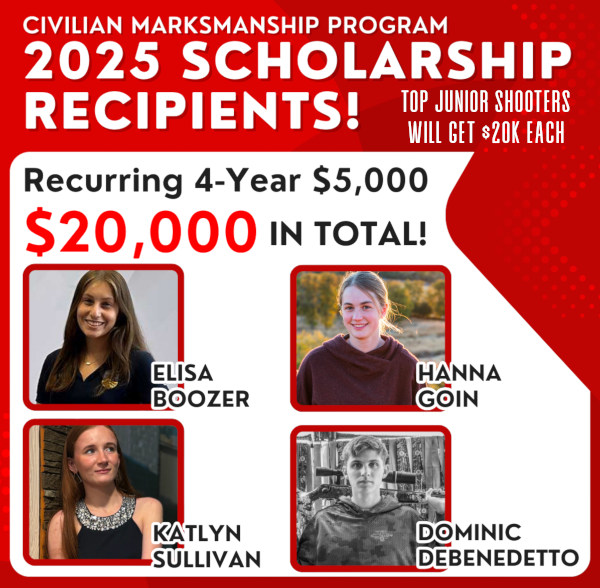
2025 CMP Top Four Winners of Recurring $5000 Grants
Since 2005, the CMP has annually offered one-year scholarships to current high school seniors based on academic merit, humanitarian efforts, extracurricular activities, and marksmanship participation. Continuing this tradition, this year the CMP presented four, $5,000 annual scholarships ($20,000 over four years) to this year’s top four applicants, as determined by members of the CMP Scholarship Committee.
Each of the four recurring $20,000 scholarships are named in honor of past CMP Board members Harry Sieben, Carolyn Hines, Jon Bengston and former Chair Judith Legerski.
This year’s Four Top Scholarship recipients are…
Elisa Boozer, Oklahoma City, OK (Judith Legerski Scholarship)
A former member of the Oklahoma Sharpshooters junior team, Elisa is a multi-time Oklahoma State Champion for both smallbore and air rifle and qualified for the Junior Olympics five times for air rifle and four times for smallbore. She also found international success, earning silver in the 10-meter women’s air rifle junior competition at the Leppa Grand Prix in Finland. Elisa went on to earn her Junior Distinguished Badge from the CMP in 2023 and is an honorary life member of the Oklahoma Rifle Association.
She credits marksmanship for teaching her focus, hard work and community. Academically, Elisa was a straight-A student, taking AP Honors and dual credit classes. She joined the University of Kentucky rifle team this fall. She is a business major.
Hanna Goin, Walla Walla, WA (Jon Bengston Scholarship)
Hanna is a former member of the Walla Walla High School JROTC program’s rifle team, where her competitive marksmanship career began. While there, she competed multiple times at the Army JROTC and CMP National Championships and at the Junior Olympics in 2025. She also took first overall at the Idaho State Junior Olympics in air and smallbore rifle and was part of the Washington State Champion Precision Air Rifle Team.
Hanna has said that marksmanship has taught her that there is nothing desirable about staying within a comfort zone, helping her to stay mentally strong through adversity. Academically, she took Honors, AP and dual enrollment courses during high school. Hanna joined the Morehead State rifle team this fall. She is a pre-med major.
Katlyn Sullivan, Statesboro, GA (Carolyn Hines Scholarship)
Among several accolades, including multiple medals at the state and national level, Katlyn was a Georgia High School Association (GHSA) Individual State Champion in 2024 and 2025 and was a member of the All-Star State Team from 2023-2025. She was also a four-time qualifier for the National Junior Olympics in air rifle and was a two-time qualifier for smallbore. In 2023, she earned her Junior Distinguished Badge.
Katlyn has said marksmanship has taught her leadership, a growth mindset and how to achieve her goals – changing how she handles setbacks. Academically, Katlyn finished second out of 392 other students, mastering multiple AP classes, and she earned a place in the National Honor Society. Katlyn joined the Nebraska Cornhuskers rifle team this fall. She is a mechanical engineering major.
Dominic DeBenedetto, Prairieville, LA (Harry Sieben Scholarship)
Domonic began marksmanship through his local 4-H program at just nine years old. He’s a six-time Nationals qualifier and placed fifth overall at the 4-H Nationals in air rifle (his team placing first in both air rifle and smallbore). He is also an accomplished rifle silhouette competitor who has competed in local, regional and national championships in the discipline, and he takes part in pistol/air pistol shooting.
He credits marksmanship for leading him to a role as an ambassador within his community – hoping to make a difference in the lives of other youth. Domonic finished in the top 3% of his 500-student class. He has enrolled at Louisiana Tech as an engineering major.
Other Scholarship Winners for Fall 2025
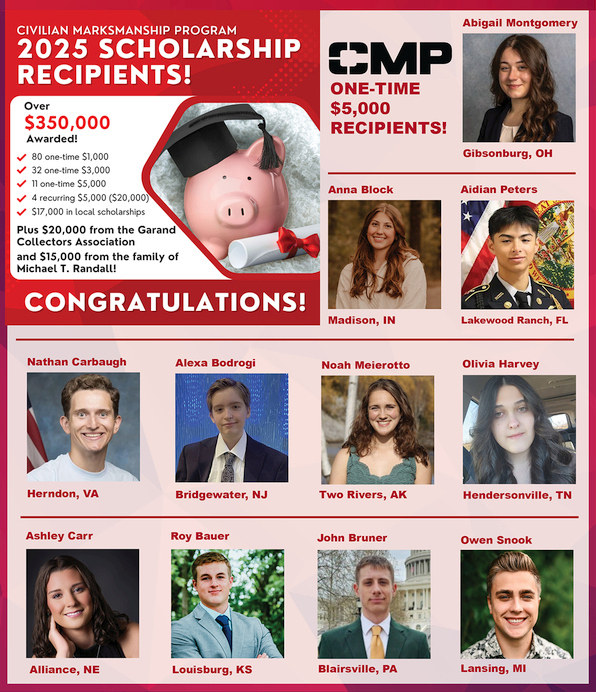
In addition to the 4-year recurring $5K scholarships, the CMP offers $1000, $3000, and $5000 one-time grants to qualified junior marksmen. These $1000, $3000, and $5000 scholarships can fund any accredited education, technical/trade school, or vocational program. Shown below are the eleven $5000 one-time scholarship winners for 2025. There were also 32 $3000 grant recipients, and 80 $1000 grant recipients.
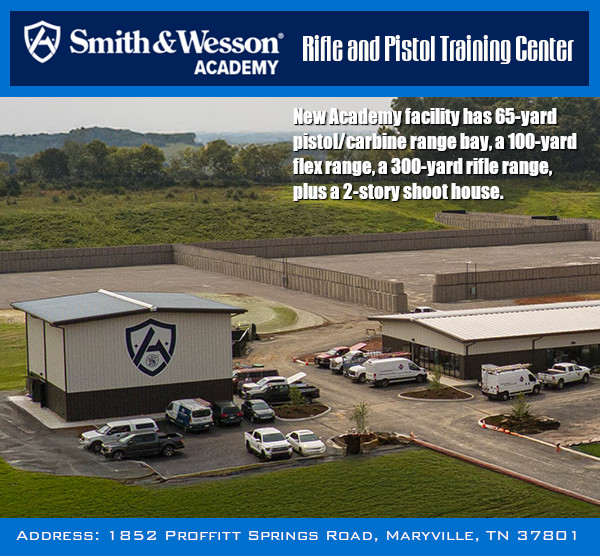
Smith & Wesson Brands, Inc. (NASDAQ: SWBI) has opened a state-of-the-art training center in Tennessee. This new Smith & Wesson Academy replaces the former Smith & Wesson Academy and Shooting Sports Center which operated in Massachusetts between 1969 to 2017.
The newly established Academy will provide training in firearm proficiency, self-defense, and firearm safety. Situated on the 236-acre headquarters campus in Maryville, Tennessee, this state-of-the-art facility features pistol and carbine ranges, a multi-purpose flex range, a 300-yard rifle range, and a two-story immersive shoot house for simunition training.
The Academy also has classrooms, a fitness center, and offices that will house world-class training instructors. Starting this weekend, a registration portal will be available on the Smith & Wesson Academy website for a variety of training courses focused on pistol, carbine, and rifle platforms. These courses will range from introductory skills and safety to advanced techniques.
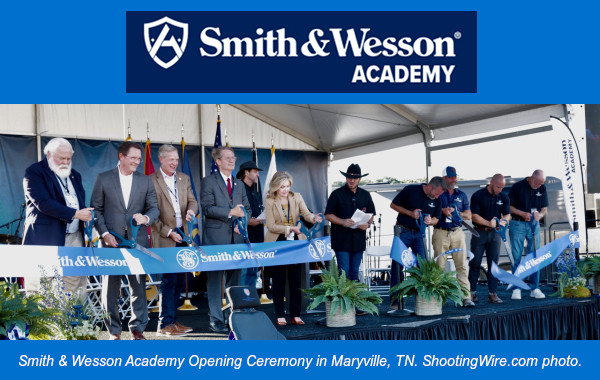
Outdoor Wire/Shooting Wire EIC Jim Shepherd attended the opening ceremonies at the new Smith & Wesson Academy. Jim noted: “One thing made obvious during the ceremonies was that Maryville, Tennessee definitely isn’t Springfield, Massachusetts. Having taken part in numerous media and training events in the former Shooting Sports Center in Springfield until its closure in 2017, the depth and breadth of the new facilities was testimony to the expansiveness of the Tennessee campus. This new facility not only includes enclosed ranges with acreage, but classrooms, a fitness center, and offices to house what the company says will be ‘world-class experts leading the training programs’.”
The Smith & Wesson Academy team will be led by renowned instructor Mark “Coch” Cochiolo. Mark is a retired U.S. Navy Chief Warrant Officer with over three decades of service in Naval Special Warfare. Mark completed four SEAL deployments to the Western Pacific and served eight years with the Navy’s premier counterterrorism unit. Following his retirement from active duty, Mark transitioned to instruction, training the next generations of Navy SEALs. As a contract instructor, he developed curriculum and trained more than 4,000 SEAL candidates in marksmanship and tactical weapons handling. Mark is recognized for his precision, discipline, and leadership in the special operations community.
Mark Cochiolo stated: “I have worked with a variety of firearm platforms, and I am grateful for the opportunity to leverage that experience in developing effective curriculum at the Academy, helping as many individuals become proficient with their firearms as possible. Smith & Wesson produces dependable, quality firearms – at the Academy, we’ll teach you how to use them”.
September 27, 2025 is National Hunting & Fishing Day. The annual celebration takes place on the the fourth Saturday of September every year. National, regional, state and local organizations will run thousands of “open house” hunting- and fishing-related events around the country. Events will include Fishing Derbys, Hunting Expos, Wing-shooting tournaments, and much more.
Hunting Safety Checklist
A good hunt begins with preparation. And during the hunt, safety is a key priority. To help hunters, the National Shooting Sports Foundation (NSSF) has created a Safety Checklist for hunters. This Hunting Safety Checklist, produced as part of the NSSF’s “Hunt S.A.F.E.” campaign, helps hunters follow good, safe practices in the field and at home.
This can be very important — even life-saving. For example, with a hang fire, i.e. a round that does not fire immediately, it is vital to keep the gun pointed DOWN-RANGE. And with a squib load, which may have left a round inside the barrel, it is vital to UNLOAD and NOT take another shot! If you did, the gun could blow up in your hand when the second, full-charge bullet hits the trapped bullet.
The Five Topics Covered Are:
Misfeed (aka Tip-Up)
Double Feed
Stovepipe (Failure to Extract)
Misfire / Hangfire
Squib Load
1. Misfeed or Tip-Up: With any misfeed you should stop firing. With the muzzle pointed safely down-range, remove the magazine, then pull the slide back and remove the round that did not feed. Check the slide for dirt, debris, and check the round that did not feed. After re-inserting the magazine, make sure the mag is seated properly.
2. Double-Feed: This is a fairly common issue with some gun types with worn springs or cheap magazines. Again you want to remove the magazine. CTD states: “Remove the magazine and cycle the action until your double-fed rounds fall out — always keeping the muzzle pointed in a safe direction[.]”
3. Stove-Pipe: This occurs when the case of a fired round does not eject fully. There can be many causes — damaged extractor, low-pressure powder charge, dirty chamber, or greasy cartridge brass. In addition the issue is common with old, worn-out recoil springs. To avoid Stove-Pipes, replace the recoil spring every 4000 rounds, and make sure your chamber is clean and the extractor is not chipped or damaged.
4. Misfires and Hang-Fires: There are multiple causes for misfires (“click no bang”) and hang-fires (slow ignition). There can be a defective primer, the firing pin could be damaged, the powder many have been bad, or the case not filled properly. With a misfire, keep the gun pointed down-range at least one minute. If the case does not fire, eject it but leave it on the ground. With a hang-fire (delayed ignition after firing pin strike), keep the gun pointed down-range, then drop the magazine and eject the (new) unfired cartridge in the chamber and inspect the gun when completely empty.
5. Squib Load: A squib load is when the gun fires, but the actual case ignition is very light with little noise, smoke, or recoil. This can be because the case had a primer but no powder. Or it can be because the powder did not ignite. Squib loads can be very dangerous in rapid-fire situations. If you EVER get a squib load STOP immediately! Do NOT fire another round! This is because the squib may have left a bullet inside the barrel.
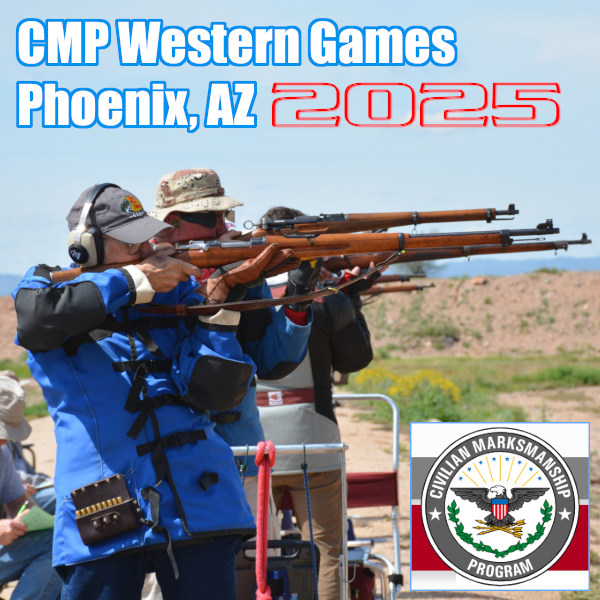
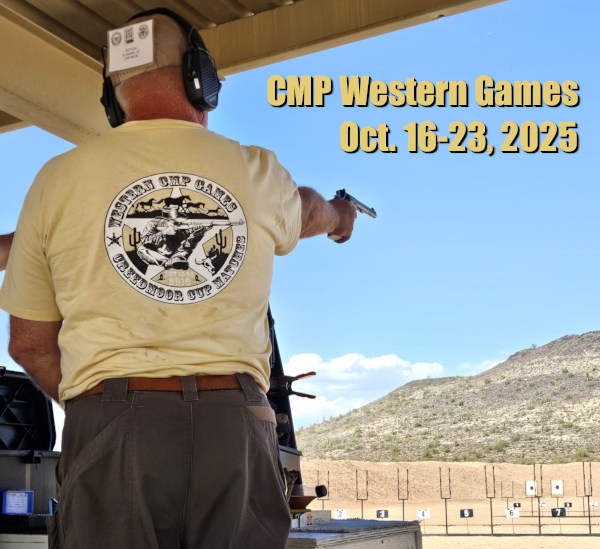
If you live out west and enjoy rifle and/or pistol competition, then consider signing up for for the Civilian Marksmanship Program (CMP) 2025 Western Games. Featuring a wide variety of Rifle and Pistol matches, the annual event is set for October 16-23, 2025 at the Ben Avery Shooting Facility in Arizona. This big match is run very efficiently, with electronic targets eliminating pit duty. And new this year is a 1000-yard Long-Range Rifle Match.
The Western CMP Games & CMP Cup Matches will feature Garand/Springfield/Vintage & Modern Military Matches, a Carbine Match, a Vintage Sniper Match and a Rifle Marksmanship 101/M16 Match (Introductory Marksmanship Class & Live Fire). The CMP Cup Matches include a CMP Mid-Range 3X600, a 2-Man Team Match, three days of CMP 800 Aggregate Matches and a CMP Service Rifle EIC Match. The Western Games will also include popular CMP vintage rifle events. All rifle matches will be held on the CMP’s outdoor eTargets — recently used at the 2025 National Matches at Camp Perry.
NEW FOR 2025: The CMP will be adding six 20-shot, 1000-yard Long Range matches held October 20-22. Competitors may fire in the Service Rifle, Match Rifle, F-Class, F T/R, AR Tactical or Palma Rifle categories.
RANGE & SQUADDING INFORMATION: All matches fired on the Highpower Range will be using the KTS Electronic Target System (no pit duty required). The CMP 80 Shot Matches, EIC Rifle Match, Carbine Match, Mid-Range 3X600 Match and Garand/Springfield/Vintage/Modern Military Matches will be pre-squadded.
2025 Western Games Notable Events:
Rifle Competitions
Garand, Springfield, Vintage & MM Matches
Carbine Match
Rifle Marksmanship 101/M16 MATCH
Rimfire Sporter Match
Mid-Range 3X600
1000-Yard LR Match
80 Shot Rifle
2-Person Rifle Team
EIC Service Rifle
Pistol Competitions
CMP Match Pistol 2700 (.22, .45, Centerfire)
Pistol Marksmanship 101/M17 MATCH
.22 Rimfire Pistol
EIC Service Pistol
EIC Service Revolver
Military & Police Service Pistol
1911 As-Issued Pistol Match
CLICK HERE to To see the Full Schedule of all Matches.
There Will Be Instruction as Well as Competition
The Western Games are open to any adult or junior with an interest in the sport – regardless of experience. Educational sessions will be held by trained instructors in the classroom and on the range. These are suitable for both beginners and more advanced individuals. This training will include Rifle/Pistol Marksmanship 101 training seminars.
Handgun Matches at Western Games
Handgun shooters can compete in four days of Pistol Matches including a Pistol Marksmanship 101/M9 Match (Introductory Marksmanship Class & Live Fire), CMP Match Pistol 2700, CMP .22 Rimfire Pistol EIC Match, CMP EIC Service Pistol Match, CMP Service Revolver EIC Match, Military & Police Service Pistol Match, and CMP 1911 As-Issued Pistol Match.
HOUSING: Competitors who plan to stay overnight near the Ben Avery Shooting Facility should stay north of the Phoenix area. There are numerous hotels, Air BnBs as well as Vacation Rentals (VRBO) in this area.
Hunting season is coming soon in most parts of the country. As part of NRA Women TV, hunting guide Kristy Titus hosts a series of videos that explain important strategies and shooting skills for hunters. These videos can help you prepare for a fall hunt. Titus is a certified instructor who has hunted around the globe. She grew up in the outdoors, running pack mules in Oregon with her father. In these videos, Kristy discusses demonstrates field positions that can be employed during a hunt. She also explains preparation for a hunt, including fitness training.
Click each link below to watch other Kristy Titus Hunting Videos.
Kristy says: “When it comes to bolt-action rifle fit, there is no ‘one size fits all’. When picking out your rifle [consider options] after the purchase to ensure you are as comfortable as possible.”
This 12″ Bullseye Pistol Diagnostic Target helps improve handgun marksmanship. The target diagnoses common problems with one-handed shooting based on shot impact zones. While this target is designed for righties, left-handed shooters can use the target too. Just observe the opposite tips.
Do you know someone who wants to get started in pistol shooting? Here’s a helpful resource. The NRA now offers its Basics of Pistol Shooting Course in an online format. That makes it easy to cover the “classroom” phase of the course on your own time. The $60.00 online course includes 11 step-by-step lessons (to be followed by live range training). CLICK HERE to enroll in online Pistol Training Course.
Train Online, Then Register for a Range Session
For the NRA Basics of Pistol Shooting course, Phase 1 is conducted in an online environment, completed on your own time (cost is $60.00, non-refundable). After successfully completing the online exam, students can register for Phase 2, the instructor-led training session. Phase 2 is conducted at your local range with an NRA-Certified Instructor. NOTE: There will normally be an additional fee for Phase 2. You must successfully complete BOTH Phase 1 and Phase 2 in order to receive your NRA Basics of Pistol Shooting course certificate.
Designed and developed by experts to accommodate busy schedules, the web-based course takes a blended learning approach to firearms training with both online and physical components. Students have 90 days to work through 11 online lessons before registering for Phase 2, the NRA Certified Instructor-led phase at a local range.
“Thanks to our online courses and network of more than 125,000 NRA Certified Instructors, it has never been easier to learn basic firearm skills,” said Kyle Weaver, NRA General Operations Exec. Director. The NRA offers other online training courses at Onlinetraining.nra.org. Along with pistol course, these offerings include Rifle Training, Shotgun Training, a Range Safety Office (RSO) course, and a Range Development and Operations course.
Know someone getting started with handguns? Here is a useful video focusing on safety:
Have you ever wondered how Olympic-class position shooters hold their aim so steady? Those bulky shooting coats help, but there is a lot of bio-mechanics involved also. Top shooters employ their body structure to help support the weight of their rifles, and to steady their aim. This interesting video, produced by GOnra Media, demonstrates rifle hold and body alignment for prone, standing, sitting, and kneeling positions. Olympic Gold Medalist Jamie Corkish (formerly Jamie Gray) demonstrates the proper stance and position of arms and legs for each of the positions.
Ideally, in all of the shooting positions, the shooter takes advantage of skeletal support. The shooter should align the bones of his/her arms and legs to provide a solid foundation. A shooter’s legs and arms form vertical planes helping the body remain stable in the shooting position.
Jamie Corkish, London 2012 Gold Medalist in Women’s 3 X 20, has retired from top-level competitive shooting. However, Jamie remains involved in the shooting sports as a Public Relations/Marketing representative for ELEY, a leading maker of rimfire ammunition. Jamie also works with shooting clubs and educational institutions to promote smallbore target shooting.
Images are stills from GOnraMedia video linked above.
Do you often carry a concealed handgun? Then you can benefit from Beretta’s FREE 15-page e-book, Ten Essential Tips for CCW Holders. This eBook, in handy PDF format, helps gun owners select an appropriate handgun (and holster), understand legal obligations and responsibilities, and train effectively with the firearm. This short PDF eBook offers many useful tips to consider, in particular for gun owners who are contemplating the pros and cons of everyday carry for themselves.
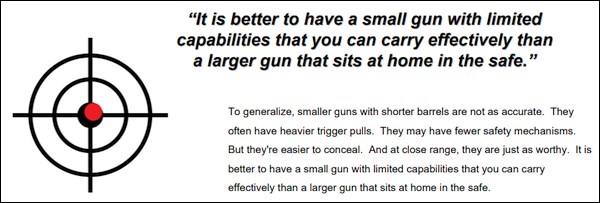
As the Beretta CCW booklet says, “Carrying a concealed handgun requires a certain amount of confidence. You need to be confident in your knowledge of laws and regulations. You have to have confidence in your accuracy, and you need to trust that you can carry a gun effectively, securely and comfortably. If a gun is a burden for you to carry, you probably won’t.”
Surprising Facts About Actual Defensive Handgun Use
You may be surprised to learn when and how handguns are actually used for self-defense. Most defensive uses are at very short range and the incident only lasts a matter of seconds. You need to be prepared, and train to be proficient drawing and aiming your weapon. And remember, shooting is a last resort, when a safe retreat is not available.
55% of gunfights take place in 0-5 feet.
20% of gunfights take place in 5-10 feet.
20% of gunfights take place in 10-21 feet.
95% of gunfights take place in 0-21 feet. (Source: FBI)
The average man can cover 21 feet of ground in 1.5 seconds.
The average gunfight is over in 3-5 seconds.
3 to 4 shots are usually fired.
Most gunfights take place in low-light conditions.
On average, one shot in four strikes someone.
Here are two (2) sample pages from Beretta’s CCW eBook.