The digital archives of Shooting Sports USA contain many interesting articles. A couple seasons back, Shooting Sports USA featured a “must-read” expert Symposium on Eye Dominance, as it affects both rifle and pistol shooting. No matter whether you have normal dominance (i.e. your dominant eye is on the same side as your dominant hand), or if you have cross-dominance, you’ll benefit by reading this excellent article. The physiology and science of eye dominance is explained by Dr. Norman Wong, a noted optometrist. In addition, expert advice is provided by champion shooters such as David Tubb, Lones Wigger, Dennis DeMille, Julie Golob, Jessie Harrison, and Phil Hemphill.
There are many benefits to shooting with both eyes open especially when shooting shotguns and handguns, but training yourself to do it can be challenging for some. For many, it is a struggle to fight the natural instinct to close one eye. So how do you train yourself to kick that habit?
How to Train to Keep Both Eyes Open
The first step is to determine if you can see the sights with both eyes. If you can’t get a clear sight picture on target with both eyes open, or if you see two front sights or some other strange configuration that is nearly impossible to decipher, then shooting with both eyes open may not work for you. It’s not the end of the world. It’s more important that you acquire a proper sight picture and hit your target.
If you are a competition shooter that struggles with this you can get a little help from some frosted tape. In most cases it; just a matter of determining your eye dominance and placing a piece of tape on your eye protection on the lens in front of your non-dominant eye. The tape blocks this eye from seeing the sights, but still allows you full access to your peripheral vision.
An effective way to prevent yourself from closing an eye is to spend a good amount of time dry firing. (Dry fire means NO AMMO!) Practice acquiring the sights with both eyes open. Start with the firearm at low ready with both eyes on the target. Bring the gun up to your line of sight and acquire the proper sight picture on your target. The repetition of presenting the gun will help train you to keep those eyes open when you transition to live fire. As with any habit, you’ll need to train yourself to stop — this means more than just a few times dry firing.
When you hit the shooting range, you may find that despite all that dry-fire practice, you still close an eye. It might be a matter of sympathetic reaction to recoil. Using .22 caliber, airsoft guns and light loads can help you transition to larger calibers and full power ammunition. Just as you had to concentrate keeping both eyes open in dry fire, it’s likely you will have to do the same during your live fire training as well.
Eley sponsors many of the world’s top rimfire shooters, who have shared their Tips from the Top for 2014. Five ace smallbore shooters provide advice on how to shoot better, how to train more effectively, and how to stay motivated even when “the going gets tough”. If you’re a competitive shooter (in any discipline) you can benefit from reading these words of wisdom from world-class shooters.
Henri Junghaenel, current world #1 ranked, 50M prone rifle shooter.
Focus on Fundamentals: Good performance requires a solid technical foundation. One can hunt after personal bests or one can try to work on the technical basics. The latter will probably lead to better results sooner.
Stay Motivated Over Time: Be persistent and don’t lose your motivation on your way to success. Shooting, like every other sport, requires a learning process which takes a lot of time.
Don’t Yield to Outside Pressures: Don’t let the expectations from others impact yourself. If some people try to put pressure on you (consciously or unconsciously), don’t let them!
Bill Collaros, 2013 Australian WRABF World Cup (Benchrest) and RBA team captain.
Don’t Skimp on Hardware: Ensure your equipment is a good as you can buy. This includes: rests, bags, rifle, scope, and ammunition.
Tune to Your Ammo: Ensure that the ammunition you have is tested and your rifle is tuned to it, to get the smallest possible group.
Train in All Conditions: Train in all sorts of wind and conditions so you know how your rifle and ammunition react in all circumstances.
Stine Nielsen, 2012 Olympic finalist for 3-Position Smallbore Rifle.
No Excuses: When I train, I train by my motto: “A loser has excuses. A winner has a plan.” And when I shoot in competitions I think about that mantra.
Stay Focused: When I stand at a shooting range, I have a good focus on my shooting and myself. I also have a good will to want to shoot 110%.
Zorana Arunovic, current world #2 ranked, 25M women’s pistol shooter.
Never give up: No matter how hard it is you should always find something that will inspire you to keep going further. I find my inspiration in the success of other athletes. They inspire me to work more and harder. I would say to any young athletes, never give up, no matter how hard it is.
João Costa, current world #2 ranked, 50m pistol shooter.
Breathing is Key: In shooting as in life, breathing is of paramount importance. So, when shooting try to be calm and quiet. On the bench in front of me I have my pistol, the scope, the magazine and my choice ammo then I count:
Here’s an interesting video about three-position shooting. Produced by GOnra Media, this video demonstrates rifle hold and body alignment for prone, standing, sitting, and kneeling positions. Olympic Gold Medalist Jamie Gray demonstrates the proper stance and position of arms and legs for each of the positions. Ideally, in all of the shooting positions, the shooter takes advantage of skeletal support. The shooter should align the bones of his/her arms and legs to provide a solid foundation. A shooter’s legs and arms form vertical planes helping the body remain stable in the shooting position.
In response to questions from a fellow F-Class shooter, German Salazar offered some expert advice in an article entitled: Basics: A Few Wind Reading Tips. Here are highlights from that essay. You can read the entire article on German’s Rifleman’s Journal Website. German cautions that: “I certainly am not attempting to make this short item into a comprehensive lesson in wind reading, but there may be a nugget or two in here for the newer shooter. There is, however, no substitute for range time and coaching.”
Preliminary Matters — Holding Off vs. Knob-Turning
Let’s begin by eliminating one topic altogether — I realize that the predominant method of wind correction in F-Class is holding-off with the crosshairs of your scope rather than adjusting the windage knob. I am a firm believer in aiming at the center and turning the knob as needed, but we’ll leave that for another time and focus on seeing what the wind is doing.
The Wave — Wind Cycles and Shot Timing
I find that most shooters begin to shoot immediately when the time commences rather than waiting for an appropriate moment in the cycle, this often leads to lost points early on. If you’ve been scoring prior to shooting, hopefully you’ve observing the flags and your shooter’s shot placement. It’s a very useful way of gaining some insight into the day’s wind patterns before shooting.
My technique is based on the understanding of wind as a cyclical wave motion. That statement alone should give you plenty to think about[.] Imagine for a moment, a surfer. He waits for a gentle swell, gets moving on it and rides it through it’s growth and ultimately its crescendo and hopefully avoids being swallowed in its crash. Wind typically behaves in the same fashion as that wave and a smart shooter behaves as does the surfer — get on early in the wave, ride through the major change and get off at the right moment. Knowing when to stop shooting is every bit as important as shooting quickly through the predictable portion of the wave; getting back on to the next wave is a matter of delicate judgment and timing.
When you are on that rising (or falling) wave, the idea is to shoot very quickly to minimize the amount of change between shots and to make a small adjustment on each shot. Too many shooters waste time trying to analyze the exact amount of the change, by which time it has changed even more! Get on with it, click or hold over a set amount and fire the next shot quickly. This is the foundation of how I shoot and it is very effective as long as you know when to start, when to stop and you have a good man working the target – a slow marker is the death of this method.
Watch Shots from Other Shooters
We all watch the wind flags, of course, and the trees if your range is so blessed (ours are fairly barren), and many other small wind indicators. Watching the shots of your fellow shooter can also be a very useful tool and should be observed whenever possible. When a good shooter next to you comes up with a poor shot, it should signal you to stop and reassess conditions as they may not be what they appear.
While scoring for another shooter, take a moment to scan the line of targets. You’ll be surprised at how most of the shot markers move in unison to one side and then the other. The sad truth is that most shooters are behind the changes in the wind and they will get carried to either side of the bull as the wind changes. You’ll see this in the targets as they come up, and once learned, you’ll find that the line of targets is as useful as another row of flags.
Readers often ask us: “Is there an inexpensive way I can get started in position shooting?” The answer is “yes” — across the country CMP-affiliated clubs host Rimfire Sporter matches. You can use a wide variety of .22LR rimfire rifles — manual actions (such as a Winchester model 52) or semi-automatics (such as a Ruger 10/22). There are prone, sitting/kneeling, and standing stages. CMP rules provide separate classifications for scoped rifles, open-sighted rifles, and aperature-sighted rifles. The matches are fun, the ammo is inexpensive, and everyone has a good time while improving their marksmanship.
Our friend Dennis Santiago recently helped run a CMP Rimfire Sporter Match in Southern California. Dennis reports: “You want something challenging? Well that X-Ring 50 yards away is the diameter of a 50 cent piece, and there are people out there that can womp that thing with iron sights.”
The rapid-fire sitting or kneeling stage of a CMP-sanctioned .22 Sporter Match consists of two, 5-shot strings. A manually-operated or semi-automatic rifle may be used for this match. Below is a video Dennis made that shows a sitting/kneeling rapid fire stage.
Dennis notes: “There are six (6) stages of fire on a tough little target. Notice the rifles that can be used run the gamut from pump and bolt actions to variations on the semi-auto theme. All still require a good eye and a steady hold to earn one’s bragging rights for the day. A match takes about an hour and a half per relay. The slowest part of the match is initial sighting in. It’ll take longer than the allocated 5 minutes for the typical first timer coming to a club match.”
At Dennis’s Burbank Rifle & Revolver Club (BRRC), procedures are modified a little bit: “What we typically do at BRRC is run two relays. Experienced competitors shoot per the full rulebook. New shooters are afforded a bit more relaxed environment to make the experience more fun and inviting. We do the same thing in our M-1 Garand Clinic/Match series.”
Rimfire Sporter Match Basics
The CMP Rimfire Sporter Rifle Match is an inexpensive, fun-oriented competition using .22 caliber sporter rifles (plinking and small game rifles) commonly owned by most gun enthusiasts. To compete, all you need is a basic rifle, safety gear, and ammunition. No fancy, high-dollar rifles are required.
The event is shot with standard sporter-type, rimfire rifles weighing no more than 7 ½ lbs, with sights and sling. Rifles may be manually-operated or semi-automatic. Shooters with manually-operated actions are given extra time in the rapid-fire stage to compensate for the difference. (See Video).
There are three classes of competition — the standard “O Class” for open-sighted rifles, “T-Class” for telescope-sighted and rear aperture-sighted rifles and “Tactical Rimfire” class, which is a .22 caliber A4 or AR15 style rifle. Firing for all classes is done at 50 and 25 yards on a target with a 1.78″ ten-ring and an 18″ outer one-ring. Even new shooters can get hits on this target, but it’s still tough enough that no one yet has fired a perfect 600×600 score.
The Civilian Marksmanship Program (CMP) has a CMP Guide to Rimfire Sporter Shooting. This FREE, 50-page digital publication covers equipment, positions, course of fire, rules, scoring and much more. You’ll find helpful “how-to” sections on aiming, sight picture, hold control, and trigger control. Reading these instructional sections can benefit any prone or three-position competitive shooter.
Talented 3-position shooter (and trick-shot artist) Kirsten Joy Weiss says that any day at the range is “always a good day”. Here is her photo to prove it. If that shot doesn’t motivate you to spend a day outdoor with rifles, we’re not sure what will…
“Always a good day…” — Kirsten Joy Weiss
Editor’s Comment: We agree with Kirsten that a day at the range is “always a good day”, except well, er, when you ventilate your chronograph, or leave your bolt at home, or load the wrong ammo, or drop a steel gong on your foot, or have a dead battery in your car, or forget the gate lock combination. If you shoot often enough, there’s a chance that one (or more) of those things might happen. But in actuality, getting out to the range is still worth it — especially if you’re there with good friends. Thanks Kirsten for the reminder.
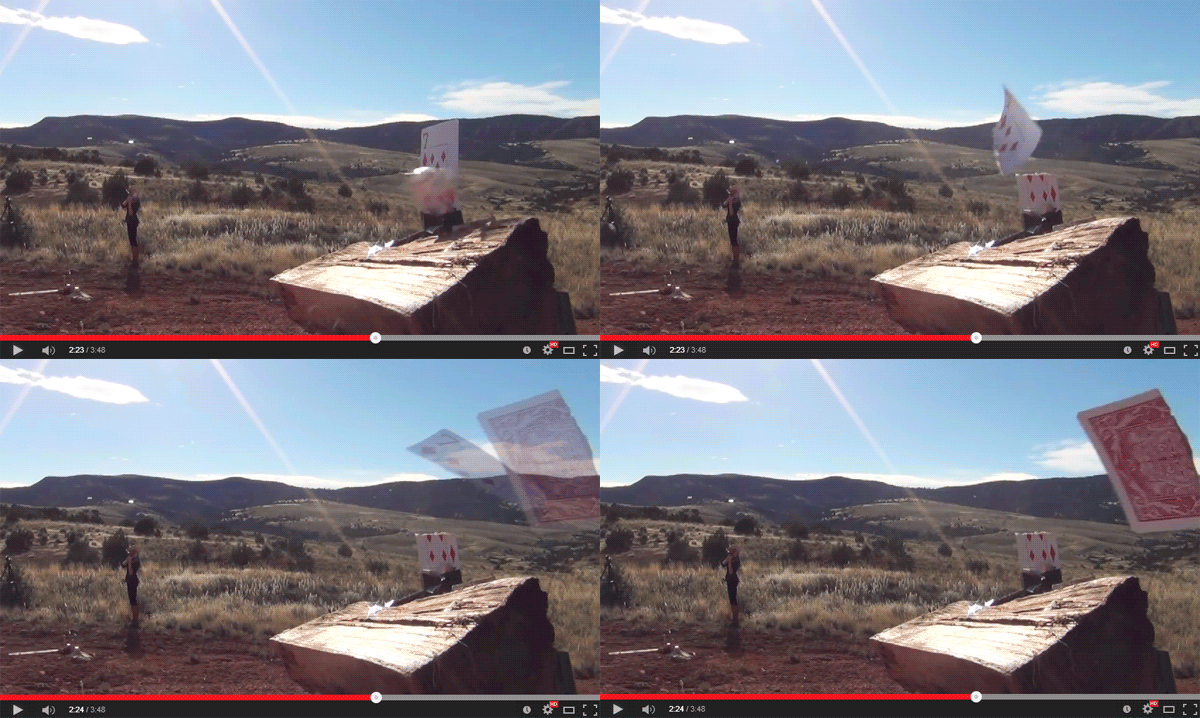
Kirsten Joy Weiss is a phenomenal off-hand rifle shooter. In this video, Kirsten performs a classic Annie Oakley trick shot, cutting a playing card in half with a bullet. Splitting a playing card would be hard enough with a scoped rifle shot from the bench. But Kirsten makes this amazing shot from standing position, shooting over iron sights, with an inexpensive rimfire lever gun. Trust us, that’s not easy. It did take Kirsten three tries, but we’re still impressed.
To accomplish this trick shot, Kirsten’s horizontal aim had to be ultra-precise. A playing card is only 0.25mm thick (about 1/100th of an inch). That leaves almost no room for error.
GIF Animation Shows Bullet Slicing Card in Half:
We know top benchresters can put five shots in one ragged hole at 100 yards, used a scoped rifle sitting on a stable rest. But make those folks stand on their hind legs, hold the rifle, and aim over primitive iron sights, and some of those benchrest aces would be lucky to hit a dinner plate at 100 yards. Kudos to Kirsten for making this great shot.
When we recently ran a story about Dennis Santiago’s new snakeskin Eliseo Tubegun, folks asked us if this kind of rifle can be competitive in F-Class competition. Here’s a detailed answer to that question by G. Salazar, who runs the Riflemans Journal Website.
A while back, G. Salazar published a three-part article on Shooting The Tubegun in F-Class. Links for all three segments are found below. The article covers some of the hardware German engineered to adapt his tubegun for long-range F-Class shooting with scope. If you’re an F-Classer, or just a fan of tubeguns, you should read German’s article, in all its parts.
In the intro to his multi-part F-Class Tubegun article, German explains:
Salazar: The tubegun has truly changed the face of High Power shooting over the past five years or so. Specifically, the CSS (Gary Eliseo) tubeguns, which are made for a broad variety of actions and configurable to single-shot or repeater, have truly helped the sport to grow. That’s not just idle talk, the two principal factors that made the tubegun so important to our growth are the ease of transition for AR15 shooters moving into a bolt-action rifle and the absolutely ridiculous length of time it currently takes to get a stock from the conventional stock makers. My last conventional stock took well over two years from order to delivery (plain fiberglass). One of my friends has now been waiting four years for a simple wood stock for a smallbore rifle. By contrast, tubeguns, which are largely CNC machined, are delivered in a reasonably short time — weeks or a couple of months at most.
Notwithstanding the foregoing, the tubegun would never have attained its present success if it weren’t for one simple fact — they are brutally accurate. I have three CSS tubeguns, one chambered in .308 and two in .30-06 and they are my favorite prone rifles due to their accuracy and great ergonomics. Those factors are just as appealing to an F-Class competitor as to a prone shooter, and indeed, the tubegun is making solid inroads into F-Class. READ MORE…
The digital archives of Shooting Sports USA feature an interview with Olympic smallbore shooter Lones Wigger. This constitutes the third and final part in a series by Jock Elliott on pressure during a match and the methods top shooters use to handle their nerves.Read Part I | Read Part II.
The Fine Art of Not Cracking Under Pressure – Part III
by Lones Wigger, Smallbore Rifle Olympic Medalist
It’s pretty complicated — this subject of dealing with pressure. I’m a precision shooter and have learned to excel in that discipline. You’ve got to learn to shoot the desired scores at home and in training. And once you’re capable of shooting the scores, you may not shoot the same way in the match because of the match pressure. As a result, it takes 3-4 years to learn how to shoot, and another 3-4 years to learn how to win — to deal with the match pressure. It takes several more years to learn how to do it when it counts.
To win, there are several things you have to learn how to do. You have to do it from within. You have to learn how to train just as if you were in a big competition. You work on every shot. You have got to learn to treat it just like a match — to get the maximum value out of every shot. You have got to use the same technique in practice and in training. A lot of shooters have a problem because they change their technique from practice to the match. In competition, you work your ass off for every shot. You have to approach the training the same way.
A second way to combat pressure is to shoot in every competition you can get into so that you become accustomed to it.
Do Everything Possible to Prepare
The third technique is preparation. Before you are going to shoot in a big competition, train hard to do everything you can to raise your scores. So when you’re in the match, you know that you have done everything humanly possible to get ready for the competition. If you have self-doubt, you will not shoot well. You have to have the will to prepare to win.
When Gary Anderson was a kid, he couldn’t afford a gun or ammunition. He had read about the great Soviet shooters. With his single shot rifle, he would get into position, point that gun and dry fi re for hours at a time in the three different positions. He had tremendous desire. He wanted to win and he did whatever he could to get there. When he finally got into competition, he shot fantastic scores from the beginning.
Visualize Winning to Train the Subconscious Mind
A little bit of psychology: You picture in your mind what you want to do. You have to say, OK, I’m going to the Olympics and perform well. Picture yourself shooting a great score and how good it feels. You are training your subconscious mind. Once you get it trained, it takes over. A coach taught me to visualize the outcome, and it worked. Eventually you train your subconscious and it believes you can win. At first I didn’t know about teaching the subconscious to take over, but now I do it all the time. And it certainly worked for me at the 1972 Olympics. What it really takes is training and doing the same thing in training as at a match. If you are “just shooting,” you are wasting your time. READ MORE….
CLICK HERE to READ FULL ARTICLE featuring interviews with Brian Zins, Bruce Piatt, Carl Bernosky and Ernie Vande Zande. (Article take some time to load.)


 The digital archives of Shooting Sports USA contain many interesting articles. A couple seasons back, Shooting Sports USA featured a “must-read” expert Symposium on Eye Dominance, as it affects both rifle and pistol shooting. No matter whether you have normal dominance (i.e. your dominant eye is on the same side as your dominant hand), or if you have cross-dominance, you’ll benefit by reading this excellent article. The physiology and science of eye dominance is explained by Dr. Norman Wong, a noted optometrist. In addition, expert advice is provided by champion shooters such as David Tubb, Lones Wigger, Dennis DeMille, Julie Golob, Jessie Harrison, and Phil Hemphill.
 There are many benefits to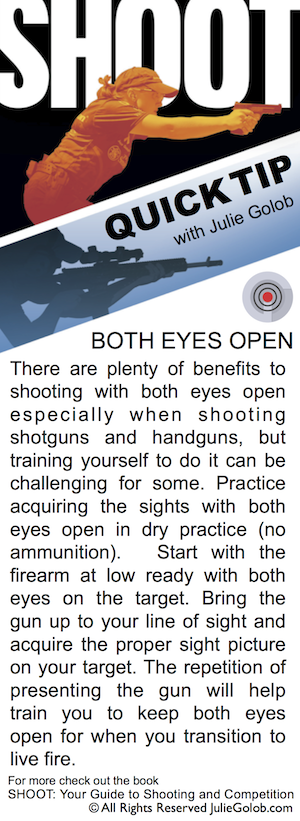


 In response to questions from a fellow F-Class shooter, German Salazar offered some expert advice in an article entitled:
  My technique is based on the understanding of wind as a cyclical wave motion. That statement alone should give you plenty to think about[.] Imagine for a moment, a surfer. He waits for a gentle swell, gets moving on it and rides it through it’s growth and ultimately its crescendo and hopefully avoids being swallowed in its crash. Wind typically behaves in the same fashion as that wave and a smart shooter behaves as does the surfer — get on early in the wave, ride through the major change and get off at the right moment. Knowing when to stop shooting is every bit as important as shooting quickly through the predictable portion of the wave; getting back on to the next wave is a matter of delicate judgment and timing.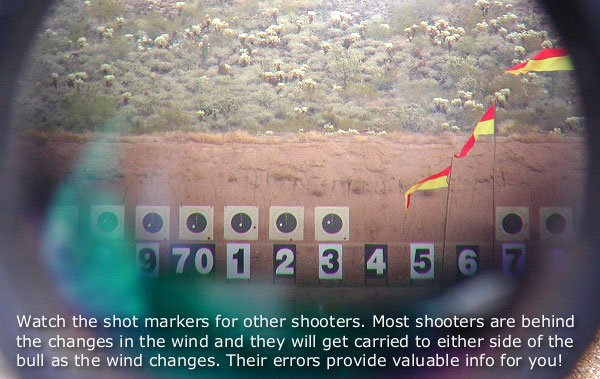


 Our friend Dennis Santiago recently helped run a CMP Rimfire Sporter Match in Southern California. Dennis reports: “You want something challenging? Well that X-Ring 50 yards away is the diameter of a 50 cent piece, and there are people out there that can womp that thing with iron sights.”




 It’s pretty complicated — this subject of dealing with pressure. I’m a precision shooter and have learned to excel in that discipline. You’ve got to learn to shoot the desired scores at home and in training. And once you’re capable of shooting the scores, you may not shoot the same way in the match because of the match pressure. As a result, it takes 3-4 years to learn how to shoot, and another 3-4 years to learn how to win — to deal with the match pressure. It takes several more years to learn how to do it when it counts.


