Ultra-Long-Range Shooting by Bryan Litz
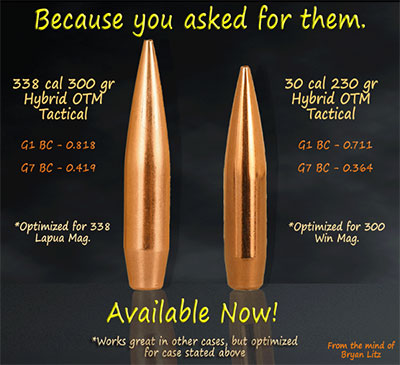
We recently did some extended long range shooting with several rifles at a “secret range” where we could shoot out to one mile. I teamed up with Paul Philips, a highly successful National and International F-TR shooter with several National records. We started out shooting a Sako TRG-42 at 1200 yards. This is the same rifle I shot in Wyoming last year at distances out to 2400 yards. This rifle shoots the new Berger 300gr Hybrids, at 2700 fps. We were pleased to find that the Nightforce NXS 5.5-22x56mm scope has plenty of elevation to get to 1200 yards with this bullet, especially when mounted on a Near Mfg. +45 MOA rail. The drop from a 100-yard zero to 1200 yards was predicted to be 34.75 MOA. The size of that 5-shot group was nothing to brag about (1.5 MOA), but what I found satisfying is that the group center was exactly centered for vertical on the target. That means the calculated .418 G7 BC and all of the other variables that went into this trajectory prediction were spot on.
New .30-Cal Tactical Bullets
Next, we shot the LaRue 7.62 OBR rifle at 1200 yards. This rifle produced a 5-shot group of 9.7″ (.85 MOA) with off-the-shelf Applied Ballistics Tactical ammo loaded with .30-cal 175gr Berger Tactical bullets. These bullets only have a muzzle velocity of 2572 fps from this short barrel, which means that in our conditions they were subsonic past 1000 yards, running 1080 fps at 1200 yard. Going subsonic didn’t prevent the 175gr bullets from shooting a sub-MOA group.
However, I was a little disappointed that the group center was 9″ high (0.8 MOA) compared to the predicted trajectory (657″ drop from a 100-yard zero). Note this 9″ error in predicted drop could be produced by small variances. The 9″ shift could be explained by a 14 fps error in muzzle velocity, or a 2% error in bullet BC, or a 5-yard error in range measurement.
For our final test, I shot Berger’s newest Tactical bullet; the .30-caliber 230gr OTM projectile. This bullet has a tested G7 BC of .368, and a G1 BC of .719. Now this isn’t my most accurate rifle and I haven’t had an opportunity to really work up a good load. As a result, I shot an unimpressive 20″ group (1.8 MOA). But the predicted drop was only off by 2″ (less than 1 click) based on the BC’s listed above.
Shooting .338 Lapua Magnums at One Mile
After shooting at 1200, we lobbed some bullets on an 8’x8′ target at 1760 yards (1 mile). At this range, the TRG-42 put the 300gr Bergers on target with four of five shots in 1/2 MOA with a flyer to make the total group 21″. At this range my group center was 18.5″ (1.1 MOA) higher than predicted. Paul Philips* shot his custom .338 Lapua Magnum rifle. This is a Dave Tooley-built Tac-338 with 30″ Brux barrel, Stiller action, McMillan A-5 stock, and Nightforce NXS 12-42×56. Paul shot at the same target and was able to hold between 1/2 and 1 MOA groups with the same 300gr Berger Hybrid bullets. Paul’s group centers were also about 1 MOA higher than predicted. This small error in prediction isn’t very troubling though, as we’re not entirely confident in the range measurement. As 1760 yards (one mile) is too far for a direct laser rangefinder measurement, the distance was determined with a combination of GPS and Google maps. At that distance, a range error of just 15 yards (out of 1760) could cause the percieved 1 MOA error in predicted drop. So, if the target were really at 1745 yards, instead of 1760 yards, it would explain why we were hitting 1 MOA high. Alternatively, if BC error were the reason for hitting high, it would suggest the G7 BC for the .338-cal 300gr Berger Hybrid is .427, as opposed to the currently advertised .418; a 2% difference.
The Joy of Ultra-Long-Range Shooting
For me, the thrill of shooting these extreme long ranges isn’t just about the group sizes, but the accuracy with which the trajectory can be predicted. The shooter who understands ballistics and inputs the right variables should be able to center a 1.5 MOA group well past 1000 yards. He can be more effective, on targets at extreme ranges, than someone who can shoot an 0.5 MOA group but can’t keep it centered. Of course the most impressive of all is the shooter who can combine precision with accuracy and center the 0.5 MOA group at extreme distances!
The best thing that can be done for the future of sport shooting in America is to recruit more female and junior participants. Young people are the future of the sport. Involving women in shooting can help reverse a “gender gap” in voting patterns that has favored anti-gun politicians. The more we can get women to enjoy shooting and adopt a positive attitude towards firearms, the harder it will be for anti-gun forces to marshal support for restrictive new laws.
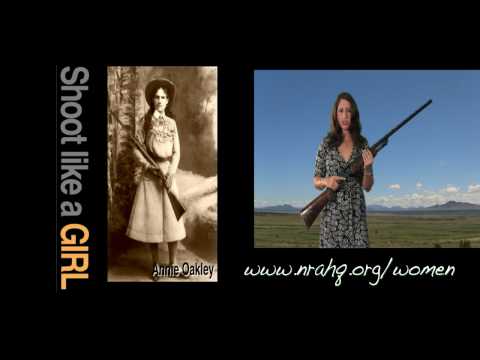
The above video features NRA programs for women of all ages and experience levels. Such programs include Women On Target® (WOT) Instructional Shooting Clinics, hunts for women, and the popular Women’s Wilderness Escapes. There are even ladies-only WOT Postal Matches. Ladies can also take part in all the NRA competitive shooting disciplines: handgun, trap/skeet, air rifle, smallbore, silhouette, high power, F-Class, and even the new NRA-sanctioned multi-gun matches.
Junior Womens’ Programs
Young women have the chance to participate in many specialized shooting programs for juniors, including the Youth Hunter Education Challenge, NRA Day events, CMP Junior leagues, and the Winchester/NRA Marksmanship Qualification Program. The NRA Foundatrion also offers a Women’s Wildlife Management/Conservation Scholarships. This women’s scholarship, from the Women of the NRA, is a renewable, one-year, $1,000 scholarship available to full-time college juniors or seniors with a minimum grade point average of 3.0, majoring in wildlife management/conservation.
Fans of 3-Gun competition should watch this week’s episode of Shooting USA television. Wednesday’s show features the Fort Benning 3-Gun event, the only multi-gun match held on an active Army base. At this 3-Gun match, the USAMU Action Shooting Team created very tough stages, with combat-type challenges for the competitors. The video below shows stages at the 2010 Fort Benning 3-Gun Competition. The video begins with a competitor firing an Army-supplied M249 machine gun.
M24EI Sniper Rifle, Henry Rifle, and Julie Golob Also Featured
In addition to the Fort Benning 3-Gun coverage, this week’s ShootingUSA broadcast features three other interesting items. Shooting USA provides a first look at the U.S. Army’s new, upgraded sniper rifle, the M24EI, based on Remington’s XM-2010 modular rifle. Also, Shooting USA tells the history of the Henry Rifle, the first really successful lever rifle and the predecessor of Winchester’s classic Model 1866 and Model 1873 lever guns. Last but not least, Team Smith & Wesson captain Julie Golob gives a lesson in IDPA shooting — one of today’s most popular pistol competitions.
This rare .44 caliber Henry rifle, used during the Civil War, sold for $48,300 at a 2009 auction.
Shooting USA airs Wednesday on the Outdoor Channel at these times:
Our buddy Eric Kennard of Harbour Arms is offering a “Christmas in July” special on his high-quality metal SnapCaps. These are precision machined aluminum SnapCaps with internal springs. Now, through the end of July, you can purchase two sets of SnapCaps (two units per set), along with two Empty Chamber Indicators (ECIs) — all for just $23.95. Eric offers SnapCaps in a wide variety of calibers including .308 Winchester, 6 PPC, 6mmBR, 6BRX, 6mm Dasher, 6XC, .243 Win, 6.5 Creedmoor, 6.5×47, .260 Rem, 6.5-284 and dozens more.
With Eric’s SnapCaps, you can dry-fire to your hearts content without harming your gun’s firing pin or fire control system. Veteran high-power shooters know the importance of dry-fire practice — one former National Champion told us he would dry-fire at least six hours for every hour he spent on the firing line. Even benchrest shooters can benefit. By using Eric’s SnapCaps, you can improve your gun-handling and trigger-pulling techniques. This Editor found his rimfire benchrest scores improved after dry-fire practice. I learned to pull the trigger straight back and I learned the hold that produced the minimal disturbance on the bags.
Readers in the Rockies region should head to the Colorado Rifle Club (CRC) range tomorrow July 2, 2011, from 9:00 am to 4:00 pm. There you can try out a variety of Savage rifles, and the ammo is FREE! Can’t beat that. This July 2 “rifle test-ride” at CRC is part of Savage’s innovative Arms Club Program, which provides sample rifles to clubs around the country. There, potential rifle buyers can try out target rifles, hunting rifles, both centerfire and rimfire at no cost.
Savage Arms provides the rifles, Nikon supplies the optics, and Hornady provides free ammo for testing. Caliber options include .17 HMR, .223 Rem, 6.5 Creedmoor, .308 Win, and .300 Win Mag. If you have not shot Savage’s F-T/R or Law Enforcement Series rifles, now is your chance. We also recommend Savage’s 93 R17, a .17 HMR rimfire with the look and feel of full-size centerfire rifle. The 93 R17 we tested last year was very accurate and we liked the look and feel of the matte-black tactical-style stock.
Directions: The Colorado Rifle Club range is located at 76099 East 96th Ave., Byers, CO 80103. Byers is 40 miles east of Denver on l-70 at exit 316. To get to the range, travel 8 miles east of Byers on U.S. 36, then about 9 miles north on Leader Road (52N), then one mile west on 96th Ave. to the range gate, then one mile north to the ranges. CLICK HERE for map to CRC range.
Latitude and Longitude: 39° 52′ 12.58″N, 104° 05′ 39.47″W
Editor’s Comment: Savage deserves praise for its new Arms Club Program. Bringing rifles to popular ranges is a great way to introduce new shooters to the sport. Letting range visitors sample an accurate target rifle (something they may not have tried before) can also help convert pistol shooters and shotgunners into avid rifleman.
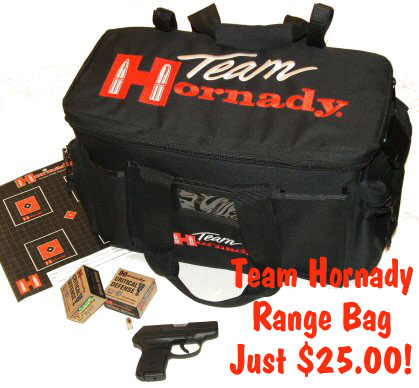
Not much to say here — the photo and the price ($25.00) pretty much tell the story. Here’s a chance to pick up a nice range bag for a low, low price. Big enough for a couple full-size pistols, ammo, and muffs, this bag features zippered pockets on both ends and slot pockets on the sides for magazines and other thin items. We don’t know why Hornady slashed the price of the Team Hornady range bag from $59.99 to a mere $25.00. That’s a 58% reduction — what we’d call a serious discount. The bag is roomy and functional, and we think it’s pretty handsome — so long as you’re not logo-phobic.
This range bag, item 9919, is sold directly through Hornady’s website. Visit Hornady’s online store soon to grab one before the price goes back up. Click photo (above) to go to the Hornady order page.
Story tip by EdLongrange. We welcome submissions from our readers.
Last weekend, the first annual Father’s Day Fun Match and Egg Shoot was held at the Original PA 1000-yard Benchrest Club in Williamsport. One of the challenges was hitting hard-boiled eggs placed on the berm at 1040 yards. Most “egg shoots” are conducted at considerably shorter distances — but at Williamsport, “fun begins at 1000″.
The video below shows the egg “shoot-off” at 1040 yards. The eggs were suspended with fishing line so they bounce a bit — adding to the challenge.
Near the end of the video, at the 1:06″ mark, you can see a hit on the #7 egg target. (That’s our Asst. Editor Jason Baney calling the hit — the shooter was using a 6mmBR). It all goes to show that, with enough rounds downrange, a good shooter can nail an egg at 1000 yards.
In the Utah backcountry, a group of avid shooters turned entrepreneurs have created an exciting new shooting sport: Rifle Golf. We kid you not — this is not a late April Fool’s story. Here’s how it works — north of Salt Lake City, at the 8,400-acre Spirit Ridge Rifle Golf facility, 30 realistic wildlife targets have been set up set at distances ranging from 175 to 1,200 yards. Shooters engage targets in numbered sequence as they progress through four covered shooting stations. Hits are scored on each of the 30 full-size metallic animal targets, with bonus points for “bulls-eye” hits to the vital zones. A single session of Rifle Golf (4 stations, 30 targets) costs just $50, with a small fee for ATV rental. The game is challenging yet fun, and it allows hunters to practice their shooting skills at various distances, with both up-angle and down-angle shots. The YouTube video below shows the action at all the shooting stations — definitely watch the video.
ATVs Haul Shooters to Four Different Shooting Stations
Marksmen test their long-range accuracy on multiple targets set up at different angles and slopes along a 6-mile course. ATVs are used to travel to each of the four stations and shooters can choose from the classic course for newcomers or the more challenging masters’ course. Each hole or target is assigned a par value depending on the degree of difficulty. Shooters can cut strokes from their score by hitting the life-size wildlife targets in the vitals area. Successful shooters are rewarded by a “dinging” sound when they hit the steel target fitted to each silhouette.
According to Jeff Petersen, Spirit Ridge guide: “Rifle Golf is an ideal way for hunters to practice their shooting skills. You’ll become a better shooter and identify your limits regarding how far you can accurately and consistently shoot.” We think this kind of multi-target, multi-location shooting experience should be fun for tactical shooters as well as hunters. Offering ranges from 175 to 1200 yards, the Spirit Ridge ‘course’ mimics real-life hunting experiences for riflemen of all abilities. Each station features multiple targets, and the shooters must, at times, make steeply angled shots — just as they would on a real hunt. The reactive targets, complete with ‘vitals’, let you know when your shot is dead-on.
Spirit Ridge — There’s No Other “Shooting Range” Quite Like It
Spirit Ridge Rifle Golf is located in scenic North Central Utah hill country. Groups of four to six shooters are accompanied by a guide who assists with locating targets and scoring. Each shooting station sits on a concrete slab covered by a metal awning. All stations are equipped with shooting benches, a picnic table and chairs for participants, guides, and spectators. The Club House features meeting space, restrooms, showers and other amenities. You’ll find lodging and restaurants in nearby Tremonton, Utah.
“We’re a one-of-a-kind shooting facility,” Petersen said. “While there are plenty of places to shoot targets, there’s no other operation like this. Nobody else has a range of this size and variety.” AccurateShooter.com is impressed with what the folks at Spirit Ridge are doing. They have put together a nice facility in a great location. Having been in business since 2005, they have refined and improved the “product”, and customer feedback has been very positive. As the organizers explain: “It’s Golf with a Gun, an ATV, and NO Dress Code.”
We think Spirit Ridge’s $50.00 “single event” fee is very reasonable, and for $175 you can get a four-session “Punch Pass”. To learn more about Spirit Ridge visit www.spiritridgeriflegolf.com. To reserve a “Tee Time”, or request a group booking, call 435-764-6980. For those of you in the Utah region — a day of “Rifle Golf” would make a perfect Father’s Day gift for an active hunter or shooter.
In the Daily Bulletin, we recently covered the NRA Junior Pistol and Smallbore Rifle Camps being held at Camp Perry this summer. But what about training opportunities for adults? As it turns out, the NRA offers a variety of instructional sessions at Camp Perry this summer.
First, the NRA Training Dept. offers a Range Safety Officer (RSO) Course. This is for those looking to learn how to run a firing line or simply learn more about proper range operations. Two RSO courses will be held, the first on July 18th and the second on July 29th. To register or to learn more about the courses, visit www.nrainstructors.org or contact Sean Thornton at sthornton@nrahq.org.
The NRA also offers coaching courses. If you’re interested in helping others hone their shooting skills, you can sign up for one of the NRA’s Coach Schools. The Coach Education Program is offering a Level 1 Pistol Coach School on July 13-15. This will be followed by a Level 3 Air Rifle/Smallbore Coaching Clinic from July 25-27. To register for these coaching classes, or learn more about the lesson plan, contact NRA National Coach Trainer Marcus Raab at mraab@nrahq.org.
In addition to the Camp Perry programs, there are adult training courses and coach schools conducted across the country. Check www.nrainstructors.org for training opportunities in your area or the Coach School listing to find the right coaching course for you.
The latest edition of the CMP’s ‘On the Mark’ newsletter for young competitive shooters has been released as a FREE, downloadable PDF file. In this Spring 2011 edition, you’ll find many items of interest including an excellent instructional article by Gary Anderson, Director of Civilian Marksmanship-Emeritus. The 4-page story is entitled: Three-Position Shooting — Teaching the First Steps. Here’s a sample from the story, Anderson’s discussion of target shooting order:
Target Bull Firing Order
Anderson writes: “When firing starts, each shooter should have a plan for the order in which the sighter and record bulls are fired. Each record bull is numbered from one to ten, but the bulls do not need to be fired in that order. Indeed, to shoot them in numerical order is one of the least efficient ways to do this. The firing order should be designed to minimize movements from one record bull to the next. The illustration (on right) shows one recommended firing order that begins with the lower sighter bull, continues to the upper sighter bull and then proceeds around the target in a counter-clockwise direction.”
In addition to the Gary Anderson article, this month’s edition of On the Mark features extensive coverage of Collegiate shooting events, and the National Junior ROTC Championships.


 New .30-Cal Tactical Bullets
 The above video features
  Fans of 3-Gun competition should watch this week’s episode of

 Our buddy Eric Kennard of

 Last weekend, the first annual Father’s Day Fun Match and Egg Shoot was held at the Original PA 1000-yard Benchrest Club in Williamsport. One of the challenges was hitting hard-boiled eggs placed on the berm at 1040 yards. Most “egg shoots” are conducted at considerably shorter distances — but at Williamsport, “fun begins at 1000″.

 In the Utah backcountry, a group of avid shooters turned entrepreneurs have created an exciting new shooting sport: Rifle Golf. We kid you not — this is not a late April Fool’s story. Here’s how it works — north of Salt Lake City, at the 8,400-acre
  According to Jeff Petersen, Spirit Ridge guide: “Rifle Golf is an ideal way for hunters to practice their shooting skills. You’ll become a better shooter and identify your limits regarding how far you can accurately and consistently shoot.” We think this kind of multi-target, multi-location shooting experience should be fun for tactical shooters as well as hunters. Offering ranges from 175 to 1200 yards, the Spirit Ridge ‘course’ mimics real-life hunting experiences for riflemen of all abilities. Each station features multiple targets, and the shooters must, at times, make steeply angled shots — just as they would on a real hunt. The reactive targets, complete with ‘vitals’, let you know when your shot is dead-on.

 In the Daily Bulletin, we recently covered the
 The latest edition of the CMP’s
  Target Bull Firing Order


