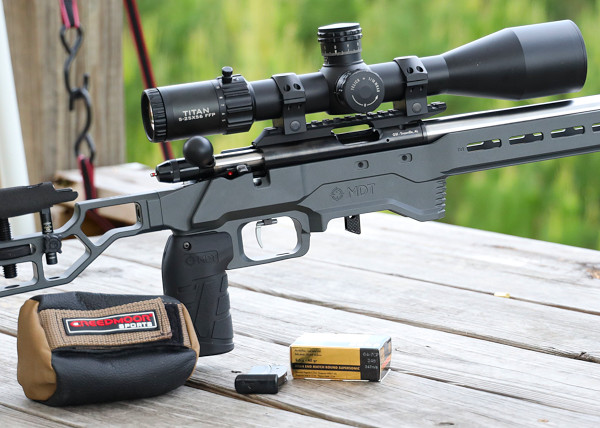
Springfield Armory has introduced a new chassis rifle that could become popular with PRS/NRL shooters. The new Model 2020 Heatseeker is a chassis-based rifle that offers “bolt-action precision and AR-style modularity in one platform”. This employs a nice Model 2020 action with dual locking lugs, a fluted bolt, and EDM raceways. This new rifle features a modern Sharps Bros. Heatseeker high-strength 6061-T6 aluminum chassis with a B5 Systems Collapsible Precision Stock and P-23 pistol grip.
Finished in rugged Coyote Brown Cerakote and equipped with a Triggertech Field Trigger, the Heatseeker will be initially offered in 6.5 Creedmoor and .308 Winchester chamberings. That makes it suitable for hunting as well as tactical competitions.
The Model 2020 Heatseeker uses Springfield’s quality Model 2020 stainless steel action with tan finish and black bolt. This action features dual locking lugs, fluted bolt, and EDM raceways. Mated to that action is a free-floated 16″ BSF barrel jacketed in a roll-wrapped carbon fiber sleeve and loaded under tension. The muzzle is threaded 5/8×24 to accept the suppressor or muzzle device of your choice, and features a thread-protector muzzle cap.
A TriggerTech Field Trigger, adjustable for a pull weight from 2.5-5 lbs., and a metal five-round AICS-pattern magazine round out the package.
3/4-MOA Accuracy Guarantee
Springfield Armory offers a 0.75 MOA accuracy guarantee for the new Model 2020 Heatseeker. This 0.75 MOA guarantee is “for a three-shot group at 100 yards with quality match-grade factory ammunition, in the hands of a skilled shooter.”
Keanu Reeves, the A-List Hollywood actor who starred in The Matrix, Speed, Point Break, and other hit movies, is a talented shooter. For his role in the popular John Wick series of movies, Reeves has done extensive training with our friend Taran Butler, one of the nation’s top 3-Gun competitors. Check out this video showing Keanu Reeves running through some multi-gun stages. The actor’s speed on target is outstanding, and his transitions are very fast. We’ve run some multi-gun matches in the past. Trust us, it takes a lot of training and dedication to get this fast. You also need good equipment.
Watch Keanu Reeves Display Impressive Multi-Gun Speed in this Video:
Precision Rifle fans should watch Shooting USA this week. On Wednesday, April 30, 2025 Shooting USA features the sixth annual Armageddon Gear (AG) Cup Invitational. The 3-day AG Cup posts the biggest cash money match in precision rifle competition. This challenging multi-stage, elimination-format competition took place in December 2024 at the Clinton House Plantation Range in South Carolina. On the final day, the top competitors face ten courses of fire to determine who will claim the Armageddon Gear AG Cup. This is an invitation-only match for America’s top Precision Rifle shooters, with the potential reward of huge cash prizes — $20,000 for the winner plus $1000 for each top scorer on the ten final courses of fire.
This Video Shows Highlights of the Armageddon Cup
Shooting USA runs on the Outdoor Channel Wednesdays 9:00 PM Eastern and Pacific, 8:00 PM Central. No Outdoor Channel on cable or if you miss the regular broadcast, you can stream the show online at any time on Vimeo for $0.99 per episode.
The AG Cup is the brainchild of Tom Fuller, the owner of Armageddon Gear, and to say it’s a success is a bit of an understatement. This invitation-only match is the richest tactical/precision competition on the planet.
This AG Cup video has good footage of the stages in a previous 2022 AG Cup.
Celebrating the Winners in 2024 AG Cup
This video shows the 2024 AG Cup winners celebration at the Clinton House Plantation Range.
Armaggedon Gear — Tactical Accessories Armageddon Gear, founded by former U.S. Army Ranger Tom Fuller, sells support bags, gun cases, slings, suppressor covers, scope covers, and a wide variety of other accessories popular with the PRS/NRL crowd. Armageddon Gear now provides products to the U.S. Military, Law Enforcement, as well as PRS/NRL competitors.
AR owners know that their black rifles require regular cleaning and maintenance. And this modular platform allows many options for stocks, fore-arms, and optics mounting. That ability to customize is one of the AR’s major attractions, but customization requires solid understanding of the AR’s design and components.
To help AR owners optimize and maintain their rifles, Gun Digest Media has a 320-page illustrated book: AR-15 Setup, Maintenance and Repair. Authored by Patrick Sweeney, this paperback book is a “one-stop guide to repairing, maintaining and modifying America’s favorite rifle.” The current price for the book is $29.99 from Gun Digest, or $24.62 on Amazon (sale price). Gun Digest also offers a $27.99 Digital Download version.
GET FREE 40-Page AR-15 Book Sample
Note, if you are interested in the book, there is a substantial 40+ page FREE sample available on the Amazon site. You can see the entirety of the first two chapters from the Kindle digital version. CLICK HERE to visit Amazon.com and then click on the button labeled “Read Sample” below the cover image.
AR Set-Up and Maintenance
If you need to disassemble and maintain your AR rifle, swap barrels or handguards, add optics, or customize the stock, Gun Digest’s AR-15 Setup, Maintenance and Repair book tells you what you need to know. From field-stripping to barrel mounting and trigger installations, the book covers a wide range of topics. The book provides step-by-step instructions for set-up and maintenance, with hundreds of detailed photos. The book also includes AR gunsmithing chapters with reviews of recommended tools.
Author Patrick Sweeney is a certified master gunsmith and armorer instructor for police departments. Sweeney has also authored the notable 4-volume Gunsmithing the AR-15 series (Vol. 1, Vol. 2, Vol. 3, and Vol. 4) and 20+ other titles for Gun Digest Books.
Whether you want to learn about disassembling your AR for regular maintenance, field-stripping, swapping out parts, adding optics or customizing a stock, AR-15 Setup, Maintenance and Repair guides you through everything you need to know to keep your AR-platform rifle running well. There are also tips on how to improve accuracy, and maintain your bolt carrier group properly.
Authored by Patrick Sweeney
Published by Gun Digest Books
ISBN-13: 978-1951115470
320 pages, softcover, 8 ¼ x 10 7/8 inches
Editor’s NOTE: The key to keeping an AR running reliably is proper lubrication (in the RIGHT places), and regular cleaning of the bolt carrier and bolt, including ejector recess and extractor recess. The majority of non-functioning ARs we’ve seen had gunk, lube, carbon, and brass shavings in those recesses.
Other AR Books by Patrick Sweeney
Bonus Video — AR15 Maintenance with Jerry Miculek
In this helpful video, legendary shooting Jerry Miculek explains how he cleans and maintains his AR-platform rifles. Miculek shoots ARs in three-gun competitions.
CBS News reports: “Gov. Jared Polis on [4/10/25] signed into law what may be the toughest gun control regulations in state history. Under the new law, it is [now] illegal to buy, sell, and make most semi-automatic firearms [rifle, shotguns, and pistols] without background checks and training.”
The law imposes tough new requirements: “Individuals would need to pass a background check and receive an eligibility card from their county sheriff, who could deny it if he or she believed the person was a danger. Those eligible for training would need to pass a 12-hour safety course certified by Colorado Parks and Wildlife unless they have completed hunters’ training, and then it would be 4 hours. Their names would then go into a state database[.]” (CBS News)
The National Shooting Sports Foundation (NSSF) condemns the signing of SB 25-003 into law by Colorado Gov. Jared Polis. Under Colorado’s SB 25-003, sales of semiautomatic firearms capable of accepting a detachable magazine are banned unless those purchasing the firearms are vetted by a local sheriff and complete a firearm certification course. Sheriff approval to apply for a permit-to-purchase is based on subjective criteria. This type of regulation was expressly rejected by the U.S. Supreme Court in the 2022 Bruen decision that struck down New York’s unconstitutional concealed-carry permitting law.
“This law is unconstitutional on its face. It is a gun control group-spurred attack on the Second Amendment rights of those who follow the law”, said Lawrence G. Keane, NSSF’s Senior V.P. and General Counsel. Colorado’s SB 25-003 makes Second Amendment rights in Colorado only permissible with a state-approved permission slip. Along with banning ARs and other semi-auto rifles, SB 25-003 also bans the sale of semiautomatic shotguns and pistols that can accept detachable magazines, unless lawful purchasers obtain similar approval from county sheriffs and obtain a permit-to-purchase.
County sheriffs can deny an application if they have a “reasonable belief that documented previous behavior by the application makes it likely the applicant will present a danger to themself or others.” Sheriffs could also revoke purchasing permissions under the same standard. The criteria for the required training course is yet to be established.
Notably, SB 25-003 is unnecessarily burdensome, because Colorado gun buyers must already be checked and approved for a purchase through the FBI’s National Instant Criminal Background Check System (NICS).
If you are looking to compete in NRL22 or PRS rimfire tactical matches, there is a new, turnkey solution that combines the legendary Anschutz 54 rimfire action with the excellent MDT ACC chassis. Called the Anschutz Model 1710, this new competition-ready rifle is capable of winning matches right out of the box. Creedmoor Sports recently received the first set of model 1710s in the USA. At our request, Creedmoor’s Brent Books and Wayne Dayberry field-tested a new model 1710. After confirming the elevation click values for various yardages, Brent put the Anschutz through its paces, showing its superb accuracy. FYI, this 1710 came with an impressive factory test target — 10 shots at 50 meters, all in a dime-sized circle.
Shooting at the CMP Talladega Marksmanship range, Brent ran a sequence of shots, hitting steel at 100, 150, 200, 250 and 300 yards without a miss. You can see this 5-shot sequence, all in one continuous take (no edits), in the video below. As Brent observed, “it definitely shoots”. Then, later, Brent cranked in more elevation (21.1 MILs) and hit steel at 435 yards. Watch this all in the video — it’s impressive!
Anschutz 1710 at Talladega, Drilling Steel from 100 to 435 Yards
Watch Hits at 100, 150, 200, 250, 300, and 435 Yards
With RWS 100 .22 LR ammo, Brent drills hit after hit with no misses out to 300 yards.
“This video shows a run after we confirmed our dope. Brent Books and I are shooting an NRL22 match in two weeks. Although he has extensive smallbore and airgun experience, this will be his first match of this type. I thought it would be a good/fun exercise for him to run the plates fairly quickly and also showcase the performance of this rifle system at the same time on the video.” — Wayne Dayberry
Anschutz Model 1710 — Great Accuracy Right from the Start
Report by Wayne Dayberry
The Anschutz 1710 MDT ACC rifle system is purpose-built for smallbore tactical precision rifle competition. With its capabilities we went from from bore-sight to 300 yards in just 12 shots. We started with a factory-fresh .22 LR Anschutz 1710 in an MDT ACC Ghost Gray chassis. This rifle incorporates a 20-inch heavy profile threaded stainless barrel and the 5119 two-stage trigger. After a clean, lube, and inspection, we mounted up an Element 5-25x56mm First Focal Plane optic we already had in a set of rings and headed out to the CMP Talladega Marksmanship Park. In addition to traditional target ranges, the CMP range has an unknown distance steel range with targets out to 600 yards. Due to a compressed schedule, we did not have time to follow the traditional zeroing and velocity-gathering processes, so we headed straight to the unknown distance steel range. This range has steel from 75 yards to 600 yards much like you would see in PRS and NRL type competitions.
Given the compressed timeframe, we didn’t follow the traditional steps one would normally take to do a break-in process, zero, collect data, and build out rifle dope. We were essentially doing all of that on a steel target range as we were putting the first rounds down the barrel while shooting this piece. At the same time, with a quality rifle system, and following a process, it worked out well as we were able to stretch out the capability of this rifle to 435 yards very quickly.
Anschutz 1710 Components and Specifications:
The new Anschutz model 1710 is built with premium components top to bottom. It features an Anschutz Match 54 repeater action with blued receiver, Anschutz 5119 two-stage trigger, 20″ stainless steel barrel, and MDT ACC alloy chassis with built-in rails. The chassis is adjustable for LOP and cheek height.
Receiver: Scope mount attachment with 11mm rail and drilled and tapped
Barrel Length: 20″ stainless steel heavy barrel, no iron sights
Chamber: Optimized Match Chamber
Crown: Recessed Target Crown
Muzzle Diameter: 0.90″
Trigger: New 5119 Two-Stage Trigger
Trigger Weight Range: 4 oz. to 7.5 oz. (110 to 215g)
Trigger Weight: Adjusted to 6.35 oz. (180g)
Magazine Capacity: 10
Magazine Release: Extended
Rifle Weight without scope: 10 lbs., 10 oz.
This photo shows the Anschutz 1710 fitted with bipod and suppressor. The tripod clamps via the integral forearm ARCA rail.
Testing the Anschutz 1710 on Steel — Expedited Procedure
The closest steel on the Talladega range that day was 75 yards so we started from scratch at that distance. Brent was on the rifle, so I spotted and ran ballistics. After bore-sighting at 75 yards, and confirming zero on steel with a few rounds, we went to the ballistic solver to start a profile. For the RWS R100 ammunition we were running, I entered a G1 BC of .14 and a guess at the muzzle velocity of 1080 FPS. The call of 1.1 MILs for the 100-yard steel resulted in Brent’s shot landing .2 MILs high of center on the first round; we “confirmed” 0.9 MILs. We noted the impact and moved on to 150 yards.
As I mentioned we were very short on time so the “confirmations” of our dope for our first pass were with a single shot and measuring in the reticle. That’s obviously not the normal process, but for us, it was good enough for this exercise, given the time we had. We were shooting on freshly-painted targets and getting excellent feedback to see POA / POI deviations and could easily measure this in the reticle, which helped. And we were shooting a top-of-the-line Anschutz which came with a confirmation test target showing a 10-shot group at 50 meters with all shots touching and within a circle the size of a dime. With a former NCAA All-American smallbore shooter running the gun, and this test target in hand, confidence was high.
Moving to the 150-yard target, a call of 3.7 MILs hit 0.6 high on our first round so we measured and confirmed 3.1. We trued the muzzle velocity in the solver as we went. At 200 yards I called 6.0 MILs and the first round hit was .3 high. We measured and confirmed 5.7 MILs. 9.0 mils was the call at 250 yards and we hit just a bit high. After measuring, we confirmed 8.6 MILs. At 300 yards, Brent was holding about 1 mil wind as a storm started rolling in. I called 12.5 MILs elevation and the first round impact was near the top of the plate, and after measuring we confirmed a come up of 11.7 MILs.
The net result was this — we went from mounting the optic and bore-sighting, to making solid first-round impacts from 100 yards out to 300 yards, at each 50-yard increment, in just 12 rounds! That’s efficiency!
Stretching it out to 435 Yards on Steel
Later, we went on to make solid hits at 350 yards and 435 yards. I got on the gun and put two on top of each other at 350 yards — pretty cool. This just proved this gun is an absolute hammer. The 435-yard target was a bear target, which was quite a bit larger than the 12″ steel we were shooting in the video. Not a small target by any means, but we were shooting 435 yards with a rimfire rifle as a storm rolled in. I think between us, Brent and I hit 5 of 6 (at 435 yards) which was pretty good given the sporty conditions. Next stop… the 600-yard plates at the end of this range. That’s a come-up of about 36 Mils.
Rimfire Maintenance — Tips from a Top Competitor
An NCAA All-American smallbore shooter, Brent Books knows a thing or two about rimfire rifles, and how to maintain optimal accuracy. Brent told us: “I shot on the rifle team at Jacksonville State University so 500 rounds a week was common through my Anschutz 2013. I’d clean my rifle at the end of each week before we travelled to a competition with a wet patch through the barrel, a few passes of the nylon brush (unscrewing the brush before pulling it back through), one more wet patch, and then dry patches until they came out clean. A bore guide was always used to protect my action from debris and to align the cleaning rod. After cleaning the barrel, I’d completely disassemble the bolt to clean and lube it, making sure the bolt would glide effortlessly in the action. After cleaning, I’d shoot a minimum of 50 rounds to foul the barrel with ammo I was using to compete.”
Anschutz Model 54 Action with 5119 Trigger
The Anschutz 1710 features the competition-proven Model 54 action, running a 10-round magazine. In the 1710, the safety-equipped action is fitted with an outstanding 5119 two-stage trigger that adjusts from 4 to 7.5 ounces. First released in 1954, Anschutz Match 54 action still represents a benchmark for smallbore rifles. Match rifles fitted with Model 54 actions have captured numerous World Championships and Olympic medals. These actions are smooth, consistent, and ultra-reliable, making them a great choice for multiple smallbore rifle disciplines. Anschutz boasts that this action has: “solid, extremely reliable construction [with] a functional safety that does not fail even under the most adverse conditions.”
MDT Adjustable Core Competition (ACC) Chassis
What’s so cool about the MDT ACC Chassis? MDT’s ACC chassis is optimized for NRL and PRS shooting formats, although it can be used in other disciplines. The ACC chassis design has been optimized with input from top PRS and NRL shooters. Key features include: full 17″ ARCA/RRS fore-end, flared magazine well, extended barricade stop, widened thumb shelf, adjustable cheek riser, adjustable length-of-pull, and adjustable MDT Vertical Grip Elite. This chassis is available for popular centerfire actions as well as some rimfire actions.
The ACC boasts an integrated weight management system, allowing shooters to fine tune chassis weight and balance. Weights can be added to the buttstock, the fore-end interior or fore-end exterior. This allows the shooter to increase the chassis-only weight from 4.5 lbs up to 12.3 lbs. Complete with barreled action, scope, rings, bipod, and accessories, shooters can run 20+ lbs for the full rig.
The weight can be tuned without taking the barreled action out of the chassis. Internal fore-end weights can be inserted from the front of the fore-end and screwed in place, while external M-LOK-compatible weights can be easily attached on either side of the fore-end. This ACC weight-management system allows shooters to rapidly adjust the feel and recoil characteristics of their system.
New Budget-Priced MDT LSS Gen2 Chassis for Anschutz and Other Actions
MDT also has a newer, much more affordable LSS Gen2 Chassis for Anschutz actions (and many other rimfire and centerfire actions including CZ, Howa, Savage, Remington, Ruger Tikka, and more). This MDT LSS Gen2 Chassis retails for just $429.95, and has hundreds of 5-star owner reviews.
Sako, and its subsidiary Tikka, make some of the finest hunting rifles you can buy. These offer smooth actions, and very good out-of-the-box accuracy for factory rifles. In addition, Sako and Tikka now offer high-tech carbon fiber stocks, along with Sako’s handsome wood stocks. With the three videos showcased today, you get a virtual tour of the Sako/Tikka production facilities in Finland.
Tour of Finland SAKO/Tikka Factory — 22-Minute Video
In this informative video, the Canada in the Rough team tours the Sako/Tikka factory in Riihimäki, Finland. All aspects of the production process are covered — crafting actions, barrel-making, stock fitting and more. It was interesting to see the hammer-forging process for barrels, and the exacting measurements that are performed on the actions and bolt assemblies. If you have an interest in rifle production and the type of modern, computer-controlled machinery now being used, definitely watch this video.
SPECIAL REPORT: NEW Tikka T3x Ace Target Rifle for PRS/NRL
Tikka is best known for its rugged and accurate hunting rifles. But recently Tikka has introduced an impressive new line of T3x Ace Target chassis rifles. These 10.6-lb rigs have impressive alloy chassis stocks, with modular M-LOK and Arca-Swiss compatible fore-ends, and interchangeable magwells. Optimized for PRS/NRL competition, the Tikka T3x Ace Target has a fine 2-stage adjustable trigger, plus a rear stock section with adjustable cheek-piece and nicely-designed attached lower bag rider. Available chamberings are .223 Rem, 6.5 Creedmoor, and .308 Winchester with prices starting at $1749.00. NOTE: Tikka also offers the rimfire .22 LR Tikka T1x Ace Target rifle for practice and competition. This is cool because NRL-22 Matches are now very popular.
Visit to SAKO/Tikka Carbon Fiber Stock Factory
This Sako-produced video shows how the company’s modern carbon-fiber stocks are produced. The stock production process is highly automated, to ensure that the finished stocks have very precise dimensions. These carbon Sakos are some of the nicest carbon-fiber stocks we’ve ever seen.
SAKO Factory Tour in Riihimäki, Finland
In this segment, huntress and outdoor video host Mia Anstine tours the Sako manufacturing facility in Riihimäki, Finland. This video covers both firearms production and ammunition manufacturing. In a follow-up video posted below, Mia tests Sako rifles and Sako ammunition at a Finland range. Mia also reported on her Sako factory tour in the Beretta Blog. She notes: “Sako built its original manufacturing facility during World War I. To this day they still utilize the original buildings but have also grown over the years to include larger production areas and updated equipment.”
Canada in the Rough Video Tip from Boyd Allen — we welcome reader submissions
Forum member Kevin (aka “N10Sivern”), revealed he needs some help with a compulsion — a compulsion to keep buying more and more guns and ammo. Particularly ARs, all shapes and sizes of ARs. Way too many ARs. You could say he has an ARdiction….
In a Forum Thread from a few seasons back, Kevin posted:
“I may need an intervention. Trying to clean my office and pulled this stuff out. I’m missing an AR10 lower somewhere and an AR15 upper. I’ll find them before the day is done. I have a big box full of parts as well, and 4 barrels still in the cardboard tubes. Sigh. This is gonna be a lot of Cerakoting for me.”
Another Forum member said: “For the love of God, man. Delete this thread lest you be accused of hoarding!”
Kevin replied: “I guess I am hoarding a little. But it’s good hoarding right?”
And then he posted this “Mail Call” photo:
Kevin’s caption: “It only gets worse. Mail Call today: 20″ .308 Ballistics Advantage barrel, 26″ Savage 25-06 barrel, 700 pieces of .38 special, 300 pieces of .357 magnum, 500 pieces .308 Win, gas tube, Hornady Modified Case Gauge. I have more crap on the way too.”
Forum Member’s Chime In…
Kevin’s “Need Intervention” post drew plenty of comments from other Forum Members:
“God! It is so refreshing to see that my illness is widespread with little hope (or desire) for a cure. I smiled reading each post.” — Gary0529
“You know you have a problem when you open a drawer and find components you forgot you bought.” — JoshB
“It’s not hoarding if you intend to use it. Says he who has 12,000 primers.” — Uthink
“I guess I’ll go ahead and volunteer to help you with your obviously much needed intervention… send me the pictured items and then you’ll no longer have to deal with those nasty temptations. Just think about it, you’ll have less clutter in your office plus you’ll not have to fret over the need for any cerakoting either. I’m just one human being volunteering to help out another fellow human who needs help!” — PikesPG
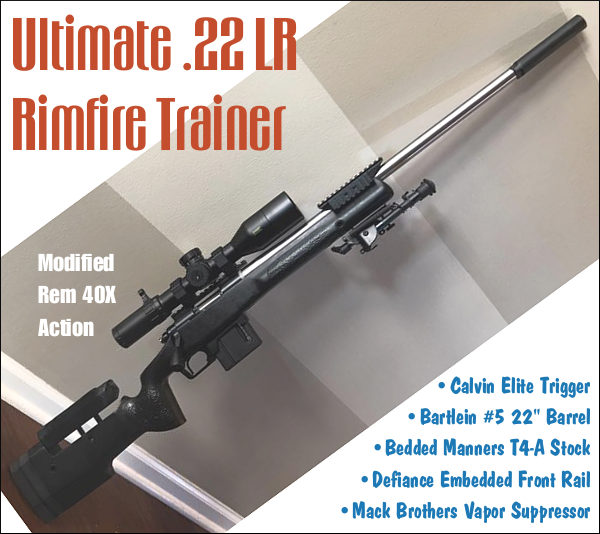
Brian, a gunsmith at GA Precision, built this rimfire rig with GAP colleague Anthony Soukup.
On his Facebook page, Tactical competitor Bryan Sikes posted a photo of a rimfire rig we really liked. Brian works at GA Precision. He and fellow GAP gunsmith Anthony Soukup built this rifle. With a modified Rem 40X action, Manners stock, Bartlein barrel, and Mack Brothers suppressor, this rig has top-quality components stem to stern. And Bryan tells us this rifle performs as good as it looks: “This is the baddest little .22 LR trainer ever. I’m stoked about it. With the barrel length and can, it’s the exact length of my regular comp rigs.” With length, balance, and ergonomics near identical to Bryan’s centerfire competition rifles, this 40X is a superb training tool.
Many readers wanted to know about the bottom metal and the detachable box magazine. Bryan Sike reveals: “The magazine setup is designed specifically to replicate my actual competition rifles. The bottom metal is for use with AI magazines and uses a standard M5 type inlet just like any centerfire completion rifle. In this case with the .22LR, Mike Bush designed a high reliability rimfire magazine using the same outside dimensions as an AI magazine. This rifle was built no different from any other. The action was modified and trued, barreled, fully bedded, etc. using ALL components common to centerfire match rifles.” The Rem 40X action was modified by Modacam Custom Rifles to work as a repeater with box mags.
Bryan adds that a new rimfire action is in the works: “My preference is modified Remington 40X actions and the [Vudoo Gunworks V-22 Action]. Both of which are TRUE repeaters and don’t feed from a Savage magazine. This rifle feels nothing like a .22 LR and that was the whole point.”
Why You Need a .22 LR Tactical Cross-Trainer
Many guys who shoot long-range tactical matches practice with .22 LR rifles of similar configuration. Rimfire ammo is way more affordable than centerfire, you do not need a big range facility, and shooting rimfire saves wear and tear on your centerfire rifle. Further, for learning how to read the wind, there really is no better training tool than a .22 LR, even as close as 50 yards.
Our Friend “DesertFrog”, who shoots tactical matches in Southern California, explains: “I used to shoot an average of 200 rounds of .308 Match ammo a month for training (50 per weekend). These days I shoot maybe an average of 50 rounds of .308 Win per month and probably around 600 rounds of .22 LR. Using mainly the .22 LR for practice did NOT hurt my standings in actual competitions. I shot my .308 just as well in matches, but saved the cost of hundreds of rounds of .308. If I didn’t reload and was still buying boxes of Federal Gold Medal Match .308 Win [at $1.75/round], this would be a savings of [$262.50 per month on the centerfire ammo (150 rounds).]” Money saved is money earned.
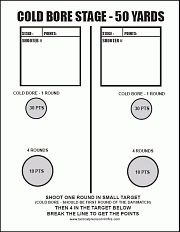
Targets for Rimfire Cross-Training
SPECIAL BONUS–Rimfire Tactical Precision Targets
These FREE targets by DesertFrog are offered in Adobe Acrobat format for easy printing. CLICK HERE to download all six targets as a .ZIP archive.
Good Guide for PRS/NRL Competitors
Currently, PRS/NRL tactical competition is the fastest growing rifle shooting discipline with both centerfire and rimfire matches around the country. Are you thinking of getting started in the Practical/Tactical shooting game? Looking for ways to be more stable when shooting from unconventional positions? Then you may want to read Marcus Blanchard’s Practical Shooter’s Guide (A How-To Approach for Unconventional Firing Positions and Training).
Unlike almost every “how to shoot” book on the market, Blanchard’s work focuses on the shooting skills and positions you need to succeed in PRS and NRL matches and similar tactical competitions.
Blanchard provides clear advice on shooting from barricades, from roof-tops, from steep angles. Blanchard says you need to train for these types of challenges: “I believe the largest factor in the improvement of the average shooter isn’t necessarily the gear; it’s the way the shooter approaches obstacles and how they properly train for them.”
Blanchard also offers good tips on shooting fundamentals. Here’s an example:
Blanchard on Trigger Control
“There will always be some amount of wobble when shooting in positions other than prone, and timing the shot to go off when the reticle is within the target is difficult to accomplish when poor trigger techniques are employed. The most common [mistake] I have seen is ‘slapping’ the trigger. The finger is usually hovering off the trigger, and when the shooter determines that NOW is the time to fire, they quickly pull their finger to the rear and ‘slap’ the trigger. The finger never pulls the trigger in the same place and often provokes a sympathetic contraction of the rest of the muscles in the hand, which results in unwanted movement before the bullet exits the muzzle.”
Author Marcus Blanchard has the credentials. A Marine Corps veteran, Blanchard is a regular Top 10 finisher in Precision Rifle Series events. In 2015 Blanchard was ranked 8th overall (nationwide) in the PRS series at year’s end. In 2016 Blanchard won the New Mexico Precision Rifleman’s Championship.
Check out the Table of Contents to see the Topics Covered:
Click image above to view larger Table of Contents.
6.5 Guys Recommend Practical Shooter’s Guide
The 6.5 Guys have reviewed Blanchard’s book and they recommend it highly: “What’s a good book for the beginning shooter who wants to get into long range precision rifle or the intermediate shooter who wants to improve his scores? [The Practical Shooter’s Guide] is particularly useful because it explores firing from various positions and props that are encountered in long range precision rifle [events]. This knowledge is completely missing from more traditional books where the shooter is usually slung up and shooting at a paper target. Marcus… goes into considerable detail about shooting from rooftops, reverse rooftops, side slopes, tank traps, barricades etc. This is the type of information that is very difficult to find. We consider ourselves reasonably knowledgeable shooters and this book provided us with new and useful information.” CLICK HERE for 6.5 Guys REVIEW.
6.5 Guys Review Marcus Blanchard’s Practical Shooter’s Guide
Former USMC scout-sniper Frank Galli explains that there is no voodoo when it comes to precision rifle marksmanship, but there ARE techniques that, when practiced, make the difference between good marksmanship and great marksmanship. Understanding the reasons that a bullet hits or doesn’t hit its intended target at ultra-long distances is a crucial element to learning.
Galli’s explanations of how to understand and compensate for wind speed and direction are excellent. In this book, Galli offers great wind-reading advice.
Published in 2020, Galli’s treatise is four years newer than Blanchard’s book, so it includes more of the latest gear and equipment. Galli’s book covers the fundamentals of precision marksmanship with easy-to-understand methodology. The book follow the same instruction process Galli uses in his live marksmanship classes (CLASS REPORT HERE).
This well-illustrated, 272-page book (2020 ed.) covers the latest equipment (scopes, LRFs, chassis systems, magazines, bags, bipods, tripods) favored by tactical competitors in PRS/NRL type matches.