Here’s a handy invention by Forum member RayJay from Georgia. It’s a simple wire clip that will hold the lid of your plastic ammo box fully open during use. RayJay explains: “Everybody probably uses the cheap plastic cartridge cases. The only problem I have with them is the lid is always in the way and sometimes when trying to open the lid farther the cartridge box tips and you can dump out the cases. I did some cogitating and came up with these .061″ music wire clips. They work great and the unexpected benefit is that the cases are more stable while sitting at the bench.”
RayJay adds: “The round wire is ideal because it still allows a cartridge to fit in the hole where the clip is placed. Now all I need to do is make another 15 or 20 so I can have one in every case I own.”
The good folks at Kelbly’s have announced a great October sales promotion. If you buy a March scope — any March scope in stock — you’ll earn a $300.00 credit that can be used to purchase any other products Kelbly’s sells. That includes rings, reloading gear, bullets, and many more items you’ll find at www.Kelbly.com.
Jim Kelbly explains how this works:
“For the month of October only, buy a March Scope in stock and get $300.00 of credit towards Kelbly’s products and the Kelbly’s store. Kelbly’s now carries a number of reloading products and bullets. The credit can be used same day as scope purchase to get scope rings or anything else we sell. This sale is for any March Scope in stock. With over 150 scopes in stock there is a great selection of scopes. If you would like to see a inventory of scopes just email us and we will send [that] to you. If you have any questions just email or call. NOTE: Scopes will only be sold to U.S. citizens and shipped to U.S. addresses.”
For more information, email jim[at]kelbly.com or call (330) 683-4674 and ask about the October Promo.
Less weight plus better heat dissipation — Sound good? Here is an innovative barrel technology that promises worthwhile performance benefits for hunters or match shooters. Lothar Walther (LW) has developed a new bi-metal barrel system that cuts weight dramatically while promising significantly-enhanced heat dissipation.
Walther’s Ultra-Lightweight Barrels combine steel with lightweight alloys. This results in a significant weight reduction without the use of carbon fiber, epoxy binders, or other heat-retaining materials. Beginning as an LW50 stainless blank, the barrel is precision-machined to remove excess weight. An outer casing of light-weight alloys is machined and the two are fitted together without adhesives. Basically you end up with the steel inner barrel inside a larger-diameter fluted aluminum outer barrel (see diagram). This gives you the ‘best of both worlds’ — light weight for ease of carry, and thick diameter for rigidity and enhanced heat dissipation. Near the action, the barrel remains all-steel.
The barrels come pre-chambered in your choice of caliber/cartridge, from .22LR up to .338 Lapua Magnum. Walther chambers the barrel — but a gunsmith is still required to finish the shoulder so that the headspace is set correctly for your action. These barrels are not inexpensive. A typical bi-metal Walther Barrel runs $850.00 – $875.00, for barrel lengths from 22″ to 30″. Threading for a muzzle brake or suppressor (if desired) is normally included in that price.
We haven’t tested one of these bi-metal composite barrels, but the potential for significant weight savings is obvious — aluminum is a lot lighter than steel. What’s more, a metals expert we contacted said that a bi-metal system employing fluted aluminum over steel, if assembled properly, could dissipate heat much better than steel alone (given the same diameter). Stainless steel has a thermal conductivity factor of 16. Aluminum has a thermal conductivity factor of 250.*
Our expert also pointed out that some other composite barrel systems on the market actually increase heat retention because they place insulating materials next to the inner steel barrel. (Carbon, Fiberglass, and Epoxy are all considered “insulating substances” as they have very low thermal conductivity*.) The LW system of aluminum over metal should avoid this mistake, our expert believes. Lothar Walther says: “Unlike solid steel barrels, this barrel sheds heat fast. VERY FAST!”
Half the Weight of Conventional Barrels
How much weight can you save? With a 1.200″ shank diameter and a muzzle diameter of 0.850″, the LW Ultra-Lightweight Barrel is less than half the weight of a standard varmint barrel of the same size. Walther claims its UltraLight Barrel can be “carried for long distances and stand up to heavy firing.” This, LW says, makes these barrels “perfect… for varmint and tactical uses”.
Pre-Chambered Ultra-Lightweight Barrels Available in .22 to .338 Calibers
Lothar Walther offers Ultra-Lightweight barrels in a full range of calibers from .22LR to .338. Each Ultra-Lightweight Barrel comes complete with chamber, crown, and breech threads. These barrels are fluted by the factory. If you order a LW Ultra-Lightweight barrel, Lothar Walter provides the services of a specialist trained in building guns with these barrels. To order one of Lothar Walther’s bi-metal barrels, CLICK HERE or contact Lothar Walthar at the address below:
*Thermal conductivity is the quantity of heat transmitted through a unit thickness in a direction normal to a surface of unit area, due to a unit temperature gradient under steady state conditions. The factor values are based on this formula: W/(m.K) = 0.85984 kcal/(hr.m. °C). Here are thermal conductivty values for common materials: Aluminum, 250; Brass, 109; Steel (Carbon 1%), 45; Stainless Steel, 16; Carbon, 1.7; Brick dense, 1.3; Concrete (medium) 0.7; Epoxy, 0.35; Fiberglass, .04.
Story tip from EdLongRange. We welcome reader submissions.
Here’s a great deal on an electronic powder dispenser/scale unit. Amazon.com now has the Hornady Lock N Load Auto Charge on Sale for just $184.46. That’s a real bargain — these dispensers sell for as much as $250.00 elsewhere.
And here’s another good deal on Hornady’s Auto Charge if you need a range bag as well. Grafs.com is currently offering the Hornady Lock-N-Load Auto Charge powder scale/dispenser for $209.99. To make the deal even sweeter, Grafs.com will include a medium-size range bag for FREE. Hornady says the range bag is worth $34.99, making your effective cost for the Auto Charge around $175.00. CLICK HERE for Dispenser/Range Bag Combo.
While we have a lot of positive experience with the RCBS Chargemaster, we haven’t done any long-term testing of the Hornady AutoCharge. However, user reviews have generally been positive. We suggest you do your own research and then make your own decision. Both the Hornady LnL AutoCharge and RCBS ChargeMaster offer load precision to ±0.1 grains. Both the Hornady Autocharge and the RCBS ChargeMaster are sold with a one-year manufacturers warranty.
Features and Specifications:
Scale capacity of 1000 grains
Easy-to-operate keypad
Large backlit display
Automatic and manual dispense options
Trickle function
Three speed settings
Easy Outflow Powder Drain
Overcharge protection
One-year manufactuer’s warranty
This Youtube video shows the Hornady Lock-N-Load AutoCharge in action.
Hunting season is here. That means many of you will be heading off into the woods. Along with your rifle and ammo, it’s wise to carry some basic survival gear on your hunt. The NRA has just introduced a cleverly-designed multi-function Survival Tube that fits in a pocket.
This new product combines a fire-starter with a knife sharpener. The NRA Survival Tube’s magnesium fire starter and steel striker can produce sparks in the wettest and windiest conditions. The easy-to-use, diamond-encrusted knife sharpener keeps hunting blades sharp. No one wants a dull knife on a hunting or camping trip. The Survival Tube is wrapped with six feet of 550 paracord, and the lanyard gives you another 31 inches of paracord. The NRA Survival Tube stows easily, or it can be hooked to a backpack loop. Price for this useful product is $19.95 at the NRA Store. That’s not bad, but remember that a $0.99 disposable lighter will start fires just fine in most conditions.
Here’s a handy, affordable product that will help you organize gear in your reloading room or “man cave”. Tipton’s new Cleaning Rod Rack (Tipton #100335) can accommodate up to six rods with various size handles. The wall-mounted Rod Rack also has horizontal studs on either end for additional accessories. These are useful for hanging the Tico Tool shotgun cleaning wands that stow in a tube with a plastic hook on the top.
Tipton Cleaning Rod Racks come complete with mounting screws (and screw slots are molded-in). You’ll find Tipton Cleaning Rod racks for under $10.00 at most vendors. They are $7.99 at Cabelas.com, while Amazon.com offers the racks for just $7.99 with free shipping for Amazon Prime Members.
The 6.5×47 Lapua necked down to 6mm is a popular wildcat. However, we’ve learned that, when necking down a 6.5×47 Lapua case to 6mm, simply running the brass into a 6-6.5×47 full-length sizer won’t give the best results. Reader “Fireball”, who has worked with both a 6-6.5×47 and a 22-6.5×47, offers this tip: “You don’t want to bring the 6.5mm case all the way down to 6mm in one step — it’s too big of a jump. First, to smooth entry, run a 6.5mm expander in the case mouth, and chamfer the outside of the case mouth — be sure to remove all burrs. Apply some lube to the neck. Then, if you have a .257 bushing, put that in a 6BR bushing neck die, and run the case up [for initial reduction].” Then, use your 6mm die for the final step.
Alternatively, you can use a Redding 6BR body die initially. The body die will funnel the neck down about half way. Body dies are pretty inexpensive ($29.99 at Grafs.com, Item #RED75317). After running the brass through the 6BR body die, then you can run the case into the Forster 6-6.5×47 Full-length sizing die. The Forster die is excellent — it sizes a no-turn neck just about perfectly, so long as you do an intermediate step first.”
Over the years, many Civilian Marksmanship Program firearms purchasers have asked if the CMP would consider offering reliable, reasonably-priced and prompt maintenance, repair and upgrade of USGI-issue rifles. The CMP has responded and the answer is “YES”.
Starting October 1, 2013, the CMP Custom Shop (Anniston, AL) opens for business, providing a wide variety of repair, upgrade and custom services for a wide range of U.S. Military rifles, specifically those issued in early eras. As well as regular repairs (and troubleshooting), the CMP Custom Shop will be able to perform virtually any normal upgrading, accurizing, customizing, and refinishing for the types of rifles the CMP sells.
CMP will work on the M1 Garand, M1 Carbine, 1903 and 1903A3 Springfield, the 1917 Enfield and the Krag. Other rifles like the Remington 40X, Mossberg 44, and H&R Model 12 can also be serviced. CMP will NOT work on shotguns, pistols, revolvers, M14/M1A, AR15-style rifles or other commercially-produced modern rifles. For a list of services (with prices) visit the CMP Custom Shop webpage.
NOTE: Before you can send a rifle to the CMP Custom Shop you must be a customer on file in the CMP system. Customers must meet the same eligibility requirements as for CMP rifle purchases. Once qualified, you can purchase a rifle from the CMP and have the CMP Custom Shop make modifications to it prior to shipping.
CMP Custom Shop Can Work on USGI Rifles Purchased from Other Sources
The CMP Custom Shop can work on rifles that may have been purchased elsewhere as long as they were made by a USGI contractor. Some examples include: Springfield Armory (not Springfield Inc.), Harrington & Richardson, Winchester, International Harvester, Remington, Rock Island, Eddystone, Inland, Underwood, Rock-Ola, Quality Hardware, National Postal meter, Standard Products, IBM, Irwin-Pederson and Saginaw. NOTE: There are many NON-USGI copies of the M1 Garand, 1903 Springfield and especially the M1 Carbine that CMP will be unable to work on.
For more information, call (256) 835-8455, x1113, or send email to customshop [at] thecmp.org. Shipping and Correspondence address for the CMP Custom Shop is:
Here’s a handy, new smart-phone App for competitive shooters. The ISSF Target Tracker App uses the touch-screen on your Android smart-phone so you can record shot positions during practice sessions or matches. Since the user inputs the shot position this will work with both old-fashioned paper targets as well as the newer electronic targets. This software automatically shows the correct target configuration for the discipline you select. Three-position shooters can create separate scoring categories for kneeling, prone, and standing. Sighters can be recorded separately from record shots.
The Target Tracker App for Android OS is now available for $9.99 through the Google Play App Store. NOTE: This Android Target Tracker App has many features not yet available for the iPhone. The App developer plans to release an updated iOS (Apple) version in a month or two.
Description of Application
The Target Tracker is a unique application for your Android devices which provides a powerful training aid for your ISSF-style shooting training, matches, and finals sessions. The application utilizes the touch screen features of the Smartphone, allowing you to record the position of each shot as it is fired during your practice session or match. It also keeps track of the time elapsed between shots, and helps you analyze this time to show what shooting pace produces your best results. You can select from several shooting disciplines, including 10m Air Rifle, 10m Air Pistol, 50m Rifle and Standard pistol 25 and 50m, and 300m Rifle. Each discipline records the shots on the correct target design with proper shot size. The application complies with the latest ISSF regulations for Match and Finals.
If you’ve read our feature story on Ultrasonic Cleaning by Jason Baney, you’ve seen the remarkable results that can be achieved with this method. Ultrasonic cleaning has many advantages over traditional tumbling methods of case cleaning. There is no dust or media residue to remove from the brass, and when done right, the cases come out clean and shiney, inside and out, even the primer pockets.
In its Benchtalk Archives, Brownell’s has an excellent article discussing Ultrasonic Case Cleaning. Brownell’s staff compares results, with measured dwell times from 5 to 75 minutes, using both Mpro-7 and HCS 200 cleaning solutions. Tests are performed with once-fired and 5X-fired Tactical 20 (Tac20) cases, as well as once-fired .260 Rem Cases. The article also compares the results from ultrasonic cleaning vs. tumbling in walnut media. Below are Brownell’s results for Tac20 cases with the HCS 200 (non-acidic solution). Go to Brownell’s article for MPro7 results and Rem 260 results.
HCS 200 Cleaning Solution Test
Procedure — Solution was de-gassed for 15 minutes, then 63 Tac20 cases were placed in a single layer, in stainless steel mesh basket. The temperature of the starting solution was 102° F. When the cases were removed the temperature was 110° F.
Once-Fired Tactical Twenty Cases (HCS 200) — Observations 5 minutes: The exterior of the cases are not significantly brighter/cleaner. The primer pockets and case interiors are still dirty. 10 minutes: Exterior of the cases are brighter. 70% of the cases show some degree of cleaning of the primer pockets. Little difference seen inside the case, but case mouths are cleaner. 15 minutes: Case brightness is about the same. Still only 70% of the primer pockets are clean, but a larger portion of each is cleaner. A Q-tip swabbed inside the cases shows that carbon/powder residues are loosening up. 20 minutes: Case exteriors are brightening up. 80-85% of the primer pockets are about 90% clean. The insides of the cases and case mouths are cleaner. 25 minutes: Cases are brighter/cleaner than even new brass. 80-85% of the cases have almost completely clean primer pockets. The inside of the cases are 80-90% clean. 30 minutes: The insides of the cases and case mouths appear to be completely clean. 87% of the primer pockets are virtually 100% clean. 13% of the cases had stubborn primer pocket residue that could not be completely removed. 60 minutes: Eight cases (13%) were placed in the tank for another 30 minutes to try to remove the remaining residue in their primer pockets. Six out of the eight cases were completely clean.
Five-Times Fired Tac20 Cases — Observations 30 minutes: Based on the above observations, I didn’t begin to observe these 5-time fired cases until after 30 minutes: The exterior cases are bright/clean. Brighter than new cases. The primer pockets on 75% of the cases are 75% clean. The remaining cases had primer pockets that were only 25% clean. The inside of the cases appear to be clean. 65 minutes: 25% of the primer pockets were 95% clean, 25% of the primer pockets were 90% clean, 25% of the primer pockets were 85% clean; and 25% were 80% clean. 75 minutes: 75% of the primer pockets were 90% clean.
How Does Ultrasonic Cleaning Work? The Brownell’s article explains: “Ultrasonic cleaning uses high-frequency sound waves (generally between 20-80 kHz) to remove a variety of contaminants from objects immersed in a liquid. The result of these high-frequency sound waves is a process called cavitation. These high frequency bursts of ultrasonic energy produce a three-dimensional wave of alternating positive and negative pressure areas as the sound wave passes through the solution. During negative pressure, microscopic cavitation bubbles form and will continue to grown until they reach resonant size. As the positive sound wave passes, the pressure rises rapidly and implodes these tiny bubbles. Before these minuscule bubbles implode they store a tremendous amount of energy. These bubbles can be as hot as 10,000 degrees and have as much as 50,000 lbs per square inch of pressure. This sounds alarming, but you have to remember that these bubbles are microscopic in nature and pose no harm to anything, unless you are a carbon /powder residue deposit on a cartridge case!
When this cavitation bubble implodes near your brass case, it transforms the bubble into a jet about 1/10th of its size. This jet of energy can travel as fast as 400 km/hour. At 43 kHz, as is the frequency for our L & R HCS 200 ultrasonic cleaner, this is happening 43,000 times per second. This micro-burst of extreme energy is responsible for removing contaminants from the surface of your cartridge brass. Ultrasonic cleaning can reach into crevices and inaccessible areas and remove surface debris that can’t be cleaned by any other process.”


 The good folks at

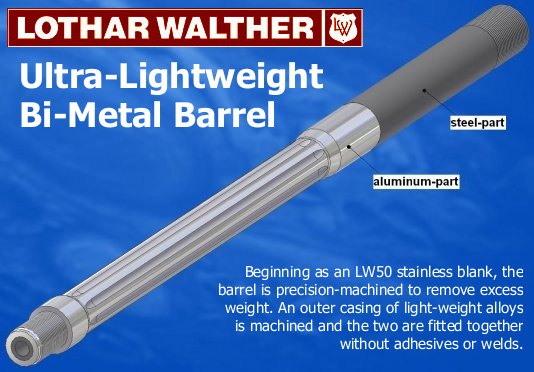
 We haven’t tested one of these bi-metal composite barrels, but the potential for significant weight savings is obvious — aluminum is a lot lighter than steel. What’s more, a metals expert we contacted said that a bi-metal system employing fluted aluminum over steel, if assembled properly, could dissipate heat much better than steel alone (given the same diameter). Stainless steel has a
 Here’s a great deal on an electronic powder dispenser/scale unit. Amazon.com now has the Hornady Lock N Load
 Hunting season is here. That means many of you will be heading off into the woods. Along with your rifle and ammo, it’s wise to carry some basic survival gear on your hunt. The NRA has just introduced a cleverly-designed multi-function


 The 6.5×47 Lapua necked down to 6mm is a popular wildcat. However, we’ve learned that, when necking down a 6.5×47 Lapua case to 6mm, simply running the brass into a 6-6.5×47 full-length sizer won’t give the best results. Reader “Fireball”, who has worked with both a 6-6.5×47 and a 22-6.5×47, offers this tip: “You don’t want to bring the 6.5mm case all the way down to 6mm in one step — it’s too big of a jump. First, to smooth entry, run a 6.5mm expander in the case mouth, and chamfer the outside of the case mouth — be sure to remove all burrs. Apply some lube to the neck. Then, if you have a .257 bushing, put that in a 6BR bushing neck die, and run the case up [for initial reduction].” Then, use your 6mm die for the final step.
 Over the years, many Civilian Marksmanship Program firearms purchasers have asked if the CMP would consider offering reliable, reasonably-priced and prompt maintenance, repair and upgrade of USGI-issue rifles. The CMP has responded and the answer is “YES”.


 For more information, call (256) 835-8455, x1113, or send email to customshop [at] thecmp.org. Shipping and Correspondence address for the CMP Custom Shop is:

 If you’ve read our feature story on
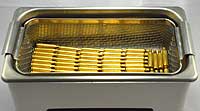 The Brownell’s article explains: “Ultrasonic cleaning uses high-frequency sound waves (generally between 20-80 kHz) to remove a variety of contaminants from objects immersed in a liquid. The result of these high-frequency sound waves is a process called cavitation. These high frequency bursts of ultrasonic energy produce a three-dimensional wave of alternating positive and negative pressure areas as the sound wave passes through the solution. During negative pressure, microscopic cavitation bubbles form and will continue to grown until they reach resonant size. As the positive sound wave passes, the pressure rises rapidly and implodes these tiny bubbles. Before these minuscule bubbles implode they store a tremendous amount of energy. These bubbles can be as hot as 10,000 degrees and have as much as 50,000 lbs per square inch of pressure. This sounds alarming, but you have to remember that these bubbles are microscopic in nature and pose no harm to anything, unless you are a carbon /powder residue deposit on a cartridge case!
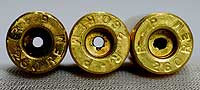 When this cavitation bubble implodes near your brass case, it transforms the bubble into a jet about 1/10th of its size. This jet of energy can travel as fast as 400 km/hour. At 43 kHz, as is the frequency for our L & R HCS 200 ultrasonic cleaner, this is happening 43,000 times per second. This micro-burst of extreme energy is responsible for removing contaminants from the surface of your cartridge brass. Ultrasonic cleaning can reach into crevices and inaccessible areas and remove surface debris that can’t be cleaned by any other process.”


