Last week Hornady introduced a variety of new products that will be introduced in 2025. These include reloading products, advanced dies, a power case trimmer and a large variety of new bullets and ammo types. CLICK HERE to see all new-for-2025 Hornady products.
Henderson-Style 3-in-1 Power Trimmer
Hornady has a new High Speed 3-in-1 Power Case Trimmer that borrows many features from the excellent Henderson Gen 3 Trimmer such as twin horizontal support shafts. This new trimmer offers quick, smooth case movement into the cutter. With a helpful see-through shield this trimmer can handle brass from 1.45″ to 3.5″ in length and with necks from .22 to .30 caliber.
Like the Henderson, this Hornady unit can trim, chamfer and deburr in a single step. The trimmer features a click-adjustable micrometer for precise and consistent trimming. The powerful 2000+ RPM motor allows rapid case trimming/chamfering. This unit may prove a good choice for shooters who need to process hundreds of cases.
New 6mm GT Ammunition with 109gr ELD Bullets
The 6mm GT is bigger than the 6mmBR Norma (aka “6BR”) but smaller than the 6mm Creedmoor. This cartridge is proving popular with PRS/NRL competitors because it feeds better from standard magazines that the shorter 6mmBR, Dasher, and 6BRA cartridges, yet it still offers very good accuracy and barrel life. 6mm GT brass is now available from Alpha Munitions. The Alpha 6mm GT brass is better and longer-lasting than the Hornady 6mm GT brass.
For 2025, Hornady is producing new 6mm GT ammo loading with tipped 109gr ELD Match bullets. Hornady states: “Designed from the very beginning to be an amazing all-around precision rifle competition cartridge, the 6mm GT provides low recoil, good barrel life, and outstanding external ballistics. [The 6mmGT] cartridge and chamber were designed simultaneously to ensure match-grade tolerances and accuracy.”
Match-Grade Reloading Dies
For 2025, Hornady will offer “New and Improved Match Grade Dies” with click-adjust micrometer seating controls. For 2025, the handy click micrometer controls comes factory-installed on Hornady’s Match Grade seating dies. With its tactile clicks for precise .001″ adjustments, this easy-to-use micrometer helps ensure very consistent seating depths for hand-loaded ammo.
Along with the micrometer-top seating dies, Hornady offers modern case sizing dies. These dies feature the ability to use interchangeable, self-centering neck size bushings that eliminate the chance of over sizing your case necks and overworking the brass. Two types of sizing dies are offered: full-length sizing and “shoulder bump neck size”.
Hornady Aluminum Loading Block
If you want a heavy loading block that stays put on your loading bench and won’t tip or slide, consider Hornady’s new Aluminum Loading Block. Made from 6061-T6 aluminum, the new Aluminum Loading Block makes reloading easy and efficient. Designed for the 6.5 Creedmoor, .308 Win, and .30-06 Springfield cartridge families, this loading block boast a bullet recess on the right plus an easy-to-clean red anodized aluminum finish.
Do you use bushings to size your case-necks? Are you assuming that your bushings are actually round on the inside, with a hole that’s centered-up properly? Well you may be in for an unpleasant surprise, based on what our friend Jim de Kort recently discovered. Jim was concerned about the run-out on his brass. His cases went into his bushing-equipped FL die pretty straight, but came out of the die with up to .004″ run-out. “What gives?”, Jim wondered. “Could the problem be the bushings themselves?”
To answer that question, Jim decided to examine his bushings. Using an Accuracy One Wheel-drive concentricity gauge, Jim checked out some of his neck bushings. What he discovered may surprise you…
Neck Bushing Flaws Revealed
Trust no one… — Jim de Kort
Jim writes: “I measured the concentricity of my 6BR rounds today. I noticed they went into the neck-bushing equipped full-length sizing die with less than .001″ deviation but came out with .003-.004″. The culprit, it appears, was the bushing itself. Without it the cases stayed within .0005″ to .001″ deviation, so something was happening with the bushing.
One bushing had .00025″ deviation on the outside, yet almost .003″ on the inside, so it is crooked. But even when using a bushing that is within .001″ I still get .003″ runout after sizing. I repeated the same procedure for my 6×47 and got the same results. When using the bushing, concentricity suffers a lot.”
Before we bash the bushing-makers, we must acknowledge that many different things can contribute to excessive run-out and/or mis-alignment of case-necks. We don’t have all the answers here, and Jim would be the first to say that some mysteries remain. Still, these are interesting results that give all precision hand-loaders something to think about.
Jim Borden of Borden Accuracy also offers this tip: “Check the trueness of the face of the die cap. That has more to do with trueness than the bushing. Also check perpendicularity of hole in bushing to top surface. When I was making dies, the cap was made by threading and facing the threaded tenon in same setup.”
Editor’s Comment: Many people have great results with neck-bushing dies, but Jim isn’t the only fellow who has seen some very odd results. I personally employ honed, non-bushing dies for many of my chamberings. These non-bushing dies (with the necks honed for .002-.003″ neck tension) produce extremely straight ammo, with run-out consistently under .0015″.
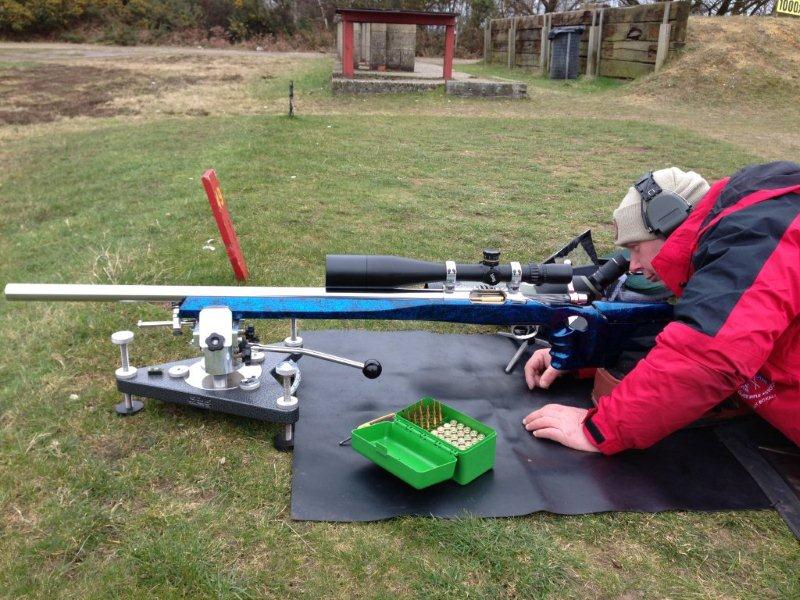
For today’s Sunday Gunday feature, we present a splash of color — the beautiful blue 7mm-270 WSM of Forum member Ian B. (aka “Elwood”) from Great Britain. A very knowledgeable guy, Ian has been one of the UK’s top F-Class shooters. And he’s the proud owner of a very “Flash” F-Class rig.
About the Shooter — Ian’s Background
Ian tells us: “I started shooting F-Class Open [many] years ago when a good friend invited me to Bisley to shoot with the Dorset Riflemen. I found it very enjoyable and a real challenge. The next year I attended the GB F-Class league’s Introduction to F-Class course, and soon afterwards started to compete in the GB F-Class league, while still shooting once a month with the Dorset Riflemen. In this short time frame, I’ve managed to finish 8th in the league last year, 12th in the Europeans, and I was a part of the GB squad that won the team event at the European Championship. I was then selected for the GB F-Open World Championship Team. Unfortunately, due to work commitments, I have had to withdraw.”
Ian’s Beautiful Blue 7mm-270 WSM F-Class Rifle
Report by Ian B. (aka “Elwood”)
Having spent my first year competing with a magazine-fed 7mm WSM tactical/sporting rifle (Surgeon action and AICS mag) and doing reasonably well with it, I then moved on to a .284 Shehane (.284 Winchester Improved). I love the Shehane and still use it but … I wanted something for those windy long-range days and so there was only one logical choice, the 7 WSM. This time I chose a 7mm-270 WSM as I quite enjoy case prep (just kidding). Actually, there’s not much to do really. The quality of Norma brass is well known and the Norma 270 WSM brass is quite easy to obtain in the UK.
The action is a Right Bolt, Left Port (RBLP) Stolle Panda F-Class action, with Jewell trigger. There wasn’t any particular reason behind the RBLP configuration — it was more of a case of that’s what I could get at the time. I had a 1.250″-diameter, straight-profile Bartlein barrel finished at 32 inches and chambered for the Berger 180gr VLD with a .313″ neck diameter. All my metal work and quite a bit of the wood work is done by the excellent Neil McKillop of McKillop Engineering. As with all top gunsmiths, Neil is meticulous to a point of obsessiveness and he’s the name behind quite a few winning rifles including several used by the GB Open and F-TR teams. Neil also inletted the stock from a blank and did the bedding for the action and the front bag runners.
Loading for the 7mm-270 WSM
I have one “tried and tested” load: 7mm Berger 180gr VLDs, seated .020″ into the lands, Vihtavuori N165 powder and CCI BR2 primers. This load is supremely accurate, but at 2990 FPS it’s a bit slow. To get more speed, I’m currently testing H1000 with good results, but it looks like I may have a slow barrel. I have another Bartlein barrel chambered and ready to screw on when the weather gets warmer. If that new barrel shoots well, the current barrel will probably be used as a practice barrel.
Loading Procedure
I do full case prep, neck-turning, uniforming primer pockets after the first firing, chamfering necks inside and out, and removing burrs around flash holes. Even the best brass sometimes suffers from imperfect quality control. I try to use Redding dies if possible, and will use bump dies, neck bushing dies, and competition seating dies.
I use an RCBS ChargeMaster 1500 to throw a charge just slightly under my desired weight and then trickle-up to final weight using the superb Dandy trickler and a Gem Pro 250 scale.
I anneal every other firing using a Bench-Source machine. Before this I used a Ken Light and also did them by spinning them in a drill. Never again will I do that after using the Bench-Source. After I have annealed, I always run a nylon brush wrapped in 0000 wire wool into the neck to remove any debris.
I keep to the same lot numbers of primers, powders, and bullets. Even the Bergers can vary from lot to lot — I have two different lots of 7mm 180gr VLDs that vary .020″ from bullet base to the ogive. I trim and point my bullets. Pointing may be a mental thing — I had a fantastic shoot while using trimmed and pointed bullets so I do it all the time now. ( A fellow GB team shot refers to them as “Pointless Dies” — I have witnessed him shoot a 99-14V at 1000 yards with bullets that weren’t trimmed or pointed). My next move will be to start measuring bearing surface…where does it all end?
Custom Wood Stock Was Modified by Ian and Treated to a Fancy Paint Job
The stock is a custom-made design crafted by Joe and Simon West of Joe West Rifle Stocks. I had several modifications done to one of their existing stock designs. Having done a lot of my shooting with the AICS, I was quite used to a thumbhole stock, so thought I would try one in F-Class. I told Simon what I wanted and he sent me down a prototype made from very inexpensive Tulip wood. We had a few discussions and then made some more mods..
I made two main changes to the stock. First, I removed the lip at the bottom of the pistol grip because I felt I might rest my hand on this and possibly disturb the rifle. Second, I had the protruding pistol grip base removed so that the bottom of the stock was completely flat like the Precision Rifle & Tool F-Class stock. Simon also made the finger grips to fit my hand and flattened them off to allow for a bit more movement. The stock was then sent to Hydro Graphics in the UK to have a custom exterior finish. The paint color is a Marbleized Candy Oriental Blue. As always, Hydro Graphics did a great job.
Optics and Rings
The scope is the excellent 5-50x56mm March with the MTR-2 reticle — far and away the best reticle I have used for F-Class. March makes great optics. During the 2012 European individual F-Class event, using another March (my 8-80x56mm), I could see my shooting partner’s impacts in the white V-Bull at 800 yards! And just recently at a club match I called two V-Bulls at 900 yards using the 8-80X (not at full power). Granted the light has to be perfect to be able to do this, but my highest praise for the Deon Optics glass is that it rivals that of Schmidt & Bender. Having owned both March and S&B scopes and compared them side-by-side, I feel that I can make this statement fairly.
UK-based Third Eye Tactical made the nice, 34mm rings. The UK is now producing some excellent products. We now have UK-made custom actions, rings, rails, stocks and more. It would be nice to think we could have a 100% British-made rifle, and not rely completely on USA-made products. I think all we need is the trigger? But I can’t see there ever being a UK-made scope!
Wind effects are complex. In trying to access wind speeds and angles, you’ll want to watch multiple indicators — mirage, dust, wind-flags, grass movement, and more. You’ll also need to be concerned about wind cycles. In the video below, Bryan Litz talks about variable wind speed along a bullet’s flight path. A respected ballistics guru, Bryan is the founder of Applied Ballistics and a designer of Berger’s Hybrid Match projectiles. He is also a past F-TR National Champion and a High Master Palma ace.
In this video, Bryan discusses how wind effects can vary in intensity at different points along the bullet’s flight path to the target. Sometimes the firing line is sheltered, and the strongest winds come into effect in the middle of the trajectory. Bryan concludes: “Wind matters everywhere … but the best thing you can do is try to get a handle on the wind [velocity and angle] where you are. That may or may not represent the wind down-range — that’s when you have to look downrange and make a judgment[.]”
Litz Competition Tip: Select your wind shooting strategy carefully. For beginners and veterans, most points are typically lost to wind. Successful shooters put a lot of thought into their approach to wind shooting. Sometimes it’s best to shoot fast and minimize the changes you’ll have to navigate. Other times it’s best to wait out a condition which may take several minutes. Develop a comfortable rest position so you have an easier time waiting when you should be waiting.
More Wind Tips from Wind Wizard Emil Praslick
In these two short videos, Emil Praslick III, former coach of the USAMU and USA National long range teams, explains how to find the wind direction and how to confirm your no-wind zero. Praslick is widely considered to be one of the best wind coaches in the USA.
When Winds Are EXTREME — Near Gale Force at Ben Avery
This video shows INSANE winds at NBRSA 100/200 Benchrest Nationals. This was filmed at the Ben Avery Range in Phoenix, AZ during the recent NBRSA 100/200 yard National Championships. Extreme to say the least. Based on what we’re seeing here, there are 20-25 mph crosswinds, with gusts to 35 mph — near Gale Force. Video by Hall-of-Fame Benchrest competitor Gene Bukys, whom we sadly lost to COVID last year. RIP Gene.
Texas gunsmith Mike Bryant reports: “This video shows the Unlimited Class 200 at the Nationals in Phoenix. I had three 10-shot groups in the low 2″ range with a 2.228″ being my big group and was glad they weren’t bigger. Thursday and Friday were the worst of the windy days. Unfortunately those were the days for the UL 200 and it was about as windy through most all of the Sporter 200.”
Excellent Wind Reading Resource
The Wind Book for Rifle Shooters covers techniques and tactics used by expert wind-readers. The authors provide a wind-reading “toolbox” for calculating wind speed, direction, deflection and drift. They explain how to read flags and mirage, record and interpret your observations, and time your shots to compensate for wind. Here are two reviews:
This is a must-have book if you are a long-range sport shooter. I compete in F-Class Open and when read it from cover to cover, it helped me understand wind reading and making accurate scope corrections. Buy this book, read it, put into practice what it tells you, you will not be disappointed. — P. Janzso
If you have one book for wind reading, this should be it. It covers how to get wind speed/direction from flags, mirage, and natural phenomenon. This is the best book for learning to read wind speed and direction. — Muddler
Millions of Americans now exercise their Constitutional right to “keep and bear arms”, specifically to carry a pistol for personal protection and home defense. In response to the rapid growth of the CCW (Concealed Carry Weapon) market, numerous gun-makers have introduced compact handguns specifically designed for concealed carry. These “Carry Guns” tend to be smaller, lighter, with smoother, rounded edges on slide and frame. Today, many modern carry guns are also “Optics Ready”, meaning they have slides that can accept smaller red dot sights. And some companies are now selling handguns with the optics pre-installed.
For today’s Saturday video showcase, we feature six videos covering a wide range of popular semi-automatic carry guns. You’ll see offerings from Beretta, Glock, HK, Kahr, Kimber, Ruger, Smith & Wesson, Taurus, Walther and more. In addition, we’ve included a video that covers the pros and cons of installing optics on carry pistols. Finally, as a bonus, we’ve included a video that highlights five handguns that you may want to avoid, as they have not lived up to expectations.
Top Ten Best Carry Pistols for the Money
Here the Honest Outlaw Channel reviews ten semi-auto pistols. The host states these are the “10 best pistols for the money,” adding that “these handguns are reliable, accurate, durable, light weight, and cost less than most alternatives.” This video was released in December 2022, so it covers the latest generation of modern carry pistols.
Five Favorite Carry Pistols — Colion Noir’s Top Handguns
Colion Noir is a very popular gun reviewer and Second Amendment advocate. In this video, which has over 1.1 million views, Colion covers the five guns he personally carries. Why five? Colion states: “When it comes to my concealed carry guns, I practice tactical polyamory. Essentially, I don’t just carry one gun. I have a rotation of guns I carry based on what I’m wearing that day, where I’m going, and what I’m doing. I put a lot of thought into my carry rotation, which changes based on my needs. Sometimes a gun that’s better at handling the job comes out, and I’ll carry it once I’m comfortable with its reliability. That said, there are five guns I consistently carry[.]”
Five Top Choices among CCW & EDC (Everyday Carry) Handguns
The host notes: “We are going over the five best CCW firearms that I reviewed this year and ranking them from 1 to 5. We are going to save the best for the last. Some of the criteria for ranking these firearms isn’t only based on performance. We are ranking based on performance, price, reliability, and comfort.”
Ten Modern Micro-Pistols for Concealed Carry
The reviewer states: “It’s 2023 and the world of firearms keeps evolving. One of the hottest trends in the firearms industry right now is micro pistols — small, compact handguns that are perfect for concealed carry or as backup guns. If you’re looking for the best micro pistols in 2023, you’ve come to the right place. This video reviews the latest and greatest micro pistols on the market, discussing their features, performance, and why they’re making waves in the gun community.”
Kimber’s R7 Mako pistol won a coveted Golden Bullseye Award from NRA’s Shooting Illustrated magazine, taking the trophy for the magazine’s “2022 Handgun of the Year” category. The R7 Mako is very compact, with good ergonomics, yet it offers 12-rd (11+1) capacity (and 13+1 with extended magazine). The R7 Mako showed outstanding accuracy when tested indoors (see video at 15:25 time-mark).
The R7 Mako is offered Optics Ready for $599.00 MSRP or with Crimson Trace Red Dot Optic installed for $799.00 MSRP. SEE Shooting Illustrated Review.
New Heckler & Koch CC9 Double-Stack Micro-Compact
Heckler & Koch (HK) has released its new CC9 micro-compact, striker-fired 9x19mm pistol. With great accuracy, ergonomics, and reliability, the HK CC9 should be a top choice among micro-compact pistols. Designed and produced in the USA, this is the smallest double-stack carry pistol HK has ever built. The CC9 features a modular grip with swappable backstraps. With a “Safe Take Down Feature” for disassembly, there is no need to pull the trigger during field-striping, making the CC9 safer than a Glock. The slide is optics-ready and there is a short Picatinny rail on the front of the polymer frame for mounting accessories. The micro-compact CC9 is 6.03″ long and 0.99″ wide. The barrel is 3.32″ long and the CC9 weighs 18.4 ounces without magazine. MSRP is currently $699.00.
Optics on Carry Pistols — Factors to Consider
Red Dot sights are becoming more popular than ever. Many pistols today are “Optics Ready”, and some handguns can now be purchased with optics already installed. There are both strengths and weaknesses having optics on CCW handguns. In this video, Massad Ayoob outlines the pros and cons of Red Dots on carry pistols. Along with covering the factors to consider, Ayoob provides advice on red dot zeroing, defoggers, and more.
BONUS: Five Handguns to Avoid
When shopping for a handgun, it’s helpful to know which models to avoid, because of poor reliability or other shortcomings. This Honest Outlaw video reveals five handguns that are not the best choices for concealed carry: Smith & Wesson CSX, SCCY CPX-2, Remington RP-9, Kahr CW 380, and Taurus PT 22.
In some areas of the country (California in particular), hunters are now forbidden to use bullets that contain lead. If you need a lead-free projectile for your deer rifle, consider Nosler’s E-Tip projectile. This has plenty of penetrating power and retained energy while complying with laws requiring “unleaded” ammunition. An “expansion chamber” behind the green polymer tip helps ensure reliable expansion with 95% weight retention. The video below shows a .30 caliber, 180gr lead-free E-Tip impressively power through TWO 12-inch blocks of Ballistics Gel at 100 yards. This was fired from a .308 Winchester.
Watch 180gr eTip Penetration and Expansion in Ballistic Gelatin:
Nosler claims the E-Tip (“Expansion Tip”) bullet has advantages over other solid copper hunting bullets: “Unlike the competitor’s one-piece designs, Nosler E-Tip bullets will not blow the petals off at extreme velocities nor will the low end expansion ever be questioned, as the minimum impact velocity is set at 1800 fps for standard calibers.” One hunter, posting on Facebook, gave the E-Tip high marks: “I have had the opportunity to take a pig with a 130 gr E-Tip from my .270 and they work flawlessly. My son took two pigs with his .300 Win Mag and 165gr E-Tips and they worked flawlessly as well.”
This video illustrates the design and construction of the Nosler eTip Bullet:
This video shows the process of cut-rifled barrel-making by Krieger Barrels, one of the world’s best barrel manufacturers. Krieger cut-rifled barrels have set numerous world records and are favored by many top shooters. The video show the huge, complex machines used — bore-drilling equipment and hydraulic riflers. You can also see how barrels are contoured, polished, and inspected.
For anyone interested in accurate rifles, this is absolutely a “must-watch” video. Watch blanks being cryogenically treated, then drilled and lathe-turned. Next comes the big stuff — the massive rifling machines that single-point-cut the rifling in a precise, time-consuming process. Following that you can see barrels being contoured, polished, and inspected (with air gauge and bore-scope). There is even a sequence showing chambers being cut.
Click Arrow to Watch Krieger Barrels Video:
Here is a time-line of the important barrel-making processes shown in the video. You may want to use the “Pause” button, or repeat some segments to get a better look at particular operations. The numbers on the left represent playback minutes and seconds.
Krieger Barrel-Making Processes Shown in Video:
00:24 – Cryogenic treatment of steel blanks
00:38 – Pre-contour Barrels on CNC lathe
01:14 – Drilling Barrels
01:28 – Finish Turning on CNC lathe
01:40 – Reaming
01:50 – Cut Rifling
02:12 – Hand Lapping
02:25 – Cut Rifling
“At the start of World War Two, Pratt & Whitney developed a new, ‘B’ series of hydraulically-powered rifling machines, which were in fact two machines on the same bed. They weighed in at three tons and required the concrete floors now generally seen in workshops by this time. Very few of these hydraulic machines subsequently became available on the surplus market and now it is these machines which are sought after and used by barrel makers like John Krieger and ‘Boots’ Obermeyer. In fact, there are probably less of the ‘B’ series hydraulic riflers around today than of the older ‘Sine Bar’ universal riflers.” — Geoffrey Kolbe, Border Barrels.
Have a good look at the photos below — this may be one of the most noteworthy target strings we’ve ever published. What you can see is the effect of barrel tuner position on point of impact (POI). You can clearly see that the tuner position alters the up/down POI location in a predictable fashion.
This remarkable 15-shot sequence was shot by French benchrester Pascal Fischbach using his 6 PPC fitted with a CG (Carlito Gonzales) action and a Bukys barrel tuner.
Pascal reports: “After [bullet] seating and load validation, I put the Bukys tuner on, screwing it out 10 turns. According to Carlito, the CG’s super stiff action-to-barrel fit gives a faster vibration modulus that is detrimental below 10 turns [position of the tuner].” Pascal’s procedure was to screw out the tuner 1/4 turn progressively from one shot to the next. He shot one bullet at each tuner position, with a total of 15 shots.
Left Half of Target Strip (shots with 1/4 rotation change of tuner in sequence)
Right Half of Target Strip (shots with 1/4 rotation change of tuner in sequence)
Pascal observed: “Note the point of impact displacement [from shot to shot] tracks clearly along a sinusoide (sine wave curve).” This is indeed notable and significant! This shows how the tuner’s ability to change barrel harmonics can alter the position of the muzzle as each bullet exits, resulting in a higher or lower POI. Pascal sent his results to Carlito Gonzales in Argentina for analysis.
Pascal poses this question to readers: “Guess which three positions Carlito recommends to try?”
Editor’s Note: While this target sequence clearly shows how tuner position can alter bullet point of impact, this, by itself, does not tell us which tuner position(s) are best for accuracy. That will require further multi-shot group testing, involving careful experimentation with tuner position (and powder charge weights). But for those folks who doubt that a tuner can make a difference on a short, fat barrel, just take another look at the photos. The up/down changes are undeniable, and noteworthy in the wave pattern they follow.
Shooting Set-up and Test Conditions:
Pascal did this test at an outdoor range under very good conditions: “This was shot at my home range, outdoors, with four Smiley flag. The range is a narrow cut in high woods. Wind was consistent with readable flags. I started testing the tuner from 10 turns out and on to 15. I recently… found a sweet spot very close to the rearmost position of the tuner, so the rigidity provided by this super long tenon (just short of 70mm) was not a reason to overlook the recommended Bukys tuning procedure.”
PASS or FAIL? Where does your U.S. Representative and U.S. Senator stand when it comes to supporting the Second Amendment, the firearm industry, hunting, and target shooting sports? NSSF has released its 2024 Congressional Report Card. You can view it here: CLICK HERE for Full REPORT CARD.
The Firearm Industry Trade Association (NSSF), released its 2024 Congressional Report Card, grading U.S. Representatives and U.S. Senators on key legislation relating to the firearm industry, to hunting and recreational shooting, and to the Second Amendment rights of U.S. citizens.
“This report card will be critical for voters to do their research as we head into … the November elections just six weeks from now. NSSF’s 2024 Congressional Report Card tells voters exactly where their lawmakers stand on issues including defending the firearm industry’s ability to engage in the lawful commerce of firearms and ammunition and safeguarding the Second Amendment rights of customers, as well as promoting hunting and recreational target shooting”, said Lawrence G. Keane, NSSF Senior VP and General Counsel. “This nonpartisan report card reflects the level of support of each lawmaker on firearm industry priority legislation during the 118th Congress, between 2023 and 2024. These grades indicate their public voting record as well as their sponsorship and co-sponsorship of key legislation, their work on committees, letters signed to support firearm industry issues, and their overall leadership[.]”
NSSF awarded 29 U.S. Senators and 123 U.S. Representatives the rating of “A+”. Of those, 8 Senators and 24 House Members attained the new NSSF distinction of being named to the Dean’s List. To earn this special recognition, members needed to have a 100-percent voting and co-sponsorship record.
» CLICK HERE for Complete U.S. Senate and House Report Card
This nonpartisan scorecard reflects the voting record of each legislator. These grades indicate their public voting record as well as the weight and importance of these lawmakers sponsoring and co-sponsoring key legislation, their work on committees, letters signed to support issues and leadership to stand for our industry. “This scorecard is of vital importance to voters as we head into November elections. This tells voters exactly where their lawmakers stand on issues they care about like recreational shooting and hunting and the right to keep and bear arms” said Lawrence G. Keane, NSSF VP and General Counsel.
NRA publication Shooting Sports USA (SSUSA) has thousands of articles online, all free for the reading. Many of these stories have been written by top competitors, including National and Olympic Champions. You will find SSUSA articles spotlighted every week on the NRA Competitive Shooting Facebook page. We recommend you bookmark that page as a valuable resource. Here are four notable SSUSA articles that have been featured on Facebook this month. Go to SSUSA.org to see even more current articles, with new content every day.
Here is an insightful, fairly lengthy 1850-word article about the phenomenon we call mirage. The article explains how and why mirage appears, how it can best be monitored, and how mirage can indicate both wind velocity and direction. Top competitors follow the adage “Mirage is your friend”, because mirage can often be the most important indicator of wind variables — sometimes even more important than wind flags. “The mirage is more sensitive than the flags since it has less inertia and momentum”, wrote Desmond T. Burke, in his book, Canadian Bisley Shooting, an Art and a Science.
Well worth reading, this SSUSA article talks about the properties of mirage. Here is a sample:
“Mirage — can make all the difference between a shot landing squarely in the X-ring or being victimized by an undetected downrange breeze. The true power of mirage is found in its ability to betray the subtlest of breezes downrange. Its fluid movement… can not only provide wind direction, but speed as well.
Typically, the ability to detect mirage is maximized on warm, sunny and sultry days. Expect mirage to be most pronounced in mid-morning or early afternoon, although it ignores these rules with regularity[.]
Mirage is extremely powerful at identifying winds of less than 12 mph, particularly those gentle breezes subtle enough to not even bother moving the flags.
When there is no wind, or a gentle head or tail wind, mirage will appear to be ‘bubbling’ directly up from the ground. Many call this ‘boiling’, and it is probably the easiest of all to detect.
As a general rule of thumb, when wind speed increases, overall height of the waves produced by the mirage is reduced. Large peaks and valleys in the waves mean that particular mirage is being driven by a very slight breeze. Conversely, crest size is reduced with wind speed, making it harder and harder to detect, until the mirage disappears entirely at somewhere around 12 miles per hour. In other words, the taller mirage’s waves appear, the slower the breeze.”
Authored by the late Glen Zediker, this article covers barrel break-in procedures. It is particularly useful for dealing with factory barrels. We CAUTION readers — with outstanding, hand-lapped custom barrels from top barrel-makers, you may want to do very little break-in — clean sparingly and keep barrel heat low. Do NOT use abrasives aggressively. On our Krieger and Brux barrels, we simply wet-patched every 2-3 rounds for 20 rounds and the barrels shot superbly from the start with minimal fouling. But for factory barrels, a moderate break-in process may prove beneficial.
Zediker explains: “Lesser, lower-cost barrels are going to have more pronounced … imperfections within the bore[.] These imperfections are largely tool marks resulting from the drilling and rifling processes. And if it’s a semi-automatic, like an AR-15, there might be a burr where the gas port was drilled. The goal of break-in is to knock down these imperfections, thereby smoothing the interior surface.”
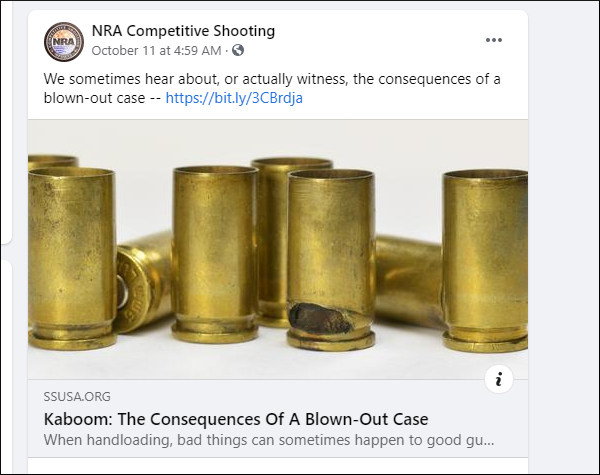
As one who has experienced a cartridge case-head blow-out with a 9mm pistol, this Editor is very conscious of the risks involved and the damage a blow-out can do to the pistol, to the magazine, and (worst of all) to the shooter. Even with new brass, the possibility of a case failure is always present. And even if the case remains intact, we’ve seen primer failures that create a dangerous jet back towards the pistol shooter. That’s why shooters should always employ protective eyewear whenever they shoot.
We love our wheelguns, but there’s no doubt that forcing cone damage can occur, particularly with hot loads and if your cylinder-to-barrel gap is excessive. This article explains how to inspect your revolvers, and how to mitigate the likelihood of forcing cone damage. The article also explains how to clean your revolvers properly. This is very important to avoid build-up of lead and powder residues.


 The 6mm GT is bigger than the 6mmBR Norma (aka “6BR”) but smaller than the 6mm Creedmoor. This cartridge is proving popular with PRS/NRL competitors because it feeds better from standard magazines that the shorter 6mmBR, Dasher, and 6BRA cartridges, yet it still offers very good accuracy and barrel life. 6mm GT brass is now available from Alpha Munitions. The Alpha 6mm GT brass is better and longer-lasting than the Hornady 6mm GT brass.




 Optics and Rings




 Have a good look at the photos below — this may be one of the most noteworthy target strings we’ve ever published. What you can see is the effect of barrel tuner position on point of impact (POI). You can clearly see that the tuner position alters the up/down POI location in a predictable fashion.