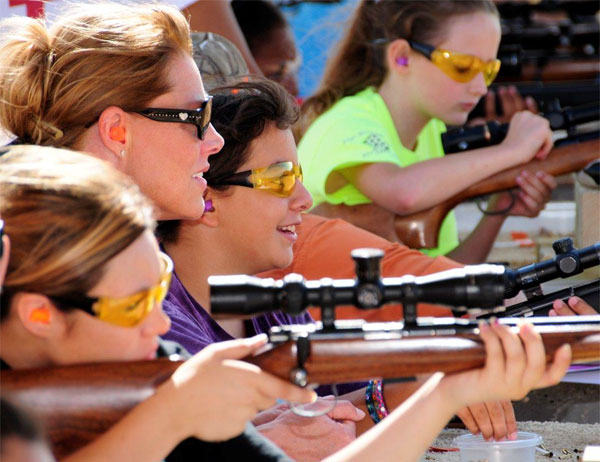
June 15th, 2013 is National Take Your Daughter to the Range Day. This is a great way to spend “quality time” with your daughter, and teach her the basics of firearms safety. At ranges nationwide, girls six and up will be able to try out a rifle, pistol, or shotgun. This event introduces young women to a sport that may become a life-long hobby, continuing a shooting tradition that helped make this country great.
Event co-founder and firearms instructor, Lynne Finch, believes it’s time to tear down the stereotypes and get those young ladies out to the range where they belong. “Boys learn to shoot in Scouts or with their Dads. Often, the girls are left behind because shooting isn’t ‘girly.’ Well, we can, and do shoot, and well. Learning to shoot gives young women confidence, helps to build self-esteem, and introduces them to a sport they can participate in their whole lives.”
The inaugural Take Your Daughter to the Range Day was held June 9, 2012, with 37 ranges in 15 states participating. The event is held each year on the third Saturday in June. Lynne Finch got the idea for the event after reading Julie Golob’s Book SHOOT, learning how Golob grew up going to the range with her father. Finch also learned from many other women how much they enjoyed going to the range with their parents during their youth. Sponsor support has made this event possible. 2013 Contributing Sponsors include: Brownells, Midway USA, Henry Rifles, Charter Arms, Front Sight Firearms Training Institute, and other organizations.
Many careful reloaders prefer to use a hand-tool for seating primers. The majority of short-range benchrest shooters seat one primer at a time, using finely-machined hand tools, such as the Sinclair priming tool Such tools offer unrivaled “feel” during the seating process, but they are slow to use and require that you handle primers with your fingers. If you’re a fumble-fingers type like this Editor, you’ll drop a primer now and then. That’s why I prefer a hand tool that keeps the primers in a strip or a tray.
We think one of the best affordable priming tools on the market is the latest RCBS hand tool. RCBS’s Universal Hand Priming Tool boasts some many nice features. The tool now shares the Universal shell-holder we liked so much in the RCBS APS (strip-priming) hand tool. An opposed set of spring-loaded jaws allows you to prime nearly all sizes of cases, without the need for conventional shell-holders. This makes the tool faster and more convenient if you load a variety of calibers. And you’re never “out-of-luck” if you can’t find the right shell-holder. However, you do have to change the “pusher” shaft when you switch from small primers to large primers or vice versa.
The universal shell-holder has another important benefit. With opposing jaws holding the casehead, this allows the case to “float” and align itself as the primer is seated. This may help primers seat more consistently every time. With most other hand-priming tools, the case is held by a conventional shell-holder. This leaves about 40% of the rim unsupported on one side. If you actually look closely at cases as you seat primers with conventional tools, you’ll see the case tilt in the shellholder as the primer is inserted. In the RCBS, by contrast, the case stays straight as the primer goes in. The new unit also shares its ergonomic grip (with plenty of leverage) with the APS model. A redesigned primer tray accommodates all brands of primer packages–you can easily load 100 primers at a time without worrying about spills. A unique Primer Safety Gate shields the primer being inserted from the remaining primers in the tray. That’s an important safety feature. The RCBS Universal Priming Tool retails for under $60.00 at major vendors such as Grafs.com, product #RCBS90201.
RCBS $10 CASH-BACK Rebate
RCBS is currently offering a $10 Mail-in Rebate good with the purchase of at least $50.00 in RCBS products. Purchase must be made between Jan. 1, 2013 and Dec. 31, 2013 and coupon must be received by Jan. 31, 2014. If you prefer, you can choose 100 Speer bullets rather than $10 cash back. CLICK HERE for RCBS $10 Mail-in Rebate Form.
Here are MidwayUSA user reviews for this tool:
“I have been reloading for 34 years and I don’t know why I didn’t buy one of these tools years ago. Everything about it is great. Changing from large primer to small primer was very easy. Ergonomic fit in the hand is good. Loading primers into the tray is no problem. The universal shell holder is a plus. I rate this product a 10″. — Keith McC., NH
“Primers flip as they should, and they are seated to a uniform depth. The universal shell holder is great! I reload .223 up to the Sharps 45-120 with no problem. Also as a few have said buy two and make each a seperate large and small primer unit. I happen to like it very much as it makes priming easy and portable.” — Tom H., NY
“This is a very well-made tool. I do not like the changing from small to large primers as it is a little bit of a time waster and a awkward. I think it is just a matter of time before one of the parts gets lost. If the price was a little lower I would just buy two. Much more substantial than the Lee which I have been using. I rate it 4 stars, deducting for price and the way you have to change between large and small. Works great however.” — Fred, FL
In late May, the U.S. District Court for the District of Columbia dismissed a lawsuit filed by the radical anti-hunting Center for Biological Diversity (CBD) and six other groups demanding that the EPA ban traditional ammunition containing lead components. NSSF filed a motion to dismiss the lawsuit last August. The court agreed with NSSF that EPA does not have the authority to regulate traditional ammunition under the Toxic Substances Control Act. EPA had already twice denied attempts by CBD to have the agency ban traditional ammunition, and the court had dismissed an earlier case brought by CBD seeking the same relief.
Traditional ammunition (with lead elements) represents 95 percent of the U.S. market and is the staple ammunition for target shooters, hunters and law enforcement, with more than 10 billion rounds sold annually.
“We are gratified that the court has found this second frivolous lawsuit, which is essentially the same as the one dismissed last year, was equally without merit,” said Lawrence G. Keane, senior vice president and general counsel for the National Shooting Sports Foundation, the trade association for the firearms and ammunition industry. In addition to NSSF, the National Rifle Association and Safari Club International intervened in the case.
“No sound science [shows that] the use of traditional ammunition has harmed wildlife populations or that it presents a health risk to humans who consume game taken with such ammunition,” said Keane. “Banning traditional ammunition would cost tens of thousands of jobs in America and destroy wildlife conservation that is funded in part by an 11 percent excise tax on the sale of ammunition. The protection and management of wildlife is properly handled by the professional biologists in the state fish and game agencies, as it has been for over a hundred years.”
Well it looks like there’s some real talent in the next generation of IBS Benchrest shooters. Watch out for those young guns — they can give seasoned veterans a run for their money — and then some. Young Kevin Donalds Jr. fired a perfect 250-25X score to win a 100-yard IBS score match at the Thurmont, Maryland range on May 18th, 2013. At just 12 years of age, Kevin is already showing he has the focus, talent, and determination to win. And, yes he managed to beat his proud father Kevin Donalds (Sr.) who finished second with a 250-23x. Like father, like son. It’s great to see a father and son who shoot together — and share the podium together.
Above, 12-year-old Kevin, match winner, is shown flanked on his left by his father (second place), and on his right by third place finisher Larry Fritz. Young Kevin was shooting a 30BR (no surprise), with a BAT action, Krieger barrel, and an affordable Sightron 8-32X scope (about $860). The rifle was smithed by Sid Goodling and stocked by Roy Hunter. The load was a stout charge of Hodgdon H4198, fired by Federal primers, pushing BIB 112gr bullets.
How would you like to lower your Extreme Spread (ES) and Standard Deviation (SD) significantly by a simple procedure that takes seconds and costs almost nothing?
Here’s all you need to do. After lubing your cases for full-length sizing, be sure to clean your hands (removing ALL residual lube) before you handle your bullets. As an extra measure to avoid lube contamination, slip on thin Latex gloves before you handle and seat your bullets. Will this make a difference? Let me tell you a story.
Keep Those Greasy Fingers Off Your Bullets
I recently loaded a couple dozen cases for a 6mm Dasher. We were in a hurry to leave for the range so I was loading faster than normal. When we started shooting the ammo I noticed that the 5-shot ES was bad — really bad — 48 fps. I was shocked because this was a known good load that had previously showed ES in the teens. This one had me stumped. What could have resulted in this high ES? What did I do different while reloading this time?
Then a lightbulb went off. I realized I had been seating bullets (round by round) immediately after lubing and sizing each case. My fingers still had some greasy lube on them which obviously got on some of the bullets, “polluting” them. My normal reloading procedure is to lube and size all cases, clean them off, then place the brass in a loading tray. Then I would clean my hands BEFORE adding powder and seating bullets. This time, in my rush, I sized a case, wiped it off, then immediately added powder and projectile. I did not take the time to clean off my fingers carefully before handling the bullets.
Big Drop in ES When I Avoided Bullet Contamination with Case Lube
The next day I went back to the loading room. I loaded the same brass with the same powder, same primer, same bullet type, same bushing — same everything. But this time, I washed my hands thoroughly with a hand cleaner, dried them with a clean paper towel, and I even put on thin latex gloves before handling the bullets. I loaded 10 rounds and fired them over the chronograph again in the same rifle. The 5-shot ES was 14 fps and the 10-shot ES was 22 fps (That’s normal for this load/rifle). Compare that to a 5-shot ES of 48 the day before. I had reduced my 5-shot ES by 70%! We were back in business. (By the way, the groups were also very small).
Lesson Learned — Keep Case Lube Off Your Bullets Your results may vary of course, but now I always make sure to remove ALL residual lube from my fingers before handling bullets or doing anything that can get unwanted lube inside the necks.
What about gloves? I don’t think the Latex gloves are essential (if your hands are dry and clean), but they just cost a few pennies when bought in bulk. You can buy a box of 100 latex gloves for under $7.00 on Amazon.com. I suggest the non-powdered type.
Use Your Common Sense
Before the critics launch a tirade, let me be the first to acknowledge that many champions have loaded perfectly good ammo (and shot great groups) without paying much attention to greasy fingers. We’ve all seen short-range benchresters loading ammo between relays. They work fast and may not take the time to clean all lube off their fingers before seating bullets. And we’ve seen some of those guys go out and shoot itty-bitty groups in the ones and zeros. So I am NOT claiming that careful “reloading bench hygiene” is essential to shooting small!
All I am saying is that I observed and recorded a significant drop in my ES when I made sure to avoid contaminating bullet jackets with case lube. This is a simple precaution that is easy to follow when loading at home. It may help you cut your ES/SD. It may help avoid that one “mystery flyer” that ruins a group. Cleaning your hands before seating bullets may seem obsessive. But the smart reloader knows that paying attention to the small details, in all respects, is the key to making ultra-accurate ammo that exhibits low ES/SD on the chronograph.
Report based on story by Lars Dalseide forNRABlog.
The NRA Bianchi Cup Championship was held May 22-25 in Columbia, Missouri. One of the premier pistol-shooting competitions on the planet, the Bianchi Cup attracts top handgunners from around the globe. From a spectator’s standpoint, one of the most exciting phases of the competition is the Colt Speed Event, where dueling duos of shooters draw and fire in under four seconds.
Nothing calls for a greater combination of agility and accuracy than the MidwayUSA/NRA Bianchi Cup’s Colt Speed Event. One of four separate stages in the Bianchi Cup Championships, the Colt Speed event begins with two shooters on the firing line. When the horn sounds, they draw and fire at six plates. The fastest finish wins. Win two out of three and you advance to the next round. Watch the video to see how it works.
Colt Speed Event at 2013 Bianchi Cup Championships
We like to use the Birchwood Casey 2″ and 3″ orange “Target Spots” stick-on circles (with diamond centers) for shooting at 300 yards and beyond (photo right). These give you a very precise aiming point if you align your cross-hairs with the corners of the diamond. However, we know that some guys, particularly those whose scopes have “target-dot” reticles, prefer to have a small box for an aim point. In addition, the orange Target Spots are not a true “Day-glo” color, so they may seem a little dull (low-contrast) when the target is in shadow.
For guys who want an ultra-high contrast target with a square box in the center, Birchwood Casey has released a new series of neon green targets with box centers and spike-style extended vertical and horizontal lines (like on a compass). The manufacturer explains: “These newly designed adhesive Target Spots come in highly-visible Atomic Green. The crosshair design fulfills the needs of open-sight shooters along with scope users. Easily line up your open sights on the center square or lay the crosshairs along the vertical and horizontal diminishing lines.” You can also rotate the Atomic Green Target Spots 45° to create a diamond center with the crosshairs in an “X” pattern.
We’ve sampled these targets. The Atomic Green background is a true “day-glo” color (like safety signs) so these circles appear very bright on a target backer. These work well in low light. We won’t throw away our orange Target Spots, but these Atomic Green circles are a nice option. NOTE: Atomic Green spots are NOT “splatter” targets — a contrasting bright color does NOT appear around your bullet holes.
Multiple Sizes Offered
Birchwood Casey sells the new Atomic green circles in various sizes. You can order a Combo Pack with sixty 1″-diameter spots, thirty 2″-diameter spots, and twenty 3″-diameter circles.
Shooting a 50 BMG, off-hand, at 1000 yards may seem absolutely nuts, but read on — this story should make you smile. At the Texas Triggers Ranch (Sonora, TX), former Army Ranger and Sniper Team Leader Ryan Cleckner, shooting OFF-HAND, hit a torso-sized steel silhouette target at 1000 yards with a 50-caliber Barrett M107. That would be impressive enough, but consider this — Ryan hit the target on his first shot. And yes he was shooting standing (on his hind legs), holding the 37-pound rifle with his arms (no support).
Watch VIDEO of Ryan Cleckner Shooting Barrett M107 Off-Hand at 1000 Yards
Jumbo-Sized Ammo, and Jumbo-Sized Recoil
The ammo Ryan used in his 50 BMG Barrett pushes a 661-grain bullet at 2900 fps muzzle velocity. This load (fired from this 37-pound rifle), has 12,357 ft-lbs of energy at the muzzle, and 81.88 ft-lbs of recoil energy. To put things in perspective, an 18-pound, .308 Win F-TR rifle, shooting a 168gr bullet at 2750 fps, has 7.99 ft-lbs of recoil energy. So, Ryan was shouldering a weapon that delivered more than Ten Times the recoil energy of a .308 Win. (Energy numbers calculated with Point Blank software). And he made it look easy. Kudos to Ryan for proving what a properly-trained marksman can do. Rangers Lead the Way….
Credit Steve Johnson of The Firearm Blog for finding this video.
The USA Shooting National Championships for Rifle and Pistol will be held June 3-9, at the home of the U.S. Army Marksmanship Unit (USAMU) in Fort Benning. More than 500 competitors will vie for national titles in rifle and pistol disciplines. This year’s National Championships serves as a World Cup selection match with the top-three finishers in each Olympic event open class earning a berth in the upcoming World Cup in Granada, Spain in July.
Many talented athletes will visit Fort Benning next week, including 2012 Olympian and Prone National Champion Michael McPhail and Olympic and USAMU teammate Eric Uptagrafft. 2012 Olympians Jason Turner and Keith Sanderson will be returning to defend their titles in Men’s 10m Air and 25m Rapid Fire Pistol. On the women’s side, 2012 Olympian Sarah Scherer looks to repeat as National Champion in 10m Air Rifle. Other standouts include National Rifle Team members Emily Holsopple, Sarah Beard, and Amy Sowash.
More information can also be found on the USA Shooting website (USAShooting.org) by clicking on the ‘Match Information’ link located under the ‘Events’ tab. Look for scores on USA Shooting’s match results page following each competition. Photos will be posted on USA Shooting’s Flickr photo gallery.
Looking for bargain-priced hearing protection for your gun club or shooting association? Contributing Editor German Salazar found some great deals on high-NRR earplugs.
Cooper Safety offers discount pricing on bulk packs of quality foam earplugs. The Howard Leight ‘Max’ plugs are now just $26.88 for 200 pairs, less than 13 cents a pair! These are some of our favorite foam plugs. They are comfortable and they have a 33db Noise Reduction Rating (NRR 33), the highest certified protection rating measured. Corded versions are also offered for $24.95 for ONE HUNDRED pairs (note quantity difference). Cooper also has the easy-to-insert Howard Leight Laser Lite disposable plugs. These cost just $21.95 for 200 pairs — less than 11 cents per pair. The pink/yellow Laser Lites feature a “winged” shape that some folks think is easier to place in the ear. The Laser Lite plugs are rated at NRR 32, slightly lower than the Howard Leight ‘Max’ plugs.
Re-Usable SmartFit Conforming Plugs
If you prefer a re-usable type of earplug, we recommend the orange Howard Leight SmartFit corded plugs. These three-flange plugs employ Conforming Material Technology (CMT) so the orange insert actually softens and conforms to your ear canal as it warms with with body heat. The longer you wear them the better they fit. They are a little stiff when you put them in initially, however they quickly form-fit and become much more comfortable, with a very good seal.
Howard SmartFit ear plugs have a 25 dB Noise Reduction Rating (NRR 25). However, this Editor uses them regularly (I keep two sets in my range kit) and they really seem at least as quiet as most soft foam plugs. SmartFits are easily cleaned with warm water. These corded SmartFit plugs typically sell for a couple bucks at gunshops. You can save big-time by buying in bulk. Amazon.com sells 100 pairs of corded SmartFits for $68.95 (with free shipping). Each pair comes in a small carry-case.
Because SmartFits have a short stalk attached to the cord, they are easier to put in and take out over the course of a day. I prefer to use SmartFit plugs in situations where I’ll spend most of my time well away from the firing line (as when in the pits). I then insert them when I get closer to the action. In my experience, these are exceptionally effective when inserted properly. Though they have a lesser NRR than some foam plugs, in my ears, nothing silences noise better (once they’ve formed to fit). Others agree: “I have used many earplugs working in the offshore industry. I find these [SmartFits] far superior to others I have used. Tip — if you wet the end of the plug, they go in very easy and to the depth you need — Rick, Safety System Services”. You may want to try a pair — but be aware, some people can’t tolerate these because they are initially somewhat stiff. You either love ‘em or hate ‘em.



 Many careful reloaders prefer to use a hand-tool for seating primers. The majority of short-range benchrest shooters seat one primer at a time, using finely-machined hand tools, such as the Sinclair priming tool Such tools offer unrivaled “feel” during the seating process, but they are slow to use and require that you handle primers with your fingers. If you’re a fumble-fingers type like this Editor, you’ll drop a primer now and then. That’s why I prefer a hand tool that keeps the primers in a strip or a tray.
 In late May, the U.S. District Court for the District of Columbia dismissed a lawsuit filed by the radical anti-hunting Center for Biological Diversity (CBD) and six other groups demanding that the EPA ban traditional ammunition containing lead components. NSSF filed a motion to dismiss the lawsuit last August. The court agreed with NSSF that EPA does not have the authority to regulate traditional ammunition under the Toxic Substances Control Act. EPA had already twice denied attempts by CBD to have the agency ban traditional ammunition, and the court had dismissed an earlier case brought by CBD seeking the same relief.


 How would you like to lower your Extreme Spread (ES) and Standard Deviation (SD) significantly by a simple procedure that takes seconds and costs almost nothing?

 Report based on story by Lars Dalseide for
 We like to use the Birchwood Casey 2″ and 3″ orange “Target Spots” stick-on circles (with diamond centers) for shooting at 300 yards and beyond (photo right). These give you a very precise aiming point if you align your cross-hairs with the corners of the diamond. However, we know that some guys, particularly those whose scopes have “target-dot” reticles, prefer to have a small box for an aim point. In addition, the orange Target Spots are not a true “Day-glo” color, so they may seem a little dull (low-contrast) when the target is in shadow.

 Shooting a 50 BMG, off-hand, at 1000 yards may seem absolutely nuts, but read on — this story should make you smile. At the


 The USA Shooting National Championships for Rifle and Pistol will be held June 3-9, at the home of the U.S. Army Marksmanship Unit (USAMU) in Fort Benning. More than 500 competitors will vie for national titles in rifle and pistol disciplines. This year’s National Championships serves as a World Cup selection match with the top-three finishers in each Olympic event open class earning a berth in the upcoming World Cup in Granada, Spain in July.

 Looking for bargain-priced hearing protection for your gun club or shooting association? Contributing Editor German Salazar found some great deals on high-NRR earplugs.


