SCATT Company, based in Russia, produces an advanced marksmanship training aid that is now being used by many of the world’s top prone and position shooters. The SCATT system uses a gun-mounted infrared (IR) sensor that precisely tracks the movement of the rifle during the aiming process. This tracking data can then be displayed on a computer screen or special electronic targets. In development since 1991, the SCATT system was first employed by the Russian Federation shooting team. However, the SCATT technology was released commercially and is now being used by many other national teams including: USA, China, France, Germany, Japan, and Switzerland.
SCATT Training Systems employ an electronic optical sensor fixed to a gun’s barrel, frame, or the compressed air cylinder of an air gun. The shooter then aims at the electronic target. A trace of the point of aim can then be followed on a ‘real-time’ display screen. When the shooter pulls the gun’s trigger, the point of impact is then displayed on the screen. (This is dry-fire only — no projectiles are loaded). All results of training sessions can be recorded for later analysis. Russian research has shown that SCATT training is both effective and efficient. Using SCATT, beginning marksmen can acquire competitive skills two to three times more quickly than with conventional practice methods alone.
SCATT Shows How an Olympian Holds
The video below shows the aiming patterns of Olympic bronze medalist Miss Snježana Pejčić, a 10m Air Rifle shooter. The SCATT system records the air rifle’s muzzle motions as green traces while Snježana dials in her aim. Her final shot positions (and scores) are recorded when the large circle appears.
SCATT Company has dealers worldwide for its training systems, electronic targets, and shooting accessories. To order SCATT systems in the USA, contact:
Center Shot Sports
www.CenterShot.com
4300 Rogers Ave., Suite 20,
Box 213
Fort Smith, AR 72903
Phone: 479-262-2584
E-mail: info [at] centershot.com
If you’re looking for an affordable holiday gift for a shooting buddy or family member, a gift that will be appreciated month after month, consider a magazine subscription. Every month your buddy or relative will get something new in the mail — so it’s like sending a dozen gifts over the course of the year. Your Editor receives a couple magazine subscriptions that were gifts from my brother, and I really do look forward to the magazines’ arrival in my mailbox each month. And each time I open up a new issue of Nat Geo or Shooting Times I think, “Thanks Bro — that was a thoughtful gift — you made my day.”
In our Shooters Forum, one newcomer wanted some advice on selecting a reticle for F-Class optics. He wondered about the advantage of Forward Focal Plane (FFP) vs. conventional scopes and also wondered if one type of reticle was better for “holding off” than others.
In responding to this question, Forum regular Monte Milanuk provided an excellent summary of aiming methods used in F-Class. For anyone shooting score targets, Monte’s post is worth reading:
Aiming Methods for F-Class Shooting — by Monte Milanuk
F-Class is a known-distance event, with targets of known dimensions that have markings (rings) of known sizes. Any ‘holding off’ can be done using the target face itself. Most ‘benefits’ of forward focal plain (FFP) optics are null and void here — they work great on two-way ranges where ‘minute of man’ is the defining criteria — but how many FFP scopes do you know of in the 30-40X magnification range? Very, very few, because what people who buy high-magnification scopes want is something that allows them to hold finer on the target, and see more detail of the target, not something where the reticle covers the same amount of real estate and appears ‘coarser’ in view against the target, while getting almost too fine to see at lower powers.
Whether a person clicks or holds off is largely personal preference. Some people might decline to adjust their scope as long as they can hold off somewhere on the target. Some of that may stem from the unfortunate effect of scopes being mechanical objects which sometimes don’t work entirely as advertised (i.e. one or two clicks being more or less than anticipated). Me personally, if I get outside 1-1.5 MOA from center, I usually correct accordingly. I also shoot on a range where wind corrections are often in revolutions, not clicks or minutes, between shots.
Some shooters do a modified form of ‘chase the spotter’ — i.e. Take a swag at the wind, dial it on, aim center and shoot. Spotter comes up mid-ring 10 at 4 o’clock… so for the next shot aim mid-ring 10 at 10 o’clock and shoot. This should come up a center X (in theory). Adjust process as necessary to take into account for varying wind speeds and direction.
Others use a plot sheet that is a scaled representation of the target face, complete with a grid overlaid on it that matches the increments of their optics — usually in MOA. Take your Swag at the wind, dial it on, hold center and shoot. Shot comes up a 10 o’clock ‘8’… plot the shot on the sheet, look at the grid and take your corrections from that and dial the scope accordingly. This process should put you in the center (or pretty close), assuming that you didn’t completely ignore the wind in the mean time. Once in the center, hold off and shoot and plot, and if you see a ‘group’ forming (say low right in the 10 ring) either continue to hold high and left or apply the needed corrections to bring your group into the x-ring.
Just holding is generally faster, and allows the shooter to shoot fast and (hopefully) stay ahead of the wind. Plotting is more methodical and may save your bacon if the wind completely changes on you… plotting provides a good reference for dialing back the other way while staying in the middle of the target. — YMMV, Monte
If you don’t own an in-vehicle GPS yet, you should strongly consider getting one. By routing you efficiently to your destination, a good GPS can save you time and save you money (by burning less fuel). By fixing your precise location, a GPS also performs a safety function should your vehicle break down or should you have some other emergency.
Here is a smokin’ deal on a very fine GPS, in the new, larger 5″-wide format. Right now, on Amazon.com you can get the Garmin Nüvi 50LM 5-Inch GPS Navigator with Lifetime Maps (USA) for just $99.99. This unit, the #1 – selling GPS on Amazon.com, features a big 5” (12.7 cm) touchscreen, spoken turn-by-turn directions, and more than 5 million points of interest (POIs). With the price of gas these days, the Garmin Nüvi 50LM can pay for itself in a few months of use.
NOTE: The $99.99 Amazon deal is a special promo price that may not last long — you snooze you loose! Right now, this same unit sells for $120 at Walmart, $140 at Fry’s, and $163 at Sears!
Free USA Maps Updated Four Times a Year
At just $99.99, the Garmin Nüvi 50LM is an exceptional value because it includes Lifetime Maps for the USA. This entitles you to FREE map updates up to four times a year, as long as you live. Along with the pre-loaded map data, this unit ships with: vehicle suction cup mount, vehicle power cable, USB cable (for synching with your computer), and a Quick start manual.
Note: The Garmin Nüvi 50LM gives you spoken turn-by-turn navigation, but it is NOT voice-activated. In other words, the 50LM will NOT react to the driver’s Voice Commands, nor will it locate a destination by voice input. We don’t think that is really much of a shortcoming. This Editor owns a Garmin with voice-recognition. It was amusing for a day or so, but I ended up turning the Voice Command feature off because it was unreliable. I found that it was much faster and easier to just tap the buttons on the touch screen for all important functions.
Bill Gravatt, President of Sinclair International, has chosen to leave his current position with Sinclair International, where he has served for 22 years. Bill told us “I sold Sinclair International to Brownells, Inc. in 2007 and have completed my five-year contract as part of the transition process. I had the opportunity to remain as President after my contract expired but, after giving the matter a great deal of thought over the past six months, I felt it was time to move in a new direction. I wish everyone at Sinclair International and Brownells all the best in the future.”
In Sinclair’s Reloading Press Blog*, Bill thanks Sinclair customers for their patronage and assures readers that Sinclair will continue to provide same high level of customer service.
Message from Bill Gravatt As you know, I sold Sinclair International to Brownells a while back. Pete and Frank Brownell and I had known each other for years, and we all agreed that the two companies would be a good fit, both in the way we treat customers as valued friends and the way our respective customer bases are complementary, similar but not identical. We also agreed that I would stay on as President of Sinclair for five years to help manage the transition.
The five years ended last summer, and now under the Brownells stewardship, Sinclair will continue to serve its customers — you — with the same care and consideration my father-in-law Fred Sinclair and I would give you. I consider it a privilege and a pleasure to have been able to serve you over the years.
Now it’s time to move on with the next (actually the third) phase of my adult life (some of you may know the first phase was the nuclear power industry). I’m certainly going to be around… I plan to continue working in the firearms industry, and you’re going to still see me at competitions and events — maybe more than before. I hope to see you at an NRA Show[.]
In the meantime, I plan to spend Christmas the way I hope you do — with friends and family, relaxing and celebrating the blessings of this life. And maybe getting started on that big winter reloading project. Wouldn’t it be great to head into the 2013 shooting season with your ammo loaded up and ready to go? Spring is closer than you think! But first [comes] Christmas — all my best wishes to you and those close to you.
Good Shooting — Bill Gravatt
*Geoff Esterline, a key member of the Sinclair team for over 15 years, has agreed to take over as Contributing Editor of the Reloading Press Blog. Bill has “every confidence” in Geoff’s capabilities.
You’ve heard of Heavy Metal, maybe even Heavy Water, but what about Heavy Sand? Every serious shooter should know about Heavy Sand for benchrest sandbags. Heavy Sand can weigh up to twice as much as ordinary silica sand (sold as “Play Sand”). By filling your rear bag with Heavy Sand rather than silica sand, you can nearly double the bag’s mass, and that can translate to better bag performance. A heavier bag resists movement and stays aligned better during recoil. If your bag moves during recoil, or becomes misaligned from shot to shot, that can alter your point of impact and open up your groups. Adding weight to your rear bag is a simple, cost-effective way to shoot more consistently, with greater overall accuracy.
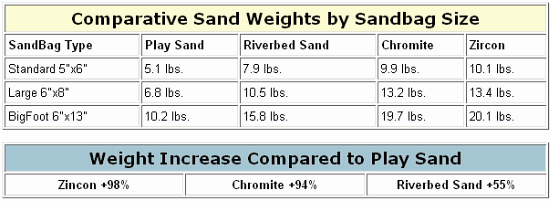
Jason tested and compared four kinds of sandbag fillers: Zircon, Chromite, Riverbed Sand, and ordinary Play Sand. Zircon is the heaviest type of sand readily available to shooters, followed by Chromite. Zircon is 98% heavier than Play Sand, while the black Chromite sand is 94% heavier than Play Sand. Riverbed Sand, commonly sold in pet stores as “Reptile Sand”, is less dense, measuring about 55% heavier than Play Sand.
Increase Bag Weight Up to 10 pounds
Compared to silica sand, how much extra weight can Heavy Sand (Zircon, Chromite, Riverbed) add to your sandbag? Up to 10 pounds, depending on the size of your rear bag. Check the chart below for the specifics. By filling a standard bunny ear bag with Zircon (vs. silica sand), you can increase bag weight by about 5 pounds. A super-sized BigFoot bag can gain 10 pounds in overall weight when filled with Zircon as opposed to silica sand.
To learn more about Heavy Sand (and where you can buy it), read Jason’s comprehensive Sand Comparison Article. It includes photos of the different sand types and links to Heavy Sand vendors, such as R.W. Hart (Zircon) and Sinclair International (Chromite).
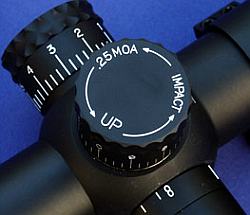
Let’s say you’ve purchased a new scope, and the spec-sheet indicates it is calibrated for quarter-MOA clicks. One MOA is 1.047″ inches at 100 yards, so you figure that’s how far your point of impact (POI) will move with four clicks. Well, unfortunately, you may be wrong. You can’t necessarily rely on what the manufacturer says. Production tolerances being what they are, you should test your scope to determine how much movement it actually delivers with each click of the turret. It may move a quarter-MOA, or maybe a quarter-inch, or maybe something else entirely. (Likewise scopes advertised as having 1/8-MOA clicks may deliver more or less than 1 actual MOA for 8 clicks.)
Reader Lindy explains how to check your clicks: “First, make sure the rifle is not loaded. Take a 40″ or longer carpenter’s ruler, and put a very visible mark (such as the center of an orange Shoot’N’C dot), at 37.7 inches. (On mine, I placed two dots side by side every 5 inches, so I could quickly count the dots.) Mount the ruler vertically (zero at top) exactly 100 yards away, carefully measured.
Place the rifle in a good hold on sandbags or other rest. With your hundred-yard zero on the rifle, using max magnification, carefully aim your center crosshairs at the top of the ruler (zero end-point). Have an assistant crank on 36 (indicated) MOA (i.e. 144 clicks), being careful not to move the rifle. (You really do need a helper, it’s very difficult to keep the rifle motionless if you crank the knobs yourself.) With each click, the reticle will move a bit down toward the bottom of the ruler. Note where the center crosshairs rest when your helper is done clicking. If the scope is accurately calibrated, it should be right at that 37.7 inch mark. If not, record where 144 clicks puts you on the ruler, to figure out what your actual click value is. (Repeat this several times as necessary, to get a “rock-solid”, repeatable value.) You now know, for that scope, how much each click actually moves the reticle at 100 yards–and, of course, that will scale proportionally at longer distances. This optical method is better than shooting, because you don’t have the uncertainly associated with determining a group center.
Using this method, I discovered that my Leupold 6.5-20X50 M1 has click values that are calibrated in what I called ‘Shooter’s MOA’, rather than true MOA. That is to say, 4 clicks moved POI 1.000″, rather than 1.047″ (true MOA). That’s about a 5% error.
I’ve tested bunches of scopes, and lots have click values which are significantly off what the manufacturer has advertised. You can’t rely on printed specifications–each scope is different. Until you check your particular scope, you can’t be sure how much it really moves with each click.
I’ve found the true click value varies not only by manufacturer, but by model and individual unit. My Leupold 3.5-10 M3LR was dead on. So was my U.S.O. SN-3 with an H25 reticle, but other SN-3s have been off, and so is my Leupold 6.5-20X50M1. So, check ‘em all, is my policy.”
From the Expert: “…Very good and important article, especially from a ballistics point of view. If a ballistics program predicts 30 MOA of drop at 1000 yards for example, and you dial 30 MOA on your scope and hit high or low, it’s easy to begin questioning BCs, MVs, and everything else under the sun. In my experience, more than 50% of the time error in trajectory prediction at long range is actually scope adjustment error. For serious long range shooting, the test described in this article is a MUST!” — Bryan Litz, Applied Ballistics for Long-Range Shooting.
The Sporting Arms and Ammunition Manufacturers’ Institute (SAAMI) has produced an amazing 25-minute video that shows what actually happens to sporting ammunition involved in a fire. This video shows the results of serious tests conducted with the assistance of professional fire crews. We strongly recommend you watch this video, all the way through. It dispels many myths, while demonstrating what really happens when ammunition is burned, dropped, or crushed.
Watch SAAMI Ammunition Testing Video
Over 400,000 rounds of ammunition were used in the tests. Some of the footage is quite remarkable. Testers built a bonfire with 28,000 rounds of boxed ammo soaked in diesel fuel. Then the testers loaded five pallets of ammo (250,000 rounds) in the back of a semi-truck, and torched it all using wood and paper fire-starting materials doused with diesel fuel.
The video shows that, when ammo boxes are set on fire, and ammunition does discharge, the bullet normally exits at low speed and low pressure. SAAMI states: “Smokeless powders must be confined to propel a projectile at high velocity. When not in a firearm, projectile velocities are extremely low.” At distances of 10 meters, bullets launched from “cooked-off” ammo would not penetrate the normal “turn-out gear” worn by fire-fighters.
We are not suggesting you disregard the risks of ammo “cooking off” in a fire, but you will learn the realities of the situation by watching the video. There are some amazing demonstrations — including a simulated retail store fire with 115,000 rounds of ammo in boxes. As cartridges cook off, it sounds like a battery of machine-guns, but projectiles did not penetrate the “store” walls, or even two layers of sheet-rock. The fire crew puts out the “store fire” easily in under 20 seconds, just using water.
Additional Testing: Drop Test, Projectile Test, Crush Test, Blasting Cap Test
Drop Test
The video also offers interesting ammo-handling tests. Boxes of ammo were dropped from a height of 65 feet. Only a tiny fraction of the cartridges discharged, and there was no chain-fire. SAAMI concludes: “When dropped from extreme heights (65 feet), sporting ammunition is unlikely to ignite. If a cartridge ignites, it does not propagate.”
Rifle Fire Test
SAAMI’s testers even tried to blow up boxes of ammunition with rifle fire. Boxes of loaded ammo were shot with .308 Win rounds from 65 yards. The video includes fascinating slow-motion footage showing rounds penetrating boxes of rifle cartridges, pistol ammo, and shotgun shells. Individual cartridges that were penetrated were destroyed, but adjacent cartridges suffered little damage, other than some powder leakage. SAAMI observed: “Most of the ammunition did not ignite. When a cartridge did ignite, there was no chain reaction.”
Bulldozer Crush Test
The test team also did an amazing “crush-test” using a Bulldozer. First boxes of loaded ammo, then loose piles of ammo, were crushed under the treads of a Bulldozer. A handful of rounds fired off, but again there was no chain-fire, and no large explosion. SAAMI observed: “Even in the most extreme conditions of compression and friction, sporting ammunition is unlikely to ignite. [If it does ignite when crushed] it does not propagate.”
Blasting Cap Test
Perhaps most amazingly, the testers were not able to get ammunition to chain-fire (detonate all at once), even when using blasting caps affixed directly to live primers. In the SAAMI test, a blasting cap was placed on the primer of a round housed in a large box of ammo. One cartridge ignited but the rest of the boxed ammo was relatively undamaged and there was no propagation.
In the wintertime, it’s common to encounter problems with static electricity when throwing your powder charges. The static can cause powder kernels to cling to the surface of reloading components, and can cause powder clumping. Clumped or sticky powder may make your measure bind or grab in the middle of the cycle, which can throw off your charge weight. Here are a couple simple ways you can minimize the effects of static electricity and improve the consistency of your powder measuring.
Ground Your Powder Measure — If you’re throwing powder charges in the fall or winter and have problems with bridging or sticking powder, use a ground wire. Bullet-smith Victor Johnson (Johnson Precision Bullets) tells us: “I have a 25-foot piece of real small wire with alligator clips on each end. It’s that long so I can run it down the hall to a water pipe. Use the wire tie from a bread bag to hold it in a small roll to put in the range box. When using it at the range use a 6″ nail from the co-op or Lowe’s / Home Depot and just push it into the ground.”
Use Bounce Dryer Sheets — A quick pass with the thin sheets used in dryers will eliminate “static cling” on your plastic reloading parts like powder throwers, powder funnels, and reloading press guides. Thanks to Doc76251 for this tip.
Reduce Electronic Scales’ Drift with Anti-Static Spray
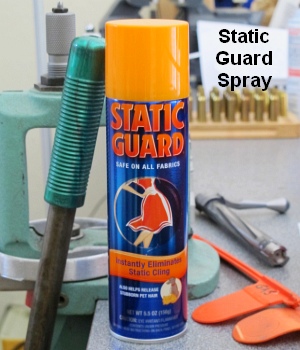
Apparently reducing static charges on and around electronic scales can reduce their propensity to drift, lessening the problem of “wandering zero”. Just how and why static charges interfere with scale performance is unclear, but many shooters have noticed that static electricity can cause electronic scales to behave strangely. So how do you reduce static charges around your digital balance? German Salazar has found a very simple solution — an anti-static aerosol spray — that, by all indications, actually works. When this “spray-can solution” was suggested to German by a fellow shooter, German was skeptical. However, German tried the stuff and he says that it really does help the scale maintain zero over time, with much less observed drift.
On his Rifleman’s Journal website, German explains that the use of “Static Guard” spray helped mitigate the problem of a drifting zero on his Ohaus Navigator electronic scale. German writes: “My electronic scale… suffers from drifting zero (as they all seem to). I’ve read dozens of forum posts about drift and how to minimize its occurrence, so I know this problem isn’t limited to my scale or my workshop. Sometime last year, John Lowther mentioned the use of anti-static spray as a solution to the drift problem. John stated that the spray had virtually eliminated drift for him.”
German found that the Static Guard actually worked: “The spray works great, just as John said it would. I spray all surfaces that I touch with my hands and arms as well as the pan (top and bottom), the metal tray on which the pan rests and the table under the scale. In six months or so of using the spray I’ve re-applied it about two or three times; it certainly isn’t something that you need to do each time you sit down to load. Before using the spray, it was not uncommon for me to re-zero the scale 10 times in the course of loading 72 rounds; now it might need it once during a session.”
To help you in the quest for good deals this holiday shopping season, the folks here at AccurateShooter.com have searched through scores of items on Amazon.com. We’ve located some of the best shooting accessories and outdoor gear you can get for under $35.00. And, mind you, that’s just the upper limit. Many of these items are under twenty bucks — that’s a bargain.
Your Editor personally purchased and now uses many of the items shown here, including the MTM Rimfire Box, Tipton Jag Kit, Kintrex Temp Gauge, Frankford Arsenal Bullet Puller, Leupold Lens Pen, Uvex Safety Glasses, Hoppes Gun Cleaning Pad, Transcend Flash Memory, SKIL Li-Ion Screwdriver, and Olympia Deerskin Gloves. These are all fine products for the price.
The box below displays 12 items. Refresh the page to see more selections or visit our Amazon.com affiliate store. There you’ll find recommended gear, books, optics, electronics, and more.


 SCATT Company has dealers worldwide for its training systems, electronic targets, and shooting accessories. To order SCATT systems in the USA, contact:
 F-Class is a known-distance event, with targets of known dimensions that have markings (rings) of known sizes. Any ‘holding off’ can be done using the target face itself. Most ‘benefits’ of forward focal plain (FFP) optics are null and void here — they work great on two-way ranges where ‘minute of man’ is the defining criteria — but how many FFP scopes do you know of in the 30-40X magnification range? Very, very few, because what people who buy high-magnification scopes want is something that allows them to hold finer on the target, and see more detail of the target, not something where the reticle covers the same amount of real estate and appears ‘coarser’ in view against the target, while getting almost too fine to see at lower powers.

 Others use a

 Free USA Maps Updated Four Times a Year
 As you know, I sold Sinclair International to Brownells a while back. Pete and Frank Brownell and I had known each other for years, and we all agreed that the two companies would be a good fit, both in the way we treat customers as valued friends and the way our respective customer bases are complementary, similar but not identical. We also agreed that I would stay on as President of Sinclair for five years to help manage the transition.

 Reader Lindy explains how to check your clicks: “First, make sure the rifle is not loaded. Take a 40″ or longer carpenter’s ruler, and put a very visible mark (such as the center of an orange Shoot’N’C dot), at 37.7 inches. (On mine, I placed two dots side by side every 5 inches, so I could quickly count the dots.) Mount the ruler vertically (zero at top) exactly 100 yards away, carefully measured.
 The Sporting Arms and Ammunition Manufacturers’ Institute (

 We are not suggesting you disregard the risks of ammo “cooking off” in a fire, but you will learn the realities of the situation by watching the video. There are some amazing demonstrations — including a simulated retail store fire with 115,000 rounds of ammo in boxes. As cartridges cook off, it sounds like a battery of machine-guns, but projectiles did not penetrate the “store” walls, or even two layers of sheet-rock. The fire crew puts out the “store fire” easily in under 20 seconds, just using water.


 Apparently reducing static charges on and around electronic scales can reduce their propensity to drift, lessening the problem of “wandering zero”. Just how and why static charges interfere with scale performance is unclear, but many shooters have noticed that static electricity can cause electronic scales to behave strangely. So how do you reduce static charges around your digital balance? German Salazar has found a very simple solution — an anti-static aerosol spray — that, by all indications, actually works. When this “spray-can solution” was suggested to German by a fellow shooter, German was skeptical. However, German tried the stuff and he says that it really does help the scale maintain zero over time, with much less observed drift.

 To help you in the quest for good deals this holiday shopping season, the folks here at AccurateShooter.com have searched through scores of items on Amazon.com. We’ve located some of the best shooting accessories and outdoor gear you can get for under $35.00. And, mind you, that’s just the upper limit. Many of these items are under twenty bucks — that’s a bargain.


