Wow. If James Bond shot F-TR, we think this is what he might use. You’re looking at the radical new Steve Jennings stock for F-TR competition. This skeletonized stock is crafted to fit the Barnard action. As you can see, there is no conventional fore-arm. Instead a carbon fiber tube extends forward of the action. At the front end of the tube, a fixture hold the beefy, forward-angled, girder-style bipod legs. These legs adjust to two heights, for prone or bench shooting. Large Delrin cylinders at the bottom of the legs provide stability and help resist bipod hop. Cost of the Jennings stock, including bipod legs and bag-rider assembly, is $700.00 at Chesebro Rifles.
The rear bag-rider, which adjusts for height, is also carried by a carbon-fiber tube that runs from the bottom of the pistol grip back to the buttplate. The bag-rider is attached via an eccentric fixture. This way, as you spin it in and out, the vertical position changes. This allows you to get the elevation centered -up on the target, but this system is not designed for fast changes “on the fly”. Small changes in elevation are made by squeezing the bag.
Mark Chesebro also offers a complete rifle built around the new Jennings stock. Built with a Barnard Action, Trueflite (NZ) barrel, and Barnard trigger, a complete Jennings F-TR rifle costs $2500.00. For more information on the Steve Jennings F-TR stock, or complete rifles built with this stock, visit ChesebroRifles.com or call (805) 280-5311. We hope to get our hands on one of these rigs for testing very soon!
EDITOR’s COMMENT: Now it would be great if Seb Lambang’s joystick bipod head could somehow be adapted to this rig, with the joystick running under the carbon fiber “fore-end”, but still using the forward-angled Jennings girder-style legs and oversize “Coke-Can” bipod feet. That could definitely be a James Bond-worthy F-TR rig.
Product Tip by EdLongrange. We welcome reader submissions.
Report based on story by Lars Dalseide forNRAblog
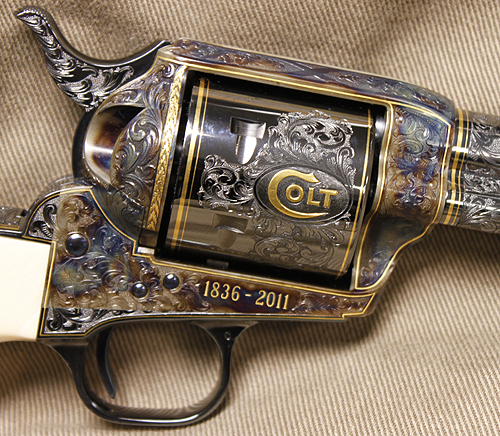
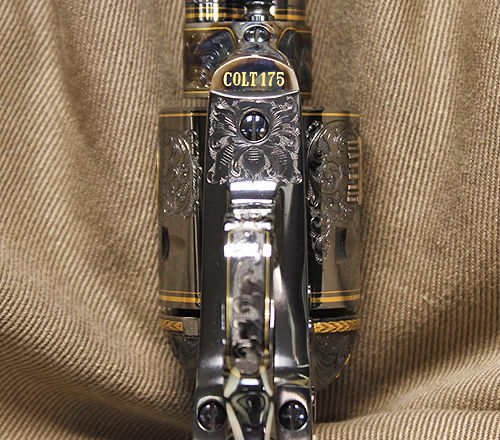
Colt Manufacturing’s 175th Anniversary Single Action Army revolver is now on loan at the NRA National Firearms Museum. The one-of-a-kind gun (serial number 175) was crafted by the Colt’s Custom Shop and engraved by Master Engravers Steve Kamyk and George Spring. It was created “to commemorate the 175th Anniversary of Colt Firearms”, notes Timothy Looney, Custom Shop Manager.
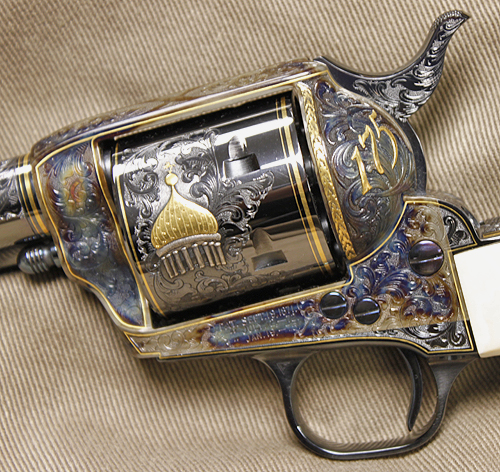
The firearm is based on the Colt Single Action Army with a black powder-style frame finished in color case hardening. The barrel, cylinder, trigger guard, and backstrap are finished in Carbonia Blue and the balance of small parts are fire-blued. The firearm has been scroll-engraved with C+ coverage and is accented by full gold frame borders including raised running leaf on both sides of the recoil shield. The left recoil shield exhibits “175” in high-relief gold over raised-relief scroll.
CLICK image squares to see larger photos.
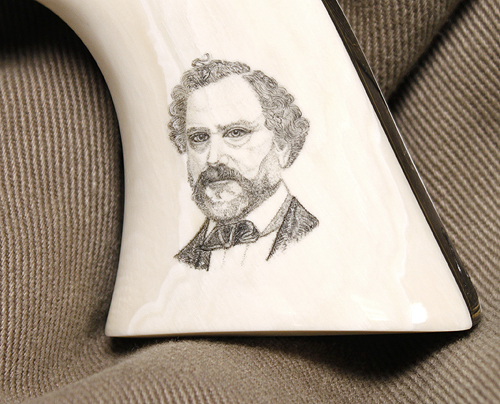
The non-fluted cylinder is highlighted by the Colt dome comprised of gold and silver raised relief and the the opposing side displays the serpentine Colt in raised gold. Hand inlaid gold bands accent the barrel and the cylinder. The backstrap has been engraved and gold inlaid with Sam Colt’s signature. The elephant ivory grips are scrimshawed with a portrait of Sam Colt on the left side and the Rampant Colt on the right side.
“The 150th Anniversary pistol was auctioned off and sold for $150,000,” explained Looney. “This one is valued at $175,000. We wanted it … where people could see it because we’re very proud of our master engravers and we like their work to be shown.” The Single Action Army Revolver will be on display at the NRA National Firearms Museum through October of 2013.
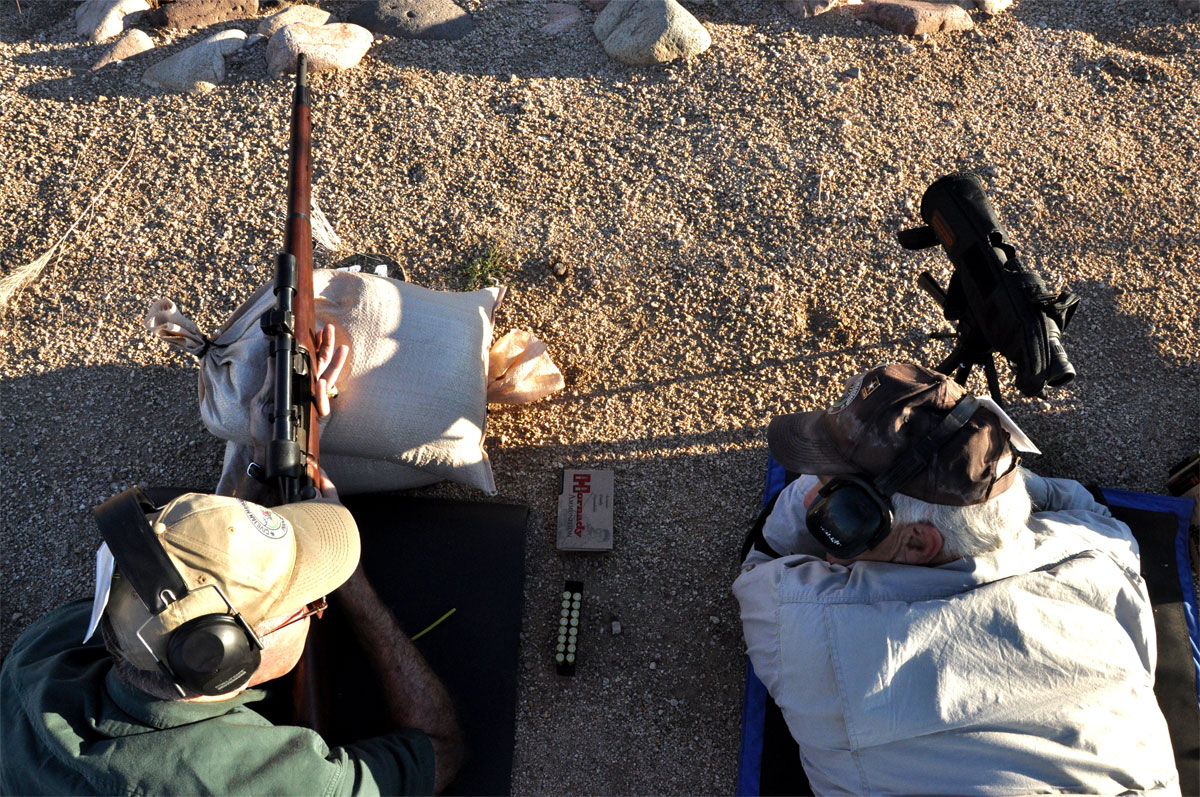
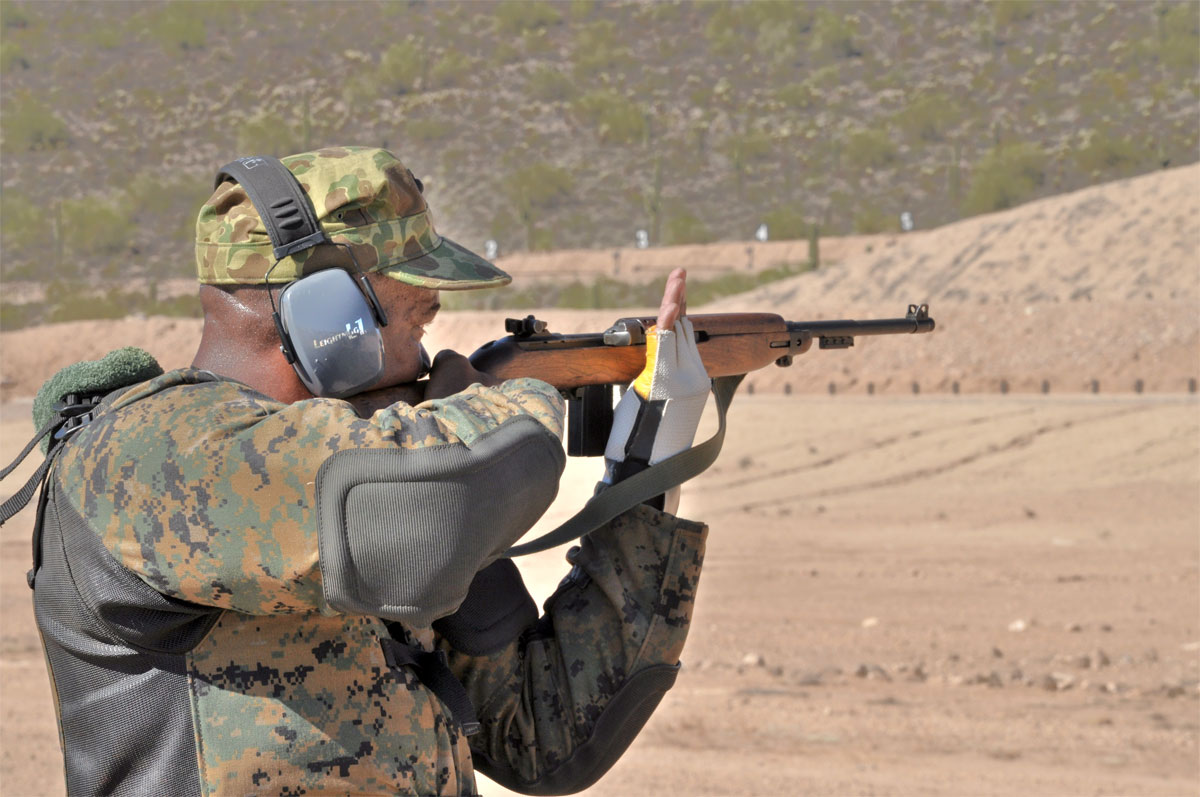
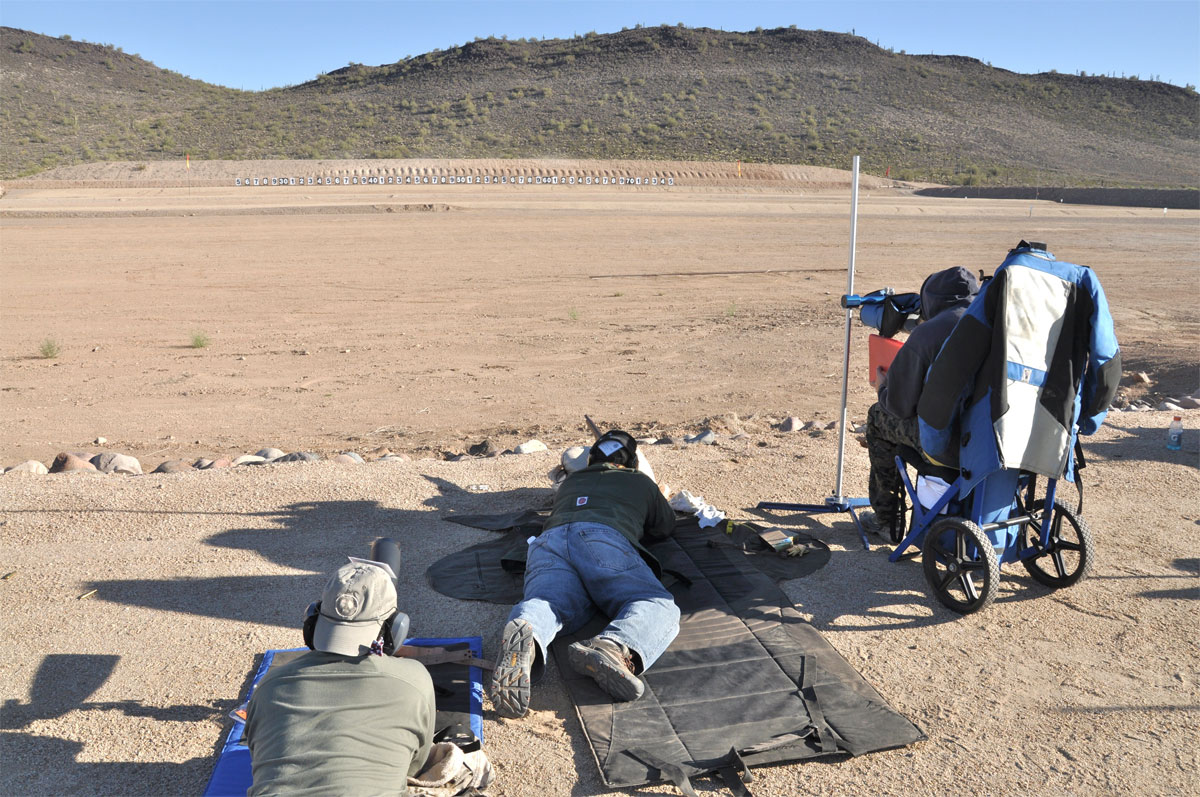
The 2012 Western CMP Games and Creedmoor Cup were held October 13-21, 2012. This combined event starts off with the CMP Games followed by the Creedmoor Cup competition. The CMP and Creedmoor matches, hosted at the Ben Avery Range near Phoenix, AZ, were well-attended this year. Competitors were treated to clear skies, and mostly favorable conditions. A highlight of the CMP season, the Western CMP Games includes numerous disciplines such as: M1 Garand Match, Springfield Match, Vintage Military Rifle Match, Vintage Sniper Rifle Match, M1 Carbine Match, and the Rimfire Sporter Match. The Creedmoor Cup is a High Power-type event, with team and individual competitions for both Service Rifles and Match Rifles.
Western CMP Games Results
The interim Western CMP Games results are found at the link below. It appears these results are incomplete, and we are still awaiting verification of the final scores (for all days). Check back here Monday and we should have the final, confirmed winner list.
Creedmoor Cup Results
In 4-Man Team Competition, the CA Killer Rabbits & One Grizzly Team won the Service rifle event with a 1895-56X score, while the Remington Roxburgh team won the 4-Man Match Rifle Competition with a 1965-73X combined score. Top Individual Match Rifle Shooter was Nick Mowrer (2376-103X) followed by Nathaniel Guernsey with 2361-89X. Scoring 2338-64X, Joel Sylvia won the Service Rifle Division, while Sagen Maddalena finished second with 2330-80X. Sagen was also High Junior (Server Rifle).
Watch 2012 Western CMP Games Slide Show (Steve Cooper Photos)
Tips for Capturing Great Images of Your CMP Match, by Steve Cooper
Photography is a lot like rifle and pistol shooting. For both disciplines you want each shot to be a winner. Here are a few tips to keep in mind next time you’re snapping photos of a match:
Get Involved – Though shooting is a pretty static sport, there’s a lot happening on the firing line. First off, let shooters know you’re there so they aren’t surprised when you walk up on their firing point. Make small talk and set the shooter’s mind at ease. When you do that you’ll be surprised how many smiling faces and enjoyment will show up in your photos.
Solid Position – Just like shooting, regardless of the type of camera you use, maintain balance and stable footing – that way you won’t bounce around and blur a good shot. Get close to the subject, whether it’s with a zoom lens or if you need to step closer, remaining in a safe position.
Anticipate – Don’t just snap random photos of a group of shooters and call it good. If you’re reading this, you’re most likely a shooter, so you know what to expect. If there’s action involved, you know what’s coming next, so be ready for it and snap the shutter when it happens or just beforehand. Wait for a reaction or catch the shooter concentrating, making equipment adjustments or maybe even catch that empty shell casing flying out of the chamber. If you’re taking snaps of a sniper match, catch the guys discussing the shot, calling wind – yelling at each other!
Be Smart – You don’t have to be a rocket scientist to capture good images, but it pays to consider the environment you’re shooting in. A cloudy bright day is perfect for photography. Harsh sun or super shady periods like early morning or dusk can be challenging. Unless a flash will disturb the shooter, using a flash most of the time is a great practice when shooting close-up photos. A flash will fill in the shadows and many times put a little needed light on the subject to improve color and tone. Don’t shoot into direct sunlight. Don’t stand so far away from the subject that you can’t identify the shooter.
Be an Artist – So what if your elementary school sculpture of your mom looked like the Creature from the Black Lagoon? That doesn’t mean your creativity hasn’t evolved. If there’s a sports photograph you really like, try to duplicate it with your camera. Try unusual angles, extreme close-us with a zoom lens – photos that show the shooter’s character, his/her ammo box, scorebook, shooting glasses – the possibilities are endless.
Shoot 10s and Xs with your gun AND your camera. With a little thought and determination, your shots will be impressive!
David, a hunter and wilderness skills teacher from Scotland, has created an informative 9-minute video that should interest varmint hunters and fans of Tikka rifles. In the video, David demonstrates the features (and remarkable accuracy) of a factory Tikka T3, chambered in .223 Remington. With David’s handloads, this rifle has grouped just over an inch at 250 yards, as shown near the end of the video.
You’ll notice that David’s rifle is equipped with a sound moderator (aka “suppressor”), a common hunting accessory in Europe. (Someday, hopefully, American shooters in all states will be able to employ sound suppressors without misguided, restrictive laws or prohibitive taxation.) David explains that a suppressor has many benefits. In addition to protecting the shooter’s hearing, the suppressor reduces the report of the shot, so there’s much less chance of spooking the game. A good suppressor also reduces recoil substantially.
David uses his rifle primarily for fox-hunting, often done at night. He employs a variable-power scope with an illuminated reticle to target his night-time prey. David offers many useful tips for predator hunters. He prefers an extra-high Harris bipod. With the bipod’s legs fully extended, he can assume a comfortable and solid sitting position. The rifle is supported on his shoulder and on the bipod, leaving both of his hands free. Being able to support the rifle without gripping it is a major advantage, David explains. This frees his hands to search for animals with binoculars or scan distances with his rangefinder. Additionally, he shows how to call in foxes, blowing on his cupped hands to make an very realistic distress call. This guy doesn’t need an electronic boom box with recorded sounds to effectively call in a fox.
We think you’ll enjoy the video, even if it is a bit grainy and David’s accent may be a bit hard for Americans to understand. He offers a lot of good, solid advice, and he certainly demonstrates the capabilities of the Tikka rifle. Above, check out the three-shot, 250-yard group David shoots. We’d say that’s better than minute-of-varmint accuracy. Tikka T3s have a reputation for excellent accuracy and smooth-working actions. Current street price for a stainless T3 Lite (like David’s), with synthetic stock, is about $580.00, but we’ve seen them as low as $540.00 on sale (price without scope).
SGT Sherri Jo Gallagher, 2010 National High Power Champion, is trading her USAMU shooting coat for a Parachute. She is now a new member of the Golden Knights U.S. Army Parachute Team. Today, Sherri posted the news on her Facebook Page: “It’s official. After 2 months and 200 jumps, eight of us were promoted from ‘try-out’ to proud members of the Golden Knights. I will always be thankful for everything the Army Marksmanship Unit has done for me and for my amazing teammates that I served with for the past 5 years. I look forward to what is to come and am humbled by the opportunity to work with another awesome team in the Golden Knights. Wooohoooo!”
Will Sherri’s aerial assignment with the Golden Knights limit Sherri’s participation in competitive shooting matches, such as the National High Power Championship at Camp Perry? We’re waiting for an answer to that question from Sherri herself. We do know that Sherri is far too talented to leave the shooting sports behind, but, in the months ahead she may be spending more time under a golden canopy than on the firing line. We congratulate Sherri on her selection as a Golden Knight. We wish her safe flights and success in her new endeavor.
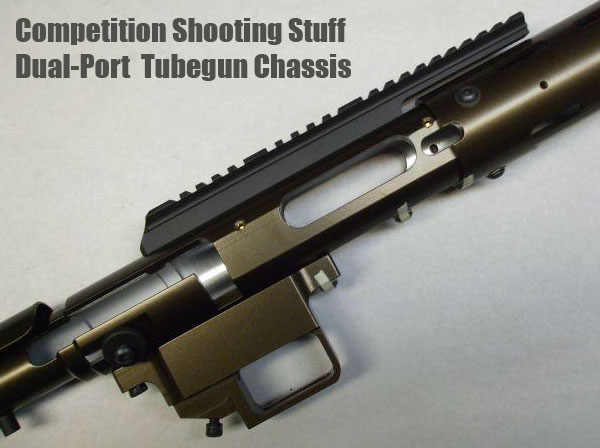
Gary Eliseo’s Tubegun chassis kits, long favored by High Power and prone sling-shooters, are now being used in increasing numbers by F-Class shooters, particularly F-TR competitors shooting from bipod. Here’s good news for the F-TR crew. Gary Eliseo has announced that his B1 and R1 Competition Shooting Stuff (CSS) Chassis kits will now be available with DUAL PORTS, by special order. This allows a right-handed F-TR shooter to load with left hand, with the fired case ejecting on the right. For more information visit www.GotXRing.com or call Gary at (714) 630-5734.
Here’s a good reason to visit your local shooting range over Veteran’s Day weekend (Nov. 8-11, 2012). During that weekend, shooting facilities nationwide will participate in Patriot Range Day, a program that provides scholarships for the families of soldiers killed or disabled in combat. Participating public and private shooting ranges will request a minimum of $1 for each shooter for the Folds of Honor Foundation. Since its inception in 2007, Folds of Honor has raised more than $21 million and awarded more than 3,600 educational scholarships. Patriot Range Day is being led by NRA Country and the NSSF with support from commercial sponsors, including Bushnell. To learn more, visit PatriotRangeDay.com.
About Folds of Honor Foundation
The Folds of Honor Foundation was founded in May 2007 by Major Dan Rooney, a former F-16 Fighter Pilot in the Oklahoma Air National Guard, PGA Professional, and USGA member. A decorated military pilot in the Oklahoma Air National Guard, Major Rooney has served three combat tours in Iraq. It was after his second tour, while a passenger on a commercial flight, that Major Rooney witnessed an event that would profoundly change his life. As the plane landed, the pilot announced, “Ladies and gentlemen, we have an American hero on board – Corporal Brock Bucklin. And his twin brother, Corporal Brad Bucklin, is accompanying him home from Iraq. As a sign of respect, please remain seated while Corporal Bucklin’s family receives him in his final homecoming.” Major Rooney watched through the window of the plane as the flag-draped casket was lowered. He saw a family waiting for Brock, and a little four-year old boy waiting for his father. This tragic homecoming inspired Major Rooney to create the Folds of Honor Foundation.
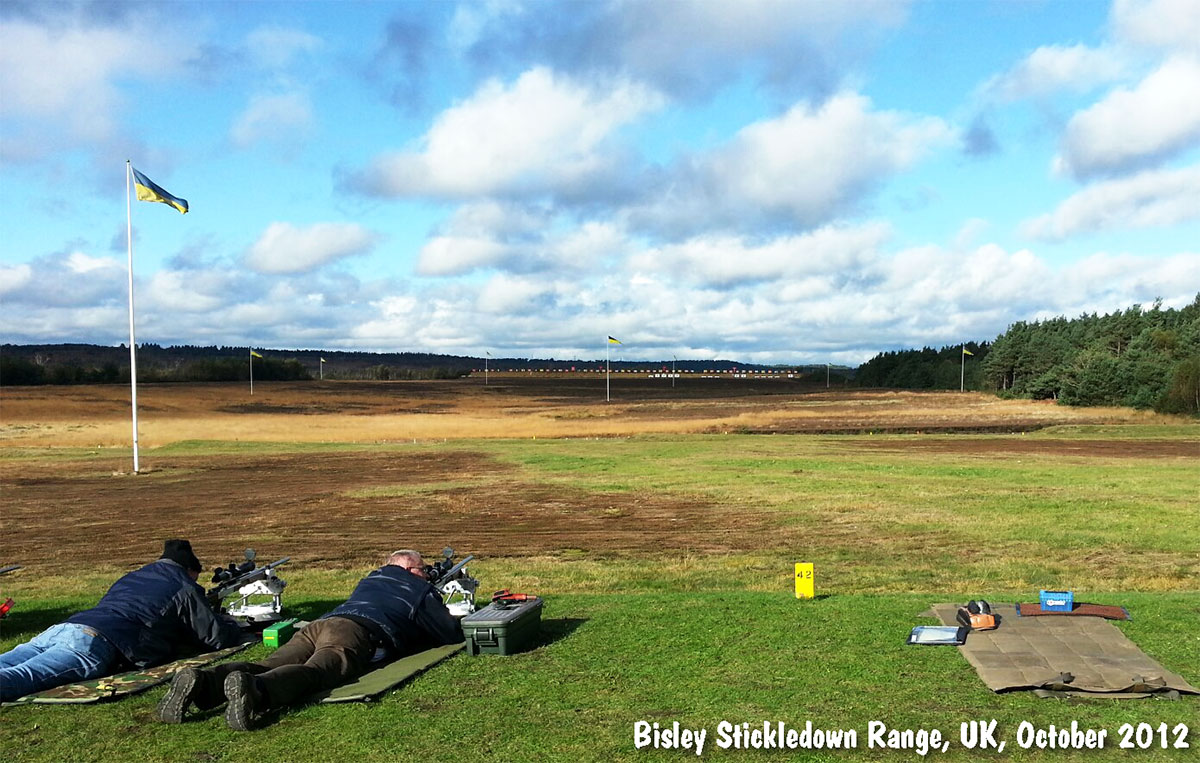
The European F-Class Championship (and British Championship) kick off this weekend (November 2-4) at the legendary Bisley Range in the UK. With 185 entrants, this event should be the largest F-Class competition of the year outside of North America. The Championship matches commence tomorrow, but competitors have already arrived at Bisley and they are getting their F-Class rifles warmed up during practice sessions. Here are some photos from the F-TR Ireland Facebook Page.
F-TR Ireland reports: “Here are photos taken during today’s Practice Day at Bisley on Stickledown Range at 800, 900, and 1000 yards. [We had] a great day’s shooting and excellent camaraderie amongst the team-mates.” The bottom photo shows the 900-yard Firing Line during Practice Day.
Two new mixed team events will be part of the 2014 Youth Olympic Games Program, while the total number of quotas will remain unchanged.
The International Olympic Committed (IOC) has approved the Shooting program for the 2014 Youth Olympic Games. The program includes the previously approved individual events, 10m Air Rifle Men, 10m Air Rifle Women, 10m Air Pistol Men and 10m Air Pistol Women plus two new events, 10m Air Rifle Mixed Teams and 10m Air Pistol Mixed Teams.
The number of participation quotas for the individual events remains the same (20 quotas per 4 events, for a total of 80 quotas). Athletes who compete in the individual events will also form two-person mixed teams (one male, one female) according to their place finishes in the individual events. No additional athlete quotas were allocated for those events.
All teams will be composed of one male and one female athlete based on their final rankings in the individual Air Rifle and Air Pistol Men and Women events.
Mixed Team events will take place over 2 days, following the 4 days of individual competitions. In the team duels, the two members of each team will fire one shot on command. The scores of the two team-members will be combined and compared with the combined score of the other team. The team with the higher total will score one point. The paired teams will continue to fire single shots on command until one team scores ten points to win that round of competition. Detailed technical rules for the YOG Mixed Team events will be provided after the ISSF Administrative Council meeting in November 2012.
When you’re practicing or developing loads at long range, it can be a challenge to see your bullet holes on the target, even with a premium spotting scope. Yes, when viewing conditions are perfect, a top spotting scope such as the 88mm Kowa Prominar can resolve 6mm bullet holes at 600 yards and beyond. However, when there is dust or mist in the air, or when the mirage gets thick and heavy, even the best spotting scope may be unable to resolve bullet holes clearly at just 300 yards.
That’s why, if you do much long-range shooting, you should consider getting a wireless target-cam system. This combines a video camera placed near the target with a monitor on your shooting bench. The image from the camera is sent wirelessly to a receiver hooked up to your monitor. With a good camera and quality electronics, a target-cam system can provide sharp images out to 1000 yards.
Until recently, good “turnkey” target-cam systems have been expensive — $1400.00 and up. Guys who couldn’t afford this investment have tried cobbling together systems from various parts. Sometimes the “home-built” systems work, but sometimes they are disappointing.
Turnkey Target-Cam Systems Starting at $725.00
Now Target-Sight.com offers complete Target-Cam systems starting at $725.00 (for 600-yard system). This includes everything you need: 27X Sony Video Camera, transmitter, receiver, color monitor, three Li-Ion batteries, AC adapters/battery chargers, and even the tripod. Or $800.00 buys Target-Sight’s complete 1000-yard system. It includes the same package of components, but with extended range.
Dan Norgrove, the man behind Target-Sight.com, has been able to source quality electronic components at very good prices. Accordingly, you may be able to buy a complete, field-tested Target-Sight system, for not much more than the cost of buying the hardware yourself. And if you put together a bunch of miscellaneous parts, you can’t be confident that they will all work together optimally. The Target-Sight systems work, have good battery life, and everything arrives in one box — delivered with free shipping.
We know that folks considering target-cam systems are justifiably cautious before they shell out hundreds of bucks. You want to be assured that the system is easy to set-up, functions right, and that the image on the monitor is sharp and clear. To satisfy those concerns, Dan Norgrove has created a video showing his Target-Sight system in use in the field. This video shows the actual image on the Monitor from a target-cam placed 300 yards away. (Please note this video is slow in sections because the field test is an uninterrupted “single take”. That way you can be confident there were no tricks done during the editing. What you see is what you get.)


 Mark Chesebro also offers a complete rifle built around the new Jennings stock. Built with a Barnard Action, Trueflite (NZ) barrel, and Barnard trigger, a complete Jennings F-TR rifle costs $2500.00. For more information on the Steve Jennings F-TR stock, or complete rifles built with this stock, visit ChesebroRifles.com or call (805) 280-5311. We hope to get our hands on one of these rigs for testing very soon!






 Anticipate – Don’t just snap random photos of a group of shooters and call it good. If you’re reading this, you’re most likely a shooter, so you know what to expect. If there’s action involved, you know what’s coming next, so be ready for it and snap the shutter when it happens or just beforehand. Wait for a reaction or catch the shooter concentrating, making equipment adjustments or maybe even catch that empty shell casing flying out of the chamber. If you’re taking snaps of a sniper match, catch the guys discussing the shot, calling wind – yelling at each other!


 SGT Sherri Jo Gallagher,


 Here’s a good reason to visit your local shooting range over Veteran’s Day weekend (Nov. 8-11, 2012). During that weekend, shooting facilities nationwide will participate in



 Two new mixed team events will be part of the 2014 Youth Olympic Games Program, while the total number of quotas will remain unchanged.
 All teams will be composed of one male and one female athlete based on their final rankings in the individual Air Rifle and Air Pistol Men and Women events.


