|
|
October 16th, 2012
This article originally appeared in Sinclair International’s Blog, The Reloading Press.
In the August 2012 Reloading Press, Bill Gravatt, President of Sinclair International, shared his experience using the Thumler’s Tumbler and stainless steel pin media to clean some .308 brass just before the National Matches. He discovered that combo is really great for cleaning brass.
This month, I want to share the results of a test I performed with stainless steel pin media, and give you some tips on how to best use this media to get cases as clean as you can. I’ve been using tumblers of some sort for more than 30 years. I got started with a sealed rotary tumber that my father and I made out of an old rock polisher we hooked up to a washing machine motor. While not as nice as a new Thumler’s Tumbler, the one-gallon capacity on that old tumbler means it’s still good for cleaning brass.
The Brass: Good, Bad and Downright Ugly
 To really test the stainless steel media’s cleaning power, I mixed three kinds of pistol brass that offered different challenges. First was some very old Amron headstamped .357 Magnum brass. The late Ken Lomont of Lomont Precision Bullets gave me the Amron brass as partial payment back when I was still in high school and working for him. I’ve been shooting it for years, so it’s obviously very durable. But it’s also very hard to clean, which made it great for the test.
I threw in some once-fired nickel-plated .357 SIG brass from Federal that had a lot of soot inside. I wanted to see just how well the stainless steel media could handle really grimy jobs. Finally, I added in the worst brass — some very corroded 9mm range pick-up brass with spots of verdigris all over them and dirt down inside them. They were terrible, which made them perfect for the test.
Case Prep For Cleaning
 Before I ran the cases through the tumbler, I knocked out all of the fired primers so that the stainless steel media would be able to get into the primer pockets and run through the flash holes. The media that we have at Sinclair is only .040″ in diameter, so it will easily go through the .080″ diameter flash hole on most domestic-produced brass, as well as the smaller .060″ flash holes found on some other cases. Once I knocked out the primers, I poured the brass and the media into the tumbler drum together.
Mixing The Solution
 Then I mixed up the cleaning solution. I poured ¾ of a gallon of water into the unit, and then put in four tablespoons of Dawn dishwashing detergent. I also added one teaspoon of lemon juice to keep the brass from spotting when it dried.
With everything ready, I sealed up the drum and started the unit and let it run for three or four hours. When I opened the drum, I could tell the media had done a very good job of removing all of the crud from the brass. The water was black, as you would expect from all the carbon inside the cases. After pouring off the solution, I separated the brass from the stainless media and rinsed it off. It took three rinses in clear water to make sure the brass was free of all the carbon the media scrubbed off.
 Then I rinsed the media, too. Rinsing the media is important: if you don’t do it, the media will be dirty when you use it next time. The media is easier to rinse while it’s still damp, and it cleans easily with clear water. As you can see, the brass cleaned up very well and showed no evidence of water spotting because of the lemon juice. The range pick-up brass came out fully usable, showing no signs of corrosion. The nickel brass looked as if it were brand new and unfired. The Amron cases looked the best that I can ever remember seeing them. Some of them still had a light amount of carbon just behind the case mouth, but a quick twist with 0000 steel wool took care of this easily during inspection of these cases before loading. All of the primer pockets were clean and clear of carbon. Impressive!
 Based on what I have seen, I will definitely use stainless steel media a whole lot in the future, even though I will still keep some of the treated organic media around for when I want a very bright shine on the brass. Several of the other Sinclair International Reloading Techs plan on trying the stainless media as well, so they might come up with some other tips for you in the future.
As always, if you have questions, please do not hesitate to call on any of us on the Sinclair Tech staff to assist you.
Bob Blaine, Sinclair International Tech
NRA Certified Reloading Instructor and RSO
TECH TIPS — Avoiding Problems with Stainless Media
Do Not Use Stainless Media Dry — I have had customers call and ask if stainless steel media can be used dry. The answer is that you will not like the results. Everything will go to the media, but it will still leave the brass dirty. If you use stainless steel media dry, you have to run it through a cleaning solution to clean the media. Then, it’s good to go again.
Do NOT Use Stainless Media in a Vibratory Tumbler — When using stainless media, you need a rotary-style, liquid-containing tumbler. You want to use stainless steel media ONLY in a rotary tumbler. Do not use stainless steel media in a vibratory type cleaner.
October 15th, 2012
One of our readers has been shooting his 6BR with considerable success in tactical/practical matches. Thus far he’s been using Lapua factory-loaded 105gr ammo. The factory ammo has delivered superb accuracy for him — under 1/4 MOA at 100 yards. Now, he is making the jump into reloading. He asked for some tips on working up a good load for an 8-twist 6BR with a no-turn neck, and selecting reloading tools. Since other readers may be 6BR novices as well, here are some helpful hints…
Accurate Reloading Tips for the 6mmBR Cartridge
 ▪ Brass Prep — You need to look at the flash-holes to make sure they’re not occluded. A few lots of Lapua brass came with a little sliver/flake of brass in the hole, sort of like a quarter moon. You can clean that up with an inexpensive pin vise. Otherwise, there is no need to ream flash holes or uniform primer pockets.
▪ Neck Chamfering — You want to develop a good feel for neck chamfering. You don’t want/need to remove a lot of brass — just knock off the sharp edge. I use a Forster 45 deg “rocket” tool. It works fine. After a couple light turns, spin backwards to smooth the cut and then finish with a twist with a green scotch pad. If you use a deep-angle chamferer, be very careful not to overcut and remove too much brass.
▪ Neck Tension — On brand new, unfired Lapua 6BR brass, neck tension is excessive. You should run an expander mandrel down the case necks before the first firing. This will reduce the neck tension while it fixes necks that may be dented or out of round. After the first firing, we suggest sizing the necks so that, after they come out of your sizing die, the neck outside diameter (OD) is .002″ less than the neck diameter of a loaded round with bullet seated. If that doesn’t work, try the next size up bushing for .001″ tension. Many top shooters like low neck tension, but we’ve also seen heavy tension work. The .002″ under loaded OD is a good starting point with the 6BR. (But note — if you have thin-walled turned necks, you may need to use a smaller bushing, running your sized necks .003 or .0035 under the OD of a loaded round.)
▪ Primers — A lot of guys like the CCI 450 primers. They’re a lot cheaper than the Federal and CCI BR primers and may give a little more velocity. The cups are also hard, which lets you run faster loads with less concern about cratering. Wolf/Tula primers also have hard cups, but you must make sure to seat them deep enough.
▪ Load Development and Bullet Choice — With the 6BR and 100-108gr bullets, load development should be relatively easy. With Varget, Reloder 15, Norma 203B, or VV N150, between 30.0 and 30.7 grains should work as your final load. My match load is 30.3 Varget and that has shot under 2.0″ at 600 yards. Start at 29.0 grains and and work up in 0.2 grain increments, checking for pressure. DO weigh every load… twice. If possible, use a chronograph during your load work-up. 2880-2920 fps is a nice “sweet spot” for the 6BR, but slower can be very accurate too. (With custom actions, tight chambers, and long barrels, some guys are going even faster — but that’s hard on brass.)
If you have a barrel on the slow side, consider shooting the Berger 100gr ‘Match Target’ BTs. These bullets are very accurate, and we’ve found that you can drive them 75-100 fps faster than the Berger 108s or Sierra 107s at similar pressure levels. With the 100-grainers, you may find that you can hit a superior velocity/accuracy node, so they may shoot better overall than the 105-108 class bullets. Varget, RL15, and IMR 8208 all work great with this 100gr bullet.
For shooting from 300-500 yards, you should consider the lighter-weight bullets: Sierra 95gr MK, Lapua 90gr Scenar, Berger 95gr and 87gr VLD. The Sierra and Lapua bullets are very accurate and not sensitive to seating depth. In addition to the powders mentioned above, H4895 and IMR 8208 XBR work very well with the 90-grain-class bullets. One note about the smaller Berger VLDs — the Berger 95gr VLD and 87gr VLD both have very short bearing surfaces, so they work best in a chamber with a short-to-moderate Freebore. We had the best luck with the 95gr VLD about .010″ into the lands. We could achieve that with an 0.075″ Freebore chamber. But you won’t be able to hit the rifling with the 95s in a long-throated chamber. With this bullet we recommend sorting bullets by base to ogive.
 For guys with 10-twist barrels, try out the new Berger 87gr VLD. It was expressly designed to work great in the 1:10″ twist barrels. Forum member Mark Schronce reports that this bullet is extremely accurate and can be driven fast. It has an 0.412 G1 BC. Note: The new 87gr VLD, product #24524, is hard to find on the Berger website, but it IS available. Berger calls it a “hunting bullet”, but it works great on paper also. MidwayUSA has the 87-grainers in stock as item #77854.

▪ Pure Accuracy — If you are looking for bughole accuracy out of your 6BR, try the Berger 80gr FBHP ‘Match Varmint’ bullets (item #24321). Many folks have reported these bullets will shoot in the ones and low twos, even in 8-twist barrels. For 100- to 200-yard distances, these bullets are hard to beat for pure accuracy. Beyond those distances, you’ll want something with a higher BC. We’ve had good luck with the Berger 80s pushed by Vihtavuori N135, and IMR 8208 XBR.
▪ C.O.A.L. — Bullet seating depth is very important. You should get the Hornady (Stoney Point) O.A.L. Gauge (shown below). This will let you discern the OAL at which the bullets just contact the rifling. The trick is tapping gently on the stick. (Get a wood dowel as the bullet can get stuck if you tap a little too aggressively.) With some practice, measuring is quick and you can get repeatable measurements of your distance to lands within .001-.002″.

A good starting point for the Berger and Lapua 105s is about .010-.015 IN the lands and then work back. Each barrel is different, but about .010″ in the lands works for many folks. One guy I know started at .012″ in the lands with Berger 105s, adjusted his load up from 30.0 to 30.4 Varget, and within an hour he was done with load dev — the gun was shooting in the low 2s. He went out and won his first match with that load the next day! With the Sierra 107s you might want to start .020″ out of the lands.
▪ Seating Die — We recommend the Wilson Micrometer Seating Die. The adjustable top makes it really easy to play with seating depths. Keep in mind, however, that moving 5 hash marks on the die may not give you exactly .005″ seating depth change — it will be close, but you should measure and write down the actual base to ogive length. FYI, I measure base to ogive of every loaded round. Occasionally you’ll find a bullet that ends up seated a little long or short.
NOTE: The fit of the 6BR Wilson seating die is very tight. You may have difficulty getting a fired case into the die if you do not full-length size the case first. Even with FL-sized cases, there may be a vacuum fit that makes the loaded round a little hard to remove. If you can’t easily extract your loaded round, try lifting the entire micrometer head and attached stem. This can release the vacuum so the case can slide out easily (unless there is a really tight fit). If that doesn’t work, here’s another trick — use the end of a Popsicle stick placed under the cartridge rim to lever the case out. I’ve found that the “working” end of a metal spoon works well too, but be careful not to nick the bottom of the die.
October 14th, 2012
Report based on Story by Lars Delsaide in NRAblog.
To steal a line from Hap Rocketto, the Americans scored a rare twofer this summer at during NRA’s National Rifle & Pistol Championships in Camp Perry. With scores of 7834 and 3994-279x, teams of top American Smallbore rifle shooters won this year’s Randle and Dewar Cup matches.
“I received an email from England saying that the United States had won both the Randle and the Dewar matches,” said NRA National Rifle Manager Howard “H.Q.” Moody. “And they didn’t just win them, they won them big!” added Moody. “That’s just phenomenal because [USA shooters] haven’t won them in almost ten years. It’s a real exciting thing to see because the Great Britain Rifle team will be coming to Camp Perry next summer to shoot the Pershing.”

USA Randle Team Photo with coaches and competitors (listed alphabetically): Michelle Bohren, Katie Bridges, Claudia Duksa, Amy Fister, Reya Kempley, Sarah Kramer, Amanda Luoma, Virginia McLemore, Amanda McMullin, and Nancy Tompkins.
The Dewar Trophy International Match is a team event with 20-person national teams (both men and women) from English-speaking countries. Each competitor shoots forty shots at 20, 50 and 100 yards. The Randle Trophy International Match is open to teams of ten women from English-speaking nations. The Randle course of fire is the same as the Dewar Match.
Origin of International Postal Matches
The origins of the Randle and Dewar Cup Postal Matches can be traced back to historic GB vs. USA team matches that began at the turn of the 20th Century. The NRA’s Howard Moody explained that everything started more than 100 years ago with the Pershing and Lord Roberts matches. American and British Teams traveled back and forth “across the pond” to compete at these big events. But that was very expensive even back then. So, it was decided to divide the matches and alternate them every four years. The British would come to America for the Pershing Match, and four years later, the Americans would travel to England for the Roberts. Thus the Pershing and Roberts matches alternate every four years. So how does this connect to the Randle and Dewar Trophy matches? Moody explained: “To keep the competition going in the off years, we use the Randle and Dewar Cup.”
October 14th, 2012
The Lee Classic Cast “O”-style press has always been an excellent value — it works as well as some other presses costing twice as much. And now Lee has improved on its Classic Cast Press design by adding a breech-lock fitting in the top. This allows you to swap dies in and out in seconds, once your dies are equipped with breech-lock quick-change bushings. The Lee Classic Cast Breech Lock press is available for under $120.00. That makes it a bargain compared to other heavy-duty single-stage presses. Midsouth Shooters Supply offers this press (item #006-90999) for $112.95, while Natchez Shooters Supplies sells the press (item #LEE90999) for $112.99.

 Breech-Lock System Allows Fast Die Exchanges
With the Lee Breech-Lock Press system, the die drops straight in from the top. Then, with a quick 1/6th (60°) turn, the die locks firmly in place (like the breech on an artillery canon). The interrupted three-start thread assures dies return and lock into the exact same position each time. Bushings cost $7.43 each at Midsouth. If you prefer, you can leave a bushing in the press, and screw your dies in normally. But consider that it normally takes a dozen or more turns to screw in a normally threaded die. The Breech-lock system is way faster.
The Lee Classic Cast press features a strong, cast-iron frame and all-steel linkage. The large 1 1/8″-diameter ram is guided by over twelve square inches of ram bearing surface. We like the fact that you can mount the handle on either side, and adjust handle angle and length. As Lee explains: “The start and stop position is adjustable with a 48-tooth, ratchet-type handle clamp. In addition, the handle length is completely adjustable. Shorten [it] when you’re loading handgun and short rifle cases.”
Lock-Ring Eliminator Quick-Change Bushings
With Lee’s basic quick-lock bushings, you control vertical die position with the normal locking ring that seats against the top of the bushing. That works fine, but Lee also offers a handy Lock-Ring Eliminator Bushing (Lee SKU 90063). This clever design combines bushing and lock-ring into a single part. The Eliminator is turned from a solid piece of steel and the lock ring is integrated into the design of the part. With the Eliminator you’ll get the most repeatable and precise die positioning because lock ring and bushing are all one piece. Moreover, some guys say the Eliminator Bushings are easier to grab and remove than the standard Lee Breech-Lock Bushings.

Press owners have praised their Lee Classic Cast Breech-Lock units. Here are reports from two MidwayUSA customers:
Five Stars: Perfect single stage press. Loads accurately 6mm BR and 308 Win for competition. Large clearance is also great for my 460 Wby and 30-378 Wby. Pistol rounds in 44 mag and 45 ACP also load easy. The press has a lot of leverage for full-length rifle case sizing. Nice primer disposal system. Lowest price for its class. This unit beats my Lyman press by several miles…. ” — J. Davidson, California
Five Stars: I waited until Lee would bring out their breech-lock system in classic cast design. This thing is outstanding and better than my old RCBS partner press. Once you get the sweet setting of the die, lock it in place and next time you load, you need not fumble to find the best setting. Breech lock is the key. I choose this press over Hornady, due to all-steel construction. I load a lot of .308 Win and .223 Rem for my ARs and this requires full-length sizing. Lee meets the challenge with no flex and excellent ram/die fit and alignment. Another nice feature is that the breech-lock inserts have a lock preventing [them] from unlocking. [T]he spent primer disposal is perfect vs. RCBS where primers can miss the primer catcher. The handle can also be placed left or right as needed and shortened for small cases or pistol to reduce the handle travel. I don’t see how you can get a better press for the price.” — E. Stanley, Rockford, IL
October 14th, 2012
|
Gun Digest offers a users’ guide for tactical rifles. Authored by Patrick Sweeney (Guns & Ammo Handguns Editor), the 224-page Gun Digest Book of the Tactical Rifle covers tactical rifle types, ammo, reloading, and tactical accessories. Most of the book’s sixteen chapters are gun-specific — detailed discussions of particular rifles such as the M15/M1A, the FN-FAL, and the Sig 556. There are also dedicated chapters on Bullpups, Rimfires, and “Sniper Rifles” (both bolt-action and semi-auto).
While the book sports an AR15 on its cover, AR-platform rifles are NOT the major focus of the book. If you are only interested in ARs, this is not the book for you. However, if you want to learn more about a variety of modern arms, you should find the book a valuable resource. Gun Digest claims: “No other book covers as many different styles of tactical rifles, and is written by a more qualified author.” |
|

About the Author
The handguns editor for Guns & Ammo magazine, Patrick Sweeney is a also a credentialed gunsmith and police firearms instructor. He has written many of Gun Digest Books’ best-selling titles including: Gun Digest Book of the 1911, Vols. I and II; Gun Digest Big Fat Book of the .45 ACP, Gun Digest Book of the AR-15, Gun Digest Book of the AK and SKS, among other titles.
October 13th, 2012
 Weatherby has issued an important safety recall of a series of stainless-barreled Vanguard hunting rifles. If you have one of the affected Vanguards, you should stop using your rifle immediately. The problem centers on the barrel nut used to secure the barrel. According to Weatherby: “On some Stainless Steel Vanguard Rifles the barrel nut is not tightened to required torque specifications. The use of the rifle with an improperly torqued barrel nut may lead to failure in a discharge situation which could result in a personal injury.” For additional information, contact the Weatherby Registration Center by calling (888) 770-7138 or sending email to: regcen@realtimeresults.net .
Recall tip from EdLongrange. We welcome reader submissions.
October 13th, 2012
 The Civilian Marksmanship Program is now taking applications for its $1,000 annual college scholarship program, available to graduating high school seniors who participate in rifle or pistol marksmanship competitions. The scholarship program provides a non-renewable, one year scholarship. One half of the total allocation is set aside specifically for graduating JROTC seniors who qualified to compete at the CMP JROTC Service Championships. Last year the CMP awarded 59 scholarships to non-JROTC students. It was the first year of the CMP’s expanded scholarship outreach program. (The CMP Scholarship Program no longer requires a relationship with an ROTC or JROTC program.)
The CMP offers up to 150 $1,000 scholarships to qualified graduating seniors active in marksmanship programs. In the 2012-13 school year, CMP awarded 138 scholarships, totaling $150,000. Members of high school shooting programs, JROTC, 4-H shooting programs, American Legion, Boy Scouts, and CMP-affiliated club competitors are invited to apply.
To learn more about the program, visit the CMP’s Scholarship Application Webpage. Click the links below to download application forms in printable PDF format. The deadline to apply for the CMP scholarship program is March 5, 2013.
Scholarship Application | Scholarship Selection Regulations
|
Eligibility requirementsfor CMP scholarships:
• Be a U.S. Citizen.
• Be of good moral character.
• Have achieved a minimum 3.0 cumulative GPA.
• Be a graduating high school senior
• Demonstrate acceptance to a university, college, or trade school leading to a diploma or trade certification.
• Qualified for CMP JROTC Service Championships; OR
• Demonstrate rifle or pistol marksmanship competition experience. |
SEND APPLICATIONS to:
Civilian Marksmanship Program
Attn: Scholarship Program
P. O. Box 576
Port Clinton, OH 43452 |
October 13th, 2012
 AccurateShooter.com has a HUGE collection of FREE downloadable PDF targets. We offer a very wide range of target designs: Load Development Grids, NRA Bullseye targets, Official-Size BR targets, Realistic Varmint Targets, Silhouette Shapes, Fun Plinking Targets, and even specialized tactical training targets.
If our collection of free targets isn’t enough, or if you want to create a new kind of target — you’re in luck. There’s an Australian-based interactive website that allows you to create your own customized, printable PDF targets. Just follow the step-by-step instructions to set paper size, layout, bullseye color and diameter. You can even add Score Numbers to your target rings. The Aussie Shooting Targets website is easy and fun to use. It’s much faster to create targets this way than to try to draw a series of circles with PowerPoint or MS Paint. And, if you’re not feeling creative, you can download nearly 100 pre-design A4-sized targets from the same Website.
CLICK HERE to Design Your Own Target | CLICK HERE to Download Free Pre-Designed Targets

October 12th, 2012
 Team Lapua’s Francis “The Animal” Kuehl won the 6th NorCal Tactical Bolt Rifle Challenge (TBRC) held September 29-30 at the Folsom Shooting Center in California. Along with winning the Match Overall title, Kuehl was TBRC Top Steel Evolution Shooter this year. Kuehl, a mild-mannered CPA in real life, has been the man to beat at the TBRC in recent seasons. His 2012 win marked Kuehl’s third overall victory in the TBRC, having finished first in both 2011 and 2009. This year, Kuehl was shooting a .260 Remington. For ammo, Kuehl used 6.5mm Lapua 139gr Scenars pushed by VihtaVuori N160 powder in Lapua .260 Rem cases.
The match featured five separate ranges, and four different evolutions (Long Range, Short Range, Steel, and Run & Gun) over two busy days of shooting. 77 competitors shot the course of fire that called for 215 rounds fired if a competitor was able to fire every required round. Shortest shot was at 25 yards, with the longest at 1000 yards. The long-range segment called for 36 rounds fired from 800 to 1000 yards. Most of the match was shot from 200 to 600 yards, with a small percentage of targets set inside 200 yards for the short range evolution.

October 12th, 2012
The NRA Store’s Catalog has hundreds of interesting items for sale, ranging from belt-buckles to a ballistic calculator watch. There are plenty of unique gift items — how about a “Don’t Tread on Me” blanket, or a stag-handle NRA Tomahawk?
 Among the many catalog items, two smart, utilitarian products caught our eye.
AR15 and m1911 Cleaning Mats
The NRA offers handy waterproof, stain-resistant Zorb-tech cleaning mats for black rifle shooters and 1911 fans. Printed on the 40″ x 14″ AR15 mat (item SA 21577, $16.95) are complete AR parts schematics, plus cleaning guide and AR assembly instructions. If you’ve ever fiddled with all the little parts on an AR15 bolt assembly, you’ll know how handy this Assembly/Cleaning mat can be. A smaller cleaning mat with 1911 pistol schematics sells for $13.95.

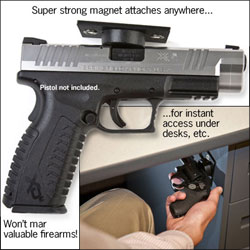 Magnetic Gun Clamp
For years we’ve been wanting a product like this. This simple magnetic device allows a handgun to be stored out of sight, yet instantly retrieved in an emergency. The device is simplicity itself. No more fumbling with jury-rigged holsters or hard-to-access drawers.
A magnet strong enough to lift 10 pounds is sealed in durable, scratch-resistant plastic, and backed with a mounting bracket. You can easily place the magnet under countertops or on the side of a cabinet or desk. (On steel surfaces the magnet will grip without screws or through-bolts). The NRA Rapid Access Gun Magnet (item SA 24385) costs $27.95.
|


