The nation’s top collegiate men and women shooters have converged on Ohio State University to compete in the 2012 NCAA Rifle Championships. The Championships run March 9-10 (Friday and Saturday) at the Converse Hall and French Field House in Columbus, Ohio. The undefeated Horned Frogs from Texas Christian University (TCU) look to upset the reigning champion Wildcats from the University of Kentucky (UK). You can follow the NCAA Rifle Championships on the NCAA.com website (rifle page). Event coverage will include live streaming video of some relays. The 8-minute video below includes profiles of top male and female shooters.
The following eight teams qualified (based on regular season aggregate scores) to compete in both air rifle and smallbore events: University of Alaska-Fairbanks (UAF), West Point Army, Jacksonville State, University of Kentucky, West Virginia University, University of Nevada, University of Texas El Paso (UTEP), and TCU. On Friday, March 9, the three-position smallbore shooters (both team and individual competition) will shoot 60 shots. The next day, air rifle competitors will take the line for 60 shots as well. According to NCAA rules: “the overall team champion will be determined by combining smallbore and air rifle team scores into one aggregate score for each institution.” The NCAA Rifle program has been in existence since 1980 and currently has 29 schools participating.
Individual and team competitions in smallbore three-position (60 shots) will be held Friday, March 9. Individual and team competitions in air rifle (60 shots) will be held Saturday, March 10. The overall team champion will be determined by combining the smallbore and air rifle team total scores into one aggregate score for each institution.
The National Shooting Sports Foundation has launched GunVote, a voter education website at NSSF.org/gunvote. The new GunVote website provides links to voter registration information for all 50 states, a guide to political races in voter districts, the latest polls, and a selection of news articles covering the campaigns. GunVote also spotlights Candidates’ positions on Gun Rights and the Second Amendment.
“It’s great to see that so many individuals have become firearm owners, but these freedoms require constant support from elected officials at the state and federal levels,” said NSSF President/CEO Steve Sanetti. “Votes on legislation and appointments to the courts have profound effects on our firearms freedoms.” Sanetti noted that two landmark Supreme Court decisions reaffirming the individual right to own firearms — D.C. v. Heller and McDonald v. Chicago — were both decided by 5-to-4 votes.
COMMENTARY — Why You Should Participate in Upcoming Elections
The votes of target shooters, hunters and gun owners can make a huge impact in the 2012 election. Participating in the upcoming election begins by making sure to register, then becoming educated about the candidates running for office and discussing choices with family and friends so that they understand the importance of voting. The final step is going to the polls and (when necessary) helping others to get to the polls, too.
More Gun-Owners Need to Register and Vote
In the 2010 Congressional election, only 46.2 percent of women and 45 percent of men 18 and over reported voting, according to the U.S. Census Bureau. Gun owners tend to be more active at the polls than this average, but there is a lot of room for improvement. Sanetti adds: “More gun owners need to vote. It’s critical that they do, and that they consider closely what candidates are saying… about our firearms freedoms.”
We’ve upgraded the AccurateShooter.com Forum, giving it a bigger, faster server. The new dedicated Forum server has a faster processor, more storage space, and more memory — all of which improves the user experience.
The switch-over was accomplished yesterday at 1630 hours (Pacific Time). All existing threads and posts have been preserved. Post counts and buy/sell feedback have also been retained. By all indications, everything is going well so far. Forum users report that pages load faster and searches take less time: “Things move along very fast now!” (Frank G. aka 40X Guy).
Join a Community of Nearly 17,000 Serious Shooters
If you haven’t visited our Shooters’ Forum yet, log on to Forum.AccurateShooter.com and check out one of the best Message Boards for precision shooters on the web. We now have nearly 17,000 Forum members including many National and International Champions. For example, this morning 2011 NRA National High Power Champion Carl Bernosky was logged in. And UK and World F-Class Champion Gary Costello (aka “GLC”) regularly visits our Forum. If you want advice from guys who really know their stuff — it doesn’t get better than that.
SSG (Staff Sgt.) Ty Cooper, a service rifle shooter/instructor with the U.S. Army Marksmanship Unit, was selected as the Military Marksmanship Association (MMA) Soldier of the Year (SOY) for 2011. MMA president Lt. Col. (Ret.) Robert Harbison made the announcement at the MMA Annual Membership Meeting. Harbison presented the Soldier of the Year Award to Cooper — a .45acp pistol donated by Smith & Wesson. Other MMA 2011 SOY nominees were: PFC Matthew Sweeney from the Action Shooting team; SGT Lawrence Cleveland from the Service Pistol team; SFC Thomas Rose, International Pistol; Shotgun team member SSG Josh Richmond; SFC Eric Uptagrafft from the International Rifle team; and SPC Billy Hankins from the Custom Firearms Shop.
Cooper Wins Big Matches After Deployment to Afghanistan
Ty Cooper had a remarkable year on and off the range. Cooper claimed his first Interservice individual championship at Quantico in July. He also won the long-range individual championship and was a member of the overall team champions, making it a clean sweep. A few weeks later, Cooper won the National Service Rifle Championship at Camp Perry, Ohio. All of this success was accomplished despite a deployment to Afghanistan that stretched into the spring.
SSG Cooper (center) with Lt.Col. R. Harbison (Ret.) (left) and Lt.Col. D. Hodne USAMU Commander (right).
“Looking back over the whole year I really am proud of being able to maintain the level of consistency it took to stay right there at the top,” said Cooper. “I think the thing I am most proud of was winning the two biggest matches that we have in our season in the same year. My goals kind of progressed as the summer went. I had never won an Interservice Championship and that was top of the list. I [also]had a burning desire to prove myself at the NRA Nationals and I won the Service Rifle National Championship.” When not shooting in competition, Coopper serves as a lead instructor for the service rifle team.
We are often asked: “What size neck bushing is best for Lapua 6mmBR brass in a ‘no-turn’ chamber?” The questioner planned to purchase a Redding Type ‘S’ full-length sizing die with neck bushings. The quick answer is that one should probably get both 0.265 and 0.266 bushings and see what works best. With the current “blue box” Lapua brass, a loaded 6BR round with an unturned neck will typically run about 0.268″ (depending on the bullet). A 0.266″ neck bushing, after springback, will give about 0.0015″ tension which can work well in a bolt gun. In a gas gun, we recommend running .003″ (or more) neck tension.
Alternative to Bushings — Honed Full-Length dies
Conventional, non-bushing full-length sizing dies can create ultra-accurate ammo with very low run-out. For some applications, we prefer a non-bushing FL die over a bushing die — so long as the neck tension is correct. But many FL dies have an undersized neck diameter so you end up with excess neck tension, and you work the brass excessively. Forster offers a simple, inexpensive solution — honing the neck diameter to whatever size you want.
If you purchase a Forster non-bushing, full-length sizing die, Forster will hone the neck dimension to your specs for about $10.00 extra. This way you can have a FL die that provides the right amount of tension for your particular load. Forster dies are relatively inexpensive so you can afford to have a couple of FL dies with necks honed to different diameters — such as 0.265″ and 0.266″ for a no-turn 6mmBR. The die itself is very affordable — currently Sinclair Int’l charges $33.95 for a Forster 6mmBR full-length sizing die (item FP6BRFL).
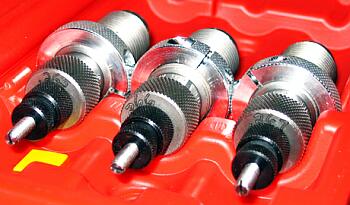
Forster FL dies, necks honed to .265″, .266″, and .267″.
Steve Rasmussen of IowaHighPower.com gave this a try. In fact, he had three dies made — each with a different neck dimension. Here’s his report: “My original Forster 6BR FL die sized the necks down a lot, less than 0.260″, .256″ if I recall correctly. I sent my die in and asked if they could supply two more FL dies (for three total) to have the necks honed to 0.265″, 0.266″, and 0.267″. The cost was $10 for my supplied die and $38.50 plus $10.00 honing fee for each additional die. Return shipping was $11.00 via USPS Priority Mail.”
The table below shows the neck diameter range of ten (10) sized cases using each die. Brass springback after sizing runs 1 to 1.3 thousandths. Steve was using the older, “brown box” Lapua brass with thicker necks so he needed the .267″ bushing. The older Lapua 6mmBR brass measures about 0.2695″ with bullet in place. Steve explained: “My loaded rounds are running 0.2697-0.2699 using [brown box] Lapua 6BR brass. So far the dies are working well. I sized 80 cases with the 0.266″ necked die. The shoulder is running 0.4582″ and 0.300″ up from the base is 0.4684″. I spun 20 of ‘em and 16 had a runout of one thousandth (0.001) and the other 4 at 1.5 thousandths (0.0015).” That shows that these honed Forster FL dies produce exceptionally straight sized cases.
by James Calhoon
(First Printed in Varmint Hunter Magazine, October, 1995)
In the course of talking to many shooters, it has become clear to me that the manufacturers of primers have done a less than adequate job of educating reloaders on the application of their primers. Everybody seems to realize that some primers are “hotter” than others and some seem to shoot better for them than others, but few reloaders know that primers have different pressure tolerances.
Primer Pressure Tolerance
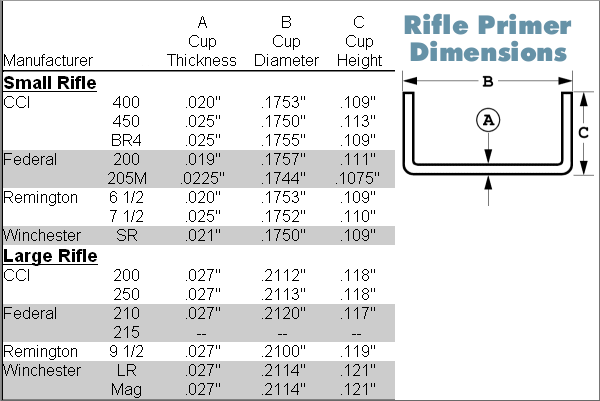
When loading a .223 to the maximum, I was getting primer piercing before I reached case overloading. I don’t know what prompted me to try CCI 450s instead of the 400s which I had been using, but I did. Presto! No more piercing! Interesting!? A primer that has a hotter ignition and yet withstands more pressure! Thats when I decided that it was time to do a dissection of all primers concerned. The chart below shows my results.
By studying the numbers (Cup “A” thickness), one can see which primers in the small rifle sections should be more resistant to primer cratering and/or piercing. Primer cup diameters are all similar and appear to follow a specification, but check out the cup thickness in the small rifle primers (Dimension “A”). Some cups are quite a bit thicker than others: .025″ for CCI 450 vs. .0019″ for Fed 200. Large rifle primers all appear to have the same cup thickness, no matter what the type. (As a note of interest, small pistol primers are .017″ thick and large pistol primers are .020″ thick.)
If you are shooting a 22 Cooper, Hornet, or a Bee, the .020″ cup will perform admirably. But try using the .020″ cup in a 17 Remington and you will pierce primers, even with moderate loads.
Considering that cup thickness varies in the small rifle primers, it is obvious that primer “flatness” cannot solely be used as a pressure indicator.
Another factor which determines the strength of a primer cup is the work-hardened state of the metal used to make the primer cup. Most primers are made with cartridge brass (70% copper, 30% zinc), which can vary from 46,000 psi, soft, to 76,000 psi tensile strength when fully hardened. Note that manufacturers specify the hardness of metal desired, so some cups are definitely “harder” that others.
What does all this mean to the reloader? - Cases that utilize small rifle primers and operate at moderate pressures (40,000 psi) can use CCI 400, Federal 200, Rem 6 1/2, or Win SR. Such cases include 22 CCM, 22 Hornet and the 218 Bee. Other cases that use the small rifle primer can use the above primers only if moderate loads are used. Keep to the lower end of reloading recommendations.
– Cases that utilize small rifle primers and operate at higher pressures (55,000 psi) should use CCI 450, CCI BR4, Fed 205 and Rem 7 1/2.
– All the large rifle primers measured have the same thickness. Therefore choose based on other factors, such as accuracy, low ES/SD, cost, cup hardness, and uniformity.
Hope this clears up some primer confusion. If you want more information about primers, priming compounds, or even how to make primers, the NRA sells an excellent book called “Ammunition Making” by George Frost. This book tells it like it is in the ammo making industry.
We’ve received inquiries from readers who are looking for a gunsafe that is big and strong but can be broken down and transported more easily that a typical 800 to 1200-lb safe. One product that fits the bill is the Zanotti modular safe. It arrives in sections, none weighing more than 170 pounds. It is assembled in place, then can be dis-assembled when you need to move. The Zanotti is also well-suited for a gun-owner who lives in an apartment up many flights of stairs.
Zanotti Armor safes are ideal for gun owners who need to move frequently or who live in a location where it is difficult to position a conventional safe. Zanotti safes arrive in three or four discrete shipping boxes. The safe is assembled by the owner, on site, in six steps. The heaviest component is the door, weighing 110 pounds in the 16-gun ZAI safe, and 175 pounds in the largest 52-gun ZAIII model. Five safe models are offered, ranging from 350 to 925 pounds assembled weight, without interior. Zanotti safes are popular with military personnel and others whose jobs force them to re-locate often. The safe can be assembled in under 30 minutes with no tools other than a hammer, and all you need is a hand dolly to move any component.
Guns Magazine reports: “The panels are interlocked by 3/8 inch, nickel-plated steel “L” shaped pins that slip into steel tubing sections welded to the interior surfaces of the panels. The slip fit is held to a tolerance of .003 inch, and the safes are completely assembled and hand-fitted at the factory to insure the panels will align properly. The body is made from 1/8 inch and 3/16 inch steel; the door from 3/16 inch steel; the locking bolts are 3/4 inch steel.” This is heavier gauge steel than you’ll find on most conventional gun safes.
Zanotti offers many deluxe interiors including a system of roll-out sliding drawers in the bottom of the safe. We think the sliding drawers are ideal for storing handguns and expensive items such as cameras and binoculars that you want to keep out of plain view. Mark Zanotti, the innovative creator of these modular safes, can also customize any interior to suit the customer’s particular needs.
Editor’s Note: For most applications, a conventional safe is still the best choice. Bolted in place, a conventional safe with welded walls will provide the best security and a conventional safe can provide increased fire protection. Zanotti safes do not employ a separate layer of sheet-rock or ceramic fire lining. The Zanotti is a special product for gun-owners with special needs. The units are well-made and Zanotti offers many nice custom interior features that you won’t find even on much more expensive conventional safes.
To learn more about gunsafe features and fire-proofing, read our Gunsafe Buyers’ Guide.
Hey folks, here’s a very good deal if you want a combo electronic powder dispenser/scale. The Hornady Lock-N-Load AutoCharge typically retails for around $240 (currently it’s $229.99 at Cabelas and $249.99 at MidwayUSA). Right now, ManVentureOutpost.com has the AutoCharge for just $186.01 (plus shipping). That’s over $50 off typical retail. NOTE: You MUST use Coupon Code SPR2012 during checkout to get that $186.01 price. Act quickly — supplies are limited at that price.
3/5/2012 UPDATE — ManVentureOutpost.com Sold Out of this item, which is now back-ordered. ManVenture is still (apparently) honoring the $186.01 price (with SPR2012 Coupon Code).
Hornady AutoCharge Is Much Less Expensive than RCBS ChargeMaster
That price for the Hornady unit is about $155.00 less than typical pricing for the RCBS Chargemaster (Sinclair sells the Chargemaster for $340.99 plus shipping). For most tasks the Hornady performs quite well. However, RCBS ChargeMaster fans will be quick to note that there has been more accumulated knowledge on tweaking the RCBS machine. But if you want a bargain, consider the “red option” — the Hornady AutoCharge.
This Youtube video shows the Hornady Lock-N-Load AutoCharge in action.
If you want to learn more about the Hornady AutoCharge, there is a detailed review in Shooting.com.au, a popular Aussie gun forum. This product review features actual test results along with lots of sharp, jumbo-sized photos. Here is the summary of the reviewer’s test results: “Weighing [20 charges of a stick powder] on a Redding beam scale (the only other scale I have) showed that 12 were spot on and the remainder we fairly equally split between 0.1 grain under and 0.1 grain over according to this scale. I consider this to be more than adequate for me.”
Legion Productions, creators of the Military Channel’s popular Top Sniper and Modern Sniper TV shows, has released a feature-length DVD covering the 9th Annual Sniper Comp at Ft. Benning, Georgia. Every year the U.S. Army Sniper School at Ft. Benning hosts the International Sniper Competition. The 9th Annual Comp drew top military marksmen from around the world. Thirty-two teams from the Army, Army National Guard, Marine Corps, Air Force, Special Forces, SWAT and three foreign countries competed in eighteen events and combat simulations over the course of seven very tough days.
Legion’s action-packed, 173-minute-long SNIPER COMP DVD follows elite sniper teams as they compete in one of the most demanding sniper challenges on the planet, a grueling event that tests participants’ marksmanship, endurance, stalking skills, and observational abilities.
SNIPER COMP HD Trailer (to view with Hi-Def 720p resolution, click the Gear Icon during playback).
DVD Proceeds Benefit Military Sniper Associations
NOTE: This production was created to raise money for deployed forces and to honor fallen soldiers. Profits from SNIPER COMP are donated to the U.S. Army Sniper Association and to the USMC Scout/Sniper Association. The SNIPER COMP video can be purchased for $15.49 through Amazon.com and Ebay.
Legion Productions is a film and television production company with offices in California and North Carolina. Legion Productions specializes in military- and weapons-themed film and television projects. In cooperation with Magpul Industries, Legion filmed and edited the very popular “Art of…” series of firearms training DVDs.
Story tip from EdLongrange. We welcome reader submissions.
As the National Governing Body (NGB) for the sport of Olympic-style shooting in the United States, USA Shooting (USAS) welcomes the dialogue created by the recent article in the Wall Street Journal by Mark Yost titled: Taking Aim at an Old Debate: Can female athletes compete against men?. In shooting, yes — but not in the Olympics. In this article, Yost points out several interesting facts and observations about our sport. This dialogue allows us to engage the shooting community, expand our thinking and establish pathways for bettering our sport for the future.
You will get little argument from many of today’s top shooters, both male and female, as to the shooting abilities of women throughout USA Shooting’s ranks. The success of the collegiate programs like TCU and many intercollegiate programs in the U.S. only echo these beliefs as do some of the sport’s elite shooters like Kim Rhode, a four-time Olympic medalist in trap and skeet shooting, or Katy Emmons, a three-time Olympic medalist from the Czech Republic who is married to [U.S. Olympian] Matt Emmons.
“I am a born competitor and whether it is men or women I want to win,” said Jamie Gray, a 2008 Olympian in Rifle. “In a sport that is equal between men and women I would most definitely enjoy the competition. I started out only knowing that men and women compete against each other. It wasn’t until I learned shooting was an Olympic sport that I realized men and women didn’t compete against each other. It is exciting to me that there are still sports out there that men and women can be equal, however for other reasons it may be better that there are different categories for each.”
From 1968 through the 1980 Olympic Games, Olympic shooting events were mixed, with opportunities for women and men to participate regardless of gender. At the 1980 Games in Moscow, there were six shooting events contested. At the upcoming Games in London, there will be 15 events contested. Opportunities for women to compete in Olympic shooting have not shrunk with the dissolution of “mixed” events, but rather have grown as a result not only in our brand of shooting but across all platforms of the shooting sports. In Olympic competition, 14 women got the opportunity to compete in shooting at the 1980 and 1976 Olympic Games combined. Since that time, the numbers have risen from 77 in 1984 to 145 female competitors at the 2008 Olympic Games in Beijing.
Shan Zhang Won Gold in 1992
Recent history also suggests that woman can perform alongside men in shooting competitions. At the 1992 Olympic Games in Barcelona, female competitor Shan Zhang of China became the Olympic gold medalist that year in mixed-event skeet, topping a field of both men and women. Over two days of competition she produced a score of 373 out of 375, a new Olympic and world record. She also became the first woman in the history of the Olympic Games’ shooting competition, to beat all the male shooters in her event. Since that time, no mixed events have been held in an Olympic shooting competition.
“As a proud American female citizen, participating in a sport where gender-specific characteristics are not advantageous, I would overwhelmingly favor a chance to compete in a mixed event — or at least a women’s event with an equal number of targets as the men,” said Kelsey Zauhar, a USA Shooting National Team member in Shotgun.
“I think that anytime you have competition where size or strength is not a factor, females can absolutely compete with the males,” said USA Shooting National Team Pistol shooter and USAS Board member Sandra Uptagrafft. “The fundamentals of executing a good shot work the same regardless of gender, size or age. The question of why females no longer compete with males or why we have differing number of shots in the same events comes up often when I explain our sport to new people. It does seem sexist, but the fact that we have separate events from males in the Olympics actually is a good thing since more females can compete this way. There can only be so many people on the shooting line at one time. I personally am just happy to have a sport like shooting in which I can excel.”
FACTOID: Research by the National Sporting Goods Association shows female participation in target shooting grew by 46.5% between 2001 and 2010. And an October 2011 Gallup Poll found 23 percent of women own a gun. According to the National Shooting Sports Foundation, from 2001 to 2010, female participation in hunting grew by almost 37 percent.


 The nation’s top collegiate men and women shooters have converged on Ohio State University to compete in the 2012 NCAA Rifle Championships. The Championships run March 9-10 (Friday and Saturday) at the Converse Hall and French Field House in Columbus, Ohio. The undefeated Horned Frogs from Texas Christian University (TCU) look to upset the reigning champion Wildcats from the University of Kentucky (UK). You can follow the NCAA Rifle Championships on the NCAA.com website (rifle page). Event coverage will include live streaming video of some relays. The 8-minute video below includes profiles of top male and female shooters.


 We’ve upgraded the

 SSG (Staff Sgt.) Ty Cooper, a service rifle shooter/instructor with the U.S. Army Marksmanship Unit, was selected as the

 We are often asked: “What size neck bushing is best for Lapua 6mmBR brass in a ‘no-turn’ chamber?” The questioner planned to purchase a Redding Type ‘S’ full-length sizing die with neck bushings. The quick answer is that one should probably get both 0.265 and 0.266 bushings and see what works best. With the current “blue box” Lapua brass, a loaded 6BR round with an unturned neck will typically run about 0.268″ (depending on the bullet). A 0.266″ neck bushing, after springback, will give about 0.0015″ tension which can work well in a bolt gun. In a gas gun, we recommend running .003″ (or more) neck tension.





 Legion Productions, creators of the Military Channel’s popular Top Sniper and Modern Sniper TV shows, has released a feature-length DVD covering the 9th Annual Sniper Comp at Ft. Benning, Georgia. Every year the U.S. Army Sniper School at Ft. Benning hosts the International Sniper Competition. The 9th Annual Comp drew top military marksmen from around the world. Thirty-two teams from the Army, Army National Guard, Marine Corps, Air Force, Special Forces, SWAT and three foreign countries competed in eighteen events and combat simulations over the course of seven very tough days.

 Shan Zhang Won Gold in 1992


