|
|
August 23rd, 2010
 K.C. Wins A Tough Match on Home Turf
K.C. Eusebio, who grew up in Southern California, returned to his home turf to capture the Men’s Championship at the 2010 Steel Challenge this weekend in Piru, CA. This was K.C.’s third overall win at the Steel Challenge. Trailing Team Glock’s Dave Sevigny for much of the match, K.C. pulled ahead in the final three stages to capture the Overall title, his third Steel Challenge Championship, with an 80.27 second total time. Right behind was Sevigny at 82.84. That was an impressive performance considering Dave was running a modified Glock against “full-race” 1911 customs, some of which cost $3500 or more. Even more amazing was the legendary Jerry Miculek, who finished third shooting a Smith & Wesson revolver with iron sights. Jerry’s total time was 83.88.

 Jessie Abbate Wins 3rd Steel Challenge
In the womens’ Division, new Team Smith & Wesson shooter Jessie Abbate of Georgia won her second consecutive womens’ Steel Challenge Championship, and the third in her career. In addition to winning the overall title, Abbate won the Ladies Steel Master title which represents the best combined score of the Open, Limited, and Rimfire events. Jessie won the Rimfire event on Day 1, having the best time on all but one of the eight stages. After that Jessie was locked in a tough battle with her S&W teammate Julie Golob, who captured the Limited Event on Friday (Day 2). In a video interview with AccurateShooter.com, Abbate confessed to being “off her mental game” on Day 2, but she pulled it all together on Saturday (Day 3), capturing the Ladies Overall and Steel Master titles. Kay Miculek, a seven-time Women’s World Speed Shooting Champion, finished second. Watch the video below for a lengthy interview with Jessie.
Young Guns Rise to the Top
This 2010 Steel Challenge showcased rising young stars. K.C. Eusebio recently left the USAMU to enroll in college. Though he no longer has the time or resources to train and compete as often as he could with the USAMU, K.C.’s skills haven’t declined. A past winner of the Steel Challenge, K.C. was fast on all stages and he even nailed a new world record on the Speed Option stage. K.C. rose to the challenge in this match, outshooting defending Steel Challenge champ Max Michel, who had not lost a match all year. We talked at some length with K.C.’s father, who was happy to have a chance to be with his son again: “K.C. left the Army because he wanted to complete his college education. He’s doing that in Georgia, so we still don’t get to see him that much. But it is great to see K.C. shooting in California again, and winning again.”
NOTE: The video has loud gunshot noise. Turn down your speakers if at work.

Oregon Teen Wins Rimfire Event
Another up-and-comer in the mens’ ranks is 17-year-old Ryan Leonard from Oregon. Ryan took the rimfire title, beating all the older sponsored pros in the process. Ryan finished tenth overall (among all competitors) to win the Junior World Speed Shooting title. Ryan has speed to burn and exceptional accuracy. Ryan actually prefers centerfire handgunning, but he obviously knows how to get the most out of the low-recoil rimfire pistols (Ryan shoots a modified Ruger MKII). When asked for his secret of success, Ryan smiled and said: “Don’t miss — Shoot the best you can, but don’t miss.” Ryan is a gifted student-athlete, currently taking college courses while completing his high school education. We expect Ryan to be a major player in the speed-shooting game in the years ahead. He is skilled, dedicated, and gifted with exceptionally fast reflexes.
 From Top Shot to the Steel Challenge
If there was a crowd favorite among all the competitors it might be J.J. Racaza who was one of the strongest competitors on the History Channel’s popular new Top Shot TV show. A blazing fast shooter who exhibited the ability to learn new skills quickly (such as archery and knife-throwing), many viewers favored J.J. to win the whole competition. He was the most consistent performer on the “Blue Team” throughout the show.
J.J. was among the last three competitors on Top Shot, but lost in a shoot-out where the three finalists got to choose their weapons and targets. J.J. told us this involved a great deal of strategy, because each pistol and rifle used on the show had quirks that the competitors had to log into memory: “You needed to know the dope on each gun. One rifle, for example, shot 6″ low at 100 yards, while one of the pistols shot low left. You had to recall those things or you didn’t have a chance.” A true competitor, J.J. was disappointed that he didn’t win the $100K Top Shots prize, but he said that the experience was memorable: “I walked away … empty-handed but I walked with a lot of lessons, and a lot of friends too.”

August 23rd, 2010
 Luckygunner.com is a rapidly-growing ammo and shooting supplies vendor with a unique business model. Luckygunner.com guarantees that all products displayed on its website are in stock. Using an advanced “real-time” inventory system, Luckygunner.com promises that “what you see is what we’ve got.” You can count on receiving your order within a few days, and not be caught in the uncertainty and delays of back-ordering.
 LuckyGunner.com to Sell Firearms Soon
LuckyGunner.com recently obtained its Federal Firearms License (FFL) and plans to begin offering firearms for sale on its website in the coming weeks. Luckygunner is expanding to sell firearms (through local FFLs) in response to customer requests. The same In Stock-Shipping policy applies to all LuckyGunner.com inventory — including firearms. Luckygunner.com promises: “If you see it on our website, it will be in stock and ready to ship. Every time. No exceptions.” When you order before 3pm EST on a business day, your order will ship the very same day.
NOTE: Purchasers do not receive firearms directly. The buyer provides contact info for a licensed firearms dealer (FFL) in the buyer’s vicinity. The firearms are shipped to the FFL, and the buyer must then comply with all Federal, state, and local laws before taking possession of the gun(s).
August 22nd, 2010
The Montana NW 1000-Yard Benchrest Club held its annual Championship at the Deep Creek Range near Missoula, Montana last weekend August 13-15. A record number of shooters attended. The winds were strong and shifty at times, and were “not typical Deep Creek conditions” according to Tom Mousel, the overall Two-Gun Winner. Despite the challenging conditions (some shooters had trouble staying on paper), competitors went home happy as match organizers gave out over $21,500.00 worth of prizes. All 56 shooters left with a prize, and many of the top competitors came home with a brand new Nightforce scope. Top shooters included: 2-Gun Champion – Tom Mousel (Kalispell, MT); Heavy Gun Winner – Ed Janikowsky (Kalispell, MT); 17 lb. Class Winner – Leo Anderson (Kalispell, MT); and 11 lb. Class Winner – Duane Capehart (Sula, MT).


Saturday Match Results & Equipment List (MS Word)| Sunday Match Results & Equipment List (MS Word)
Over the course of the weekend, despite the difficult winds, some great groups and scores were shot. Richard Schatz of Bismark, ND, nailed a 100 score/5.502″ group on Saturday, and Scott Nix of Whitefish, MT, shot a remarkable 100 score/4.556″ group on Sunday. Both men were shooting 6mm Dashers. Schatz got his 100 in a Heavy Gun Relay (though his rifle is not a true Heavy), while Nix shot his century score in 17-lb. Relay. Two-Gun Overall Champ Tom Mousel shot a 6mm Dasher in both 17-lb and Heavy Gun Classes. Tom’s match-winning and record-setting Dasher features a Stiller Viper Drop-port action, Krieger 8-twist barrel, Nightforce scope, and Shehane Tracker stock. Tom’s gun was smithed by Montana gunsmith John King (King Machine). Tom shoots Berger 105gr VLDs, pushed by a stout load of H4895, with CCI 400 primers. Tom has at least 12 firings on his Lapua cases, which he anneals every 3-4 firings with a Bench-Source annealing machine.

6mm Dashers Dominate 2010 Montana 1000-Yard Championship
Missoula’s Deep Creek Range is definitely “Dasher Country” and the diminutive 6mmBR Improved cartridge totally dominated the event. Consider this, four out of the top five places in the two-gun overall were shot with Dashers (Barry Bluhm was 5th overall with a 6-6.5×47). All of the top five places in Heavy Gun were Dashers, and in the 17-lb Class, again Dashers were first through fourth, with Bluhm’s 6-6.5×47 in fifth. After the match Barry told us: “You know, my 6-6.5×47 is shooting well, but I’m thinking of going to the Dasher when it’s time to re-barrel. I’m tired of getting beat by them.” The performance of the little cartridge is pretty remarkable, when you consider this entire match is shot at 1000 yards. Check out the equipment list for Saturday’s Heavy Gun Relays 1 & 2 (below). The fact that the “top guns” are running the little Dashers, even in an unlimited weight class, speaks volumes. While other larger cartridges offer superior ballistics at 1K, the Dasher is “inherently accurate”, and its low recoil allows the best shooters to fire ten rounds in well under 30 seconds. When you can nail ten shots all in the same condition, the Dasher is hard to beat.

August 21st, 2010
Hodgdon will introduce two new propellants in 2011, LEVERevolution and Superformance. According to Chris Hodgdon, these powders will allow hand-loaders to replicate Hornady’s factory-loaded LEVERevolution and Superformance ammunition. Hornady used proprietary powder blends to achieve impressive velocities in its Superformance ammo. Now reloaders can take advantage of that blending technology to get more performance from their hand-loaded cartridges.

According to the Shooting Times website, the two new powders should be available starting in January 2011: “This is welcome news to handloaders who until now have had to sit by and watch as factories make the best use of new bullets such as Hornady’s FTX and mass-produced loads that handloaders couldn’t safely duplicate. This should also be welcome news to shooters who until now have avoided new high performance cartridges over concerns about future high performance ammunition availability.”
August 21st, 2010
Here’s a great deal on a versatile, multi-purpose pack that should suit the needs of tactical guys as well as game hunters. Right now Cabelas.com has genuine CamelBak® UpRoar packs on sale for just $29.88. The regular price on these packs is $99.99, so you save over seventy bucks.

With a 1,710 cu.-in. cargo capacity, the Uproar pack (Cabela’s item OG-580060) can carry enough for a full day in the field. And of course, since it’s a CamelBak®, the pack totes plenty of H20 via a 24 oz. fitted water bottle (NOT a bladder with sipping hose). Other features include: goggles pocket, organizer pocket, laptop sleeve, and gear-attachment lash points. The discounted UpRoar pack is offered in either olive drab with black accents, or black with blue piping (the Coyote tan color shown at right is NOT on sale). This pack is well-designed, with a comfortable surface next to your back, and ergonomically curved shoulder straps (complete with sternum bridge strap). NOTE: This pack carries H20 in a plastic water bottle in a fitted side pocket. Unlike most other CamelBaks, there’s no internal bladder or hose, so you’ll have to reach around to get your water.
August 20th, 2010
According to FiscalAccountability.org, this year the average American toiled from January 1 through August 19, 2010 just to pay the total burden of government taxes, fees, surcharges, and mandatory withholding. In other words, August 19th was the day on which the average American had earned enough gross income to pay off his or her share of the spending and regulatory burdens imposed by government at the federal, state, and local levels. So enjoy today, August 20th. You finally get to spend the money you earned!
 The latest report by the Center for Fiscal Accountability reveals that “Working people must toil 231 days out of the year just to meet all costs imposed by government — 8 days later than last year and a full 32 days longer than 2008.” Think about that — this year you worked a full month longer for the government than you did two years ago. It sort of like being in a leaky lifeboat and you have to keep bailing faster and faster just to stay afloat. According to the Report, the cost of government now consumes an astonishing 63.41% of national income!
We do question some of the assumptions used for this calculation — after all most wage-earners do keep more than half their income, even after taxes. Nonetheless, there is no question that government spending, at all levels, is rising, and significant new taxes are in the works. To learn more about the tax burden on the average American, you can download the 2010 Cost of Government Day Report. Even if some of the numbers in the report over-state the immediate problem, it is undeniable that government spending is increasing at an alarming rate.
In the interest of balanced reporting, we note that another watchdog organization, the Tax Foundation, has calculated that “Tax Freedom Day” occurred on April 9th, 2010, one day later than in 2009. This would be the day when Americans have collectively earned enough money to pay this year’s tax obligations at the federal, state and local levels. Why the big difference in the Tax Freedom dates (April vs. August)? Well the Tax Foundation looks at actual tax revenues collected, while the Center for Fiscal Accountability calculates tax burden based on total government spending and obligations. Since the federal government (and many states) are engaged in massive deficit spending, the spending-based tax burden is actually much larger than current tax collections.
The Tax Foundation explains: “Tax Freedom Day does not count the [federal] deficit even though deficits must eventually be financed. Since 1948, when Tax Freedom Day was first calculated, the difference between what governments are spending and what they’re collecting has never been as great as during 2009 and 2010. If Americans were required to pay for all government spending this year, including the $1.3 trillion federal budget deficit, they would be working until May 17 before they had earned enough to pay their taxes — an additional 38 days of work.” If you add in debt service, local taxes, and other factors you can push the Tax Freedom date out even further — this explains, in part, how the Center for Fiscal Responsibility came up with August 19th.
August 20th, 2010
Bore-Tech has released a new line of coated cleaning rods. Bore-Tech’s new V-STIX cleaning rods feature a free-floating ball-bearing handle, a durable, long-lasting shaft coating, and steel cores that resist bending and bowing. Priced at about $28.00 each, the rods are affordable, and we like the handle shape, and the fact that the handles are different colors for different calibers. Right now Grafs.com carries V-STIX rods in multiple lengths, and three rifle bore sizes: 17-20 caliber, 22-26 caliber, and 27-50 Caliber. For a long-barreled 6mm bolt gun, we recommend the 40″ or 44″ V-STIX. These V-STIX are $3-4 cheaper less than Dewey rods, and the V-STIX are way less expensive than Pro Shot rods.

August 20th, 2010
 The Steel Challenge, one of the world’s premier speed-shooting events, kicked off yesterday in Piru, CA, just down the road from AccurateShooter.com’s home base. Thursday saw shooters compete in the rimfire division. The star of the day was young Ryan Leonard of Oregon City, OR. This 17-year-old pistol prodigy proved that youthful enthusiasm (and quick reflexes) CAN beat age and experience. Ryan outgunned all the big-name pros, including Glock’s Dave Sevigny, Blackhawk’s Todd Jarrett, and Smith &Wesson’s B.J. Norris.
Leonard posted the fastest score on three of the eight stages — 5 To Go, Smoke & Hope and Outer Limits — to finish in a final time of 69.76 seconds. Next fastest man was Dave Sevigny, 1.45 seconds behind. It was a brilliant showing by the 17-year-old Leonard, who claimed the Open Rimfire Championship. Congrats to the Oregon teen — we expect we’ll here more from the young shooter in the years ahead.
 Finishing 5th overall, and winning the women’s open rimfire division was Jessie Abbate, now with Team Smith & Wesson. The popular shooter from Georgia was the fastest lady on seven of the eight stages in the match. Abbate’s final time of 76.90 seconds outpaced her Team S&W team-mate Kay Miculek by 11.60 seconds. In the Ladies’ iron-sight Rimfire event, the winner was Team S&W co-captain Julie Golob.
The Rimfire event is the first leg of the three-event contest that decides the Steel Master winner. The second is the iron sight centerfire pistol event shot in either the Limited or Production division. And the third is the Open pistol contest, the main event of the World Speed Shooting Championships.
Abbate is the defending Ladies’ Steel Master Champion and is a favorite to win the title again in 2010. For more info visit www.SteelChallenge.com.
August 20th, 2010
Savage’s Fullbore (Palma) rifle team performed well in recent competitions. The four-man team (Darrell Buell of Damascus, OR, John Weil of Welches, OR, Monte Milanuk of Wenatchee WA, and Stan Pate of Milwaukie, OR) wrapped up the season with two internationally-sanctioned matches. The first was the Canadian International Fullbore Championships in Chilliwack, B.C. and and the second was the Pacific International Fullbore Championships held just outside of Portland, OR. At both matches, elite shooters from around the world competed at 800, 900 and 1,000 yards. The two matches combined constitute a “Super Aggregate”, or Continental Title.

Team members (L to R): John Weil, Darrell Buell, Monte Milanuk and Stan Pate. (File Photo 2009).
Team Savage loaded up on the hardware at both matches, winning multiple medals at the various distances. Savage’s four shooters captured the team gold at the Canadian match and Gold and Silver in the individual Super Aggregate.
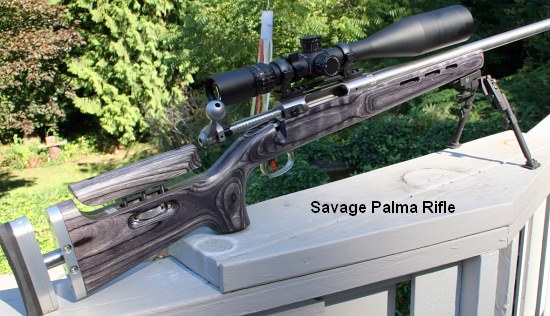
At the Pacific Int’l match in Oregon, local knowledge helped Team Savage rack up the medals. This competition was held on Weil and Pate’s home range at the Douglass Ridge Rifle Club. With John Weil leading the way, Team Savage put on a clinic: Weil won all seven gold medals available, while teammate Pate won six silvers. Milanuk added three bronzes. Weil also shot an impressive 148-4X at 1000 yards. In the video below, Team Captain Stan Pate demonstrates the accuracy of the Savage Palma (Fullbore) rifle, nailing a steel target at 1169 yards.

August 19th, 2010
 John Whidden of Whidden Gunworks used a collection of .243 Winchester and .308 Win rifles to win his third NRA National Long-Range Championship this week at Camp Perry. We had a chance to discuss Whidden’s winning guns during a long telephone conversation with John yesterday, as he motored back to Nashville, Georgia. John revealed some interesting facts about his long-range arsenal.
For the “Any sights, Any Rifle” and “Iron Sights, Any Rifle” stages of the Long-Range Championship, John used three different .243 Win rifles. He shoots the same load in all his .243s: Berger 105gr VLD bullets (moly-coated) with N160 powder and PMC (Russian) primers. The bullets are seated very long, with about .001″ neck tension, so the bullets “soft-seat” themselves into the rifling as he closes the bolt. This way he can use the same ammo in different guns and the bullets always find the same seating depth relative to the rifling. John uses a very stout load of N160 that drives his Berger 105s at about 3,300 fps. No that is not a misprint. John launches thin-jacket 105s at 3,300 fps and he doesn’t have an issue with bullet blow-ups. Moly helps keep the heat down, but John’s Broughton 5C (canted land) barrels are key. These are gentler on the jackets than barrels which have very tall or sharp lands.
 John shoots the Berger 6mm 105gr VLDs because they are a proven commodity that seem to work in a variety of barrels and cartridges: “We need something that is very reliable from an accuracy standpoint, match in and match out. The 105s are more reliably accurate over a range of different cartridges, barrels, and conditions. I’ve considered using the 115s, but I’ve heard mixed results. Across the whole range of variables, the 105s and 107s always seem to work for people but I’ve heard a lot of mixed results with the 115s.”
At 3,300 fps, the 105s deliver ballistics that are hard to beat, according to John: “My .243 shoots inside a 6.5-284 with 142s. Nothing out there is really ahead of [the .243], in 1000-yard ballistics unless you get into the short magnums or .284s and those carry a very significant recoil penalty. In the past I did shoot the 6.5-284. I went to the .243 because it had similar ballistics but had much less recoil. It doesn’t beat me up as much and is not as fatiguing.
With the .243… there’s no tensing-up, no anticipating. With the reduced recoil, I can break and shoot very good quality shots. I find I just shoot better shots with the .243 than I ever did with the 6.5-284.”
John’s primary “Any Sights” .243 is built on a Winchester m70 action, it has a Broughton 32″, 1:8″ twist 5C (canted land) barrel. This gun shot very well, but he did have a firing pin issue during the Remington Band of Brothers match on Day 1 of the Long-Range competition, so he was forced to bring out his back-up “Any Sights” gun. This features a Stolle Panda action, and Broughton 30″, 1:8″ twist 5C barrel. Both guns employ a Nightforce 8-32x56mm Benchrest Scope. John joked: “I’ve done a lot of hauling back-up guns across the country for no reason in the past, but this time it mattered a lot.”
For the “Iron Sights, Any Rifle” stages Whidden uses a .243 Win with a Gilkes-Ross action, Warner Rear Sight, and CG front sight with +0.5 diopter. As with John’s scoped .243s, this gun has an 8-twist, light Palma contour, Broughton 5C barrel. This is the same gun and 32″ barrel John used to set the Leech Cup record in 2008. It has about 650 rounds through the barrel. The chambering, as with his other “Any Rifle” guns, is a “plain vanilla .243 Win”.
.308 Palma Rifle Shooting 185gr VLDs with N140
Whidden’s .308 Winchester Palma Rifle is the same rifle we featured as our Gun of the Week Number 59 (photo below). It’s the same gun with the same barrel, a 32″ Broughton 10-twist with 5C rifling, light Palma contour. Round-count on this barrel is over 3000! John’s current .308 Win load is a very stout charge of N140 power, PMC primers, and 185gr Berger moly-coated VLDs. The brass is Lapua .308 Win with the standard large primer pocket/large flash holes. He turns his case-necks for a .333″ loaded round in a .343″-necked chamber, which was cut with the popular “95 Palma” reamer. As with his .243s, John loads his .308 ammo long and “soft-seats” his bullets with bolt closure.


Barrel Selection is Key to Running 6mm VLDs at Very High Velocities
Given John’s success with the .243 Winchester at Camp Perry, we asked him why more competitors weren’t using this cartridge at Perry. The combination of great ballistics and moderate recoil seems hard to beat. John explained: “There were several other .243s on the line. Lamar Jones, my travel partner, shot a .243, and there were a couple other guys out there. But there are more 6.5s I think. If there were an equipment list, I would be pretty certain that the 6.5-284 would be the majority in the ‘Any Rifle’ category.”
Importantly, John explained that it takes the right hardware to run the heavy 6mm bullets at high velocities. Bullet blow-up is a risk. John told us: “At the velocities I’m running the 105gr VLDs in the 243s, barrel brand selection is really important. You absolutely have to shoot a barrel that is easy on bullets to run these velocities. To avoid bullet blow-ups at these speeds, you can’t shoot barrels that have the tallest and sharpest rifling, such as you find with some cut-rifled barrels. I’m still shooting the thin-jacket Berger VLDs. I haven’t even switched to the thick-jacket bullets. To do this you need a rifling solution that is kinder to the bullet. The point I’m trying to drive home is that barrel selection is a very important factor. If my barrels didn’t work we would have smoked a lot of bullets. But that’s not the case with the Broughtons. I haven’t blown up a .243 bullet through a Broughton barrel.”
|


