Texan Jackie Schmidt, using a 13.5-lb 30BR Heavy Varmint rifle, has shot a pending NBRSA world record 5-target, 5-shot-per-target Aggregate at 100 yards. Jackie’s 5x5x100 Agg measured 0.1118! How small is that? To help our readers visualize this, the illustration at right shows what a SINGLE 0.111″ 5-shot group (with .30-cal holes) would look like. Jackie’s actual measured group sizes for his five-target Aggregate were: .153, .093, .120, .100, and .093.
If this record is certified, it will be the best 5×5 100-yard Agg ever shot in history by a bag gun in competition. Jackie’s Agg may also beat the “Unlimited” (Rail Gun) 5x5x100 records, but we’re still researching that. Remarkably, Jackie shot his 0.1118″ Agg with a stout-recoiling 30 BR (not a PPC), he did it in howling winds, and he did it with brass that had been fired 30 times! He also shot the entire Agg without cleaning his barrel.
We know it may be difficult for some readers to understand how hard it is to average 0.1118 for 25 shots on FIVE targets. To help demonstrate this, we’ve created an illustration that shows a SINGLE 0.111″ five-shot group. Jackie shot five groups that averaged this size. And he wasn’t “machine-gunning”. He took 6-7 minutes to shoot each target, firing on a “angle transition” in the conditions. Jackie explained: “The wind was switching, but I wasn’t shooting the dominant condition. I would wait for the transition and then shoot when the flags came around to about 15 degrees.”
Jackie gave credit to his rifle: “Though I usually use this rifle for score shoots, this 30BR is the most accurate rifle I have in terms of shooting small groups. I was lucky and hit the perfect tune. There was absolutely no vertical. You can’t shoot [an Agg] like this unless you have a rifle tuned to the hilt.” Jackie recognizes that this performance was a “once in a lifetime type experience.” He told us: “Today everything was right. The rifle was shooting impeccably, I had a good handle on the conditions, and just didn’t make a mistake.” Jackie added: “These days are few and far between — you just have to cherish the moment.”
Jackie’s 5-target Agg was so good that many experts predict it will stand as a record for a long time. On Benchrest Central, respected BR gunsmith Mike Bryant wrote: “The current record … was still Rex Reneau’s .1399 Agg from 1982. With Jackie’s Agg, I’m sure that it will easily beat Rex’s record when measured by the records committee. It’s just too far under the current record for it not to hold up… [and] to do it with a .30 BR is even more amazing. That should put to rest the notion that the .30 BR is a score cartridge only.”
Many people are surprised this pending Agg record was shot with a 30BR rather than a 6 PPC. When asked if he thinks the 30 BR can rival the 6PPC in group competition, Jackie told us: “In the 13.5-lb Heavy Varmint class, a good 30 BR is every bit as accurate as a good PPC, and possesses an equal Agging capability.” It’s different in the 10.5 classes, Jackie acknowledged: “in the LV/Sporter 10.5-lb classes, the 30 BR can get a little aggravating over the course of a match due to its greater recoil.”
Jackie’s Aggregate May Be Best in Benchrest History
Shooting in a Midland, Texas BR for group match, Jackie battled shifty, 15-20 mph winds in what may well be the greatest single-day display of “pure accuracy” in the history of the shooting sports. To put this accomplishment in perspective, Jackie’s 5-target Agg was better than any other 5×5 100-yard Aggregate ever shot in a registered benchrest match by a bag-gun. And according to the published records we could find on file with the NBRSA and IBS, Jackie’s 0.1118″ also beats even the existing rail-gun 5x5x100 Aggs. So, this could potentially be the smallest 5-target Agg ever shot in history, by any gun, in any registered match, at any time. Below are the current IBS and NBRSA World records listed on the Internet:
Current Benchrest 100-yard World Records (5 Targets, 5 shots per target)
5-5-100 Aggregate (NBRSA)
Unlimited: .1283″ Steve Kostanich 8/10/2003
Heavy Varmint: .1399″ Rex Reneau 9/6/1982
Light Varmint: .1500″ Jeff Fowler 6/11/1994
Sporter: .1573 (na) Dick Katchmar 4/14/1985
5-5-100 Aggregate Records (IBS)
Unlimited HB: .1386 (na) R. Howell 12/3/04
Heavy Varmint: .1407″ Tony Boyer 8/3/07
Light Varmint: .1599″ B. Goad 8/13/08
Sporter: .1592″ R. Boop 8/13/08
Gun Specs: Jackie was shooting a 13.5-lb 30 BR that he chambered and assembled himself. The barrel is a 4-groove, 1:18″ twist, HV-taper Krieger, fitted with a 5.5-oz. “snubber” barrel tuner made by Jackie. The action is a cast Farley, “glued and screwed” into the stock and fitted with a Jewell trigger. The stock is a Robertson Composites BRX, built with extra weight to make the gun a dedicated 13.5-pounder. The scope is a 50-power March.
Record Load: Jackie was running a stout load of Hodgdon H4198 powder, Federal 205M primers, and BIB (Robinette) 112gr flat-base bullets seated about .003″ into the lands. Load is “tuned for 3020 fps”. Cases are formed from Lapua 6mmBR brass using a dedicated forming barrel that blows the necks out to 0.330″ in one step. Trim length is 1.540″, longer than most 30 BRs. Jackie turns the necks for a total of .002″ clearance.
MidwayUSA has just launched a special, exclusive promotion for AccurateShooter.com readers that can save you big bucks. It’s a very attractive offer: $10.00 off any order of $50.00 or more, $50 off $500 (or more) orders, and $100 off $1000 (or more) orders. There are a few limitations — for example you can’t use the promo for back-ordered items, but basically this deal can save you 20% right off the top of a fifty-dollar order. This limited time offer ends midnight July 31, 2010. To get your $10, $50, or $100 discounts, use the following PROMO CODES during online check-out:
$10 off $50 – Code 2437210 | $50 off $500 – Code 2847210 | $100 off $1000 – Code 3087210
NOTE: This offer excludes MidwayUSA Gift Certificates, Nightforce, and Clearance Sale Products. Limit 1 per retail customer. In stock products only. Offer valid 7/2/2010 through 7/31/2010.
We recently tested some interesting “club benchrest” rifles created by MT Guns. Recognizing the demand for highly accurate “club-level” smallbore BR guns, Mac Tilton and his crew at MT Guns have started producing two new types of affordable rimfire benchrest rifles. One line of rifles employs Anschütz actions refitted with modern SS barrels and benchrest stocks. As its second line of rimfire BR guns, MT Guns is offering highly-modified BSA Martinis, tricked out with bag-riders and premium barrels fitted with tuners. With the hot-rod Anschütz running about $2000.00 and the modified BSA costing about $1500.00, these guns should provide an affordable alternative for club-level rimfire benchrest shooters. Plus you won’t have to wait months or years to get a “big-name” smith to build you a rifle.
Anschütz Modified for Serious Accuracy
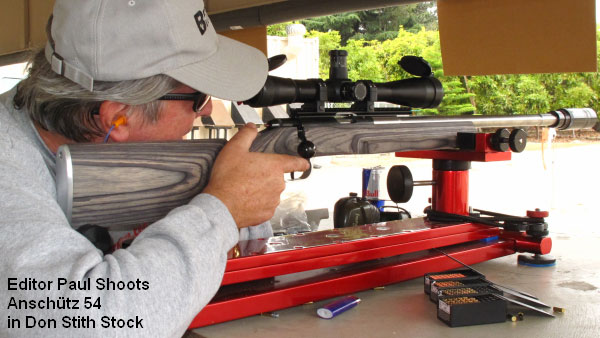
For Anschütz fans, MT Guns has fitted high grade Benchmark barrels to the legendary Model 54-type action. These re-barreled Anschütz actions are placed in Don Stith laminated benchrest stocks. With a modern low-profile, wide-forearm stock, MT Gun’s Anschütz BR guns track beautifully. So far, MT Guns has created two of these Anschütz-based bench guns, both built from model 19XX donor rifles — which also provided superb 5018 triggers. Barrels on both guns are Benchmark — one a 2-groove, the other a 3-groove. In the Stith stocks, complete with aluminum butt plates and weighted tuners, both rifles tip the scales at about 10 pounds. Price for the Anschütz bench guns is $1995.00 with unfinished Stith stock. A fitted Hoehn barrel tuner adds $200 to the price, while a Picatinny rail is a $125.00 option.
BSA Martini — Classic Design with 21st Century Upgrades
If you want to get noticed at your club’s next smallbore rimfire match, then a modified BSA Martini may be the gun for you. These rifles, originally built for prone target shooting, earned a well-deserved reputation for accuracy. MT Guns has done some basic modifications allowing the unique BSA Martinis to be surprisingly competitive in the benchrest game. The factory barrels were “retired” in favor of a 2-groove or 3-groove reverse taper Benchmark barrel — the type of tube that has won big matches and set records. To improve the rifle’s “bench manners” MT Guns fits a custom-made low-friction polymer sled in the front. Fitted with this 3″-wide bag-rider, the gun is extremely stable. An optional Hoehn tuner allows you to tune barrel harmonics for maximum accuracy.
Speaking of which, readers may be asking “How accurate can this BSA Frankengun really be?” Amazingly accurate. Watch the slide show below. In the last frame you’ll see two very impressive 5-shot groups shot by the BSA Martini Int’l Mark III at 50 yards. The ammo was Lapua X-Act.
In the video below, Bruce Duncan of MT Guns explains the distinctive mechanical design of the lever-activated, tilting-block BSA Martini. Bruce also discusses the history of the BSA Martini marque, reviewing the many BSA Martini models produced in the last century. The BSA Martini International MK III is perhaps the most desirable in the long evolution of target Martinis built by BSA from the Great War era to the early 80s. These MK IIIs, dating from the 1960s, feature Benchmark 28 3/4″ reverse-taper barrels, Hoehn barrel tuners, and special bolt-on Picatinny rails fabricated by MT Guns. Bruce noted: “The MT Guns bag rider attaches to the rifle’s fore-end rail. During testing, we noted that the fore-and-aft position of the bag rider on the rail affected the rifle’s tune.” For more info, visit MTGuns.com or call the shop at (805) 720-7720.
On June 19, the 4R Rifle Club in Alex, Oklahoma hosted its Spring Balloon Shoot. This challenging “fun shoot” drew nearly 50 competitors from five states. In this multi-yardage event, shooters try to break four balloons, one each at 100, 250, 400, and 500 yards. A total of 18 rounds were allowed. The balloons were worth 10, 20, 30, and 45 points respectively. Shooters attacked the balloons in 12 relays. Even with challenging winds, some impressive scores were fired. When the smoke cleared and all the competitors had tried their luck, only two had perfect scores of 420. Jim Fowler turned in a pair of 410s to win the Two-Gun award, youth winner Dalton Ernst shot a 390, and factory gun champ Don Johnson managed a 365 with his Savage 6BR.
Exciting Shoot-off Decides Match Winner
The top six shooters of the day returned to the bench with clean scorecards for the Shoot-off. They would repeat the same course as earlier in the day — one balloon each at 100, 250, 400, and 500 yards, with 18 rounds. Two competitors, Don Johnson and Rick Jensen, emerged from the Shoot-off tied, having both shot clean scores of 420. The balloons were set up again, only this time, Don and Rick were allowed just 8 rounds. Hard choices had to be made. Both men elected to start at 400 yards, breaking all four balloons before moving to 500, where both Don and Rick broke three. As a final tie-breaker, each man fired a single shot at a distance of 300 yards. When the targets were retrieved, Don Johnson prevailed as the Overall Champion, with Rick Jensen in second. Don was shooting a .243 Win, while Rick had a .284 Win; both guns featured Surgeon actions. Finishing 3rd, 4th, and 5th respectively were: Shane Herman, Jim Fowler (2-Gun Champ), and Arthur McMeans.
Top Ten Shooters’ Equipment List (in alphabetical order)
Match organizers offer special thanks to the many match sponsors who filled a rich prize table, and thanks to the Reeves family for hosting yet another great match at the 4R Rifle Club.
Lapua’s new 22-250 brass has finally started to arrive on dealers’ shelves. Forum member William P. (aka “Heath”) just got two boxes of the new brass. Both boxes have the same lot number. Heath was kind enough to sort the brass and report his findings.
Based on Heath’s 200-count sample, we can say this new brass is very, very consistent in weight. The total weight spread (delta) for 200 cases was just 1.4 grains! And the vast majority, 83%, were within 0.7 grains in weight (160.3 – 161.0). For the varminter, sorting may be superfluous. Once again, Lapua has produced a superb new product, and we love the new, blue plastic boxes.
FYI, you 6mm shooters should know that the Lapua 22-250 brass can be made into quality 6XC brass. And it’s even easier to create a 6-250 wildcat. In May, Robert Whitley explained how he created a tack-driving 6-250 Wildcat from the new Lapua 22-250 brass.
Replacing retiring Leupold executive Tom Fruechtel, Calvin Johnston has been appointed as Leupold & Stevens’ President and CEO effective July 19, 2010. Johnston has very limited, if any, experience in the optics industry or in hunting/shooting-related businesses. Johnston’s primary expertise is in the apparel sector. Since 2007, Johnston has served as President of Aramark’s Galls Division. Galls specializes in direct sales of police and public safety uniforms and gear. Presumably, Leupold’s Board of Directors hopes that if Johnston can sell uniforms and gear to law enforcement buyers, he can expand Leupold’s LEO optics business.
Prior to running Galls, Johnston served from 2005-2007 as group president/CEO of Russell Athletic, which manufacturers sports clothing. Before that, Johnston, who earned a Marketing MBA from Northwestern Univ., held a series of sales and marketing positions, including a two-year stint as Director of International Marketing for Rollerblade.
What Does the Future Hold for Leupold & Stevens?
Johnston succeeds Tom Fruechtel, who will retire from Leupold at the end of 2010. Fruechtel served as CEO of Leupold & Stevens for 12 years. During that period Leupold sales and profits grew considerably. However, Leupold’s reputation in the market for high-end premium optics has suffered in the past decade. Companies such as Nightforce Optics, Schmidt & Bender, and Zeiss are well-established in the top end of the market, while, in the medium-priced scope segment, smaller optics companies such as Sightron and Vortex have taken market share from Leupold by offering more bang for the buck. In the laser-rangefinder market, Leupold needs to make major improvements in order to compete with the latest products from Leica, Swarovski, and Zeiss.
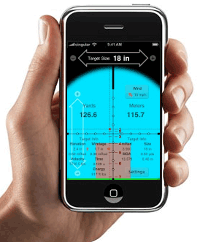
Many of our readers are now using smart-phones for ballistic calculations. Now there is a new App for the iPhone which makes mildot target ranging simple and easy. Mil-Dot Rangefinder 2.0 does all the math for you. Just input the size of the target, and the program calculates range instantly, in yards and meters. The standard edition costs just $1.99 while the “Pro” version is $9.99. We think that, if you’re going to really use this program in the field, it’s well worth paying ten bucks for the Pro version. The Pro edition gives you a full-featured ballistics calculator with windage/elevation corrections. That calculator alone is worth the extra money, and the Pro version offers many other features, which are listed below:
Target ranging (yards and meters)
US Army and USMC mil-dot reticles
Target Info display
Advanced ballistics calculator
Fast windspeed/direction adjustment
Range card (ballistics chart)
Point of impact indicator
Bullet drop compensator
Windage/elevation corrections
Time to target
Shot energy/velocity at target
Multiple Ballistic Profiles
This is a very powerful program. We suspect it will take most users a few days before they really understand all its functions and options. To see a more detailed demonstration of the Mil-Dot Rangefinder App, click on the YouTube video below. There’s no voice-over, so the video can be hard to follow. But at least the video showcases the flexibility of the program and the wide variety of functions it offers. Credit The Firearm Blog for spotlighting this useful App.
The July digital edition of Shooting Sports USA is now available for free online. In this latest edition of the popular “e-zine”, Managing Editor Chip Lohman reports on recent major collegiate matches, including the first ever Intercollegiate Rifle Club Championship.
This July issue also features an excellent article by Scott Pilkington on Airgun Maintenance. This is an important topic which needs more coverage. Pilkington is a respected air rifle expert who served as the official gunsmith for the U.S. Olympic air gun squad at the Sydney Olympic games. He also runs his own Tennessee-based business, Pilkington Competition Equipment, www.pilkguns.com.
We recently had a chance to test the new Chimera Titanium Rings from TacticalRifles.net. The Chimera Rings are “ultra-premium” items designed to compete with the very best tactical rings on the market. As you’d expect, they’re expensive. The 30mm Chimera Rings retail for $224.00 per matched set, including Torx driver. Though these fat boys are beefy in size, offering 7.5 square inches of clamping area per set (way more than most rings), they are very light weight. A medium-height, 30mm Chimera ring weighs just 84 grams (2.96 ounces).
The Chimera rings are precision-machined to exacting tolerances. We had our Mark, our in-house machinist, check them out and he was very impressed: “These rings exhibit beautiful fit and finish and are extremely tough. The fit of the ring bases on a Picatinny rail is perfect. I liked the radius shapes given to most of the surfaces. The front and back faces of each ring are standard flat planes, and the ring caps have a flat disc in their centers, but the remainder of the cap and the sides of the bodies are gently curved. This design requires sophisticated machining processes to pull off, but it looks good. The larger-than-standard heads on the cap hardware, 8-32 X #25 Torx, are another departure that looks well thought out. One danger this increased head size would present if the fasteners were threading into typical 6061 aluminum bodies would be the potential to over-torque and strip the threads with the larger #25 Torx wrench. However, since the titanium bodies have approximately double the tensile strength of 6061 aluminum this is not a problem.”
Assymetrical Tensioning by Design
The Chimera Titanium Rings employ an assymetrical clamping design. This should allow the rings to provide stronger clamping force with less chance of ring distortion. Here’s how they work. After placing the scope in the lower halves of the rings, you screw down the top halves on one side only (opposite the bolt head that clamps to the Picatinny rail). After the three Torx screws are tightened fully on one side, so that the top Ring half butts firmly on the bottom half, there will still be a small gap on the opposite side of the ring (see photo). Don’t worry — that is by design. Final torque is applied to the side with the gap. With the final tensioning done on one side only, the scope is less prone to twist. Furthermore, the manufacturer claims this design puts less stress on the scope tube during mounting.
We did fit the Chimera rings to a Leupold LRT 8-25x50mm scope with 30mm tube. Fit was excellent with no high or low points. With the rings installed as instructed, with one side first clamped flush and the opposite side then torqued to spec, the scope was very secure. On removal the Chimera rings left no visible marks on the tube. I can’t say that it would be a waste of time to lap these rings, but on our Leupold scope the fit was perfect, and the “grip” was uniform over the entire clamping surface.
Tactical Precision System TSR™ Rings TSR™ rings made by Tactical Precision Systems (TPS) have a clamping design very similar to the Chimera Titanium Rings. After placing the scope in the TSR ring set, you clamp down one side (of the ring tops) until metal meets metal. This then leaves a gap of 0.020″ on the other side. The TSR Picatinny 30mm 7075 Aluminum Medium Rings cost $82 in aluminum or $94.00 in alloy steel. The TSR rings are narrower than the Chimeras, and have two Torx bolts per side, rather than the three on the Chimeras.
M3 Hinged Scope Rings from American Rifle Company
An even more radical clamping system is employed by the new, patent-pendingM3 Scope Rings from The American Rifle Company. The top section of the M3 rings is attached with a hinge on one side. After placing the scope in the bottom section of the M3 rings, you swing the upper ring half into place over the scope tube. Then the clamping is done with two inverted (head-down) machine screws that actually pull the hinged ring section downwards. This is designed to put less stress on the scope than conventional rings. The axis of the screws is tangential to the scope tube. Sophisticated finite element analysis (FEA) was used to develop the “over the top”, tangential-clamping ring design. According to the manufacturer, this design evenly distributes clamping forces over the tube and “eliminates the damaging effects of [scope] bending”. The manufacturer claims that, with its rings, “no significant stress concentrations are present on the scope tube”. American Rifle Co. backs up these claims with a series of 3D stress analyses published on its website.
Credit The Firearm Blog for reporting on the M3 ring design.
Disclosure: TacticalRifles.net loaned a pair of Chimera Titanium Rings for testing and evaluation.
The U.S. Army has begun shipping its new, improved 5.56×45 cartridge, the M855A1 Enhanced Performance Round, to U.S. troops in Afghanistan. The Army will procure over 200 million rounds of the new M855A1 ammo in the next 12-15 months, and soldiers in Afghanistan will begin using M855A1 ammo in the summer of 2010. The new round replaces the current M855 cartridge used by U.S. troops since the early 1980s.
The military sought to replace current M855 ammo because M855 has not performed adequately in the Afghan theater. Specific complaints include: 1) inability to effectively penetrate vehicle windshields; 2) poor long-range performance; and 3) failure to fragment even in short-range anti-personnel use. The Army’s Picatinny Arsenal claims that the new M855A1 has improved hard target capability, more consistent performance at all distances, improved accuracy, reduced muzzle flash, and higher velocity. M855A1 ammo is tailored for use in M4 carbines but should also give enhanced performance in M16s and M249s.
New Steel-Tip Bullet Design
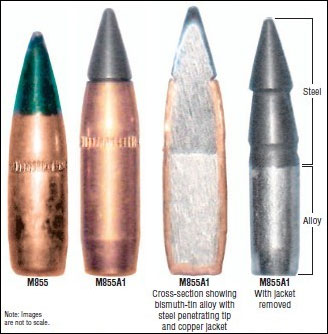
The 62-grain bullet for the new M855A1 ammo is a completely new design. While it may appear to have a plastic “ballistic tip”, that’s deceiving. The new bullet created for M855A1 ammo has a bismuth-tin alloy core with a steel “stacked-cone” penetrating tip. The photo at right shows the version from last year; the final production version may be slightly different (e.g. the final version tip is a different color). Apparently the latest bullet design is a winner. During testing, M855A1 ammo performed better than current 7.62mm ball ammunition against certain types of targets. According to Lt. Col. Jeffrey K. Woods, the program’s product manager, the new M855A1 ammo is “the best general purpose 5.56mm round ever produced. A true general purpose round, the M855A1 exceeds the performance of the current M855 against the many different types of targets likely to be encountered in combat.” The chart below illustrates how M855A1 ammo performs on hard targets compared to M855.
Over One Million Rounds Fired in Army Tests
Prior to initial production, the new M855A1 round underwent vigorous testing. Official qualification of the round consisted of a series of side-by-side tests with the current M855. Overall, the Army fired more than one million rounds to ensure the new cartridge met all expectations. The new M855A1 round is the “most thoroughly tested small caliber round ever fielded” according to Lt. Col. Woods. The new M855A1 is sometimes called “Green Ammo” because it uses a lead-free projectile. Woods said the M855A1’s bullet design shows how “greening” a previously hazardous material can also provide extremely beneficial performance improvements.


 Texan Jackie Schmidt, using a 13.5-lb 30BR Heavy Varmint rifle, has shot a pending NBRSA world record 5-target, 5-shot-per-target Aggregate at 100 yards. Jackie’s 5x5x100 Agg measured 0.1118! How small is that? To help our readers visualize this, the illustration at right shows what a SINGLE 0.111″ 5-shot group (with .30-cal holes) would look like. Jackie’s actual measured group sizes for his five-target Aggregate were: .153, .093, .120, .100, and .093.
 Gun Specs: Jackie was shooting a 13.5-lb 30 BR that he chambered and assembled himself. The barrel is a 4-groove, 1:18″ twist, HV-taper Krieger, fitted with a 5.5-oz. “snubber” barrel tuner made by Jackie. The action is a cast Farley, “glued and screwed” into the stock and fitted with a Jewell trigger. The stock is a Robertson Composites BRX, built with extra weight to make the gun a dedicated 13.5-pounder. The scope is a 50-power March.


 BSA Martini — Classic Design with 21st Century Upgrades
 On June 19, the 4R Rifle Club in Alex, Oklahoma hosted its Spring Balloon Shoot. This challenging “fun shoot” drew nearly 50 competitors from five states. In this multi-yardage event, shooters try to break four balloons, one each at 100, 250, 400, and 500 yards. A total of 18 rounds were allowed. The balloons were worth 10, 20, 30, and 45 points respectively. Shooters attacked the balloons in 12 relays. Even with challenging winds, some impressive scores were fired. When the smoke cleared and all the competitors had tried their luck, only two had perfect scores of 420. Jim Fowler turned in a pair of 410s to win the Two-Gun award, youth winner Dalton Ernst shot a 390, and factory gun champ Don Johnson managed a 365 with his Savage 6BR.



 Replacing retiring Leupold executive Tom Fruechtel, Calvin Johnston has been appointed as
 Many of our readers are now using smart-phones for ballistic calculations. Now there is a new App for the iPhone which makes mildot target ranging simple and easy.

 The July digital edition of

 We recently had a chance to test the new
 Assymetrical Tensioning by Design


 New Steel-Tip Bullet Design


