|
|
May 13th, 2010
 Open Range Day in Phoenix, AZ is a special NRA program providing shooting opportunities for persons with disabilities. Under the direction of Vanessa Ross, NRA Disabled Shooting Services Manager, the 2d Annual Open Range Day was a great success. Art Merrill, a freelance writer for Shooting Illustrated, provides this on-the-spot report from Phoenix’s Ben Avery Shooting Facility.
Open Range Day Report (by Art Merrill)
Vanessa’s safety briefing Saturday morning was the no-nonsense pronouncement we’re used to hearing from rangemasters – except for the “sip & puff” part: “Always always always keep the gun pointed in a safe direction! Keep your finger away from the trigger until you’re ready to shoot. If you’re using the sip & puff trigger mechanism, don’t put it your mouth ’til you’re ready to shoot. If you need help, if you have a question, don’t be stubborn – ask a volunteer.”
Indoor Air Rifle Shooting Popular
The air rifles appealed to a lot of shooters today, and not just because it was indoors, sheltered from the 95-degree desert spring. Every shooter enjoys hitting reactive targets, in this case, air rifle metallic silhouette targets. But there are other reasons, as well: “I don’t like loud bangs,” Ashleigh Justice said. “I liked the .22 pistol, but the .38 was too much.”
Ashleigh had never shot a firearm before today. What motivated her to come out to Open Range Day? “I was afraid of guns. I wanted to get over it,” she said. “My husband shoots and I was tired of the anxiety I felt around guns.” Beyond that, however, was a desire to push the envelope of her disability to achieve something more: “I want to be good at something that takes skill more than physical ability”, she said. Looks like she found it: she, too came away from the firing line talking about the possibility of a regular air rifle competition.
 Shooting Provides Important Challenge
For Mike Tagliapetra, it’s all about challenge. You can feel it in his handshake even before he talks about competing in marathons and even a triathlon – using his wheelchair. Mike’s motivation, a quote from writer Ella Wheeler Wilcox, is boldly emblazoned on his business card: “There is no chance, no destiny, no fate that can hinder or control the firm resolve of a determined soul.”
Open Range Day is winding down now, and the shooters are all going home. They had different motivations for being here and yet, because every participant said they want to return again next year. Something about the shooting sports is satisfying all of their motives. If there’s a common denominator to these motives, it’s the desire for challenge and the satisfaction of success – and empowerment – that comes from it. In the shooting sports, yes, there’s only one match winner; but every time we approach the firing line we are competing, not only against others, but also with ourselves to accomplish our personal best.
Contributions from many businesses made Open Range Day possible. Sponsors included: Birchwood Casey (targets), Colt (firearms), Davidson’s (Weatherby shotguns), Kowa (spotting scopes), Lapua (ammo), Pyramid Air (pellets), Ruger (firearms), Savage Arms (rifles), White Flyer (trap targets), and Winchester (ammo). Symbius Medical catered lunch, and Arizona’s Game & Fish Department made its world-class facility available for the event.
May 12th, 2010
GalleryofGuns.com, the website of firearms distributor/wholesaler Davidsons Inc., has just unveiled its new VIDEO HUB. The Gallery of Guns Video Hub offers TV show previews, informational videos from Ruger and the NSSF, plus scores of product videos illustrating rifles, pistols and shotguns. If you’re interested in gun-centric video programming, check out the new VIDEO HUB. It’s a good resource if you’re planning to purchase a factory-built pistol, shotgun, or AR-style rifle. Unfortunately, as yet, there is little of interest for fans of precision bolt-guns, but Davidson’s will likely augment the content mix in the future. Click the image below to visit the new VIDEO HUB. Warning: Turn down your computer speaker volume if you are at work!

May 12th, 2010
 CMP efforts to develop the new National Match Air Rifle (NMAR) shooting discipline continue to advance. The CMP has created a new 30-shot NMAR Sporter-Garand Course especially for new and recreation-oriented shooters (as well as cross-over military rifle shooters). A special NMAR webpage is now posted on the CMP website to provide a handy, complete source of updated information. A revised edition of the CMP Guide to National Match Air Rifle with the latest rule changes was recently released and can be downloaded from the CMP website. The National Matches Air Gun Events Program featuring a month of daily NMAR opportunities during the National Matches has also just been released.
 General Information for NMAR Competitors
Download the CMP Guide to National Match Air Rifle (PDF) for additional details. This 20-page booklet contains NMAR Rules, Courses of Fire, Firing Procedures and Range Commands, Safety Definitions and Regulations, and Range Officer Commands along with information on how to get started in NMAR and how clubs can run NMAR Matches.
A new Sporter-Garand Course has been added. This course of fire closely duplicates the popular 30-shot John C. Garand Course that is fired outdoors (with as-issued military rifles). The Sporter-Garand Course is fired with Sporter Class rifles only. All three stages of this course are fired on the AR-SR (200-yard reduced) target. This new course is designed expressly for new and inexperienced shooters and for Military Rifle shooters who want a rifle event that duplicates what they will shoot outdoors.
NMAR Rules and Guide Updated
A few rule changes were recently adopted after experiences from earlier NMAR matches were evaluated. The latest NMAR rules that are listed in the CMP Guide to National Match Air Rifle (PDF), on the CMP website. Front sight inserts in Sporter Class rifles can now be either posts or rings (apertures). It turned out that so many shooters, especially juniors, were coming to NMAR matches with aperture experience only so the change was adopted.
May 12th, 2010
 Timney Mfg. now sells triggers for left-hand Remington m700 rifles. There is both a standard lefty model (#502) and a safety-equipped lefty model (#511). The model #502 uses the existing safety and bolt stop in your gun, while the model #511 has an external safety on the left side of the trigger housing. Both these left-hand triggers require no gunsmithing, are fully-adjustable, and can be ordered with default pull weights ranging from 1.5 pounds to 4.0 pounds.
External Safety Trigger Based on Innovative 2006 Design
In 2006, Timney began producing a new drop-in trigger for the Remington 700 with external safety. This was a totally new design with a safety that blocks the trigger not the sear. For 2010 has adapted this trigger for left-hand Rem 700 rifles. If you don’t need an external safety, Timney also now offers a standard left-hand trigger. MSRP for either version is $124.95. The housings of both triggers are milled from solid billet. Other components are machined using state-of-the-art Electrical Discharge Machining (EDM) from high-grade solid steel. This allows Timney to maintain very precise tolerances on its triggers. For more info call toll-free 866-4TIMNEY, or visit www.timneytriggers.com

May 11th, 2010
 New optical technology from the Idaho National Laboratory could make a big improvement in non-telescopic iron sights. INL’s new “MicroSight” uses a Zone Plate design to focus light so that BOTH front sight-blade AND the target appear in sharp focus. This technology could be a major breakthrough for iron sights shooters, particularly older shooters whose eyes have difficulty focusing at multiple distances. The INL MicroSight’s wafer-thin optical element is only about 1/4″ in diameter, and it has been successfully adapted for match-type rear iris sight systems. Initial tests show the MicroSight can help iron sights users shoot better scores, with less eye fatigue. The technology could aid hunters and soldiers, too, either as a primary aiming device or as a lightweight backup for other types of sights.
By Mike Wall, INL Communications and Governmental Affairs
The human eye has trouble focusing on both a firearm’s front sight blade and the much more distant target at the same time. Idaho National Laboratory’s innovative gunsight technology, the MicroSight, helps the eye solve this problem. The MicroSight, a disc smaller than a dime, brings both the target and the iron sight into simultaneous focus, giving marksmen a better sight picture. The new sight has national-security applications, as it could improve safety and performance for American soldiers. Millions of target shooters and hunters should also benefit.

“The MicroSight gives you much of the performance you’d get out of a holographic or telescopic sight,” says INL engineer David Crandall, who developed the technology. “But it’s more reliable, much lighter-weight and much cheaper.” The alternating rings on zone plates bring faraway and nearby objects into focus simultaneously.
The Magic of Zone Plates — Concentric Rings Using Diffraction
Crandall is not an optics specialist. Most of his past work tended toward infrastructure engineering, like nuclear projects with INL’s Advanced Test Reactor. But Crandall is a highly accomplished target shooter — he’s a member of the U.S. national long-range rifle team — and he’s come up with several other shooting-related inventions. He patented a rifle-stabilizing shooting sling, and a small, powerful breaching shotgun that could help law-enforcement personnel storm buildings more effectively.

One day, Crandall was leafing through an optics textbook, and he stumbled across a section on “zone plates.” Zone plates are optical devices that resemble lenses. But whereas lenses focus light using refraction — essentially, changing the direction of light waves by changing their speed — zone plates use diffraction. Diffraction describes how waves bend, break up, spread out and interfere with each other as they encounter obstacles. The diffraction of sound waves, for example, explains how you can hear someone’s voice from around a corner.
Zone plates focus light via a set of concentric rings that alternate between transparent and opaque. The transparent sections let some light waves pass through unchanged, focusing objects that are far away (basically, at infinity). But light passing the edges of the opaque rings gets diffracted, which brings nearby objects into focus. The seemingly impossible result: sharp images of distant and near objects, simultaneously.

Zone plates aren’t new. Frenchman Augustin-Jean Fresnel worked out their underlying scientific principles in the early 1800s. [Editor’s NOTE: A.J. Fresnel also invented the Fresnel lenses used in light-houses and theatrical spotlights.] But it took Crandall, with his shooter’s eye, to recognize the potential zone plates held for improving gunsights. “Competitive shooters are always looking for an edge, for something better,” Crandall says. “You have to, when you’re going against the best in the world.”
Crandall took his idea to INL’s technology transfer division, which also saw the promise and agreed to fund his research. He eventually found his way to phased zone plates. Phased zone plates replace the opaque rings with transparent glass of varying thickness. This accomplishes the same goal — diffraction — but does so without losing as much light, yielding brighter images. After much tinkering, Crandall came up with the MicroSight. CLICK HERE for giant-sized photo of MicroSight element.
A Smaller, Cheaper, More Robust Sight
Without help from zone plates, the human eye cannot focus on two different planes at the same time. So shooters using only standard-issue iron sights see either a blurry target or a blurry sight. The MicroSight isn’t the only gunsight technology that can overcome this problem, of course. Telescopic sights magnify targets, bringing them into close, crisp focus. And holographic sights project a red dot onto an image of the target, showing clearly where the shot will land.
But telescopic and holographic sights have their drawbacks. For one thing, they tend to be bulky. Both types of sight can add one or two pounds to the weight of a rifle — not a trivial concern for hunters or soldiers who must lug their weapons for miles over rough terrain. Further, both are complex instruments with fragile components. They can break, especially if dropped or banged against a rock or tree. Red-dot sights require batteries, which can die. And neither one is cheap: most red-dot sights cost more than $100, and high-quality telescopic ones can run $1,000 or more.
 MicroSight Should Be Versatile and Affordable
The MicroSight, on the other hand, is tiny — its zone plate is thin and only about 1/4″ in diameter — and relatively cheap. Crandall says the sight should cost significantly less than red-dot and telescopic sights when Apollo Optical Systems, which licensed the technology, takes it to market. The company is currently working with gunsight manufacturers to design and develop various MicroSight versions. In the future, some of these versions might add refractive power to the zone plate, achieving some level of target magnification. Crandall foresees other possible applications as well, such as in handguns and night-vision goggles. In any situation that requires taking the long and the short view at the same time, this new INL technology could provide a major advantage.
Article and graphics courtesy Idaho National Laboratory (INL), www.inl.gov.
May 10th, 2010
 The 2010 LaRue Tactical Multi-Gun Match has wrapped up and two new champions have been crowned. The match was held at the Cawthon Cartridge Club in Cawthon, Texas. Taran Butler won the Tactical Division and Benny Hill won the Tactical Heavy Division. Butler is a 5-Time USPSA Multi-Gun National Tactical Champion and 10-Time California State 3-Gun Champion. Those who’ve seen Taran Butler in action understand why he’s one of the top multi-gun shooters in the county. He can compete head-to-head with the best handgunners, and he’s blazing fast with his carbine, even on the move.


Photos courtesy www.taranbutler.com.
May 10th, 2010
The National Shooting Sports Foundation (NSSF) now offers FREE educational video DVDs about firearm safety and wildlife conservation to teachers and school administrators. Already, more than 4,500 DVDs have been ordered by educators. Teachers can order the DVDs (and download related PDF brochures) via the NSSF website. In addition to the videos, each DVD contains guides and activity planners to assist teachers. For more information, visit the NSSF Education Videos webpage.

The Firearms Safety DVD contains three video segments, two designed for viewing by students and one for a general audience. These videos show students how to make correct decisions when encountering a firearm in an unsupervised situation at school, at home or at a friend’s home. The Wildlife Conservation DVD features three videos that teach students about America’s wildlife management system and explain how hunters contribute funding for conservation. Teachers can preview both the Firearms Safety Videos and the Conservation Videos on the NSSF Website.
“We believe teachers and school administrators should teach students how to correctly respond if they encounter an unattended firearm. Students who understand what to do in such situations can potentially save lives,” said Steve Sanetti, NSSF President. Regarding conservation education, Sanetti said, “We have a generation of children who spend less time outdoors and who see more wildlife on television than in the wild. It’s important that students today understand how once-endangered species such as white-tailed deer and wild turkey have been brought back to abundance through efforts funded by hunters.”
May 9th, 2010
Today is Mother’s Day. For your own mother (or the mother of your children), do something special today. Bring her flowers, cook her a meal, take her someplace fun. Remember that life passes quickly — we need to take these moments to say a heartfelt “thank-you” and “I love you” to our mothers, and appreciate the chance to be together. A lot of shooters are edging into their fifties and sixties. We’re getting older, and so are our mothers. My own mother turned 88 years old earlier this week. Who knows how many more “Mothers’ Days” she and I can celebrate together? Perhaps other readers are in a similar situation. So… get away from the computer and go spend some “quality time” with your mom today. She deserves it.

May 8th, 2010
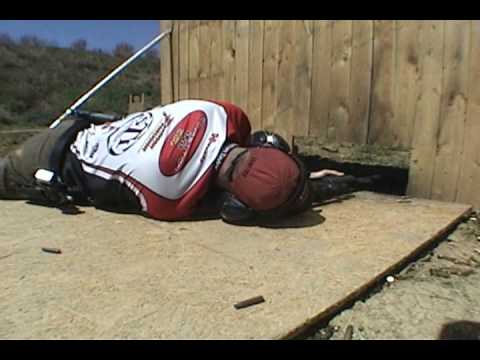
 The Cawthon Cartridge Club (Millican, TX) hosts the 2010 LaRue Tactical Multi-Gun Match this weekend, May 8-9. More than 220 shooters will compete in eight (8) stages of fire using pistol, rifle, and shotgun. This is action shooting, with lots of movement. Shooters negotiate obstacles, run to firing positions, and engage targets from multiple positions, often firing through ports or around barricades. Targets are placed at distances from a few yards (pistol) to 500 yards (rifle).
With stage names such as “House of Pain,” “Jungle Run,” and “Tunnel Rat,” this match will challenge the competitors’ shooting skills and physical abilities. With temperatures predicted to reach the 90s, competitors must battle the heat and the sometimes high winds as they run through stages and take long shots with their rifles. Pre-match favorites include Taran Butler, Kelly Neal, and Bennie Cooley, but there are many lesser-known shooters who could end up on the podium.
The video below shows Stage 8 from the 2009 LaRue 3-Gun Match, held at the Tiger Valley Tactical Institute range near Waco, TX.
May 8th, 2010
If you use an AR-platform rifle for varminting, multi-gun matches, or Service Rifle competition, one simple upgrade you can make to enhance reliability is to replace the mil-spec gas rings with a one-piece McFarland™ bolt gas ring. The McFarland ring is a single spiral of spring steel that loops around the bolt three times and leaves no path for gas leakage. With conventional gas rings, you need to correctly rotate each ring so the “gap” does not line up, thereby allowing gas blow-by that can cause cycling problems. The one-piece ring is an inexpensive, “set and forget” solution that eliminates the need to monitor your ring position on the bolt body.

The one-piece McFarland gas ring is recommended by Fulton Armory and other AR experts. Installation is simple and the one-piece rings last a very long time. One AR user comments: “Ever since I tried single rings I would never change back to mil-spec rings. I’ve experienced more consistent recoils and cyclic rates of fire. And, as to wear — I haven’t worn one out yet.” On Brownells.com, two gunsmiths offered these reviews:
“Easy install, zero chance of a gap, one less thing to worry about in the bolt carrier group. This item should greatly improve gas pressure consistency. This is a ‘must have’ item.” — Jake, SC
“The concept is simple and sound. The one-piece gas ring removes the possibility of gaps lining up. It installs easily, holds great tension, and is cheap. Doesn’t get much better.” — Lane, TN
The McFarland™ one-piece bolt gas ring can be purchased from Brownells for $3.99 (item 100-001-257) or from Fulton Armory for $2.99 (item FA-AR-300-109). Purchase three or four at once to save on shipping costs — that should be enough for a decade of AR shooting.
|


