Brownells’ 4th Annual Gunsmith Career Fair takes place on April 23 and 24, 2010, at Des Moines Marriott Downtown in Des Moines, Iowa. The event, free to gunsmiths and exhibitors, is designed to help new gunsmiths find work and otherwise advance their careers and businesses. Expert gunsmiths and gun industry leaders will be on hand to share their experience and lead seminars. Scheduled Seminars include:
- Time = Money (The Cold, Hard Facts)
– Financing your Business
– Gunsmithing Tax
– Increasing your Revenue through Engraving
– Gunsmithing for a ‘Big Box’ Retailer
– Merchandising Tips
In addition, Tom Shay (Profit Plus) will outline the essential components of a business plan and BATF Reps will host two seminars on Federal rules and regulations pertaining to gunsmithing.
Frank Brownell told us, “I’m delighted to see the seminars growing. Our goal is to make the Career Fair much more than just a place to find a job.” There’s still time to register to attend or exhibit. Sign up now at gunsmithcareerfair.com or call Stacy or Jill at (641) 623-5401. NOTE: Attendees and exhibitors should book hotel rooms and flights early as other major events are scheduled in Des Moines that same weekend.CLICK HERE to watch Gunsmith Career Fair VIDEO (Recommended).
We wish you have the chance to spend this Easter Sunday with your family and loved ones. Perhaps take the time to contemplate the blessings we all have, despite the many challenges in today’s world. In Christian theology, this day marks resurrection and rebirth.
For all of us, regardless of creed, this day carries a message of hope and the possibility of a better future. Last year, in his Easter Sunday message from the Vatican, Pope Benedict XVI declared: “At a time of world food shortage, of financial turmoil, of old and new forms of poverty, of disturbing climate change,… of growing fears over the future, it is urgent to rediscover grounds for hope.”
Danny Biggs, two-time F-TR National Champion, decided to shoot Open Class at this year’s 2010 F-Class National Championships in Sacramento. Danny did very well, finishing third overall in F-Open with a score of 1324-67X. Danny’s X-count, the highest of all competitors, was 10 Xs higher than F-Open winner Derek Rogers and runner-up Ken Dickerman, who both finished with 57X.
While most F-Open shooters used a front pedestal rest, either a joystick design or a center column pedestal with remote-adjustable windage top, Danny used a wide-base bipod, as he had done at past Nationals in the F-TR class. But Danny’s bipod was very special. It is a prototype, modified Sinclair design with height adjustment via a central, vertical-axis knob. As you can see from the pictures below, the left and right bipod legs are attached to a T-shaped silver (aluminum) bracket. This bracket moves up and down as the silver knob is turned clockwise or counter-clockwise. As the knob turns, its threads pull the T-shaped bracket up and down relative to a center block of aluminum bolted to the bipod’s attachment to the rifle’s forearm accessory rail. With this system, Danny can easily reach forward and make precise adjustments in elevation. Note that the Sinclair bipod’s secure rail attachment is retained and Danny can still adjust rifle cant (tilt), using the rear push-button handle. This rear handle functions like a Pod-lock allowing the rifle to be tilted a few degrees to one side or the other to compensate for side-sloping terrain.
We watched Danny shoot with this heigh-adjustable bipod, and it worked superbly. With its wide foot-print, the bipod is ultra-stable. During recoil, the ski-type feet slide evenly straight back. Danny was able to quickly dial in a little vertical, as needed, during his string of fire. This gave him more precise control over elevation than other bipod shooters who had to slide their guns forward or backward or pinch the ears of their rear bags to make small changes in rifle elevation.
Production Plans Not Yet Certain
Wondering “Where can I get one?” Unfortunately, the Biggs Bipod adjuster is not in production yet, and we don’t know for sure if this design (or something like it) will be added to the Sinclair Int’l F-Class Bipod in the future. But Danny Biggs certainly demonstrated that the concept works superbly. We expect micro-adjusting vertical controls to appear on other F-Class bipods at future matches.
Want to become a pro shooter? Here’s your chance. Smith & Wesson is now soliciting new shooters interested in joining Team Smith & Wesson for the 2010-2011 competitive season. Applications, which will be accepted until April 30, 2010, are available online at Champions.smith-wesson.com. The selection process is open to all shooters interested in becoming a part of a winning team. You must have the “right stuff” of course.
To evaluate each applicant, Smith & Wesson has developed a cumulative point system to award sponsorships to prospective S&W Team members. Selection criteria includes, but is not limited to, match level, performance, experience and exposure. Over the course of last year’s season, the 20 members of Team Smith & Wesson won a total of 28 state, 31 regional, 9 national, 5 international and 18 world championship titles.
Julie Goloski — Captain of Team Smith & Wesson Womens’ Team.
Tom Kelly, Vice President of Marketing for Smith & Wesson states: “By becoming a member of Team Smith & Wesson, you will have the opportunity to showcase your skills in matches across the country while serving as a representative to one of the largest and most prestigious firearms manufacturers in America.” For more information regarding Team Smith & Wesson, including team member bios, match recaps and to access an application, visit www.smith-wesson.com and click on the Champions Icon on the left side of the homepage.
An integrated laser sight can be very useful on a defensive handgun. When properly adjusted, the laser displays a small red circle where your shot will impact. When shooting at night, or in a crisis situation where you don’t have time to carefully align font and rear iron sights, a laser sight can be a life-saver. Some people also believe that laser sights can have a deterrent effect — if the bad guy sees the red dot shining on his body, he may withdraw, if you’re lucky.
The problem with most handgun laser installations is that they are bulky or the laser can be obscured by your fingers/hands when holding the gun. Crimson Trace has developed a series of grips with integrated lasers. These work pretty well but we’ve found that you can still obscure the beam with your hands with the smaller pistols. You can mount a laser in front, under the barrel, but then you’ll have trouble finding a holster to fit.
LaserLyte, a small company in Arizona, offers an impressive new system that may be the most practical laser mount yet devised for “carry” pistols used for personal defense. The compact laser and battery are integrated into the rear sight. This mounts the laser up away from the hands. So, you never have to worry about blocking the beam with your fingers, and you can use any “normal” holster.
Introduced in 2009, the LaserLyte Rear Sight Laser (RSL) has proven very popular. It is priced at $199.95, and there are models to fit Glock, Springfield XP, Smith & Wesson M&P, Ruger SR, and other popular handguns. LaserLyte Rear Sight Laser modules come with a one-year limited warranty.
In recent years, environmental concerns over lead toxicity have inspired efforts to eliminate conventional lead-based ammunition. To protect endangered species from lead poisoning, California has banned hunting altogether on huge tracts of public land. In other areas which harbor protected species, hunters are forbidden to use lead-core or solid lead bullets. There is an ongoing FDA investigation into the health of venison taken with lead-core bullets. Responding to such concerns, in 2008, Barnes Bullets (now part of the Freedom Group), introduced its MPG™ (Multi-Purpose Green) lead-free bullets. These bullets are intended for hunting and for rifle training in locations where lead is restricted.
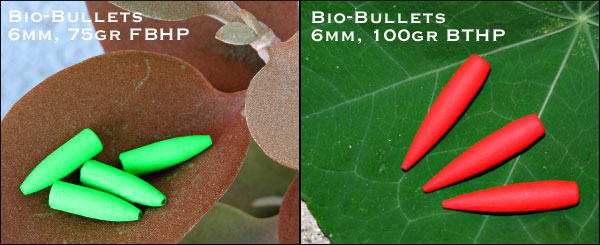
Following Barnes’ lead, BIO-Bullets, a small company in Wanganui, New Zealand has invented a jacketless bullet that is not only lead-free, but is also 100% non-toxic, and bio-degradable. The new bullets have zero lead content and are made from “all-natural”, organic compounds. Unlike conventional bullets formed in a die, the new BIO-Bullets are pressure-molded from a proprietary composite, using sintered mineral compounds in a silica matrix. The mineral compounds, interestingly enough, not only bind the bio-degradable bullet together, but they provide nutritional benefits for any game that might ingest the projectiles. If an animal eats the bullet, it won’t get sick — it will actually get healthier.
That’s right — these edible BIO-Bullets are not only non-toxic, they are actually nutritious. “When we came up with a non-toxic component mix, we realized we could actually provide a blend of flavorful nutrients in the matrix.” Said Trevor MacDiarmid, BIO-Bullets’ chief bullet designer. “It may seem far-fetched but just look at the label on a typical multi-vitamin supplement. You’ll see iron, chromium, magnesium, potassium, and zinc, among other minerals. These are all elements that can be combined into a durable bullet form that is actually healthy when ingested by an animal.” MacDiarmid, who holds a Ph.D in chemical engineering, explains that the health benefits of the BIO-Bullet came as an unexpected bonus: “Our first goal was simply to create a shootable, lead-free bullet that was non-toxic. But when our silica matrix proved more than hard enough to survive the friction, heat, and pressure of a 3500 fps trip through a rifle bore, we realized we could add additional minerals into the mix that would have a salutary effect on wildlife health.”
BIO-Bullet’s founder, Steven Williams, is a gregarious 45-year entrepreneur who earned his first millions promoting dietary supplements in his native New Zealand. Noting the growing interest in “eco-friendly” ammunition components, Williams expects a huge demand for his new BIO-Bullets. “Globally, the annual sales of hunting bullets exceed €500 million in value. And the military bullet market may be triple that number — as long as you Yanks keep fighting wars”, he joked. Williams believes his new company is in the right place at the right time: “Being based in eco-aware New Zealand gives us a strong marketing advantage in launching this new product.” Williams’ company has earned the coveted “100% Pure New Zealand” certification, signifying that Bio-Bullets are “all-natural” and organic.
A select group of New Zealand hunting guides has already been using prototype BIO-Bullets in the field. The new eco-friendly bullets have earned high praise from these tough-to-please outdoorsmen. “In terms of ballistics and knock-down power, I reckon the ‘greenies’ are as good as anything on the market”, reports veteran outfitter Bart Coutts. South Island guide and deer farmer Dennis Amon said, “I’ve used them for predator control, and, as a test I even fed them to some of our captive Red Deer. The Reds ate them up like they were candy. Ever since then we’ve been calling these BIO-bullets the ‘incredible edibles’.”
BIO-Bullets will initially be available in .224, 6mm, and .308 calibers starting at $40 (NZ) per box of 100. The varmint-grade, flat-based bullets will be finished with a day-glo green outer coating, while the longer, boat-tail match bullets will be fluorescent red. Said designer MacDiarmid: “Since our BIO-Bullets don’t use a conventional jacket, we can finish them in any color by adding non-toxic dyes to the silica matrix. It’s sort of like putting the colored shell on a jelly bean. I favored a more sedate color, but the boss wanted something bold and eye-catching. Steven’s the marketing guru, and he writes the checks, so we went with fluorescent colors. But any exterior color scheme is possible, even digital camo.”
BIO-Bullets is currently finalizing arrangements with North American distributors. The company expects its eco-friendly bullets to appear on American and Canadian store shelves in time for the traditional fall hunting season.
Just days after surprising the firearms industry with the announcement that the Marlin Firearms factory in North Haven, Connecticut would be shut down, executives of Remington Arms today dropped another bombshell concerning the fate of Marlin, a Remington subsidiary. This morning, Remington released a statement declaring that Marlin would be “re-constituted” as a multi-product outdoor gear manufacturer, with a primary focus on fishing tackle and equipment.
In the wake of Remington’s decision to shut down the North Haven plant by mid-2011, laying off all 265 Marlin employees in the process, many questions remained as to the fate of legendary arms-maker Marlin, which has been building firearms in Connecticut continuously since 1870. When the Marlin plant closure was announced, Remington, part of the Cerberus Freedom Group of companies, would neither confirm nor deny that Marlin firearms, particularly the popular lever-action rifles, would still be produced. Sources inside Remington were quoted as saying that Marlin rifle production would be relocated to Remington’s Ilion, New York facilities.
Now it appears that Remington has other, quite radical plans for Marlin, which surely reflect the strategic goals of Remington’s parent, Cerberus Capital Management, a private holding company. Cerberus has no doubt “seen the writing on the wall”, recognizing that gun sales are in a steep decline following the buying frenzy precipitated by the Democratic election victories in 2008. To protect its investment in Marlin, Cerberus saw the need to shift Marlin into a whole new market. That’s certainly a bold strategy, but is it wise?
AccurateShooter.com was able to reach one high-level Remington insider with insights into the latest Marlin transition. Our source confirmed that “most of the Marlin firearms line will survive, but not every product will be staged into production right away. Only the most popular rifles will be transitioned into immediate production at Remington plants in Ilion, New York and elsewhere.” Our source explained that building Marlin rifles outside Connecticut is not easy: “Understand that most of the machines and tooling in North Haven were quite antiquated. It’s not even worth moving most of the big equipment. We have to figure out how to replace that junk before we can start building lever guns again.”
“Marlin’s real focus”, our source continued, “will be the fishing stuff — and that’s where 90% of our resources will be allocated. Our market research shows we can sell more rods and reels, at a higher profit margin, than we can old-fashioned rifles. Demographically, fishing is growing while rifle shooting has become a cultural anachronism — a hobby for old white guys. With the Marlin name and trademark, we realized we had a perfect platform to get into the fishing market. Ask most Americans what a Marlin is… nine out of ten will say it’s a fish, not a rifle. Since most consumers already connect the name Marlin with fishing, it made perfect sense to change the company’s focus. And now’s the perfect time to do it, what with the imminent North Haven plant closure.”
While devotees of Marlin rifles may lament the passing of yet another storied American gunmaker, anglers nationwide, who outnumber rifle shooters by nearly 3 to 1, have reason to celebrate. The “rebirth” of Marlin as a rod, reel, and tackle manufacturer promises to offer fishing enthusiasts a wide range of new products, proudly marketed with the “Made in USA” legend. Shown above is Marlin’s new “Fish Eagle II” Rod and Reel combo, complete with Marlin’s signature lever action. The fishing gear industry is currently dominated by foreign manufacturers. Marlin’s movement into the fishing market gives anglers a chance to “buy American” again.
Savage Arms has released a new line of Savage EDGE centerfire rifles. This new platform was built from the ground up as an affordable entry-level rifle. The EDGE features a new modern look, and while it shares key features with its older brother the Model 110, it has a different receiver design.
Though the basic model has a low, $329.00 MSRP, the EDGE includes some nice features: detachable box magazine, pillar bedding, and 2-position safety. For $379.00, you can get the EDGE XP, which includes a 3-9×40 scope (mounted and bore-sighted). Factory camo versions are also offered in both basic and XP configurations.
The EDGE action is apparently long enough to handle both short and long cartridges. This “one size fits all” approach has been used on some recent European rifles as well. We were pleased to see that Savage is offering a wide variety of chamberings: 223 Rem, 22-250, 243 Win, 25-06, 270 Win, 7mm-08, 308 Win, 30-06 Springfield.
An Affordable Gun for a Tough Economy
The EDGE was conceived in January of 2009. At the time, Savage observed heavy activity at the entry level pricepoint from consumers as well as manufacturers. The poor economy created more interest in pricepoint hunting guns and key manufacturers were cutting already low prices even lower.
“We wanted to not only maintain our market share, but to grow it,” Savage VP of Sales & Marketing Brian Herrick said. “We felt the only way to accomplish this was to develop a new rifle designed for this segment, rather than discount current models. We wanted a rifle that not only had a lower price, but one that had better features and was more aesthetically appealing than what was out there at the time.”
We just got the complete F-Class Nationals match results from Jim O’Connell of the Sacramento Valley Shooting Center. Jim provided two (2) MS-Word documents, one for F-Open and the other for F-TR. Jim added: “Thanks to the California Grizzlies (target pullers) for all their work and helping to make the Saturday and Sunday shoots more enjoyable. Thank you all for your support of the Folsom Shooting Club and we hope to see you at future matches.”
The Hickory Groundhog Shoot, the nation’s most popular groundhog shooting competition, will be held Saturday, April 3rd in Vale, North Carolina. Now in its 30th year, this is the biggest Varmint competition on the East Coast, with over $4000.00 worth of prizes awarded each year, including $1000.00 in cash.
You can compete individually or as part of 3-man teams. The entry fee is $25 per gun, plus (optional) $10 per team. There will also be a 500-yard Egg Shoot with a $2.00 entry fee.
Custom or Factory Classes — Simple Rules — Valuable Prizes
There are two classes, custom and factory, and the rules are pretty basic. You can run pretty much anything but a rail gun in custom class, and you can use any kind of front rest (including one-piece rests). A “factory” gun must be “bone stock” as purchased and you are limited to bipod, sandbags, or basic pedestal style front rest. The only modifications allowed for factory class are: 1) bedding job; and 2) trigger tuning (without replacement parts). Competitors may enter one gun in each class, but the fee is $25.00 per gun.
This year, ALL targets will be at known distances: 100, 300, and 500 yards. That should be a cake walk for you 1000-yard shooters. In the past, 6BRs, 6BR Improveds and the mid-size 6mms have been the calibers to beat. To see what it takes to win, read this article about Harold Seagroves’ Spencer-built 6BR (below), which has won the Hickory Shoot multiple times.
The range will be open for practice Monday through Friday the week preceding the match. The practice range is open ’til 6:00 pm Tu-Thurs, but will close at 1:00 pm on Friday. The match will start 8 o’clock sharp Saturday morning, April 3rd. If you have any questions call Larry Willis, Bulls Eye Sporting Goods, (704) 462-1948, or visit www.BullseyeLarry.com. To find the actual range using online maps or your GPS, use this address: 8216 Will Hudson Road, Lawndale, NC 28090.


 Brownells’ 4th Annual Gunsmith Career Fair takes place on April 23 and 24, 2010, at Des Moines Marriott Downtown in Des Moines, Iowa. The event, free to gunsmiths and exhibitors, is designed to help new gunsmiths find work and otherwise advance their careers and businesses. Expert gunsmiths and gun industry leaders will be on hand to share their experience and lead seminars. Scheduled Seminars include:

 We wish you have the chance to spend this Easter Sunday with your family and loved ones. Perhaps take the time to contemplate the blessings we all have, despite the many challenges in today’s world. In Christian theology, this day marks resurrection and rebirth.
 Danny Biggs, two-time F-TR National Champion, decided to shoot Open Class at this year’s 2010 F-Class National Championships in Sacramento. Danny did very well, finishing third overall in F-Open with a score of 1324-67X. Danny’s X-count, the highest of all competitors, was 10 Xs higher than F-Open winner Derek Rogers and runner-up Ken Dickerman, who both finished with 57X.

 An integrated laser sight can be very useful on a defensive handgun. When properly adjusted, the laser displays a small red circle where your shot will impact. When shooting at night, or in a crisis situation where you don’t have time to carefully align font and rear iron sights, a laser sight can be a life-saver. Some people also believe that laser sights can have a deterrent effect — if the bad guy sees the red dot shining on his body, he may withdraw, if you’re lucky.

 Following Barnes’ lead, BIO-Bullets, a small company in
 BIO-Bullet’s founder, Steven Williams, is a gregarious 45-year entrepreneur who earned his first millions promoting dietary supplements in his native New Zealand. Noting the growing interest in “eco-friendly” ammunition components, Williams expects a huge demand for his new BIO-Bullets. “Globally, the annual sales of hunting bullets exceed €500 million in value. And the military bullet market may be triple that number — as long as you Yanks keep fighting wars”, he joked. Williams believes his new company is in the right place at the right time: “Being based in eco-aware New Zealand gives us a strong marketing advantage in launching this new product.” Williams’ company has earned the coveted “100% Pure New Zealand” certification, signifying that Bio-Bullets are “all-natural” and organic.


 We just got the complete F-Class Nationals match results from Jim O’Connell of the Sacramento Valley Shooting Center. Jim provided two (2) MS-Word documents, one for F-Open and the other for F-TR. Jim added: “Thanks to the California Grizzlies (target pullers) for all their work and helping to make the Saturday and Sunday shoots more enjoyable. Thank you all for your support of the Folsom Shooting Club and we hope to see you at future matches.”