|
|
February 13th, 2010
 This may surprise you. We’ve learned that the time interval between neck-sizing operation and bullet seating can have dramatic effects on neck tension (as measured by the force required to seat bullets). Controlling neck tension on your cases is a very, very important element of precision reloading. When neck tension is very uniform across all your brass, you’ll see dramatic improvements in ES and SD, and your groups will shrink. Typically you’ll also see fewer fliers. Right now, most reloaders attempt to control neck tension by using different sized neck bushings. This does, indeed, affect how firmly the neck grips your bullets. But time of loading is another key variable.
James Phillips discovered that time is a critical factor in neck tension. James loaded two sets of 22 Dasher brass. Each had been sized with the SAME bushing, however the first group was sized two weeks before loading, whereas the second group was neck-sized just the day before. James noticed immediately that the bullet seating effort was not the same for both sets of cases — not even close.
 Using a K&M Arbor press equipped with the optional Bullet-Seating Force Gauge, James determined that much more force was required to seat bullets in the cases which had been neck-sized two weeks before. The dial read-out of seating force for the “older” cases was in the 60s, while the seating force for the recently-neck-sized cases was in the 20s. (These numbers loosely correspond to the amount of force required to seat the bullet). Conclusion? In the two weeks that had elapsed since neck-sizing, the necks continued to get tighter and stiffen.
When we first posted this information, it spawned some debate. Many people said they have observed the same thing, but the question is why? Something seems to happen over time that makes the necks less “springy”. Our theory is that, over time, the necks (as sized) are taking a “set” and seem to lose elasticity or the ability to stretch. When they are freshly sized, the neck material seems to be more ductile and expands more readily as the bullet is seated.
In a comment to this post, Steve Blair offered this explanation of how case necks can change over time: “When [metal] material is cold worked, the lattice stresses induced may not be uniform and immediately realized. The grain structure can continue to change for some time, becoming harder and less ductile as the lattice deforms further. Seating a bullet in a case neck provides ongoing radial stress to which the metal will respond over time.”
Concerning the seating force numbers (20 vs. 60) — keep in mind that the K&M simply has a dial read-out activated by a Belleville washer stack with a link rod. This isn’t an ultra-precise measure of force. But you CAN feel the difference between a 20 dial position and a 60. If you use the K&M you’d see what I mean -– the needle tends to swing back and forth as the bullet is seating. What you want to watch for is the max reading and “spikes” in the seating force. I think what is going on is the resistance to seating goes up as the brass becomes less elastic over time.
Lesson learned: For match rounds, size ALL your cases at the same time. If you want to reduce neck tension, load immediately after sizing.
Whether or not you accept the notion that case-neck bullet seating resistance rises with time (you’ll need to do your own experiments), it makes sense to size all your match cases at the same time, and then seat all the bullets you need for a match at the same time. If, for example, you need 200 rounds for an upcoming match, you don’t want to size all 200 cases and seat 100 bullets the same day, and then load the remaining 100 rounds three weeks later. Almost certainly you’ll find some difference in neck tension. That variance in neck tension may show up on the target.
This brings up another point — to minimize velocity variances from round to round, it makes sense to shoot the ammo you load in the same order it was loaded (or exact inverse order). That way, if you have some scale drift over time, causing small changes in powder charges, the shot-to-shot variation is reduced.
February 13th, 2010
Here’s good news for Washington State gun owners. A King County Superior Court judge has struck down a ban on guns in Seattle city parks because it violates Washington State’s long-standing preemption statute. Judge Catherine Shaffer ruled from the bench that the gun ban, adopted under former Mayor Greg Nickels, violates Washington’s law, which placed sole authority for regulating firearms in the hands of the State Legislature. That law was adopted in 1983 and amended in 1985, and has served as a model for similar laws across the country.

The lawsuit was litigated by the Second Amendment Foundation and National Rifle Association on behalf of five individual plaintiffs. “This is a great victory for the rule of law and Washington citizens,” said SAF Executive Vice President Alan M. Gottlieb, who added: “This case affirms the intent of lawmakers in 1983 to prevent cities like Seattle from creating a nightmare patchwork of conflicting and confusing firearms regulations.”
Gottlieb suggested a review of local ordinances may now be in order, so that city and county governments can be compelled to remove old gun regulations or face legal consequences. “This ruling puts anti-gun local officials on notice that legally-armed citizens have rights, too,” Gottlieb stated.
Founded in 1974, the 650,000-member strong Second Amendment Foundation (www.saf.org) is the nation’s oldest and largest tax-exempt education and legal action group dedicated to the Constitutional right to privately own and possess firearms.
February 12th, 2010
The 2010 Winter Olympics kick off tonight in Vancouver, BC, Canada. Shooting sports fans should follow the USA Biathlon team, which is considered the strongest group of American biathletes ever. Tim Burke, a top finisher in recent Biathlon World Cup events in Europe, is one of the favorites to collect a medal in Vancouver. That would be quite an accomplishment. Thus far, no American has ever won an Olympic Biathlon medal. Burke hope to change that. In the video below, Tim explains his training methods and his love for the sport. Definitely watch this video (produced by Time.com). Tim shows off his shooting skills and the reporter even tries out Tim’s Anschütz rifle. In an entire day of training, Tim only missed one target.
WATCH This Video — It Does a Great Job Explaining the Sport

While the American team is strong, it will face tough competition from the Europeans. Biathlon is far more popular in Europe than it is in the USA. In fact Biathlon is the #1 televised winter sport in Europe. Nonetheless, the American team has been training hard in hopes of a strong performance. The video below shows members of the USA Biathlon team doing off-season “dry land” training. In the summer months, Biathletes train with special short skis equipped with wheels. They shoot with the same rimfire rifles used in winter events.

Over 90% of Olympic-level Biathletes use Anschütz rifles, most commonly fitted with a straight-pull Fortner action. These rifles are capable of 1/4 MOA accuracy at 50 meters. Of course, it’s not so easy to hold the guns steady after skiing many kilometers with no time to rest before engaging the targets. That’s what makes Biathlon so challenging. For more information on Biathlon competition, visit the TeamUSA.org website.

February 12th, 2010
 Many of our Forum members have reported that they have received their new Sightron SIII 10-50x60mm target scopes. These come with 1/8 MOA clicks and either a Fine Cross Hair reticle or FCH with target dot reticle. Currently the scopes do NOT include lens covers or screw-in sunshades.
In terms of optical performance, feedback so far has been very positive. Forum member Nat Lambeth recently received one of the new 10-50 Sightrons. He reports: “This scope, like the 8-32x56mm SIII, is much heavier-built than the first Sightron target scopes. It is very clear and sharp edge to edge. I shot 20, 5-shot groups with my [6BRX rifle with Savage Target action]… off a BR Rest and leather rear bag. The scope was cranked up to 50 power during my entire afternoon of shooting. The focus ring has a very short window of focus for a given distance. Otherwise clarity and light gathering was superb.”
The new scope is pretty large, measuring 16.9″ overall and weighing just under 29 ounces (without rings). Below you see the new Sightron 10-50x60mm next to a Nightforce NXS 12-42x56mm.

Some folks have been concerned about vertical clearance with the large 60mm front objective. The photo below shows the scope mounted on a Weaver-type rail with Burris Signature Zee “Extra-High” scope rings. As you can see, there is more than ample clearance. With most Weaver rails and barrel profiles you could probably go to the next lower Burris ring height — but we recommend you get the specs if you plan to use other types of rings.

The new Sightron 10-50x60mm scopes remin in stock at various vendors, but they are selling fast. MidwayUSA has them in stock today, priced at $994.99 (item 589261). Note: At this time, these scopes ship without scope caps or sunshade. Sightron hopes to have both caps and shades available by mid-summer.
CLICK HERE for more photos by Forum Member SwitchBarrel.
February 12th, 2010
Gun industry executives will talk about their product lines (and give away some free stuff), this week on Tom Gresham’s Gun Talk radio show. Tom Munson (Trijicon), Bud Fini (Sig Sauer), and Travis Noteboom (Crimson Trace) are all slated to appear on the Sunday (Feb. 14th) edition of the nationally-syndicated talk show.
Trijicon has been in the news recently, and the company’s Marketing Director Tom Munson will highlight new products Trijicon is bringing to market. Bud Fini, Sig Sauer’s VP of Sales and Marketing, will discuss the new products introduced at the SHOT Show last month, including the P238 Tactical Laser. Travis Noteboom will detail the products being given away in the new Gun Talk contest — the Crimson Trace Great Grip Giveaway.

Tom Gresham’s Gun Talk Radio is in its 15th year and runs on 89 stations, plus SIRIUS XM Satellite Radio. All Gun Talk shows can be downloaded as podcasts through Apple iTunes or via the GunTalk Archives.
February 11th, 2010
Michael Bane, producer and host of the popular DownRange TV show on the Outdoor Channel, also creates a short video “podcast” each week. Michael’s weekly podcasts cover a variety of topics — product intros, major competitions, shooting tips, and gun industry news. This week (8 min, 30 sec into the video), Michael comments on the upcoming Supreme Court hearing in McDonald v. Chicago. That case will determine whether the landmark Second Amendment ruling in D.C. v. Heller shall be extended to state and local government actions. Bane also spotlights the FBI’s new 40sw AR15 carbines (from Rock River Arms) and the re-introduction of the classic Merwin-Hulbert revolver, now marketed as a compact CCW weapon. Notable Merwin-Hulbert design features included interchangeable barrels and auto-ejection of spent cartridges (when bbl assembly was unlocked).

Details of Merwin Hulbert Revolver Design (NRA YouTube Video)

February 11th, 2010

The First Shot, the CMP’s online magazine, features a well-written article on Prone Shooting Technique by SPC Matthew Sigrist of the U.S. Army Marksmanship Unit (USAMU). The article covers all the major points of gun hold and body position: hand position, elbow position, stock weld, buttstock placement, and sling position/tension.

SPC Matt Sigrist of the USAMU breaks down the prone position into “fundamentals” and explains how you put each element together to create a stable body position: “The fundamentals are the building blocks of a position. Much like the framework of a house, a correct application of the fundamentals ensures a solid and stable structure. Since each person’s position will depend on their particular body build and shape, there is no ‘perfect position’ that applies to everyone. Experience, practice and knowledge of the correct fundamentals will dictate the best position for you.”
SPC Sigrist also demonstrates the two basic variations of the leg position when shooting prone: open/spread legged, and bent-legged.
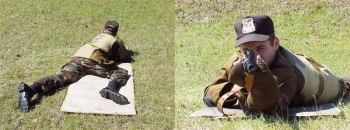

For any service rifle, highpower, cross-course, or prone shooter, this helpful article can improve your performance in the prone position.
February 10th, 2010
These days, it’s not uncommon for shooters to bring electrical gadgets to the shooting range, particularly when testing loads. You’ll see guys running chronos with laptop computers, or loading with electronic powder dispensers (such as the RCBS ChargeMaster). If your favorite range doesn’t have AC outlets, how do you keep all that stuff powered up? You can get one of those portable 120v power supplies (basically a big battery with inverter and carry handle), but they are heavy and fairly expensive.
Another option, for those needing 120v AC to drive powder dispensers, laptops etc., is to use your car battery. Compact, affordable, and reliable inverters are now available that let you draw current from your car/truck’s cigarette lighter or accessory jack. Yes, it would be possible to run-down your battery, but if you start with a healthy vehicle battery, you’re not going to drain it by throwing a couple dozen charges with a ChargeMaster.

Black & Decker makes a rugged 100-Watt Inverter that converts your vehicle’s 12-volt DC power into 115-volt AC power. The unit has a single AC outlet, with an accessory plug that adjusts 45 degrees for convenience. An automatic low battery shutdown prevents draining the vehicle battery, and an LED indicator shows charging status. Black & Decker backs its inverter with a 2-year warranty. The Black & Decker 100-Watt Inverter costs $22.96 at Amazon.com.
Duracell has a similar Pocket Power Inverter fitted with a cord on the 12V end. (The cord is much longer than shown in picture). The cord can be helpful if your power take-off or cigarette lighter jack is hard to access. The Duracell unit has been popular, but, unlike the Black & Decker, the Duracell only delivers 100 Watts for for 5 minutes, after that it delivers 80 watts. That’s still enough to drive most of the gadgets you’ll use for load testing at the range. Duracells Pocket Power Inverter sells for $19.99 on Amazon.com. A more powerful 175 watt version sells for $48.75.

February 10th, 2010

Right now Cabela’s.com is running a major Hunting Gear SALE with some popular items discounted 30% or more. You’ll find great deals on Bushnell, Leupold, and Nikon optics. Rifle ammo for a wide variety of calibers is on sale, and you’ll find good deals on knives and hunting accessories.
To make this sale even more attractive, Cabela’s is offering $5 flat-rate shipping, now through February 16, 2010. To qualify, your order must total AT LEAST $150.00, and you need to use Promo Code 2XFLAT when checking out.

February 9th, 2010
Mark Trope, Webmaster of the Gun Owner Network website, has written a very thorough review of the SEB Coaxial front rest. Mark’s SEB Rest Review covers all the bases, showing how the rest works with a variety of rifle types, including both wide-forearm match rifles and narrow-forearm sporter rifles.

Mark provides dozens of good photos of the rest, including many close-ups showing the fine points of SEB’s impressive design. The review shows how to set-up and level the rest, and how to tune the “feel” of the joystick to suit your preferences. Some rest users prefer the joystick to move quite freely, while others prefer to dial in some resistance so there is no chance of movement when you remove your hand from the joystick.

After covering the features and performance of the SEB Rest, Trope turns his attention to the SEB “BigFoot” rear bag. He explains why it’s a super-stable choice in rear bags, one of the best products available. You’ll note we acquired a SEB BigFoot rear bag for our latest AccurateShooter.com Project Rifle (see story above). After providing tips on how to fill the bag with heavy sand, Trope shows how to adapt a RubberMaid “ActionPacker” plastic storage bin to carry both the SEB Front Rest and the BigFoot Bag.

If you are considering the purchase of a joystick-style front rest, or joystick-style rest top, you should definitely read Trope’s Rest Review. It will definitely help you identify the features you need, so you can make an informed decision, whatever brand you ultimately choose. To learn more about the SEB coaxial rest, or to place an order, contact Sebastian Lambang’s American dealer, Ernie Bishop:
Ernie Bishop
306 West Flying Circle Drive
Gillette, WY 82716
(307) 257-7431
ernieemily [at] yahoo.com
|


