|
|
December 9th, 2009
In Norway, the annual Landsskytterstevnet (Rifle Country Fair) is Norway’s largest shooting tournament. One of the most popular Landsskytterstevnet events is a rapid-fire competition. The objective is to achieve the most hits on multiple targets in the alloted time period (typically 25 seconds or less). In some stages, all targets are at the same distance, while in other stages the shooters engage targets at 3 or 4 different distances.
You would think that a semi-automatic rifle would dominate the rapid-fire matches, but that isn’t the case. In the video linked below, civilian shooters with mag-fed Sauer 200 STR bolt-action target rifles outpace Norwegian army personnel using HK select-fire rifles in semi-auto mode. You’ll be amazed to see how fast the civilians can shoot their target rifles. It’s a great video… be patient and let it load from the Norwegian server.
CLICK HERE to load MATCH VIDEO (May take 30 seconds or more to load page).

 Crowds Cheer Shooters
Equally amazing is the size of the crowd and the spectators’ enthusiasm. We’ve never seen anything like this in the USA. Over 1000 Norwegian fans are clapping, cheering, and singing during the match. You’d think this was a Big Ten Football game! Obviously the Norwegians love their shooting sports. Electronic scoring and big display screens allow the crowd to follow the fast-paced action.
Thanks to Gary Eliseo for finding this video. Gary says: “Check out how the boltgunners manipulate the bolt and operate the trigger, also how the gas gunners struggle to keep up! Looks like great fun, were going to try to put on a ‘Stangshoot’ like this at BRRC (Burbank Rifle & Revolver Club) next year.”
December 9th, 2009
UPDATE: This was a “Deal of the Day” on 12/9. Amazon’s Price is now $124.49.
A modern, GPS vehicle Navigator that provides spoken, turn by turn directions is handy to have. For those who do a lot of traveling, a GPS might be considered a necessity. If you’ve been waiting for prices to drop before buying your GPS, here’s your chance. The TomTom XL 325 widescreen (4.3″) GPS Navigator is now on sale as Amazon.com’s “Deal of the Day” for just $89.99 with FREE shipping. That’s $60.00 the regular price!
Best Price: CLICK HERE for TomTom XL 325 4.3-inch Portable GPS Navigator

Just $89.99 instead of $150.00
The TomTom XL 325 is a top-selling unit at Amazon and elsewhere, with most buyers very satisfied with this piece of navigation technology. Better act quick or this special $89.99 price may go up. Normally the TomTom XL 325 is priced around $150.
December 8th, 2009
Doan Trevor, a gunsmith based in New Mexico, has created a stunning Palma rifle to benefit the USA Veterans Rifle Team. Doan, a gifted wood-worker and machinist, crafted the high-grade walnut stock, fitted the barreled action, and custom-fabricated many of the gun’s metal features. The step-by-step process of creating this one-of-a-kind rifle is illustrated on Doan’s website. Visit DoanTrevor.com, to see the Veterans Team Rifle being built from start to finish. Below are photos of the finished rifle, plus the “work in progress”.

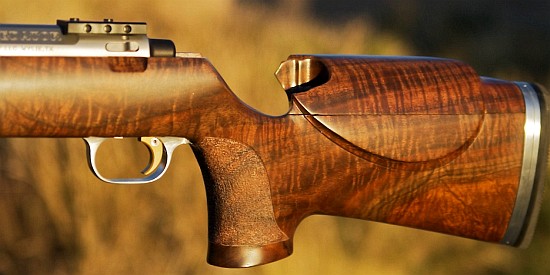
The USA Veterans Team Rifle carries a unique serial number signifying the 2011 World Championships in Australia. CLICK HERE to learn more about the US Veterans Rifle Team, www.USAVRT.org.
Rifle Raffle Tickets Cost $5.00
You have a chance to own this special Trevor-built Palma Rifle. Raffle tickets for the USA Veterans Team rifle can be bought for $5 each or six (6) for $25 from Mike StClair, 12138 Eastglen Street, San Diego, CA 92131. Questions? You can email Mike: estclai1 [at] san.rr.com. Make checks payable to Palma Promotions.
Components Donated for USA Veterans Team Rifle
A variety of individuals and businesses donated components for the USA Veterans Team Rifle. Krieger Barrels donated the barrel while Scott Riles provided front sight and trigger. Doan Trevor and Richards Microfit jointly donated the stock, while Stillers Precision Firearms, LLC provided the stainless Predator action.
Contact: Doan Trevor, DoanTrevor.com, Ph: 505-890-0368. Photos © Sue Trevor 2009.
December 8th, 2009
 In April 2010, Purdue University will host the expanded NRA Intercollegiate Rifle Club Championship. This event will be open, for the first time, to ALL levels of collegiate shooters. This new championship format will include NRA College Rifle Clubs, Varsity Rifle Teams, ROTC Teams, and independent shooters, for which there is currently no national championship. The 2010 NRA Intercollegiate Rifle Club Championship will be held April 8-11 at the Purdue University Armory.
The championship will feature smallbore and air rifle competitions, plus training summits for participants and coaches. Both individual and team champions will be named for NRA College Rifle Clubs, Varsity Rifle Teams, and ROTC Teams. Shooting in the NRA Intercollegiate Rifle Sectionals is required to qualify for the championship. Additionally, the top three teams and top five individuals from sectionals earn free entry to the championship. The official NRA Collegiate Smallbore target is the NRA/USAS 50 target, which must be used for Intercollegiate Sectionals.
NRA Intercollegiate Rifle Club Championship
April 8-11, 2010
Purdue University, West Lafayette, IN
2010 Rifle Championships Program
December 7th, 2009
Adam Braverman of Nammo-Lapua just confirmed that Lapua, at the behest of the U.S. Palma team, has been quietly developing a NEW version of the .308 Winchester cartridge that has a small BR-style primer pocket. That’s right, this is no joke. Lapua has crafted small primer pocket .308 Winchester brass that will be introduced at SHOT Show in Las Vegas (Jan. 19-22).

The new .308 variant is identical to Lapua’s current .308 match brass with the exception of the primer pocket. The brass will be head-stamped “.308 Win Lapua Palma”.
FLASH HOLES: The flash-hole size for the current pre-production .308 Lapua Palma brass is 1.5mm (.059″), the same as Lapua 6mmBR and 220 Russian brass. Lapua spokesmen were not certain if the flash hole size will change for the regular production brass. Note: if you have a Redding .308 die, you can ask Redding for a smaller decapping rod tip (.057″) to use with the new brass.
Tests Reveal Better ES and SD with Small Primers
Initial tests of the small primer pocket .308 by U.S. Palma team members have been very promising. The small primer pocket case seems to have advantages in both accuracy and the ability to handle high-pressure loads. However, the primary improvement found with the smaller primer is reduced ES and SD. Palma Team members have found that, with almost every brand of primer tested (small vs. large), the smaller version has yielded reduced Extreme Spread and Standard Deviation. This pays dividends in 1000-yard shooting. Also, some testers believe that small primers are more consistent and require less sorting — and that there are more varieties of small primers that seem to work really well in the .308 case. Moreover, the small primer types are more uniform, from lot to lot, than are large primers, according to some testers. More info will follow later today.
December 6th, 2009
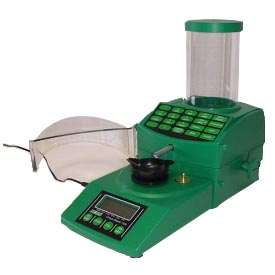
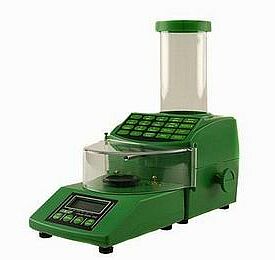 The RCBS ChargeMaster 1500 electronic powder scale and dispenser is the most popular product of its kind on the market. In our original Electronic Powder Dispenser Comparison Test, the ChargeMaster normally dispensed most kinds of powder faster than competitive units from Lyman and PACT. However, after the initial release of the ChargeMaster 1500, RCBS “tweaked” the software a bit to achieve more consistent charge-throws. This slowed down the process somewhat. Some owners have wanted to speed up their ChargeMaster. This IS possible with a relatively simple reprogramming. Most of the internal parameters of the Chargemaster can be modified, under guidance from the tech staff at RCBS.
Gunsmith and Forum member NAT Lambeth reports: “I thought My RCBS ChargeMaster 1500 Combo was fast enough. But I still called RCBS and asked for the programing changes to see if I could speed it up. It was a lot easier than I thought. My 1500 Combo was taking from 15-30 seconds to dispense the powder to the tenth of a grain. I reprogrammed the numbers and now it takes between 7 and 15 seconds to dispense to a tenth. This effectively doubled my loading speed. I only changed the HSB_A1, HSB_B1, and BSP_C1 settings.”
Key ChargeMaster Parameters with Default Settings
HSB_A1 (15.68) Grains under target weight to go from full to high speed
HSB_B1 (3.42) Grains under target weight to go from high to slow speed
BSP_C1 (1.08) Grains under target weight to go from slow to final trickle speed
Nat cautions that you should talk to a RCBS tech before attempting to re-program your ChargeMaster: “You will benefit from talking to the RCBS tech. I have now gone back and played with the numbers a couple of times. (The numbers given to me by the tech at RCBS were still a little conservative.) I think each machine may have its own likes and dislikes. If you get too aggresive with lowering your numbers it will over-throw your intended load.”
 Source for ALL the Parameters
There is an extensive discussion of RCBS ChargeMaster programming on the South Africa Hunting Rifle Shooting Assn. (SAJSV) Forum. In this SAJSV Forum ARTICLE, Jaco Brink lists virtually all the programming codes. Importantly, Jaco also provides the default values for various parameters. This is very important, because the ChargeMaster does not have a “return to default” option. Once you change any value, if you want to return to the original value you must enter it manually. Jaco cautions: “I have to advise you to only make changes to your scale if you are confident to do so, and remember that there is not a ‘return to default’ setting in the scale. If all else fails return your scale to the default settings [I have listed].”
CLICK HERE for list of RCBS ChargeMaster Default Programming Values
Use a McDonald’s Straw to Reduce “Over-Throws”
Jaco Brink provided another useful tip to avoid “over-throws” (excess charge weight): “The RCBS employee advised me to take a McDonnell’s straw (because it is thicker than a normal straw), cut off about a half inch piece and put it into the tube where the powder exits. This caused the last [few kernels] of an extruded powder to cluster less, and reduced the amount of overthrows dramatically.”
CLICK HERE for more ChargeMaster 1500 optimization TIPS.
December 6th, 2009
 Women’s participation in hunting and the shooting sports is going up, according to new data from the National Sporting Goods Association. Between 2003 and 2008, the number of women hunting with firearms rose from 2.1 million to 2.9 million; women who bowhunt rose from 400,000 to 600,000; and women who target shoot increased from 4.1 million to 4.8 million. Guides and outfitters are seeing women as a growing market, and gun clubs seeking members are often shocked at how many women will sign up, if simply given some friendly instruction. There is now even a dedicated magazine just for lady hunters, Woman Hunter.
These nationwide figures are consistent with the participation trends NRA has seen in its Women On Target program, which began in 1999. Women On Target conducts women-only hunts and instructional shooting clinics. Both provide a venue for experienced women hunters and shooters to mentor newcomers.
 While the mainstream media may be surprised that women have any interest in guns, the Women On Target program proves otherwise. The number of clubs running Women On Target shooting clinics rose 37% from 211 in 2007 to 289 in 2009. A total of 6,066 women attended those clinics in 2007, and there should nearly 8,000 by the end of 2009—a 32% increase. The program’s women-only hunts are growing steadily. Ten hunts are planned for 2010. Click here for 2010 hunt schedule.
Editor’s Comment: Signing up more women members may be the single most important thing gun clubs can do to improve “public relations”. In mainstream media reports on firearms, the bias is too often negative. However, when women shooters/hunters are the focus of a media story, the overall slant is often very positive. The news media like stories about women who succeed in a male-dominated sport such as shooting. Moreover, women-only shooting events are usually shown to be fun and “empowering”, while women shooters are, more often than not, portrayed in a positive light.
December 5th, 2009
 We have confirmed that Lapua will produce and distribute 22-250 cartridge brass starting in early 2010. The official product release will be at SHOT Show in Las Vegas (Jan. 19-22). We don’t have production samples yet, but there are about 1000 pieces of brass in the hands of testers in the United States at this time. This stuff is for real — CLICK THIS LINK for PHOTOS.
 One of the folks lucky enough to get his hands on the new Lapua 22-250 brass is writer/shooter Steven Boelter, author of the Rifleman’s Guide to Rimfire Ammunition. Steven has measured and inspected the new brass and he says it appears to be “on a par, quality-wise, with Lapua’s 220 Russian and 6BR brass”, which is saying a lot. Steve adds that: “[what I have] is in fact part of a pre-production run, and the main stuff will be ready for second quarter, 2010″. Steven is working on an article for Precision Shooting magazine that will include exact dimensions for the new brass, as well as initial load testing results. An exact release date for Steven’s article has not yet been set, but Boelter hopes the story will come out in January or February.
Boelter can’t say much more about the brass prior to publication of the article. But we can confirm that it has a large primer pocket, standard 22-250 rim size, and it is annealed like other premium Lapua brass. Steven has posted a couple photos of the brass on the Saubier.com web site.
We’re always excited when Lapua decides to expand its line of cartridge brass. For 22-250 shooters, who will now have a new ultra-high-quality brass option, the news of Lapua 22-250 brass must be like an early Christmas present.
Link to Lapua 22-250 Brass Photo

Above is a QuickDESIGN diagram of the 22-250 Remington cartridge based on CIP Metrics converted to English units. This is NOT the official print for the new Lapua 22-250 brass, which may vary slightly in dimensions. We suggest you get the actual production brass in hand before ordering new chamber reamers or dies.
December 5th, 2009
If you’re not familiar with the short-range benchrest game, and want to learn more about this most precise of all shooting disciplines, Canada’s Peter Cronhelm has prepared an excellent summary of Benchrest Basics. Cronhelm covers everything from the origins of the PPC cartridge, to the special lingo used at short-range benchrest matches.
Terminology
Bughole: Very small group.
Mothball: The 10-ring on the standard Benchrest Target.
Tomato Stake: A worn out or otherwise inaccurate rifle barrel.
Screamer: A group measuring less than 0.100″ at 100 yards or less than 0.250” at 200 yards.
Weather Report: A Group “scattered” as a result of poor wind doping.
Wailing Wall: Place where targets that have been scored can be viewed by competitors.
Dope the Wind: Ccompensate for the effects of wind by shifting aiming points on the target.
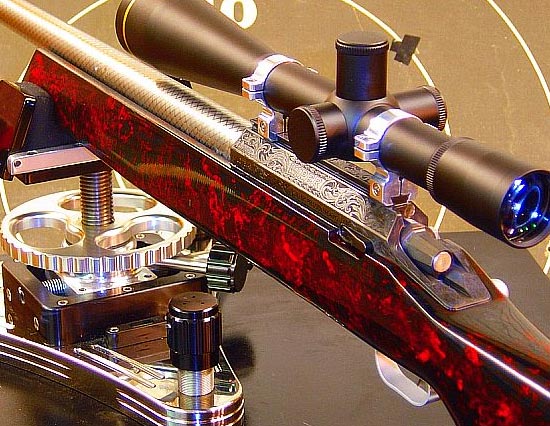
‘Ultimate PPC’ by Speedy with engraved Stiller Viper action.
Competition — Benchrest for Group
Matches are usually shot at 100 and 200 yards with some including the 300-yard distance. Individual scores are determined by measuring the actual size of the 5-round group[.] Aggregate scores are the average of all the groups shot over the course of the match. [In short-range benchrest for group] the placing of the group on the record target is not considered, only the size of the group.

At the top levels, 5-round groups are usually a single ragged hole in the target. To ensure that the competitors fire 5 rounds into the target, a moving backer paper is installed behind the record target. This way it is easy for the match officials to see that all 5 rounds were fired. For each target, there is normally no limit to the number of sighting rounds a competitor may fire, but there is a time limit for record fire.
A total of 5 groups (per class) are fired in a typical Benchrest match. Winning aggregate scores are commonly in the 2s (less than 0.3 inches), with individual groups in the 1s now common, and individual groups in the zeros (less than 0.1 inches) becoming more common.

How is it possible to fire a group measuring only 0.1 inches across with a bullet that is 0.243 inches in diameter? Group sizes are measured from center to center of the two widest bullet holes. As a result bullet size is removed from the equation and groups from different caliber rifles can be compared on equal terms.

If you want to learn about “point-blank” BR, give Peter’s well-written article a read. Found on the Canadian National Firearms Assn. website, Peter’s fact-filled summary provides a quick but thorough explanation of the rules, gear, and shooting styles used in the short-range benchrest game.
Black Rifle and Targets photos courtesy Jim Borden, www.BordenRifles.com. |
December 4th, 2009
Here’s good news for iPhone and iPod owners. There are two new FREE applications (Apps) that let you use your device as a firearms shot timer. It may be a while before we see iPhones used at 3-gun matches, but it’s nice to know that Apple’s smartphones can do double duty as timers. Both Surefire, maker of tactical flashlights, as well as Taurus, firearms manufacturer, offer Shot Timer Apps that can be downloaded, for FREE, from the iTunes store. (Note: you must have iTunes software installed on your computer to download the Shot Timer programs. iTunes software is free, but it is a hefty 90-meg install.)
CLICK HERE for Taurus Shot Timer App Download | CLICK HERE for SureFire Shot Timer FAQ
With either the SureFire ShotTimer or Taurus Timer apps installed, your iPhone/iPod can function just like a dedicated shot timer (such as the PACT Club Timer III), but you no longer need a dedicated unit. All the key functions can be performed with your iPhone or iPod. The screen displays the elapsed time and the split time for every shot fired. You can review time between consecutive shots, shot count, and total firing time. A “start delay” option let you train alone, and you can use the Par Time mode to train “against the clock”.
Once the unit is adjusted, the built-in microphone on an iPhone or iPod should be able to track every shot without fail. Even indoors, anti-echo technology provides reliable shot detection. The software allows you to adjust microphone sensitivity to the unique sound “profile” of the shots. Just tap ‘Adjust Sensitivity’ on the display to raise the sensitivity in 10% increments until the Shot Timer consistently detects all your shots.
 With either the SureFire or Taurus Timer Apps, you can hold your iPhone like a traditional shot timer or use the start delay mode with the iPhone placed on a shooting bench, or held in your shirt pocket. The Shot Timer will display both elapsed time and split time for every shot. You can store practice session results in your iPhone’s internal memory.
|


