|
|
September 22nd, 2009
 If you’re looking for the latest info on the upcoming SHOT Show, the NSSF now has a SHOT Show Blog with regular updates. The SHOT Show Blog currently explains how you can sign up for SHOT Show Webinars and SHOT Show University. In addition, you can learn about Media Day at the Range, which will be held Jan. 18, 2010 at the Boulder City Pistol & Rifle Range, outside Las Vegas.
If you are planning to attend the 2010 SHOT Show, note that this year, SHOT Show will be held in the Sands Expo Center, located next to the Venetian Casino Resort in the heart of the Las Vegas Strip. Discounted lodging at a variety of nearby hotels and casinos is available through the SHOT Show Travel Desk.
September 21st, 2009
The 2009 U.S. Practical Shooting Association (USPSA) Nationals were held Sept. 11-19 at the Desert Sportsman’s Rifle & Pistol Club outside Las Vegas, NV. The event drew more than 620 top shooters from across the country and around the world.
 Abbate Wins Both Production and Limited Titles
Glock shooter Jessie Abbate won dual national women’s titles at the 2009 USPSA National Handgun Championships. This year Abbate claimed both the Production and Limited division championships. In 2008 she was crowned the Limited and Limited-10 champion.
In the Production division, Abbate took top honors among lady shooters posting a final score of 1097.9378, outpacing runner-up and Julie Goloski-Golob by more than 111 points. Abbate’s score was also good enough to finish 37th overall among all shooters, male and female. In the Limited division, Jessie again put on an impressive display shooting a score of 1050.2892 and finishing over 114 points ahead of Team SVI shooter Lisa Munson, who came in second with 935.3943.
Max Michel Wins Open Division in Tight Race
Just over 11 points separated the top three shooters in the battle for the coveted Open Title at the USPSA National Championships but it was Max Michel who took home the crown.
Heading into the final stages, three ace shooters had a chance to win: Max Michel, K.C. Eusebio, and J.J. Racaza. In the end it was Michel who emerged on top. Max had the best time on 4 of the 16 stages on his way to winning the USPSA Open Title. “Max is one of the top shooters in the sport and a threat to win any match he enters,” observed Michael Voigt, USPSA president. “He faced intense competition this year from both K.C. and J.J. but was able to pull out the win.” Michel’s victory cemented his reputation as one of the top action shooters in the world. His “shooting bio” now includes two World Speed Shooting Championships (2007 and 2005), five USPSA National Championships (2009, 2007, 2006, 2005 and 2004) and nearly 30 USPSA Area Championships. In May 2009, Max completed his U.S. Army service. Leaving the USAMU team, Max is now Sig Sauer’s Manager of Competitive Shooting Activities. In the video below, created while Michel served with the USAMU, Max explains how to shoot on the move:

September 20th, 2009
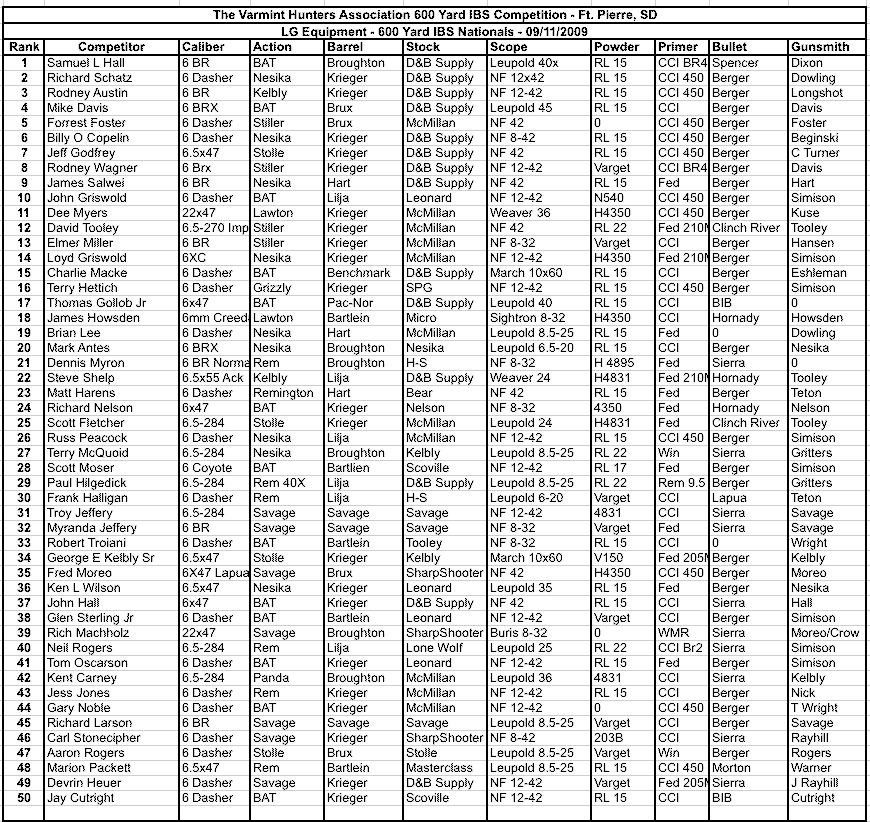
 After scanning the equipment list for the recent 600-yard IBS Nationals, one of our readers noted how the 6mm Dasher dominated the Top 10 list in both Light Gun and Heavy Gun Classes. But Sam Hall won the Grand Agg with a straight 6BR, Mike Davis won the Heavy Gun Agg with a 6BRX, and Richard Schatz won the Light Gun Agg with a 6mm Dasher. So which cartridge should you pick? What’s the best for the 600-yard game — 6BR or Dasher or BRX?
Sam Hall, 2008 IBS 600-yard Shooter of the Year and back-to-back 2009/2008 IBS 600-yard National Champion, offers this advice:
“I shot a Dasher most of this year at IBS 600-yard matches and shot a no-turn BRX in a couple of shoots. I even tried a BRDX (40° improved with a longer neck than Dasher) in a practice barrel. By looking at the results on my target, I would never have been able to tell the difference between any of them if I did not already know what cartridge I was shooting. The 6BR or an improved version are just downright inherently accurate. They are all easy to load for and tune. I do believe the 6-6.5×47 Lapua is harder to get tuned than the 6BR. There are always the exceptions though. I have been beaten a few times this year by one exceptionally good shooting 6-6.5×47.
My next step is to try a no-neck-turn 6BR. I have been beaten by some a few times. I am now wondering if neck-turning is worth the time. A lot of the top BRX and Dasher shooters are not turning their necks and doing extremely well.

In my opinion pick your favoite BR or improved version, learn it well, practice, and don’t deviate. If someone you know shoots a BRX (or Dasher) and has a lot of experience with it — that is a good head start for loads. You can then compare what shoots good and what does not. I sure did not learn everthing on my own. I got some good load info here on this website (AccurateShooter.com) and I used to hound Terry Brady to death for loads to find out what he was winning with. Don’t be afraid to ask questions! I still do! Good luck and have fun.”
– Samuel Hall
September 19th, 2009
The 2009 200-300 Yard IBS Score National Championship was held September 12-13 at the Thurmont Conservation & Sportsmans’ Club in Thurmont, Maryland. Competition was fierce with the combined yardage winners taking one-point victories in two of the three classes. Shooting a 498-17X, Wayne France won the 200/300 combined in the Varmint for Score (VFS) class, followed by Al Weaver (497-17X), and Hal Drake (497-10X). In Hunter Class, Gary Long (491-10X) took top honors for the combined yardages, followed by Frank McKee (487-5X), and David Apple (484-11X). Finally, in Varmint Hunter Class, David Thomas (494-11X) edged Eddie Harren (493-12X), with Sara Haran finishing third with 484-5X.

During the match, there were four perfect 250s shot at 200 yards: Curtis Nelson (250-12X) and Fred Ridgway (250-11X) in VFS, Gary Long (250-6X) in Hunter Class, and David Thomas (250-8X) in Varmint Hunter Class. Wayne France nailed the best score overall at 300 yards, an impressive 249-7X in VFS class. Congratulations to the winners and to all the competitors.
2009 200/300 IBS Score Nationals Equipment List (Partial)

September 19th, 2009
 An updated (V2) version of the National Standard Three-Position Air Rifle Rules is now posted on the CMP website. (CLICK HERE to download.) You can also order printed copies of the rulebook from the CMP for $2.00 each. The updated rules incorporate changes adopted by the National Three-Position Air Rifle Council at its annual meeting at Fort Benning, GA in June. The revisions were made necessary by the adoption of a new Sporter Class air rifle and the increased use of the Orion Scoring System that uses computer-imaging technology to score scanned paper targets.
New Sporter Air Rifle Approved
The new Sporter Class air rifle is the Crosman Challenger 2009. The CH2009 uses a fixed cylinder charged with either compressed air or CO2. It is equipped with a pressure gauge, a Lothar Walther barrel, adjustable cheek-piece and adjustable butt-plate. The Crosman CH2009 is available to “qualified instructional groups” at $410.00 with sights, or $345.00 without sights through Crosman’s EASY program.

There are currently three (3) approved Sporter Class air rifles that have adjustable butt-plates and cheek-pieces. In approving the Crosman sporter, the Council continued its practice of only approving specific Sporter Class air rifles by manufacturer and model. The Council has also adopted a price ceiling, for all Sport Class air rifles, of $525.00 with sights.
Computer-based Scoring Inspires Rule Update
The Orion scoring system uses computer software to plot bullet locations on targets scanned using off-the-shelf, flat-bed scanners. Though sometimes called “electronic scoring”, the Orion system is really quite different than true electronic targets which use microphones or digital sensors to plot shot impacts. It may be better to think of the Orion system as “computer-aided optical scoring”.
 The increased use of electronic targets for major three-position air rifle competitions and the popularity of the Orion Scoring System for paper targets has made it necessary to update the rules for scoring and score protests. The revised rules explicitly recognize three scoring methods, 1) manual scoring of paper targets with scoring gauges and human judgment, 2) electronic scoring targets and 3) electronic scoring of paper targets.
The new rules recognize that electronic scoring (with computer technology) and manual scoring are two completely different methods of scoring, and one method shall not be used to challenge the other. Manual scoring compares the outside edge of a scoring gauge with the outside edge of a scoring ring to determine whether a close shot receives a higher or lower value. Electronic targets and electronic scoring, on the other hand, measure the radial distance from the exact center of a shot hole to the exact center of the target. It is neither fair nor accurate to use one scoring method to check the accuracy of another.
September 18th, 2009
Sam Hall did it again. The 2008 IBS National Champion and 2008 Shooter of the Year captured his second straight National Championship, winning the 2-Gun Grand Agg shooting a standard 6BR in both Light Gun (LG) and Heavy Gun (HG) classes. It was an impressive victory in challenging conditions at the Varmint Hunter Assn. (VHA) range in Pierre, South Dakota. But this was a very close match. Mike Davis, runner-up in the Grand Agg, tied Sam in 2-Gun points, but Sam was awarded the title based on 2-Gun Small Group tie-breaker. Richard Schatz was just one point behind Sam and Mike. All three men shot superbly and any of the three could have won it all. Davis won the HG Overall Agg (with Hall second), while Schatz won the LG Overall Agg, with Hall again placing second. Both Davis and Schatz shot 6BR Improved cartridges in both LG and HG — Davis shooting the 30°-shoulder BRX, while Schatz campaigned a 40° Dasher. Rodney Wagner (6BRX) and John Griswold (6 Dasher) tied with 27 points in the 2-Gun overall, with Wagner earning 4th place overall on the tie-breaker.
Horrendous Conditions on Friday — Many DQs
Sam Hall said the conditions on Friday were “horrendous” with 25 to 35-mph gusts. Conditions were among the worst ever seen by the VHA rangemasters, and a third of HG competitors (17 of 48) DQ’d because the wind blew shots off paper. Luckily, conditions moderated for the Saturday relays, with mild 10 mph winds. Regulars at the VHA range said Saturday’s conditions were “about as good at it gets in Pierre.”
Complete Results are posted under Long Range Match Results on the IBS Website.
Equipment — Still dominated by 6BR and 6BR Improved
A quick look at the equipment lists for both LG and HG classes showed the 6mm as the preferred caliber, with a 6mm Dasher or 6mm BRX the most popular cartridge (though Hall won it all with his standard 6BR). Despite the windy conditions, the mid-sized cases such as the 6-6.5×47 Lapua couldn’t outshoot their smaller brothers. Notably, Sam Hall used a plain vanilla 6BR to win LG Agg with a 2.852″. Shooting a 6BRX, Mike Davis won HG Agg with a 2.492″, with Hall’s 6BR only .054″ behind.
LG Equipment List


HG Equipment List

Calibers: 17 of the top 20 in LG shot 6mms, mostly Dashers (but Hall won LG with a standard 6BR). There was one .22 and two 6.5s. In HG it was pretty much the same story, 16 of 20 using 6mms, with a couple 6.5s, a .308 Baer and a 30 BooBoo (not “39” as stated in equipment list).
Barrels: Sam Hall won LG Group Agg with a Broughton button-rifled barrel, but otherwise cut-rifled barrels from Brux, Krieger, and Bartlein dominated the Top 20 in both classes. In HG, Mike Davis shot a Brux to finish #1. NOTE: Sam Hall had a Lilja barrel on his second-place, 28-lb Heavy Gun, not a Brux as shown on the official equipment list.
Bullets: Sam Hall used Spencers in LG, and Steve Shelp shot BIBs in his 30 BooBoo Heavy Gun. Otherwise it was “all yellow box”, with Berger filling the Top 10 equipment rankings for both LG and HG. It’s fair to say Berger Bullets dominated the match.
Powder/Primers: Alliant Reloder 15 and CCI 450s (usually pushing Berger 6mm bullets) composed the preferred combo in both LG and HG. Sam Hall did use CCI BR4s, however. Rodney Wagner was the only Dasher shooter to use Hodgdon Varget, but he finished fourth overall in the 2-Gun Aggregate.
Optics: While ace shooters Sam Hall and Mike Davis both used Leupold Competition Scopes in both LG and HG classes, Nightforce scopes, (mostly 12-42 BR models) dominated the Equipment Top 20 lists. To our surprise, there were only a couple March Scopes in the Equipment Top 20 in HG, and just one in LG.
Stocks: Shehane (D & B Supply) stocks were used by 8 of the Top 10-ranked LG Shooters, and 5 of the Top 10 in HG rankings. The Trackers, both ST 1000 and MBR Tracker, remain hard to beat. We did see some “true maxies” in this match.

Hall Reveals Shooting Secrets in Home-Made Video
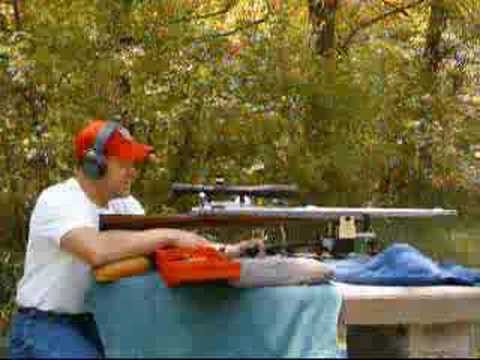
If you’re interested in 600-yard competition, or just want to shoot more accurately and consistently from the bench, you should watch a video Sam Hall put together last year. Because of wind noise, the audio is pretty bad at first, but be patient. Sam delivers some invaluable advice in the video. His tips on body positioning, gun-handling, and follow-through can earn you some points in your next match.
September 18th, 2009
Confused about the meaning of a term such as “meplat”, “magnaflux” or “obturate”? Need to know the OAL of an unusual Wildcat such as the .218 Donaldson Wasp? Well CCI and MidwayUSA offer handy answers on the web. CCI’s Shooters’ Glossary is a very complete collection of gun-related and reloading terms. MidwayUSA’s GunTEC Dictionary contains short descriptions of hundreds of cartridges, plus definitions of thousands of shooting-related words and phrases. How many of you knew that “Maggie’s Drawers” is “a colloquial term used for the red flag once used by pit workers to signal a missed shot at high-power rifle competitions”?

Consulting the dictionary, we learned that “Magnus Force” was not a Tom Selleck TV show. Rather, “Magnus Force is the movement of a bullet in the direction it is rotating (and downward) due to the lower air pressure surrounding it. The low pressure pocket is caused by the effect of the bullet’s fast rotation on the surrounding air.” MidwayUSA’s GunTEC dictionary even includes short “bios” of notable firearms inventors and marksmen, including J.M. Browning, Fredrich von Martini, and Peter Paul Mauser. A serious shooting buff could spend hours browsing the GunTEC dictionary, learning new facts (and a ton of obscure trivia.)
September 17th, 2009
Forum member Steve C. (aka RemVS308) unveiled his handsome new .308 Winchester in the Pride & Joy thread in our Shooters Forum. Sporting a beautiful, exotic hardwood A5-L stock by Joel Russo, the gun features premium components all around. We’ve had to create a new descriptive category for this kind of rifle which combines a tactical-style stock and multi-shot action with fancy wood. We call it “Glam Tactical”. (CLICK HERE for another Russo “Glam Tactical” rig.) The stock on Steve’s rifle is laminated African Pomele Sapele wood. If you are interested in a Russo stock for your next project, email jkrussos [at] comcast.net, or call Joel at (717) 805-0940.

The barrel is a 1:11.25″-twist, MTU contour, 26″ Krieger. It was chambered by gunsmith Nat Lambeth and fitted to a Stiller Predator action with Jewell HVR trigger. Befitting a proper multi-purpose rifle, the gun has Pacific Tool & Gauge stainless bottom metal and a Wyatt extended magazine. Up front is a Harris bipod, fitted with KMW Pod-Loc and Zephyr Dynamics Pod-Paws (Zerphyr’s Paws are, unfortunately, out-of-production).

For optics, Mike’s rifle carries a 12-42x56mm Nightforce NXS scope in Seekins rings. Overall this eye-pleasing package combines the visual appeal of premium wood with serious long-range accuracy. So, is this gun a “beauty” or a “beast”? Maybe both — and that’s why it’s such an appealing rig.
September 17th, 2009
National Hunting and Fishing Day (NHF Day) takes place next week, on Saturday, Sept. 26th. The annual celebration serves as a reminder that conservation succeeds because of leadership and funding from hunters, shooters and anglers. National, regional, state and local organizations will run thousands of “open house” hunting- and fishing-related events around the country. Events will include Fishing Derbys, Hunting Expos, Wing-shooting tournaments, and much more. An estimated four million Americans will participate. For information on NHF Day, visit www.nhfday.org. To find an NHF Day event near you, click the link below.
CLICK HERE for a State-by-State list of Hunting & Fishing Day Events
Outdoor Sportsmen Support Conservation
Hunting and angling together are an economic force worth $76 billion a year, and it is estimated that 1.6 million jobs depend on hunters and anglers. Moreover, conservation programs depend on hunters and fishermen for funding. Through licence fees and excise taxes, hunters and anglers contribute $1.75 billion per year, for wildlife, fisheries and habitat programs.

History of National Hunting and Fishing Day
In 1972, Congress unanimously passed legislation authorizing National Hunting and Fishing Day on the fourth Saturday of every September. President Nixon signed the first proclamation of National Hunting and Fishing Day, writing, “I urge all citizens to join with outdoor sportsmen in the wise use of our natural resources and in insuring their proper management for the benefit of future generations.” Currently, the national celebration is coordinated by the official home of National Hunting and Fishing Day, Wonders of Wildlife museum in Springfield, Missouri. Sponsors for 2008 include NSSF, Bass Pro Shops, The Sportsman Channel, National Wild Turkey Federation, Realtree, Cabela’s, Woolrich, GunBroker.com, Outdoor Channel, Safari Club International, Hunting Heritage Trust, Smith & Wesson, Field & Stream and Outdoor Life.
September 16th, 2009
Readers often ask: “What priming tool should I use?” There is no simple, clear-cut answer. Different tools have different advantages and disadvantages. Many short-range benchresters like the Sinclair one-at-a-time priming tool. They believe this unit has the best “feel” for seating primers.
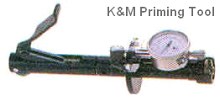 Others prefer the K&M tool, another “single-loader”, because it can be fitted with a seating depth gauge, for the ultimate in precision. On the other hand, one top shooter with a couple National Championships under his belt favors the modest $19.00 Lee Autoprime tool: “It’s simple, efficient and has served me well for years–I’m not convinced the fancy, expensive tools do a better job.”
This editor has tried all of these tools, and personally I favor the RCBS APS hand priming tool. It has two important advantages. Number one, primers are held in color-coded plastic strips so you never have to touch the primers. If you buy the pre-loaded strips, there is no chance of getting an upside-down primer, and you never have to fool with flipping primers in a tray. Second, the APS tool has a “universal” shell-holder. This employs spring-loaded jaws so it can fit any size cartridge, from a 17 Fireball to large magnums. The unit has a comfortable grip and plenty of leverage. Each time you seat a primer, the strip automatically advances. (NOTE: If you like the universal shell holder but don’t like strips, RCBS offers a new m90201 Universal Hand Priming Tool with a universal shell-holder that uses a conventional primer tray.)
 
Currently, only CCI primers can be purchased pre-loaded into strips. But there is an inexpensive tool that allows you to load Federal, Winchester, or Wolf primers into the strips. The strips come in a variety of colors (Red, White, Blue, Orange, Yellow, and Black), so you can sort your primers by color.

The RCBS APS hand primer is ideal when doing primer comparison testing. You can slide one strip of 25 primers in the tool, seat 5 or 10, then easily remove the strip with the remaining primers, and slide in a second strip with another primer type. You can slip the first strip back in a storage box and the primers remain ready to use.
As contained in the strips, primers can also be used in an RCBS 2000 progressive press, a bench-mounted priming unit, and a special device that fits into the top of a Rockchucker or similar press. I have loaded over 20,000 pistol rounds with an RCBS progressive press and I have had not a single flipped primer. Not one. The strip-priming system also makes it easy to switch from small to large primers on the progressive–this can literally be done in under 20 seconds.

The bench-mounted unit is ideal for priming large quantities of cases. The long handle provides plenty of leverage, and you can work fast, as the primers automatically feed through the system. When I load large quantities of varmint rounds, I use the bench-mounted APS system. The only gripe I have concerns the small plastic bushing that guides the primer seating rod. This bushing breaks easily and is easy to lose.
|