|
|
April 3rd, 2009
Every month ShootingUSA offers a handsome new firearm in a drawing. This month the prize is a S&W 1911 with Crimson Trace Laser-Grips, MSRP $1,493.00. Sweet Pistol. To enter the contest, you need to provide personal info and the name of an FFL-holder to whom the gun can be shipped. In addition, you need to answer a question. We thought all our readers should know the answer to the current question: “You shoot a One MOA group at 1,000 yards — How wide is the spread of the group?” The suggested answers range from 5 inches to 12 inches. HINT: 1 MOA is 1.047″ at 100 yards.

About the Contest Gun
The S&W 1911 PD is a Commander-size model with 4 1/4″ barrel, carbon steel slide, and Scandium frame. With an 8+1 round capacity, it weighs 28 ounces empty. This model features a Novak rear sight, external extractor (for reliability), and wrap-around Desert Tan Crimson Trace Laser grips. This Editor owns a full-size, all-stainless S&W 1911. My gun has proven exceptionally accurate and has excellent fit and finish. With handloads my gun will shoot as accurately as some Baer and Wilson customs I’ve tried. Below is 5-round group I shot offhand at 10 yards with my 5″ S&W 1911. The bullet hole edges are sharp because I was using semi-wad-cutters. I used Vihtavuori N320 (my favorite powder for 45acp) and 200-grain SWCs from Precision Bullets in Texas. The only thing I would change on my S&W 1911 is the trigger shoe. I prefer the old-fashioned short trigger in 1911s (but that’s a matter of personal preference).
Target from Editor’s 5″ S&W 1911 (not contest pistol).

April 2nd, 2009
 Lead by top UK shooter Vince Bottomley, a team of UK gun experts has launched Target Shooter, a new online “e-zine” dedicated to precision shooting. This is a great new offering — you should log on to TargetShooter.co.uk right now to check it out. Vince explains: “Our online magazine will cover target shooting in all its forms, including rimfire and centerfire benchrest, F-Class, classic military rifle, and tactical. We’ll deliver feature articles plus match reports and gear reviews.”
Target Shooter employs a publishing format called “Scribd” that delivers a print-magazine style format over the web. This is actually kind of cool, as you can zoom pages smaller and larger and download the entire “magazine” for off-line reading. A new edition of Target Shooter will be released every month.
Target Shooter Offers Great Content
The debut April 2009 edition, 109 pages long, is truly impressive. It contains many interesting articles including a 2009 IWA (Euro Shotshow) report from Vince Bottomley, a comparison test of budget scopes by Carl Boswell, a detailed F-TR Tubegun review by Laurie Holland and Vince B., and a fascinating discussion of Field-Target shooting by Tim Finley (covering all positions). And that’s not all — the magazine offers a two-month event calendar, plus match reports (check out Gwyn Roberts’ Gallery Shooting Tri-Nations tournament report).
Target Shooter also features many gear reviews and product evaluations. In the April edition, Carl Boswell provides a comprehensive review of the BullzeyePro optical boosters. If you are considering purchasing this product you should definitely read this review — it even includes through-the-lens photos, so you can see the magnification boost with your own eyes.
Overall, the new Target Shooter online magazine is a mighty impressive accomplishment. It is rich with content, the photography is excellent, and the level of technical expertise is high. We were very impressed by the diversity of disciplines covered — this magazine covers much more than conventional benchrest. Any gun enthusiast interested in precision shooting should log on to TargetShooter.co.uk. Not only is it one of the best sources of shooting information available, but it is currently 100% free. You can’t beat that.

April 1st, 2009
 Air rifles and air pistols are not considered “firearms” under federal law. Therefore, in all 50 states, air rifles and air pistols can be purchased “over the counter”, without background checks. The lack of controls on pneumatic guns has long troubled many California lawmakers who have “taken aim” at the airgun industry with tough new legislation. This year, California extends its sweeping gun-control policies to air rifles and pistols under the terms of new legislation, AB 1984, recently codified into law. Under this bill, air rifle and pistol owners will be required to pay an “Air Excise Tax” on all canister refills and CO2 propellants. In addition, all refills must be done by state-licensed air refill centers operated by the California Air Resources Board (CARB). In order to qualify for refills (and purchase propellant cartridges), air rifle and pistol owners must first obtain a state-endorsed “Air User Certificate”, which will cost $95.00, renewable annually. These new regulations take effect June 1, 2009.

New Law Carries Stiff Penalties, Yet Fear of Air “Black Market” Persists
Recognizing that air is an abundant and otherwise free resource, the new law contains tough provisions to prevent air rifle and pistol owners from filling their air canisters from non-approved sources. Any air rifle/pistol owner caught refilling canisters from a private pump or compressor will be subject to a $10,000 fine for the first offense, with criminal penalties (up to 5 years in prison) for repeat offenders. This may, initially, cause some practical problems. Currently, CARB has no certified filling stations for airguns, and given California’s current budgetary crisis, it may be many months before the first filling stations come on-line. In the mean-time, using $8.3 million in Federal Stimulus funding, CARB will hire 65 “Air Security & Surveillance Officers” (ASSOs) to find scoff-laws who continue to fill their airguns with unregistered air. Some observers worry that one unfortunate side-effect of AB 1984 could be the creation of a criminalized “black market” for air in the Golden State.
 Democratic legislators praised the new regulations. An official statement by the Assembly Democratic Caucus declared: “This is a great day for all Californians. Air rifles can be just as dangerous as powder-fired weapons. These air rifles are silent killers and even when used for target sports they can put your eye out.” California Governor Schwarzenegger did not issue a formal statement about the new Air Excise Tax. However an aide to the Governor, who declined to be named, remarked: “Look, this state is $40 billion in the red. Any new revenue source is welcome.” Off the record, he added: “We tax gasoline, we tax real estate, we tax health care, we tax income, we tax all the products you buy in stores, and we even tax you when you die. Why not tax air? It’s brilliant. Heck, if we could tax sunshine, we would”.
The California State Employees Union also expressed support for the new legislation, noting that it would create up to 200 new, permanent high-paying jobs. Sacramento has an abundance of workers skilled in the dispensing of hot air, so CARB believes it can quickly fill the new positions mandated by AB 1984. The California Legislative Analyst’s Office (CLAO), tasked with estimating the costs of new legislation, has predicted that Air Excise Tax revenues should “more than cover the hardware costs of air filling stations.” However, the CLAO cautioned that “attendant administrative and enforcement costs, including salaries, entitlements, and mandatory pensions, could run into the tens of millions of dollars annually.” Asked to comment on those projected costs, AB 1984’s author, Assemblywoman Juanita Wilson (D. Berkeley), observed: “Let’s worry about that later. This is about Hope and about Change…we’re doing this for the children. Plus California needs jobs, and my ground-breaking legislation will put hundreds of Californians back to work.”
April 1st, 2009

At the U.S. Army’s Aberdeen Proving Ground, a team of ballistics technicians, supported by some of the U.S. Army’s top sniper instructors, has been quietly developing a radical new “dimpled” bullet. The exterior of the bullet resembles the dimpled surface of a golf ball. The function of the special dimpled skin is to reduce projectile drag, providing a flatter long-range trajectory, and greater retained energy at the target.
.338 Projectile with MIM Exo-Jacket
(3D-CAD Artist’s Rendering) |
 |
In their pursuit of a lower-drag bullet, the Army tried a variety of designs, including bullets with circumferential drive bands, dual-radius ogives, and rebated boat-tails. The dimpled “golf-ball” design was considered a “long shot” according to the design team, but it has performed beyond all expectations. The nominal drag coefficient (Cd) has improved by about +.040, while cartridge muzzle velocity has increased by nearly 80+ fps because the bullet’s dimpled skin reduces in-barrel friction. What’s more — the terminal performance of the dimpled bullet has been “spectacular”. The Aberdeen team set out to produce a slightly more slippery bullet for U.S. Army snipers. What they ended up with is a bullet with dramatically enhanced long-range ballistics and superior killing power on “soft targets”.
 Lt. Col. Ben Eldrick, Long-Range Projectile Project (LRPP) team leader, told AccurateShooter.com how the radical bullet was conceived: “During our initial design work, we wanted the benefits of a high-BC, pointed bullet, but in a design that could be mass-produced and could work as a tracer. We consulted some of the top civilian bullet experts, including ballistician Bryan Litz of Berger Bullets. Mr. Litz really got the ball rolling. He suggested that the ‘next big step’ in bullet design would involve the turbulent boundary layer over the body of the bullet. Litz told us that ‘pointing bullet tips will take you only so far… think about optimizing the airflow over the entire bullet’. That made a lot of sense to us. When you design a race car to be aerodynamic, you sculpt the whole body, not just the front bumper.”
Lt. Col. Eldrick continued: “It turns out Litz was right on the money. By employing a golf-ball type dimpled surface, we were able to optimize the turbulent boundary layer on the bullet body. This reduced the low-pressure wake zone behind the bullet significantly, resulting in reduced base drag. As a result the bullet experiences much less overall drag, effectively raising the BC.” The Army team had discovered that what works for golf balls also works for bullets.
 After testing a series of prototypes, the Aberdeen bullet design team settled on a copper-jacketed bullet with dimples about 0.5 mm in diameter. The first-generation bullets were formed in special binary impact swages that press-form the dimples after the bullets were pointed up in conventional dies. Future production bullets will be made with an advanced metal-injection-molding (MIM) process that forms the dimples directly into the surface of the bullets. Rather than simply wrap the core material (which is classified), the MIM is molecularly bonded to the core. The Aberdeen LRPP team calls this “Exo-Jacket” construction, as in “Exo-Skeleton”.
 Higher Velocities Achieved
There was a surprise benefit of the dimpled bullet design — higher muzzle velocities. Given the same powder charge, dimpled bullets exit the muzzle faster because they produce less in-barrel friction than do conventional bullets. This is because the recessed dimples effectively reduce the metal-on-metal bearing surface. Lt. Col. Eldrick revealed: “the added velocity was an unexpected bonus. With equal-pressure loads, dimpled .308 bullets will fly about 80 fps faster than normal .308 bullets. With the large .338-caliber projectiles, the difference is even greater… we can pick up nearly 150 fps.” Given the observed velocity gains achieved with dimpled bullets, Aberdeen designers are now working on dimpled shell casings for larger artillery projectiles.
Dimpled Jacket Delivers ‘Explosive’ Fragmentation
While the internal design and core materials of the new dimpled bullet remain classified, the design team revealed that the terminal performance of the new bullet has been “spectacular”. The bullet penetrates like a FMJ but then explosively fragments, resulting in a devastating energy release in the target. According to Capt. Jack Sarazen, an Aberdeen engineer, “the enhanced terminal performance of the dimpled bullet was unanticipated. This was a serendipitous effect of the slight thinning of the jacket material where the dimples are pressed.” Sarazen explained: “Most FMJ bullets break along the cannelure and then fragment into two or three large pieces. With the dimpled bullets, you have multiple fragmentation points so the bullet literally blows up like a grenade in the target.”
April 1st, 2009
Major commodities exchanges announced that they would commence trading of cartridge primers and primer futures contracts, starting on April 2, 2009. This marks the first time that an ammunition component will be exchange-traded, alongside oil, gas, precious metals, and agricultural products. Federal, CCI, Remington, and Wolf primers will be listed on the NYMEX (N.Y. Mercantile Exchange), CME Group (Chicago Mercantile Exchange), and the USFE (U.S. Futures Exchange).
“Primers may be the pork-bellies of the future.” — V. DeMarco, Commodity Trader
 The price of primers has skyrocketed in recent months, with Federal 205M primers rising from the mid-20 dollar mark to $60.00 per box (see chart). Price hikes have been driven by increased demand as Americans salt away large caches of primers in fear of future shortages. The demand for primers (half of American households have guns), combined with the volatility of bulk primer prices, convinced commodity exchange managers that it was time to start trading primers and primer futures. Vince DeMarco, a trader on the Chicago Mercantile Exhange, explained: “Primers may be the pork-bellies of the future. Demand is at an all-time high. With the ability to buy and sell primer futures, now investors can make money on price movements.” Leslie Woods, an analyst for Forbes magazine, noted that “We are seeing significant hoarding. People are buying primers by the hundreds of thousands, yet many purchasers have no intention of ever using all those primers. Many of the buyers are not even active shooters. They are clearly acquiring large stocks of primers for speculative purposes. Now, with primers being traded as commodities, these investors can maintain their stake in the primer market without actually holding physical inventory.”
Marcus Singleton, a V.P. with the N.Y. Mercantile Exchange (NYMEX) explained: “We should have done this (trade primers as commodities) years ago. More Americans buy primers than will ever buy gold or silver bullion. Primers are consummable, which means that there will always be a lag between supply and demand, which is what moves markets. And a moving market, whichever way it goes, makes money for the exchanges.” Singleton also noted: “Let’s face it, people don’t really want to have half a million primers stashed under their bed. That’s a potential fire hazard. And due to Haz Mat charges, large quantities of primers are very expensive to ship. For the small investor, concerned about rising primer prices, it’s much better to purchase primer futures contracts. That way he gets price protection in the long run and he doesn’t actually have to store anything.”

March 31st, 2009
Today, after weeks of “teaser” pre-release marketing, Benelli introduces its all-new ‘Vinci’ line of self-loading shotguns. While Benelli’s product launch press releases are understandably self-congratulatory, the new shotgun does have many impressive features. Overall, this is a significant new product — not just another 1960s design in new clothing.

CLICK HERE for more photos, and product specifications.
First, the take-down/assembly procedures are impressively simple — the steel receiver/barrel assembly attaches directly to the front of the buttstock with a simple twist fitting. The receiver is very low profile and the entire bolt and bolt buffer assembly operates along the same axis as the bore. That’s smart engineering that should make the gun more controllable under recoil. Benelli claims that the combination of the all-inline, inertia-driven bolt system with the “Comfortech Plus” buttpad gives the Vinci 72% less felt recoil than other lightweight shotguns. (That’s quite a claim — it would be interesting to see how Benelli substantiates that number.)
We like the fact that the stock is easily adjustable. You can adjust Drop, Cast, Length of Pull and Cheek Height — all without tools. The tubular magazine and forearm can also be quickly removed without tools. Various forearm and stock options allow the Vinci to switch from standard shotgun, to pistol grip turkey gun, or to a pistol grip tactical scattergun. The Vinci is currently offered with either 26″ or 28″ barrels. Colors are matte black, Realtree APG camo, and Advantage Max 4 camo.
CLICK HERE to view Vinci Shotgun Videos.

NOTE: May take a long time to load or stall on slow connections.
March 31st, 2009
 John Parker of the NRA’s Competitive Shooting Division has authored a new brochure on the topic of High Power Rifle competition. It is available from the NRA online store for just $0.50, item CT17000. The booklet covers all the key components needed for High Power shooting. It also includes a special “Getting Started” section.
In the new booklet, Parker covers the following topics: Course of Fire, Rifle, Sling, Spotting Scope, Shooting Coat, Shooting Glove, Eye and Ear Protection, Sight Blackener, Scorebook, and Ammunition. Parker also explains the NRA Classification System and provides basic summaries of popular High Power disciplines: Long Range, Mid Range Prone, F-Class, and High Power Sporting Rifle.
You can order this booklet online at the NRA Program Materials Center, or call 800-336-7402 to place your order over the phone. Visit NRA’s High Power Rifle Competition webpage for more information.
This report comes courtesy of the NRA Blog.
March 30th, 2009
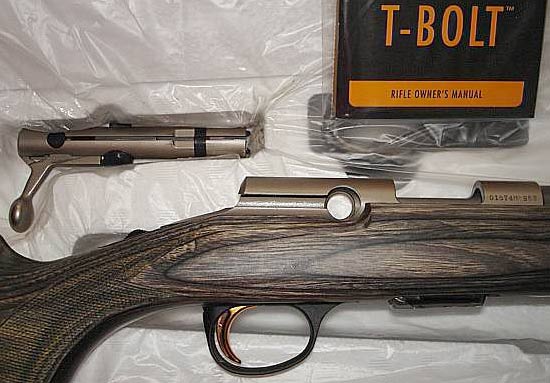
The Browning T-Bolt straight-pull rimfire rifle is an American classic, first produced from 1965 through 1975. In 2006 Browning wisely resumed production of the fast-cycling T-Bolt. We were pleased to see the re-introduction of the T-Bolt, as the unique action is smooth and quick to use. This makes the rifle well-suited for both varminting and the new “Rimfire Tactical” discipline. With enhanced materials and improved manufacturing methods, the new-generation T-Bolt is more reliable and smoother-operating than ever.
Browning Launches Left-Handed T-Bolts
Browning has added twelve new offerings to their T-Bolt rimfire rifle line for left-handed shooters. All the new models incorporate the basic design of the T-Bolt rifle but with the bolt on the left side. There are four new left-hand models in each caliber: .22 long rifle, .22 Winchester Magnum and .17 HMR.

On all T-Bolts (both right- and left-handed), receivers are drilled and tapped for scope mounts. Barrels are free-floated and have recessed crowns. T-Bolts feature a 3-lever, short-travel trigger design. Trigger pull weight is adjustable with an external screw and there is a convenient, thumb-operated tang safety.
Among the new T-Bolt models, we like the heavy-barreled Target/Varmint model. This has a satin finish checkered walnut stock with a Monte Carlo comb and wider fore-end. Suggested retail price for the .22 LR Target/Varmint is $719.00 and $729.00 for the .22 WinMag and .17 HMR guns. There is also a less expensive Sporter Model with a lighter-contour barrel.

March 29th, 2009
Review by LARRY BANEY
The Sightron 6-24×50mm Mildot is the latest in Sightron’s SIII line-up of side-focus, 30mm riflescopes. This follows the hot-selling 8-32×56mm SIII, which we reviewed last fall. While our 6-24x50mm test sample has a Mildot reticle, Sightron’s new 6-24x50mm scope is also offered with a fine cross-hair (FCH) with target dot reticle. Both Mildot and FCH versions are 14.96″ overall with a near-constant 3.6-3.8 inches of eye relief. Clicks are 1/4 MOA (15 MOA per revolution), and total elevation (and windage) adjustment is listed as 100 MOA (50 MOA on either side of center). That’s a class-leading amount of elevation, which should make the new 6-24×50mm popular with long-range shooters.

Shown above is the Sightron 6-24×50mm Mildot, flanked by a Leupold 8-25×50mm LRT and the Sightron 8-32×56mm. The controls on the 6-24 Sightron are identical to those of its big brother, but it is shorter, with a smaller objective. The shorter length and 50mm front objective allow a 2.8 ounce weight savings over the larger model (21.9 oz. vs. 24.7 oz.).

Sightron 6-24x50mm Quick Review
Assistant Editor Jason Baney has been evaluating the optical qualities of the new Sightron 6-24 Mildot scope. Jason also had a chance to test the scope’s real-world performance in a tactical match. Here is Jason’s report:
“When the new 6-24x50mm mil-dot Sightron SIII arrived, it looked like the little brother of the Sightron 8-32x56mm. Controls and “styling” are similar. This family relationship was made clear as my review of its performance progressed. It shared the same ergonomics, same superior glass, and same unbeatable tracking.
 I had a Leupold 8.5-25x50mm LRT for comparison purposes. The Leupold, which is actually 24.3x at max power, is a popular scope with a good reputation for clarity and sharpness. However, the new 6-24x50mm Sightron seemed better in many respects than the Leupold LRT. The Sightron’s glass appeared superior, giving better color rendition, a brighter field of view, and better contrast.
Also, with the Sightron, there was no noticeable parallax lash in the side-focus system. There was no need to start the side-focus at a travel stop every time. You could simply dial the side parallax adjustment and get the observed target in sharp focus with minimal parallax. This has been a problem with some Leupolds (i.e. you can’t get minimal parallax and best focus at the same time.) While observing bullet holes in different colored targets at 300 yards, the Sightron also appeared to show slightly better resolution than the Leupold and therefore better ability to locate individual bullet holes in the paper.”
Field Testing at the Allegheny Sniper Challenge (ASC)
In any competition riflescope, precise, repeatable tracking is absolutely vital. When you crank-in elevation and/or windage you want the reticle to move the exact value you dialed. Then you want the scope to repeat exactly when you return to the original zero. To test the Sightron’s tracking, Jason did more than a simple range test. He tested the scope’s tracking in the “real world”, during a two-day tactical comp.
Jason reports: “The 6-24 was thrown into action right away at the Allegheny Sniper Challenge (ASC) in Seneca Rocks, WV in August 2008. This was a team match that I shot with my father. ASC entails interesting weather, and even more interesting shots. In a matter of two days, over 100 shots are expended and a scope’s adjustments are REALLY put to the test. Maintaining zero is very important, because there are no sighters to check your zero. Shots range from less than 100 yards to nearly 1200 yards, and in the end, everyone has clicked their scope up-and-down 40 times or more. This means 40+ up/down repetitions on the elevation knob. This is as tough a test of a scope’s tracking ability as you’ll find.”
Great Tracking Ability, Excellent Value
So how did the Sightron’s tracking rate? The new Sightron 6-24×50 returned from ASC with the EXACT same 100-yard zero as when it started. This scope maintained its zero as well or better than any other scope out there, including those costing $3000.00+. The scope’s great elevation range was also much appreciated. Jason reports: “With 100+ MOA of elevation available and a 20 MOA base on the rifle, I had enough ‘up’ to shoot all the way out to 1200 yards with no problem.”

In Jason’s opinion this scope will be very hard if not impossible to beat in its price range in many aspects. The new Sightron 6-24 certainly rivals the overall optical quality of the Sightron 8-32×56, and that’s saying a lot. But since it is a Mildot scope there is another level of scrutiny needed. This scope is not a purpose-built tactical scope, but it represents a good base on which to build if Sightron offers enhancements in the future. If a shooter wishes only to use the mil-dots for holdover, he will be well served, but a Front Focal Plane (FFP) reticle would be more useful for serious tactical work. An illuminated reticle would also be welcome, and Jason would like to see a different reticle design with half-mil markings.
Also, some tactical shooters would prefer to have mil-based click values, rather than 1/4 MOA clicks. In raising these points, we need to stress that the $800.00 Sightron 6-24x50mm Mildot is affordable and works well as a general-purpose scope with reticle marks that allow hold-overs. This scope was not designed to compete with a $2700.00 Schmidt & Bender PMII. Jason explains: “I just want the serious tactical guys to understand that the Sightron won’t give you all the features of a dedicated FFP mildot optic with mil-based clicks. However, at about $800.00 average retail, the Sightron 6-24x50mm costs less than a third of what you’ll pay for high-end tactical scopes from S&B or U.S. Optics.”
March 29th, 2009
Spc. Tyrel Cooper of the USAMU won the individual championship at the South African Bisley Union (SABU) 80th Anniversary Match. For the past two years, Ty has been one of the best long-range shooters in the world. In 2008 he won the Target Rifle Overall Aggregate at the Spirit of America Match. Congrats to Ty for outstanding shooting in South Africa!

Shooting in very challenging wind conditions, the host South Africans took first place in both the Invitational 8-man team match (score: 2314-209v) and the SABU Int’l Anniversary 12-man team match (score: 3516-350v). The United States 12-man team finished second with a 3469-303v score. Reporting on the Anniversary Team Match, Walt Walter reported to the NRA Blog: “At 800 meters, South Africa extended their lead in ‘very very difficult’ wind conditions. Almost all of the time allowance was used with sighters from later firers being fired early to assist the coaches with their wind calling. Once again, South Africa used their local knowledge to increase their lead with some excellent shooting and equally good wind calling. Going back to 900 meters, the wind remained just as tricky and with the South Africans averaging solid 70s scores, they finished an impressive 49 points of the USA.”
| Individual Ranking |
TEAM Ranking Anniv. Match |
1. Ty Cooper (USA) 208-20v
2. Alwyn McLean (Ireland) 208-15v
3. Jane Messer (England) 207-25v
4. Andy Wilde (England) 206-22v
5. David Luckman (England) 206-20v |
1. South Africa 3516-350v
2. USA 3469-303v
3. England 3461-293v
4. Ireland 3442-274v
5. Wales 3419-255v |
Note: In South Africa, the “v”-count is equivalent to the “X”-count in North America.
|


