|
|
September 4th, 2008
Arizona gunsmith Gary Ocock ranks fourth overall on the all-time Benchrest Hall of Fame Points list. This Monday he added two potential NBRSA Unlimited (Rail Gun) records to his list of achievements. Shooting in a special Monday Labor Day match at Visalia, California, Ocock demolished the existing Unlimited 200-yard NBRSA record. Gary’s 5-target, 200-yard aggregate was 0.1129. (That’s the measured average of five, 5-shot targets, divided by two). Once certified, this will be a new NBRSA record. The previous 200-yard record was a 0.1396 shot in 2003 by Bart Sauter. Gary’s 100-yard Agg was also in the “teens”, a 0.1534. So, Ocock’s combined 100 + 200 “Grand Agg” was a stunning 0.1331, which would also be a new record, beating Bill Forrester’s 0.1496 Grand Agg shot in 1989.

Record-Setting Railgun with Delrin Barrel Sleeve
Gary Ocock was using a Jay Young Railgun with some custom “enhancements” by Gary. As with most railguns, the barrel is held by a barrel block. But Gary employs something pretty unique. Between the metal halves of the 7″-long barrel block, Gary has fitted a Delrin sleeve around the barrel. This is then clamped in place when the block is bolted together. What’s the advantage of the Delrin sleeve? According to Gary “The Delrin seems to help with accuracy. I had a couple barrels that just didn’t seem to shoot well no matter what load I tried. I first tried a sleeve made from lead and epoxy in an effort to make those barrels competitive. The barrels did shoot better, but the epoxy/lead sleeve was a pain to make. So, I came up with the Delrin sleeve and it works just as well or better. I can’t tell you exactly why it works, but it probably is damping the barrel vibration. With the Delrin sleeve I’ve turned average barrels into winners.”
| Jay Young Railgun
At right is a Jay Young Railgun, similar to the Unlimited gun used by Gary Ocock to set two new records. Gary’s gun has a longer barrel (26″) and Gary has devised a special Delrin sleeve that fits between barrel and barrel block. Gary believes the Delrin Sleeve dampens barrel vibration. For more info, email Gary Ocock: onehole149 [at] aol.com |
 |
Bullets Seated OFF the Lands
For his record-breaking effort on Monday, Gary used a 26″-long, 1.350″-diameter straight-contour 6mm Krieger barrel. Twist is 1:13.5″, and the chambering was a tight-neck 6PPC using Gary’s own 67gr BT match bullets. Gary shot a relatively “mild load” and interestingly his bullets were NOT engaging the barrel rifling. That’s right, he figures his seating depth was about .005-.010″ OFF the lands. The action was a BAT SV with a non-ejector bolt borrowed from another BAT. Scope was a March 50X.
Smart Wind Calls Helped Gary at 200
Watching the wind was key to his amazing 200-yard performance, Gary said: “Mirage was quite heavy, but I noticed things worked best in a light left to right condition. I tried to wait for that condition on most of my shots at 200 yards. On three of the five groups I didn’t hold off at all. On two groups I held off a little. The key was waiting to shoot in that left to right condition.”
September 4th, 2008
Here’s another outdoor industry business consolidation, another big fish swallowing little fish. Beretta Holdings, through its Burris division, has acquired Germany’s Steiner-Optik GmbH. Steiner, a respected maker of optics, particularly binoculars, is based in Bayreuth, Germany, and now employs 120 workers. Steiner will be integrated into the Beretta Group through its optics subsidiary, Burris, based in Colorado. So now the Germans will be making binoculars for a US-based company owned by Italians.
 Why did this acquisition take place? Steiner has not been very successful in the North American market. Steiner’s President and CEO, Carl Steiner, needed the help of an international group with strong distribution and plenty of marketing clout. Beretta Holdings doubtless believes that the addition of Steiner, a “prestige” optics name for over 50 years, will help Burris compete against high-end brands such as Leica and Swarovski. This is a good thing for Burris. Steiner has a record of innovation: Steiner produced the first pocket-sized binoculars, the first commercial binoculars with rubber armor, and the first binoculars with an anti-UV protective lens coating.
Burris General Manager, Steve Bennetts, said both Burris and Steiner have strong brand identification, and he suggested that the two companies will soon coordinate their product development efforts. We suspect this means the high-end optics will carry the Steiner name while mid- and low-cost optics will be sold as Burris products.
Beretta’s companies offer a vast range of products, with optic devices representing an increasingly important component. Current companies owned by Beretta Holdings include: Beretta, Benelli, Burris, Franchi, Meccanica Del Sarca, Sako, Stoeger, Tikka, Uberti Replicas.
September 3rd, 2008
Here’s your chance to own a gorgeous, .308-caliber Palma Rifle, while helping the U.S. F-Class Open Team. This handsome rifle, valued at over $3000.00, will be raffled off as a Team fund-raiser. This gun was owned by F-Class Team Vice-Captain Shiraz Balolia and very lightly used. A brand new Bartlein barrel was installed by Jim Cloward before the gun was donated by Grizzly Industrial to help raise money for the U.S. F-Class Open Rifle Team. Funds will help cover the costs of sending the Team to the 2009 World Championships in Bisley, England.
CLICK HERE for MORE Rifle PHOTOS.


Donate $10.00 and get two tickets to win. The more you donate, the better your chances for winning this rifle. A maximum of 2000 tickets will be distributed. Tickets are available from many F-Class Open Shooters around the country, or you may write a check for your desired donation and send it to:
U.S. F-Class Open Rifle Team
P.O. Box 3110
Bellingham, WA 98227
Make checks out to U.S. F-Class Open Rifle Team. If you are making a donation of over $20.00 and would like a receipt for tax deduction, please make out your check to PALMA Promotions and mail to the above address. All tickets and receipts will be sent by return mail. Drawing will be held in February, 2009 in Bellingham, WA.
September 3rd, 2008
Special events are being planned across the country for National Hunting and Fishing Day (NHF Day), set for September 27th. The annual celebration will serve as a reminder to all Americans that conservation succeeds only because of leadership and funding from hunters, shooters and anglers. National, regional, state and local organizations will run thousands of “open house” hunting- and fishing-related events everywhere from shooting ranges to suburban frog ponds. An estimated four million Americans will participate. For information on NHF Day, visit www.nhfday.org. To find an event in your area, click the link below.
CLICK HERE for a State-by-State list of Hunting & Fishing Day Events

History of National Hunting and Fishing Day
In 1972, Congress unanimously passed legislation authorizing National Hunting and Fishing Day on the fourth Saturday of every September. President Nixon signed the first proclamation of National Hunting and Fishing Day, writing, “I urge all citizens to join with outdoor sportsmen in the wise use of our natural resources and in insuring their proper management for the benefit of future generations.” Currently, the national celebration is coordinated by the official home of National Hunting and Fishing Day, Wonders of Wildlife museum in Springfield, Missouri. Sponsors for 2008 include NSSF, Bass Pro Shops, The Sportsman Channel, National Wild Turkey Federation, Realtree, Cabela’s, Woolrich, GunBroker.com, Outdoor Channel, Safari Club International, Hunting Heritage Trust, Smith & Wesson, Field & Stream and Outdoor Life.
September 2nd, 2008
 One of our readers asked: “Is it OK to clean live, loaded ammo in a vibratory tumbler?” The basic answer is NO, do NOT tumble live ammo in a vibratory tumbler. There are serious potential safety hazards that can result from tumbling live ammo. Since it is really NOT necessary to tumble loaded ammo, why take the risk?
Tumbling Can Alter Powder Burn Properties
The main reason to avoid tumbling loaded ammo is that tumbling can break down the powder kernels inside the case and/or alter the burn-rate retarding coatings on the outside of the kernels. This can alter the powder’s burning properties, with dangerous consequences. If you vibrate loaded rounds for a long time, you can both grind or shear the kernels and alter the kernels’ external coatings. Read the warnings on a can of powder, it says do not shake (for that reason).
While we are aware that some hand-loaders, particularly pistol shooters, tumble loaded ammo to remove residual lube or just to make their ammo nice and shiny, this is NOT a sensible procedure. RCBS and most ammo-makers specifically warn against tumbling live ammo in a vibratory tumbler. Hodgdon’s official policy is: “Completed ammo should not be tumbled. The powder will degrade and increase in burn speed.” (From Mike Daly, Customer Satisfaction Manager, Hodgdon/IMR.)
Consider this commentary from the Fr. Frog website:
Q. Is tumbling loaded ammunition dangerous?
Answer: “…Extensive tumbling can cause the breakdown of the powder grains. This would have two major effects. First, smaller grains will ignite more quickly than larger grains, and second the deterrent coating on the outside of the grains may be rubbed off and will be absent from any fractured edges which will cause the powder to burn more quickly raising pressures.
Tests run some years ago by a commercial entity did indicate that potentially dangerous changes in powder charge burning characteristics do take place after PROLONGED periods in either a vibratory or a tumbling cleaner.
The key word here is prolonged. Many manufacturers of ammunition do a final cleaning of their product either by tumbling or a vibratory process before boxing it for shipment. In no case is this allowed to exceed more than just a couple of minutes. The intent is not so much to “polish” but to remove any traces of contaminants which might in time leave marks on the finished product. There seems to be a consensus among the ammunition manufacturing engineers that a minute or two of vibratory cleaning has no discernable effect on burning rates, especially for loads that are compressed, or nearly so. However, all have emphasized the need for EXTREME CAUTION not to overdo the process.
They also pointed out that there is a considerable difference in effect on the powder charge depending on whether the process is by ‘tumbling’ or ‘vibrating’. It would appear that tumbling has less effect on the powder than vibrating, though this is mostly a matter of degree. The admonition to use EXTREME CAUTION to insure that the process never exceeds a couple of minutes applies equally to either process.”
September 2nd, 2008
Every Wednesday on the Outdoor Channel, starting at 4:00 pm, you can enjoy a full line-up of firearms-related television shows. That’s right, you can sit down and soak up 7 hours of shooting broadcasts without changing a channel. That may be overkill, but it’s nice to know there’s plenty of firearms-related content every week, all in one place. Here is a typical Wednesday-night schedule for the Outdoor Channel (specific offerings and times subject to change). MidwayUSA is to be commended for sponsoring many of these shows.
CLICK HERE for detailed Outdoor Channel Programming Guide.
 |
Wednesday 4:00 PM – 11:00 PM EST
4:00 PM: American Rifleman Television
4:30 PM: Shooting USA
5:00 PM: Sighting In with Shooting USA
5:30 PM: Guns & Ammo Television
6:00 PM: Hunter’s Specialties Outdoors
6:30 PM: Inside USA Shooting
7:00 PM: Step Outside
7:30 PM: MidwayUSA’s Cowboys
8:00 PM: Shooting Gallery presented by Crimson Trace
8:30 PM: Shooting USA
9:00 PM: Sighting In with Shooting USA
9:30 PM: Guns & Ammo Television
10:00 PM: American Rifleman Television
10:30 PM: MidwayUSA’s Cowboys |
September 1st, 2008
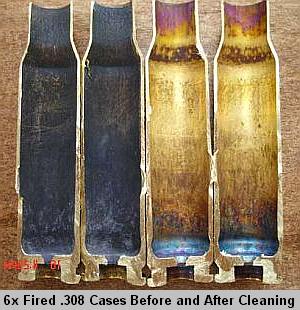
As a cartridge case is reloaded multiple times, burnt powder residue and carbon builds up on the inside of the case. Unless the case interior is cleaned in some fashion, eventually you’ll see a reduction in case capacity. One of our Forum members from Australia wonders about the effects of reduced case capacity: “If the capacity of the case decreases as the crud builds up, then it effectively reduces the chamber size. Wouldn’t that change the pressure produced from that of an equivalent clean case?”
Ultrasonic Cleaning Example:
Interesting Test of Case Capacity Changes
Forum member Fred Bohl has actual test results that can help answer the above question. Fred proved that, over a 20-reload cycle, the case capacity of uncleaned cases did, indeed, decline a small amount. However, surprisingly, this did not seem to affect the actual chronographed velocity of the load. ES did increase, but Fred believes the higher ES was due to changes in case-neck tension, rather than due to the slight reduction in case capacity.
Fred reports: “Back when beginning to use ultrasonic case cleaning, part of the motivation was to get the inside clean based on the assumption that allowing burnt residue to build up inside cases would affect capacity, and, ultimately, performance. An experiment was done to test this hypothesis. The load used, 30.5 grains of RL15 behind 107gr SMKs in a 6mmBR, was selected for best group and lowest ES in prior load development. It turned out to be 92% of initial case capacity and neither “full” or compressed. (I would suspect that different powders, load weight, and total case capacity might produce very different results.)
We took 30 cases of identical initial capacity and tracked three lots of 10 each:
LOT 1: No Internal cleaning
LOT 2: Cleaned with media in tumbler
LOT 3: Cleaned with Ultrasound machine
Each case (in each lot) was shot and reloaded 20 times. The simplified results after 20 reloads of each lot were as follows:
Lot 1 (not cleaned) – 0.3 to 0.4 gr. loss of capacity, 5 to 8 fps greater ES.
Lot 2 (tumble cleaned) – 0.1 to 0.3 gr. loss of capacity, 4 to 6 fps greater ES.
Lot 1 (ultrasonic cleaned) – no loss of capacity, no detectable change in ES.
FINDINGS
There was no detectable correlation of velocity change to the lots. An oddity was that on very hot days Lot 1 velocities were, occasionally, slightly higher. [Editor’s note: That does suggest that the carbon build-up inside the uncleaned cases might cause a slight increase in pressure that shows up on hot days. Fred has posted that “A local shooter reported doing the 20 reload, no clean test on a .308 that gave a loss of capacity of 2.0 grains, doubled ES and signficant velocity changes. However, I don’t have any details on his load weight or powder.”]
NOTE: From results of another ongoing test, I believe the above differences in ES are probably due more to variance in bullet grip tension than case capacity. The ultrasound cleaned cases (LOT 3) did maintain the lowest ES, but we are not 100% sure of the reasons why. More consistent bullet seating might be the reason.
[Editor’s comment: Jason found that with his ultrasonically-cleaned cases, the inside of the necks got so “squeaky clean” that he needed to use dry lube in the necks. Jason uses the $10.95 dry lube kit from Neconos.com. This applies ultra-fine Moly powder to the neck using small carbon steel balls]

September 1st, 2008
For storing fine firearms in a gunsafe or storage locker, we recommend Bore-Stores. These thick, synthetic fleece bags are treated with silicone and a special rust inhibitor to safeguard against rust and corrosion. Bore-Stores also cushion your rifles, protecting against nicks and dings while you’re moving your guns in and out of the safe.

Right now, through the end of September, MidwayUSA has most popular sizes of Bore-Store bags on sale. Bags for 4″ and 6″-barreled pistols are marked down from $5.89 to $4.99, and the 46″ Scoped rifle Bore-Store bag (item 570349) is just $9.99, reduced from $11.49. NOTE: Even if your rifle measures a bit longer, we have found this bag is large enough to fit a Benchrest-style rifle with up to 28″ barrel. For shorter guns with big scopes, we recommend the 42″ AR15 case (item 360601).
Bore-Stores are outstanding products, much better than the thin “gun socks” made by other companies. The fleece material is breathable, so it wicks away moisture from the firearm. By contrast, typical hard cases with “eggcrate” foam interiors attract and retain moisture — they can actually breed rust on your guns. Likewise, most zippered soft cases retain moisture.
GoldenRods on Sale Too
GoldenRods are electric heating elements that help prevent corrosion in your gunsafe by maintaining a constant temperature that is above the dewpoint. This prevents rust-breeding moisture from condensing on your guns. Both large and small GoldenRods are on sale this month at MidwayUSA, starting at $15.99 marked down from $19.99. The largest “gold” model (item 621013), which protects up to 300 cubic feet, is now $10.00 off, marked down to $29.99 from $39.99.

August 31st, 2008
Federal Premium Ammunition has completely updated its website with many great new features for shooters. The new site is so rich, it takes a while to find all the new options. (Check out the Federal SITEMAP below.) For rifle shooters and hunters, two new features really stand out. First there is an interactive ammo information page that provides load components and ballistic data for all Federal ammo. Second, the upgraded Federal website is now “video-rich” with many high-quality product videos.
CLICK HERE for Federal Ammunition SITEMAP showing all content.
Ammo Information Page
The new Interactive Ammo Info Page gives you detailed data for every type of ammunition Federal makes. Choose a chambering and load, then the web page will switch to detailed entries, with velocity (fps), energy (ft/lbs), wind drift (10 mph 90°), and calculated drop out to 500 yards. Data is provided for six distances: muzzle, 100, 200, 300, 400, and 500 yards. Click on a thumbnail chart and you can see the data presented in a graphical format (x,y axes).

Dedicated VIDEO Player and New Product Videos
Federal’s new VIDEO PLAYER offers a variety of Product Videos. Watch “The Bullet Breakdown” to see performance of popular hunting bullets in ballistic gelatin. You can also DOWNLOAD “The Bullet Breakdown” (and other videos) to your hard drive.

August 31st, 2008
Gunsmith Nat Lambeth (“RustyStud” on our Shooters’ Forum) offers the following advice for readers who need to ship rifles or major gun components (actions, barrels etc.) to gunsmiths or repair facilities.
“You have several options when shipping your guns to and from a Gunsmith. I’ve tried them all and had problems with them all. Here are some pointers:
1. Always package your unloaded firearm so that it is not loose and can’t work itself loose during transport. I recommend, at minimum, you use a hardcase inside a cardboard box. You can order a hard case from any of the 6mmBR.com website catalog advertisers. It will come in a nice cardboard box. Just open the end and slide it out. Put your gun in the plastic hard case (after oiling the metal parts) and slide it back into the box. Then tape and relabel the box. Make sure marking on the box does NOT identify the contents as a gun. (You may be required to identify the contents to the shipping company or U.S. Postal Service clerk however.) For a very expensive gun, consider using a wood shipping crate. I will be making some shipping cases from plywood and foam line them. I will have to charge my customer a deposit and when they return the shipping crate I will return their deposit.
2. Pack individual components carefully, and enclose them in separate bubble wrap (or styrofoam) if there is any chance the parts can contact one another. Your editor had an experience where the finish of a fine, blued handgun was ruined because the repair facility had placed old, replaced trigger parts loosely in a foam-lined case with the handgun. During shipping these spare parts worked back and forth, gouging and scratching the pistol.
 
3. Confirm the recipient’s address BEFORE you ship. Individuals and businesses change locations all the time. Don’t assume an address you used a few months ago is still valid. It’s tempting to use old addresses that are pre-configured in the UPS or Fedex web-based shipping programs, but you should always confirm address validity prior to shipping.
4. Always put the sender’s and recipient’s telephone number on the outside of the box with the address. I have neighbors call me all the time saying I have a box that was delivered to them by mistake. If there is any way the label could be torn off or ripped, write the number on the cardboard with a felt pen.
5. Always send your packages insured for full replacement value. Take time-dated pictures of the contents before you ship. (This is yet one more reason to get an inexpensive digital camera, such as the Canon A590IS.) If you’re shipping a firearm with special collectors’ value, deluxe wood, or engraving, be sure you have detailed, high-quality photos of the item so you can prove its worth.
6. Always send firearms and expensive components “Adult Signature Required” if by FedEx, UPS, or DHL. If they are sent via U.S. Postal Service, send them restricted delivery. This insures a tracking number and verification they got to their destination. If you ship USPS, it’s not a bad idea to pay a little extra for the green return receipt. That’s one more piece of evidence that works in your favor if the recipient claims non-delivery. The green card also reminds the carrier to confirm the address.
7. Keep all your shipping documentation for a year after the package has been received. There could be a unseen damage that turns up several months down the road. This illustrates the importance of carefully inspecting items you receive immediately. Don’t let a box sit around for days before you open it.
8. Handguns are by law required to be sent by common carrier (unless you are an FFL holder). Most of the common carriers have their own rules requiring overnight or next day delivery. Long guns can be sent by ground and you can use the U.S. Postal Service. Companies such as FEDEX and UPS may try to stick you with a higher cost shipping bill by claiming that rifles and shotguns must go next day or air. That is not true. Long guns can be shipped via ground. Do check local laws however–California has special rules regarding ARs and registered “assault weapons”.
 9. Keep an eye on your gun by monitoring the tracking number. You can do this online with FEDEX, UPS, and USPS. If your package does not reach its intended destination, when it is supposed to be there, then initiate a traceright away. Don’t wait.
When Something Goes Wrong–Filing Claims
In my experience it takes from 7 days to 10 months to get a settlement on a claim. Don’t hesitate to take a shipper to small claims court if necessary. If the shipper gives you the run-around, filing a small claims action may be the best $40.00 you can spend. It only costs $40.00 to start a small claims action and the subpoena is another $5 bucks. Usually sending a subpoena to an officer will result in a rapid settlement. It is cheaper for the carrier to settle than have their corporate bigwig stuck in some small claims action. Realize the carrier usually is not the insurer.
I have had two claims within the last 10 weeks and neither has been settled yet. In both cases the barelled action was double-boxed ,and in one case it was also inside a piece of schedule 80 PVC pipe and was broken. The other was in a double-walled cardboard box. The action was bent at the action barrel juncture, it now looks like a boomerang. The muzzle was pushed through six layers of double wall corrugated box.
I quit using UPS over a year ago. Depending on how FEDEX settles these last two claims, I’ll decide whether I use their services again. Your editor prefers FEDEX as he has found that they paid non-delivery claims swiftly and at full value. One thing for sure, if you use USPS you have the Postal Inspectors and the BATF looking for your gun if it is lost.”
|


