|
|
August 23rd, 2008
The NRA’s American Rifleman Online website has an excellent article this month that shows how to construct a rock-solid Reloading Bench. There are plenty of photos, and a detailed set of Bench Blueprints showing all dimensions and listing all needed materials. This bench is very well designed, with many deluxe features, such as an upper drawer with fitted slots for die boxes, and large lower drawers with 100-lb rated slides to store heavy materials or tools. If you have good wood-working skills this would be an excellent project for the fall or winter (but if you’ve never done anything but assemble IKEA furniture, you may want to stick to a simpler design).

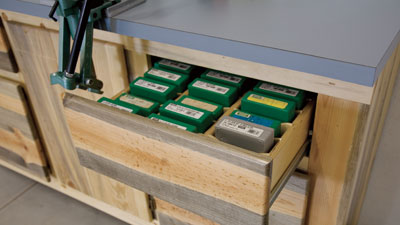
The author, Dave Campbell, offers good advice on building the bench top: “I ripped a sheet of 3/4″ AC plywood into two 24″ wide pieces and cut them to 72″ long. Then I glued them together to form a 72″ long, 1 1/24″ thick top. The trick here is to keep the edges smooth and flat so that the laminate will adhere properly and without voids. I chose a light grey laminate finish for the top because it’s easier to see what I am working on and keep clean. If you have never worked with laminate, remember it’s prudent to glue and rout the edges flush before gluing on the top. The top was attached to the carcass with eight steel L-shaped angle brackets and No. 10×1 1/4″ wood screws.”
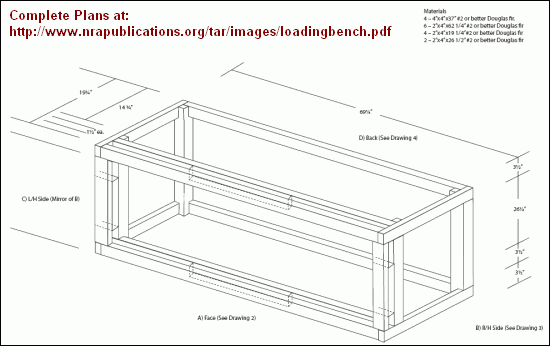
Photos Copyright © 2008 The National Rifle Association, used by permission
August 22nd, 2008
At the recent IBS 100/200 Yard Nationals, Benchrest legend Tony Boyer shot a spectacular 0.1697 Grand Agg in the Heavy Varmint class (0.1552 at 100, and 0.1843 at 200). This is the combined, distance-adjusted average group size for five targets at 100 yards and five targets at 200 yards. Interestingly, Tony was shooting a very unusual new gain-twist barrel from Bartlein Barrels of Wisconsin. A “gain-twist” barrel has rifling with a variable twist rate, that starts with a slower twist and transitions into a faster twist. The barrel used by Boyer had a very slight gain twist: 1:15″ twist at the breech end, increasing to 1:14.25″ at the muzzle.

Gain twist barrels are nothing new. Barrel-makers in the 19th century experimented with gain twist. More recently, Dan Lilja did quite a bit of testing with gain-twist barrels in the 1980s. However, Lilja concluded that gain twist offers no accuracy advantages: “You get just as good or better accuracy with a standard twist…just as long as the twist remains exactly the same the entire length of the bore.” (See Elements of Accuracy Article.)
 Gain Twist — Does It Offer an Accuracy Advantage?
Given Boyer’s impressive performance, maybe it’s time to revisit gain twist technology. The theory is that a slower initial twist rate may be “kinder” to bullets as they start to engrave in the rifling. There may be some slight velocity advantages as well.
Frank Green of Bartlein barrels has noted: “Gain twist type barrels have been around forever. It was used a lot back in Pope’s day with the false muzzle loaders shooting lead bullets. A lot of lead bullet shooters and rimfire shooters have asked us to do [gain-twist] barrels for them. Also shooters shooting the new, solid, machined-type bullets with driving bands on them want a gain twist type barrel. Supposedly it’s easier on the driving bands as the bullet enters the rifling. Also in bigger calibers like 20mm the gain twist is used. Mostly because you are starting a very heavy bullet into the barrel.
At Bartlein, we designate gain-twist type rifling as “T” style rifling (“T” for transitional). Why? Simply because we can cut [many variations]: straight conventional-style twist, a very uniform slow gain-type twist, or a radical gain-type twist. We can [create] anything the customer wants. The tooling still plays a part and can effect the cost of the barrel on a gain type twist.
Is gain twist for everyone? At this point in time I would say no still. Also remember, way back when, gain twist type barrels had a radical type gain. The one that Tony and couple of other guys have are not a drastic type gain. The [gain twist barrel] that Tony has only goes from a 1-15 at the breech to 1-14.25 at the muzzle. It didn’t seem to hurt him at all at the Nationals. He picked the twist and we made it for him.
I would agree with the general statement that most gain twist type barrels don’t shoot conventional jacket/lead core bullets well or should I say [they can be] temperamental. However, a slight gain seems to be OK after what Tony did.”
Lou Murdica has been evaluating Bartlein gain-twist barrels with a 1:14″-1:13.25″ twist. Lou won a Benchrest match with a 14-13.25 Bartlein gain-twist in Sacramento convincingly, and Lou told Bartlein that a similar gain-twist barrel on Lou’s railgun has been very accurate and ultra-consistent when tested with a wide variety of bullets. Lou can’t speculate as to why, but the Bartlein gain-twist BR barrels appear to be working extremely well and are not finicky about bullet choice.
Tony Boyer photo courtesy IBS.
August 22nd, 2008
Hexagonal Boron Nitride (HBN) is an advanced bullet-coating material. HBN, also known as ‘White Graphite’, has similar (hexagonal) crystal structure as graphite, though it is a much better lubricant. For those who prefer shooting coated bullets, HBN appears to have many advantages over molybdenum disulfide (moly). First, it is much more slippery, so it can reduce friction more effectively. Second, it goes on clear, and when applied correctly it doesn’t leave a dusty, chalky finish that can come off on your fingers. Most importantly, HBN will not react with moisture to leave potentially harmful chemicals in your barrel.

Boron nitride-coated DTAC bullets are sold by Superior Shooting Sytems (David Tubb). Tubb’s company also offers HBN bullet-coating services for a fee (minimum quantity 1000). However, many shooters want to plate their own bullets with Boron Nitride. Lowerfriction.com sells hexagonal boron nitride dry lubricant powder in 1-lb and 10-lb quantities. The two particle sizes appropriate for bullet coating are 70 nm (MK-hBN-N70-Nano) and 0.50 micron (MKhBN-050). Some shooters prefer the smaller 70 nm version, while others say the larger 0.50 micron works fine. Lowerfriction.com sells 70 nm HBN for $90.00 per pound, and the 0.50 micron HBN for $79.00 per pound. CLICK HERE for order page.
Lowerfriction.com allows provides instructions for coating bullets with Tungsten Disulfide (WS2), but company technicians say the same procedure can be used with HBN:
Tumbling/Vibratory bowl coating
This method is ideal for bullets and other small parts. Speed and friction determine how effectively the material bonds to the part. The greater the speed and the pressure of application, the greater the bond. For best results use a power tool. A buffing wheel, Dremel tool or even a hone can be used.
Clean and degrease the part.
Take 5-6 small empty plastic bottles (empty aspirin bottles will do). Put few parts in the bottle and fill the bottle (up to 75%) with WS2 powder. Fill all bottles likewise.
Put the bottles in vibratory bowl/tumbler with sand or vibratory media.
Vibrate/Tumble for 4-5 hours.
Empty the bottles (you can reuse WS2) and wipe clean the parts with soft tissue/cloth. |
Bullet Coating — Step by Step with Photos
A photo-illustrated Guide to Bullet Coating is available on the WrzWaldo website. This site is maintained by a Pacific NW shooter who retails 0.5 Micron Tungsten Disulfide (WS2) and will soon be offering Hexagonal Boron Nitride (HBN) as well. The website shows how to plate bullets using 0.177″ BBs in pill bottles, which are then agitated in a vibratory tumbler. This is a simple procedure that isolates the plating media from your tumbler, and covers the bullets very completely in 30-40 minutes. WrzWaldo says his method works equally well for both Tungsten Disulfide (WS2) and Boron Nitride (HBN). The photos below show bullets coated with WS2.


August 21st, 2008
High Power shooters have a bunch of gear to carry to the firing line–pad, shooting jacket, scope stand, spotting scope, ammo, log-book and rifle(s). If you’re shooting F-Class, add a heavy front rest and 15-lb sand-bag to the list. A range cart makes life much easier, particularly if the shooting area’s a long way from the parking lot. Creedmoor Sports makes a folding range cart that is very popular with the iron sights crowd. This unit features 14″ ball-bearing wheels and the frame is made from solid aluminum–not lightweight tubing that can bend or crack. Lift a simple locking lever and the cart folds. The cart can be completely dis-assembled, without tools, to fit in a suitcase (collapsed size 30″ x 17″ x 8″). The Creedmoor cart retails for $499.00, and that includes a rifle case, tray, and rain-cover. The rifle case doubles as a rack/holster.


If $499.00 isn’t in the budget, or you’d like to build your own range cart with a lockable storage compartment, you should look at the carts used by Cowboy Action shooters. These wooden carts are heavy, but they provide a stable platform for multiple guns and a nice, solid perch for sitting. There are many do-it-yourself designs available. One of our favorites is the GateSlinger cart shown below. This well-balanced design breaks down into two pieces for transport. Click Here for cart plans, and read this “How-to Article” for complete instructions with many photos.

| The least expensive way to go is to purchase a Dolly (Hand Truck) at Harbor Freight, or a large warehouse store such as Home Depot. Make sure to get one with wheels at least 10″ in diameter, or you’ll have problems in rough terrain. The bigger the wheels the better. Normally you can find dollies for under $30.00. Just bolt a large box or milk crate to the bottom, and voilà, instant range cart. You can clamp a piece of wood at the top with slots for barrels on one side and a flat tray for ammo on the other. Use bungee cord or leather straps to hold the barrels in place. Having built a couple all-wood range carts (both collapsible and one-piece), this editor can assure you that starting with an inexpensive welded hand truck is the cheapest, simplest way to go overall. You can buy oversize, spoked wheels from NorthernTool.com. (From the Northern Tool home page, search for “spoked wheels”.) |
 |
August 21st, 2008
 Beijing isn’t the only location where shooters from many nations are competing this month. The United States Int’l Muzzle-Loading Team turned lead bullets and shot into gold, silver and bronze medals at the 23rd World Muzzle Loading Championships, held August 11-16 in Adelaide, Australia. 205 competitors, representing 17 nations, vied for honors with a variety of muzzle-loading arms, ranging from matchlock muskets to sophisticated percussion target rifles and pistols. Both original antiques and modern replica guns are used, competing in different divisions.

Top honors were taken by Dr. Michael Arnette, whose score of 93 in the original division of the “Lamarmora” 50-meter offhand percussion rifle-musket event not only won the gold, but set a new world record in the process. Arnette took the same gun to the 100-meter line for the “Minie” prone match, shooting well enough to help a team of Arnette, Allan Godshalk, Gary Crawford, Frank Kapper, and Tony Ulisse take 3rd place in the “Grand Prix de Versailles”, an aggregate for military longarms that is often considered the overall world team championship. An equally strong performance was turned in by Harry Sparks, who took both gold and bronze in individual shotgun events.
CLICK HERE for Photo Gallery from Adelaide
The World Muzzle Loading Championships are held biennially, with Pacific and European Zone Championships in the off years. The 24th World Championships will be held in Portugal in August 2010. CLICK HERE for more info on precision long-range muzzle-loader shooting.
August 20th, 2008
Recently we covered the first SoCal Rimfire Tactical Precision Match. Your editor had a chance to attend the second match on August 9. I can testify that match Director Bill Irwin presided over a fun, well-orchestrated competition with an interesting variety of stages. Competitors engaged paper targets and steel at various distances, plus clay birds and other reactive targets. For one stage, Irwin set building nails set in vertical sticks. The object was literally to drive the nails into the wood with your 22LR bullets. Easier said than done, I assure you. Here’s a “highlight video” from the August 9, match.

Stills courtesy RKSimple and Shooter65
SAKO FinnFire ‘Range’ — Accurate, Ergonomic, and RELIABLE
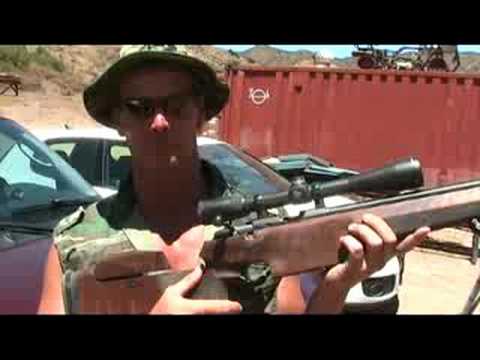
To my surprise, at the match I witnessed quite a few malfunctions, both in bolt-action rifles and self-loading 22s. One 10/22 was particularly troublesome, and the normally reliable Savage MKII BTVS models gave some problems when cycled rapidly. One rifle that ran flawlessly throughout the match was the handsome SAKO FinnFire ‘Range’ belonging to Mark E. from Huntington Beach.

This gun has a stock that is virtually identical to the stocks on Tikka’s centerfire Master Sporter rifles. With that stock, the FinnFire boasts ergonomics and dimensions similar to a centerfire tactical rifle, making it ideal for cross-training. Mark talks about his FinnFire in the video below.
August 19th, 2008
Denver Instrument, maker of the MXX and Timberline Series of precision balances, has created a helpful guide explaining how to get the best performance from a digital scale. Denver Instrument knows that, to achieve and maintain a very high level of accuracy with digital scales, they must be calibrated regularly, leveled properly, and kept away from sources of interference. Unfortunately, some reloaders treat their electronic scales as if the machines were toasters — something to place on a tabletop, plug into an outlet, then “set and forget.” There’s a better way to set up your scale and keep it functioning optimally. Here are ten guidelines provided by Denver Instrument. Follow these “TEN Commandments” and you’ll benefit:
 10 COMMANDMENTS OF GOOD BALANCE USE
ONE: Thou shalt choose the best resting spot. The performance of your balance depends greatly on the surrounding environment. Choose a location away from the main traffic flow of the room, especially doors. Also be aware of heating and cooling vents as these produce air movement. You can adjust the environmental settings on your balance to provide the best performance in the chosen location. Balances must be placed away from magnets as they affect the weigh cell performance.
TWO: Thou shalt avoid vibrations. Vibrations can come from large machinery in production environments and from fume hoods in laboratories. An alternative to fume hoods are Power Safety Workstations which are designed specifically for use with a balance.
THREE: Thou shalt watch temperature changes. On an analytical balance a one degree temperature change can cause a 1 digit (0.0001g) drift. Although Denver balances have temperature correction built-in, it is still important to calibrate your balance when the temperature changes significantly. Choosing to place your balance in a temperature controlled room, away from sunlight, and calibrating often helps minimize the effects of temperature.
FOUR: Thou shalt calibrate often. Upon installation and each time the balance is moved you should calibrate your balance. For example moving an analytical balance to a location that is only 13 feet higher changes the weight reading from 200.0000 g to 199.9997 g; which means the result is 0.0003 g lighter than the actual mass.

FIVE: Remember to check the level. The instrument should be leveled upon installation with all feet (two front feet for round pan units, four feet for square pan units) touching the countertop. If the level changes, the balance should be re-leveled and recalibrated. As an example, a 200g sample would weigh 0.0025 g less when tilted at an angle of 0.3°.
SIX: Honor thy weights. Keep in mind that weights are only as reliable as their quality and certification. Remember, a 1 g does not weigh precisely 1.00000 grams. Weights should be recertified annually. Denver Instrument offers recertification services on all weights 1 mg to 5 kg. Check to make sure you have selected the proper weight class for your balance. The weight tolerance should be better than balance readability. Always use tweezers or gloves when handling weights as smudges and indentations change the value of the weight. Keep weights in cases so they don’t get scratched or dusty.
SEVEN: Thou shalt always use a small container and weigh in the center of the pan. Especially when using an analytical balance, the effects of air buoyancy increase as the sample container size increases. Using a small sample container will minimize the effects. Items placed on the pan provide a downward force. Placing them directly in the center of the pan keeps corner loading errors at a minimum.
EIGHT: Thou shalt not unplug. To perform within published specifications balances must have power applied for 30 minutes to 48 hours depending on the resolution of the balance. Denver balances have a standby mode which turn the display to standby but keep power cycling through the electronics.
NINE: Thou shalt not ignore static. Static is one of the most common weighing “noises”. It can cause reading to appear too high, too low or just be unstable. Denver balances include grounding methods to reduce the effects of static. However sometimes extra supplies are needed. Consider anti-static weigh dishes, anti-static brushes or low tech ways to increase the humidity of the chamber like placing damp cotton balls or glass wool in a small vial in the corner of the analytical draft shield.
TEN: Thou shalt clean often. Dirty weigh pans and powder in weighing chamber can contribute to static issues and lead to a wide variety of problems. Denver weigh pans are made from stainless steel and can be cleaned using a variety of household and laboratory chemicals. A small paint brush can be used to get power away from the edges of the draft shield for easy clean up.
August 19th, 2008
Alliant Powder, a division of ATK, has issued the following safety notice concerning Alliant Blue Dot powder, a popular propellant for handgun loading:

Alliant offers a FREE detailed, 43-page Reloader’s Guide with recipes for shotgun, pistol, and rifle cartridges. This guide includes important safety instructions, plus reloading data for most popular cartridges. Unfortunately the guide does not yet include Alliant’s new Reloder 17 and the listed loads for centerfire rifles only include Speer bullets.

CLICK HERE to download ALLIANT RELOADER’S GUIDE (.pdf format).
August 18th, 2008
Army Specialist K. C. Eusebio of the United States Army Marksmanship Unit (USAMU) edged out B. J. Norris to win his second Steel Challenge World Speed Shooting title in Piru, California. Eusebio finished with a record time of 79.16. K.C. first won the Steel Challenge while still in High School — an amazing performance for such a young shooter. K.C. has set speed-records for many of the Steel Challenge’s stages, including “Smoke & Hope” shown in the video. Eusebio’s win is the third time an Army Marksmanship Unit member has taken the title in the past four years. Staff Sergeant Max Michel took the title in 2005 and 2007. Below is exclusive video taken by AccurateShooter.com at the Steel Challenge on August 16.
CLICK HERE or on screen to WATCH VIDEO.

In the women’s division Kay Clark-Miculek took her seventh Women’s Steel Challenge title with a time of 105.85. Miculek now has twice as many titles as any other female shooter. In the Limited Category, Phil Strader of the US Shooting Academy’s 93.49 time was good enough to defeat 2006 World Champion JJ Racaza by just over 9 tenths of a second.

|


