|
|
May 23rd, 2008
 The Firearm Industry Super Shoot is underway right now at the Kelbly’s Range in North Lawrence, Ohio. We’re told that Tony Boyer, the all-time Hall of Fame points leader, won the Heavy Varmint 100 on Thursday, with a “teen” Agg. For you non-benchresters, that means a 5-target, 5-shot per target average of 0.1300″- 0.1999″.

Lou Murdica, who dominated the Cactus Classic earlier this year, had a 4th and 5th going into Friday’s events, making him the current two-gun leader with a .2195″ combined Aggregate, after two days.
Conditions were not as blustery as in previous years. Shooters reported consistant, cool temperatures with considerable humidity but no rain. Wind so far have not been bad, with average speeds in the 3-6 mph range with some gusts to 15 mph. Stronger winds are predicted for the shooting today (Friday) and Saturday.
May 23rd, 2008
RELOADING TIP: Andris Silins has come up with a simple way to measure length to the lands in your rifle:
“Here’s what I did to find length to lands for seating my bullets. I made four cuts into the neck of fire-formed brass. Then I pressed the bullet in lightly and chambered the entire gauge. As the cartridge chambers, the bullet slides back into the case to give you length to lands. It took less than five minutes to get it cut and working. A little light oil in the barrel just past the chamber helps ensure the bullet does not get stuck in the lands. It works great and is very accurate.
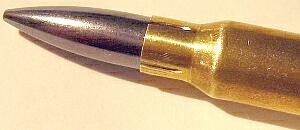
I made the cuts using a Dremel with a cut-off wheel. You can adjust tension two ways. First, you can make the cuts longer or shorter. Longer cuts = less tension. If you used only three cuts insted of four you would get more tension. The trick is to be gentle when you open and close the bolt. If you ram the bolt closed you may wedge the bullet into the lands. When you open the bolt it helps to keep a finger or two near by to guide the case out straight because the ejector wants to push it sideways.”
May 23rd, 2008
The 17 Remington Fireball has received the 2008 NRA Golden Bullseye Award for “Ammunition Product of the Year” from Shooting Illustrated magazine. This award recognizes innovative new products introduced in 2007 which offer outstanding performance in their respective category.

The 17 Remington Fireball is a necked-down version of the .221 Remington Fireball case. It is very similar to the popular 17 Mach IV wildcat, but the cartridge dimensions are NOT identical. If you want to shoot this cartridge we recommend you chamber your rifle specifically for 17 Rem Fireball rather than use a Mach IV reamer.

Along with the 17 Remington, the 17 Fireball is the ONLY factory-loaded 17-caliber centerfire round. As a cartridge for squirrels, gophers, and small varmints, the 17 Rem Fireball is a very efficient cartridge that achieves high velocities with a modest powder charge — roughly half the powder charge of a 22-250. When loaded with Remington’s 20gr AccuTip-V bullet, .17 Rem Fireball factory loads deliver 4000 fps, closely matching the velocity of the .204 Ruger. With the 17 Fireball, it’s easy to see your hits, even without a muzzle brake, as the 17 Fireball has 86% less recoil than the 22-250.
17 Fireball reloading recipes are now available at the Hodgdon Reloading Data Center.
May 22nd, 2008
Jon Jackoviak of The Optic Zone reports that his first shipment of Bushnell Elite 6500 4.5-30×50 scopes has arrived. These come with a Fine Multi-X reticle and 1/4-MOA clicks, and are priced at $739.00. (A mildot reticle version may arrive in a few weeks.) Other dealers may be stocking this scope soon.

These scopes have been anxiously awaited, ever since they were announced at SHOT Show earlier this year. The 6.5x magnification range is the widest in the industry, and the scope’s 30mm main tube and side-focus parallax adjustment puts it in the running with Leupold’s 8-25×50 LRT. The new scope also features Bushnell’s patented, Rainguard® hydrophobic (water-repellant) lens coating. This coating prevents fogging by causing condensation to bead up into much smaller droplets.
The question mark remaining about the new Bushnell 6500 is the actual elevation range. The Optic Zone (and some other vendors) are claiming 80 MOA each of Windage and Elevation Adjustment, but the Bushnell website says there are only “50 inches” total Elevation on the 4.5-30×50. Right now we’re betting on Bushnell’s lower number, which is significantly less than the 75 MOA offered by the new Sightron 8-32×56, which we have confirmed.

May 21st, 2008
Most legal experts agree that the case of District of Columbia v. Heller is the most important Second Amendment case in nearly 70 years. The case, brought by Dick Heller, a security guard who lives in the District of Columbia, seeks to overturn the District’s complete ban on handguns for personal defense in the home. This case presents a Second Amendment issue front and center — the Supreme Court must decide whether the Second Amendment of the U.S. Constitution confers an individual right to “keep and bear arms” or whether it only empowers an organized militia.

Oral arguments in the case were heard on March 18, 2008. The final, written decision is expected by mid-summer, maybe even in June. Until then, we wait with anticipation. It appeared, based on the statements of the Justices during oral arguments, that a majority of High Court members (including Chief Justice Roberts) agree that the Second Amendment recognizes an individual right. If that’s how the Supreme Court rules, it will be a major victory for gun rights advocates. However, that could give rise to further legal battles, to determine what is “reasonable regulation”.
If you haven’t listened to the D.C. v. Heller Oral Arguments yet, you owe it to yourself to do so. Michael Bane of DownRangeTV has collected the official audio recordings of the DC vs. Heller oral argument. These are now available in MP3, streaming audio versions, on the DownRangeTV website.
CLICK HERE to Access Oral Arguments (MP3 AUDIO)
May 21st, 2008
Regular readers of the Daily Bulletin know we’ve recommended Ballistol as a near-ideal case lube for basic full-length sizing. It’s extremely slick, and goes on very thin when applied with the aerosol version. Unlike many other case lubes, you won’t need to use a solvent or tumble the brass afterwards to remove. All you need is a very thin layer of Ballistol, and this easily wipes off with a paper towel. (For case-forming and neck expansion, we recommend a thicker lube such as Imperial Die Wax or Mobil 1.)

Unfortunately, many folks have told us that they can’t find Ballistol at local shops, or they want to combine it with a reloading supply order to cut down on shipping costs. Here are sources for Ballistol, including Brownell’s and MidwayUSA. For convenience, we recommend the aerosol version, but the liquid version can be diluted and used also.
Brownell’s
1.5 oz. Aerosol $4.43 982-000-001
6.0 oz. Aerosol $6.82 982-000-002
MidwayUSA
1.5 oz. Aerosol $3.99 727130
6.0 oz. Aerosol $6.49 831231
BULK ORDER SOURCES:
Ballistol USA
PACKAGE 1: BALLISTOL-LUBE
Two – 1.5oz. aerosols
Three – 6 oz. aerosols
$ 24.00 + 9.00 s&h = $ 33.00
FireHawktech.com
Basic Aerosol Pack
Two – 1.5 oz. Aerosol Can
One – 6 oz. Aerosol Can
Total $20.95 incl. shipping
Aerosol 5-pak
One – 1.5 oz. Aerosol Can
Four – 6 oz. Aerosol Can
Total $39.95 incl. Shipping
Ballistol Frequently Asked Questions
Q: Is the “Ballistol Lube” with the white label the same as the Ballistol “Sportsman’s Oil” with the green label.
A: Yes. Same product, just different labels. But remember there are both aerosol and liquid versions. The aerosol comes out very thin — like water. The liquid is thick — like motor oil.

Q: The liquid version is more economical by weight, but can I dilute it down?
A: Yes, Ballistol liquid can be diluted with water, up to a 10:1 ratio and it will remain slick. We recommend about a 6:1 ratio for use as a general case cleaner and lubricant — but you should experiment yourself.
Q: Will Ballistol get gummy over time, like other lubricants?
A: Nope. Here’s an interesting story. In 1952, a bottle with Ballistol, with the cap only loosely attached, was found in the attic of a deceased German hunter. The purchase receipt was found proving that the Ballistol had sitting for over 30 years. Yet, it still had the consistency of freshly produced Ballistol.
Q: If Ballistol oil can be diluted with water, does that mean it will promote corrosion?
A: No. Ballistol emulsifies in water. The resulting product will displace H20 like WD40, and then leaves a thin, protective oil. Ballistol is also mildly alkaline (pH between 8.5 and 9.5), so it neutralizes mild acidic residues such as hand sweat or residues from black powder (which are acidic).
Q: What’s Ballistol made from — it smells funny?
A: Ballistol is made from medical grade mineral oil, alkaline salts of oleic acid, several alcohols, Benzyl Acetate and oil from vegetable seeds. The smell comes from medicinal Anethole oil, which is derived from the Anise plant. Ballistol is biodegradable and non-toxic. CLICK HERE for the Material Data Safety Sheet
For more information on Ballistol, contact Ballistol USA, (800) 253 2460, (252) 261 0408 (fax).
May 20th, 2008
 The National Shooting Sports Foundation has announced a new grant program for ranges aimed at helping public and private shooting facilities jumpstart their recruitment and retention efforts. “The best way to increase participation is to enhance and promote shooting opportunities at the local level,” said Melissa Schilling, NSSF recruitment and retention manager. “We’re looking for unique proposals that move the needle on recruiting new shooters, attracting lapsed shooters back to the range and increasing opportunities for active shooters.” The projects will serve as pilot programs, which, if successful, can be used by other facilities across the country. A total of $250,000 will be available through the program.
Project applications will be accepted on an ongoing basis in 2008, and the funded program must be completed by February 2, 2009.
CLICK HERE to Download 2008 Grant Application Form
The NSSF noted that this grant program is NOT intended for land purchases, for building or improving structures (such as club-houses), or for acquisition of range equipment and supplies. A winning grant proposal will focus on bringing new shooters to the sport and reviving the interest of shooters who are currently inactive. The NSSF also favors programs that will allow active shooters to try new disciplines. To learn more about program objectives and grant selection criteria, visit RangeInfo.org.
May 19th, 2008
Gunsmith Nat Lambeth, nlambeth [at] embarqmail.com, recently had a client bring in a Custom-Shop Remington that wouldn’t even hold one Minute of Angle (MOA) at 100 yards. Nat was able to correct flaws in the factory action and then fit a new barrel. Remarkably, after action truing and barrel replacement, the gun shot like a house on fire. After working his magic, Nat shot a 0.111″ 5-shot group with the gun.
Nat tells us: “I had a customer bring in a Remington 700. This rifle was supposed to have been from the custom shop. It was a stainless model 700 with a 5R Mil Spec barrel in a HS Precision stock. The customer paid a premium price for this rifle. The customer complained the rifle ‘won’t shoot groups under 1.5″ at 100 yards’, and he wanted a new barrel. He had 400 rounds down the tube. The barrel looked to be in good shape with maybe a scratch 8 inches from the muzzle.

Blue-Printing the Receiver
I removed the barrel from the receiver and looked at the internal bolt lug engagement surfaces. Only one lug seemed to be contacting. I put the bolt in a V-Block and measured the rearward bolt lug surfaces. The right or bottom lug had .019″ more reaward surface than the left or upper lug. This would have taken me two days to lap out so I set up the bolt in a truing jig and turned the bolt .020. I then put the action in a action truing jig and machined the inside lug surfaces until I got one even surface. I lapped the lugs until I had 80% bi-lateral contact, then re-faced the bolt and action face.
New Broughton Barrel
I dialed in a new 26″ Broughton 1:10, 5C barrel. It was indicated on both ends until a .0001″ indicator needle was not moving. The barrel was turned, threaded, and chambered in the same setup using thinbit tooling, a PT&G 95 Palma reamer with a .3004 bushing. The chamber was cut within .0015″ with a Lambeth/Kiff Micrometer Adjustable Reamer Stop. The factory recoil lug was replaced with a precision-ground lug.
The barrel was removed from the lathe and the muzzle was cut 1.250 shorter in a bandsaw. The barrel was re-mounted in the lathe and the muzzle dialed in the steady rest. The crown was faced with a piloted, PT&G facing tool then faced with a piloted, 79° counter bore .100″.
Stock Work
The rifle stock was re-inletted and glassed in for two inches. Then the barrel free-floated.
A Tack-Driver is Born
I thoroughly prepped 22 pieces of used 308 Federal Gold match brass, which were then loaded with 42.5 grains of H4895, CCI BR2 primers, and Hornady 168 HPBT bullets. After cleaning the barrel, I fired one test round with no problems and cleaned the barrel again. I then installed a Leupold 6.5-20AO scope in Farrell bases and rings. I bore-sighted the rifle by eye with the bolt removed at 50 yards.

After some sighters to set Point of Aim, I sat down and did 5 shots for record at 100 yards. Those five shots went into one ragged hole. (See Target Below — this editor measures the group as 0.111″ center to center using OnTarget Software.) Another customer who was there at the range, then shot a 5-shot group that went into 0.312″. That’s an 0.2115″ average for the two groups. I then was able to shoot a couple more groups in the ‘teens.”

Conclusion
Nat proved that attention to detail DOES make a difference, and that truing an action, improving the bedding, and fitting a superior barrel can make a HUGE difference in accuracy. Now, mind you, we’re not suggesting that you can take a factory .308 and make it into a gun that will win the Super Shoot. Nat’s 0.111″ group was exceptional. Still this demonstrates that major gains can be had by action blue-printing combined with bedding work and a new barrel.
May 19th, 2008
 You may already know this, but just in case you missed the announcement, here’s the bad news.
The United States Post Office raised the price of first class postage one penny to forty-two cents ($0.42), effective May 12th. The USPS is now allowed to adjust stamp prices independently, based on inflation. Under new rules, the Postal Service can increase the price of a stamp by a penny without any oversight as long as it gives 45 days notice. You may recall that the USPS already increased the price of a first-class stamp to 41 cents in 2007, a two-cent hike at the time.
Other USPS Price Hikes, effective May 12:
Postcard rate is up 1 cent to 27 cents
Large Envelope rate is up 3 cents to $1.00
Certified Mail is up 5 cents to $2.70
Penny Wise Advice:
With postal rates going up a couple times a year, and stagflation looming on the horizon for the U.S. economy, it may be wise to buy a bunch of “Forever Stamps” next time you’re at the Post Office. These special non-denominated stamps, now priced at $0.42 each, are “immune” to price hikes. “The stamp will be good for mailing one-ounce First-Class letters anytime in the future — regardless of price changes,” the USPS has promised.
May 18th, 2008
As most of you know, Cerberus Capital Management acquired Bushmaster Firearms, a leading maker of AR-platform rifles, in April 2006. A year later, Cerberus acquired Remington Arms. Not surprisingly, Cerberus has merged the product lines of these two companies, so AR-style rifles are now marketed under the Remington label.

Yesterday, at the NRA Annual Meeting in Louisville, KY, Remington unveiled its latest semi-auto rifle, dubbed the Remington R-25. The R-25 is based on the AR-10, the “big brother” of the AR15, a heavier, beefier rifle designed to shoot the .308 Winchester and similar cartridges. The R-25 will be offered in three chamberings: .308 Win, .243 Win, and 7mm-08. We were hoping Remington might also offer the .260 Remington or other 6.5mm caliber such as the 6.5 Creedmoor, but right now Remington is sticking to the more mainstream hunting calibers. However, Remington reps indicated that Short Magnum calibers might be added to the line-up in the future.

The basic R-25 features a flat-top receiver and metal float tube. The whole rig is decked out in Mossy Oak® Treestand™ Camo. Barrels for all three calibers are 20″ in length, with a 1:10″ twist rate. Barrels are fluted ahead of the gas block but that’s more for looks than anything else. Remington chose a fairly light barrel contour, keeping the gun’s weight down to 8.75 pounds, without optics. The trigger is a single-stage unit set at 4.5-5 pounds. That’s pretty disappointing, and we expect the first thing many R-25 owners do is modify or swap out the trigger to reduce pull weight. The R-25 ships with a 4-round magazine, but will use any standard AR-10 mag.
The Remington R-25 is priced at $1532 MSRP, and the first units are expected to ship in July 2008. At first blush, the price seems high for a pretty average rifle with a heavy trigger and what, we predict, is a mediocre barrel. Shooters wanting a .308 cartridge-size semi-auto platform for a cross the course rifle or space gun should consider other, less expensive sources such as Armalite for a separate AR-10 lower. Match AR-10 uppers are available from a variety of boutique makers such as Fulton Armory.
|


