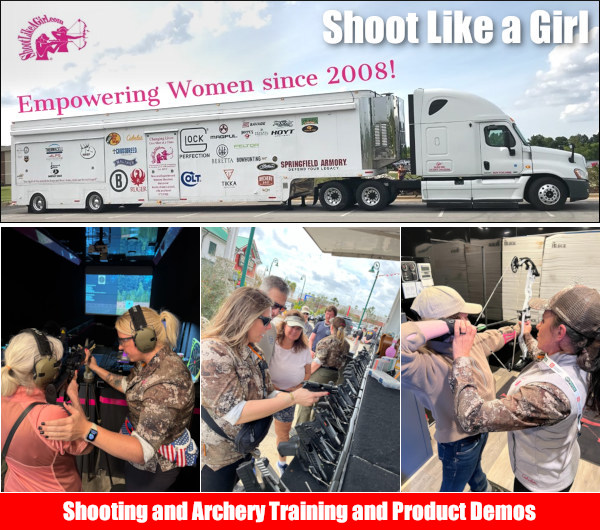
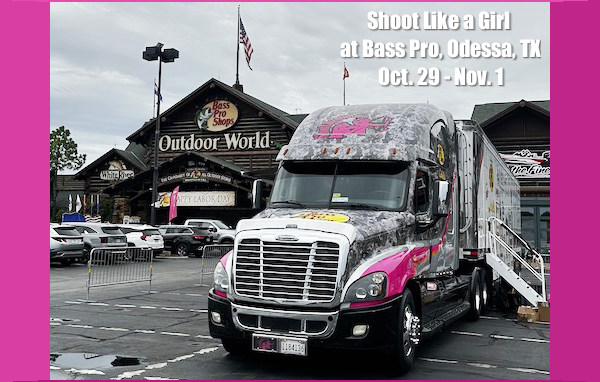
The Shoot Like a Girl operation (SLG2, Inc.) will appear at the Bass Pro Shops Grand Opening in Odessa, Texas, on October 29 through November 1. Following a successful stop in Mesa, Arizona, the Shoot Like a Girl mobile operation will introduce women and their families to shooting sports, focusing on safety, responsibility, and empowerment. SLG2 President Karen Butler stated: “We are excited to complete our [2025 tour] at the new Bass Pro Shop in Odessa, Texas. We love being part of these … grand openings[.]”
The Shoot Like A Girl experience will be stationed in front of the New Bass Pro Shop in Odessa, Texas, on the following dates:
Wednesday, October 29: 4 p.m. to 8 p.m.
Thursday, October 30: 10 a.m. to 6 p.m.
Friday, October 31: 10 a.m. to 6 p.m.
Saturday, November 1: 9 a.m. to 6 p.m.
The event will feature Shoot Like A Girl’s state-of-the-art mobile range, where participants 18 and older can handle handguns and long guns and practice shooting. Certified female instructors will offer a comprehensive introduction to firearm safety and handling using a Firearms Training Systems (FATS) by InVeris military-grade simulator, which provides immediate feedback on recoil, impact, and sound. This experience fosters a fun, secure and comfortable atmosphere, building confidence in shooting sports activities. Shoot Like A Girl instructors will also offer safety talks for youth under 18 years old.
The Shoot Like A Girl semi-tractor trailer travels to cities all across the USA, giving attendees an opportunity to learn about firearms in a fun, safe and comfortable atmosphere. These events utilize the InVeris military grade firearm simulator. Shoot Like a Girl events are free to guests thanks to SLG2’s generous corporate partners.
Outside of the range, attendees can explore the Shoot Like A Girl gun display which features revolvers, semi-auto pistols, shotguns and rifles. Additionally, participants can see product demonstrations including the MAGPUL DAKA Grid system and Gun Tote’n Mamas Original concealed carry handbags.
Women and men of all experience levels are welcome, and no prior knowledge is necessary to participate in this free event. All necessary equipment will be provided to guests upon arrival. For more information on the SLG2 program, visit the Shoot Like A Girl website and SLG2’s Instagram and Facebook pages.
Are you planning to purchase or sell a gun? Or perhaps you want to give one to a family member. Maybe you want to transfer a gun to a friend out of state. These are all situations that demand you understand the law before you buy, sell, or transfer a gun. Thankfully the NRA Blog has a series of helpful articles that can guide you through firearms transfers and transactions.
Do note that laws on private transfers vary from state to state. Also, some of these articles are a few years old. Laws do change, typically becoming more restrictive. You should carefully review current laws in your state before buying/selling any firearm. For a summary of state gun laws, we recommend Legal Heat’s 50 State Guide to Firearms Laws and Regulations reference book. Even this reference was released in 2023, so you should still check for recent changes in state laws.
Here are five articles providing key facts you need to know.
Click each title to read the specific article.
IMPORTANT: All five of these articles reference general rules that apply nationally and in MOST states. However, some states, such as California, New Jersey, and New York (and others) have very special rules and regulations on gun transfers. If you have ANY questions about gun transfers in your state/region, you should consult an attorney familiar the laws of YOUR state and municipality.
On the Defensive Edge Website, you’ll find a good article by Shawn Carlock about wind reading. Shawn is a veteran law enforcement marksman and a past USPSA national precision rifle champion. Shawn offers good advice on how to estimate wind speeds and directions using a multitude of available indicators — not just your wind gauge: “Use anything at your disposal to accurately estimate the wind’s velocity. I keep and use a Kestrel for reading conditions….The Kestrel is very accurate but will only tell you what the conditions are where you are standing. I practice by looking at grass, brush, trees, dust, wind flags, mirage, rain, fog and anything else that will give me info on velocity and then estimate the speed.”
Shawn also explains how terrain features can cause vertical wind effects. A hunter on a hilltop must account for bullet rise if there is a headwind blowing up the slope. Many shooters consider wind in only one plane — the horizontal. In fact wind has vertical components, both up and down.
» CLICK HERE to Download Full Article as Printable PDF
If you have piloted a small aircraft you know how important vertical wind vectors can be. Match shooters will also experience vertical rise when there is a strong tailwind blowing over an up-sloping berm ahead of the target emplacements. Overall, Shawn concludes: “The more time you spend studying the wind and its effect over varying terrain the more successful you will be as a long-range shooter and hunter.”
This Editor, as a life-long sailor, also has some suggestions about wind. Many folks may not realize that wind can cycle, both in direction and in speed (velocity). If you are patient, you should be able to sense the timing of the cycles, which will help you predict shifts in wind direction and velocity. While it is tempting to shoot in the lulls, sometimes the true wind vector (angle + speed) may be most constant when the wind is blowing stronger.
Another tip for hunters is to orient your shot, when possible, in alignment with the wind direction. Try to face into the wind, or have the wind at your back. This is especially effective when shooting in a varmint field. Use a string of tape on a pole to show wind angle. Then shoot directly into the wind or with the wind directly at your back. This will minimize horizontal deflection caused by the wind.
Conventional brass jags work great — except for one thing. They can react to solvents, leaving a blue “false positive” on patches. In recent years, jag-makers have experimented with many different materials in an effort to cure the solvent-reaction problem. Today we have polymer jags, nickel-plated jags, and stainless steel jags. And the latest innovation is the aluminum jag from Dewey.
J. Dewey Mfg. offers a series of “Copper Eliminator” jags and brush adapters made from aircraft-grade aluminum with the same hardness as brass. Dewey claims that its aluminum jags will not become embedded with grit or particles that could harm your bore. At the same time, Dewey’s aluminum jags will not react to ammoniated bore solvents that can turn patches blue green when used with brass jags. Dewey aluminum jags are offered with either male OR female 8/32 threads.
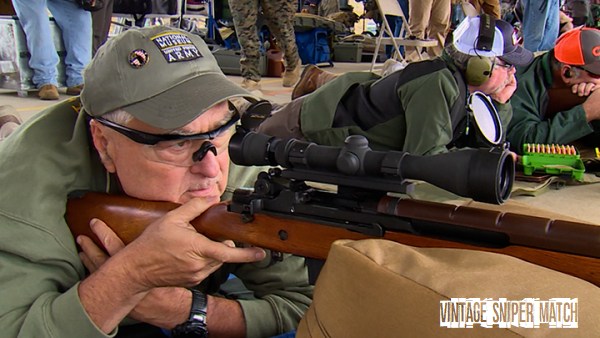
The October 22, 2025 episode of Shooting USA TV features the Vintage Sniper Rifle match at Talladega Marksmanship Park in Alabama. Vintage Sniper competitions use period correct battle rifles with older-style optics. Teams of two engage targets at three hundred and six hundred yards. “It’s a match that brings … a nostalgic competitor out. You’ll see World War II time-period rifles, sniper-type rifles that were used during World War II, [and] Korean War era,” noted Mark Johnson of the CMP. “The optics are either original optics or current reproduction of old optics.”
Shooting USA Broadcast Times: Wednesday 9:00 PM Eastern and Pacific, 8:00 PM Central on Outdoor Channel. Check your local listings for the Outdoor Channel.
Vintage Sniper Rifle matches have proven popular with competitors of all ages, from 18 to 80. These matches are conducted with two-man teams, using vintage rifles with scopes. Most shooters use bolt-action rifles such as the 1903 Springfield and Swedish Mauser, but there is also a semi-auto class popular with Garand shooters. Along with today’s Shooting USA episode, you can watch a previous Vintage Sniper match on YouTube. Click the arrow below to start the 48-minute show:
Vintage Sniper Rifle Competition at Talladega
The Vintage Sniper Match at the CMP’s Talladega Marksmanship Park is a popular two-man team event, for shooter and spotter, using military rifles in service up to 1953. One added challenge is the time limit. The team has only 20 seconds to complete each shot — That’s 20 seconds for the spotter to read the conditions, and for the shooter to pull the trigger.
Who can identify this vintage European rifle, with its unusual scope mount?
From the late ’70s through 1983, a huge, concrete-walled warehouse in Houston was used for benchrest testing. Virgil King and Bob Fisher set up a bullet-catching backstop at the end of a 30-yard-wide, 325-yard-long fire lane that remained unobstructed even when the warehouse was in use. This allowed accuracy tests in virtually perfect “no wind” conditions. Over a six-year period, about 30 shooters were invited to test their rifles. The results were amazing, with numerous “zero groups” being shot in the facility. Many of the lessons learned in the legendary Houston Warehouse still help benchresters achieve better accuracy today.
Dave Scott explains why the Warehouse was so unique:
“Over a period of six years, the levels of accuracy achieved in the Houston Warehouse went beyond what many precision shooters thought possible for lightweight rifles shot from sandbags and aimed shot-to-shot by human eye. For the first time, a handful of gifted, serious experimenters — armed with the very best performing rifles (with notable exceptions) — could boldly venture into the final frontiers of rifle accuracy, a journey made possible by eliminating the baffling uncertainties of conditions arising from wind and mirage. Under these steel skies, a shooter could, without question, confirm the absolute limits of accuracy of his rifle, or isolate the source of a problem. In the flawlessly stable containment of the Houston Warehouse … a very few exceptional rifles would display the real stuff, drilling repeated groups measuring well below the unbelievably tiny .100″ barrier. The bulk of rifles, however, embarrassed their owners.”
Scott’s article also reveals some interesting technical points: “One thing that IS important is that the bullet be precisely seated against the lands. T.J. Jackson reported this fact in the May 1987 issue of Precision Shooting. In a letter to the Editor, T.J. wrote, ‘…in all our testing in that Houston warehouse… and the dozens and dozens of groups that Virgil King shot in there ‘in the zeroes’… he NEVER fired a single official screamer group when he was ‘jumping’ bullets. All his best groups were always seated into the lands, or at the very least… touching the lands. Virgil said his practice was to seat the bullets so the engraving was half as long as the width of the lands. He noticed an interesting phenomenon with rifles that could really shoot: if the bullets were seated a little short and the powder charge was a bit on the light side, the groups formed vertically. As he seated the bullets farther out and increased the powder charge, the groups finally became horizontal. If he went still farther, the groups formed big globs. He said the trick is to find the midway point between vertical and horizontal. That point should be a small hole.”
You should definitely read the complete article, as it provides many more fascinating insights, including shooting technique, barrel cleaning, neck-turning, and case prep.
EDITOR: Will the lessons of the Houston Warehouse work elsewhere? Is this repeatable magic? We remind readers that what T.J. Jackson discovered worked for his barrels, his cartridge type, and his choice of bullets. Jumping bullets can definitely produce good results in other cartridge types with bullets such as Berger Hybrids. Still, the Houston results are intriguing. Any time someone shoots in the “zeros” one should pay attention to how that was achieved.
Are you looking for a new carry pistol or defensive handgun? Are you curious as to what handguns are most popular with American buyers? Well Gunbroker has published its Top 10 handguns based on sales through the end of 2024. You’ll find these ten pistols ranked below, starting with the SIG Sauer P365.
Gunbroker, via the GunGenius.com site, publishes a monthly Top Sales Report featuring the Best Sellers for each major category of firearms on GunBroker.com. This culminates in a year-end report listing the Top Selling Firearms of the Year. Illustrated below are the Top 10 handguns based on 2024 sales:
Here Are the Top 10 Handguns in 2024:
1. SIG Sauer P365
2. Sig Sauer P320
3. Glock G19
4. Ruger American Pistols
5. Glock G43
6. CZ-USA CZ 75
7. Ruger Mark IV
8. Smith & Wesson M&P9
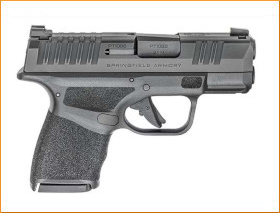
9. Springfield Hellcat
10. Armscor/RIA Rock
Here is a video review of the SIG Sauer P365, the #1 Selling handgun in 2024:
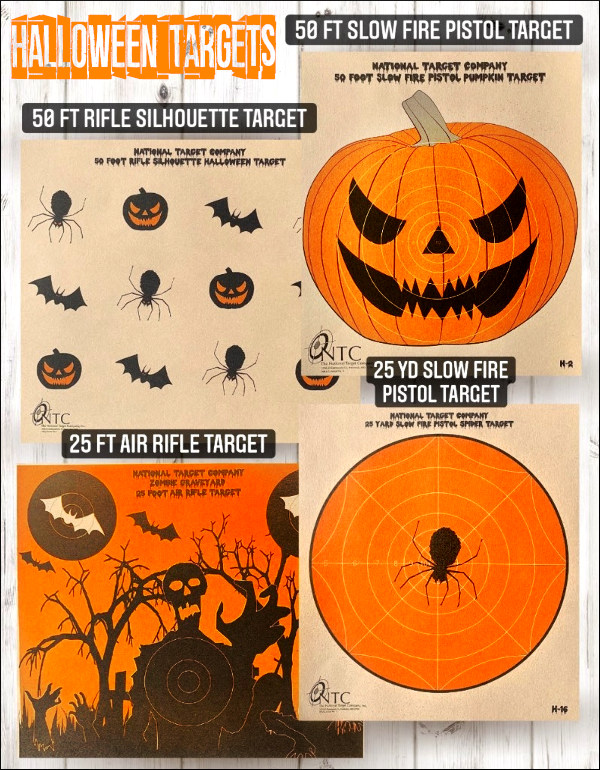
Halloween, October 31st of each year, is just 10 days away. As we approach “All Hallow’s Eve”, you may want to have fun at the range. We found a cool 4-pack of Halloween-theme targets you may want to buy. This 100-target Halloween Sample Pack is offered by the National Target Company for just $12.10 plus shipping. That’s a great deal — you can pay that much for a burger and fries these days.
The set includes 100 Halloween Targets with four different styles shown above. These paper targets, listed as 12″ × 18″ in size, feature bright orange and black graphics on pale orange backgrounds. There’s a big Jack-0′-Lantern pumpkin with scoring circles, a target with dozen smaller graphics (bats, pumpkins, and spiders), a Zombie Graveyard scene with 3 circles, and a large orange circle with spider and scoring rings.
Target One: 50′ Slow Fire Pistol Pumpkin Target (Jack-O’-Lantern face and rings)
Target Two: 50′ Rifle Silhouette Target (bats, pumpkins, spiders)
Target Three: 25 Yard Slow Fire Pistol Target (circle and spider)
Target Four: 25′ Air Rifle Target (Zombie Graveyard)
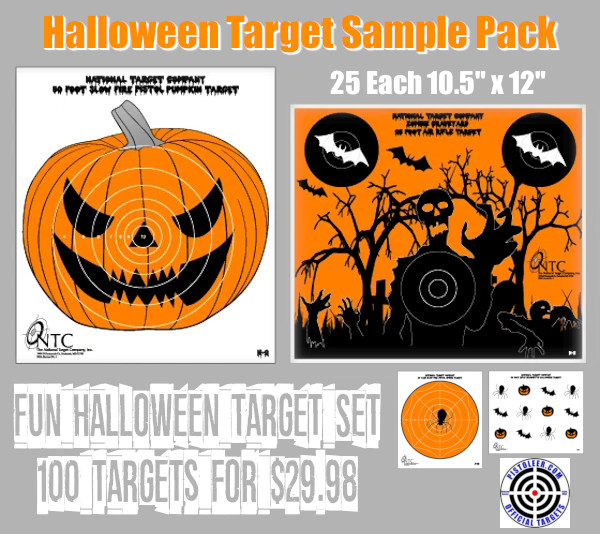
NOTE This Option Just SOLD OUT Today: A similar target pack with 10.5″ x 12″ targets is also available from Pistoleer.com for $29.98 on eBay with FREE Shipping. Delivery is promised before October 27, so you should get the 100 targets with time to have fun at the range before Halloween 2025. NOTE: These Pistoleer targets replicate the National Target Company (NTC) designs, but the Pistoleer targets show higher contrast (more white) backgrounds than the same targets displaying on the NTC site. Below are the targets as shown by Pistoleer on eBay:
Over time the 1911 design has evolved into many variants, including the modern “race gun” used in rapid-fire pistol competitions. Show above is an STI DVC Open model fitted with a C-More sight, and front compensator. It is chambered for the .38 Super.
This article has good tips on pistol marksmanship (grip and trigger control). In addition we offer resources on how to upgrade and accessorize 1911-type handguns.
How to Grip a 1911 Handgun Properly
World Champion pistol ace (and 18-time Bianchi Cup winner) Doug Koenig demonstrates how to grip a handgun. While the fundamentals are demonstrated on a 1911 pistol they are effective for establishing a proper grip on any handgun.
Trigger Press and Trigger Control
In this video Champion shooter Doug Koenig talks about key techniques that apply to all pistol marksmanship — not just speed shooting “on the clock”. With any handgun, Doug explains, you should focus on consistent trigger control. You want to avoid yanking the trigger or anticipating recoil.
How to Accessorize Your 1911
The Brownells YouTube Channel has a series of videos showing how to accessorize a 1911. The videos show procedures for upgrading the magazine release, slide release, hammer, guide rod, mainspring housing, and grips. There are also good videos on barrel replacement and drop-in trigger group installation. If you want to upgrade your 1911, these videos are worth watching. Below are links to three of these 1911 videos.
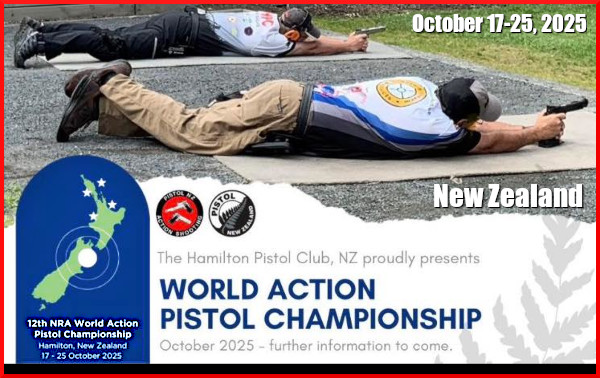
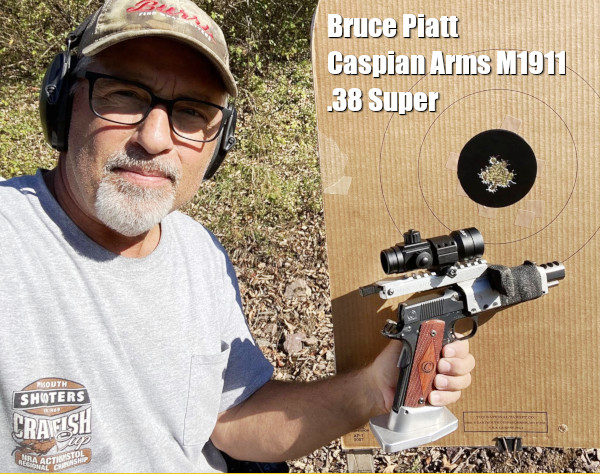
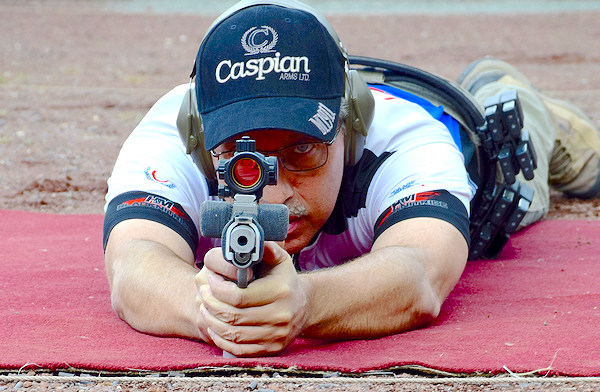
A major pistol championship takes place “down-under” this week in New Zealand. Ace American shooter Bruce Piatt has traveled to Hamilton, New Zealand to compete in the 2025 World Action Pistol Championship. Bruce is one of America’s top pistoleros, having won multiple World and National Championships. He started competing in the 1980s and Bruce has had a 30+ year law enforcement career.
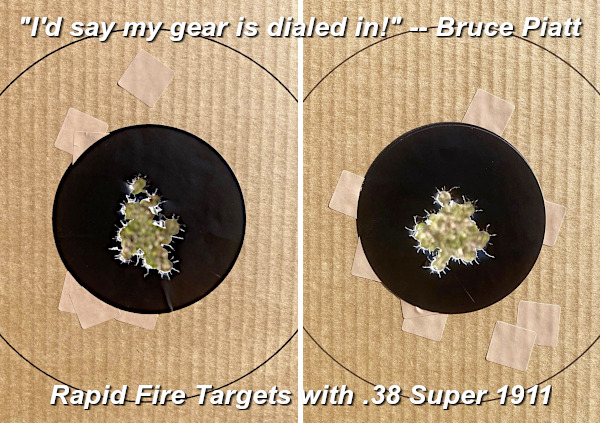
Before flying across the Pacific to the Southern Hemisphere, Bruce conducted some range training: “A little barricade practice today for the upcoming Action Pistol World Championship in Hamilton New Zealand where I’ll be on the U.S. Team for the CMP – Civilian Marksmanship Program. I’d say my gear is dialed in!”
Bruce will be shooting a Caspian Arms 1911 pistol chambered for the .38 Super cartridge and fitted with a Burris Optics XTS-135 scope on top. The ammo he’ll use in New Zealand is loaded with Vihtavuori N320 powder and Sierra 115gr JHP bullets, in Starline Brass cases.
Location of World Action Pistol Championship in Hamilton, New Zealand (North Island)







 Dave Scott explains why the Warehouse was so unique: