|
|
July 28th, 2007
We now have hundreds of entries in our Daily Bulletin. A few readers have told us: “I read something in the Bulletin last week, but now I can’t find it. Where did it go?”
Don’t worry. Every Bulletin entry is archived, and each is listed by one or more categories as well. You can search for a past entry by keyword, or just click on a category. If you want to watch a video again, just click on “Videos”. If you saw a review of a scope, click on “Optics”, or do a word search such as “Nikon” or “reticle”. The “Articles” item at the top of the list will bring up posts that link to a longer feature article on this site or elsewhere.
Once you get the hang of it, you should find it easy to find stuff using the navigation tools. The search is fast and effective. The illustration below shows how to use the navigation tools, found at the upper right of this page.

July 27th, 2007
Confused about the meaning of a term such as “meplat”, “magnaflux” or “obturate”? Need to know the OAL of an unusual Wildcat such as the .218 Donaldson Wasp? Well CCI and MidwayUSA offer handy answers on the web. CCI’s Shooters’ Glossary is a very complete collection of gun-related and reloading terms. MidwayUSA’s GunTEC Dictionary contains short descriptions of hundreds of cartridges, plus definitions of thousands of shooting-related words and phrases. How many of you knew that “Maggie’s Drawers” is “a colloquial term used for the red flag once used by pit workers to signal a missed shot at high-power rifle competitions”?

Consulting the dictionary, we learned that “Magnus Force” was not a Tom Selleck TV show. Rather, “Magnus Force is the movement of a bullet in the direction it is rotating (and downward) due to the lower air pressure surrounding it. The low pressure pocket is caused by the effect of the bullet’s fast rotation on the surrounding air.” MidwayUSA’s GunTEC dictionary even includes short “bios” of notable firearms inventors and marksmen, including J.M. Browning, Fredrich von Martini, and Peter Paul Mauser. A serious shooting buff could spend hours browsing the GunTEC dictionary, learning new facts (and a ton of obscure trivia.)
July 27th, 2007
The National Shooting Sports Foundation (NSSF) announced the launch of its new online NSSF Marketplace Buyers Guide. Available on NSSF’s Web sites, this directory allows shooters to quickly locate specific products and services by keyword or category. The NSSF Marketplace employs a powerful search engine that continually indexes the Web sites of all companies represented in the directory.
The Marketplace has both keyword-search capability and dozens of links for specific product categories such as ammunition, optics, cleaning gear, and guide services. Click on “Optics/Electronics”, for example, and a page appears with linked subcategories for Scopes, GPS units, Rangefinders, Eyewear, Binoculars and more.

The NSSF Marketplace also offers a downloadable desktop search application. If you install this, you can search for products and services directly from a small search window on your desktop. The NSSF Marketplace also includes a Request for Information (RFI) tool, enabling users to contact a group of suppliers with one click of a button. The buyers guide can be found on www.nssf.org and other association-supported sites, including www.huntandshoot.org, www.wingshootingusa.org, www.wheretoshoot.org, www.huntinfo.org and www.stepoutside.org.
July 26th, 2007
 How would you like a full-length sizing die perfectly fitted to your fired brass? At one time that required you to purchase a die blank, a special undersized reamer (a chamber reamer is too big), and send the work out to a skilled gunsmith. You could expect to have $250-$350 tied up in your custom die when all was said and done.
Now Hornady’s custom shop offers a much less expensive alternative. For roughly $75-$90, plus shipping, Hornady will produce a custom-made die based on your reamer print, spec sheet or fired brass. You can either order a conventional non-bushing FL die, or a FL die that uses bushings to size the case-necks. To order, we recommend you send 3 or 4 fired cases along with a reamer print to Lonnie Hummel at Hornady Mfg., Box 1848, Grand Island, NE, 68802. Give Lonnie a call first at (800) 338-3220, ext. 208, to discuss design details and get an estimated delivery date.

Lonnie and his team of skilled machinists have produced custom dies for many top shooters. Scott Parker had Hornady produce a custom full-length die for Scott’s 6BRX. Scott reports: “The die is great. I’m very impressed. The die is a perfect fit for my brass and the sized brass has very low run-out.” Past F-Class Champion John Brewer has a set of Hornady custom 6-6.5×47 Lapua dies on order currently.
July 26th, 2007
Dave Kiff’s Pacific Tool & Gauge is the “featured brand” this week at MidwayUSA.com. You’ll find excellent prices on everything from “Go” gauges to ultra-durable, fast-cutting carbide chamber reamers. PT&G sells both fixed-end and piloted (floating tip) reamers. The piloted reamers have a definite advantage when you chamber barrels from different manufacturers that may vary slightly in internal bore dimensions. The pilots are interchangeable so you can select a pilot diameter that best fits your particular barrel.

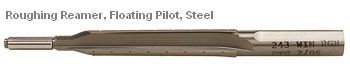


 In addition to reamers, gauges, and miscellaneous cutting tools, MidwayUSA carries Dave Kiff’s Gunsmith’s Book of Chamber Prints. This 425-page, spiral bound resource contains a huge collection of chamber prints for many of the reamers that PTG makes (circa 2002). Complete mechanical schematics are well drawn and all required measurements are provided. This reamer book is a great place to start if you are choosing a special caliber for your next rifle, or considering building your own wildcat cartridge. Dave Kiff will send out reamer prints on request, but the book offers them all in one place for a reasonable price: $47.99 (Midway item # 347655).
July 25th, 2007
Soldiers of the U.S. Army Marksmanship Unit have scored major victories recently, including First, Second and third in the just-completed Service Rifle Championship at Quantico. The Service rifle team competes, primarily, with an accurized version of the M16A2 rifle at distances of 200 to 1000 yards. Select members of the team also compete with bolt-action rifles equipped with both telescopic and aperture sights from 800 to 1000 yards. Below are recent winning performances by USAMU team members. USAMU shooters and coaches will also be competing in the Centennial matches at Camp Perry in the next few weeks.

Interservice Highpower Rifle Championships
Quantico, Va., July 16 to 24
USAMU service rifle shooter Sgt. 1st Class Lance S. Hopper won the Overall Individual Interservice Rifle Championship, followed by Sgt. 1st Class Grant L. Singley in second place and Sgt. 1st Class Kyle A. Ward in third. Singley won the Navy Match and Staff Sgt. William T. Pace won the Marine Corps Match. The USAMU Service Rifle Team coached by Staff Sgt. Emil Praslick III won the 2007 Interservice Rifle Championship Commanding General Team Match; shooters were Hopper, Green, Singley, Ward and Sgt. 1st Class Lance D. Dement and Spc. Matthew T. Sigrist and the team captain was Spc. Tyrel L. Cooper.
National Smallbore Rifle Matches
Camp Perry, Ohio, July 19 to 21
Sgt. Shane M. Barnhart won the National Smallbore Three Position National Championship; Lt. Col. Robert E. Harbison took third place. Barnhart also won the Three Position Any Sight Championship, in which Spc. Nicole M. Cooper finished third; Cooper also won the Women’s Championship. Second Lt. Lucas F. Leinberger placed second in the Three Position Metallic Sight Championship. The USAMU Team of Cooper, Staff Sgt. Armando R. Ayala, Cpl. Henry L. Gray and Spc. David R. Sprecher won the Three Position Any Sight Team Match and the USAMU Team of Harbison, Leinberger, Barnhart and Maj. Michael E. Anti took the Three Position Metallic Sight Team Match.
Pan-American Games
Rio de Janeiro, Brazil, July 15 to 21
Sgt. 1st Class Jason A. Parker won Gold Medals in the Air Rifle and Three Position Free Rifle matches. Sgt. 1st Class Thomas A. Tamas received the Gold Medal in the Free Rifle Prone competition, in which Spc. Michael D. McPhail got the Silver. Spc. Joshua M. Richmond received the won the Gold Medal in the Double Trap match, followed by Spc. Jeffrey G. Holguin with the Silver. In the Skeet competition, the Gold Medal went to Pvt. 2 Vincent C. Hancock and the Silver to Sgt. 1st Class James Todd Graves.

July 24th, 2007
In this video by Dan Lilja, you can see the difference between a factory barrel and a hand-lapped custom barrel with your own eyes. The borescope reveals the tooling marks, rough surface, and flaws in the lands that are not uncommon in a factory barrel. Conversely, the custom barrel (shown in the image below), shows sharp lands, a smooth surface (without excess machining marks), and rifling without scratches or cuts. If you haven’t watched this video before, you may be amazed.

You can learn more about borescopes by reading the Hawkeye Borescope Review by top UK shooter Vince Bottomley. Vince put a Hawkeye unit through its paces and concludes that it is an invaluable tool for diagnosing barrel problems and monitoring barrel wear. Vince writes: “With a borescope, you can tell immediately if your cleaning regime is effective, or inspect for throat-erosion and the general condition of the rifling. In addition, I have found that it is very useful for inspecting newly-cut chambers–making sure they are free from scoring and other machining defects and you can even have a good look at the muzzle-crown from the inside–one of the most important parts of any barrel. Tiny burrs can often be present on newly-cut crowns and even the most minute damage to a crown (often caused by careless cleaning) can play havoc with accuracy. For the professional gunsmith, you could say that a borescope is the equivalent of a doctor’s stethoscope.”

July 24th, 2007
This may be a first in ARA 50-yard competition. Using a Calfee-built Rem XP100 pistol with 20″ barrel, Joe Friedrich shot a perfect 2500 score at the Open Grove range in California this past weekend. His four-target total was 9650 (2350, 2450, 2500, 2350). The pistol was supported by a skeletal bipod in front with a conventional sandbag in the rear. The group was shot at night in very stable conditions. Joe told us: “This pistol is incredible. I’ve only had it a couple of weeks, and I’m still learning the technique.”

We find it very interesting that Joe was able to achieve this kind of accuracy with a relatively short barrel. Conventional wisdom (at least with rimfire rifles) dictates that one needs a barrel 25″ or longer to work optimally with the tuner systems. Many folks also believe that the longer barrels tend to “iron out” shot to shot velocity differences. It will be interesting to see if some ARA shooters now experiment with shorter barrels on their rifles.
Joe credits much of his recent hot shooting to a new wind indicator product he’s using: “Snuffy” Sail Tails. These use nylon ripstop sailcloth material and maintain a tubular shape (like a long cigar) when attached to a wind flag. They rise and fall with velocity changes, and are much easier to read. Joe says these don’t flutter around like conventional wind tails or surveyors’ tape. They are sensitive enough for small zephyrs but they don’t swing back and forth erratically giving potential false reads. You can order the Sail Tails from Howard “Snuffy” Smith in Macon, GA, (478) 477-2829. A set of five Sail Tails in a PVC tube is $24.50 delivered. Link to Advert.

July 23rd, 2007
Many of our readers were interested in the 6BR Improved cases with a longer neck than a Dasher, such as David Stipling’s 6 BRDX and the 6 BRG from gunsmith Billy Dale. At our request, Billy measured his 6 BRG wildcat and provided us some additional details. It has slightly larger capacity than the 6 BRDX. Fire-formed 6 BRG cases (Lapua Brass) offer 40.6-40.8 grains of H20 capacity, just a little bit less than a 6mm Dasher (41.0-41.3 grains), and about 2.5 grains more than a fire-formed 6BR case. The 6 BRG neck is .264″ long, just about .058″ shorter than standard 6BR brass. That gives you plenty of neck to seat both long and short bullets, and to “chase the lands” as the throat erodes.

Billy reports: “The 6mm BRG was designed by myself and Dr. Robi Robinson as a 1000 yd competition and long range varmint cartridge. The neck is about .250″ and the body taper is reduced to .010″ (.005″ per side). The BRG fills the gap between the 6mm BR and the 6mm Dasher, giving the shooter a neck length of .264″–somewhat longer than the Dasher enabling him to seat VLD bullets out further to chase lands as they wear. Varget Powder works extremely well in the BRG and with a 28″ Lilja 3 groove barrel, you can push a 105gr VLD bullet 3100+ FPS with extreme accuracy. On a recent varmint hunt in Kansas with one of my clients, I witnessed many kills from 700 to 1120 yards with this gun and cartridge. For more info, I can be reached at 804-314-6787 or BDRCustomguns[at]aol.com. My website is BDRcustomguns.com.”
Dave Kiff at Pacific Tool & Gauge created the reamers for the 6 BRG and a 6.5 mm version, and a reamer print is available in PT & G’s archives.
July 23rd, 2007
Even in today’s digital age, many reloaders prefer the simplicity and reliabilty of a balance scale for weighing powder charges. In this Bulletin, we reported that our own PACT digital scale suffers from fluctuating read-outs. The weight reading drifted up to 0.3 grains in less than an hour. (PACT Story). LTRDavid has come up with a clever upgrade to an O’Haus-type scale that makes the weighing process easier for those of us with old eyeballs. He’s simply mounted a magnifying glass in front of the balance marker, using two clamps. Pretty ingenious wouldn’t you say? We wonder why the scale-makers didn’t offer a small magnifier as a factory option long ago. For more smart reloading tips, check out David’s website, LTRDavid.net.
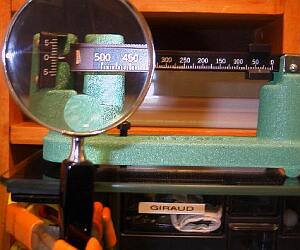
When working with balance beam scales, be sure you have the device leveled. Even a small amount of tilt will throw off the measurement. We’ve seen folks who keep their scale on a shelf or storage area, and then take it out for use. That’s fine, but remember than your loading bench may not be uniformly level on all sections. Unless you put the scale in exactly the same place on the bench every time (at the same angle), you may have to re-set the level. Likewise, if you take the scale to a range, be sure to re-level it to your new working surface. And remember that is it just as important to level the scale front to back as left to right.
|


