A radical new tactical rifle, the UXR (User Xchange Rifle) was just introduced by PWS (Primary Weapons Systems). This unique, revolutionary rifle allows users to quickly switch chamberings by exchanging just three parts: barrel, magwell, and bolt head. Initially available in 5.56×45 and .300 BLK variations, the UXR platform will also be available in .308 Win and 8.6 BLK configurations later this year.
Our friend True Pearce of GunsAmerica Digest Tests the new PWS UXR:
The new UXR rifle has a unique, patent-pending Xchange system. The upper receiver of the UXR is the only serialized part of the setup, enabling the shooter to easily transition from configuration to configuration, caliber to caliber. Adaptability is the core principle of the UXR, showcased in its many customizable features such as an adjustable buttstock that can fold left or right, an adjustable cheek plate, and ambidextrous-able selector switch, magazine release and even the charging handle.
The UXR platform also features a proprietary “modified long-stroke piston system” which allows the rifle to run reliably with any UXR barrels regardless of caliber. This internal system allows the user to swap calibers and barrels without needing to adjust the gas system each time. And the newly-designed Bore Evacuator reduces back pressure, especially when a suppressor is being used, making the UXR a good choice for suppressed shooting.
For more information on the UXR, visit Primaryweapons.com/firearms/uxr. PWS will have the UXR at the Industry Day at the Range on January 22, 2024, and it will be showcased at SHOT Show 2024.
The RCBS Lock-Out Die can also be used with some Dillon and Hornady progressive presses.
If you load pistol or rifle ammo with a progressive press, we strongly recommend you get a Lock-Out Die from RCBS. This unique reloading die will prevent your progressive press from advancing if the dispensed powder charge is more or less than about 0.3 grains too high or too low. The Lock-Out Die really works. Your Editor uses it on his RCBS 2000 progressive press. I can affirm that a Lock-Out Die has “saved my bacon” a half-dozen times over the years when there was an over-charge (which could cause a Kaboom) or a low charge (which could cause a squib load).
The Lock-Out Die works by using a central die detection rod that sets its vertical position based on the height of the powder column in the case. Through an ingenious design, if the powder column height is too low or too high, the rod locks in place as you start to pull the press handle. This halts the press before the ram can lift and the cartridge plate can advance. Unlike a beeping alarm system (which can be ignored or defeated), the Lock-Out Die physically stops the movement of the press ram and prevents a bullet being seated in the “problem” case.
It takes a bit of tweaking to get the Lock-Out Die detection rod setting just right, but once it is correctly positioned, the Lock-Out Die works smoothly in the background. The Lock-Out Die won’t interfere with the loading process unless it detects a high or low charge — and then it positively stops the progressive loading cycle.
While crafted for use in RCBS progressive presses, the RCBS Lock-Out Die can also be used on a Dillon XL Progressive (see video below) or Hornady Lock-N-Load progressive — though it does take up one station which could otherwise be used for a final crimp die (after the seating die). The RCBS 2000 has one more station than a Dillon 550/650, so it’s an ideal platform for using the Lock-Out Die.
Learn More at UltimateReloader.com
On the UltimateReloader.com website, run by our friend Gavin Gear, you’ll find an excellent two-part series on the function and set-up of the RCBS Lock-Out Die. Part One explains how the Lock-Out Die functions, using cut-away illustrations. Part Two shows how to install and adjust the Lock-Out Die on various progressive presses. The Ultimate Reloader video at the top of this article shows setup of the RCBS Lock-Out Die on the Dillon XL-650 progressive press, while the Reloading Bench video below shows the Lock-Out Die on a Hornady LnL progressive.
Ever wish you could look inside your rifle, to see how the trigger and fire-control system work? Well now that is possible with the magic of 3D computer graphics. Modern software allows detailed “cutaway” side-views (see below), as well as 3D views with 360° rotation. The software can also provide X-Ray-type views into the gun’s internals — as you can see above. And computer animation can show the complete firing process from trigger pull to chambering of the next round.
Rem 700 Cutaway View from Right Side
This article provides some very cool 3-D “Cutaway View” animations of the popular Remington 700 action, probably the most successful American bolt-action ever created.
READERS — Take the time to watch the video! The Rem 700 animation is really outstanding! EVERY bolt-action shooter should watch this video all the way through.
Cutaway 3D Animation of Rem 700 Action — Watch Video
The Model 700 series of bolt-action rifles have been manufactured by Remington Arms since 1962. All are based on basically the same centerfire bolt action. They are typically sold with an internal magazine depending on caliber, some of which have a floor-plate for quick-unloading, and some of which are “blind” (no floor-plate). The rifle can also be ordered with a detachable box magazine. The Model 700 is a development of the Remington 721 and 722 series of rifles, which were introduced in 1948.
The Remington 700 is a manually-operated bolt action with forward, dual opposed lugs. It features “Cock On Opening”, meaning the upward rotation of the bolt when the rifle is opened cocks the firing pin. A cam mechanism pushes the firing pin’s cocking piece backward. The bolt face is recessed, fully enclosing the base of the cartridge. The extractor is a C-clip sitting within the bolt face. The ejector is a plunger on the bolt face actuated by a coil spring. The bolt is of 3-piece construction, brazed together (head, body. and bolt handle). The receiver is milled from round cross-section steel.
This video was made with the help of the World of Guns: Gun Disassembly interactive encyclopedia with 3D rendering. This remarkable web-based software allows users to view the inner workings of hundreds of different rifles and pistols — everything from a .22 LR Ruger to a .55-caliber Boys Anti-Tank rifle. There are also 25,000+ parts diagrams. This is a remarkable technical resource. SEE MORE HERE.
Are you seeing unpredictable changes in Point of Impact on your target? Think you may have a scope issue? Well maybe not — when was the last time you checked your BARREL?
Yes scopes do fail, and scope bases/rings do get loose. But sometimes problems with erratic POI shifts are caused by a LOOSE BARREL. This issue came up a while back in our Shooter’s Forum. One member complained that his zero was shifting from day to day — by as much as two inches at 100 yards. He was convinced he had a scope problem, based on erratic POI:
“I think my scope loses 1 to 3 MOA per day. When I shot my rifle Monday it was dead on. On Tuesday it was 1″ low. Then on Wednesday it was 1 or 2″ lower. I don’t get it. — the elevation knob never touched. Scope will track and return to zero that day perfect. Yes EVERYTHING has been checked, nothing loose. What is the chance the erector tube spring has gone south? For the record this is a Vortex GE. Never had a bad scope, but this has me wondering”. — LB
On Forum member told LB to send the scope right back to the manufacturer. Two other members suggested mounting the scope on a different rifle to test. Good advice. That’s generally a smart strategy before you conclude a scope has gone bad…
Could Problem Be the Scope Base?
Two Forum members, ExPiper and Dickn52, suggested checking the scope base, recounting their past experiences with troublesome bases. This was intelligent — anyone with a POI problem should check all the optics attachments:
“Went crazy one day chasing my impacts on a 100-yard target. Shots would group fine for three then go nuts for 4-5. I cranked and un-cranked for about an hour. Then I reached up and the base wobbled on the rifle. Removed scope, tightened base screws and back in business.” — Dickn52
“Years ago I had a problem [where] shots were climbing with almost every shot. I was blaming the scope. However, when removing the scope I noticed that the 20 MOA base was cracked and getting wider with every shot. Needless to say I replaced the base and the problem was solved. — ExPiper
Eureka Moment — The problem was the BARREL, not the Scope
There were many helpful suggestions, but member PirateAmmo steered LB to the real problem — a loose BARREL: “We had a problem on a home-built AR-platform rifle once, barrel was loose a tad…”
Member Snert chimed in: “Yep — I had a PPC that suddenly went 19″ low. Picked up gun off bench by barrel and felt a wiggle. I tightened the barrel and the POI went 19 inches up”.
Problem Solved — Barrel Tightened up and POI Back to Normal
The gentleman with the POI problem took the advice of PirateAmmo and checked his barrel. BINGO! Low and behold, the barrel WAS loose.
LB posted: “Barrel loose by about 2%, checked it twice before and didn’t find it the first two times”.
After LB re-tightened his barrel, his rifle started shooting normally again. No more shooting low by 1-2 inches. Problem solved. The fix didn’t cost a penny and now LB doesn’t have to send a perfectly good optic back to the manufacturer.
Lesson learned? Check ALL the variables before you assume a scope has gone bad. Along with the barrel, also check your action screw tension, and of course the scope base and rings.
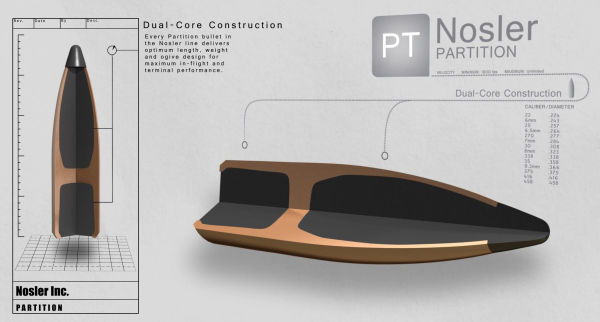
John Nosler lived 97 years, passing in 2010. During his long lifetime, John was an iconic figure in the shooting and hunting world. Considered a true pioneer in bullet and ammunition design, Nosler developed the famous Partition bullet in the 1940s. Born on April 4, 1913 in Brawley, California, John built his business from scratch. He founded his bullet company in 1948. He was considered to be one of the great innovators whose designs helped create the premium bullet category and influenced ammunition manufacturers worldwide.
Moose-Hunt Inspires Partition Bullet Design
While hunting in Canada, John experienced a bullet failure on the hide of a mud-caked bull moose. He then began developing a revolutionary new projectile, which he called the “Partition”, because of the barrier that separated the bullet into two sections. One year later, John and a friend traveled back to British Columbia with his new Partition bullets, which were designed to provide deep penetration and expansion. The men bagged two moose with two shots, and the rest is history.
NRA Golden Bullseye Pioneer Award
In recognition of his contribution to the shooting sports industry, John was the unanimous choice for the inaugural 2007 NRA Golden Bullseye Pioneer Award. The award was the highlight of a long and fruitful career. Even though he officially retired in 1988 when his son and daughter-in-law, Bob and Joan Nosler purchased the company, John still managed to come to the office on a daily basis until his health declined.
Today, John’s son Bob Nosler still presides over the company as president and CEO of Nosler, Inc., based in Bend, Oregon. Along with bullets, the company now produces cartridge brass, loaded ammunition, and hunting rifles.
To learn more about John Nosler and his bullet designs, get your hands on Going Ballistic, a “Professional Memoir” told by John Nosler to outdoor writer Gary Lewis. CLICK HERE to hear a short John Nosler audio clip or to order the book from the author.
John Nosler remained an avid hunter and shooter even late in life. Gary Lewis recalled that, at age 92, John Nosler attended the opening of a new shooting range outside Bend, Oregon. Even in his nineties, Nosler managed to drill two shots inside nine inches at 1000 yards. John Nosler leaves a legacy that will benefit hunters and shooters’ nationwide. The John A. Nosler Endowment of The NRA Foundation, sponsors the NRA’s Basic Rifle Training Program which instructs novices in safe rifle handling.
Thousands of new products will be on display at SHOT Show 2024, the major gun industry trade show held each January in Las Vegas. The official SHOT Show Product Planner offers a “sneak peak” at 294 new-for-2024 products for hunters and shooters. More will come in the weeks ahead. Here are nine interesting new products for gun owners and reloaders. Since these are all recently-released items, we haven’t been able to test them yet. Product profiles are based on descriptions provided by the manufacturers. We will run a separate feature on new pistols and rifles that will debut in 2024.
The Leapers UTG Big Bore Bipod is a heavy-duty bipod designed for very large caliber ELR rifles. This bipod is available with either a MIL-STD Picatinny or ARCA mount. The Big Bore Bipod is 40° pannable and 22° tiltable with tension adjustment levers. The throw levers are user serviceable. The bipod’s hub sits within minimal offset in relation to its mount. This provides improved stability with a lower center of gravity, and better weight distribution. That, plus the bipod’s 60° wide open angle, makes the bipod very stable. The extendable legs offer a wide range in center-height adjustment and retract at the push of a button. Note: This is not yet on Leaper’s website. Price: $299.97
GunStixx allow efficient use of gunsafes. GunStiXX from Winchester are designed and sized to work universally with rifles and shotguns down to .20 caliber. This new firearm storage system consists of an MDF gun rack with holes, aluminum caps, and plastic rods. Each rod is made of sturdy, damage-free plastic material to prevent scratching your gun’s surface or barrel and can be trimmed to your preferred length. This works as a modular racking system securing guns in an upright position, creating more storage capacity within the same available footprint. Note, like other barrel rods, this system works best with rifles/shotguns with relatively narrow forearms. And for long-term storage we recommend that you remove the scope. That creates more room inside the safe.
Many tactical shooters are now mounting red dot optics to a conventional zoom optic. This allows very rapid target acquisition at short range. This dual optic option can can be done easily with the Delta RDS Ring Cap. The ring caps for the Delta Series Mounts feature direct mount footprints for popular red dot sights to accommodate the use of backup red dot sights on scoped carbines. Available footprints include the RMR, Micro Red Dot, EFLX, MRO, Fast Fire, 509-T, and ACRO Red Dot Sights.
This clever Presma AR15 buttstock includes a secure carrier/holder for a spare magazine. This will attach to any regular mil-spec buffer tube and will fit all standard 5.56×45 (.223 Rem) AR15/M16/M4 magazines. This would be a handy accessory for Action Shooting competitions requiring rapid mag changes. The buttstock is adjustable and includes a recoil pad. The magazine-holder has a handy quick release, similar to a standard AR mag release. The buttstock has strap hole features for multiple sling/strap positions. Dimensions are: 7.24″ x 5.47″ x 2.23″. Price: $35.00.
Some states now limit the use of lead bullets and lead shotshell media. That can be problematic for trap/skeet shooters and bird hunters. Thankfully, there are some good options that can replace lead shot. Agescan International has introduced new, non-toxic High-tensile Superb Bismuth Shot. The maker states: “We invented a revolutionary formula and production technique. The new Superb Bismuth Shot (“SBS”) exhibits extremely high quality in terms of uniformity, perfect roundness, mirror-finished surface, and zero fragmentation rate. By saying zero fragmentation rate, the ballistic test showed SBS performs like lead shot and entirely solved the shattering issue with traditional Bismuth shot.” This can be loaded into shotshells for use in areas that ban ammo containing lead projectiles.
We like this versatile multi-gun case from SKB. It can hold THREE rifles and THREE pistols, making this one of the biggest-capacity cases on the market. This waterproof, virtually indestructible MIL-SPEC case features custom-cut foam to accommodate three ARs and three handguns, with plenty of room for magazines, ear protection, and other accessories. This big wheeled transports case is made in the USA and comes with an unconditional lifetime warranty. MSRP is $499.99 — a substantial investment.
The Bore-Max Cleaning Kit & Mobile Workstation has a great selection of tools — jags, brushes, bore mops and more. The workstation has two innovative features that make cleaning easier. The first is the Gun Gripper technology built into the yokes, which firmly grip barrels, handguards and stocks. The second is four Smart-Assist ports located on the corners of the case. These allow plugging in the included hands-free flexible flashlight or other accessories. Tools include: Smart-Fit Bore Guide, Bore-Max 3-Pc Smart Rod, Gun Gripper Form-Fitting Grips, Gun Detailing Tools (Steel Picks, Cleaning Brushes), Micro Cleaning Mat, Travel Case.
With collectors and enthusiast in mind, Custom & Collectable Firearms has proudly introduced the Colt Python Black Stag 3″. This special revolver includes hand and laser engraving on the frame, wheel, and barrel with almost 1/4″ in depth on the engraving. The firearm also showcases exceptional handsome black Stag antler grips that give it that beautiful, yet rugged look. The Colt Black Stag ships with a 1 of 200 challenge coin and hand signed certificate.
Breakthrough Clean Technologies, an Allen Company enterprise, has released an innovative Suppressor Cleaning Kit to address the challenging task of keeping suppressors, muzzle brakes, and compensators clean and in proper working condition. Based on the effectiveness of BCT’s cleaning solution, a suppressor cleaning kit has been developed to make the entire process easier and more effective. This new Suppressor Clean Kit and other new-for-2024 items will be shown at Allen SHOT Show booth #13021. Cleaning Kit includes: 16 oz. Suppressor Cleaner Fluid, Soaking Tube, Two Specialized Brushes, Retrieval Tool, and Organized Tool Tray.
The folks at Sierra Bullets asked a few staff bulletsmiths a classic question about guns: “If you could own only one firearm which one would you choose?” There were many interesting answers including a “cheater” response — the drilling — which is really two guns in one. The most-often mentioned chambering was the venerable .30-06. Respondents cited its versatility, hunting prowess, and ready availability of ammo. The popular .308 Winchester, as expected, got mentions as did its cousins the .243 Win and 7mm-08. There were quite a few votes for classic lever guns, as well as 12-gauge shotguns. Two bulletsmiths cited the .22 LR, and we can certainly see the logic in that answer. The little rimfire cartridge is versatile, quiet, and inexpensive. SEE All Answers.
We ask our readers the same question — if you could only have one long gun, what type of firearm would it be? List the gun type and chambering in the comments section.
If You Could Have Just One Long-Gun — ANSWERS:
Media Relations Manager Carroll Pilant answered: “I would NEVER own only one gun. If I HAD to pick one, it would be a drilling in 12 gauge over .30-06.”
Ballistic Technician Rich Machholz answered: “The early tang safety Ruger M77s pretty much have all you could want in a bolt gun, but I do like the Winchester lever guns and the combination guns, particularly the drillings. Since I have the first two, I’m going for a Doug Turnbull 1886 or a side by side 20 gauge over .223 drilling.”
Ballistic Technician Philip Mahin answered: “More than likely it would have to be a bolt action .30-06. The reliability is legendary on a wide range of game animals and factory ammunition has still been available at my local stores even in these tough times.”
Ballistic Technician Duane Siercks answered: “If I had to boil it all down to one gun, it would probably be a .30-06. I have a Remington 700C (custom shop gun) that has worked very well for anything and everything I have ever wanted to do with it.”
Ballistic Technician Paul Box answered: “A .22 Rimfire.”
Chief Ballistician Tommy Todd answered: “Remington 700 in .308 Winchester.”
VP – Sales & Marketing Matt Reams answered: “A light weight Kimber in 25-06.”
Production Toolsetter Brad Vansell answered: “Savage weather warrior 7mm-08 is my rifle of choice.”
Production Toolsetter Dan Mahnken answered: “The .308 Winchester rifle — [based on the] wide range of bullets made and the wide range of things that one can hunt with it.”
Process Engineer David Palm answered: “Savage action 243 Winchester.”
Ballistic Technician Gary Prisendorf answered: “Probably a .22 LR. It may not be the best choice, but you could use it for about anything if you really had to.”
Production Manager Chris Hatfield answered: “Beretta A300 Outlander 12 gauge.”
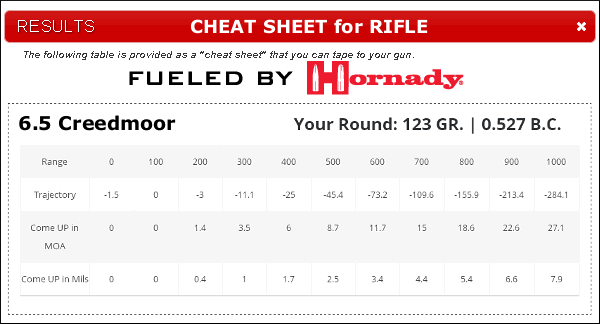
Need a simple, easy-to-use drop chart for your rifle? Something you can tape right to the buttstock? Then check out Hornady’s handy Online Ballistics Calculator. This user-friendly calculator will compute your drops accurately, and output a handy “Cheat Sheet” you can print and attach to your rifle.
Here’s how it works. From the Ballistics Calculator Page, first select 4DOF or Standard. Next input G1 or G7 BC values, muzzle velocity, bullet weight, zero range, and a few other variables.
Click “Calculate” to view the full chart (shown below). Then click “View Cheatsheet” and the simpler, 4-line Drop Chart (shown above) appears. Click “Print” and you’re done!
Choose Basic Table or Advanced Version with More Variables
The online ballistics caculator is easy to use. You can select the basic version, or an advanced version with more data fields for environmental variables (altitude, temperature, air pressure, and humidity). You can also get wind drift numbers by inputing wind speed and wind angle.
Conveniently, on the trajectory output, come-ups are listed in both MOA and Mils — so this will work with either MOA clicks or Mil-based clicks. There are more sophisticated ballistics solvers available on the web, such as the outstanding Applied Ballistics Online Calculator, but the Hornady Calculator is very simple and easy to use. If you just want a basic drop chart, you may want to check this out.
The latest GunBroker.com Top-Selling Handguns list reveals the most popular pistols among gun buyers this past year. Turns out that two SIGs top the list. For 2023, the SIG Sauer P365 came in as the Top-Selling Handgun. The SIG Sauer P320 was second and the GLOCK G19 took third in the handgun category.
The P365 also came in as the best-selling firearm overall — meaning it sold more than any rifle or shotgun, as well as any pistol. Notable, the SIG Sauer P320 was also the second-best selling firearm overall. Both handguns have grown steadily in popularity in recent years. The P320 is the civilian version of the military’s M17. CCW holders really like the P365 because of its moderate size and good ergonomics. It also boasts a higher capacity than most handguns in its size category.
The Glock G19 has been popular with shooters pretty much since its introduction back in the 1980s, especially after numerous law enforcement agencies adopted either it or the G17, from which the G19 was derived. Shooters like the G19 because it’s more concealable than the G17, but still has the same reliability. New G19 variants are available, such as the G19 Gen 5 MOS which comes fitted with a Holosun optic.
GunBroker’s Top-Selling Handguns of 2023 (Top 10):
1. SIG Sauer P365
2. SIG Sauer P320
3. GLOCK G19
4. GLOCK G43
5. CZ-USA CZ 75
6. Colt Python
7. Ruger Mark IV
8. Smith & Wesson M&P9
9. Ruger Blackhawk
10. Beretta 90 Series
There are, of course, numerous other handguns popular with shooters, as shown by the monthly data released by GunBroker.com on the top selling firearms by category on the site. Later this month GunBroker will publish a full report of all top-selling firearms, including handguns, rifles, and shotguns. Stay tuned.
Handguns Under $400 Featured on GunBroker.com
If you are in the market for a new handgun, but have a limited budget, GunBroker has a helpful review. In the article Top 10 Handguns for under $400, Gunbroker’s editors showcase ten interesting pistols. We think the three top featured choices were the Taurus G3 9mm, Smith & Wesson SD9 VE, and Canik TP9SA Mod 2 9mm (shown below):
This thought-provoking article is one of the 15 most popular Daily Bulletin features over the last 12 months. We are republishing this story today for readers who may have missed it the first time around…
Here’s a little known fact that may startle most readers, even experienced gunsmiths: your barrel wears out in a matter of seconds. The useful life of a typical match barrel, in terms of actual bullet-in-barrel time, is only a few seconds. How can that be, you ask? Well you need to look at the actual time that bullets spend traveling through the bore during the barrel’s useful life. (Hint: it’s not very long).
Bullet-Time-in-Barrel Calculations
If a bullet flies at 3000 fps, it will pass through a 24″ (two-foot) barrel in 1/1500th of a second. If you have a useful barrel life of 3000 rounds, that would translate to just two seconds of actual bullet-in-barrel operating time.
Ah, but it’s not that simple. Your bullet starts at zero velocity and then accelerates as it passes through the bore, so the projectile’s average velocity is not the same as the 3000 fps muzzle velocity. So how long does a centerfire bullet (with 3000 fps MV) typically stay in the bore? The answer is about .002 seconds. This number was calculated by Varmint Al, who is a really smart engineer dude who worked at the Lawrence Livermore Laboratory, a government think tank that develops neutron bombs, fusion reactors and other simple stuff.
On his Barrel Tuner page, Varmint Al figured out that the amount of time a bullet spends in a barrel during firing is under .002 seconds. Al writes: “The approximate time that it takes a 3300 fps muzzle velocity bullet to exit the barrel, assuming a constant acceleration, is 0.0011 seconds. Actual exit times would be longer since the bullet is not under constant acceleration.”
We’ll use the .002 number for our calculations here, knowing that the exact number depends on barrel length and muzzle velocity. But .002 is a good average that errs, if anything, on the side of more barrel operating life rather than less.
So, if a bullet spends .002 seconds in the barrel during each shot, and you get 3000 rounds of accurate barrel life, how much actual firing time does the barrel deliver before it loses accuracy? That’s simple math: 3000 x .002 seconds = 6 seconds.
Gone in Six Seconds. Want to Cry Now?
Six seconds. That’s how long your barrel actually functions (in terms of bullet-in-barrel shot time) before it “goes south”. Yes, we know some barrels last longer than 3000 rounds. On the other hand, plenty of .243 Win and 6.5-284 barrels lose accuracy in 1500 rounds or less. If your barrel loses accuracy at the 1500-round mark, then it only worked for three seconds! Of course, if you are shooting a “long-lived” .308 Win that goes 5000 rounds before losing accuracy, then you get a whopping TEN seconds of barrel life. Anyway you look at it, a rifle barrel has very little longevity, when you consider actual firing time.
People already lament the high cost of replacing barrels. Now that you know how short-lived barrels really are, you can complain even louder. Of course our analysis does give you even more of an excuse to buy a nice new Bartlein, Krieger, Shilen etc. barrel for that fine rifle of yours.


 If you load pistol or rifle ammo with a progressive press, we strongly recommend you get a Lock-Out Die from RCBS. This unique reloading die will prevent your progressive press from advancing if the dispensed powder charge is more or less than about 0.3 grains too high or too low. The Lock-Out Die really works. Your Editor uses it on his RCBS 2000 progressive press. I can affirm that a Lock-Out Die has “saved my bacon” a half-dozen times over the years when there was an over-charge (which could cause a Kaboom) or a low charge (which could cause a squib load).


 This video was made with the help of the

 NRA Golden Bullseye Pioneer Award
 To learn more about John Nosler and his bullet designs, get your hands on Going Ballistic, a “Professional Memoir” told by John Nosler to outdoor writer Gary Lewis.




 Gone in Six Seconds. Want to Cry Now?


