Think you need a relatively long case-neck for good accuracy? Think again. Stan Ware broke all the rules with his radical Wolfpup cartridge, proving that a near-no-neck design can deliver match-winning accuracy. Read on to learn how the Wolfpup works…
Retired gunsmith Stan Ware is a talented shooter who’s not afraid to think “outside the box”. Stan competes in both Hunter Benchrest (HBR) and Varmint for Score (VFS) disciplines. In his quest to build the ultimate Hunter Benchrest cartridge, Stan created the radical “Wolfpup” wildcat, based on a 6mmBR parent case. Noting the dominance of 30 BRs in VFS matches, Stan wondered if a stretched 30 BR could work in HBR competition. The challenge was case capacity. Under HBR rules the cartridge must hold at least 45.0 grains of water, equal to the capacity of the classic 30/30 case.
To get the requisite HBR case capacity, Stan figured he needed to boost the volume of a 30 BR case significantly, so he would have to move the shoulder forward — a lot. He did this by running a 30 BR reamer deeper and deeper, test-firing brass along the way. After three reamer passes, he ended up with the capacity he needed (the Wolfpup holds 45.3 grains of water). But then he looked at the finished product — a case with almost no neck, and he wondered “how could this possibly work?”.
From Trashbin to Winner’s Circle
Ware’s prototype Wolfpup ended up so short-necked, so unlike any “normal” cartridge, that Stan figured it was “dead on arrival”. Stan told us: “I said ‘this ain’t going to work’ and I threw the brass in the trash can. Honest. But later I thought I better shoot it and see what it does.” There was one problem — Stan didn’t have a seating die. He noticed the short neck provided a bit of tension after fire-forming, so he literally seated some bullets, BIB 118s and 125s, with his fingers. For powder he used H4198 and started with 35 grains, one grain more than a 30 BR load. Stan then did a pressure work-up: “I actually went up to 41.0 grains and didn’t have a sticky bolt. I ended up at 37.9 grains of Hodgdon 4198 — that gave 3150 fps, where the sweet spot is.” (Later testing revealed a second accuracy node at about 3020 fps, using 36.4 grains of H4198).
Stan’s radical short-necked Wolfpup shot great from the get-go. Once he found the right velocity node, the gun shot in the ones and zeros with both 7-ogive and 10-ogive bullets, both 118s and 125s. The Wolfpup proved easy to tune — it’s not finicky at all. And it’s a winner. Stan began shooting the Wolfpup in 2006 in both VFS and HBR matches and the ‘Pup’ started winning matches right away. In 2007, Stan won the Wisconsin State VFS Championship shooting the Wolfpup. In June 2010 at a Webster City, Iowa VFS match, Stan won the Grand Agg and posted high X-Count for the match, while placing first at 100 yards and second at 200 yards. How’s that for a cartridge that almost ended up in the trash bin?
Does Stan deserve an award for “most innovative benchrest cartridge design”? Stan chuckles at that notion: “I’m not a hero, not a genius. I really didn’t do anything. The fun part is thinking outside the box — for me anyway. Shooting is an age-old process of experimentation. You never learn it all.”
Why Does It Work?
How can such a radical case design perform so well? “That’s a good question,” Stan admitted. He then explained: “The 30 BR is inherently accurate, so I figured something based on the 30 BR should be accurate too. My personal belief is that the short neck doesn’t hurt you. Plus if the throat in the barrel is straight, the bullet can self-align. If the chamber is good, the bullet will self-center in the throat. In a regular case there’s not much room to do that, so a bullet can start off-center, and you don’t get the same results every time. A bullet in a conventional case is stopped from self-centering by the stiffer neck, particularly in a tight-clearance BR gun.”
Reloading the .30 Wolfpup
Stan’s Wolfpup chamber has a neck dimension of 0.330″. He turns his necks for a 0.327″ loaded round. Bullets are jammed .020″ forward of first contact with the lands. When he closes the bolt it pushes the bullet back in the case — almost a soft seat. Stan notes: “To start with I normally bump the shoulder .0005-.001″ so they go in easy. Just by doing that I get a little neck tension. I also use a bushing. Right now I’m running a .322, but it’s not particularly sensitive. I’ve tried one-thousandths increments up to a .325 bushing and couldn’t tell a lot of difference.” For bullet seating, Stan uses a Wilson 30 BR seater die into which he ran the chamber reamer. This gives perfect case fit during seating operations.
About the Illustrated Gunstock
You’ll notice Stan’s stock contains scenes from Vietnam and a quotation. Here’s the story. A Vietnam combat veteran, Stan served “in-country” with the Army’s 509th Non-Divisional Combat Unit (out of Fort Riley) from 1965-1966. Shortly before he left Vietnam, Stan went to a shop to have a souvenir lighter engraved. He asked the vendor for an appropriate inscription. The shop’s metal-worker engraved: “War is a tragedy. It takes mans’ best to do mans’ worst.” That message, along with the combat scenes, were hand-painted on Stan’s rifle by his wife Susan, a talented artist. She spent more than 20 hours painting the rifle stock.
Check out that bolt assembly. It features a fluted stainless bolt body, laser-engraved Titanium shroud, and Titanium dragon-scale bolt knob with polished stainless handle.
You haven’t seen a Ruger Precision Rifle (RPR) like this before. Forum member TerryH has customized his Second-Gen 6.5 Creedmoor RPR with a wicked purple finish, snazzy stainless/titanium bolt, and slick HDPE (polymer) bag-riders front and rear. The mods on this Hot Rod Ruger don’t stop there. Terry added a Seekins hand rail, Timney trigger, ergonomic grip, and more…
For his Hot Rod Ruger, Terry has the right skill set, learned on the job: “I work in a body shop and have pretty much custom-painted all my stuff for many years. For this 6.5 CM RPR, colors of choice are House of Kolor PBC-65 Passion Purple and black covered with Cerakote MC-161 matte clear.” Terry even painted his Bald Eagle rest purple to match his Hot Rod RPR.
Terry reports: “I’m shooting an RPR in 6.5 CM. It has a Patriot Valley Arms 26″ barrel. Josh at PVA is making a thread protector for me so I can remove the Mad Scientist brake. The butt stock has a V-Tab adjustable butt plate and Wiebad check rest pad. Glass is a currently a Vortex Gen I PST 6-24x50mm but I have a Golden Eagle on layaway”. To learn more about this rifle or ask TerryH questions about the build, visit this AccurateShooter FORUM THREAD.
Ruger Precision Rifle Modifications: Chassis and Handguards Painted Passion Purple
Patriot Valley Arms 26″ Barrel with Brake
Timney Trigger with Ambi Safety
Custom HDPE (Polymer) Bag-Riders front and Rear
V-Tab adjustable butt plate and Wiebad cheek-pad
Seekins Rail
Good Accuracy with Factory Ammunition
Terry reports: “The RPR is shooting .3 MOA @ 100 with factory Fed American Eagle 140s.” Terry plans to start handloading for the rifle with the goal of shooting F-Class matches next year: “I’ve successfully shot steel out to 1140 yards on the range but [I don’t know] if that will actually translate well in a match. I’m committed to practicing as much as I can and starting to shoot some matches in 2018.”
Front and Rear Bag-Riders with Protektor Rear Bag and Upgraded Bald Eagle Rest
Terry has engineered a slick set-up for F-Open competition and load testing. Up front is a Bald Eagle rest upgraded with windage knob mod, stainless F-Class feet, and longer adjusters. Terry also “changed the hardware to all stainless and added a couple of levels”. In the rear, Terry runs a Protektor Doctor rear bag with 1″ ear spacing.
Impressive additions are the custom HDPE bag-riders Terry crafted himself: “I realized that the butt stock wasn’t going to cut it on the rear bag and even though I got the 2 1/4″ front bag and the Seekins rail is 2″ wide and flat that it wasn’t as stable or smooth as I’d like.” So Terry made his own front and rear bag-riders from HDPE, a material similar to Delrin. Currently the front unit is 2.25″ wide, but Terry will be changing that to a 3″-wide front sled: “I decided that I’d get a 3″-wide front bag and mill a new front bag-rider. I’m going to recess the center to fit around the hand guard and I’ll mill a recess on the bottom of that one.”
Shown below is the Hot Rod Ruger before Terry added the HPDE Bag-Riders front and rear. Terry says the rifle now handles much better with the bag riders, and he plans to upsize the front sled to 3″ width.
Bling’s the Thing. Below is the Hot Rod Ruger’s bolt assembly. It features a custom flat-fluted bolt shaft, laser-engraved Titanium shroud and Titanium dragon-scale knob with polished stainless handle. Terry confesses: “I simply can’t resist anything shiny!”
New Product Showcase Part Two Shooting Industry’s January 2024 issue has the second installment of the 2024 New Product Showcase — featuring new (or recently introduced) products from dozens of companies including Beretta, Colt, Mossberg, Ruger, Savage, SIG Sauer, Sightron, Smith & Wesson, Volquartsen, Walther and more. You can see all these new products in a mobile-friendly format that works with cell phones.
Or, CLICK HERE to see the full January 2024 issue in printable PDF format. The New Product Showcase is found on pages 52-64. NOTE: This PDF may take time to load.
There are dozens of other new (or recently introduced) products in Shooting Industry’s Part 1 2024 Product feature, found in last month’s December 2023 issue. CLICK HERE to see Part 1 Products.
Here are our Top Six Picks among the many new products featured this month in Shooting Industry magazine.
Mossberg Optics-Ready Turkey Model 500 and 836 Shotguns
This year, Mossberg will offer optics-equipped 500 and 835 shotguns in multiple models and gauges. These pump-action shotguns have extended turkey chokes and bi-color front fiber optic sights. Some models come with Holosun HS407K red dot sights installed. And the receivers will accept low-profile direct mounting of other Shield RMSc-pattern optics. The 500 models are offered in .410 bore or 20 gauge with a 20″ barrel and 6-shot capacity. For better fit with a variety of shooters the 20-GA 500 Super Bantam’s stock includes 1″ spacers to extend the length of pull.
Smith & Wesson Metal-Frame Performance Center M&P9 M2.0
The new Smith & Wesson Performance Center M&P9 Metal M2.0 features a handsome OD Green Cerakote finish on the metal frame and slide. The ventilated slide boasts a C.O.R.E plate system for mounting optics and raised suppressor-height iron sights. This Spec Series pistol includes a built-in Faxon compensator for reduced recoil. This Spec Series Smith & Wesson M&P9 Metal M2.0 ships with two 23-round magazines, two 17-round magazines, a bonus knife and custom M&P Spec Series challenge coin.
Springfield Armory Hellion Bullpup Carbine
Springfield Armory has updated its 5.56×45 (.223 Rem) Hellion bullpup rifle. Three colors are now offered: Gray, Olive Drab Green, and Flat Dark Earth Tan. This rifle has a 16″ barrel in a compact 28.25″ overall length. The design features ambidextrous controls, rear-placed magazine, and a reversible ejection system. This could be a good choice for a home defense gun.
Pulsar’s new Thermion 2 LRF XL50 optic boasts impressive new technology for hunters. This scope has thermal imaging capability so you can see game animals easier at night and during low light. Pulsar states the “The high-definition [temp] sensor maintains exceptional image detail across the entire magnification range, with the option to magnify the optic in 2x increments or in a smooth, continuous motion, depending on the situation.” This scope also include a built-in Laser Rangefinder with a range of 875 yards (in good conditions). This scope will also connect to Pulsar’s Stream Vision Ballistics App. With the App you can load ballistic profiles directly into the Thermion scope’s built-in memory.
Volquartsen Summit Rifle, Straight-Pull .17 HMR and .22 WMR
Ever shot a straight-pull (aka toggle-link) action rifle? We like these action types, which were developed for Biathlon competitors who needed to shoot fast, but were not allowed to use semi-auto actions. The biathlon-style toggle action features a lever on the side of the action. Pull the lever back with your index figure to open the bolt, then push forward with your finger to close the bolt. With some practice, you can cycle the action in a couple of seconds — nearly as fast as a semi-auto. The Summit has been a popular .22 LR rifle for quite some time. Now, in response to requests from varminters, Volquartsen will be selling the Summit in .17 HMR and .22 WMR, two potent rimfire cartridges.
SIG Sauer P-322 Comp .22 LR Pistol
SIG Sauer has a new .22 LR rimfire handgun — the P322-COMP pistol. Designed for speed, accuracy, and flat shooting (low muzzle flip), this new rimfire pistol from SIG Sauer is ready for competition right out of the box. It comes with a red dot optic, barrel-mounted compensator, slide-mounted racker, good trigger, and high-capacity (20- and 25-rd) magazines. READ P322 Manual.
Discover more in 2024 at ShootingIndustry.com. Dealers and retailers can sign up for Dealer Advantage weekly emails to get the latest industry news and new product info. And you can see regular news items on the Shooting Industry Facebook page.
Do you find that the crosshairs in your scope get blurry after a while, or that you experience eye strain during a match? This is normal, particularly as you get older. Focusing intensely on your target (through the scope or over iron sights) for an extended period of time can cause eye strain. Thankfully, there are things you can do to reduce eye fatigue. For one — breathe deeper to take in more oxygen. Secondly, give your eyes a break between shots, looking away from the scope or sights.
In our Forum there is an interesting thread about vision and eye fatigue. One Forum member observed: “I have noticed recently that if I linger on the target for too long the crosshairs begin to blur and the whole image gradually darkens as if a cloud passed over the sun. I do wear contacts and wonder if that’s the problem. Anyone else experienced this? — Tommy”
Forum members advised Tommy to relax and breath deep. Increase oxygen intake and also move the eyes off the target for a bit. Closing the eyes briefly between shots can also relieve eye strain. Tommy found this improved the situation.
Phil H. explained: “Tom — Our eyes are tremendous oxygen hogs. What you are witnessing is caused by lack of oxygen. When this happens, get off the sights, stare at the grass (most people’s eyes find the color green relaxing), breath, then get back on the rifle. Working on your cardio can help immensely. Worked for me when I shot Palma. Those aperture sights were a bear! The better my cardio got the better and longer I could see. Same thing with scopes. Try it!”
Keith G. noted: “Make sure you are still breathing… [your condition] sounds similar to the symptoms of holding one’s breath.”
Watercam concurred: “+1 on breathing. Take a long slow deep breath, exhale and break shot. Also make sure you take a moment to look at the horizon without looking through rifle or spotting scope once in a while to fight fatigue. Same thing happens when using iron sights.”
Arizona shooter Scott Harris offered this advice: “To some extent, [blurring vision] happens to anyone staring at something for a long time. I try to keep vision crisp by getting the shot off in a timely fashion or close the eyes briefly to refresh them. Also keep moisturized and protect against wind with wrap-around glasses”.
Breathing Better and Relaxing the Eyes Really Worked…
Tommy, the shooter with the eye problem, said his vision improved after he worked on his breathing and gave his eyes a rest between shots: “Thanks guys. These techniques shrunk my group just a bit and every little bit helps.”
Read more tips on reducing eye fatigue in our Forum Thread: That Vision Thing.
To avoid eye fatigue, take your eyes away from the scope between shots, and look at something nearby (or even close your eyes briefly). Also work on your breathing and don’t hold your breath too long — that robs your system of oxygen.
Keith Glasscock is one of America’s greatest F-Class shooters, as well as a highly respected wind coach. A High Master, Keith finished second overall at the 2021 NRA F-Class Long Range Championship in F-Open division. He also finished second at the 2020 F-Open Nationals, and second at the 2019 F-Open Nationals. His consistency is unrivaled, which means he definitely knows the secrets of competition shooting and loading ultra-accurate ammo. Recently Keith has started PRS/NRL competition, bringing his shooting skills to those popular tactical disciplines.
Keith has a great YouTube Channel with new content every week. On Keith’s Winning in the Wind channel, Keith offers 190+ informative videos on a wide range of topics including wind reading, reloading, component selection, load development, and training. For today’s Video Showcase, we offer four of our favorite Keith Glasscock videos. Each video has important points that can benefit any competitive rifle shooter, whether you shoot in local 100-yard fun matches or compete at the National Level in F-Class, LR Benchrest, Palma, or High Power.
How to Reduce Extreme Spread (ES) and Standard Deviation (SD)
Having minimal Extreme Spread (ES) does not necessarily guaranteed optimal accuracy. Some PPC shooters accept a relatively high ES for a load that shoots best at 100/200 yards. But very low ES — i.e. having bullets all exit the muzzle at virtually the same FPS speed — can definitely reduce vertical dispersion at long range (assuming consistent bullet BCs). In this video, Keith talks about various methods to reduce ES and SD. This can include seating depth, primer choice, powder charge weight, brass prep, bullet seating methods and more. Our tip is to have good smoothly-chamfered case mouths, use a quality arbor press with seating force measurement, measure powder loads very precisely, and use the highest-quality brass you can find.
Keith notes that, to achieve the lowest ES, you need to look at multiple processes, including precision powder weighing, careful seating, brass annealing, and primer selection. Another factor is bullet selection. Not all bullets of the same nominal caliber and weight class have exactly the same bullet diameter or shape. Sometimes you can get better accuracy AND lower ES by trying a different brand of bullet. We have found bullet diameters, of the same stated caliber, can vary by up to .0008″ (eight ten-thousandths). Some barrels like the fatter bullets, while other barrels may favor the skinny bullets.
Top 10 Methods to Improve Your Shooting Accuracy
To shoot top scores, you need great skills and great hardware. This video covers 10 things that can improve accuracy, starting with the most important. The #1 item, notes Keith, is rifle shooting skill — you need to be able to hold on target properly and run the rifle consistently shot after shot. The second most important thing is an accurate rifle — you need a rifle with an excellent barrel, quality components, and top-tier inherent accuracy. Third, you need very accurate ammo, and this means you need to perfect your reloading skills. You need precise powder measurement and good, consistent bullet seating. Fourth in the list is related to ammo — you need the ability to do effective load development to pick the best load for your particular barrel. Number 5 is the “right bullet”. You need a high-quality, ultra-consistent bullet that is a good match for your particular barrel and discipline. Watch the video for the other five items.
Balance Beam vs. Advanced Electronic Scale with AutoTricker
Here Keith evaluates the performance of ammo loaded with a conventional balance beam scale vs. ammo loaded with a precision, electronic force-restoration scale fitted with an AutoTrickler V4. It turns out that the balance-beam loaded ammo was actually quite accurate and consistent. Keith concluded that balance-beam ammo may well be good enough for PRS/NRL competition. However for other disciplines, such as benchrest and F-Class, Keith suggest it may be worth the investment. But the key factor is also time — with the precision scale and AutoTrickler Keith can load large quantities of competition-grade ammo much, much faster. Keith points out he puts value on his time, reminding us that, indeed, “time is money”.
Barrel Break-In Procedure for Match Barrels
In this video, Keith explains his procedure for breaking-in his match barrels. He starts by bore-scoping the barrel and cleaning it. If he finds some burrs he may use some JB Bore Paste, a patch, and a worn brush and “give that throat a little scrub” (See 1:30 time-mark). He used different stroke lengths to avoid putting a “step” in the throat. When he’s satisfied he goes to the range. He fires the first five rounds, then cleans. He then fires quite a few rounds before cleaning the barrel again and beginning load development (See 8:25 time-mark).
Bullet Sorting Methodology — Effective Methods
Bullet sorting can improve scores and accuracy, particularly for long-range competitions. There are various methods for sorting — weight, base-to-ogive measurement, bearing surface length, tip condition, and max diameter. In this video Keith explains the pros and cons of various methods. The best choice can also depend on the brand, design, and caliber of each bullet. Some bullets show significant base to ogive variance, other bullets (such as Lapua Scenars), have been extremely consistent. Overall, if you are a long-range competitor, is it probably useful to bullet sort, and you can use outliers for fouling shots.
Tripod Options for PRS/NRL Competition
Over the past two seasons, Keith has added PRS/NRL shooting to his competition resume. Along with his stellar F-Class skills, Keith now has considerable experience with tactical competitions. And he’s learned that having a good tripod will make a difference over the course of a match. In this video, Keith looks at various tripod options and explains the ways you can use a tripod for PRS/NRL centerfire and rimfire competition. While the tripod can obviously be used to support the rifle, it can also be used for various other functions, as shown in the video.
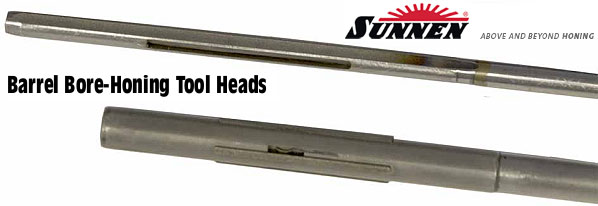
Some custom barrel makers are now honing barrels (after drilling) to improve bore diameter uniformity, smooth the interior finish, and reduce barrel lapping times. For years, large-scale manufacturers of hammer-forged barrels have employed honing. Now the process is being used by smaller, “boutique” barrel-makers. This article explains how and why barrel honing is done. Take the time to watch the video. For anyone with an interest in barrel-making, this video from Sunnen Products Co. is an eye-opener.
Barrel Honing Process Demonstrated (Worth Watching!):
For custom barrel makers, honing is a time-saver and cost cutter. A few minutes on a honing machine can cut lapping times in half, leaving a cross-hatched surface finish in single or low double-digit Ra. Honing is the same process used to make diesel fuel injectors with bore roundness and straightness controlled to fractions of a micron (<0.000040"), with surface finish Ra ≤0.15 µm (6 µin).
A key manufacturing process used for hammer-forged barrels is now getting attention from the makers of custom button-rifled barrels. This process is precision bore-honing. Honing produces a high-quality bore surface fast, which is critical to hammer forging. (Why is honing so important with hammer forging? Surface finish is the one feature of the barrel that cannot be controlled in hammer forging. Surface imperfections in a barrel blank tend to be amplified as the blank is formed on the rifling mandrel. And if the bore is chromed afterwards, imperfections in the surface finish become even more obvious.)
Honing dramatically improves bore diameter size uniformity and accuracy, surface finish and roundness throughout the length of the barrel. It can certainly be used in place of a pre-rifling lap. The chief difference between a lapped and honed bore is the direction of the finish lines in the bore. Honing leaves fine spiraling crosshatch lines, while a lap leaves lines going longitudinally in the bore. After rifling the manufacturer can remove the crosshatch finish with a quick lap if desired. Honing is fast, accurate, and can be automated. Its surface quality and geometry can duplicate lapping, except for the longitudinal lines of the lapped finish.
In 2015 Frank Green of Bartlein Barrels told us: “We worked with Sunnen and we did all the initial testing on the prototype machine for them. The machine works great! We ordered and received … a new manufactured machine with the changes we wanted on it and [subsequently] ordered a second one.”
The Sunnen hone secures the barrel blank in a 3-jaw chuck, with honing oil pumped into one end while the tool works from the opposite end. Sunnen’s specialized Long Bore Tool uses metal-bond diamond or CBN superabrasives to quickly remove reamer marks, waviness, tight spots and other imperfections left by upstream processes.
Sunnen states that: “Honing is an ideal replacement for hand-lapping barrel blanks before rifling. It quickly removes reamer scratches and surface waviness without labor-intensive hand lapping. By producing a consistent bore diameter (±0.0001″ or less), parallelism, roundness and surface finish end to end, honing yields more consistent performance from rifling buttons and cutters, resulting in a constant groove depth. The ideal bore geometry reduces distortion of the bullet shape.”
Computer-Controlled Bore-Honing
Honing can be done with great precision through the use of advanced, computer-controlled honing machines. Sunnen Products Company offers an advanced machine for .17 to .50-caliber barrels (see control panel below). The spindles on this machine can correct bore size imperfections so small only an air gauge can measure them. The consistency this allows improves bore uniformity, which, in turn, produces more accurate barrels for the precision market.
Sunnen Products Company is the world’s largest vertically-integrated manufacturer of honing systems, tooling, abrasives, coolants, and gauging for precision bore-sizing and finishing. Sunnen’s customers include manufacturers of diesel and gas engines, aerospace components, hydraulic components, oil field equipment, and gun/cannon barrels. Sunnen employs more than 600 people worldwide.
Here’s a very cool 3D Animation showing pistol rounds being fired. Computer-generated graphics provide a look inside the cartridge at the moment of ignition as the primer fires and the flame front moves through the ignited powder. It’s really kind of mesmerizing. If you’ve every wondered just what happens inside your cartridges the moment that firing pin strikes, then watch this video…
Watch Video to See Handgun Ammo Being Chambered and Fired:
Mute Enabled — Click Speaker Icon to Hear Audio. Firing Sequence Starts at 1:28.
This animated video from German ammo-maker GECO (part of the Swiss RUAG group of companies) reveals the inside of a pistol cartridge, showing jacket, lead core, case, powder and primer. Employing advanced 3D rendering and computer graphics, the video shows an X-ray view of ammo being loaded in a handgun, feeding from a magazine.
Then it really gets interesting. At 1:28 – 1:50 you’ll see the firing pin strike the primer cup, the primer’s hot jet streaming through the flash-hole, and the powder igniting. Finally you can see the bullet as it moves down the barrel and spins its way to a target. This is a very nicely-produced video. If you’ve ever wondered what happens inside a cartridge when you pull the trigger, this video shows all. They say “a picture’s worth a thousand words”… well a 3D video is even better.
The Rimfire Challenge Shooting Association (RCSA) is now an official partner of the +ONE Movement, a mentorship program organized by the National Shooting Sports Foundation (NSSF). “RCSA is looking forward to a long relationship with NSSF,” stated RCSA Board President Peter Swenson.
NSSF +ONE programs encourage mentorship related to firearm safety, firearm basics, shooting sports, and hunting. The +ONE program focuses on peer-to-peer development in shooting sports and hunting.
About the Rimfire Challenge Shooting Association
Designed to introduce new shooters to shooting sports in an exciting, family-friendly format, Rimfire Challenge matches focus on competition with .22 LR rifles and pistols. Matches are open to shooters of all shooting experience levels, with events conducted at ranges nationwide. The annual RCSA World Championship takes place each October. See match action in the video below. The RCSA promotes rimfire competition nationwide, supports beginning competitors and clubs, and solicits support for rimfire events from industry businesses.
Watch Action from the 2023 Rimfire Challenge Championship at Cavern Cove Range in Alabama
Programs that inspire mentoring can make a huge difference. According to recent research, if just one out of three target shooters and hunters can introduce someone new to the shooting sports, we can help to secure a strong future for generations to come.
The NSSF encourages shooting sports enthusiasts and hunters to join the +ONE movement and invite someone to the range or afield. Learn more about the +ONE Movement by visiting LetsGoShooting.org and LetsGoHunting.org.
This article is Copyright 2023 AccurateShooter.com. No reproduction on any other site is permitted.
Do you have a friend or family member who is a first-time gun owner? Then show them this article. It provides important guidelines for new gun owners. There’s an Infographic printed below. And, there’s a helpful Firearm Storage and Safety Assessment Quiz. This walks gun owners through questions related to safe handling and storage of firearms. Here is Part One of the Quiz. If you click on this part, you can complete the entire Quiz and see how you score.
Big news — Lapua will be releasing 6mm GT and .300 WSM cartridge brass in 2024! Lapua has announced the addition of two major additions to its brass lineup. In spring, Lapua will start shipping .300 Winchester Short Magnum (WSM) cartridge cases. And, in the fall of 2024, Lapua promises to offer 6mm GT brass through authorized Lapua retailers.
Lapua 6mm GT (6GT) Brass
Lapua’s new 6mm GT brass promises to be a big hit with PRS/NRL shooters and varminters who want a bit more capacity than the 6mmBR case. The 6mm GT (aka 6GT) cartridge was conceived as a “bigger Dasher” for PRS/NRL competition. The 6mm GT’s creators wanted 6mm Dasher accuracy and moderate recoil delivered via a cartridge with a slightly longer case body for better mag-feeding, longer neck for seating flexibility, and more moderate pressures. So far the 6GT has performed very well in PRS/NRL competition. With the upcoming availability of premium Lapua-brand 6mm GT brass, we may also see a greater adoption of the 6GT in mid-range benchrest competition. We expect varminters may adopt the cartridge also, both in 6mm and necked down to .22 caliber.
Lapua’s Vice President of Sales & Marketing, Jarkko Aro stated, “Competitors shooting PRS, and similar long-range disciplines, have urged us to develop a 6mm GT case with unmatched quality and superior cartridge geometry to those currently offered in the marketplace. We’re confident we’ve exceeded their demands by collaborating with original cartridge developers, George Gardner and Tom Jacobs.”
Lapua .300 Winchester Short Magnum (WSM) Brass
Available in spring of 2024, Lapua will offer a superior-quality .300 WSM case through authorized retailers. Lapua cartridge cases are known for their superb quality, consistency, and longevity. Lapua brass cases are the #1 component choice of competitive shooters in most accuracy disciplines. Lapua uses only the highest-quality materials and manufacturing processes to satisfy the demands of reloaders who seek the highest levels of precision from their .300 WSM firearm platforms.
This product release is significant news for hunters and F-Open shooters. The .300 WSM has been an effective F-Open cartridge, both in .30-caliber and necked down to 7mm. With the availability of Lapua-brand .300 WSM brass later this spring, we expect that more F-Open shooters will employ a match cartridge based on this brass.
Lapua Sales & Marketing Manager, Erkki Seikkula stated, “.300 WSM reloading enthusiasts who insist on using the best components now have Lapua cartridge cases available for their long-range target rifles and custom hunting guns. From all of us at Lapua, thank you for seeking out our components to fulfill your precision reloading needs.” Order now for delivery in spring 2024 from authorized Lapua retailers.


 Retired gunsmith Stan Ware is a talented shooter who’s not afraid to think “outside the box”. Stan competes in both Hunter Benchrest (HBR) and Varmint for Score (VFS) disciplines. In his quest to build the ultimate Hunter Benchrest cartridge, Stan created the radical “Wolfpup” wildcat, based on a 6mmBR parent case. Noting the dominance of 30 BRs in VFS matches, Stan wondered if a stretched 30 BR could work in HBR competition. The challenge was case capacity. Under HBR rules the cartridge must hold at least 45.0 grains of water, equal to the capacity of the classic 30/30 case.
 From Trashbin to Winner’s Circle
 Why Does It Work?






 This animated video from German ammo-maker


