Splatterburst 1″ circles, 62 per sheet, 10-pk $9.99. These can be pasted on other paper backers.
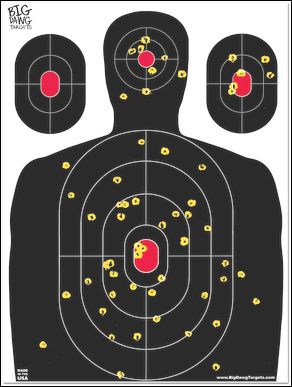
We’ve all seen conventional splatter targets with a single large black bullseye. When a shot hits the target, a halo (usually neon yellow) appears around the bullet hole. This makes it easier to see your shot placements indoors, or at long range outdoors. Today we feature a variety of other targets that also offer the cool halo/splatter effect. We’ve found grids, multiple bull targets, sheets with 62 one-inch circle pasters, handgun training targets, and even white background splatter targets (that produce black halos). Try out some of these targets for fun (kids love plinking with splatter targets).
Precision rifle shooters don’t have to hit a big-league fastball, or launch a top-fuel dragster in the blink of an eye. Nonetheless, reaction times are important in our sport — both for competitive shooters and hunters. Want to catch that prairie dog before he slips down his hole? You’ll need to be quick. Want to win at short-range benchrest? Then you’ll need to watch your windflags and respond quickly to a change. Miss a major wind-shift and you could ruin your whole weekend.
Here’s a fun test of reaction times from HumanBenchmark.com. The way it works is that, after clicking “Start”, you wait until the background color changes from red to green. The instant you see green, immediately click your mouse. The average (median) reaction time is 273 milliseconds, according to data collected so far. Hint: If you keep your finger “preloaded” in contact with your mouse button you can shave some milliseconds — but don’t “jump the gun”.
Tips for Faster Times
Here are three tips to speed up your reaction times:
1) Respond to the color change (by itself), rather than wait to read the word “CLICK!” after the box shifts to green.
2) Try focusing at the corner of the box, rather than the center. This may help you react “without thinking”.
3) Have your index finger “poised and ready” over the left button–you can shave milliseconds by very slightly depressing the button before you actually click.
Editor’s Note: This story was first published many seasons ago. In the interceding years, equipment has evolved — actions, optics, front rests and so on. But this rifle remains very competitive in the 600-yard silhouette game, and it remains a wicked weapon for long-range varminting.
The 6-284 may well be the “ultimate” 6mm cartridge, if speed AND accuracy are considered. While it burns a lot more powder than a 6mmBR or 6 Dasher, it also delivers a lot more velocity. Our friend John Southwick, owner of this week’s featured 6-284, can push 107gr SMKs past 3400 fps — velocities no 6BR, 6BRA, or 6 Dasher can touch. He normally dials that back to 3200 fps or so, but that’s still well beyond the limit of a 6 Dasher even a 6mm Creedmoor. John’s gun is more than a speed demon of course — it’s a hyper-accurate match rifle that has claimed many Varmint Silhouette wins. At his club, when John and the Black Borden come out to play, everyone else is usually competing for second place.
Building the Borden Black Beauty
John tells us: “I chose the 6-284 mainly because it appeared in the winning equipment lists of 1K BR matches, and it was becoming very popular with long-range varminters. Skip Talbot had also used a 6-284 to set an IBS 1000-yard record (subsequently lowered in the last decade). Norma and Lapua offered quality 6.5-284 brass, so case-forming would be easy. I wanted a fairly light-recoiling rifle, and after much research I came to the conclusion that a high-BC 6mm bullet driven at 3200+ fps would meet my needs.
I was looking for a very high performance long-range target/bench rifle, primarily to use in 600-yard matches at my local club (Ojai Valley Gun Club), and possibly 1000-yard bench matches, plus occasional varmint hunting. I wanted to have a rifle that was built by a prominent gunsmith. I chose to work with Jim Borden of Borden Rifles for several reasons: his rifles had set world records, his reputation was excellent, and his rifles often showed up in the winning equipment lists of IBS and NBRSA sanctioned shoots. Also I had decided that I wanted a Nesika-actioned gun. I was impressed that Jim had designed one of the Nesika’s key features – Borden Bumps. Likewise, I liked the Bald Eagle front rest, and found out that Jim contributed to its design as well. This gave me confidence that Jim understood every element that goes into precision rifle performance.
Loading for Accuracy
My match load consists of Norma 6.5-284 brass, 51.0 grains of Alliant Reloder 22, Fed 210m primers, and Sierra moly-coated 107gr MKs, seated about .010″ into the lands. This runs about 3250 fps from the 28″ barrel. Case necks are turned to .0133″ wall thickness for a .270″ loaded neck diameter. I use a .268 or .269 bushing, and bump the shoulders back each time. I set the “bump” so that, with firing pin removed, I can just feel the case in the chamber when closing the bolt. My loaded rounds typically show no more than .0015″ runout on a NECO concentricity gauge. I credit the low run-out in large part to the custom inline seating die and shoulder-bump neck-bushing die Jim made for me.
How the 6-284 Shoots
The rifle has fulfilled all my expectations. It is a superbly precise and accurate rifle, as long as I do my part in steering the gun and feeding it consistent, quality ammo. I haven’t done a lot of 100-yard group shooting, just enough to test loads. Typically the rifle easily puts five shots into half-MOA or less at 600 yards. I’ve logged several 3-shot groups between 1.06″ and 2.2″ at 600 yards. I’ve been told that kind of accuracy would be competitive in a 600-yard BR match. But most importantly, I have confidence the gun will hit where I aim. Our Ojai club uses half-size silhouette targets. This gun’s ability to pick off the relatively small steel targets, even in some of the worst conditions imaginable, is nothing short of amazing. At times it seems I’m launching 107gr silhouette-seeking guided missiles.”
Borden 6mm-284 SPEC SHEET
Borden Long-Range Rifle, 16.5 lbs
Nesika ‘K’ Action, 1.70″ diam., Right Bolt, Left Port.
Hart 28″, 1:9″ twist, .920″ at muzzle, cryo’d with .272″ neck diam. and 1.5° throat.
McMillan MBR stock, Borden texture finished, pillar-bedded, with action also glued in.
Nightforce 12-42x NXS,
NP-R2 reticle, 20 MOA ramped scope base, Leupold Mark IV rings.
A Special Brand of Silhouette Shooting
John’s rifle is a purpose-built gun, optimized for one task — hitting little half-size silhouettes at very long distances, at a shooting venue that demands serious wind wizardry. At Ojai, even though matches commence early in the morning, it’s not unusual to have a 10 mph wind blowing left to right at the firing line, no wind at the mid-course flag, and a swirling variable wind at the targets. To make matters worse, the little critters sit on top a ramped berm. When the wind switches to 6 o’clock, it can rise right in front of the target, sending shots high. Despite the often-wicked conditions, John and his Black Borden have excelled at the varmint matches — he’s the “smart-money” bet to win on any given weekend.
John reports: “The rifle has really proven itself at the 600-yard silhouette match at my local club. We shoot ten targets per match, usually three “matches” or relays per day. Targets are half-size NRA Hunter Pistol metallic silhouettes: 1 Ram, 2 Turkeys, 3 Pigs, and 4 Chickens (note, these are larger than the mini-silhouettes in the above photo). The Ram counts one point, Turkey two points, Pig three points and the Chicken counts four points. The Chickens have a “hit zone” roughly .6 MOA at 600 yards–about 3.6″. Trust me, that can be challenging, particularly in shifting winds. Unlike conventional silhouette matches, we shoot F-class fashion from the ground, using bipods or pedestal rests. That’s easier than shooting off your hind legs of course, but our targets are much smaller than standard high-power silhouettes.”
The Black Borden was the rifle to beat at Ojai for many years. John held the record for the most “cleans” (no misses) for the event, and he was the annual Champion for many years, including five years in a row. One year he won the championship in the very last match. John noted: “Thankfully, the gun was humming and I made the right wind calls. I picked up enough points in the final shoot to win the series for the year.” Yes, John’s flat-shooting Borden 6-284 had done its job once again.
Long-Range Silhouette Match Strategy and Techniques
In competition, John says watching the conditions, and minimizing mental mistakes is key: “I keep things pretty basic. Our varmint silhouette matches allow 20 minutes for sighters and 10 shots on target (one per animal). We usually get in three “matches” or relays per event. I try to wait for a favorable condition, then take a few sighters and adjust the scope as needed. If the condition holds steady, I’ll try to run my targets before the wind changes.
At the Ojai range, it is vital to watch the wind flags and heed your spotters’ calls. I’ve seen the wind go from 7mph right to 10mph left from one target to the next. That’s nearly a foot and a half of horizontal change for my gun. If there is a major change, I will try to wait it out. If the shift is small, I may hold off a bit. Scope corrections are a last resort; while you’re dialing, the wind may switch again.”
Technical Report from Jim Borden, Gunsmith
We set up John’s 6-284 as we would for 1000-yard Light Gun competition. We’ve also built some of these rifles in 6MM BR for use in 600-yard competition. For John, we used a Borden/Nesika Model K 1.70″ diameter action as the beginning basis of the rifle. The timing and cocking-piece system for this rifle has the Borden improvements to improve firing pin energy and lock time. The action was pillar-bedded and glued into a McMillan Tooley MBR pattern stock. The stock blank was gel-coated and then epoxy-finished with a texture.
About the Muzzle Brake — We normally blend the brakes into the barrel to make the transition smooth and unseen. John preferred to have the brake larger than the barrel so that it could also be used on future barrels.
9-Twist Barrel — The barrel is a 1:9″-twist Hart HV pattern 28 7/8 inches long. Our 6×284 reamer has a .272″ neck diameter. It is throated with a tight cylindrical section followed by the 1 ½ degree throat. Chambering of the barrel was done utilizing our proven Benchrest chambering techniques. The method of chambering ensures that the body, neck and throat of the chamber align concentrically with the bore and grooves of the barrel. [Editor: With a 6BR or 6 Dasher, we’d definitely recommend an 8-twist barrel to shoot 105-107 grain match bullets. However, with the extra velocity of the 6-284, the 9-twist Hart worked great for John.]
NOTE: Borden Accuracy (BordenRifles.com) now produces its own excellent Borden Custom Actions, which have won National Championships and set World Records. Borden offers precision bolt action receivers for competition, ELR, hunting, varmint, PRS, and other shooting applications.
Situated in the Coastal Mountains behind Ventura, California, the Ojai Valley Gun Club is a beautiful place to shoot. And the Hwy 33 route up to the range offers stunning views.
If you don’t match your ammo to your chamber, bad things can happen, that’s for sure. A while back, Forum member BigBlack had an experience at the gun range that reminds us of the importance of safety when shooting. He encountered evidence that someone had fired the wrong cartridge in a 7mm WSM rifle. The problem is more common than you may think. This Editor has personally seen novices try to shoot 9mm ammo in 40sw pistols. BigBlack’s story is along those lines, though the results were much more dramatic. It’s too bad a knowledgeable shooter was not nearby to “intervene” before this fellow chambered the wrong ammo.
7mm-08 is Not the Same as a 7mm WSM
BigBlack writes: “I know this has probably been replayed a thousand times but I feel we can never be reminded enough about safety. This weekend at the range I found a ruptured case on the ground. My immediate thoughts were that it was a hot load, but the neck area was begging for me to take a closer look, so I did. I took home the exploded case and rummaged through my old cases until I found a close match. From my investigative work it appears someone shot a 7mm-08 in a 7mm WSM. Take a look. In the above photo I’ve put together a 7mm WSM case (top), the ruptured case (middle), and a 7mm-08 case (bottom).”
The photo reveals what probably happened to the 7mm-08 case. The shoulder moved forward to match the 7mm WSM profile. The sidewalls of the case expanded outward in the much larger 7mm WSM chamber until they lacked the strength to contain the charge, and then the case sides ruptured catastrophically. A blow-out of this kind can be very dangerous, as the expanding gasses may not be completely contained within the action.
Can’t Happen to You? Think Again.
This kind of mistake — chambering the wrong cartridge — can happen to any shooter who is distracted, who places even a single wrong round in an ammo box, or who has two types of ammo on the bench. One of our Forum members was testing two different rifles recently and he picked up the wrong cartridge from the bench. As a result, he fired a .30-06 round in a .300 Win Mag chamber, and the case blew out. Here is his story:
“I took two of my hunting rifles I have not used for over 25 years to the range yesterday to get new scopes on paper, a .30-06 and .300 Win Mag. I had four boxes of old Winchester factory ammo (two of each cartridge), which had near identical appearances. I accidentally chambered a .30-06 round in the Sako .300 Win Mag rifle. It sprayed powder on my face and cracked the stock at the pistol grip. If I had not been wearing safety glasses I might be blind right now.
You should always wear protective eyewear, EVERY time you shoot.
“I feel lucky and am very thankful for being OK — other than my face looks funny right now. I am also grateful for learning a valuable lesson. I will never put two different cartridges on the bench at the same time again.”
In some areas of the country (California in particular), hunters are now forbidden to use bullets that contain lead. If you need a lead-free projectile for your deer rifle, consider Nosler’s E-Tip projectile. This has plenty of penetrating power and retained energy while complying with laws requiring “unleaded” ammunition. An “expansion chamber” behind the green polymer tip helps ensure reliable expansion with 95% weight retention. The video below shows a .30 caliber, 180gr lead-free E-Tip impressively power through TWO 12-inch blocks of Ballistics Gel at 100 yards. This was fired from a .308 Winchester.
Watch 180gr eTip Penetration and Expansion in Ballistic Gelatin:
Nosler claims the E-Tip (“Expansion Tip”) bullet has advantages over other solid copper hunting bullets: “Unlike the competitor’s one-piece designs, Nosler E-Tip bullets will not blow the petals off at extreme velocities nor will the low end expansion ever be questioned, as the minimum impact velocity is set at 1800 fps for standard calibers.” One hunter, posting on Facebook, gave the E-Tip high marks: “I have had the opportunity to take a pig with a 130 gr E-Tip from my .270 and they work flawlessly. My son took two pigs with his .300 Win Mag and 165gr E-Tips and they worked flawlessly as well.”
This video illustrates the design and construction of the Nosler eTip Bullet:
This week we focus on five classic metal-framed 9mm pistols. These five world-class handguns all shoot the 9mm Luger (9x19mm) cartridge. Most have been used by military and police forces as well as used by civilians for sport-shooting and defense. This Editor has shot all five pistol types and owned three. I can recommend all of them. Metal-framed pistols typically have a lower center of gravity and weigh more than Glocks and other polymer-framed handguns. Consequently, they tend to have less muzzle flip, and less perceived recoil than polymer-framed handguns.
SIG Sauer P226
The SIG Sauer P226 is a high-quality, ultra reliable single-action/double action handgun with a proud Swiss/German heritage. It has a very ergonomic grip that fits most hands very well. Standard P226s do NOT have a manual safety, but the P226 has a decocking lever drops the hammer safely. This Editor has trained new shooters with a Sig P226 and Glock 17. For 80% of my trainees the Sig P226 pointed better due to the superior grip design. This meant that the sight picture was better, and the trainees achieved better results with the P226 vs. the Glock 17. The P226 is also a very reliable firearm. I have over 6000 rounds through my P226 with not one single jam. That’s impressive. The first video, reviewing the SIG P226, has over 1.4 million YouTube views, indicating it is very popular with pistoleros.
HK P7 Series (PSP, P7m8, P7m13)
This Editor has shot a P7m8 extensively. It is superbly accurate. With a very low bore axis, it has much less muzzle flip than most 9mm pistols. And with a fixed barrel, the slide moves straight back during cycling. The HK P7 blowback-operated semi-automatic pistol was designed and manufactured by German gun-maker Heckler & Koch (H&K) from 1978 to 2008. It is thin, superbly accurate, with a precise trigger that shames the Glock. The P7m8 features a unique gas-delayed blowback system, which uses gas from the cartridge to retard the rearward motion of the slide. This works via a barrel port and a piston inside a cylinder under the barrel. The signature feature of the P7 series is the “squeeze cocker” on the front of the grip. Squeezing the cocking lever cocks the firing pin. When the front of the grip is released, the weapon is fully de-cocked, making it safe with a round in the chamber.
Browning Hi-Power
The Browning Hi-Power is a single-action, semi-automatic handgun with a legendary heritage. This handsome all-metal pistol was based on a design by American John Moses Browning, and completed by Dieudonné Saive at Fabrique Nationale (FN) of Herstal, Belgium. J.M. Browning died in 1926, several years before the design was finalized. FN Herstal initially named the design the “High Power”, which alludes to the 13-round magazine capacity, almost twice that of other designs such as the Luger or Colt M1911. The name was later shorted to “Hi-Power”. The Browning Hi-Power has served military forces and police in many countries throughout the world. It is a very well-balanced pistol, with a nice, crisp trigger. After 82 years of continuous production, FN Herstal announced that the Hi-Power would be discontinued in 2018. However, in 2022 FN resumed Hi-Power production, so this classic lives on.
CZ 75
The CZ 75 is the flagship pistol of CZ-USA and has been a staple among 9x19mm fans for over 45 years. Originally introduced in 1975, hence the name, the CZ 75 remains viable as a defensive pistol. CZ claims the CZ 75 is “used by more governments, militaries, police, and security agencies than any other pistol in the world”. The CZ 75 is very reliable and works well for both defense and IDPA competitions. The ergonomics are good, controls are intuitive, and the trigger is very nice. Over the years, CZ has made numerous variations of the CZ 75 pistol, but the original is still an excellent handgun.
Beretta 92FS and Military M9
For Americans, the Beretta 92 series of pistols is best known as the official sidearm of the American military for 30+ years. The United States military replaced the .45 ACP M1911A1 pistol in 1985 with the Beretta 92FS, designated as the “M9″. The M9 and the civilian models 92/92FS have a distinctive, recognizable feature — the cut-away slide which exposes most of the 9mm barrel. The metal frame also has an attractive grip design. The 92FS pistols we’ve shot were accurate and reliability was good. There have been various modifications and upgrades over the years. However the M9 was replaced in 2017 by the new polymer-framed SIG Sauer P320, adopted as the military’s M17/M18 modular pistols.
This Hickok 45 video review of the Beretta 92FS has over 3.1 million views:
Readers who have just recently discovered the Daily Bulletin may not realize that AccurateShooter.com has hundreds of reference articles in our archives. These authoritative articles are divided into multiple categories, so you can easily view stories by topic (such as competition, tactical, rimfire, optics, shooting skills etc.). One of the most popular categories is our Technical Articles Collection. On a handy index page (with thumbnails for every story), you’ll find over 120 articles covering technical and gunsmithing topics. These articles can help you with major projects (such as stock painting), and they can also help you build more accurate ammo. Here are five popular selections from our Technical Articles archive.
Stress-Free Pillar Bedding. Richard Franklin explains how to do a top-quality bedding job, start to finish.
OnTarget Software Review. Our Editors test free software that measures shot groups with great precision. We explain how to use the program and configure advanced features.
Savage Action Tuning. Top F-TR shooter Stan Pate explains how to enhance the performance of your Savage rifle by optimizing the torque settings of the action screws.
Complete Precision Case Prep. Jake Gottfredson covers the complete case prep process, including brass weight sorting, case trimming, primer pocket uniforming, neck-sizing, and, case-neck turning.
Stock Painting Instructions. Step-by-step guide for stock painting by expert Mike Ricklefs. Mike shows both simple coverage and fancy effects.
It’s October, the fall season, and that means rainy, wet weather is on the way in many areas of the country. With rain comes increased moisture in the air, i.e. increased humidity. And that, in turn, can affect how your powders perform by altering their burn rates.
Most shooters realize that significant changes in temperature will alter how powders perform. That’s why you want to keep your loaded ammo out of the hot sun, and keep rounds out of a hot chamber until you’re ready to fire. But there are other factors to be considered — HUMIDITY for one. This article explains why and how humidity can affect powder burn rates and performance.
We’ve all heard the old adage: “Keep your powder dry”. Well, tests by Norma have demonstrated that even normal environmental differences in humidity can affect the way powders burn, at least over the long term. In the Norma Reloading Manual, Sven-Eric Johansson, head of ballistics at Nexplo/Bofors, presents a very important discussion of water vapor absorption by powder. Johansson demonstrates that the same powder will burn at different rates depending on water content.
Powders Leave the Factory with 0.5 to 1.0% Water Content
Johansson explains that, as manufactured, most powders contain 0.5 to 1% of water by weight. (The relative humidity is “equilibrated” at 40-50% during the manufacturing process to maintain this 0.5-1% moisture content). Importantly, Johansson notes that powder exposed to moist air for a long time will absorb water, causing it to burn at a slower rate. On the other hand, long-term storage in a very dry environment reduces powder moisture content, so the powder burns at a faster rate. In addition, Johansson found that single-base powders are MORE sensitive to relative humidity than are double-base powders (which contain nitroglycerine).
Tests Show Burn Rates Vary with Water Content
In his review of the Norma Manual, Fred Barker notes: “Johansson gives twelve (eye-opening) plots of the velocities and pressures obtained on firing several popular cartridges with dehydrated, normal and hydrated Norma powders (from #200 to MRP). He also gives results on loaded .30-06 and .38 Special cartridges stored for 663 to 683 days in relative humidities of 20% and 86%. So Johansson’s advice is to keep powders tightly capped in their factory containers, and to minimize their exposure to dry or humid air.”
Confirming Johansson’s findings that storage conditions can alter burn rates, Barker observes: “I have about 10 pounds of WWII 4831 powder that has been stored in dry (about 20% RH) Colorado air for more than 60 years. It now burns about like IMR 3031.”
What does this teach us? First, all powders start out with a small, but chemically important, amount of water content. Second, a powder’s water content can change over time, depending on where and how the powder is stored. Third, the water content of your powder DOES make a difference in how it burns, particularly for single-base powders. For example, over a period of time, a powder used (and then recapped) in the hot, dry Southwest will probably behave differently than the same powder used in the humid Southeast.
Reloaders are advised to keep these things in mind. If you want to maintain your powders’ “as manufactured” burn rate, it is wise to head Johannson’s recommendation to keep your powders tightly capped when you’re not actually dispensing charges and avoid exposing your powder to very dry or very humid conditions.
Real-World Example — “Dry” H4831sc Runs Hotter
Robert Whitley agrees that the burn rate of the powder varies with the humidity it absorbs. Robert writes: “I had an 8-lb. jug of H4831SC I kept in my detached garage (it can be humid there). 43.5-44.0 gr of this was superbly accurate with the 115 Bergers out of my 6mm Super X. I got tired of bringing it in and out of the garage to my house for reloading so I brought and kept the jug in my reloading room (a dehumidified room in my house) and after a few weeks I loaded up 43.5 gr, went to a match and it shot awful. I could not figure out what was going on until I put that load back over the chronograph and figured out it was going a good bit faster than before and the load was out of the “sweet spot” (42.5 – 43.0 gr was the max I could load and keep it accurate when it was stored in less humid air). I put the jug back in the garage for a few weeks and I now am back to loading 43.5 – 44.0 gr and it shoots great again. I have seen this with other powders too.”
If you have two jugs of the same powder, one kept in a room in your house and one somewhere else where it is drier or more humid, don’t expect the two jugs of the same lot of powder to chrono the same with the same charge weights unless and until they are both stored long enough in the same place to equalize again.
With hunting season in full swing, many folks will be shooting factory hunting ammunition. In setting scope elevation clicks for various distances, it would seem logical to use the velocity listed on the ammo box with your ballistics App or drop chart. But that could be a problem. You SHOULD still chronograph the ammo to determine its true velocity in your rifle. Read on to understand why.
Why You CANNOT Rely on the Muzzle Velocity
Printed on the Ammo Box!
When figuring out your come-ups with a ballistics solver or drop chart it’s “mission critical” to have an accurate muzzle velocity (MV). When shooting factory ammo, it’s tempting to use the manufacturer-provided MV which may be printed on the package. That’s not such a great idea says Bryan Litz of Applied Ballistics. Don’t rely on the MV on the box, Bryan advises — you should take out your chrono and run your own velocity tests. There are a number of reasons why the MV values on ammo packaging may be inaccurate. Below is a discussion of factory ammo MV from the Applied Ballistics Facebook Page.
Five Reasons You Cannot Trust the Velocity on a Box of Ammo:
1. You have no idea about the rifle used for the MV test.
2. You have no idea what atmospheric conditions were during testing, and yes it matters a lot.
3. You have no idea of the SD for the factory ammo, and how the manufacturer derived the MV from that SD. (Marketing plays a role here).
4. You have no idea of the precision and quality of chronograph(s) used for velocity testing.
5. You have no idea if the manufacturer used the raw velocity, or back-calculated the MV. The BC used to back track that data is also unknown.
1. The factory test rifle and your rifle are not the same. Aside from having a different chamber, and possibly barrel length some other things are important too like the barrel twist rate, and how much wear was in the barrel. Was it just recently cleaned, has it ever been cleaned? You simply don’t know anything about the rifle used in testing.
2. Temperature and Humidity conditions may be quite different (than during testing). Temperature has a physical effect on powder, which changes how it burns. Couple this with the fact that different powders can vary in temp-stability quite a bit. You just don’t know what the conditions at the time of testing were. Also a lot of factory ammunition is loaded with powder that is meter friendly. Meter friendly can often times be ball powder, which is less temperature stable than stick powder often times.
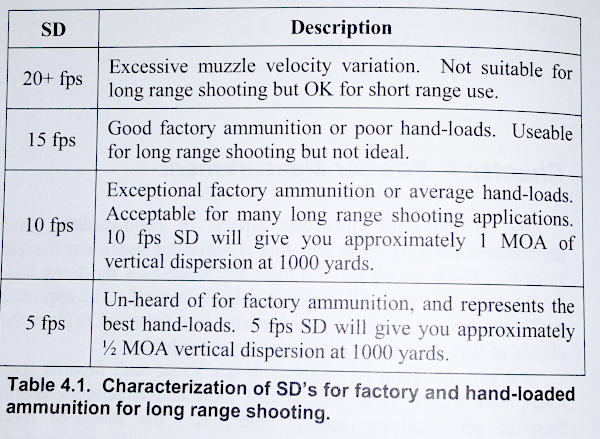
3. The ammo’s Standard Deviation (SD) is unknown. You will often notice that while MV is often listed on ammo packages, Standard Deviation (normally) is not. It is not uncommon for factory ammunition to have an SD of 18 or higher. Sometimes as high as 40+. As such is the nature of metering powder. With marketing in mind, did they pick the high, low, or average end of the SD? We really don’t know. You won’t either until you test it for yourself. For hand-loaded ammo, to be considered around 10 fps or less. Having a high SD is often the nature of metered powder and factory loads. The image below is from Modern Advancements in Long Range Shooting: Volume II.
4. You don’t know how MV was measured. What chronograph system did the manufacturer use, and how did they back track to a muzzle velocity? A chronograph does not measure true velocity at the muzzle; it simply measures velocity at the location it is sitting. So you need to back-calculate the distance from the chrono to the end of the barrel. This calculation requires a semi-accurate BC. So whose BC was used to back track to the muzzle or did the manufacturer even do that? Did they simply print the numbers displayed by the chronograph? What kind of chronograph setup did they use? We know from our Lab Testing that not all chronographs are created equal. Without knowing what chronograph was used, you have no idea the quality of the measurement.
5. The MV data may not be current. Does the manufacturer update that data for every lot? Or is it the same data from years ago? Some manufacturers rarely if ever re-test and update information. Some update it every lot (ABM Ammo is actually tested every single lot for 1% consistency). Without knowing this information, you could be using data for years ago.
CONCLUSION: Never use the printed MV off a box of ammo as anything more than a starting point, there are too many factors to account for. You must always either test for the MV with a chronograph, or use carefully obtained, live fire data. When you are using a Ballistic Solver such as the AB Apps or Devices integrated with AB, you need to know the MV to an accuracy down to 5 fps. The more reliable the MV number, the better your ballistics solutions.
When your cases become hard to extract, or you feel a stiff bolt lift when removing a cartridge, it’s probably time to full-length size your cases, and “bump” the shoulder back. We generally recommend bumping shoulders each time you reload, after the initial fire-forming. Benchrest and F-Class benchrest shooters, running relatively high pressures, typically full-length size every load cycle, bumping the shoulder .001-.003″. High Power shooters with gas guns generally full-length size every time, and may need to bump the shoulders .003″ or more to ensure reliable feeding and extraction.
Use Shims for Precise Control of Shoulder Bump
Some shooters like to set the “default” position for their full-length die to have an “ample” .003″ or .004″ shoulder bump. When they need less bump, a simple way to reduce the amount of shoulder movement is to use precision shims in .001″ (one-thousandth) increments.
Here are reports from Forum members who use the shims:
“Great product. I have my die lock ring(s) adjusted for the shortest headspace length on my multiple chambers 6BRs and 6PPCs. When needing a longer headspace, I just refer to my notes and add the appropriate shim under the lock ring. Keep it simple.” — F.D. Shuster
Mats Johansson writes: “I’ve been using [shims] since Skip Otto (of BR fame) came out with them. I set up my dies with the .006″ shim, giving me the option of bumping the shoulder a bit more when the brass gets old and hardens while still having room to adjust up for zero headspace, should I have missed the original setup by a thou or two. Hunting rounds can easily be bumped an extra .002-.003″ for positive, no-crush feeding. Being a safety-oriented cheapskate, I couldn’t live without them — they let me reload my cases a gazillion times without dangerous web-stretching. Shims are a must-have, as simple as that.” — Mats Johansson
Sinclair Die Shim Kit — Seven Shims for $14.99
Sinclair Int’l (through Brownells) offers a seven-piece set of Sizing Die Shims that let you adjust the height of your die (and thereby the amount of bump and sizing) in precise .001″ increments. Sinclair explains: “Some handloaders will set their die up to achieve maximum sizing and then progressively use Sinclair Die Shims between the lock ring and the press head to move the die away from the shellholder. Doing this allows you to leave the lock ring in the same position. These shims are available in increments of .001″ and work very well.”
Seven Shims from .003″ to .010″
Sinclair’s $14.99 Die Shim Kit (item 22400) includes seven shims in thicknesses of .003, .004, .005, .006, .007, .008, and .010. For ease of use, shim thickness is indicated by the number of notches cut in the outer edge of each shim. Even without looking you can “count” the notches by feel.




 Building the Borden Black Beauty
 Loading for Accuracy

 Long-Range Silhouette Match Strategy and Techniques
 We set up John’s 6-284 as we would for 1000-yard Light Gun competition. We’ve also built some of these rifles in 6MM BR for use in 600-yard competition. For John, we used a Borden/Nesika Model K 1.70″ diameter action as the beginning basis of the rifle. The timing and cocking-piece system for this rifle has the Borden improvements to improve firing pin energy and lock time. The action was pillar-bedded and glued into a McMillan Tooley MBR pattern stock. The stock blank was gel-coated and then epoxy-finished with a texture.


 Tests Show Burn Rates Vary with Water Content