You are looking at a true game-changer — a full-size spotting scope with a digital screen, not a conventional rear glass eyepiece. On the new Omnis Digital Spotting Scope, the large front objective gathers light effectively as does a normal spotter, but you view the image on a digital screen. This has many advantages — multiple persons can view the screen at the same time. You don’t have to get extremely close to the screen as you would with a conventional eyepiece. This is great for a spotter or coach, who can also maintain a broader view downrange in his field of vision.
In addition, digital screen graphics can potentially provide range and ballistics information (via software). Another major advantage is that the screen output can recorded and later replayed for analysis or review. That’s great for training programs or when reviewing match stages — you basically can record a movie of your shooting sessions. And, the system works well at night and in low light, so it is great for hunters. Wouldn’t it be cool if your current spotting scope could be used at night?
GunsAmerica Hunt 365 Omnis Video Review and Field Test
To learn more about the Accufire Omnis Digital Spotting Scope, check out the extensive review on The Firearm Blog. That 1300-word review explains the primary advantages of a spotting scope with an electronic screen. The TFB review also covers reticle options, day/night mode, recording capabilities, and accessory mounting. Some 28 photos illustrate the scope’s controls, on-screen features, and mounting options. If you are considering getting an Omnis Spotter, definitely READ the TFB Review.
Accufire Technology, maker of the Omnis Digital Spotting Scope, explains its advantage over conventional non-electronic optics: “Anyone who has spent more than a few minutes with their face behind a traditional spotting scope knows that eye fatigue is a real problem. Add to that the difficulty of [explaining to] another person … what you are looking at and it is a wonder why people still use traditional spotting scopes.”
Omnis Digital Spotting Scope Notable Features
The Omnis Digital Spotting scope has a 30X-120X digital zoom range displayed on a 2.95 inch OLED Screen. This eliminates eye fatigue and allows multiple users to view the frame at the same time. The Accufire “walk-through” video below explains the key features of the Omnis Digital Spotting Scope:
Software App Allows Video streaming from Omnis Spotting Scope
With the Accufire App, the user can connect to the Omnis’s onboard WiFi network and stream to any compatible Apple or Android device. On top of all that the Omnis can record audio and video to its internal memory on an SD card. This can also be accessed via a USB-C port.
Rechargeable Batteries Plus External Power Capability
The Omnis spotting scope is powered by four (4) rechargeable CR123a batteries that give it a 4-hour continuous run time. The Omnis can also be connected to an external battery via the USB-C port for even longer run-time. External battery packs are inexpensive.
Accufire Omnis Spotting Scope Features:
Magnification: 30X – 120X
Video Out Resolution: 1440×1880
2.95 inch OLED screen
Day and Night Capable (using IR light at night, not included)
Sierra Bullets has published load data for the 6mm Creedmoor cartridge, a necked-down version of the popular 6.5 Creedmoor. Sierra has released very comprehensive 6mm Creedmoor load data, covering fifteen (15) different bullets from 55 to 110 grains. NOTE: Hornady-brand brass was used for Sierra’s 6mm Creedmoor load tests, not the newer, stronger Lapua 6.5 CM brass with small primer pockets. Hand-loaders using Lapua 6.5 Creedmoor brass necked to 6mm may have to adjust their loads.
Sierra writes: “As soon as the 6.5 Creedmoor was released in 2007, a 6mm version was being envisioned. After the 6mm Creedmoor demonstrated its worth at 1000 yards it began to catch the attention of Precision Rifle Series (PRS) competitors. The 6mm Creedmoor is a great fit for those looking for an AR platform-friendly cartridge. It delivers velocities very similar to the .243 Win and yet fits the AR10 magazine length[.] The 30-degree shoulder makes this a very efficient case and helps prolong case life as well. The 6mm Creedmoor works well with powders such as H4350, [RE-16], RE-17, and Ramshot Hunter for heavier long-range bullet weights. Slightly faster powders such as RE-15, Win 760, and Vihtavuori N540 work well with lighter weight bullets.”
Sierra Bullets Tested for 6mm Creedmoor Load Data
55gr BlitzKing (#1502)
60gr HP (#1500)
70gr HPBT (#1505)
70gr BlitzKing (#1507)
75gr HP (#1510)
In developing its 6mm Creedmoor load data, Sierra tested a very wide selection of propellants, two dozen overall. For the smaller bullets, fast-burning powders such as Benchmark, H4895, and CFE223 were tested. For the heavier 100+ grain bullets, Sierra tested a selection of medium-burn-rate powders including H4350, Reloder 16, Reloder 17, Varget, and Superformance. Sierra did a very thorough job. We know this information will be welcomed by 6mm Creedmoor shooters.
Don’t know what powder to try first? For the 107-110 grain bullets, if you want best accuracy and low ES/SD, our Forum members recommend Alliant Reloder 16 and Hodgdon H4350. If you are seeking max velocity with the 110-grainer, look at Hodgdon Superformance and Reloder 19.
Here are Sierra’s 6mm Creedmoor Load Data Charts for 90-95 grain bullets plus the 107gr MK and 110gr MK. There are five other tables for other bullet types.
BONUS: PRB 6mm Creedmoor and 6.5 Creedmoor Load Survey
The Precision Rifle Blog compiled Load Data from PRS Competitors, for both 6mm Creedmoor and 6.5 Creedmoor. This is a good place to start. PRB surveyed the match loads for “173 of the top-ranked precision rifle shooters in the country”. One cautionary note: These PRS guys may be loading fairly hot, so work up gradually, 0.3 grains at a time. CLICK HERE.
Gorgeous wood stock crafted by Joel Russo: “A customer from Texas commissioned me to make him a one-of-a-kind stock, so I pulled a slab out of inventory, and put it all together.”
One of the most popular items in our Shooters’ Forum is the ongoing “Pride and Joy” thread. Since 2009, Forum members have posted photos and descriptions of their most prized firearms. Here are some notable “Pride and Joy” rifles (and one wheelgun) showcased in our Forum. Do you have a gun you’d like to see featured there? Register for the Forum and you can add your favorite gun to the list.
Above is a nice field rifle built up by a father for his daughter. Forum member FrankZ explains: “This is my favorite rifle and it will become my daughter’s first centerfire. The action is from the first rifle I purchased with my own money 21 years ago (700VSS).” The rifle now sports a 24″ Brux barrel chambered in 6mm Creedmoor, with aftermarket PT&G Bolt and DBM metal.
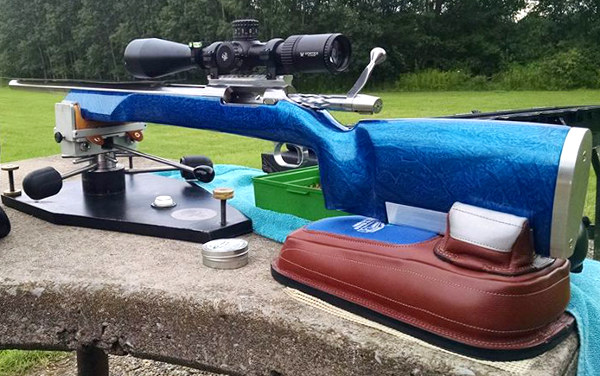
Here is a 6BR Ackley Improved built by Alex Wheeler. This blue marble-painted beauty features a BAT “B” action timed by Alex, fitted with Jewell trigger, and Borden trigger guard. The barrel is a Hawk Hill HV contour finished at 28 inches. The stock is a Deep Creek Tracker with 4″ forearm and rudder system (the toe of the stock adjusts for angle, allowing better tracking). This scope is a Vortex 15-60x52mm Golden Eagle riding in Burris Signature Zee rings.
Forum member Grimstod posted this nice 6BRX in a scenic setting: “Bill Goad at Premier Accuracy crated this fantastic 6BRX. It shoots better then I do.” The rifle features a single-feed Alpin action, with Hart 26″ 1:8″-twist barrel, chambered for the 6BRX (6mmBR wildcat) with .269 neck. Grimstod currently runs 95gr Berger VLDs in Lapua brass. On top is a Leupold 40x45mm scope on a Picatinny rail that Grimstod machined himself. The stock is an HS Precision painted by Premier Accuracy.
Here’s a gorgeous green 6mm Dasher. Forum Member Gunnermhr states: “This is my new 12-lb Dasher for the 1000 Yard Benchrest silhouette matches. My good friend at CRS Custom Rifle Stocks in Aaronsburg, PA made and painted the stock. It’s similar to a Tooley MBR with a few modifications. It still supported on a 3″ forearm and is full length. Hard to imagine it still makes weight with a wood stock and a 36 power Leopold. Crossed the scale at 11.7lbs. The rifle features a BAT “B” Action. The paint is Candy Apple Green, the forearm has a white base-coat, center section is gray base coat and the buttstock is black base coat, all covered with five coats of clear. It’s the new pride of the fleet as it shoots as good as it looks. This gun hammers with 105gr Berger Hybrids.”
Here’s a state-of-the-art Benchrest rifle, finished proudly in bright red. Forum Member JimmyMac posted: “Picked up my new 6 PPC today. This red rig features a Borden B action (Jewell trigger) fitted with a Lederer 1:14″-twist barrel with a Loker tuner. The barrel action rides in a Roy Hunter stock. On top is a Nightforce 42x44mm Competition scope in BAT rights. The rifle was smithed by Dave Bruno.
This impressive rifle features an “antique” 1917 Enfield action chambered for the .338 Win Magnum cartridge. The lovely Maple stock was hand-carved by Forum member Spitfire_ER. He tells us: “I found this piece of wood as a return at a lumber yard about 7-8 years ago. I asked the guy in the yard about it and he said it had been returned because it had too much figure for the job the customer was working on. First thing I thought was, ‘That would make a nice stock’.”
Not a Rifle But Still a Stunner…
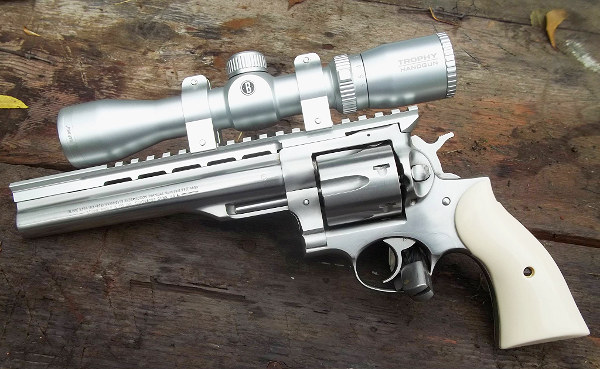
Last but not least is one of the nicest stainless Ruger revolvers we’ve ever seen. Forum member Longcarbine says: “This is not a rifle, but it’s my favorite weapon”. The Ruger is fitted with a custom Picatinny scope rail with matching silver-tone Bushnell Trophy handgun scope, plus handsome faux Ivory grips. This wheelgun is almost too pretty to hunt with…
From the late ’70s through 1983, a huge, concrete-walled warehouse in Houston was used for benchrest testing. Virgil King and Bob Fisher set up a bullet-catching backstop at the end of a 30-yard-wide, 325-yard-long fire lane that remained unobstructed even when the warehouse was in use. This allowed accuracy tests in virtually perfect “no wind” conditions. Over a six-year period, about 30 shooters were invited to test their rifles. The results were amazing, with numerous “zero groups” being shot in the facility. Many of the lessons learned in the legendary Houston Warehouse still help benchresters achieve better accuracy today.
Dave Scott explains why the Warehouse was so unique:
“Over a period of six years, the levels of accuracy achieved in the Houston Warehouse went beyond what many precision shooters thought possible for lightweight rifles shot from sandbags and aimed shot-to-shot by human eye. For the first time, a handful of gifted, serious experimenters — armed with the very best performing rifles (with notable exceptions) — could boldly venture into the final frontiers of rifle accuracy, a journey made possible by eliminating the baffling uncertainties of conditions arising from wind and mirage. Under these steel skies, a shooter could, without question, confirm the absolute limits of accuracy of his rifle, or isolate the source of a problem. In the flawlessly stable containment of the Houston Warehouse … a very few exceptional rifles would display the real stuff, drilling repeated groups measuring well below the unbelievably tiny .100″ barrier. The bulk of rifles, however, embarrassed their owners.”
Scott’s article also reveals some interesting technical points: “One thing that IS important is that the bullet be precisely seated against the lands. T.J. Jackson reported this fact in the May 1987 issue of Precision Shooting. In a letter to the Editor, T.J. wrote, ‘…in all our testing in that Houston warehouse… and the dozens and dozens of groups that Virgil King shot in there ‘in the zeroes’… he NEVER fired a single official screamer group when he was ‘jumping’ bullets. All his best groups were always seated into the lands, or at the very least… touching the lands. Virgil said his practice was to seat the bullets so the engraving was half as long as the width of the lands. He noticed an interesting phenomenon with rifles that could really shoot: if the bullets were seated a little short and the powder charge was a bit on the light side, the groups formed vertically. As he seated the bullets farther out and increased the powder charge, the groups finally became horizontal. If he went still farther, the groups formed big globs. He said the trick is to find the midway point between vertical and horizontal. That point should be a small hole.”
You should definitely read the complete article, as it provides many more fascinating insights, including shooting technique, barrel cleaning, neck-turning, and case prep.
EDITOR: Will the lessons of the Houston Warehouse work elsewhere? Is this repeatable magic? We remind readers that what T.J. Jackson discovered worked for his barrels, his cartridge type, and his choice of bullets. Jumping bullets can definitely produce good results in other cartridge types with bullets such as Berger Hybrids. Still, the Houston results are intriguing. Any time someone shoots in the “zeros” one should pay attention to how that was achieved.
This photo is one of Nightforce’s series of picturesque “Gunscapes”. SEE MORE HERE.
August is National Shooting Sports Month. So be sure to get to the range sometime soon, preferrably outdoors.
We should remember the real reasons many of us enjoy the shooting hobby. Many of us like shooting because it gets us outdoors, away from work pressures. Shooting gives us a chance both to enjoy solitude as well as have fun with friends and family in the outdoors. For this Editor, a solo trip to the range in mid-week was often the perfect antidote to job stress. Going to a scenic venue and sending a few shots downrange was satisfying. And getting out of the hustle and bustle of the city did indeed calm the soul.
Talented 3-position shooter (and trick-shot artist) Kirsten Joy Weiss says that any day at the range is “always a good day”. Here is her photo to prove it. If that shot doesn’t motivate you to spend a day outdoor with rifles, we’re not sure what will. Here’s hoping you’ll have a chance to get in many fun days of shooting and/or hunting this summer and fall. That can be with air rifles, rimfire guns, or centerfire guns — they are all fun to shoot.
When you want a firearm for home defense instantly available, you don’t necessarily want it buried in a large gun safe in a remote section of your house. There are reasons you may want a rifle, pistol, or shotgun ready to be deployed quickly. One solution for this is the “hidden in plain sight” option. Using common household furniture or house features (such as vents and mirrors), you can stash a firearms where it can be quickly accessed, but no unwelcome visitor will suspect it is stored. This article presents some popular gun storage options.
Virginia-based Tactical Walls is a leader is specialized gun storage/concealment systems. This company offers a variety of USA-made furniture/decorative options for gun storage. There are mirror assemblies, sliding wooden flags, tables with hidden storage, bookcases, shelving units, and more. The General Manager of Tactical Walls is Dennis DeMille, formerly GM of Creedmoor Sports, and a talented marksman.
Dennis tells us: “Tactical Walls was the pioneer in concealing firearms in plain sight”. He says this company has great creativity and impressive production capabilities. View all Tactical Walls concealment gun storage options at TacticalWalls.com.
Fine Firearms Furniture with Slide-Open Table Top
Here’s something that will teach unwanted guests some “table manners”. We’ve seen handguns hidden in books, and stowed behind faux baseboard vents, but this hand-crafted, slide-open table takes the cake. We doubt that anyone could sit down at this table and suspect that a shotgun, scoped rifle, two pistols and a knife were stored securely inside. There’s an arsenal hiding in there!
To access the guns under the sliding table-top, first you flip down a wood trap-door on the side. That exposes a key-lock which unlatches the interleaved left and right table segments. These slide open horizontally on metal tracks, exposing the full arsenal underneath. This “table vault” is a very clever design, built with fine craftsmanship. You can purchase this table from the maker for $1899.00.
Hidden in Plain Sight — Guide Gear Vent Pistol Locker
This clever “imposter vent” should fool any unwanted visitors. This Guide Gear Hide-A-Gun vent storage unit is just $34.99 on Amazon. NOTE: This will require installation in the wall, with attachment to studs.
Decorative Storage — Patriot Flag Concealment Unit
This handsome triangular wood box has hidden storage for a firearm and/or valuables. It currently costs $71.99 on Amazon. You may want to bolt this down to a shelf for extra security.
The 38th annual Gun Rights Policy Conference (GRPC), co-hosted by the Second Amendment Foundation (SAF) and Citizens Committee for the Right to Keep and Bear Arms, will be held September 22-24, 2023, in Phoenix, Arizona. The conference is FREE to attend, if you pre-register in advance. CLICK HERE to register online.
The theme of this year’s event, which will be held at the Marriott Phoenix Airport Hotel, is “Road to Liberty!”. GRPC Registration is available online at the SAF website. If you are near Phoenix that weekend, you may definitely want to attend. For those unable to attend, the conference will be featured on multiple platforms including YouTube and Facebook.
As in the past, this year’s conference and all materials are FREE!
This year’s conference will be attended by more than 600 gun rights advocates and activists and will feature a veritable “Who’s Who” of leaders in the Second Amendment movement. More than 80 speakers will offer presentations on a variety of subjects, including legislation, the upcoming campaigns for the 2024 elections, firearms litigation, and more.
Notable scheduled speakers this year include Alan Gottlieb, Adam Kraut, Stephen Hallbrook, John Lott, Massad Ayoob, Mark Smith, AWR Hawkins, John Correia, Ryan and Tom Gresham, Mark Walters, Stephen Gutowski and representatives and staff from SAF, CCRKBA, FPC and GOA as well as leaders of state organizations. Learn more about the speakers on the GRPC Speaker Bio Page.
Gun Rights Policy Conference Schedule
Friday, September 22: The conference begins with registration and an evening reception, 7-9 pm.
Saturday, September 23: The conference gets fully underway with panel discussions, individual presentations, and the annual awards luncheon. It’s an all-day event running from 8 am to 6 pm.
Sunday, September 24: The conference has more panel discussions and reports from 9 am to 1 pm.
SAF founder and Executive V.P. Alan Gottlieb said this year’s GRPC event occurs at a critical time for the Second Amendment movement:
“Our rights have been under continuing and unrelenting attacks from the Biden administration. While we have seen several Second Amendment victories in the courts and the various state legislatures. We are witnessing continued growth in the number of legally-armed citizens, with more than half of the states now enjoying Constitutional/permitless carry.
“We’ve come a long way since the first GRPC was held in Seattle in 1986,” Gottlieb added. “We will be delighted to see old friends and make new ones, and we expect this year’s conference to be an awesome event for everyone.”
With fall approaching soon, hunting season is right around the corner. Long-range hunters may want to add Shooter’s Bible Guide to Rifle Ballistics (2nd Edition, 2022) to their reference library. Written by Dr. Wayne van Zwoll, this 264-page resource focuses on the basic principles of ballistics. While the book concentrates on the many factors that affect bullet trajectories, the book also includes chapters on everything from rifle design to bullet construction and handloading. And there are many helpful tips for long-range hunters.
Gunsmith and long-range shooting school instructor Darrell Holland recommends the book highly. This updated Second Addition was released in July 2022, so it is still quite current. Darrell tells us: “Friend and noted author Wayne van Zwoll has authored another fine book on long range shooting. Wayne is a great shot (probably one of the best sling shooters I’ve been around) and superb hunter in his own right. We applaud his efforts to provide sound and accurate knowledge on long range hunting.”
Van Zwoll is the “real deal” — an experienced outdoorsman, with serious shooting and writing “creds”. Over his career, Van Zwoll worked for the BLM, then Washington’s Department of Game. He worked as a photographer for the U.S. Forest Service, then became one of the Elk Foundation’s first field directors. He has guided hunters in Utah and Wyoming, and has hunted on five continents. Wayne has shot competitively since his days on the Michigan State University rifle team. He qualified for the final Olympic smallbore tryouts in 1972 and later won two state prone titles. For many years he conducted shooting seminars for Safari Club International (SCI). Wayne van Zwoll has authored 14 books, and written more than 2,000 articles for numerous magazines, including Field & Stream, and Outdoor Life. In 2006 he received the Jack Slack Outdoor Writer of the Year award. Wayne now serves as Special Projects Editor for Intermedia Outdoors.
A high ballistic coefficient helped a Creedmoor bullet slice stiff wind 250 yards to this Vaal Rhebok.
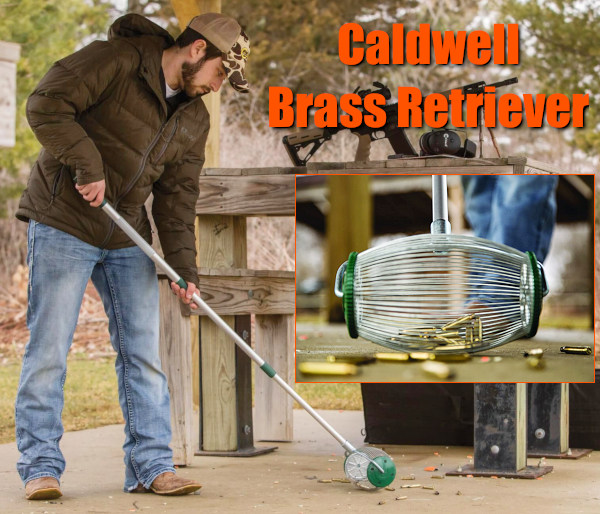
Caldwell Brass Retriever
Tired of bending over or kneeling down to retrieve your fired cartridge brass? For older shooters (including this Editor) getting down on the ground to pick up brass is tough on the lower back and knees. Here’s a product that makes brass retrieval quick, easy, and pain-free. The Caldwell Brass Retriever works quite well with a little practice, once you apply the correct pressure. While it won’t always grab every fired case, it will capture nearly all, and that can really make the job go much faster.
One owner praises this as a “very good tool” that is “a lot easier on my back.” While it can work on grass, gravel, and hard-packed earth, the unit works best on smooth, hard surfaces. Currently priced at $47.52 on Amazon, it is an affordable tool.
Caldwell states: “Spend less time bending over and picking up brass at the range and more time shooting. The Caldwell® Brass Retriever picks up brass, saving your back and time. The Brass Retriever can pick up rifle and pistol brass quickly and efficiently. The retriever comes complete with a roll cage separator that allows you to dump the collected brass into a bucket quickly. It is collapsible as well, making it convenient to transport. The retriever’s handle expands from 28″ up to 57″ tall.”
Brass Retriever Owner Reviews
Here are Amazon reviews from actual purchasers. It’s clear the device is not perfect and can miss a case or two. However, the Brass Retriever does grab the vast majority of brass on the ground, sized .223 Rem or larger diameter. This will save time and reduces stress on your back and joints:
“This thing … does a terrific job of collecting the brass from a standing posture quickly and efficiently. It helps to have the cases on a smooth surface like concrete or dirt without a lot of vegetation. But we used it on open desert yesterday and it collected nearly every case with a single pass. It’s now a permanent piece of gear in the stuff we take when target or ground squirrel shooting.” — Hans H.
“This WILL save your back. The only drawback is you can’t overload it with brass. After couple dozen pieces (or less) it will start dropping brass while you’re attempting to collect others. That’s the limitation (one of them). There is a short learning curve (15 min.) in which you’ll learn how much brass is too much And how you need to orientate the wires to pick up the brass. It doesn’t do as well on gravel or high grass as it does on a smooth, firm surface. Even with its limitations, it’s a keeper. Just empty every dozen or so pieces and it works very well.” — Jeff M.
Specialized Tool for .22 LR Brass
NOTE: The Caldwell Brass Retriever is designed primarily to recover reloadable rifle and pistol brass, with case diameters as fat as .223 Rem or larger. Some people state it can be used for smaller .22 LR cartridges too, but there is a much better product for that.
The UniqueTek Rimfire Brass Wizard is optimized for picking up .22 LR rimfire cases. It has a smaller basket with wires spaced closer together. It can also pick up pistol and rifle cartridge brass but will hold fewer cases than the original Brass Wizard or the Caldwell Brass Retriever. The Brass Wizard “Rimfire” The Brass Wizard “Rimfire” comes standard with the telescoping handle and includes a”Dumper” accessory.
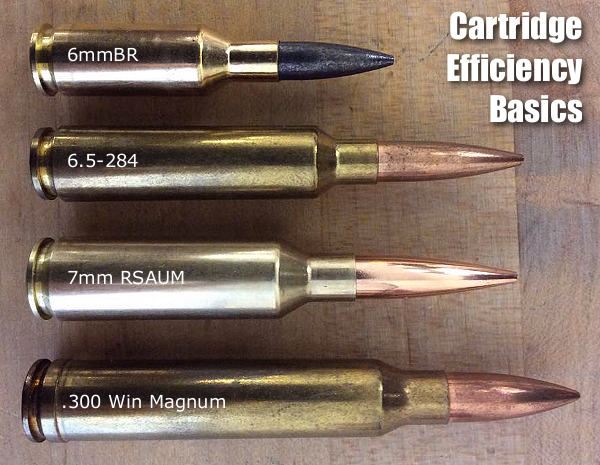
Efficient cartridges make excellent use of their available powder and case/bore capacity. They yield good ballistic performance with relatively little recoil and throat erosion.
Cartridge Efficiency: A Primer (pun intended!)by USAMU Staff
The U.S. Army Marksmanship Unit (USAMU) published a series of reloading articles on its Facebook Page. In this article, the USAMU discusses cartridge case efficiency and its benefits. While this is oriented primarily toward NRA High Power Rifle and Long Range (1000-yard) competition, these factors also apply to medium/big game hunters. Assuming one’s rifle and ammunition are accurate, key considerations include ballistic performance (i.e., resistance to wind effects, plus trajectory), recoil, and throat erosion/barrel life.
Efficient cartridges make excellent use of their available powder and case/bore capacity. They yield good ballistic performance with relatively little recoil and throat erosion. A classic example in the author’s experience involved a featherweight 7x57mm hunting/silhouette rifle. When loaded to modern-rifle pressures, just 43-44 grains of powder pushed a 139gr bullet at 2900 fps from its 22” barrel. Recoil in this light rifle was mild; it was very easy to shoot well, and its performance was superb.
An acquaintance chose a “do everything” 7mm Remington Magnum for use on medium game at short ranges. A larger, heavier rifle, it used ~65 grains of powder to achieve ~3200 fps with similar bullets — from its 26″ barrel. Recoil was higher, and he was sensitive to it, which hampered his shooting ability.
Similarly efficient calibers include the 6mm BR [Norma], and others. Today’s highly-efficient calibers, such as 6mm BR and a host of newer developments might use 28-30 grains of powder to launch a 105-107gr match bullet at speeds approaching the .243 Winchester. The .243 Win needs 40-45 grain charges at the same velocity.
Champion-level Long Range shooters need every ballistic edge feasible. They compete at a level where 1″ more or less drift in a wind change could make the difference between winning and losing. Shooters recognized this early on — the then-new .300 H&H Magnum quickly supplanted the .30-06 at the Wimbledon winner’s circle in the early days.
The .300 Winchester Magnum became popular, but its 190-220gr bullets had their work cut out for them once the 6.5-284 and its streamlined 140-142gr bullets arrived on the scene. The 6.5-284 gives superb accuracy and wind performance with about half the recoil of the big .30 magnums – albeit it is a known barrel-burner.
Currently, the 7mm Remington Short Action Ultra-Magnum (aka 7mm RSAUM), is giving stellar accuracy with cutting-edge, ~180 grain bullets, powder charges in the mid-50 grain range and velocities about 2800+ fps in long barrels. Beyond pure efficiency, the RSAUM’s modern, “short and fat” design helps ensure fine accuracy relative to older, longer cartridge designs of similar performance.
Recent design advances are yielding bullets with here-to-fore unheard-of ballistic efficiency; depending on the cartridge, they can make or break ones decision. Ballistic coefficients (“BC” — a numerical expression of a bullet’s ballistic efficiency) are soaring to new heights, and there are many exciting new avenues to explore.
The ideal choice [involves a] balancing act between bullet BCs, case capacity, velocity, barrel life, and recoil. But, as with new-car decisions, choosing can be half the fun!
Factors to Consider When Evaluating Cartridges
For competitive shooters… pristine accuracy and ballistic performance in the wind are critical. Flat trajectory benefits the hunter who may shoot at long, unknown distances (nowadays, range-finders help). However, this is of much less importance to competitors firing at known distances.
Recoil is an issue, particularly when one fires long strings during competition, and/or multiple strings in a day. Its effects are cumulative; cartridges with medium/heavy recoil can lead to shooter fatigue, disturbance of the shooting position and lower scores.
For hunters, who may only fire a few shots a year, recoil that does not induce flinching during sight-in, practice and hunting is a deciding factor. Depending on their game and ranges, etc., they may accept more recoil than the high-volume High Power or Long Range competitor.
Likewise, throat erosion/barrel life is important to competitive shooters, who fire thousands of rounds in practice and matches, vs. the medium/big game hunter. A cartridge that performs well ballistically with great accuracy, has long barrel life and low recoil is the competitive shooter’s ideal. For the hunter, other factors may weigh more heavily.
Cartridge Efficiency and Energy — Another Perspective
Former Lapua staffer Kevin Thomas explains that efficiency can be evaluated in terms of energy:
“Cartridge efficiency is pretty straight forward — energy in vs. energy out. Most modern single-based propellants run around 178-215 ft/lbs of energy per grain. These figures give the energy potential that you’re loading into the rifle. The resulting kinetic energy transferred to the bullet will give you the efficiency of the round. Most cases operate at around 20-25% efficiency. This is just another way to evaluate the potential of a given cartridge. There’s a big difference between this and simply looking at max velocities produced by various cartridges.”





 Dave Scott explains why the Warehouse was so unique:





 Van Zwoll is the “real deal” — an experienced outdoorsman, with serious shooting and writing “creds”. Over his career, Van Zwoll worked for the BLM, then Washington’s Department of Game. He worked as a photographer for the U.S. Forest Service, then became one of the Elk Foundation’s first field directors. He has guided hunters in Utah and Wyoming, and has hunted on five continents. Wayne has shot competitively since his days on the Michigan State University rifle team. He qualified for the final Olympic smallbore tryouts in 1972 and later won two state prone titles. For many years he conducted shooting seminars for Safari Club International (SCI). Wayne van Zwoll has authored 14 books, and written more than 2,000 articles for numerous magazines, including Field & Stream, and Outdoor Life. In 2006 he received the Jack Slack Outdoor Writer of the Year award. Wayne now serves as Special Projects Editor for Intermedia Outdoors.