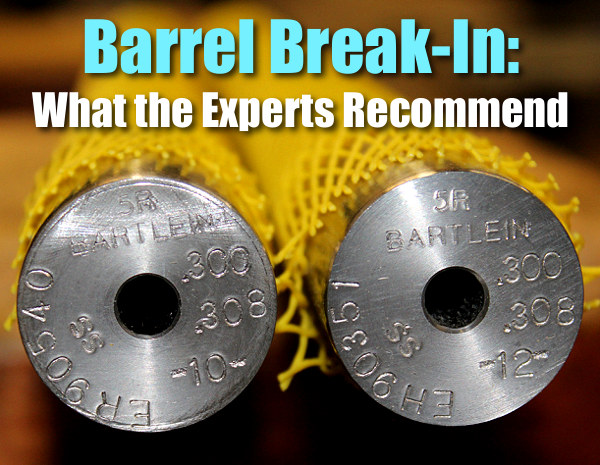
The question of barrel break-in is controversial. Some folks advocate an elaborate, lengthy cycle of shooting and brushing, repeated many times — one shot and clean, two shots and clean and so on. This, it is argued, helps barrels foul less and shoot more accurately. Others say minimal break-in, with patching and brushing after 10-15 rounds, is all you need. Still others contend that break-in procedures are a total waste of time and ammo — you should just load and shoot, and clean as you would normally.
We doubt if there will ever be real agreement among shooters concerning barrel break-in procedures. And one must remember that the appropriate break-in procedure might be quite different for a factory barrel vs. a custom hand-lapped barrel. This Editor has found that his very best custom barrels shot great right from the start, with no special break-in, other than wet patches at 5, 10, and 15 rounds. That said, I’ve seen some factory barrels that seemed to benefit from more elaborate break-in rituals.
What’s the best barrel break-in procedure? Well our friend Eric Mayer of Varminter.com decided to ask the experts. A while back Eric interviewed representatives of three leading barrel manufacturers: Krieger, Lothar-Walther, and Shilen. He recorded their responses on video. In order of appearance in the video, the three experts are:
Do I Need to Break-In a New Rifle Barrel?
Eric Mayer of Varminter.com says: “That is a simple question, [but it] does not necessarily have a simple answer. Instead of me repeating my own beliefs, and practices, on breaking-in a new rifle barrel, I decided to answer this one a bit differently. While we were at the 2016 SHOT Show, we tracked down three of the biggest, and most popular, custom barrel makers in the world, and asked them what they recommend to anyone buying their barrels, and why they recommend those procedures. We asked the question, and let the camera run!” Launch the video above to hear the answers — some of which may surprise you.
Long-Term Barrel Care — More Experts Offer Opinions
Apart from the debate about barrel break-in, there is the bigger question of how should you clean and maintain a barrel during its useful life. Some folks like aggressive brushing, other shooters have had success with less invasive methods, using bore foam and wet patches for the most part. Different strokes for different folks, as they say. In reality, there may not be one solution for every barrel. Different fouling problems demand different solutions. For example, solvents that work well for copper may not be the best for hard carbon (and vice-versa).
“Why worry about a little barrel fouling when the throat is subjected to a brutal 5,600° F volcano at 55,000 PSI? To investigate these and other questions about taking care of a match barrel, we spoke with a dozen experts and share their knowledge in this first of a series of articles.
After listening to folks who shoot, build barrels or manufacture cleaning solvents for a living, we concluded that even the experts each have their own unique recommendations on how to care for a match barrel. But they all agree on one thing — the gun will tell you what it likes best. Because the life expectancy of a match barrel is about 1,500 to 2,500 rounds, the objectives of cleaning one should include: preserve accuracy, slow the erosion, and remove fouling — all without damaging the gun. This article doesn’t claim that one cleaning method is better than the next. Rather, we set out to interject a little science into the discussion and to share some lessons learned from experts in the field.” — Chip Lohman
The Legal Brief is a feature of TheGuncollective.com that focuses on firearms rules and regulations. In this Legal Brief video, Attorney Adam Kraut explains key State and Federal regulations governing firearms, and explains how to ensure compliance with all applicable laws.
This five-minute video explains barrel length rules for rifles and shotguns, and also explains the best (and most fool-proof) methods to measure your barrel. In addition, the video explains how to measure firearm overall length. A rifle or shotgun which is less than 26 inches overall can also be classified as a “Short-barreled” rifle/shotgun subject to the NFA. NOTE: Under federal law “If the rifle or shotgun has a collapsible stock, the overall length is measured with the stock EXTENDED”.
Highlights of LEGAL BRIEF Discussion of Barrel Length and Firearm Overall Length
The ATF procedure to measure the length of a barrel is to measure from the closed bolt or breech face to the furthest end of the barrel or permanently attached muzzle device. ATF considers a muzzle device that has been permanently attached to be part of the barrel and therefore counts towards the length.
How to Measure Barrel Length: Drop [a] dowel or rod into the barrel until it touches the bolt or breech face, which has to be closed. Mark the outside of the rod at the end of the muzzle crown (if you don’t have a permanently attached muzzle device) or at the end of the muzzle device if it is permanently attached. Remove the rod and measure from the mark to the end of the rod. That is your barrel length[.]
Remember, if the barrel length is less than 16 inches, it is possible that the firearm could be a short barrel rifle (if you are building a rifle or it is already on a rifle) and if the barrel length is less than 18 inches, it is possible the firearm could be a short barrel shotgun (again if you are building a shotgun or it is already a shotgun). Both of these firearms would be subject to the purview of the National Firearms Act and would require the firearm to be registered accordingly.
How to Measure Overall Length:The overall length of your rifle or shotgun may also classify it as a Short Barrel Rifle or Short Barrel Shotgun. The overall length of a firearm is the distance between the muzzle of the barrel and the rearmost portion of the weapon measured on a line parallel to the axis of the bore. … If the rifle has a permanently attached muzzle device, that is part of the overall length. … If the rifle or shotgun has a collapsible stock, the overall length is measured with the stock extended.
The National Rifle League (NRL) started off sponsoring major centerfire tactical matches, similar to PRS competitions. That proved successful so the NRL added a .22 LR Rimfire series, called NRL22. The NRL22 rimfire discipline has been a major success, as rimfire guns are fun to shoot and ammo is very affordable. The most popular NRL22 matches have drawn up to 200 rimfire competitors. And now there is a companion rimfire long-range series, NRL22X. Learn more about NRL22 and NRL22X at NRL22.com.
NRL22 is a great way to get into competition shooting with minimal expense. There are six (6) classes: Open, Base, Ladies, Young Guns (8-16), Old Guns (OG 60+), and Air Rifle. Base Class is for the budget-minded shooter — the combined MSRP of Rifle and Optic may not exceed $1650.00 in 2026 (so you could spend $950 on a rifle and $700 on a scope for example). That keeps the sport affordable.
Open, Youth, OG, and Ladies Classes have no price limits on rifle and optic. Visit NRL22.com to find an NRL22 match near you. CLICK HERE for a full set of NRL22/NRL22X rules. The NRL also sponsors NRL22X matches. These involve significantly longer distances for greater challenge. Currently, an NRL22 membership costs $60/year for adult classes or $25/year for Young Guns Class.
March 2023 NRL22 Course of Fire
For actual NRL22 competitors, this is a very useful video. It shows how shooting from a variety of positions, and it includes very cool through-the-lens views. This covers the NRL22 March 2023 course of fire.
NRL22 Competition with Base Class ($1200 Max) Rifle
One good thing about NRL22 competition is you don’t need to spend a fortune to compete. Base class is limited to $1200.00 for rifle and optic. You can do very well even at this budget level. This video, complete with through-the-lens imagery, shows an NRL22 match shot with a Base Class Ruger Precision Rimfire rifle.
NRL22 and NRL22X are not just for guys. The ladies enjoy the competition too and do very well. There is a separate Ladies class, but women can also compete in other classes. Photo by Jonathan Ocab.
Interview with NRL22 Founder Travis Ishida
This Vortex Nation video features an 80-minute interview with Travis Ishida, one of the original founders of the NRL22 and NRL22X disciplines. Travis told us that the NRL now runs 7-8 times as many rimfire matches as centerfire matches.
NRL22 Competition Guide — Match Procedures and Equipment
If you want a basic overview about NRL 22 Competition, there is a good NRL22 Competition Guide on the Widener’s website. This covers the classes, the rules, target dimensions, the types of supports used, and match strategies. Here are some samples:
Any rifle system that comes in under a combined MSRP of $1200 shall be eligible to compete in the Base class. This combined MSRP price is for the rifle and scope only. It excludes scope rings and bases, bipods, suppressors, data cardholders, magazines, spare magazine holders, auto bolt releases, aftermarket triggers, and extended magazine releases. Adjustments are also allowed in this division as well as adding rails of any type. If any shooter goes over the MSRP amount of $1200, they get bumped into Open class.
One of the most obvious rules is that all rifles must be chambered in .22 Long Rifle. Magnum and like rimfire cartridges are not allowed. It is recommended that whatever rifle you choose has a removable magazine rather than a fixed, tubular magazine since it’s harder to make safe, but they are allowed.
You can use any equipment in NRL22 unless a specific course of fire rules out using an item specifically. The only exception is tripods are never allowed. The sharing of equipment is allowed as well as slings to assist in unsupported positional shooting.
The steel target dimensions range from .25 inches wide to 6 inches wide. Some stages will require 10 rounds to be shot, while others may have you shoot 12 rounds. Most often, you’ll have 120 seconds to shoot a course of fire.
Ammunition Selection for NRL22 and NRL22X
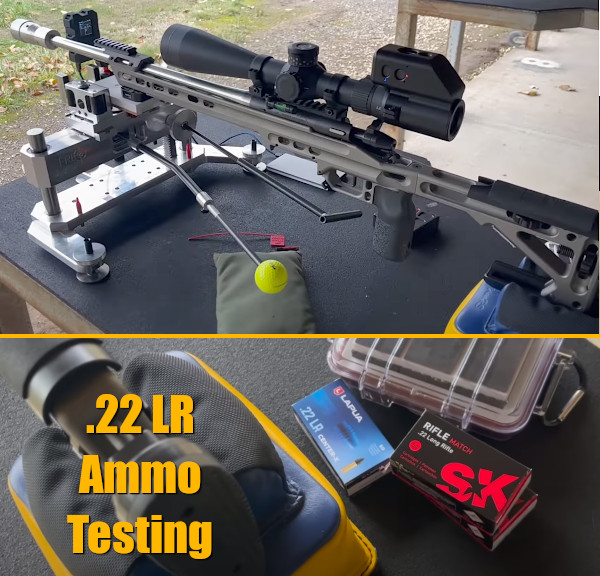
Our friend F-Class John, a top F-Open competitor, has recently started tactical rimfire matches. He enjoys the challenge. And he admits a big part of the appeal is the MUCH cheaper ammunition. He has seen good results with relatively inexpensive Norma Tac-22 ammo, but he now favors SK ammo which he says offers great performance for the price. In this video, F-Class John tests SK Rifle Match Ammo vs. the premium Lapua Center-X ammo. He tested using a benchrest set-up with his MPA chassis rimfire rifle.
How to Register for NRL22 Competitions
Looking to get started in NRL22 or NRL22X (long range) competition? CLICK HERE to visit the NRL22 home page. The NRL22/NRL22X website has a registration page along with information on equipment rules, match locations, match rules, and the 2023 Match Schedule. CLICK HERE for NRL22 rules and CLICK HERE for NRL22X-specific Rules.
BONUS — Rimfire Practice Targets
SPECIAL BONUS–Rimfire Tactical Precision Targets
These FREE targets by DesertFrog are offered in Adobe Acrobat format for easy printing. CLICK HERE to download all six targets as a .ZIP archive.
This article Copyright 2025 AccurateShooter.com. Any reproduction without authorization gives rise to penalties under 17 U.S. Code § 501.
There are many centerfire rifle competitive shooting disciplines — High Power, F-Class, silhouette, short-range benchrest, long-range benchrest, and PRS (tactical) to name a few. But on any given spring or summer weekend in the USA, there are probably more local “fun matches” happening than there are F-Class, registered benchrest, and PRS events combined.
Harold Seagroves’ 3-time Hickory Ground Hog Match-Winning Rifle
At clubs across the country, varmint fun shoots (also known as “groundhog matches”) are becoming more popular every year. In these matches, usually shot from the bench, you engage paper targets, clay pigeons, steel “critter” silhouettes, or some combination of paper and reactive targets. Shooters like these matches because you can shoot a wide variety of rifles, you don’t have to spend a fortune to be competitive, and there is fun for the whole family. Rules are inclusive — you won’t be turned away because your rifle is two ounces overweight. A large percentage of the match fees usually go back to shooters in the form of cash prizes. And the level of camaraderie is high.
Inclusive Rules Welcome All Shooters
Forum member Danny Reever has explained the appeal of groundhog matches: “We don’t have a governing organization, or have to pay $50 a year membership just to compete in matches. Sure the rules vary from club to club, but you adapt. You build your rifle (or even pistol) to fall within the rules of either the clubs you shoot, or to fit all the clubs rules. If not there still is a class for you to compete in. If your factory rifle doesn’t conform to the rules, it can shoot in a custom class. If your custom doesn’t make weight for Light Custom (usually 17 pounds and under), you shoot it in heavy custom class. If you want to try your Tactical rifle or F-Class rig, bring it out there’s a class you can shoot it in. If you don’t like one club’s rules, you just don’t shoot there. It’s no big deal.
There are no National records, or Hall of Fame points — just individual range records. If you want to shoot in BIG matches (with big prizes), there is the Hickory Ground Hog Shoot among others. If competition isn’t your bag, many clubs offer mid-week fun matches that you can shoot just for fun. You shoot the same targets but with a more relaxed atmosphere with no time limits.
The best part is you don’t have to shoot perfect at every yardage. You always have a chance because in this sport it really isn’t over until the last shot is fired. Typically ALL the entry money goes to the host club, with much of the cash returned back to the shooters via prizes. Junior shooters often shoot for free, or at a reduced rate. That lessens the burden on the family’s wallet (not a small thing in these economic times). The low entry cost also encourages young guys to get involved who don’t have $4000 custom rifles or the money to buy them.
More Fun, Fewer Complications
There isn’t a sea of wind flags to shoot over or to put up and take down. If the range has a couple of flags so much the better, but after all it is a varmint match. No pits to spot shots and slow things down either. If you can’t see your hits through your rifle scope or spotting scope well you are in the same boat as everybody else. That’s what makes it interesting/ sometimes frustrating!
As for calibers, I’ve seen everything from .223 Rem to .338 Lapua and everything in between. Our range record at my club is held by Bill Slattery, who shot a 147 out of a possible 150 with a 22BR 13 months ago. That’s on a target with a 1.250 ten ring at 200/300/500 meters. That record will stand for awhile, and shows you that some very good shooting is done at groundhog matches.
The best part is it’s laid back, everyone gets along, there is no place for big egos here. We who shoot the Ground Hog Matches don’t begrudge the other organizations and shooting disciplines, or those that shoot in them, heck some of us cross over and compete in registered benchrest matches too. Life’s too short, live and let live is our motto so just come out and have fun!”
Fellow Forum members chimed in:
FdShuster: “I’ve competed in our local ground hog matches for several years now, have introduced a number of others to them, and we all enjoy them and more importantly, continue to learn from them. Distances are as close as 100 yards, (with a 5/8″ 10 ring) to as far as 500 meters. With a 2″ 10 ring. Wind, mirage, bullet trajectories, all make them a challenge, and unlike shooting for group, where the group can be anywhere on the paper, in this game they must be very small, but also in the 10 ring. With the different classes — Custom, Factory, Hunter — almost any rifle will fit in somewhere. And Danny is correct about the friendly attitudes. I’ve seen competitors go out of their way, and jeopardize their chances of winning, to help someone else who may have a problem on the line.”
Mike C: “Here in Texas, our version of groundhog matches involves shooting at clay pigeons at 400 yards. We use 60mm, 90mm, and 108mm clay pigeons attached to target boards. You have 10 shots to break 8 clays, with a seven-minute time limit. We have developed a good following at these matches. In past years, a Shooter of the Year Award was given based on the Aggregate score for three of our matches, which are held in Utopia, San Angelo, and Huntsville.”
40X Guy: “I would have to say upon finishing my first year ever of groundhog matches, that the average Joe can grab his Swift, or his 25-06, or his 22-250 and go rip some holes in paper. Everybody is having a good time and its a gathering of like-minded people who have all shot chucks at some point or another. Even if one does not win the match, you can look at your target and say “darn that chuck target has five holes in him at 400 yards and he’s dead” just as well as the next guy shooting a custom bench rifle. Everybody fits in and everybody, 8 to 80, is having fun! It is addictive and will drive you to spend your hard-earned currency for sure!”
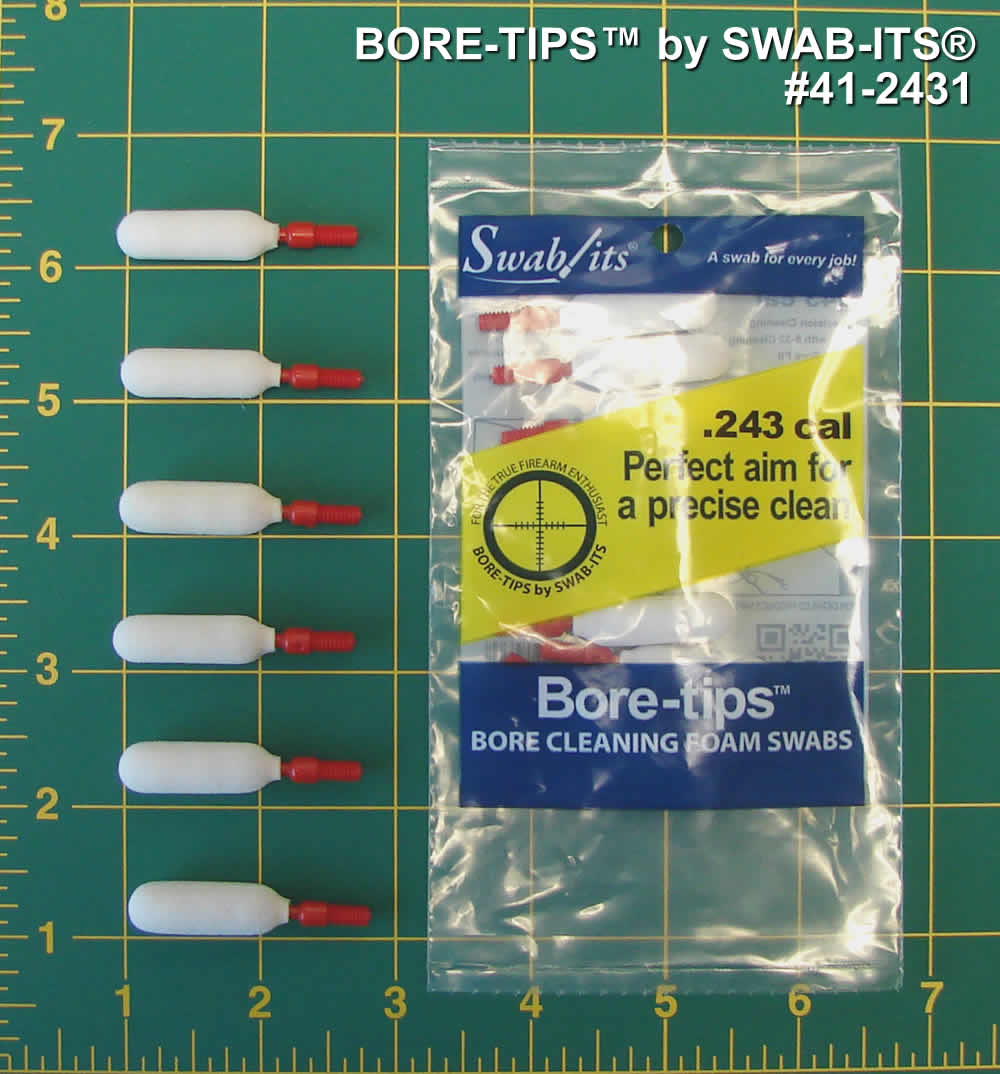
Wouldn’t it be nice to dispense with patches and jags when cleaning your guns? The folks at Super Brush, LLC, had the same idea, so they invented Bore-tips® swabs. These reusable foam “mops” provide 360° of contact with the bore, reaching both the grooves and the lands. Bore-tips thread onto standard cleaning rods. They are offered in a variety of sizes, from .22 caliber up to 12 Gauge. Rifle Bore-tips come in .22 (5.56mm), .243 (6mm), and .308 (7.62mm) calibers. Pistol Bore-Tips are offered for .22, .30, 9mm, .357, .40, and .45 calibers.
We first saw Bore-tips products at the Southwest Nationals a couple years ago. We were intrigued. These foam swabs may be useful for some applications, particularly pistols and shotguns which require minimal brushing. For rifles they do a good job of applying solvents because they hold more liquid than a patch. However, you probably won’t want to abandon your jags and patches. Sometimes a tight-fitting patch is still the best tool for the job. Patches are cheap and it’s easier to discard a used patch, rather than fuss with cleaning foam swabs. But for shotguns (and lightly used pistols), these things make sense.
Bore-tips Claimed Benefits:
• Each tip is reusable and can be cleaned with solvents or soap and water.
• Tough and fiber-free, Bore-tips will not shed or leave lint behind as cotton will.
• FAST PATCHLESS CLEANING — solves the shortcomings of the jag and patch.
• Foam fills the lands and grooves of the rifling, not sliding over the top like a patch.
• Quick threading on a standard 8-32 cleaning rod. Shotgun sizes use a 5/16 x 27 rod.
• Can be used with most commercially available solvents and oils.
AR15 Chamber Cleaner:
Pull-Through Bore-Whips for Quick Cleaning Jobs
Along with the screw-on Bore-tips there are handy pull-through Bore-whips for air guns and rifles. These are offered in .177 for air rifles and .223/5.56 for rimfire and centerfire rifles. We have found these Bore-whips very handy as the .177 version (see below) can also be used for .17 HM2 and 17 HMR rifles.
How to Use Bore-tips
Use a Bore-tip to apply solvent to the barrel. After allowing the solvent time to work, brush the bore to break up any fouling. Next use a clean Bore-tip to push the fouling out the bore. When the now dirty Bore-tip clears the bore, wet it with a little solvent and then squeeze it with an absorbent rag or paper towel, this will blot the dirt off. After blotting the Bore-tip should be clean enough to continue using to remove the fouling until you are finished cleaning. When you are satisfied with the cleanliness of your barrel, use a clean Bore-tip to dry the bore.
Click for Full-Screen Images
How to Clean Bore-tips®
For faster cleaning, apply mineral spirits to the Bore-tip and squeeze/blot into an absorbent rag or paper towel. When the Bore-tip is clean, let dry and reuse. Using soap and water, squeeze to blot out any excess solvent or dirt. Next, wash the Bore-tip with a grease-cutting soap and warm water. Once clean, rinse then let dry completely. See cleaning video below:
With April just two days away, we are well into the “swing of spring”. Here are six “fun and games” targets that can provide some fun springtime shooting opportunities, both indoors and outdoors. While each requires good conventional marksmanship skills — hitting a small aiming point — there are other strategies involved, such as playing darts or hitting the right combination of poker cards. Most of us started shooting as kids, just plinking for fun. Here’s an opportunity to be like a kid again — to spend a day at the range just having fun with friends and family members.
Dartboard Target with Colored Rings
This printable Dartboard Shooting Target has the numbers inside the outer dartboard ring to allow a larger target. With this target you can shoot for the center bull, or actually play pub-style dart games, aiming for numbers and particular rings. If you don’t know how to play traditional dart games, visit NiceDarts.com for complete darts rules. One popular game is “Around The World”. The object is to hit the numbered zones, starting with number 1. Then you try for 2, 3, and so on. After hitting all the numbers 1 through 20, then hit the bullseye to win. CLICK HERE for Other Dart Board Color combinations.
Atomic Target — Aim for Protons, Neutrons, and Electrons
The Atomic Target was originally created as a contest for our readers. The design is by Michael Forester of Auckland, New Zealand. First aim for the bigger green and red neutrons and protons, then try your luck with the smaller, more challenging blue electrons. You can also use the four black and yellow Atomic warning symbols as bullseye targets.
Poker Target — Get the Best Hand
Poker players will enjoy this target. With this playing card-themed poker cards target, each shooter takes five shots and the one with the highest hand wins. You can also shoot for four-of-a-kind, against the clock, fastest four (without a mistake) wins.
Slot Machine Jackpot Target
Enjoy a little Las Vegas-style fun on your next trip to the range. This cool Slot Machine Target has four sets of slot machine patterns each with three rows of three symbols. Connect three in a row to win — and hit the Jackpot! This is one of many colorful, free targets available from Targetz.com.
Flies in Circles Target
Now you can boast to your buddies that you hit a fly on your target — 16 times. On this target, 16 flies with bright red eyes are arranged in a inside circles, 16 to a page. There are various ways to use the fly targets. Some shoot to hit the head only — so aim for those red eyes. There are 11 other variations of this Fly Target available on the Targets.WS website.
Tic-Tac-Toe Fun Game Target
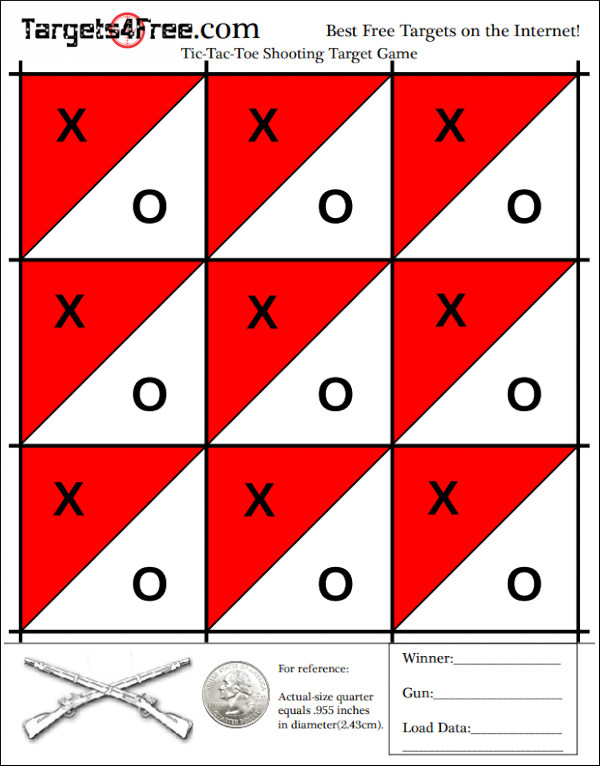
This Tic-Tac-Toe Shooting Game Target lets you challenge your shooting buddies at the range. One player can shoot the red triangles, while the other shoots the white zones, taking turns. You proceed just like a regular Tic-Tac-Toe game, alternating shots, with the goal of getting three of the same color in a row. This is a fun game for a parent and a young family member. You’ll find other fun targets on Targets4free.com.
Special BONUS — AccurateShooter.com Load Development Target
Our Load Development Target has been used by tens of thousands of shooters. It has proven very popular, since all your load data fits neatly in the boxes under each target. In fact this target is being employed by both rifle-makers (Bergara) and barrel-makers (including Criterion) to test their products. The target was designed for aiming efficiency. The red diamonds have 1/2″ sides and you can align your cross-hairs on the horizontal and vertical lines. It is a clean design that is easy to see even at 200 yards with a 20X scope. NOTE: When we test, we usually crank in a little elevation, setting the point-of-impact higher, so our shots fall in the gray circles. That way you leave the red diamonds intact for precise aiming.
With the huge popularity of NRL22 and PRS rimfire matches, along with the growth of rimfire benchrest events and local rimfire fun matches, we’ve seen heightened demand for all types of .22 LR ammunition. Plus the high cost of centerfire bullets and limited availability of powders and primers has pushed many centerfire shooters into the rimfire ranks. But even with increased demand, we’ve seen ample supplies of rimfire ammo arriving at retailers, with some good deals on SK, Norma, CCI, and Aquila. Check our Deals of the Week every Monday. And definitely visit Ammoseek.com, a site that tracks dozens of vendors. With a click of a button, Ammoseek reveals the best current deals on all types of .22 LR rimfire ammunition, from bulk-pack plinking fodder to high-end Lapua, ELEY, RWS, SK, and Norma.
Find Rimfire Ammunition Fast with AmmoSeek.com
Ammoseek.com is great search service that can help you locate hard-to-find ammunition and reloading components — while saving money in the process. AmmoSeek.com monitors scores of online vendors — checking current pricing and available inventory, for pistol, rifle, and shotgun ammunition. Looking for .22 LR ammo for your rimfire trainer or NRL22 rifle? Just select “.22LR” from AmmoSeek’s “Quick Seek” menu. NOTE: In mobile view type “22LR” in the “Search Ammo by Caliber” field top center.
And here are the 3/10/2023 search results for .22 LR ammunition. Here are five of the 1000+ entries, starting with the least expensive, just 4.7 cents ($0.047) per round:
How to Search by Ammo Manufacturer and Bullet Weight
You can also search for a particular .22 LR ammunition manufacturer, and/or search by bullet weight. Just click on the “Modify Search Link”. Once you see the “Modify Search” column on the left, scroll down and you can sort by manufacturer, bullet weight in grains, price (cost per round), and/or shipping cost. Here are the first results of a search for SK .22 LR rimfire ammunition:
Midsouth Shooters has a large selection of Rimfire Ammunition in stock, including SK Ammo:
The prone position demonstrated by two talented Service Rifle shooters. At top is SFC Brandon Green, multi-time High Power National Champion. Below is Tony Chow, a gifted match shooter. NOTE: Current Service Rifle rules allow the use of optics up to 4.5X.
Jay Christopherson, 2020 Southwest Nationals F-Open Champion, is one of the nation’s best F-Class shooters. When shooting F-Class, Jay uses a SEB Mini front rest and a large rear sandbag to support his big 22-lb F-Open rifle. Though he loves F-Class, Jay was also interested in Service Rifle competition where no external supports are allowed. You hold the rifle with your arms and a sling. Some Service Rifle competitions involve three position (Standing, kneeling/sitting, and prone), while others are prone only. Even in the prone position, the sling is a vital accessory.
Jay dramatically improved his Service Rifle “hard-holding” technique by enlisting the help of Emil Praslick III, former U.S. Army Marksmanship Unit (USAMU) rifle coach. Emil’s guidance and advice resulted in an immediate increase in Jay’s scores on target, as recorded by his ShotMarker electronic target system. Jay noted: “These targets show the difference between hacking it on your own, and spending an hour with someone who knows what they are doing and can tell you that you are doing it wrong.” These targets show Jay’s “before and after” Service Rifle results shooting slung up prone at 600 yards:
Service Rifle, Prone with Sling at 600 Yards
Here is Jay’s target BEFORE training with Emil Praslick — a 194-3X with lots of vertical.
And here is Jay’s improved target AFTER putting Praslick’s advice to work — impressive 199-8X with significantly less vertical.
You can see on this second target much improved vertical. All 20 shots were in a vertical range much smaller than the vertical height of the 10-Ring. Had shot 16 not gone wide left, this would have been a 200. Shot 16 was OUT of the 10-Ring to the left, but note that vertically it has almost perfect elevation.
Jay stated: “I was pretty amazed at not only the difference on the target, but how much difference the changes Emil suggested made to how my hold felt. The entire feel was different and a ton less stress in my neck and arms compared to what I was feeling before. I was actually feeling pretty good about that 194 yesterday, because I hadn’t slung up in two years and that was my highest score (by one point) after doing some load fixing. But having someone explain what you are doing wrong and why makes a world of difference.
The 2023 NRA Annual Meetings & Exhibits will take place at the Indiana Convention Center on April 14-16, 2023 in Indianapolis, Indiana. The Exhibit Hall is open all three days and will showcase over 14 acres of guns and gear from hundreds of manufacturers and retailers.
For those who plan to attend this big NRA event, we recommend that you PRE-REGISTER immediately. Don’t delay. For NRA members who pre-register, admission passes will be mailed out on or before March 24, 2023. You can also pick up ID materials at the convention, but pre-registration will save you time.
A bigger-than-ever Exhibit Hall will host approximately 800 exhibitors, with receptions and demonstrations. Attendees can see the latest guns, knives, optics, ammo and accessories available on the market today.
At the 2023 NRA convention, events include the NRA Foundation Banquet and Auction, the NRA-ILA Leadership Forum, plus multiple seminars. There will be appearances from notable celebrities, and a major Saturday concert with leading musical artists.
The NRA Convention is just 36 days away. If you plan to attend the 152nd NRA Annual Meetings & Exhibits you should register soon and get your hotel booked well ahead of time. With the current policies coming from the White House, there has been no more important time to support the Second Amendment.
Here is some useful information for FFLs and gun dealers. The NSSF now offers a special online training course: “Completion of the ATF Form 4473 2023 Edition”. NSSF members can access this web-based course via the SHOT University Online education center.
Why do you need to learn about the latest ATF Form 4473? Well the Bureau of Alcohol, Tobacco, Firearms and Explosives (ATF) revised the form in December 2022 to reflect new statutory requirements imposed by the Bipartisan Safer Communities Act, the NICS Denial Notification Act, and the ATF Final Rule 2021R-05F. Use of the latest December 2022 edition Form 4473 is mandatory as of April 1, 2023.
This training series reviews key elements of the 6-page Form 4473, as well as tips for identifying and correcting common errors made by both buyers and sellers. The training series has three segments:
Module 1: Overview of Form 4473
Module 2: Completing Form 4473, Sections A-B
Module 3: Completing Form 4473, Sections C-E
The NSSF states that “All FFL counter salespeople, compliance officers, records keepers, and license holders should consider these SHOT University Online courses to be vital training to enhance FFL training and help reduce errors when using the new form.”
FFLs can order the December 2022 edition of the Form 4473 through the ATF Distribution Center, and the form is available for download at www.atf.gov. Use of the December 2022 edition is mandatory beginning April 1, 2023. At that time, use of the May 2020 edition must be discontinued. The new Form 4473 and continuation sheets are available from the ATF in both English and Spanish. A PDF version is offered online also.
SHOT University Online and the “Completing the Form 4473 2023 Edition” series are available as part of NSSF member benefits. For this and other instructional offerings, paid NSSF members should log in at SHOT University’s home page with their username and password, then click on the course of their choice.


 Do I Need to Break-In a New Rifle Barrel?






 Inclusive Rules Welcome All Shooters
 More Fun, Fewer Complications
 Mike C: “Here in Texas, our version of groundhog matches involves shooting at clay pigeons at 400 yards. We use 60mm, 90mm, and 108mm clay pigeons attached to target boards. You have 10 shots to break 8 clays, with a seven-minute time limit. We have developed a good following at these matches. In past years, a Shooter of the Year Award was given based on the Aggregate score for three of our matches, which are held in Utopia, San Angelo, and Huntsville.”