Matchlocks, Wheellocks, Flintlocks, Breechloaders, Lever Actions — All these historically significant firearms designs (and more) are featured in a fascinating series of videos produced by Ruger.
Sturm, Ruger & Co. has created a series of 11 short videos that trace the history of firearms, from matchlocks to modern semi-autos. Ruger’s “History of the Gun” video series provides a fascinating look at firearms technology throughout the years. The host is Garry James, Senior Editor of Guns & Ammo magazine. Featured here is Segment 7 on Rifling. Other installments in the series are linked below. If you are interested in the history of gun design and manufacturing, this series is definitely worth watching.
One Shooters’ Forum member asked: “What makes an AR accurate? What parts on an AR can really affect accuracy — such as free-floating handguards, barrels, bolts, bolt carriers?” He wanted an honest, well-informed answer, not just sales pitches. Robert Whitley posted a very detailed answer to this question, based on his experience building/testing scores of AR-platform rifles. Robert runs AR-X Enterprises, which produces match-grade uppers for High Power competitors, tactical shooters, and varminters.
Building an Accurate AR — What is Most Important
by Robert Whitley
There are a lot of things that can be done to an AR to enhance consistent accuracy, and I use the words “consistent accuracy” because consistency is a part of it (i.e. plenty of guns will give a couple great 5-shot groups, but won’t do a very good 10- or 20-shot groups, and some guns will shoot great one day and not so good on others).
Here are 14 key things we think are important to accuracy.
1. Great Barrel: You’ll want a premium match-grade barrel, well-machined with a good crown and a match-type chambering, true to the bore and well cut. The extension threads must also be cut true to the bore, with everything true and in proper alignment.
2. Rigid Upper: A rigid, heavy-walled upper receiver aids accuracy. The typical AR upper receiver was made for a lightweight carry rifle and they stripped all the metal they could off it to make it light to carry (which is advantageous for the military). The net result are upper receivers that are so thin you can flex them with your bare hands. These flexible uppers are “strong enough” for general use, but they are not ideal for accuracy. Accuracy improves with a more rigid upper receiver.
3. True Receiver Face: We’ve found that truing the receiver face is valuable. Some may argue this point but it is always best to keep everything related to the barrel and the bore in complete alignment with the bore (i.e. barrel extension, bolt, upper receiver, carrier, etc.).
4. Barrel Extension: You should Loctite or glue the barrel extension into the upper receiver. This holds it in place all the way front to back in the upper receiver. Otherwise if there is any play (and there typically is) it just hangs on the face of the upper receiver completely dependent on the face of the upper receiver as the sole source of support for the barrel as opposed to being made more an integral part of the upper receiver by being glued-in.
5. Gas Block: You want a gas block that does not impose pointed stress on the barrel. Clamp-on types that grab all the way around the barrel are excellent. The blocks that are pinned on with tapered pins that wedge against the barrel or the slip on type of block with set screws that push up from underneath (or directly on the barrel) can deform the bore inside of the barrel and can wreck the accuracy of an otherwise great barrel.
6. Free-Float Handguard: A rigid, free-float handguard (and I emphasize the word rigid) really makes a difference. There are many types of free-float handguards and a free-float handguard is, in and of itself, a huge improvement over a non-free-float set up, but best is a rigid set-up. Some of the ones on the market are small diameter, thin and/or flexible and if you are shooting off any type of rest, bipod, front bag, etc., a rigid fore-end is best since ARs want to jump, bounce and twist when you let a shot go, as the carrier starts to begin its cycle before the bullet exits the bore.
7. Barrel Contour: You want some meat on the barrel. Between the upper receiver and the gas block don’t go real thin with a barrel (we like 1″ diameter if it’s workable weight-wise). When you touch off a round and the bullet passes the gas port, the gas system immediately starts pressuring up with a gas impulse that provides vibrations and stress on the barrel, especially between the gas block back to the receiver. A heavier barrel here dampens that. Staying a little heavier with barrel contour through the gas block area and out to the muzzle is good for the same reasons. ARs have a lot going on when you touch off a round and the gas system pressures up and the carrier starts moving (all before the bullet exits the bore) so the more things are made heavier and rigid to counteract that the better — within reason (I’m not advocating a 12-lb barrel).
8. Gas Tube Routing Clearance: You want a gas tube that runs freely through the barrel nut, through the front of the upper receiver, and through the gas key in the carrier. Ensure the gas tube is not impinged by any of them, so that it does not load the carrier in a stressed orientation. You don’t want the gas tube bound up so that when the gas tube pressures up it immediately wants to transmit more force and impulse to the barrel than would normally occur. We sometimes spend a lot of time moving the gas block with gas tube on and off new build uppers and tweaking gas tubes to get proper clearance and alignment. Most gas tubes do need a little “tweaking” to get them right — factory tubes may work OK but they typically do not function optimally without hand-fitting.
9. Gas Port Tuning: You want to avoid over-porting the gas port. Being over-gassed makes the gas system pressure up earlier and more aggressively. This causes more impulse, and increases forces and vibration affecting the top end and the barrel. Tune the gas port to give the amount of pressure needed to function properly and adequately but no more.
10. Front/Back Bolt Play: If accuracy is the game, don’t leave a lot of front/back bolt play (keep it .003″ but no more than .005″). We’ve seen factory rifles run .012″ to .015″ play, which is OK if you need to leave room for dirt and grime in a military application. However, that amount of play is not ideal for a high-accuracy AR build. A lot of front/back bolt play allows rounds to be hammered into the chamber and actually re-formed in a non-consistent way, as they are loaded into the chamber.
11. Component Quality: Use good parts from a reputable source and be wary of “gun show specials”. All parts are NOT the same. Some are good, some are not so good, and some aftermarket parts are simply bad. Don’t be afraid to use mil-spec-type carriers; by and large they are excellent for an accuracy build. Also, remember that just because a carrier says “National Match” or something else on it does not necessarily mean it’s any better. Be wary of chrome-plated parts as the chrome plating can change the parts dimensionally and can also make it hard to do hand-fitting for fit and function.
12. Upper to Lower Fit: A good upper/lower fit is helpful. For quick and dirty fit enhancement, an Accu-Wedge in the rear helps a lot. The ultimate solution is to bed the upper to a specific lower so that the upper and lower, when together, are more like one integral unit. For the upper receivers we produce, we try to get the specs as close as we can, but still fit the various lowers in the market place.
13. Muzzle Attachments: Don’t screw up the muzzle (literally). Leave as much metal on the barrel at the muzzle as you can. People like to thread the muzzle for a flash hider, suppressor, muzzle brake, or some other attachment, but if you really want accuracy, leave as much metal as you can there. And, if you have something that screws on, set it up so that it can be put on and have it stay there without putting a lot of torque and stress on it right where the bullet exits the bore. If you are going to thread the end of the barrel, make it concentric with the bore and make sure what you screw on there is as well. For all muzzle attachments, also ensure that the holes through which the bullet passes through are dead true to the bore. Many aftermarket screw-on things are not so good that way. Anything that vents gas should vent symmetrically (i.e. if it vents left, it should vent equally right, and likewise, if it vents up, it should vent down equally). Uneven venting of gas can wreck accuracy.
14. Quality Ammunition: Ammo is a whole story by itself, but loads that are too hot typically shoot poorly in an AR-15. If you want accuracy out of an AR-15, avoid overly hot loads. Shown below are test groups shot with four (4) different uppers, all with moderate loads. These four uppers all pretty much had the same features and things done to them as explained in this article, and they all shot great.
Here’s a “must-read” article for .22 LR rimfire shooters. The October 2018 issue of Shooting Sports USA (SSUSA) includes a great article with data on thirty-one (31) different types of popular .22 LR rimfire ammunition. The line-up includes low-speed, standard, and Hi-Velocity types, plus choices for plinking, varminting, and target applications. Brands tested include: Aguila, American Eagle, CCI, Federal, Fiocchi, Lapua, Remington, and Winchester. The slowest ammo, CCI Quiet-22 Lead RN, clocked 727 FPS. The fastest ammo, CCI Short-Range Green Lead-Free HP, ran 1735 FPS, 2.4 times the speed of the Quiet-22.
For each ammo type, SSUSA lists the bullet weight, velocity (FPS), and average of two, 5-shot groups at fifty yards. The most accurate ammo was Lapua Center-X LRN, with a 0.37″ average 50-yard group size. Second best was Lapua X-ACT LRN at 0.42″. Ammo was tested from a bench with a Cooper Model 57-M rifle fitted with 3-9x33mm Leupold VX-2 scope. The ammo offerings were grouped into three categories: (1) Varmints/Small Game; (2) Target; and (3) Plinking. (See ammo tables below.)
Click for larger page-view.
Different types of .22 LR (Long Rifle) rimfire ammo have different applications. Subsonic ammo, typically, is best for 25m to 50m target work with precision rimfire rigs. Hi-Velocity .22 LR ammo provides a flatter trajectory for longer ranges. SSUSA explains: “The array of .22 LR loads… turns a person’s head every which way. Subsonic target loads are the key to decisive accuracy on targets, while hyper-velocity cartridges provide striking bullet expansion on small varmints. In between, standard and high-velocity .22 LRs are loaded with a variety of bullet weights and styles for everything from small-game hunting to plinking[.]” READ Full SSUSA .22 LR Rimfire Ammo Story.
The NRA has produced a good video on general principles of gun safety. New shooters should definitely watch this video, which provides many important reminders for long-time gun owners as well. This video and other safety principles are featured in a Shooting Sports USA article.
While at the range, shooters should practice Three Basic Rules:
1) Always keep the gun pointed in a safe direction.
2) Always keep your finger OFF the trigger until ready to shoot.
3) Always keep the gun UNLOADED until ready to use.
In addition, whenever you are shooting, indoors or outdoors, know what is behind your target and never shoot if there is not a safe backstop. With a centerfire rifle at an outdoor range, just a few degrees of elevation can cause a shot to impact more than a mile away.
Store Guns Safely When Not in Use
After your range sessions or hunts, is vital to store all guns safely. We recommend storing all firearms (pistols, rifles, shotguns) in a sturdy gun safe with thick steel walls. Use a GoldenRod or other device to control humidity inside the safe. We also like to use Bore-Stores or other treated gun sacks to help protect against corrosion.
At the request of our readers, we provide select “Deals of the Week”. Every Sunday afternoon or Monday morning we offer our Best Bargain selections. Here are some of the best deals on firearms, hardware, reloading components, optics, and shooting accessories. Be aware that sale prices are subject to change, and once clearance inventory is sold, it’s gone for good. You snooze you lose.
NOTE: All listed products are for sale to persons 18 years of age or older. No products are intended for use by minors.
1. Precision Reloading — Lee PRO 1000 Press Package, $189.99
⏺ Amazing deal on Progressive Press with Case Feeder for loading pistol ammo
If you want the efficiency of a progressive press, but have a limited budget, consider the Lee Pro 1000 Progressive Reloading Press. This reloading kit includes 3-station press, dies (Carbide FL Sizing, Powder-Through Expanding, and Bullet Seating Dies), 3-Hole Turret, Shell Plate, Powder Measure, Universal Case Feeder, and priming system. Yes that’s right this $189.99 Kit includes the case feeder! Order the kit for your favorite cartridge type including: .32 S&W, .38 Auto/.38 Super, .38 Spl/.357 Mag, .380 ACP, .45 Colt, .45 ACP, and .223 Remington. NOTE: Lee cautions that “Only CCI or Remington brand primers are safe to use with this press”. While this is a great deal it’s best suited for pistol cartridge loading. BONUS: Also, through 11:59 PM CST on 12/26/2022 you save 10% on orders over $75 with Code 122522.
⏺ Kit offers good press and big savings over price of individual tools
The RCBS Rebel Master Reloading Kit offers everything you need to get started with precision hand-loading. On sale now for just $349.99 at Midsouth, this package includes: Rebel Single-Stage Press, Uniflow-III Powder Measure, 1500 grain digital scale, hand priming tool, powder funnel, hex key set, chamfer/deburring tool, accessory handle with case neck and primer pocket brushes, case loading block, and spray lube. You even get a Speer #15 loading manual. This is a heck of a deal for $349.00 with FREE Shipping. You could pay $200 for just a good single-stage press alone.
3. Sportsman’s Warehouse — Savage Rascal Sale + Rebate
⏺ Good little bolt-action training rifle, now with REBATE
The Savage Rascal is a great starter rifle for new shooters. This compact, single-shot, bolt-action rimfire comes in a variety of stock colors and patterns. Purchase one by 12/31/2022 and get a $25 mail-in Savage rebate. These Savage Rascal Rifles feature laminated stocks, threaded (1/2-28) barrels, and modern aesthetics. Though sized for younger shooters, the design shares full-size rifle features, including Savage’s user-adjustable AccuTrigger system.
4. Amazon — Magpul Bipod, $66.00
⏺ Quality, sturdy yet light-weight bipod
Looking for a lightweight, easy-to-mount yet stable bipod? The modern Magpul MOE Bipod features injection molded components for weight reduction while still retaining the functionality, strength, and value of Magpul’s all-metal bipods. It’s easy to mount the MOE bipod using the rapid-attach mounting system that attaches securely to sling wwivel studs on the rifle forearm — no track required.
5. Amazon — RCBS Hand Priming Tool, $33.99
⏺ Very good price on an quality, durable hand-priming tool
Shopping for a very reliable hand priming tool at a bargain price? We recommend the RCBS 90200 Hand Priming tool. This durable tool seats primers quickly and safely, with plenty of leverage. The unit ships with BOTH large and small primer plugs. A safety mechanism separates the seating operation from the primer supply, significantly reducing the the possibility of tray detonation. Yes there are better, high-end hand priming tools, but you might have to pay $80+ to get noticeably better performance.
6. KYGUNCO — Taurus TX22 Competition, $419.99
⏺ Affordable .22 LR match pistol with compensator has earned positive reviews
Rimfire pistols let you enjoy action pistol competitions without spending a ton of money. Among .22 LR pistols, the Taurus TX22 Competition SCR offers great performance for the price. The TX22 Competition SCR builds features a precision-engineered slide and match-grade bull barrel. The “skeletonized” slide with enlarged ejection port is designed so that a red dot optic can be mounted to the barrel. That helps prevent problems during ejection of empty shells. Taurus claims this mounting configuration enhances accuracy compared to a slide-mounted optic platform.
7. Midway — Caldwell Front Rest & Rear Bag, $99.99
⏺ Great price on good set-up for sighting-in hunting rifles
Need a good basic front rest and rear bag to sight-in that hunting rifle or do load development? Here’s a solid, functional benchrest set-up at a great price. This Caldwell Rock BR Rest and Bag Combo is great combo deal for just $99.99. This will more than suffice for testing a hunting rifle or basic bench-work. Upgrade the rear bag later. The front rest adjusts for both windage and elevation. This is a GREAT deal — consider that the Caldwell Rock BR Rest by itself sells for $179.99 at Sportsmans.com.
8. Midsouth — Year-End RCBS Sale, Save Big Plus Free Shipping
⏺ Great prices on top-tier items plus FREE Shipping
9. Amazon — Hearing Protection and Shooting Glasses, $35.99
⏺ Excellent kit with 30 NRR muffs plus TWO sets of safety eyewear
Nearly every time we’re at the range we see people without proper eye and/or ear protection. For under $40 you can get excellent protection with this Earmuffs and Safety Lenses Kit. You get a comfortable set of 30 db NRR earmuffs plus TWO sets of protective glasses, all housed in a handy carry kit. The ANSI Z87.1-approved lenses are Anti-Fog and scratch-resistant. We like having a choice of lens colors — the clear lenses provide max light transmission while the yellow lenses offer enhanced contrast and work well on overcast days. If you do a lot of indoor training, this is a very good kit for the price.
10. MidwayUSA — MTM 4-Can Ammo Crate, $27.52
⏺ Great system that hold many pounds of ammo securely
This MTM ammo crate is popular with our readers. The MTM AC4C Ammo Carrier features four lockable polymer ammo cans in a fitted, four-slot 23.5″ x 11.3″ x 7.5″ carry crate. This makes it easy to haul four full ammo cans. Actual purchasers have raved: “Moments after I received this storage box set I ordered another. Very well-built and great design — a steal at the price.” The system includes four lockable, O-Ring 11.3″ x 7.2″ x 5″ ammo cans (AC30T) for multi-caliber ammo storage. The crate even includes tie-down points for transport in a cart or ATV. This is on sale now at MidwayUSA for $27.52 or $34.27 on Amazon.
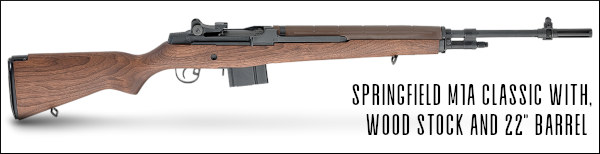
Do you own an M1A rifle? If so, you’ll want to view a new video from Springfield Armory (SA). As part of SA’s new Workbench Video Series, this 9-minute video is a detailed guide to the M1A rifle. The video can benefit any M1A owner or shooter: “These in-depth videos were developed to help new gun owners safely care for and maintain their firearms, as well as provide a useful resource for seasoned gun owners”, notes Steve Kramer of Springfield Armory. In the video, firearms expert Steve Horsman provides a step-by-step guide for the popular M1A semi-auto rifle.
Springfield Armory M1A Workbench Video:
“Descended from the M1 Garand, the M14 utilized multiple improvements that made it a far superior firearm for combat and a much better rifle for competition.” — Dick Jones, Shooting Sports USA.
An evolution of the M1 Garand, the M14 was designed to shoot the 7.62×51 (.308 Win) round instead of the larger .30-06 Springfield cartridge used in WWI, WWII and Korea. While the vast majority of today’s M1As are chambered for .308 Win/7.62×51, Springfield Armory also produces a 6.5 Creedmoor version
For many years, the semi-auto version of the M14 was “top dog” in iron sights Service Rifle competition. Now that discipline is dominated by .223 Rem (5.56×45) AR-type rifles, but the bigger .308-caliber rifle, now sold as the M1A, remains popular. Each summer, the CMP hosts a major M1A Match at Camp Perry, sponsored by Springfield Armory. This is a popular event with 100+ competitors and significant cash prizes.
See how the modern M1A is built in this Springfield Armory Video:
As racing improves automobiles, competition improves firearms, and the current crop of Springfield M1As, from the Basic to the top-of-the-line Super Match and Loaded models, reflects the years of development. The M14 and its variants are … still considered by many to be the best battle rifle in the history of the U.S. Military. — Dick Jones, Shooting Sports USA
How to Install a Scope Mount on an M1A
Folks — there is another M1A scope-mounting video from Springfield Armory which is worth watching. We recommend you watch both videos before starting this task, which requires some specialized tools.
Military Version Operation Revealed — M14 Training Film
The original military version of the M1A was the select-fire M14. The 27-minute official U.S. Army video below demonstrates the operation of the M14. Field-stripping is shown from the 5:13 time-mark through 8:30. Cut-away drawings show the M14’s gas operation at 8:40.
Watch M14 Functioning Cycle Starting at 9:25 Mark:
The M14’s complete 8-step functioning cycle is demonstrated from the 9:25 time-mark through 22:41. These eight operations are: 1) Feeding; 2) Chambering; 3) Locking; 4) Firing; 5) Unlocking; 6) Extracting; 7) Ejecting; and 8) Cocking. This movie is fairly long, but every M1A owner should definitely watch this video start to finish.
Holiday Greetings to Our Readers
Merry Christmas and Happy Holidays to all our readers and especially our 66,500+ Forum Members. This marks our 18th Christmas “in business”, and the site is stronger than ever thanks to our Gold and Silver Forum members and industry sponsors. AccurateShooter.com is now accessed by over 500,000 visitors every month, who enjoy our Shooters’ Forum, Daily Bulletin, Cartridge Guides, and Feature Articles. Part of the reason for that success is the hard work of our dedicated staff and volunteer helpers.
Unsung Heroes Deserve Recognition
I want to acknowledge those guys who have really helped out the site. Number one is skilled F-Class shooter Praveen K. who serves as our System Admin. Along with being a talented trigger-puller, Praveen is a super-smart computer wizard who has kept our servers running smoothly and helped with vital software upgrades. Praveen has also done some key product tests for the site. We also thank Andy B., our Xenforo ace who has contributed vital Forum software solutions.
A huge “thank-you” goes to F-Class John who finds weekly bargains for the Bulletin and tests new products. John produces gear/hardware reviews for the Daily Bulletin with informative videos showcased on his YouTube Channel. John’s work has become a highlight of our Bulletin content. We also regularly feature videos from wind wizard Keith Glasscock, and product tests from Gavin Gear of UltimateReloader.com. We thank Boyd Allen and EdLongRange who supply story leads for the Daily Bulletin. And we wouldn’t be here without Jeff Williams, who handles site donations by mail. We have a great place to test rifles thanks to our valued friend Joe Friedrich. Other important contributors include: Bryan Litz of Applied Ballistics, Bill Marr of Rifleshooter.com, Jason Baney of EuroOptic.com, and Dennis Santiago. These folks have contributed stories, reviews, and videos. I also want to recognize Hunting Editor Colton Reid and Norway’s Thomas Haugland. All these men (and many others) have aided the site.
Praise for our Site Sponsors and Advertisers
We also want to thank our major sponsors, without whose support the site could not provide the full AccurateShooter.com experience, with an active Forum, an archive of in-depth articles, and fresh content 365 days a year in our Daily Bulletin. We’re grateful to ALL our sponsors and advertisers. In particular, we want to acknowledge the major companies which have been strong supporters of this site for many years: Capstone Precision Group (Berger, Lapua, SK, Vihtavuori), Bruno Shooters Supply, Bullet Central, EuroOptic, Graf & Sons, Midsouth Shooters Supply, Powder Valley Inc., PMA Tools, Precision Reloading, Whidden Gunworks, and Zeiss Sports Optics. Their continuing support helps us keep up the flow of information and serve our readers and Forum members.
Proud owner Dirk L. says: “This is my first build — never thought it would be a .308!”
Here’s a handsome F-TR rifle with a beautiful red stock that suits the holiday season. This ruby red beauty was a recent addition to the long-running Pride and Joy Rifle thread in our Shooters’ Forum. The rifle belongs to Forum member Dirk L. (aka “Pinkes”) who hails from South Africa. This is a .308 Win, with 30″ Bartlein barrel, and X-Max action. The stock is a custom composite with carbon fiber for strength and lightness. And yes this rifle shoots as good as it looks. Check out the impressive 5-shot groups below…
X-Max for Xmas — Impressive Metal-work
Along with that beautiful red stock, this F-TR rig has some very cool features, including a South African-crafted X-Max Action. The action designer Piet Welgemoed explains: “The X-Max action body is 17-4PH stainless steel pre-hardened to 44° Rockwell. Bolt and handle are one-piece stainless steel, nitrated to 55° Rockwell 0.2mm deep. Bolt is also fluted. Inside is the firing pin with washers (see below). The washer cuts the lock-time almost by half and also weighs less. The bolt-knob and bolt shroud are CNC aluminum. The action has very tight tolerances.” The complete action with +20 MOA rail and trigger weighs 1.475 kg (3.25 lbs).” Owner Dirk notes that the competition trigger, set at 3.0 ounces, is also Welgemoed’s design.
Wicked Accuracy with Bartlein Barrel, Varget, and 220gr SMKs
This gun has already proven to be a great shooter. Below are two FIVE-shot groups at 100 meters. The group on the left is in the low threes, with three of five shots essentially in one hole. Dirk loads Lapua .308 Palma brass and #2231 200gr Sierra Matchkings, seated 20 thousandths off the lands. The Varget powder and CCI primers drives the 200gr SMKs at 2620 fps.
Brass: Lapua .308 Win Palma (small primer) | Primers: CCI 450 | Powder: Varget
Bullet: New 200gr SMK #2231 | Seating: 0.020″ Off | Velocity: 2620fps
Composite Stock — One of Three by Renier Mostert
And what about that beautiful red stock? The rifle’s owner told us: “This was one of three similar stocks built as a test run by Renier Mostert, a professional composite stock builder and former benchrest shooter from Pretoria, South Africa. Renier was approached by three friends, who were all looking for decent, custom-built FTR composite stocks. There were a number of stocks available to them (mostly imported), but [those] were either made of wood or aluminum. The requirements for the composite stock build was very specific. Aluminum V-Blocks for the actions were required. The stocks had to be light enough to carry some beefy barrels and optics without compromising rigidity and still be within the F-TR weight limit. The three friends supplied Renier with an imported wooden stock as their shape of choice. Although the shape was quite straight-forward, Renier made a few dimensional changes to features which were not symmetrically correct on the sample, and then built a mold from it.”
Renier uses several methods to craft composite stocks for various disciplines: F-Class, benchrest, competition rimfire, hunting, and tactical. For this build he chose to build a shell constructed of a well-planned mix of woven fiberglass cloth and bi-directionally woven carbon fiber with aerospace quality epoxy resin to reduce weight in some areas and increase stiffness in other areas. He used a wet lay-up process where the two halves gets laid up and joined together while still wet to form a complete, continuous shell. The closed mold gets cured under pressure in an oven for several hours at very specific temperatures. After curing, the shell is filled with a high-tech mix of lightweight filler and epoxy resin. The composition of the mix varies in different areas of the stock to facilitate more strength or reduced weight where applicable.
After the initial build, the aluminum hardware was installed. An adjustable cheek piece, Anschutz rail, and adjustable recoil pad mechanism were installed. The stocks were inletted by Renier, while the final fitting and bedding procedures were left for each customer’s gunsmith to complete. The stocks were light enough for the rifles to comfortably be within the F-TR weight limit. A barrel tuner was mounted on one of the rifles, and the rifle still made the F-TR Class weight limit, 8.25 kg (including bipod). The bipod shown in photos in the SEB Joy-Pod.
Paint — Candy Apple Red over Metallic Silver Base
After final gunsmithing, the stocks were returned to Renier Mostert for custom painting. The rifle featured in this article was done in Candy-Apple Red paint from DNA Paints (an Australian company). To get the desired effect, a metallic silver base coat was used, enhanced with a modest amount of medium coarse glitter, followed with multiple layers of candy until the correct shade was achieved. A high-quality automotive clear coat was used to finish off the paintwork.
With snow on the ground and sub-freezing temperatures in much of the country, we hope our readers are staying warn indoors with family members this Christmas Eve day. To provide a bit of entertainment we’ve found six videos that combine a holiday theme with the shooting sports.
In this fun video, YouTube host 22plinkster plays a holiday tune on steel plates. Using a Henry Golden Boy .22 LR lever gun, 22plinkster performs a plate-by-plate musical rendition of Jingle Bells. To hit each tuned plate in the right order takes considerable skill and concentration. But we thank 22plinkster for offering this special holiday shooting range concert.
Here we have 22plinkster once again. He wanted to see how many Christmas ornaments could be penetrated by one .22 LR round. To answer that burning question, he lined up 40 plastic Xmas bulbs in a row and then fired a single round of CCI .22 LR Velocitor ammo through the bunch, using his Henry Golden Boy lever action rifle. Did the bullet penetrate a dozen ornaments? Two dozen? What do you think? Watch the video to find out the surprising answer.
From a modest .22 LR rifle we move on to the real big boomers — military canons. This holiday-themed video shows multiple large-bore artillery pieces. The video is accompanied with a background tune based on the classic “12 days of Christmas”. If you’re a fan of military hardware and history, you should enjoy this clever video from the Matsimus YouTube Channel.
Christmas Gifts for Gun Guys and Gals
Need to do some last-minute shopping for your shooting buddies and/or gun-friendly family members? Here are three videos that provide gift recommendations for gun guys and gals. Suggestions include hunting accessories, knives, reloading equipment, and some handsome handguns and rifles. Warning — you may find a few items you end up buying for yourself.
Kirsten Joy Weiss has created a useful video about Dry-Fire practice. Dry-Fire is a method of training without a live round in the chamber. Dry-Firing is effective, Kirsten explains, because “it eliminates all the extra noise and messages that you get when you fire a live round. Without recoil, without the sound of a shot going off etc., all you hear is the click of the trigger. This allows you to focus on your sight picture and your trigger press.” This the lastest installment in Kirsten’s ‘How to Shoot Awesomely’ series. Kisten says: “I hope it helps you, and keep on aiming true!”
The Benefits of Dry-Fire Training
If you are not doing Dry-Fire practice yet, then it’s time to start. Dry-Fire training is essential to the sling disciplines, and very useful for F-Class. Dennis DeMille, a national Service Rifle Champion, told us that, for every minute he spent in actual competition, he would spend hours practicing without ammunition. While in the USMC, Dennis would practice in the barracks, working on his hold and dry-firing:
“The most important thing is to spend time off the range practicing. Most of what I learned as a High Power shooter I learned without ammunition — just spending time dry firing and doing holding exercises. Holding exercises will really identify the weak parts of your position. The primary purpose of dry firing is to get you used to shooting an empty rifle. If you can shoot a loaded rifle the same way you shoot an empty rifle then eventually you will become a High Master.”
Dry-Fire Training Can Benefit Benchrest Shooters
What about benchrest? Well, we’ve found that Dry-Fire sessions can even benefit benchresters — it can help reveal flaws in your trigger technique, or inconsistencies in the way you address the rifle from shot to shot. With the gun set up with your front rest and rear bag, if you see the scope’s cross-hairs wiggle a lot when you pull the trigger, you need to work on your technique. Also, dry-fire practice can help you learn to work the bolt more smoothly so you don’t disturb the gun on the bags.


 5. Gas Block: You want a gas block that does not impose pointed stress on the barrel. Clamp-on types that grab all the way around the barrel are excellent. The blocks that are pinned on with tapered pins that wedge against the barrel or the slip on type of block with set screws that push up from underneath (or directly on the barrel) can deform the bore inside of the barrel and can wreck the accuracy of an otherwise great barrel.




 Holiday Greetings to Our Readers


 The Benefits of Dry-Fire Training


