Austin Orgain was the top finisher in the 2021 Precision Rifle Series season, winning the Golden Bullet award for the second year in a row, as the Pro Class Open Points Series Champion.
PRS competitor Austin Orgain took home the Precision Rifle Series Pro Series Golden Bullet award for the second year in a row. With his many wins and top 5 performances, Austin is now ranked #1 in the PRS Bolt Gun Series PRO Division. Austin took top Pro Division honors at the PRS Series Finale held Nov. 6-7, 2021 at the NRA Whittington Center in Raton, New Mexico. Some 200 of America’s top PRS shooters competed in the challenging Finale.
Orgain’s PRS match rifle features a PROOF Research steel competition contour .243 1:7.5″-twist cut-rifled barrel chambered for the 6mm Dasher. Note the left bolt action.
Remarkable Record in PRS in 2020 and 2021
Austin Orgain has shot 61 total PRS matches, of which 47 are Pro Series matches. Orgain’s best Pro Series finish was at the 2021 PRS PRO Series Finale match where he finished first (#1) out of 214 shooters. Orgain has won his last three matches straight, for a fantastic finish to 2021:
Winner: November 6, 2021 — 2021 PRS PRO SERIES FINALE Raton, New Mexico
Winner: September 18, 2021 — BOX CANYON SHOWDOWN AG Qualifier, Medicine Lodge, Kansas
Winner: August 28, 2021 — OKIE SUMMER SHOWDOWN, Ninnekah, Oklahoma
PROOF Research’s cut-rifled barrels are designed for extreme accuracy, performance, and reliability under any environmental condition. Orgain commented, “The consistency and accuracy that I see from PROOF barrel to barrel makes my job so much easier. Break one in, load the same charge, and go hammer.” The Competition Contour barrel and all of PROOF Research’s barrels are single-point, cut-rifled, lead-lapped, and thoroughly inspected at multiple quality-control stations.
About PROOF Research
Headquartered in Columbia Falls, Montana, PROOF Research maintains research and manufacturing centers in Montana and Ohio. PROOF Research has developed next-generation composite materials for carbon fiber barrels, premium hunting rifles, and weapon systems. PROOF Research’s goal is to make reduced weight, durability, and match-grade accuracy a reality.
While Austin Orgain shoots with an all-steel barrel, PROOF Research produces advanced carbon-wrapped barrels offering significant weight savings.
Image Courtesy NSSF. This story is based on an NSSF Article.
‘Tis the season of gift-giving (and Christmas Day is nearly here). Perhaps you’re considering giving a a first rifle to your grandson or perhaps a carry pistol to a spouse. When making a gun gift to a friend or family member, however, there are some very important legal considerations. Also the rules on firearms gift transfers vary from state to state. Bottom line here — you need to know the law BEFORE you deliver that shiny new firearm to a family member, close friend, or relative.
The first thing to remember if you’re thinking about giving someone a gun is that … it’s a gun! You already know that ownership of a firearm brings with it some serious legal and ethical obligations that other consumer products don’t. So let’s look at some questions you may have about giving a firearm as a gift.
Image Courtesy NSSF
The first question you have to ask is whether the intended recipient can legally own the firearm where he or she lives. With more than 20,000 different gun laws on the books, even the kinds of firearms that law-abiding citizens can own vary from place to place. For example, juveniles (under age 18) generally speaking are precluded by law from possessing a handgun. Check out the Bureau of Alcohol, Tobacco, Firearms and Explosives (ATF) website for an overview of local laws and, whatever you do, don’t forget that you can never under any circumstances transfer a firearm to someone you know — or have reasonable cause to believe — legally can’t own one. That’s a federal felony, so be careful.
There’s no federal law that prohibits a gift of a firearm to a relative or friend who lives in your home state. Abramski v. United States, a recent Supreme Court decision involving a “straw purchase” of a firearm did not change the law regarding firearms as gifts. The following states (California, Colorado, Connecticut, Delaware, New York, Oregon, Rhode Island, Washington State) and the District of Columbia require you to transfer a firearm through a local firearms retailer so an instant background check will be performed to make sure the recipient is not legally prohibited from owning the gun. Maryland and Pennsylvania require a background check for private party transfer of a handgun. There are exceptions, so it’s important to check the law of your state or ask your local firearms retailer.
Consider a Gift Card Instead of Direct Gift
The ATF recommends that if you want to give someone a new firearm, rather than going to a gun store and buying the gun on your own, consider instead purchasing a gift certificate/card from your favorite gun retailer. Then give that gift card as the present. That way the recipient can choose the exact gun he or she wants, and there’s no question about who is “the actual buyer of the firearm,” which is a question any purchaser must certify on the Federal Form 4473 at the time of purchase. The Gift Card option avoids any “straw purchaser” issues.
These days, online gun Auctions and Classifieds attract more attention than ever. With so many folks accessing the internet daily, many gun owners find it easier to sell their firearms online rather than in the local gun store. Online selling opens up a much larger audience. With over 60,000 members in the AccurateShooter Forum, we have a very active gun Classifieds area. And then of course, there are the big dogs — Gunbroker and GunsAmerica. You’ll find tens of thousands of guns for sale on those big sites.
Before selling your stuff online, you should survey the major online sales and auction sites, comparing their fees and features. The costs are NOT all the same. For example, though you can list an item on Gunbroker for free, if the gun sells you may end up paying a LOT of money. Confirm this with the Gunbroker FEE Calculator. Using Gunbroker’s Fee Calculator we determined that, for a $2500.00 gun, the seller will pay $93.75 in fees! Yes, that’s for a single sale.
That’s why many sellers prefer to list their rifles on Benchrest.com, or on the AccurateShooter.com FORUM Classifieds. Currently, basic Accurate Forum members get three (3) free adverts in a 12-month period, while Gold and Silver members get unlimited classifieds for 12 months. A $25 Silver membership is less than you’d pay to sell one single $550 item on Gunbroker ($25.50 fee).
SEVEN TIPS for Selling Your Gear Online
1. Include Good, Sharp Photos: A custom rifle or expensive optic will sell two to three times as quickly, at a higher price, if you include good sharp photos. We can’t over-emphasize the importance of good photos. For all products, show multiple angles, and include the original boxes if you still have them. For a rifle, include detail shots as well as a photo of the complete gun.
2. Resize Your Photos Before Posting: Half of users will probably be viewing your ads with a smartphone. So you don’t need huge photos. We recommend you size your photos down to 1000 pixels wide. This will make uploads more efficient and ensure the Forum server can handle the file sizes.
3. Be Fair and Complete in Your Description: Buyers appreciate honesty and thoroughness in product descriptions. Potential buyers want details. For a rifle, list the gunsmith, barrel-maker, round count, and provide the specifications. If the rifle has a winning competition history, say so. Always highlight the positives in your description, but you should disclose significant flaws. A buyer will be more willing to purchase if he thinks the seller is 100% honest.
4. Don’t Forget Contact Info: We’re amazed by how many adverts omit key contact info. In a forum classified ad, include a first name, e.g. “Ask for Dan.” We also suggest you list your residence city and state. Some buyers will prefer to buy from a seller in their home state. When communicating with a buyer, provide your phone number and email address. We recommend that all buyers and sellers actually talk live on the phone before concluding high-value deals.
5. Make the Price Attractive: Buyers, everywhere, are looking for good deals. If you want your item to move quickly, set the price accordingly and don’t expect top dollar. Check comparable listings and then discount by 10-15% if you want the item to move fast.
6. Include a Call to Action: Advertisements can be twice as effective if they include a “Call to Action”, i.e. a statement that directly inspires the potential buyer to respond. Sample calls to action are: “Free Shipping — today only.” Or, you can use a time limit: “Special Sale Price good ’til the end of the month”.
7. Always Follow ALL Applicable Laws: Even in states where private face-to-face gun sales are allowed, we recommend ALWAYS using an FFL for firearms transfers. This will protect YOU the seller. In addition, do your homework. Don’t sell to a buyer in a city or state (such as California) state or city where the particular firearm (such as an AR15) may be restricted
Classified Advert vs. Auctions For benchrest, F-Class, Silhouette, Tactical or High Power rifles, you may get the best results posting a For Sale ad on a Forum that caters to the right discipline. You want your ad to reach the right audience. On the other hand, a GunBroker.com auction will have tens of thousands of potential buyers. Realistically, however, if you price your rig attractively, it should sell quickly in a Forum Classified Advert. Plus with conventional Classifieds, you can sell immediately — you don’t have to wait for the auction to end. For scopes and reloading equipment (but not firearms, actions, barrels etc.), also consider eBay, which still allows many gun-related items.
Here’s something you’ve probably never seen before — a rimfire tracer bullet split in half on the blade of a machete. This pistol trick shot is performed by 22Plinkster, an avid rifle/pistol shooter with a hugely popular YouTube Channel. This impressive split bullet demonstration was filmed with high-speed cameras. This lets you see the bullet fly onto the machete blade in slow motion, with red tracer particles streaming behind. And then a freeze-frame clearly shows the two bullet halves after they have passed through two balloons. Check it out:
The high-speed camera (which allows super slow-motion playback) was provided by RatedRR studios. The .22 LR tracer ammunition was provided by Piney Mountain Ammunition Company.
Watch .22 LR Tracer Shooting Montage (Shots Synced to Music):
Here’s a very cool video that shows .22 LR Rimfire Tracer Rounds shot at a variety of targets. There’s a nice musical background that adds to the entertainment value. This video has been viewed over 240,000 times with over 2600 “likes”!
CMP Guide to Target Shooting with Vintage Military Rifles
The Civilian Marksmanship Program (CMP) now offers VMR: Target Shooting With Vintage Military Rifles, an instructional guide by Gary Anderson, Director of Civilian Marksmanship Emeritus. Gary himself was a world-class marksman who earned two Olympic Gold medals in rifle shooting.
The CMP says this 284-page illustrated book is “likely the most comprehensive manuscript ever written about the methods of training and competing with popular American and foreign vintage military rifles.” Fans of vintage military rifles will likely find this 18-chapter book “to be the most complete coverage of the topic, from a competitor’s and historian’s point of view”, said Christie Sewell, CMP Programs Chief. The book is up-to-date, having been released in early 2021.
Anderson definitely has the credentials — he won Olympic Gold Medals in Tokyo and Mexico City in the 1960s. Gary also set multiple U.S. and international records. The originator of the CMP’s competitive vintage rifle program, Anderson set out to present a detailed manual covering all aspects of shooting vintage military rifles. The book covers 1903 Springfield, U.S. Krag, 1917 U.S. Enfield, M1 Garand, M1 Carbine and many more, including rifles from “across the pond.”
Target Shooting With Vintage Military Rifles Topics:
Origins and Fundamentals of Marksmanship
Operation, Cleaning, Loading & Unloading
Sight Adjustment, Zeroing & Fine Tuning
Highpower Rifle Match Procedures
Firing Rifles in Competition
Prone, Sitting and Standing Position Building
Using a Scorebook/Databook
Strategies for Improvement
Critical Value of the Sling
Rifle and Range Safety
Purchase Online at CMP E-Store (When Available)
This informative Gary Anderson book is sold through the CMP E-Store for $29.95. You can also print out and submit the CMP Publications order form (order item NLU # 792, $29.95). The CMP stores in Alabama and Ohio also carry this Gary Anderson book. Unfortunately it is currently back-ordered on the E-Store.
Curious about suppressors (aka “silencers”, “moderators”, or “cans”)? Below you’ll find an informative NSSF Infographic that covers the history, legal status, design, and operation of modern-day suppressors.
Here’s a cool video showing how suppressors work. This video features see-through rifle suppressors filmed with ultra-high-speed (110,000 frame per second) cameras. When played back in super-slow-motion, you can see the flame propagate through the suppressor and the bullet move through each baffle before it exists the muzzle. Check it out!
See Through Suppressor in Super Slow Motion (110,000 fps) — Click Arrow to Watch:
Suppressor Facts — What You Need to Know
In this infographic, the NSSF provides the history, specifications, benefits and uses of firearm suppressors. Don’t suppress your knowledge!
Suppressors reduce gunfire sound levels by using baffles that contain expanding gasses exiting a firearm’s muzzle when ammo is discharged. Suppressors are similar to car mufflers that were, in fact, developed in parallel by the same inventor in the early 1900s. Well-designed suppressors typically reduce the gun sound levels by 30-35 decibels (dB). Suppressors are becoming more popular even though it still takes many months to get approved. In fact, the number of suppressors registered with the ATF grew by over 1 million from 2011 to 2017. That’s a 355% increase.
Women are arming themselves — millions of females now have carry permits and female gun ownership is up 77% since 2005. What factors should women consider when choosing a handgun for self-defense? What are good choices for a lady’s defensive handgun, suitable for concealed carry? Is a self-loading pistol better than a revolver? In this article we include two videos focusing on handgun options for females. The videos cover six key factors: function, size, weight, ergonomics, reliability, and concealability.
Classic Swiss Precision — the Sig P239
The single-stack Sig P239 is an ultra-reliable, compact pistol with a grip suitable for smaller female hands. Weighing 25 oz. in 9mm, it is slightly heavier than polymer-framed handguns, but that may be a good thing. During my handgun training days, this Editor found most women shot the Sig P239 better than Glocks, with more control over recoil. This is a hammer-fired pistol with decocker but no separate safety. There are many other good handgun options for concealed carry — some smaller, thinner and lighter, but the Sig P239 provides a good benchmark for reliability and accuracy. Shown is the .40 S&W model. We prefer the 9mm Luger version. Photo Creative Commons BY-SA 3.0.
Choosing a Self-Defense Handgun — Ladies Explain the Options
Not Just a Guy Thing — Half of New Gun Buyers Are Women
According to the Wall Street Journal, over the past two years, “Close to half of all new U.S. gun buyers since the beginning of 2019 have been women.” And the percentage of female gun owners overall has increased dramatically. Here’s an interesting statistic — according to an NSSF survey, the percentage of gun owners who are female has increased dramatically. The National Shooting Sports Foundation (NSSF) has documented a 77% rise in female gun ownership since 2005, just 16 years ago.
And now nearly one-quarter of American gun owners are female. According to statistics from the NRA, around 23% of women in the U.S. own guns currently, when just 13% did in 2005.
The vast majority of first-time female gun buyers acquire a handgun for defensive purposes. However, the statistics also show that many new female gun owners are also getting involved in sport shooting and/or competitive shooting. An interesting TWAW survey shows that 76% of female gun owners are over 45 years of age, and most are married or in a serious relationship.
NRA News host Cam Edwards has interviewed Celia Bigelow, who has written about the rise of gun ownership among ladies on the Townhall.com website. Follow Cam’s interview in this YouTube video:
Conventional brass jags work great — except for one thing. They can react to solvents, leaving a blue “false positive” on patches. In recent years, jag-makers have experimented with many different materials in an effort to cure the solvent-reaction problem. Today we have polymer jags, nickel-plated jags, and stainless steel jags. And the latest innovation is the aluminum jag from Dewey.
J. Dewey Mfg. offers a series of “Copper Eliminator” jags and brush adapters made from aircraft-grade aluminum with the same hardness as brass. Dewey claims that its aluminum jags will not become embedded with grit or particles that could harm your bore. At the same time, Dewey’s aluminum jags will not react to ammoniated bore solvents that can turn patches blue green when used with brass jags. Dewey aluminum jags are offered with either male OR female 8/32 threads. The $5.25 aluminum jags and $3.70 brush adapters are offered in a wide variety of calibers. You can order these products from Dewey Mfg. or Brownells.
Story Tip from Boyd Allen. We welcome submissions from our readers.
This discussion of rear bag designs and fill levels may offer some new insights for many readers. By “tuning” your rear bag you can reduce hop on shot-firing and help your rifle track better. All that can translate to better scores, particularly with large-caliber rifles.
Tuning Your Rear Sand Bags
Over the years, noted gunsmith and a Benchrest Hall-of-Fame inductee Thomas ‘Speedy’ Gonzalez has learned a few things about “tuning” rear sandbags for best performance. On his Facebook page, Speedy recently discussed how sand bag fill levels (hard vs. soft) can affect accuracy. Speedy says you don’t want to have both your front and rear sandbags filled up ultra-hard. One or the other bag needs to have some “give” to provide a shock-absorbing function (and prevent stock jump). And you want to tune your fill arrangements to match your shooting style. Free recoil shooters may need a different fill levels than bag squeezers (who a softer bag but harder ears).
SAND BAGS & HOW TO FILL THEMby Speedy Gonzalez
I was asked several times by competitors at the S.O.A. Matches and F-Class Nationals as to how I fill my sand bags for benchrest competition. Here is a copy of a reply I gave several years ago:
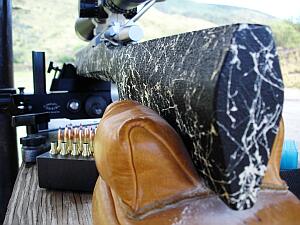
Back in the old days, Pat McMillan told me: “You can not have two bags filled so hard that you gun bounces on them in the process of firing round at your target, especially if you have a rig with a very flexible stock. The bags must be set up in a manner for them to absorb the initial shock of the firing pin moving forward and igniting the primer.
Then [they must] maintain their shape and absorb the second shock wave as well the rearward thrust and torque of the rifle. What happens to the rifle when this is not done? Well let me tell you. The rifles have a very bad tendency to jump and roll in the bags. This causes many of those wild, lost shots that one can’t explain.”
Here’s some Good General Advice for Bag Set-up:
1. You should not have TWO hard bags [i.e. both front AND rear] in your set-up.
2. Heavy sand magnifies these phenomena.
3. If you are a bag squeezer, pack ears hard and leave bag pliable enough to squeeze for the movement required. You may pack front bag as hard as rules permit.
4. Free recoil shooters pack both bags firm, but not so hard as to allow stock jump. Especially if you have a stock with a very flexible forearm.
5. We use play-ground sand, also know as silica sand. I sift mine to get any large impurities out then mix it with 25% to 50% with Harts parakeet gravel to the desired hardness that I am looking for. The bird gravel keeps the sand from packing itself into that solid as a brick state.
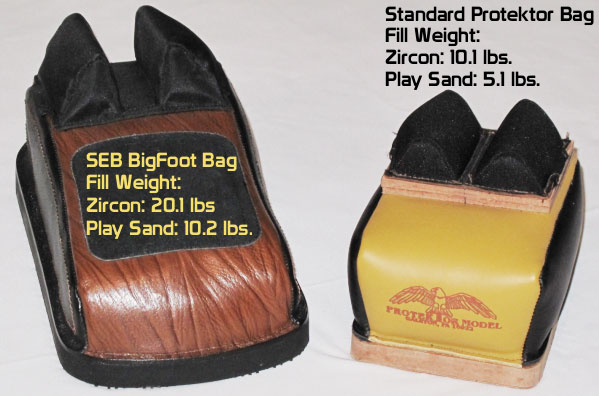
Speaking of bricks — another thing that happens when shooters employ that heavy zircon sand is the ears form a low spot under them from recoil and then tend to rock back and forth with the rifle causing many low shots to crop up. Edgewood makes an Edgewood/Speedy rear bag specially reinforced under the ears to eliminate this scenario.
Show below are the latest SEB Bigfoot Bags. Note that the bags sit perfectly flat — there is no bulge on the bottom even though the bags are “packed to the brim with sand”.
General Thoughts about Bag Construction and Ear Materials
I do not like the solid double-stitched leather bottoms. While this seems like a good idea, I see more shooters have problems because of them. They tend to slide around the bench and or slide with the rifle on recoil. The standard Protektor with Cordura rabbit ears and an Otto ring bag with a Cordura front would be what I would suggest to the new shooter or one of the Edgewood / Speedy rear bags, these mimic the “Donut” and feature a ring of leather around the bottom circumference that keep the bottom from rocking on the bench or ground[.]
One last note –If you use the Cordura bags, keep them sprayed with a good silicon spray or “Rain-Ex”. This keeps them from getting sticky. — Speedy
In 2019 CCI introduced a new type of .22 LR rimfire ammunition. CCI’s innovative Clean-22 Ammo features polymer-coated bullets. This is actually a pretty important development. The bullet coating on CCI’s Clean-22 ammo provides three main benefits:
1. Copper fouling in the barrel is greatly reduced.
2. Lead fouling in the barrel is greatly reduced.
3. Lead build-up in suppressors is reduced by 60-80%.
CCI now offers three versions of Clean-22 rimfire ammunition: High Velocity (#944CC, 40gr, 1235 FPS MV), Subsonic (#934CC, 40gr, 1070 FPS MV), and Suppressor (#980CC, 45gr, 1000 FPS). These all feature lead bullets with polymer coatings. The High Velocity ammo has red-coated bullets, the Subsonic has blue-coated bullets, and the Suppressor version has black-coasted bullets. MSRP is $12.99 for 100 rounds of Subsonic, $11.99 for 100 rounds of Hi-Vel, and $35.99 for 200 rounds of Suppressor variant. There is also a special 400rd Christmas pack of Clean-22 Hi-Vel ammo with Red and GREEN coated bullets. List price is $48.99 for item #946XMAS.
Clean-22 High Velocity: 1235 FPS | Clean-22 Subsonic: 1070 FPS
Clean-22 Ammo with Polymer-Coated Bullets
Clean-22 uses an exclusive polymer bullet coating to greatly reduce copper and lead fouling in the barrel without leaving a residue. It also cuts lead buildup in suppressors 60 to 80 percent. Both the Sub-Sonic and High Velocity loads feature a 40-grain round nose lead bullet with geometry that’s been optimized for accuracy. With dependable CCI priming and consistent propellant, Clean-22 provides reliable cycling through semi-automatics and all 22 LR firearms.


 The first question you have to ask is whether the intended recipient can legally own the firearm where he or she lives. With more than 20,000 different gun laws on the books, even the kinds of firearms that law-abiding citizens can own vary from place to place. For example, juveniles (under age 18) generally speaking are precluded by law from possessing a handgun. Check out the
  Consider a Gift Card Instead of Direct Gift
 These days, online gun Auctions and Classifieds attract more attention than ever. With so many folks accessing the internet daily, many gun owners find it easier to sell their firearms online rather than in the local gun store. Online selling opens up a much larger audience. With over 60,000 members in the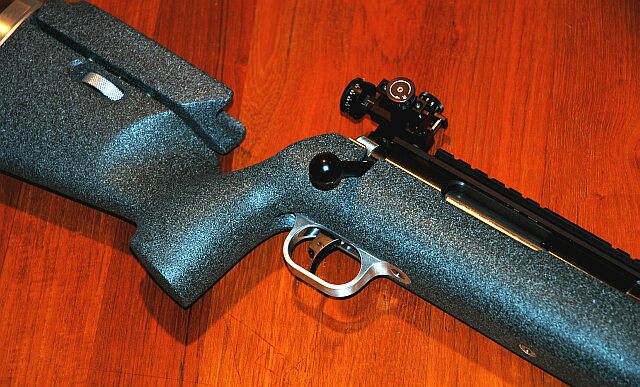
 For benchrest, F-Class, Silhouette, Tactical or High Power rifles, you may get the best results posting a For Sale ad on a Forum that caters to the right discipline. You want your ad to reach the right audience. On the other hand, a GunBroker.com auction will have tens of thousands of potential buyers. Realistically, however, if you price your rig attractively, it should sell quickly in a Forum Classified Advert. Plus with conventional Classifieds, you can sell immediately — you don’t have to wait for the auction to end. For scopes and reloading equipment (but not firearms, actions, barrels etc.), also consider eBay, which still allows many gun-related items.


 Back in the old days, Pat McMillan told me: “You can not have two bags filled so hard that you gun bounces on them in the process of firing round at your target, especially if you have a rig with a very flexible stock. The bags must be set up in a manner for them to absorb the initial shock of the firing pin moving forward and igniting the primer.


