The Oklahoma CMP Games & CMP HP Rifle Matches will be held October 17-24, 2021 at the Oklahoma City Gun Club. The CMP Highpower Match schedule includes two CMP 800 Aggregate Matches followed by a 4-Man Team Match and EIC Service Rifle Match. Following the HP matches are the CMP Games events. The CMP Games Matches include Rifle Marksmanship 101 & M16 Match (formerly SAFS), GSMM Matches, Carbine Match, Rimfire Sporter Match, and Vintage Sniper Team Match. If you’re anywhere near Oklahoma City next week you might want to check out the action.
NOTE: The CMP’s Oklahoma Games are not just for seasoned competitors. There will be a Small Arms Firing School plus a New Shooter Clinic for those who have never shot a CMP Games match before. And the Rimfire Sporter match is popular with novice shooters, who can can compete with very affordable rifles.
Electronic Targets Allow Faster Relays and No Pit Duty!
The High Power range will be set up with Kongsberg Electronic Targets (KTS). The KTS system registers each shot and relays the location and score value to a monitor beside each shooter on the firing line. Wireless monitors are placed at each firing point so competitors can immediately view their shot placements. Scores are tallied automatically by the KTS system.
GSM New Shooter Clinic Plus M1 Maintenance Clinic
There will also be a GSM New Shooter Clinic and an M1 Maintenance Clinic held during the week. CMP Sales will be at the event with a limited supply of rifles. Ammunition and CMP memorabilia will also be available for purchase.
VINTAGE SNIPER MATCH — Wednesday, October 20th
The 2021 Oklahoma Games will include the popular Vintage Sniper Team Match. Competitors must use Korean War or earlier, as-issued military sniper rifles or replicas of those rifles. Optics must also be original issue or replica scopes from the same period. The CMP Games Rules lists the approved rifles and optics.
The course of fire is designed to reproduce the conditions under which skilled long-range military riflemen operated. Two riflemen work together as a team. During the match, each team member functions alternately as a shooter or a spotter. After one team member finishes firing, they switch roles and the other team member fires. Firing is done at distances of 300 and 600 yards from the prone position. Shooters may use either a sling or sand bag support, but not both. Wind doping is critical and firing must be done quickly; targets are exposed for each shot for only 20 seconds and then withdrawn for 20 seconds.
Pistol Competitions for Centerfire and Rimfire
There are also several pistol matches including CMP As-Issued 1911 Pistol Match, Military & Police Service Pistol Match, 40 Shot Pistol Match, EIC Service Pistol Match, CMP .22 Rimfire Pistol EIC Match and Pistol 2-Man Team Match. A Pistol Marksmanship 101 training class will also be held.
About the CMP Travel Games
The CMP Travel Games are regional competitions held in different corners of the country throughout the year, featuring exclusive CMP rifle and pistol outdoor events. A common part of the CMP schedule for the last decade, the Games are centered around recreation-oriented competition and educational activities that are designed to accommodate experienced marksmen as well as those just beginning the sport.
For more information about the Oklahoma CMP Games, email Competitions@TheCMP.org or call 888-267-0796, ext. 714.
A “10.9” is a perfect shot in Olympic and ISSF smallbore and airgun shooting. Since today is the ninth day of October, officially 10/9/2021, Creedmoor Sports is running a special 10.9 FREE SHIPPING promotion. To celebrate the PERFECT shot this weekend, Creedmor Sports is offering Free Shipping on orders over $109 (with some exceptions). Use promo code PERFECT at checkout. This offer runs through Monday 10/11/21 at 11:59 pm. See website for details: Creedmoorsports.com.
What is a 10.9 Score — Isn’t a 10 the Highest Value?
Under ISSF rules, “The final score is made of decimal points, with the maximum score per shot being 10.9.” You get extra value, above 10 points, by placing your shot in the very center of the ten ring, as shown in red in the photo above. The maximum score is a 10.9.
Bill Lee, former U.S. Olympic Shooting Team Member, explains the 10.9 score in a Quaro Post:
A 10.9 would be a DEAD-CENTER shot.
ALL ISSF events that previously uses paper bullseye targets with numerical scoring rings have switched to electronic targets since the conclusion of the 1988 Olympics. From this point forward decimal points scoring was introduced, initially for only the finals for both rifle and pistol. Still, in recent years all rifle events’ in both preliminary/qualifying AND the FINAL stage of the match are entirely scored in decimal points. In contrast, the pistol events, only the finals are scored down to decimals.
Why? To break ties, and see who CONSISTENTLY comes close to dead center hit with every shot, of course! They don’t call it the Olympics for nothing.
A 10.5 is a shot that “nicks” the lines on the inner 10-ring (It’s the smallest circle on ALL ISSF bullseye rifle and pistol targets). — Bill Lee
If a shot just slightly cuts the outside of the 10-ring (2nd smallest circle), it’s a 10.0.
Terms of 10.9 Special Offer at Creedmoor Sports
This is a limited time offer for Free Shipping for orders over $109.00 dollars. Use Promo Code PERFECT at checkout. The FREE shipping for orders over $109.00 applies to all Creedmoor Sports departments (see below), but there are exclusions for certain, specific products: “Some exclusions apply (Hagar brass, ammunition, tumbler media, portable air gun ranges, targets, kneeling roll pellets, cleaning rods, and posters. Drop shipped items (all Giraud and Gracey products, Big Shot Tumblers) are excluded.”
Creedmoor Sports Departments — Ammo, Guns, Gear, Optics, Tools, Targets, Coats and More
The Three Amigos in New Mexico (L to R): Kelly McMillan, Paul Phillips, Derek Rodgers.
Three years ago nearly to the day, Kelly McMillan, Derek Rogers, and Paul Phillips enjoyed the fellowship and satisfaction of a successful New Mexico Antelope hunt. But sadly, Kelly passed away on June 1, 2021 from rapid, unexpected medical issues. Yesterday, October 7th, 2021, Paul Phillips posted: “Three years ago today. This hunt with Kelly McMillan and Derek Rodgers was a great memory. I miss Kelly.” Yes Paul, scores of us who counted Kelly as a friend and colleague miss him, and think of him often.
This isn’t your typical hunting story, because these weren’t your typical hunters. Derek Rodgers is the reigning F-TR World Champion, and past King of 2 Miles. Paul Phillips is the 2019 King of 2 Miles and a member of the Silver Medal-winning F-TR Team McMillan at the 2018 Nationals. The third hunter, Kelly McMillan, needs no introduction. The past owner of McMillan Fiberglass Stocks, Kelly was a leading figure in the gun industry for decades. He also supported many top rifle shooting teams. This story helps us remember Kelly and all he did for the shooting sports.
In October 2018, these three friends got together for a very successful hunt in New Mexico, Derek’s home turf. All three bagged an impressive Antelope, with Paul Phillips dropping the biggest buck of all. Derek made the longest shot, hitting his buck at an impressive 510 yards, verified by laser rangefinder.
Paul Phillips posted: “Our New Mexico Antelope hunt with Kelly McMillan and Derek Rodgers was a success. To hunt with these two icons was definitely on my bucket list. I shot my buck at 389 yards in an 18-mph wind through a barbed wire fence.” It was a big trophy buck, measuring 84 3/8 inches.
Derek nailed his Antelope at 510 yards with a .308 Win fitted with a suppressor. As dusk approached, despite blustery wind and rain, Kelly dropped the third Antelope with a great 230-yard shot from a broken tree crotch. Paul noted: “All three bucks had their own challenges and funny story. All three hunts required team work with stalking, communication.” The three hunting buddies all had top-quality rifles built with McMillan stocks of course.
For long-range hunting you need to have your drops absolutely “spot-on”. Paul posted: “When you do a 30-45 minute stalk… you need to have all your ballistics perfect or they get away. We were glad that we had a practice day before the hunt to confirm our zeros and verify our ballistics.”
Kelly noted: “Paul Phillips scored this nice 80″+ buck in New Mexico. It was Paul’s first antelope.” The .338 LM rifle featured a Stiller TAC338 action, Bartlein 20″ barrel, McMillan A5 Stock, and Nightforce ATACR scope. In the Facebook video, Paul talks about making the shot, directly into the wind.
Both of Kelly’s Amigos — his hunting partners — were profoundly saddened by his passing. They miss him, as do all of us who knew Kelly.
Derek Rodgers wrote of his friend and hunting partner: “It is difficult to tell you how deeply saddened I feel about the loss of Kelly. What started as a shooting relationship quickly became a close friendship so many years ago. It was a privilege to know Kelly on a personal level and I will never forget his generous, caring nature and the never-ending kindness he had for others. He will forever be missed.”
Paul Phillips posted: “I have no words to express how saddened I am … we lost an icon in the shooting industry. Kelly McMillan was not only a great friend but the most generous and giving man I knew in the industry. There is not enough space to write about everything he did for competitive shooters, military snipers, hunters, and shooting enthusiasts. You were one-of-a-kind Kelly and I will forever remember your friendship and how big an advocate you were for shooting sports. R.I.P. my friend.”
Over 8 million Americans purchased their first firearm, typically handguns, since the start of 2020. These first-time gun owners definitely need training. In addition, all CCW permit holders should definitely practice regularly. For many, pistol practice is an indoor experience. Indoor ranges are most convenient for those who live near urban centers, where the biggest threats to public safety currently exist. This article covers indoor firearms training and the proper procedures you should follow at indoor ranges.
This Video Covers Basic Gun Range Safety Rules and Etiquette
FIVE IMPORTANT SAFETY PROCEDURES for Indoor Ranges
1. Follow the Three Fundamental Rules for Safe Gun Handling
ALWAYS keep the gun pointed in a safe direction. ALWAYS keep your finger off the trigger until ready to shoot. ALWAYS keep the gun unloaded until ready to use.
2. Follow ALL Range Officer Instructions
ROs are the first and final authority on any range and their decisions are generally final. Arguing with a Range Officer may just get you thrown out.
3. Don’t Bother Others or Touch Their Guns
Respect other shooters’ privacy unless a safety issue arises. Do NOT engage other shooters to correct a perceived safety violation unless absolutely necessary – inform the RO instead. NEVER handle or touch another shooter’s firearm without their permission!
4. Know Your Range’s Rules
Review and understand any and all range rules and requirements/expectations. For example, what is the range’s maximum rate of fire? Are you allowed to collect your brass?
5. Know What To Do During a Cease Fire
IMMEDIATELY set down your firearm, pointed downrange, and STEP AWAY from the shooting booth (or bench). Range Officers do not want shooters trying to “secure/unload” their firearms in a cease fire situation — they want the shooters separated from their guns instantly.
Double-Up on Hearing Protection When Shooting Indoors
When shooting indoors we recommend quality muffs with earplugs underneath, offering double protection. When inside an enclosed range, with other shooters blasting away right next to you, you really need effective hearing protection. But you also need to hear range commands and be able to communicate. That’s why we recommend electronic muffs with quality plugs underneath. We recommend the NRR 33 Howard Leight Max-1 Plugs. These tapered plugs are comfortable, easy to insert, and have a flared end for better sound seal.
On top of those plugs, run high-quality muffs. For indoor ranges where sound levels can be extremely high, we recommend Howard Leight Impact Pro Muffs. These offer an impressive 30 dB Noise Reduction Rating (NRR) and the effective noise reduction can be improved by 4 decibels or more by running plugs as well.* These muffs are pretty comfortable and offer Headphone Functionality so you can connect to your smartphone, MP3 player, or other audio device. These muffs are a good value, an Amazon’s Choice for $57.47.
* Four decibels may not sound like much, but remember the decibel measurement system is logarithmic, so four decibels is VERY significant. We have discussed the merits of “doubling up” hearing protection with Ph.D. sound engineers. They told us that a combination of muffs and plugs could reduce effective noise levels by up to five decibels compared to plugs alone. In addition, good muffs will block bone conduction sound energy better than plugs alone.
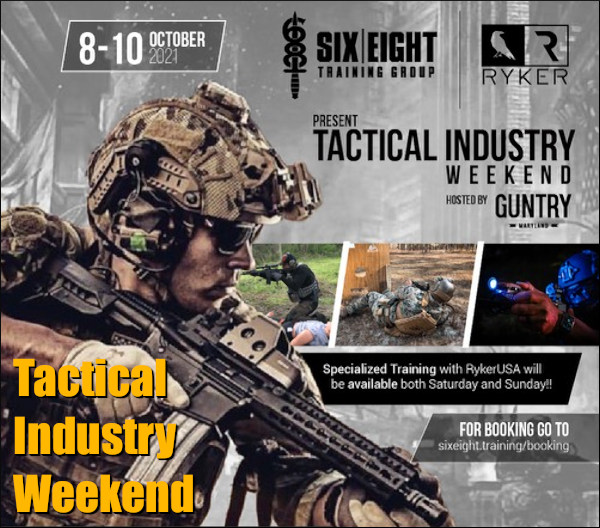
GUNTRY of Maryland is hosting the first Tactical Industry Weekend on October 8-10, 2021. Presented by Six Eight Training Group and RYKER USA, this mini-Expo is a weekend-long event for industry professionals, manufacturers, retailers, and consumers. The main focus is on defensive firearms — pistols, semi-auto rifles, and shotguns. There will be plenty of the latest Black Rifles and accessories on display. This is an opportunity to check out/demo new gear at a state-of-the-art shooting center with vast indoor range offerings along with sophisticated computer-controlled simulator rooms. Participating vendors will have products for demo and purchase.
Vendors at the event will include: MantisX, RYKER USA, Roger That, Six Eight Training Group. Special Operations Recruiting Battalion, UNIT Solutions, Wilder Tactical, U.S. Law Shield, and Vertx.
About GUNTRY of Maryland GUNTRY of Maryland is in a league of its own. The 64,000 square-foot facility is the premier shooting and training facility on the East Coast. It features 34 indoor live-fire shooting ranges, a fully immersive state-of-the-art simulator, on-site gunsmithing services, and a full-service café. The facility has garnered more than 100 five-star reviews>
“Building an expo where consumers can meet face-to-face with industry professionals, manufacturers, retailers, and media to try their hands at new gear and learn about personal defense is how we convey our commitment to the right to bear arms,” said Ron Holmes, USMC MSgt (Ret.), Director of Training and Product Development for RYKER USA. “We are especially thankful to have U.S. LawShield as an important partner in promoting awareness of self-defense as we educate law-abiding gun owners.”
According to P.J. Hermosa, CEO of U.S. LawShield, “We expect the first annual Tactical Industry Weekend at the renowned GUNTRY Range of Maryland to be a stellar success.”
Real Avid has introduced a new, specialized gun vise with notable features and unmatched versatility. Read Avid states that its new Master Gun Vise is the “first real bench vise made exclusively for guns and gun tools.” This vise articulates and swivels easily so you can place your gun/barreled action in different orientations without ever removing it from the vise. The supplied, reversible Gun-Fit jaw sleeves will adapt to a variety of stock/forearm styles — from ARs to fancy wood shotguns. The special Torq-Lok pin provides additional locking power to secure the angle/orientation of the vise jaws when working on heavy rifles or barreled actions.
Master Gun Vise: Build, Repair, Clean, and Customize Your Guns
The base of the vise features an articulating ball and socket joint with the adjustable Speed-Cam Lever that applies pressure to the joint allowing the vise and gun to be positioned in any orientation the user desires. An additional Torq-Lok pin is ready for heavy torque applications. This removable pin intersects the ball and socket joint locking it into the base. The locking pin can be inserted every 90 degrees with the vise in either the vertical or horizontal position. That ball joint lets you set the jaws at various angles, to make work easier. For example you can tilt your gun to a muzzle-down position for easier cleaning. SEE Video above.
Early testers of this new DIY Gun Vise were impressed: “We did a soft launch on this product a couple weeks ago and were amazed at the vast number of military [users], gun manufacturers, and law enforcement agencies that were jumping to get this new vise. These are people who work on and build guns for a living and the benefits were apparent to them immediately. That really confirmed for us we had created something revolutionary”. — Chris Witte, Real Avid Mktg. Director.
Respected gunwriter Tom McHale reviewed the Master Gun Vise for American Handgunner magazine: “I use this setup more than anything as an extra pair of hands … the Real Avid Master Gun Vise is, bar none, the handiest tool on my bench. It’s great for cleaning, repairing, tinkering, installing, inspecting, assembling and disassembling. Heck, you can even use it to mount optics with the precision leveling knob.”
Accu-Level Knob Allows Rapid, Precise Angular Adjustments — Great for Scope Mounting
The Master Gun Vise include an innovative Accu-Level leveling knob. This allows the vise to be tilted 3 degrees to either side (6° total) for making micro-adjustments when leveling guns for optics mounting. This precise leveling can be accomplished without having to reposition the firearm in the clamps.
The vise also comes with reversible Gun-Fit sleeves that can be easily installed or uninstalled with pins that lock them in place. One side features a high-density foam pad providing a compression fit to firmly grip cosmetic surfaces. While the other side is a rigid nylon with grooves to secure gun parts, picatinny and Arca Swiss rails, barrels, silencers and more.
Special Accessories for AR-Platform Rifles
Real Avid has some special accessories for working on AR-15s and AR-10s. Sold separately, the adjustable Smart-Fit AR15 Lower Vise Block and the Lug-Lok Upper Vise Block (available in two versions, AR15 and AR10) integrate seamlessly with the vise jaws and firmly lock into place. The Lug-Lok eliminates jaw slippage when applying heavy torque to AR barrel nuts and muzzle devices.
Hunting season is here. Time to organize your gear before heading to deer country. If you don’t have a quality, compact Laser Rangefinder, here’s a great deal. The 7x25mm SIG Sauer Kilo 2200 BDX Rangefinder is now on sale for under $350.00. This is an accurate LRF that ranges deer-sized targets at long distances quickly. The scan mode is fast and very effective. The unit is compact and light — a bonus for hunters.
This SIG LRF sold for over $500.00 when it was introduced. Now you can save 30%, with the Kilo 2200 BDX selling for just $346.99 at Amazon, with Free Shipping. Given its performance, that’s a steal. (With very similar performance, the SIG Kilo 2200 BDX is less than half the price of SIG’s Kilo 2400 BDX, $799.99 on Amazon.) We have tested a variety of LRFs from Bushnell, Leica, Leupold, Sig, Swarovski, and Zeiss. This SIG Kilo 2200 BDX will run with anything in the sub-$500 price range. If you are looking for a small LRF that can fit in a shirt pocket, this Kilo 2200 BDX is a good choice. Glass is good, controls are good, ranging capability is good. Light-Wave DSP Technology enables the Kilo 2200 BDX to range extremely fast. Scan mode refresh rate is an ultra-fast 4 times per second. The unit’s “smart” OLED Lumatic Display automatically runs bright in full sunlight, while dimming down to low levels at dusk and dawn.
And the BDX (Ballistic Data Xchange) capability is a big bonus if you have a compatible SIG Sauer BDX riflescope. This rangefinder can communicate with BDX scopes or phone Apps, providing ballistics solutions. Using Bluetooth, the built-in BDX system sends an illuminated holdover dot to any Bluetooth-enabled SIG Sauer BDX scope. Even with a conventional scope, the SIG Kilo 2200 BDX rangefinder will communicate with a free ballistics App on your mobile device.
SIG Kilo 2200 BDX Verified Buyer Reviews
Read the reviews on Amazon. 87% of verified buyers gave this SIG LRF Five Stars:
Five Stars: “I spent a lot of time agonizing over which rangefinder to purchase, and I’m glad I went with this one. I’ve easily ranged objects out to 1300 yards. Pairing it with the Sig Sauer BDX App and imputing some ballistic and wind data shows me MOA adjustments both in the App and directly in the rangefinder while I’m ranging.” (Review by A. Kirzner, June 2020)
Five Stars: “Amazingly fast and accurate readings. The fact that they pair with Bluetooth to the ballistics App on my phone makes long range shooting much easier.” (Review by Eric A., May 2019)
Five Stars: “Quick to acquire target, easy to use, red reticle works great in low light conditions.” (Review by Brian C., October 2019)
And here is a review of the previous model, the SIG Kilo 2000: “It’s small — palm-sized. If you’re a backcountry shooter and every ounce counts, you can wear this unit around your neck all day long. In my experience and opinion, the Sig Kilo 2000 is an amazing laser rangefinder at a very reasonable price. When it comes to the raw function of a laser rangefinder, to give accurate, repeatable distance measurements within your target range, the Sig Kilo 2000 blows away anything even remotely close to it in its price range.” (Review by Verified Customer, July 2016)
Today Shooting USA TV features the 2021 Bianchi Cup, hosted May 24-28, 2021 at the Green Valley Rifle & Pistol Club in Hallsville, Missouri (near Columbia). The 2020 Bianchi Cup was cancelled due to COVID. In 2021 the four stages of fire are back, but without international competitors, who were locked out due to pandemic travel restrictions. But there was still plenty of superb marksmanship.
This episode of Shooting USA airs Wednesday, August 18, 2021, 9:00 PM Eastern and Pacific, 8:00 PM Central on the Outdoor Channel. Shooting USA is also available On Demand via Vimeo.com.
Officially, the annual competition is known as the National Championship of NRA Action Pistol. But its is generally called the Bianchi Cup — from the trophy named for one of the founders, John Bianchi. In the past 30 years the match has become the richest handgun tournament in the world, with cash and prizes for the best scores on four stages of fire.
The Bianchi Cup has been called the most prestigious pistol tournament in the world. After the cancellation of the 2020 Bianchi Cup due to COVID-19 restrictions, bringing the match back for 2021 involved challenges given health and safety protocols. In 2021 the NRA turned the organization and management of the match over to a new group from the Green Valley Rifle and Pistol Club. And the international competitors, who have previously made up much of field of competitors, are not able to shoot with the continuing travel restrictions for COVID-19.
Due to the high accuracy required in each stage of the Bianchi Cup, the tournament is considered one of the most difficult handgun championships on the planet. To finish on top, you have to be near-perfect. Ace shooter Carl Bernosky (shown above) explains: “To win a Bianchi Cup you’ve got to be consistent. You’ve got to shoot good ALL the time… you can’t make any mistakes.”
Bianchi Cup — the Richest Handgun Match on the Planet
Over the past 30+ years the Bianchi Cup has become the richest handgun event in the world, with cash and prizes for the best scores on four stages of fire for both revolver and semi-auto pistol divisions.
Bianchi Cup — Classic Course of Fire
The Bianchi Cup is a combination of Speed and Accuracy. Competitors shoot from both standing and prone positions and are also required to shoot with both strong and weak hands at various stages. Stages may combine stationary and moving targets. As conceived by former police officer and holster-maker John Bianchi, the Bianchi Cup originated in 1979 as a Law Enforcement Training match. The Course of Fire consists of four separate matches:
The Bianchi Cup is scored on the Aggregate of the four (4) fired events: Practical, Barricade, and Moving Target, and Falling Plates. Each of the four events requires 48 shots to complete. 480 points possible on each event. Three of the four are scored on the NRA tombstone P1 target. You must hit in the 10-ring or inner X-Ring on EVERY shot to shoot a “clean” 1920.
Four Divisions in 2021 Bianchi Cup
There are now FOUR divisions at the Bianchi Cup, three traditional, and one new this year. First, the Open Division includes the guns specifically built for this competition with every enhancement possible to improve accuracy. Second, the Metallic Division includes purpose-built guns but without red dot optics, compensators and barrel shrouds. Third is the Production Division for minimally-enhanced factory guns, typically with polymer frames.
New for the 2021 Cup is the fourth category, the Production Optics Division. This includes minimally-enhanced production guns with a slide-mounted red dot optic. It was interesting to see the action with this new Production Optics class. Shown above are Glock and S&W production pistols fitted with Leupold’s new, low profile Delta-Point Red Dot Optic.
October is Halloween month, so we thought we’d share the seasonal spirit with our readers. In this video, our friend Kirsten Joy Weiss shows off her impressive trick-shot skills. To help celebrate the gouls/goblins holiday, Kirsten “carved” a pumpkin using her semi-auto Volquartsen .22 LR rifle. Kirsten had to send a lot of rimfire rounds into her orange friend. It turns out the little .22-caliber bullets worked better on exit than entry — Mr. Pumpkin’s posterior side was more impressive than his front. But overall, the effort turned out very well indeed, as you can see. Nice job, Kirsten.
On inspection, Kirsten found that the most impressive Jack ‘O Lantern face appeared on the reverse side of her pumpkin. The “exit wounds” were better than the entry holes.
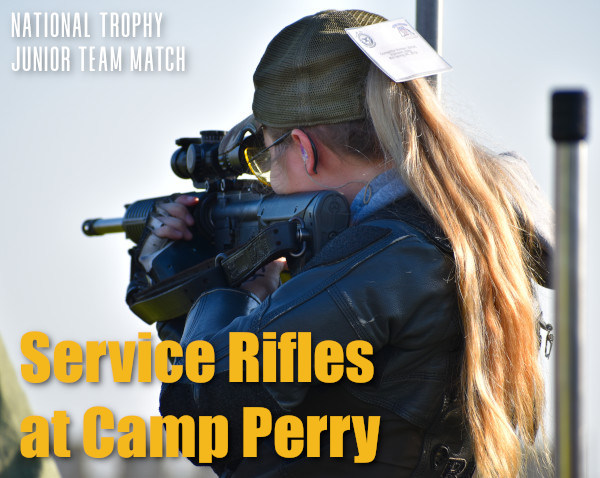
Hi-Lux Optics has created three videos of interest to across-the-course and service rifle competitors. The first video highlights the appeal of service rifle shooting, with comments from 2021 Camp Perry competitors. The second video offers five tips for new service rifle shooters. The third video focuses on the CMP matches at Camp Perry this past summer. If you have ever wanted to share the Camp Perry experience, this last video provides a great over-view of the event.
Four Reasons to Shoot Service Rifle
Service Rifle shooting is fun yet challenging. You need to develop skills with multiple positions and be able to make rapid wind calls. However, the modern AR-based service rifle is affordable and has relatively low recoil. Highly-customizable, modern service rifles can be fitted with adjustable stocks and optional magnified optics. Older military rifles, such as the M1A and M1 Garand, offer different challenges with heavier-recoiling cartridges, greater weights, and classic iron sights. Hi-Lux asked competitors at Camp Perry during CMP’s 2021 summer games what they enjoyed most about competition with service rifles and Military rifles such as the M1 Garand. The shooters’ responses had four key themes: Self-Improvement, Comradery, History (enjoying shooting rifles with heritage), and Challenge.
Five Tips for New Service Rifle Shooters
This summer at Camp Perry, Hi-Lux reporters asked competitors “What advice do you have for new shooters getting into service rifle?” The most common responses, explained below, were: Keep Learning, Don’t Quit, Stay Calm, Practice Fundamentals, and “Get Started!”. These tips will actually apply to a wide variety of shooting disciplines.
00:21 Keep Learning
Every shot you take is a learning experience. There are so many ways to learn — talk to fellow shooters, watch training videos, attend a training clinic such as those hosted at the CMP Regional Games. Don’t be afraid to ask, and never stop learning.
01:38 Don’t Quit
You may hit a performance plateau. Don’t let that stop you. The only way to get better is to continue moving forward. Persevere and continue your training off-season with dry-fire practice.
03:10 Stay Calm and Focused
Go into each shot with a clear and empty mind. While you’re up on the line, it’s just you and your rifle.
04:20 Practice Fundamentals
With the right mindset in place, practice will strengthen your fundamentals. Dry firing can reveal issues with follow-through and trigger pull that might not be noticeable under recoil. This is especially true with offhand shooting.
05:48 Get Started
You’re not too old to start a new discipline. There are many free clinics available, and many local ranges have regular service rifle competitions where you can hone your skills. Learn more about Service Rifle shooting clinics on the CMP website.
The 2021 National Matches at Camp Perry — Return of the Games
After cancellation in 2020 due to COVID, the CMP National Matches at Camp Perry returned in summer 2021 with a full selection of matches for pistol and rifle. This video showcases the unique experience that is Camp Perry — the leading venue for American marksmanship competition since 1907. The video covers different disciplines, including Service Rifle, M1 Garand matches, Vintage Sniper, and more.
History of Camp Perry
“In the year 1907 the machinery of the National Matches, now grown to immense proportions, was moved to the mammoth new range at Camp Perry.”
—James Drain, Arms and the Man, August 1911
Federal legislation originally launched the National Matches. The 1903 legislation also established the National Matches, commissioned the National Trophy and provided funding to support the Matches. The National Matches have been held at Camp Perry since 1907. The range is located along the shores of Lake Erie in northern Ohio near Port Clinton. The site was first acquired in 1906, in response to the need for a larger facility for military training and the NRA’s shooting programs. In 1906 Gen. Ammon B. Crichfield, Adjutant General of Ohio, ordered construction of a new shooting facility on the shores of Lake Erie, 45 miles east of Toledo, Ohio. The original land for Camp Perry was purchased in 1906, and the reservation was named after Commodore Oliver Hazard Perry, the American naval commander who won the Battle of Put-in-Bay during the War of 1812.
On August 19, 1907, Cpl. L. B. Jarrett fired the first shot at the new Camp Perry Training Site. And that year, 1907, Camp Perry held its first National Pistol and Rifle Championship events. This location has hosted the annual National Matches ever since (though they were cancelled in 2020 due to COVID). Typically over 4,000 competitors attend the National Matches each year, making it the most popular shooting competition in the western hemisphere.