We all know reloading powder is in VERY short supply these days. And the most popular propellants, such as Varget, H4350, and Reloder 16, are almost impossible to find at reasonable prices. Thankfully, there is a new solution in the works — smaller containers. This should give handloaders a whole new way to source those precious powders needed for a day at the range. And even if the volume is limited, something is ALWAYS better than nothing, right?
The big (and small) news for reloaders is that the major powder suppliers plan to start shipping powders in more compact, easy-to-ship containers. Instead of buying a pound of powder, you will be able to purchase an efficient, handy 1000 grain container. These are light weight (just 1/7th of a pound) so they are convenient to transport and carry. And you’ll never have the problem of over supply. A 1000-grain container with load approximately 33 6mm BR rounds — that should be plenty for a day at the range. We’re blessed to have this new compact powder option thanks to the U.S. Department of Transportation (DOT).
The U.S. Department of Transportation (DOT) recently approved new smaller containers for shipment of smokeless powder. The new containers are designed to hold 1000 grains, exactly one-seventh of a pound. That works out to 2.29 ounces of powder — quite a bit less than you are getting currently with one-pound (16 oz.) containers.
Here how it works out:
7000 grains = 1 pound = 16 ounces
1000 grains = 0.143 pounds = 2.29 ounces
Many products — from cereal boxes to Snickers bars — have been down-sized in recent years. Now downsizing has come to the powder marketplace. The strategy behind the smaller containers is simple. In a market where demand vastly outstrips available supply, the smaller containers allow powder-makers to generate more revenue with a given amount of powder inventory. Will consumers accept the smaller powder containers? Probably so — 1000 grains is enough to load 20-22 rounds of .308 Winchester. In the current marketplace (with many powders virtually impossible to find), most consumers would probably prefer to get 2.3 ounces of their favorite powder, rather than nothing at all. (NOTE: The major powder suppliers will continue to offer popular powders in 1-lb, and 8-lb containers. The new 1000-grain containers will be phased-in over time, as an alternative to the larger containers).
Why the small bottles? One industry spokesman (who asked not to be named) explained: “We’ve had a severe shortage of smokeless powder for nearly two years. The powder production plants are running at full capacity, but there’s only so much finished product to go around. By moving to smaller containers, we can ensure that our customers at least get some powder, even if it’s not as much as they want.”
Why are the new containers 2.3 ounces rather than 8 ounces (half a pound) or 4 ounces (one-quarter pound)? One of the engineers who helped develop the new DOT-approved container explained: “We looked at various sizes. We knew we had to reduce the volume significantly to achieve our unit quantity sales goals. Some of our marketing guys liked the four-ounce option — the ‘Quarter-Pounder’. That had a nice ring to it, but ultimately we decided on the 1000 grain capacity. To the average consumer, one thousand grains sounds like a large amount of powder, even if it’s really only 2.3 ounces. This size also made it much easier to bundle the powder in six-packs. We think the six-packs will be a big hit. You get nearly a pound of powder, but you can mix and match with a variety of different propellants.”
Less Bang for Your Buck?
We’re told the new 2.3-ounce powder bottles will retail for around $11.99, i.e. about $5.21 per ounce. At that price, it may seem like you’re getting less bang for your buck … but hey, something is better than nothing, right?
Currently, when you can find them, quality reloading powders are going for $45-$60 per pound (in 1-lb containers). At $45 per pound, you’re paying $2.81 per ounce. That means that the new mini-containers will be roughly twice as expensive as current one-pounders ($5.21 per ounce vs. $2.81 per ounce).
Along with the 2.3-ounce containers, the DOT has approved “six-pack” consolidated delivery units that will hold six, 1000-grain containers. Some manufacturers plan to offer “variety packs” with a selection of various powders in the 1000-grain bottles. Wouldn’t it be cool to have a six-pack with H322, H4895, Varget, H4350, H4831sc, and Retumbo?
Hornady’s Handbook of Cartridge Reloading (11th Edition) is coming soon. This latest 11th Edition features new bullets, new cartridges, and a significantly expanded range of reloading powders. This is a worthy addition to any hand-loader’s resource collection. You can get a traditional hard-copy bound book, an Apple iBook or an Amazon Kindle version. In addition, the key content in the 11th Edition Handbook will be available in smartphone Apps for both iOS (Apple) and Android.
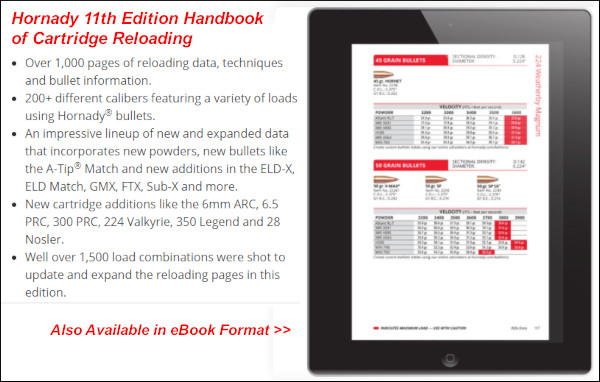
Along with many hundreds of pages of load data, the 11th Edition Hornady Handbook includes articles on loading techniques and very detailed information on Hornady component bullets. Countless hours of field testing went into this handbook. Hornady says: “Well over 1,500 load combinations were shot to update and expand the reloading pages in this edition.”
New Cartridge Types in 11th Edition
New cartridges covered in the 11th Edition include: 6mm ARC, 6mm Creedmoor, 6.5 PRC, 300 PRC, 224 Valkyrie, 350 Legend, and 28 Nosler. Also added to this edition (for the first time) are the popular 5.45×39, 300 Norma Magnum, and 450 Rigby cartridge types.
New Powders in 11th Edition
Many new or previously not included powders have been added including IMR 4955 & 8133, StaBall 6.5, Shooters World Precision and Tactical Rifle, Vihtavuori N-530, N-565, and N-570, Norma 217, CFE BLK, Accurate No. 11FS, 2200 and 4100, Reloder 16 and Ramshot LRT. Other recent additions like Reloder 23, 26 and 33, Accurate LT-30 and Power Pro 300 MP have been expanded.
New Bullets in 11th Edition
Numerous new bullets make an appearance, including the new A-TIP® Match and new editions in the ELD-X®, ELD® Match, GMX®, FTX®, SUB-X® and more.
Get 11th Edition Handbook as eBook or SmartPhone App
The 11th edition Hornady Handbook of Cartridge Reloading is available as an eBook via the iTunes iBook store as well as a Kindle edition sold through Amazon.com (coming soon). It will also available in App form from the App Store and from Google Play.
“Many unique challenges have arisen between the 10th and 11th edition handbooks. Despite the adversity, our team persisted and after hundreds of hours and thousands of rounds, we are proud to bring you the newest addition to our lineage of reloading handbooks.” said Jason Hornady, Vice President.
Shooting Industry (SI) magazine is often the first media source to reveal new firearms and gun-related products. And once again, in SI’s just-released April 2021 edition, we got our first glimpse of dozens of cool new guns and hardware. CLICK HERE to see all new featured products (best for mobile platforms) or CLICK HERE for magazine-style layout.
The current Shooting Industry issue spotlights 28 new products. We’ve select a half-dozen notables for our readers. There is an interesting WOOX Hybrid stock, new Lapua products, an impressive big-bore revolver from Taurus, the new Mark 7 Apex 10 progressive press, a rugged AR-friendly shooting rest, plus a handy totable cleaning kit from Otis.
Here Are Six Standouts from Shooting Industry April 2021:
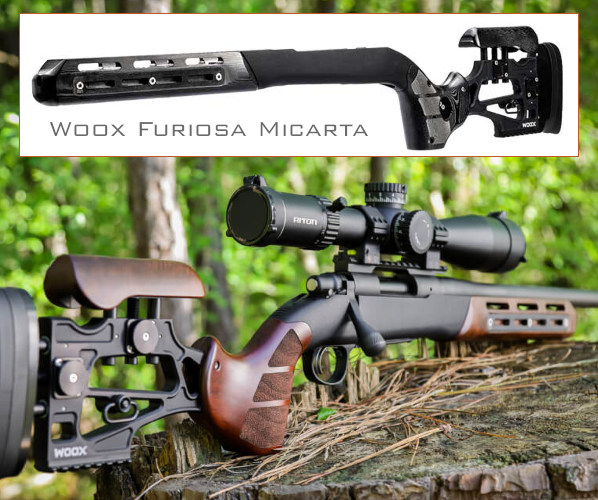
WOOX Advanced Furiosa Micarta Rifle Chassis
The new Furiosa Micarta Rifle chassis combines the best of both worlds — aircraft grade aluminum chassis strength with human-friendly ergonomics and a weather-resistant finish. The Furiosa Micarta’s outer shell casts off moisture as well as oils and solvents. The manufacturer claims the hybrid stock absorb vibrations, effectively providing harmonic dampening (as you would get with conventional wood or fiberglass stocks). The Woox Furiosa Micarta chassis is available for Remington 700, Howa 1500, Weatherby Vanguard, Sauer 100, and Tikka T3 actions.
Birchwood Casey — Alpha Shooting Rest (AR Optimized)
Birchwood Casey’s new Alpha Shooting Rest features a tubular steel frame with non-slip rubber stock rest. Weighing in at a stout 35 pounds, with integrated weighted front, this Alpha Rest should be stable. It features adjustable leveling feet with bulls-eye bubble level, ambidextrous controls, and oversized adjustment knobs. Notably this Alpha Rest will accommodate ARs with 30-rd magazines. The front of the shooting rest maneuvers 2″ for windage, 3.5″ for elevation and 4.25″ to accommodate various rifle sizes.
Lapua — New Brass and Loaded Ammunition
Lapua now offers loaded match ammunition in 6.5 Creedmoor and .260 Remington plus loaded hunting ammunition in .223 Remington and 6.5 Creedmoor. Plus NEW BRASS — Lapua has added 6.5 PRC, .284 Win, .300 Win Mag, and 300 PRC cartridge cases to its 2021 product line. Cases are sold in boxes of 100. Errki Seikkula, Lapua Sales Manager, states: “Our new Lapua cartridge case offerings for 2021 display our continued commitment to the precision shooting disciplines which are popular in the USA and globally.” The .223 Rem hunting ammo features Lapua 50 Grain Naturalis bullets, while the new 6.5 Creedmoor hunting ammunition is loaded Lapua’s 156 Grain MEGA Soft Point.
Taurus Raging Hunter Revolver in .460 S&W
For 2021 Taurus introduces a new Raging Hunter Revolver chambered in .460 S&W. This beefy wheelgun features sleeved barrel construction, and factory porting to reduce muzzle rise. A Picatinny rail on the barrel shroud makes it easy to mount optics (to complement the adjustable rear iron sight). To help manage recoil (and provide a secure hold), the Raging Hunter features an ergonomic grooved grip with cushioned inserts. Taurus CEO Bret Vorhees states: “The Taurus Raging Hunter was a hit among … handgun hunters when we introduced it in 2019. We [now offer more] downrange performance with the new Raging Hunter in .460 S&W.” This revolver is offered in three barrel lengths: 5.12″ (top photo), 6.75″, and 8.37″ (second photo).
Mark 7 Apex 10 Professional-Grade Progressive Press
TEN Stations in 2021! Mark 7, a Lyman brand, has introduced the new Apex 10, a 10-station progressive press compatible with the Mark 7 Autodrive, Mark 7 Primer Xpress, and all Mark 7 sensors. Apex 10 features include a 10 station tool head, Mark 7 mechanical powder measure, 11″ case feeder with speed adjustments, reverse setting, transparent trap door, metal construction, and case sensor activation technology. The Apex 10 also features shuttle disk priming system and double guide rod support. The new cast toolhead is designed to reduce flex under pressure.
OTIS Technology — Professional Pistol Cleaning Kit in Pouch
Otis Technology’s new Professional Pistol Cleaning Kit is optimized to clean and maintain 9mm, .40 Cal and .45 ACP Glock pistols. But of course it can be used for other handguns as well. The kit includes three bronze and three nylon bore brushes, Memory-Flex cables and three caliber-specific ripcords. A steel pistol loop rod and Otis’s 8-in-1 Pistol T-Tool for pushing and resetting pins and front site adjustment are also included. The kit even comes with a magazine plate removal tool.
In response to the growing number of first-time gun buyers during the Coronavirus outbreak, the NRA’s Education & Training Division is offering four new Online Gun Safety Courses that can be done online at home. The six NRA Online Gun Safety Courses ARE:
Each course, lasting from one to eight hours, is available online at NRAInstructors.org. To Access the 0nline training options, first CLICK HERE. Then under the Heading “DISTANCE LEARNING”, you will see options. CLICK the small gray box at the left of the title to select the course. IMPORTANT — Next you MUST SCROLL to the bottom of the NRA webpage to SEARCH. Select your state or Zip code, then you will get a list of the moderated online courses in your area.
Here is the Procedure to Follow:
1. CLICK HERE to Access ALL Course Listings
2. Select a “Distance Learning” Course.
3. Scroll Down and SEARCH for your State or Zip Code.
4. Review Course Dates and Times.
For example, here are the listed NRA online safety courses for California only. Elsewhere (in other states), YOUR list will be different!
NRA ONLINE Training Courses Sample List
“These courses will provide an option for first-time gun owners who don’t have the ability to take an NRA certified instructor-led class at their local shooting range at this time,” said Joe DeBergalis, Exec. Dir. of NRA General Operations. “While there is no replacement for in-person, instructor-led training, our new online classes do provide the basics of firearm safety training for those self-isolating at home.”
Though range time is an important part of the classes, there is still a wealth of knowledge available in the online programs. “The NRA recommends that all new gun owners seek professional training at the range, but that doesn’t mean you can’t get a head start on learning the basics of firearm safety at home. Taking one of these classes moderated by a certified NRA instructor, can only make you safer…” DeBergalis added.
At the request of our readers, we provide select “Deals of the Week”. Every Sunday afternoon or Monday morning we offer our Best Bargain selections. Here are some of the best deals on firearms, hardware, reloading components, optics, and shooting accessories. Be aware that sale prices are subject to change, and once clearance inventory is sold, it’s gone for good. You snooze you lose.
1. Sportsman’s Warehouse — Winchester .22 LR Wildcat, $219.99
⏺ Removable lower receiver, Picatinny rails, good trigger, great price
Here is a fun little semi-auto .22 LR rifle at a crazy low price — $219.99 at Sportsman’s Warehouse. The Winchester Wildcat takes Ruger 10/22 mags, and has some great features, such as field-removable lower receiver, ambidextrous controls, integral Picatinny rails and rear barrel access. It has a good trigger and shoots well. In many respects the Wildcat beats the Ruger 10/22 while costing considerably less. The lower receiver assembly is easily removed from the upper assembly by pushing a button — no tools required.
2. Bullet Central & Whidden — Bix’n Andy Dakota Trigger, $199
⏺ Outstanding trigger with safety for hunting or competition
Are you putting together a new build but still can’t decide on a trigger? The Bix’n Andy Dakota trigger is a great choice for both hunting and target applications. Easily adjustable for pull weight, this is one of the crispest triggers on the market. Find these superb triggers IN STOCK now at both Whidden Gunworks or Bullet Central.
⏺ Matched high-quality upper and lower receiver combo
Let’s face it, with Federal gun control looming, it will likely become more difficult to buy/build AR-platform rifle over the next few years. The threat of new AR bans is already leading to a shortage of parts. Here is a nice matched lower + upper receiver combo available in a wide variety of finishes. The Juggernaut Tactical AR-15 Combo Lower and Upper Receiver package comes in 4 different Cerakote and two anodized colors. These combos accept standardized fire control kits in the lower and mil-spec bolt assemblies in the upper.
4. Protektor Model — DR. Rear Shooting Sand Bags
⏺ Great competition rear bag — choose your ear height, spacing, material
Keeping your rifle stable while shooting is critical for accuracy. For benchrest shooting and F-Class, you need a stable rear bag. Among the best rear bags, favored by many top benchrest competitors, are the Protektor Model DR. Rear Bags. These boast a very solid leather base that sits flat. Chose angled or flat top, with or without carry handle. NOTE: These are “semi-custom” products. You can specify ear height, ear spacing, and ear covering type (leather, cordura, slick silver fabric).
5. Midway — Leupold Mark 5HD 5-25x56mm with Rings, $1999.99
Leupold is one of America’s leading scope-makers, and the Mark 5HD is Leupold’s latest flagship optic. If you’re looking for a top-of-the-line First Focal Plane (FFP) scope with 1/10 Mil clicks, check out this killer deal on the Leupold Mark 5HD 5-25x56mm. NOTE: This product includes a set of Leupold’s fine Mark 4 rings. This optic offers great glass, outstanding low-light performance, zero-stop functionality, and plenty of elevation. Plus Leupold offers a superior lifetime warranty. To learn more about the Leupold Mark 5HD series, watch this 7-35x56mm Mark 5HD video review (MOA version).
6. Palmetto SA — SIG BDX Scope + Laser Rangefinder, $699.99
⏺ “Smart” Scope Shows hold-over calculated by linked BDX Rangefinder
Here’s a great set-up for a hunter — a riflescope and rangefinder combo that communicate. This SIG BDX Combo Kit ($699.99) includes a six-power KILO 1400BDX Laser Rangefinder that links to the SIG Sierra 3BDX 3.5-10x42mm scope. The rangefinder’s onboard Applied Ballistics calculator sends ballistic data (via Bluetooth) directly to the Sierra 3BDX’s reticle, providing an illuminated holdover dot. Just put the dot on the target — no turret dialing needed. If you want more magnification, there is also a SIG Combo Kit with SIG 3BDX 4.5-14x44mm Scope and KILO 1800BDX Laser Rangefinder for $899.99.
7. Midsouth — Caldwell BR Rock Rest, $139.99
⏺ Solid, reliable front rest at very good price
Do you need a solid front rest for target shooting or load development, but don’t require instant adjustments or fancy features? For shooters on a tight budget, the Rock Benchrest Competition Front Shooting Rest fits the bill. This easy-to-use rest is solid, stable, and has a large-diameter wheel for precise elevation adjustment. This is a great value at $139.99.
8. Amazon — Bluetooth Digital Anemometer, $39.99
⏺ Measures wind velocity with Bluetooth connection to Smartphone App
To shoot successfully at long range, you need precise wind speed readings. This “smart” Digital Anemometer (windmeter) records Max/Min/Average wind speeds and ambient temperature which display on-screen. Importantly, the unit also outputs wind readings to your smartphone via Bluetooth. This allows you to mount the wind meter downrange and view wind speeds via a smartphone App. The unit’s base is threaded for tripod mounting. This is a pretty impressive system for under forty bucks.
9. Amazon — Vanguard Porta Aim Gun Rest, $44.99
⏺ Handy, ultra-portable rest for casual duties — rifle or pistol
Do you ever find yourself out for a day of shooting or hunting but there’s nothing to rest your rifle on? Worry no more as you can keep the Vanguard Porta Aim Gun Rest easily tucked away in your vehicle or range bag and it’ll always be there for you when you need it. This can be used to support pistols as well.
10. Amazon — MTM 30 Rd Rimfire Ammo Wallet, $5.19
⏺ Convenient case holds rimfire ammo cartridges securely
Yes this MTM Ammo Case holds .17 and .22 caliber rimfire ammo types including .17 HM2, .17 HMR, .22 Short, .22 LR, .22 WMR (but not .17 WSM). Each round is held securely with an individual clasp. The 8.66″ x 6″ box is small and thin enough (0.7″ thick) that you can easily carry it in a coat pocket. Owner review: “Sturdy case, bullets fit tight into it and don’t move around, case is small and fits right in your back pocket.”
This Sunday we feature an impressive .300 WSM Heavy Gun shot by a superb long-range shooter. With this rig, at age 83, Arizona benchrest ace Charles Greer drilled a remarkable 2.862″ 100-10X group, beating all known 1000-Yard HG 10-shot records on the books. If this record is approved (which is likely), Greer’s .300 WSM can rightfully be hailed as the most accurate 1000-yard gun in history.
Story compiled with help from Jason Peterson
This would be an excellent 10-shot NBRSA Heavy Gun group at 600 yards, but this target was shot at 1000 yards by Charles Greer (aka “chuckgreen” on AccurateShooter forum) on February 13, 2021 at an NBRSA Match in Arizona. Chuck was shooting his .300 WSM Heavy Gun with Borden action, Krieger barrel, and Berger 220gr Hybrids. The event was hosted by the Sahuaro 1000 Yard Benchrest Club, at Three Points Range, outside Tucson, Arizona. Though it is pending final approval, it appears this is the smallest 10-shot Heavy Gun group ever shot, anywhere, at 1000 yards, and it was centered for a 10X. That’s doubly impressive when you consider that Charles Greer achieved this at age 83! Yes “Old guys rule”!
Amazing 100-10X 2.642″ (unofficial) 10-Shot Group at 1000 Yards.
This group is perfectly centered for an amazing 100-10X score. The group was range measured at 2.642 inches. For reference, the 1000-yard X-Ring is 3.00″ in diameter. The “X” itself is about 1.2″ tall. Pending final verification, this amazing target should shatter two NBRSA records. This handily beats the current single target HG score record of 100-6X held by Bill Schrader since 2005, and the single target HG group record of 3.650″ held by Tim Height (2019). For comparison, the current IBS 10-Shot 1000-yard HG group record is 2.871″ by Michael Gaizauskas from 2016. So it appears that this may be the smallest 10-shot group ever shot in competition in history. And from what we can determine, this is the first potential HG size record that also has a 100 score with TEN Xs.
Because shots are not marked in this discipline, this stunning group was a surprise to Greer: “I had no idea that I was shooting a world record target until I went back to the pits after my relay. Just as well. If I’d seen nine rounds in the X on the target, staying steady [for the last shot] would have been challenging….”
Forum member “Tom” (2016 IBS 1000-yard Nat’l Champion and holder of several IBS 1000-yard records) unofficially measured Greer’s 1K group at 2.680 inches (0.256 MOA), using Ballistic-X software. Awaiting final group measurement by the NBRSA Long Range Committee, as currently measured, this target is just under existing IBS and Williamsport 10-shot HG 1000-yard records: The current IBS HG 1000-yard group record is 2.871″ held by Michael Gaizauskas. The current Williamsport HG 1000-yard group record is 2.815″ held by Matthew Kline.
Benchrest Shooting — Sport for All Ages Charles Greer reminded us that even senior citizens can succeed in benchrest competition: “One of the benefits of benchrest shooting is that it is a sport accessible to us even as we age. I cannot run and gun anymore like I used to do in IPSC and IDPA but as long as I can get my body and my equipment up to a bench, I can still be very competitive. That is not possible for us old guys in most sports and shooting disciplines. As I am ‘only 83′ I am hoping to squeeze a few more years of competition out of the old body before I have to pack it in for good.”
Charles is thankful for what he has achieved in this sport over many decades: “The Shooting Gods have certainly smiled on me from time to time during my brief shooting career and for that I am incredibly grateful.”
This target may also be the smallest 1K 10-shot group ever shot in competition, in ANY Class. In 2014, Jim Richards fired a 10-shot, 2.6872″ Light Gun group under Williamsport Rules at Deep Creek Range in Montana. However, Jim’s record small group was NOT centered in the 10-ring and it appear that Greer’s group could measure smaller. [Editor: Charles is no stranger when it comes to 1000-yard records. Charles is the current listed holder of two NBRSA 1000-yard score records: 3-Target HG Score: 294-8X (2010); 6-Target 2-Gun Score: 441-13X (2010).]
100-10X at 1000 — This May Be a First
After looking at all the 1000-yard records from different organizations, it appears that Greer’s 100-10X score could well be a first! And it may be many years before another 100-10X score is ever shot in competition.
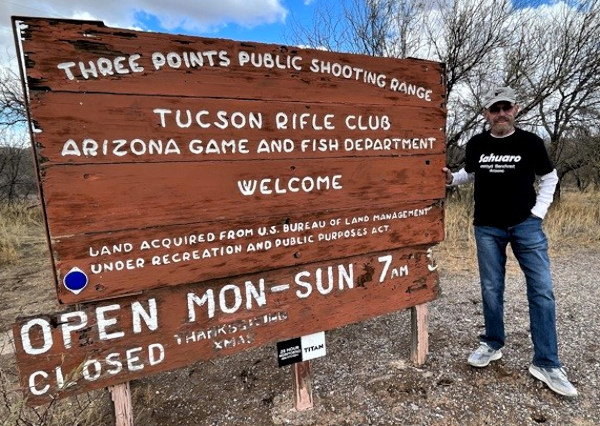
Arizona’s Three Points Range is known for its windy conditions. So much so that small groups are not common in match reports. 6mm cartridges that are commonly shot at other 1000-yard benchrest competitions are rarely shot at Sahuaro 1K BR Club matches. The bigger calibers dominate here.
Charles Greer NBRSA 1000-Yard Heavy Gun Specifications:
Action: Borden BRMXD drop port
Barrel: Krieger 30″ 4-groove, 1:10″ twist, custom contour 1.35″ tapered to 1.00″
Chambering: .300 Winchester Short Magnum (WSM)
Chamber Specs: .337 neck with .280 freebore
Stock/Weight: McMillan/Wheeler LRB (solid fill) stock at 27 pounds
Gunsmith: Gerald Reisdorff
Optics: Vortex Golden Eagle 15-60x52mm
Front Rest: Sinclair Competition with 4″ Edgewood bag
Rear Rest/Bag: Wahlstrom mechanical rear rest with custom Edgewood bag
Load Details: Norma .300 WSM brass, Alliant Reloder 23 powder, Federal 210M primers, Berger 220gr LR Hybrid bullets at 2800 FPS
Greer has done something clever with his McMillan/Wheeler benchrest stocks. He has flipped over (inverted) the adjustable metal rudder (or keel) that runs on the underside of the buttstock. This provides a wider, flat tracking surface. The inverted rudder runs in a special sandbag on a Walhstrom mechanical rest. NOTE: Mechanical rear rests ARE legal for BOTH Heavy Guns and Light Guns under current NBRSA rules (see page 24). Shown at right is Greer’s Light Gun, but his Heavy Gun has the same system.
Charles explains: “Both my LG and my HG are of the same configuration except for additional weight in the stock of the HG. I decided to do this so that I would not need a separate rest system for each gun which saves on expense and makes it much easier to switch the LG out for the HG during competition. No need to change rest systems and re-align everything. Both of my stocks are McMillan/Wheeler LRB models with the adjustable rudder that can be repositioned horizontally to improve tracking. The rudder has a 3/4 inch-wide base that is usually fit into an Edgewood gator bag with a flat top. I did not like the way the rifle tracked with this set up and wanted something more solid and stable.
So I found that if I turned the rudder upside down and re-installed it that way on the stock, using the same screws and holes, the top of the rudder when turned down provided me with a base 1.5″ wide with a 1/4″ rail on each side. I got a Wahlstrom mechanical rear rest and had a custom Edgewood front bag made for it with a 1.5″ separation between the ears. The rail tracks perfectly in the bag and I can tighten the ears to make it quite solid and steady. I have noticed a huge improvement in tracking with this set up. I am still refining this arrangement but plan to continue using it on both rifles. I have never seen this done and was thinking maybe your readers would be interested.”
Questions & Answers with Charles Greer
Hall of Fame short-range shooter Gary Ocock interviewed Charles Greer. This interesting Q&A dialog covers shooting styles, equipment selection, recoil management and other notable topics.
Q: Tell us about your rifle, accuracy standards, and choice of calibers and bullets for the 1K game.
Greer: I set up two rifles, Light Gun and Heavy Gun. Both will shoot 100-yard 5-shot groups in the high ones and low twos. In Arizona I want a heavy, high-BC bullet in both guns to buck the wind and want to keep the ES under 10 FPS. I’m finding .300 WSM with Berger 220 LRHT bullets and a 4 groove Krieger barrel will provide the performance I need, and I shoot this round in both rifles.
Q: Explain your rest set-up, tracking, and recoil management. And how fast do you typically shoot your strings of fire?
Greer: I am using a Sinclair Competition Front Rest along with a mechanical rear rest, both with Edgewood front bags, to give me the stability necessary to provide consistent tracking even with these relatively high recoil rounds. Almost perfect tracking and consistent return to battery in the same spot is necessary to get a record string off quickly and smoothly. I try to get my strings off in a time of between 6 and 10 seconds per round depending on conditions. Any faster and I get sloppy.
Q: What were conditions like when you shot that amazing 10-shot group?
Greer: On the day I shot the record-pending target I had the first relay. There was wind but it was light, maybe 4-5 mph and seemed steady. The flags were about halfway up to horizontal and seemed to be holding that way. My procedure is to shoot 5 sighter rounds, two to adjust my initial round on paper to the X-Ring and then three more during the last minute to check for changes in the wind. If these last three rounds stay in the Ten Ring it is usually a sign that the wind may be steady enough for me to shoot a good group. On the “record” day the last three sighters were right in or near the X-Ring and when the record target came up I quickly but carefully dumped my 10 rounds holding the scope dot right on the X. The wind apparently held absolutely steady, and I got the result you see on the target.
That is my normal shooting technique. I pretty well know during the last minute of the sighter period whether a good group will be possible. If each of my last three sighters ends up inches away from the X in different directions, I know the wind is shifty and a good group on that target is unlikely. I adjust the last sighter to the X and then dump the string the same way just hoping the wind may hold for a minute or so. Sometimes it does, but often not so much.
During the record strings there is no way to know where the rounds are going. They are not marked, and the holes cannot be seen through the scope at that distance. The 1K flags are big and heavy and not very indicative of minor wind changes so I do not try to hold off or change my point of aim unless a flag completely reverses direction during a string. I’ve found that over the years adjusting my point of aim to the X after the last sighter and then dumping my strings gets the best results overall.
Q: What is your highest shooting accomplishment so far?
Greer: Well, the highest accomplishment (if one can call it that) would have to be this 100-10X target. This may end up being the best 10-shot target ever shot in a sanctioned match. 0f course, there is a tremendous amount of luck involved in this coming together but I certainly am pleased.
I had set four NBRSA world records when I was shooting previously: Light Gun Agg in 2008, and all three possible Highest Three Target Score records in 2010, two of which still stand. The first was probably the most satisfying as was my performance in the 2010 Nationals where I placed high in several categories and was Heavy Gun Champion for Score.
Q: Who do you attend matches with?
Greer: During the last year my son, Brian, has become my match shooting companion. We go out together every month. Brian was able recently to purchase the great 300 Ackley HG that I competed with and set world records with in 2010. I sold the rifle to a friend who never shot it and it found its way back into our family. Brian is now becoming a serious competitor.
Photo Right: Charles Greer with son Brian.
Q: What are your future shooting goals?
Greer: To keep on shooting our local match each month and to try to get to the Nationals once or twice more before I get too damn feeble. And to be able to see my son take my place as a regular winner when I can no longer compete.
Q: Is there any advice you would like to share with new shooters?
Greer: Make a commitment to excel at whichever discipline you choose. Get the best equipment and components that you can afford and consider each match a learning experience. At some point anything that can go wrong will go wrong and one must learn from these mistakes. Most importantly, be patient and keep coming back. In Arizona good shooting conditions are rare. You gotta be “in it to win it”. If you show up at every match you can attend eventually a great condition will appear on your relay and you will have a chance to shoot a spectacular score.
Q: What is your shooting background?
Greer: I started shooting rabbits as a kid in the Mojave Desert, trained on various firearms in the military in the fifties and sixties and over the years hunted birds and large game and played with various handguns. In 2005 I moved to Tucson from Mexico the first time and, looking for an activity, started shooting IDPA and IPSC pistol matches at Pima Pistol Club. Shortly thereafter I bought a .308 Savage tactical rifle and got interested in shooting for accuracy. One thing led to another and before long I bought a better Savage varmint rifle in .300 WSM and started shooting the 1K match at Tucson Rifle Club at Three Points around 2007. I kept upgrading my equipment, started winning matches, set some world records.
After the 2011 NBRSA Long Range Nationals I felt rather burnt out on shooting. I sold all my guns and equipment and headed South looking for perhaps one more adventure. I found some but they did not include shooting as South of the border folks tend to shoot back when they hear anything go bang. I returned to Tucson in May of 2019, built a couple of new rifles, and got involved again in the monthly Sahuaro match where the most recent world record target was shot. I would like to resume shooting the NBRSA Long Range Nationals. Will not be ready this year but probably will in 2022.
Q: Have you tried other disciplines at different ranges?
Greer: I have only competed in Long Range, mostly 1000 yards but 600 yards a few times at the Nationals. I would like to try shooting “Score” and there is a monthly match at our range. May try it if I can get an appropriate rifle.
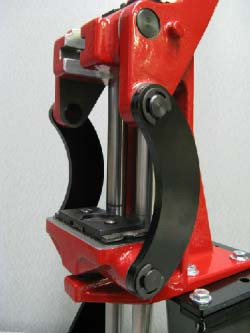
Forum member Erik Cortina has produced a series of YouTube videos about reloading hardware and precision hand-loading. Here we feature Erik’s video review of the Forster Co-Ax® reloading press. The red-framed Co-Ax is unique in both design and operation. It boasts dual guide rods and a central handle. You don’t screw in dies — you slide the die lock ring into a slot. This allows dies to float during operation.
Erik does a good job of demonstrating the Co-Ax’s unique features. At 1:00 he shows how to slide the dies into the press. It’s slick and easy. At the two-minute mark, Erik shows how sliding jaws clasp the case rim (rather than a conventional shell-holder). The jaws close as the ram is raised, then open as it is lowered. This makes it easy to place and remove your cases.
At the 5:20 mark, Erik shows how spent primers run straight down into a capture cup. This smart system helps keep your press and bench area clean of primer debris and residues.
While many Co-Ax users prime their cases by hand, the Co-Ax can prime cases very reliably. The priming station is on top of the press. Erik demonstrates the priming operation starting at 4:20.
Smart Accessories for the Co-Ax from Inline Fabrications
Forum member Kevin Thomas also owns a Co-Ax press, which he has hot-rodded with accessories from Inline Fabrications. Kevin tells us: “Check out the add-ons available from Inline Fabrications for the Co-Ax. I recently picked up a riser mount and a set of linkages for mine and love the results. The linkages are curved. When you replace the original straight links with these, the work area opens up substantially and the the press becomes much easier to feed.” CLICK HERE for Co-Ax Accessories.
Inline Fabrications Forster Co-Ax Accessories
Forster Co-Ax Curved Side Linkage (For Better Access)
The Civilian Marksmanship Program (CMP) will offer hands-on rifle and pistol training programs in 2021 at locations around the nation. The CMP’s Marksmanship 101 Program, formerly known as the Small Arms Firing School (SAFS) On The Road, is designed to train beginners on rifle or pistol essentials and competition basics in a closely monitored setting, utilizing the talents of qualified CMP staff, trainers, and members of the U.S. Army Marksmanship Unit (USAMU).
Held at CMP Games matches and at various CMP Affiliated Clubs around the nation, the courses are led by certified CMP Master Instructors and talented members of the U.S. Army Marksmanship Unit. The course curriculum is based off of the Small Arms Firing Schools (SAFS) offered at the annual National Rifle and Pistol Matches at Camp Perry, Ohio, which have been attended by countless individuals since 1918.
Upcoming Rifle Marksmanship 101 Classes:
New England Games, September 19, 2021, Jericho, Vermont
Oklahoma Games, October 17, 2021, Oklahoma City, Oklahoma
Talladega 600, November 16, 2021, CMP Talladega Marksmanship Park, Talladega, Alabama
Upcoming Pistol Marksmanship 101 Classes:
New England Games, September 19, 2021, Jericho, Vermont
Oklahoma Games, October 17, 2021, Oklahoma City, Oklahoma
Firearms and Ammunition Are Provided by CMP
Here is one of the biggest lures of the Marksmanship 101 Program — the CMP supplies guns and ammo! Rifles (AR-15), pistols (M9) and ammunition will be provided by the CMP at each location.
Programs Combine Classroom Learning and Outdoor Shooting
The Marksmanship 101 rifle and pistol courses train both adults and juniors in a safe and comfortable environment. Courses will be held at multiple locations. CMP Training Director Steve Cooper explains: “We know there are many people across the country who simply don’t have the time or means to travel to Ohio for the Small Arms Firing Schools during the National Matches, so, we decided to take the same basic curriculum and training on the road and customized the name.”
The Marksmanship 101 courses are a mix of indoor classroom learning and outdoor experiences on the range. Areas covered during the course include firearm safety, essential firing practices and handling, positioning and other competition skills, along with live firing on the range. Each course ends with applying everything learned to a true Excellence-In-Competition match on the range. “We always start our 101 events in a classroom environment, where we explain and demonstrate everything we’re going to do, very thoroughly,” Cooper said.
Program Requirements for Marksmanship 101
Since CMP Marksmanship 101 programs are designed to fit even those new to the marksmanship world, no previous firearm experience is required to attend. Participants ARE required to bring hearing and eye protection for the live-fire activities. Individuals should also dress according to weather conditions and may also bring any other desired competitive shooting equipment they wish to use.
How to Register for CMP Marksmanship Training Programs
Visit the CMP Marksmanship 101 website for Registration Links and other information. Once on the website, click your desired date and location to be sent to the CMP Competition Tracker page to complete registration. Questions regarding Marksmanship 101 may be directed to Amy Cantu at 419-635-2141 ext. 602 or acantu@thecmp.org.
You may want to monitor Gun Talk Radio this Sunday, March 28, 2021. This Gun Talk episode will be one of the most important of the year. The broadcast covers efforts in Washington to throttle the Second Amendment along with a shocking decision by the 9th Circuit Court of Appeals denying citizens the right to carry firearms. This broadcast airs Sunday, 3/28/21 from 2:00 PM to 5:00 PM Eastern time. You can interact with the Gun Talk team by calling 866-TALK-GUN with comments and questions.
Multiple Gun Rights Issues Covered on Sunday
Important topics include the 9th Circuit’s recent ruling in Young v. Hawaii that the Second Amendment does not guarantee the right to bear arms outside the home, state preemption laws, a bid to end the FOID card, examining the partnership between the gun industry and the mental health industry. The show also covers the recent Boulder, Colorado shooting and a U.S. Senate hearing on the prevention of gun violence. Top Shot’s Chris Cheng testified in the Senate Judiciary Committee Hearing on Gun Violence Prevention. Chris stops by to talk about the hearing. CLICK HERE for Video of testimony at Senate Hearing.
In this Gun Talk episode journalist Emily Miller examines the Ninth Circuit’s latest decision regarding open carry. CLICK HERE to read Miller’s analysis of that Circuit Court decision issued Friday, 3/24/2021.
Young v. Hawaii Decision Goes Against Supreme Court Precedents
Speaking about the 9th Circuit’s recent 7-4 ruling in Young v. Hawaii, the NSSF says that upholding Hawaii’s ban on carry ignores the clear language of the Second Amendment and U.S. Supreme Court precedent of the landmark 2008 Heller decision and 2010 McDonald decision, which displayed the exact opposite findings. The Ninth Circuit’s ruling underscores the need for the U.S. Supreme Court to accept firearm-related cases for review to settle the long-standing disputes. Lower courts have failed to apply Supreme Court precedents and are effectively treating the Second Amendment as a second-class right.
“The blatant defiance of the Supreme Court to undermine Heller and hollow out rights afforded to individuals by their Creator and clearly protected by the Constitution is unconscionable,” said Lawrence G. Keane, NSSF Senior VP and General Counsel. “It is with amazing boldness that the Ninth Circuit brazenly sets aside not just the previous findings of the Supreme Court, which legally they are bound to apply, but actively chooses to ignore plain English and refuses to acknowledge the right to bear arms. We look forward to filing an amicus brief when this heads to the Supreme Court.”
On Gun Talk Radio this week, Tom Gresham covers the shooting in Boulder and the calls for new gun control laws that were launched within minutes of the breaking news. With random attacks always comes talk of mental health, and Walk the Talk America’s Michael Sodini will address mental health issues on the Sunday show. In addition, Illinois State Senator Neil Anderson talks about lifting the Illinois requirement to have a Firearm Owners Identification Card (FOID) in order to purchase or own a gun.
Gun Talk Radio Broadcast Times — and Podcast Archive
This broadcast airs Sunday, March 28, 2021 from 2:00 PM to 5:00 PM Eastern time on radio stations nationwide. Past podcasts can be heard online via the GunTalk Podcast Center and Apple iTunes. The Gun Talk podcast archive has many great shows. Click the link below to hear a recent show (1/3/2021) about mainstream media and financial industry bias against firearms and shooting sports enterprises.
Podcast about Boulder Colorado Shooting and Gun Control
Podcast about Impending Gun Control Laws:
Tom Gresham’s Gun Talk Radio show airs live on Sundays from 2PM-5PM Eastern, and runs on more than 270 stations. Listen on a radio station near you or via LIVE Streaming. All Gun Talk shows can also be downloaded as podcasts through the GunTalk Podcast Center or Apple iTunes. Gun Talk is also available on YouTube and GunTalk.com.
Do you have trouble seeing your bullet holes (on paper) when shooting past 400 yards? That’s a common issue even with premium ($1600+) high-magnification scopes. Here’s a target that solves that problem. A hit creates a larger black circle that’s much more visible than a plain bullet hole, making this target ideal for use at longer range (500 yards and beyond).
The 12″ square Birchwood Casey white background Sight-In Target displays a black “halo” around each hit (like the yellow circle on a conventional Shoot-N-C). Larger than bullet diameter, the “halos” can be easily seen with a high-magnification scope at long range (see video below). The self-adhesive target features four diamonds with contrasting red box centers. For precise aiming, you can position your cross-hairs to align with the corners of the boxes. Or, you can put a target dot sticker in the middle.
This video shows Black Shot Halos on white background:
While we envision using this target with optics at long range, Birchwood Casey says that open sights show up well against the white background, making these targets well-suited for indoor ranges or use in low light conditions.
This white background grid target has five aiming points and a 1-inch grid overlay for quick and easy sight adjustments. It comes with target pasters that allow shooters to cover up bullet holes and continue using the target for added value. The White/Black Shoot-N-C 12″ Sight-In Targets come in 5-packs with 75 target pasters for $7.19 from MidwayUSA or $8.09 on Amazon.
High-Viz Option — Yellow on Black Grid with Yellow Halos
If you prefer seeing ultra-high-contrast yellow/green “halos” for your hits, Birchwood Casey also makes adhesive grid targets with five yellow-edged diamonds. Red circles provide precise aiming points in the middle of each box. You can quickly estimate group size or dial-in your zero using the hi-viz yellow 1″ grid lines. These yellow-on-black targets are available in three sizes: 8″ square, 12″ square, and 17.5″ square. These yellow-on-black grid targets start at $4.95 for an 8″ six-pack.


 The U.S. Department of Transportation (DOT) recently approved new smaller containers for shipment of smokeless powder. The new containers are designed to hold 1000 grains, exactly one-seventh of a pound. That works out to 2.29 ounces of powder — quite a bit less than you are getting currently with one-pound (16 oz.) containers.
 Currently, when you can find them, quality reloading powders are going for $45-$60 per pound (in 1-lb containers). At $45 per pound, you’re paying $2.81 per ounce. That means that the new mini-containers will be roughly twice as expensive as current one-pounders ($5.21 per ounce vs. $2.81 per ounce).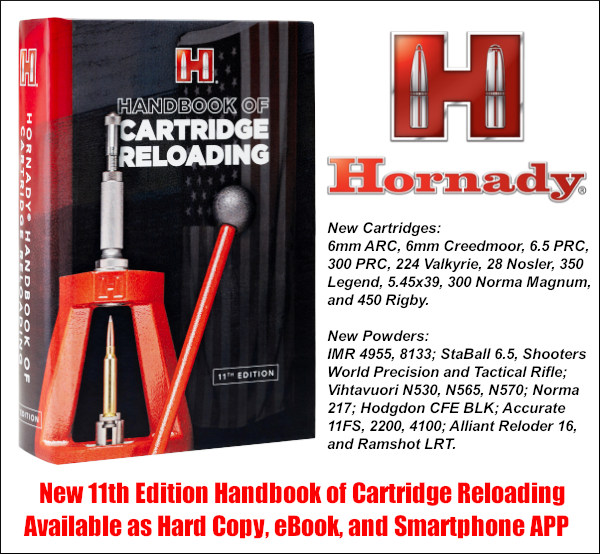




 Charles Greer reminded us that even senior citizens can succeed in benchrest competition: “One of the benefits of benchrest shooting is that it is a sport accessible to us even as we age. I cannot run and gun anymore like I used to do in IPSC and IDPA but as long as I can get my body and my equipment up to a bench, I can still be very competitive. That is not possible for us old guys in most sports and shooting disciplines. As I am ‘only 83′ I am hoping to squeeze a few more years of competition out of the old body before I have to pack it in for good.”


 Greer has done something clever with his McMillan/Wheeler benchrest stocks. He has flipped over (inverted) the adjustable metal rudder (or keel) that runs on the underside of the buttstock. This provides a wider, flat tracking surface. The inverted rudder runs in a special sandbag on a Walhstrom mechanical rest. NOTE: Mechanical rear rests ARE legal for BOTH Heavy Guns and Light Guns under current
  Q: Who do you attend matches with?