Airport photo by Politikaner under Creative Commons License.
With hundreds of readers traveling to Raton, New Mexico next month for the 2020 F-Class Nationals (October 25 – November 1, 2020), and with many others planning hunting trips out of state, we thought we’d repeat an article providing important information about air travel with firearms. If you will be flying with firearms this fall, you should read this article. You need to familiarize yourself with current Federal Regulations on gun transport before you get anywhere near an airport. Thankfully, the Transportation Security Administration (TSA) has a web page that states the important requirements for airline passengers traveling with firearms* and/or ammunition.
You’ll want to visit the TSA Firearms and Ammunition webpage, and read it carefully. In addition, before your trip, check the regulations of the airline(s) with which you will fly. Some airlines have special requirements, such as weight restrictions.
Here are the TSA’s key guidelines for travel with firearms:
More Airline Travel Tips from Tom McHale
Tom McHale has written an excellent article for the Beretta Blog, Ten Things You Need to Know about Flying with Guns. We suggest you visit the Beretta Blog to read this informative story. Here are two of Tom McHale’s Travel Tips:
Weigh your gun case and ammunition
Most airlines will allow up to 11 pounds of ammunition. And, like any luggage, you will be charged more for any baggage weighing more than 50 pounds. This sounds like a lot, but when traveling to the Crimson Trace Midnight 3 Gun competition last year, my case with shotgun, rifle, pistol and ammunition tipped the scale past the 50 pound mark.
Pack ammo in the same locking case
This is another area that’s misunderstood and full of internet myth. Your ammo just needs to be stored in some type of safe container and not loose. Technically, you can keep ammunition in magazines, but I wouldn’t recommend it. It meets the letter of the law storage requirement, but too many airline and TSA agents will give you grief. Use a plastic ammo box or original cardboard packaging and you’ll be fine carrying that in the same lockable case as your gun.
*SEE United States Code, Title 18, Part 1, Chapter 44. A “firearm” is defined as: any weapon (including a starter gun) which will, or is designed to, or may readily be converted to expel a projectile by the action of an explosive; the frame or receiver of any such weapon; any firearm muffler or firearm silencer; and any destructive device. As defined by 49 CFR 1540.5 a loaded firearm has a live round of ammunition, or any component thereof, in the chamber or cylinder or in a magazine inserted in the firearm.
Hunting Season has already started in some states, and is right around the corner in other locations. For readers who plan to hunt game this fall, we recommend you brush up on hunter safety and learn the laws in your jurisdiction. Here are some helpful resources for hunters: Safety Tips, Hunter Education, License Requirements, and Where-to-Hunt interactive map. Top photo courtesy Horn Fork Guides, Ltd., in Colorado.
Visit WhereToHunt.org
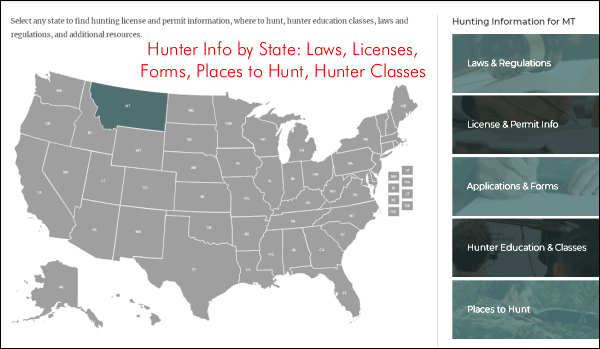
There’s a great online resource for hunters that will help you find game locations in your state and ensure you have all the proper permits and game tags. WheretoHunt.org features an interactive map of the country. For all 50 states, the NSSF has compiled information about hunting license and permits, where to hunt, hunter education classes, laws and regulations and more. For each state you’ll also find a link for required applications and license forms.
Click Map to Get State-by-State Hunting INFO
Hunter Safety Tips NRAFamily.org has a good article listing six salient safety tips for hunters. Anyone preparing for a fall hunt should read this article before heading into the field. Here are three key bits of advice:
1. Be Positive of Your Target before Shooting
This might sound overly simplistic, but the fact remains that, every year during whitetail season, farmers everywhere are forced to spray-paint their cattle or risk having them “harvested” by hunters who don’t bother confirming the species of the large ungulate in their sights. Why does this happen? The most likely explanation is “buck fever,” meaning that the hunter wants so badly to see a nice big buck that sometimes his eyes deceive him into thinking that there’s one there. When in doubt, don’t shoot.
2. Scopes Are Not Binoculars
Never use a riflescope as a substitute for binoculars. The temptation to do so is real, but when one does this, one is by definition pointing the muzzle of the gun at unknown targets.
3. Know When to Unload
When finished hunting, unload your firearm before returning to camp. You should also unload your gun before attempting to climb a steep bank or travel across slippery ground.
Hunting Affiliation Groups
There are many good organizations dedicated to promoting hunting and preserving our hunting habitats. These groups all offer valuable information for hunters:
Hunting season is starting soon in most areas of the country. Here’s a way you can improve your hunting skills/knowledge. The NRA is offering a FREE online Experienced Hunter Education Course for those preparing to take advantage of the 2020 hunting season.
“As a result of COVID travel restrictions, states have seen a considerable increase in the number of hunting license sales”, said Peter Churchbourne, director of NRA’s Hunters Leadership Forum. “Our Experienced Hunter Education Course provides those who might have taken a season or two off a convenient way to sharpen their skills before heading back into the field.”
NRA’s free 2-hour course is a firearm and hunting safety-training refresher in a convenient and engaging platform available through desktop, tablet, or smartphone. The course is available to everyone at www.NRAEHE.org. NOTE: The course is NOT a substitute for state-mandated hunter safety requirements and does not offer any certifications.
The NRA’s NRA Experienced Hunter Education Course, is an online training program designed to help hunters brush up their skills. Free to all, this comprehensive hunting refresher course will help hunters become safer and more confident before heading out into the field. CLICK HERE for more information.
“If you’ve taken a break from the shooting sports or haven’t hunted in a season or two, our Experienced Hunter Education Course is the perfect refresher for firearms safety and safe hunting practices,” explained Elizabeth Bush, managing director of NRA Community Engagement. “Best of all, we’re offering this service completely free of charge.”
Course Description
This online training course is specifically designed for individuals who have not hunted in the past year or more and are looking for a safety refresher before they head back out in the field. In this course, hunters will have the opportunity to refresh their skills by taking a look at safe hunting practices and firearms safety. Once completed, you will be a safer hunter in the field.
Election Day is just 52 days away. On November 3, 2020, Americans will head to the polls. For gun owners, this may be the most significant Presidential election in a generation. The Democratic Party, as stated in the DNC platform and Democrat-sponsored Bills now in Congress, intends to severely restrict gun rights, require a federal license for gun ownership, ban online ammo sales, and ban whole classes of firearms.
Nearly 5 million Americans are first-time gun buyers. We hope they, along with ALL gun owners, will vote on November 3rd, and remember which candidates support the Second Amendment. As the National Shooting Sports Foundation (NSSF) states: “Current events across the United States demonstrate why the Founding Fathers 230 years ago had the foresight to recognize why the right to keep and bear arms would still be vital today.”
Target shooters, hunters, and gun owners must work together to defend their Constitutional rights. On Election Day 2020, vote to protect America’s firearms freedoms: #GUNVOTE.
Hornady Contributes $500,000 to 2020 #GUNVOTE Effort
#GUNVOTE is a vital NSSF campaign to encourage America’s gun owners to register to vote and vote for candidates who support the Second Amendment and gun rights. Go to Action.gunvote.org to learn how to register to vote in your state, and find your polling place.
Hornady Manufacturing, maker of ammunition, tools, and reloading components, has contributed $500,000 to the NSSF’s #GUNVOTE voter registration and education campaign.
“A historic number of Americans have jumped off the fence to purchase firearms so far this year, and it’s critical for gun owners old and new to be educated and vote in November,” said Steve Hornady, President of Hornady Manufacturing. “The Second Amendment has never faced a threat like it does today. It is crystal clear why our right to keep and bear arms is now more important than ever. Making this contribution to NSSF’s #GUNVOTE campaign will ensure the firearm and ammunition industry has the resources needed to educate gun owners, target shooters and hunters about what is at stake in this election. Hornady Manufacturing is proud to support this critical voter registration, education and mobilization campaign.”
SIG Sauer Contributes $250,000 to 2020 #GUNVOTE Effort
SIG Sauer, a world-leading firearms maker, has contributed $250,000 to NSSF’s #GUNVOTE voter registration and education campaign. This campaign seeks ensure that America’s gun owners exercise their right to vote so they can protect the Second Amendment.
“SIG Sauer believes it is imperative for all gun owners to be registered to vote and to know where the candidates at all levels of government stand on the Second Amendment so that on election day they can make informed choices to protect their rights”, said SIG Sauer CEO Ron Cohen. “Our contribution to the #GUNVOTE campaign represents SIG Sauer’s wholehearted belief in the NSSF #GUNVOTE effort”.
With the Presidential election looming, the stakes have never been higher. Joe Biden and his VP candidate Kamala Harris have pledged to enact new laws that could result in rifle confiscation, criminalization of private sales, and banning of online guns and ammo purchases. In addition, Biden and Harris have called for new gun taxes, while Harris has advocated banning guns by Executive Action — rule by fiat, bypassing the legislative process.
For hunters in a tree stand, SFC McPhail recommends a position with your weakside leg pulled up and firmly braced on the front rail of the treestand. You can then rest your support arm on your leg. This provides a rock-solid position when shooting from a stand.
Team USA Olympian and ISSF World Cup Winner SFC Michael McPhail is one of the world’s best smallbore rifle shooters. He is also an avid hunter, who enjoys harvesting game with centerfire rifles. In a USAMU video, McPhail shows how competition shooting positions can be adapted for hunters. McPhail shows how well-established positions can provide a more stable platform for hunters in the field. That can help ensure a successful hunt. McPhail demonstrates three positions: kneeling, supported prone, and sitting in a tree-stand.
Watch SFC McPhail Demonstrate Positions for Hunters (Good Video):
McPhail first demonstrates the kneeling position. Michael notes: “I like kneeling. It’s a little bit of an under-utilized position, but it’s almost as stable as prone. It allows you get up off the ground a little bit higher to [compensate for] vegetation. For kneeling start by taking your non-dominant foot and put that towards the target, while at the same time dropping down to a knee on the dominant leg. At the same time … wrap the sling around wrist and fore-arm, lean slightly into the target and take the shot.”
McPhail shows a nice “field expedient” use of your backpack. He shows how the basic prone position can be adapted, using the pack as a front rifle support. McPhail recommends pulling your dominant (strongside) leg forward, bent at the knee. According to Michael, this takes pressure off the abdomen, helps minimizes heart beat effects, and helps with breathing.
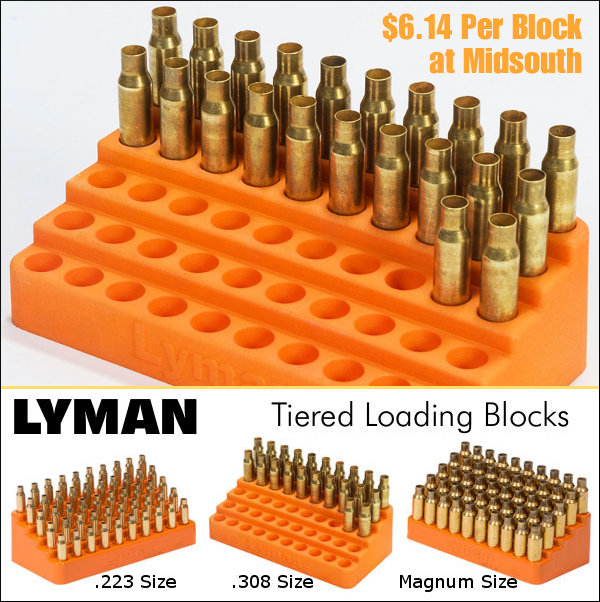
Here’s an inexpensive product that can make your case prep and loading tasks easier. We use and recommend the cleverly-designed Lyman Bleacher Blocks. These multi-level (stepped) cartridge holders save space on your bench AND make it easier to select a particular case/cartridge from a full block. Each row is a different height for convenience. With Bleacher Blocks it’s also easier to check for powder levels, or place bullets before the seating process.
Lyman’s Bleacher Block cartridge holders have many advantages over conventional, single-level blocks. Use the different levels for sorting brass. Or, migrate the brass from top to bottom as you proceed through case prep stages. If you are assembling loads with different bullets for load testing, you could arrange the loaded rounds on different levels for easy recognition. For example put V-Max loaded rounds on the top tier, and Berger Hybrid loaded rounds on the bottom tier. Or, if you are experimenting with neck tension, you can use different rows for cases processed with different bushings.
Made of durable orange polymer, Lyman Bleacher Blocks are molded in three sizes. The smallest size (with 0.388″-diam holes) fits .223 Rem-size case heads. The middle size (with 0.485″-diam holes) fits .308 Win-size case heads. That works for 6mmBR/Dasher sized cases perfectly. The biggest Bleacher Block has 0.565″-diameter recesses for magnum-size cases. All three cartridge block sizes hold fifty (50) rounds. Purchase any size for just $6.14 per Block at Midsouth.
Here’s what Lyman says about its innovative cartridge block design: “Our [stepped] loading blocks allow for easier handling of cases in and out of the loading block. Our stepped design allows you to easily grip a single case without jamming your fingers down into a group of cases like in traditional loading blocks, and allows for a smaller ‘footprint’ on your bench.”
Lyman Bleacher Blocks are among the Reloading Tools reviewed in this helpful video:
One Pistol, Two Barrels, Two Playing Cards — here’s a trick shot we just had to share. The talented Kirsten Joy Weiss does something we’ve never seen before, splitting TWO (2) playing cards with a unique, twin-barreled 1911-style pistol. Watch the video to see Kirsten pull off this double-barreled doozy of a trick, firing two bullets at the same time.
It took a few tries, but Kirsten makes the shot at the 3:14 time-mark:
Kirsten was enthusiastic about this unique trick: “Splitting two cards with two bullets fired at once? The double-barreled 1911 was just begging for a trick shot application. Arsenal Firearm’s 2011 A1 twin-barrel, 1911-style pistol is a heavy monster to wrangle, but a lot of fun to shoot!”
Brownells is a well-known retailer of guns, gun parts, tools, accessories, ammo, and pretty much everything gun related. Brownells has a very active video production department that releases new “how-to” and product information videos every week. These videos offer helpful advice on gun cleaning/maintenance, reloading, as well as selecting/assembling components for various kinds of rifles. There now over 1000 videos on the Brownells YouTube Channel, this really is a remarkable resource.
One of our favorite regular Brownells video features are the Quick Tip Cartridge Comparisons. Brownells tech staffers look at a pair of cartridge types and reveal the noteworthy differences. Here are three recent Cartridge Comparison videos from Brownells.
1. 6.5 Creedmoor vs. .260 Remington
Brownells Gun Tech Caleb Savant compares and contrasts the 6.5 Creedmoor rifle cartridge with the older .260 Remington. Both cartridges are often loaded to nearly the same overall length (OAL), but with more of the bullet inside the neck for the .260 Rem. The .260 Remington is basically a .308 Winchester necked down to 6.5mm (.264″). The 6.5 Creedmoor has a shorter case, with a more modern 30-degree shoulder angle. With the same cartridge OAL, that can make it possible to load longer-ogive, higher-BC bullets. However, with a long-freebore chamber, the .260 Rem can certainly run any high-BC 6.5mm bullet made.
The .260 Remington can, theoretically, generate a bit more velocity at the muzzle because its longer case holds a bit more powder. However, with high-quality Lapua brass, in the real world, the 6.5 Creedmoor comes pretty darn close to .260 Rem performance with any given bullet weight. Moreover, the 6.5 Creedmoor is available with small primer pocket brass from Lapua. This brass may give a higher number of reloading cycles before case-head expansion becomes a problem. For the hunter, both choices are good, but the older .260 Rem may feed a bit better from a magazine, given the .260’s case taper and longer body. Overall, we favor the 6.5 Creedmoor for its versatility and efficiency, but the .260 Rem is a good cartridge too.
2. 6.8 SPC vs. 6.5 Grendel
Brownells Gun Tech Caleb Savant compares two medium-caliber cartridges that can work in AR15-platform rifles: the 6.5 Grendel and the 6.8 SPC (aka 6.8mm Remington “Special Purpose Cartridge”). The 6.5 Grendel is typically loaded with a high-BC .264″ bullet, while the 6.8 SPC has a larger-diameter .277″ bullet. Both have the same 2.26″ OAL as the AR-15’s standard .223 Remington / 5.56 NATO round. The big difference is the 6.5 Grendel’s faster velocity and flatter trajectory. With the same bullet weight, Brownells says the 6.5 Grendel will be about 100 fps faster than the 6.8 SPC. Given a 100-yard zero, the 6.5 Grendel will drop about 8.5″ at 300 yards, while the 6.8 SPC will drop 10.5″ at the same range. The 6.5 Grendel is probably a better choice for long-range targets, at least when loaded with a higher-BC bullet. A big difference is brass. You can get superb Lapua brass for the 6.5 Grendel. Not so for the 6.8 SPC, which really has never developed into a widely popular accuracy round.
3. 7.62×51 NATO vs. .308 Winchester (Subtle differences)
Brownells Technician Caleb Savant talks about the .308 Winchester and 7.62x51mm NATO. Most shooters know that both rounds have the same external dimensions. In fact, the military 7.62×51 was developed from the civilian .308 Winchester. So… can they be used interchangeably? The 7.62×51 cartridge normally can be fired from any rifle chambered in .308 Winchester because the 7.62 is spec’d for a lower pressure than SAAMI max in the .308 Win. However, we have encountered some British and Austrian 7.62×51 NATO milsurp ammo that was VERY hot — more than a typical commercial .308 Win Load. Accordingly you should always be careful when shooting new 7.62×51 ammo in your rifles. Likewise you should be careful about shooting higher-pressure .308 Win in some 7.62 NATO rifles. The 7.62×51 NATO chamber is slightly longer, and the cartridge’s case is typically a bit thicker, so it will “flow” and expand into the extra space. NOTE: Some newer rifles with 7.62×51 NATO chambers ARE made to handle .308 Win ammo. Check the owner’s manual or contact your rifle’s manufacturer to find out for sure.
Each day, on Facebook, the NRA National Firearms Museum showcases something special from the Museum collections. A while back the Museum displayed a trio of snakes — three very special Colt Pythons. From bottom to top, these three prized wheelguns are: Colt Python serial number 2, number 3, and number 5. And yes, that is the original box for Python #2 (at bottom). The museum says such low serial number guns were typically produced for a company executive or key members of the gun design team.
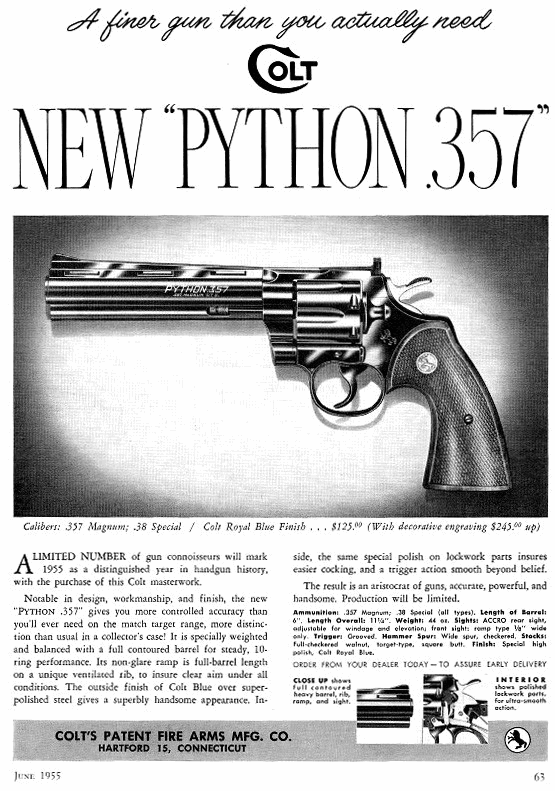
Loved for their beautiful finish, nice balance, and great trigger, Colt Pythons have proven to be excellent investments. Since the Colt Python was first introduced in 1955, Python prices have gone through the roof. A pristine, LNIB early-era Colt Python can now command $4000.00 or more. The Museum estimates the price of Pythons has risen 14,300% since 1955. How much did a Python cost in 1955? You could purchase the Royal Blue model for just $125.00! Factory-engraved models started at $245.00, according to this Colt advertisement from June, 1955:
You can see hundreds of other interesting firearms on the National Firearm Museum website, www.NRAMuseum.com. Or, if you’re lucky, you can see the collections in person. The NRA now operates three Museum locations: the NRA National Firearms Museum in Fairfax, Virginia; the NRA National Sporting Arms Museum in Springfield, MO; and the Frank Brownell Museum of the Southwest in Raton, NM.
Shown is text from H.R.5717 and S.3254 mandating Federal firearms licensing.
Make no mistake about it — leaders of the Democratic party want to dismantle the Second Amendment and impose devastating new restrictions on gun owners. Companion Bills currently in Congress will require a Federal License to own ANY Firearms. The first line of the identical bills, H.R.5717 and S.3254, mandates a federal license for any American to legally “purchase, acquire, or possess a firearm or ammunition”. Yes you can’t even own ammo without a Federal license. Morever, to obtain such a license, citizens can be subject to psychological/character exams so that bureaucrats can “make a determination of suitability”. Such requirements effectively destroy the Second Amendment. Imagine if you had to obtain a license to vote, or pass a psychological “determination of suitability” before you could attend your church.
These companion bills, which have been endorsed by Joe Biden and his running mate Kamala Harris, represent the greatest legislative threat to the gun rights in the history of the country. Biden himself has called for the banning of AR15s and other modern sporting rifles, while Harris has advocated the use of Executive Action to confiscate semi-auto rifles (as was done recently in Canada).
The Jews for the Protection of Firearms Ownership (JPFO.org) have analyzed these companion bills in Congress. The JPFO states that this legislation’s “character [and] suitability” requirements for licensing would effectively eliminate the Second Amendment: “The Bill of Rights’ ban on infringement would be ignored… Unelected bureaucrats will literally choose who can bear arms [and] all existing arms in private hands will be subject to confiscation.”
The Democratic-sponsored gun control legislation, H.R.5717 and S.3254 will require current and future gun owners to pass psychology and character tests to continue owning the firearms they already legally possess. When asked, legal experts have been unable to describe how this could be applied fairly and predictably. America has an estimated 100 million gun owners. That number has grown dramatically in 2020 because of citizens’ fears over large scale rioting and intimidation by BLM and Antifa, and the demands by Democrats to “defund the police”.
The first line of the identical bills, HR5717 and S3254, requires a federal license for any American to legally “purchase, acquire, or possess a firearm or ammunition”. This is de facto infringement.
To obtain this license you would need to prove to unelected officials that you are of “sound mind and character”, you do not “potentially create a risk to public safety”, and you meet “any other requirements the State determines relevant”. Authorities, “make a determination of suitability”, for your possession and ownership of firearms, including any you currently own.
How bad are the Democratic-sponsored gun bills? Read this summary of Senate Bill 3254, sponsored by Elizabeth Warren. The provisions of companion House Bill H.R.5717 are identical.
Senate Bill 3254 Official Summary of Provisions
Gun Violence Prevention and Community Safety Act of 2020
This bill makes various changes to the federal framework governing the sale, transfer, and possession of firearms and ammunition. Among other things, the bill does the following:
— Requires individuals to obtain a license to purchase, acquire, or possess a firearm or ammunition;
— Raises the minimum age — from 18 years to 21 years — to purchase firearms and ammunition;
— Establishes new background check requirements for firearm transfers between private parties;
— Requires law enforcement agencies to be notified following a firearms-related background check that results in a denial;
— Creates a statutory process for a family or household member to petition a court for an extreme risk protection order to remove firearms from an individual who poses a risk of committing violence;
— Restricts the import, sale, manufacture, transfer, or possession of semi-automatic assault weapons and large capacity ammunition feeding devices;
— Restricts the manufacture, sale, transfer, purchase, or receipt of ghost guns (i.e., guns without serial numbers);
— Makes trafficking in firearms a stand-alone criminal offense;
— Requires federally licensed gun dealers to submit and annually certify compliance with a security plan to detect and deter firearm theft;
— Removes limitations on the civil liability of gun manufacturers;
— Allows the Consumer Product Safety Commission to issue safety standards for firearms and firearm components;






 Team USA Olympian and