Most competitive shooters are pretty good about bore cleaning (some may even clean their bores too aggressively). However, we’ve found that many shooters neglect the chamber area and the bolt lug recesses. It’s too easy to clean the bore, slip out the guide rod and say “I’m done.” Sinclair Int’l explains why it’s important to clean the action interior: “Shooters use a lot of grease and oil on their bolts to reduce friction and to prevent wear[.] Unfortunately, both of these compounds attract grit, powder and primer residues. Cleaning your receiver is especially critical [with] custom actions where the fit between the action and bolt is held to very tight tolerances. Routine cleaning of the action will prevent unnecessary wear on the bolt body, locking lugs, and the action raceways/guide rails. Frequent action cleaning is also essential to keeping the trigger area free of debris which can cause trigger hang-ups and failures.”
Your rifle deserves a clean action and lug recesses. For action cleaning, our friend Danny Reever favors the PMA Action Cleaning Tool. This handy tool speeds up the cleaning process, letting you do a better job in less time. Danny reports: “I’ve been using the PMA Action Cleaning Tool Kit ($79.95) for quite some time. Previously, I used one of the old style (round knob) action-cleaning tools with cylindrical cotton rolls. I think the PMA Action Cleaning Tool Kit is easier to use, and possibly achieves better results. CLICK HERE to Read Full Tool Review.
Cleaning the Chamber
Combustion by-products, lubricants, and solvent residues can collect in your chamber. Severe build-up of grease and carbon can interfere with chambering. Also some solvents will promote corrosion. You need to keep your chambers clean.
1) Install a clean cotton mop of the correct size on the end of a chamber rod and insert the mop into the chamber. Rotate the mop several times to remove any brush bristles left behind and any excess solvent that was between the rod guide snout and the end of the chamber. Make sure the chamber is dry. Prior to storing a rifle you can oil the chamber but make sure the oil is removed prior to firing the rifle.
2) Alternatively, install an old bore brush on a chamber rod, overlap a couple of patches on the brush bristles, and wrap them around the brush completely. Then insert the patch-covered brush into the chamber while rotating it to remove the excess solvent and debris. Push it firmly into the neck area of the chamber. A similar method is to pierce a large patch on the end of the brush loop and insert it into the action, again rotating the brush as you push the patch up against the breech.
Cleaning the Lug Recess Area
The action lug recess area is one of the dirtiest places on a bolt-action rifle. To properly clean this area, always use a tool designed for the task, such as the $24.99 Sinclair Action Cleaning Tool (Brownells #749003115) which is part of the full Sinclair Action Cleaning Tool Kit ($48.99 at Brownells, #749004651).
1) Insert a cotton roll or cleaning felt into your lug recess cleaning tool and wet both ends and the face of the cotton roll/felt with solvent.
2) Insert the tool into the action and push it forward until it is positioned fully in the lug recess area and rotate the tool head several times. Then reverse the rotation for another few turns. While rotating the tool move it slightly in and out to cover the entire recess area and to also clean the breech face.
3) Remove the tool from the action and inspect the surface of the felt or cotton roll. If there is quite a bit of residue on both sides of the felt/roll, then repeat with another wet felt/roll.
4) When you feel the recess area is completely clean, insert a dry cotton roll into the tool and rotate the tool head to remove any remaining solvent and debris. If necessary, use a second dry cotton roll.
5) You can follow this step up with another pass of a mop or patches into the chamber to get any debris or solvent that pushed forward out of the lug recess area.
We are often asked “Can I get more velocity by switching primer types?” The answer is “maybe”. The important thing to know is that changing primer types can alter your load’s performance in many ways — velocity average, velocity variance (ES/SD), accuracy, and pressure. Because there are so many variables involved you can’t really predict whether one primer type is going to be better or worse than another. This will depend on your cartridge, your powder, your barrel, and even the mechanics of your firing pin system.
BE SAFE: Be cautious when changing primer types. Glen Zediker recommended decreasing your load ONE FULL GRAIN when changing to a different primer type, one that you haven’t used before.
Interestingly, however, a shooter on another forum did a test with his .308 Win semi-auto. Using Hodgdon Varget powder and Sierra 155gr MatchKing bullets, he found that Wolf Large Rifle primers gave slightly higher velocities than did CCI-BR2s. Interestingly, the amount of extra speed (provided by the Wolfs) increased as charge weight went up, though the middle value had the largest speed variance. The shooter observed: “The Wolf primers seemed to be obviously hotter and they had about the same or possibly better ES average.” See table:
Varget .308 load
45.5 grains
46.0 grains
46.5 grains
CCI BR2 Primers
2751 fps
2761 fps
2783 fps
Wolf LR Primers
2757 fps
2780 fps
2798 fps
Speed Delta
6 fps
19 fps
15 fps
You can’t extrapolate too much from the table above. This describes just one gun, one powder, and one bullet. Your Mileage May Vary (YMMV) as they say. However, this illustration does show that by substituting one component you may see significant changes. Provided it can be repeated in multiple chrono runs, an increase of 19 fps (with the 46.0 grain powder load) is meaningful. An extra 20 fps or so may yield a more optimal accuracy node or “sweet spot” that produces better groups. (Though faster is certainly NOT always better for accuracy — you have to test to find out.)
WARNING: When switching primers, you should exercise caution. More speed may be attractive, but you have to consider that the “speedier” primer choice may also produce more pressure. Therefore, you must carefully monitor pressure signs whenever changing ANY component in a load. In his books, the late Glen Zediker recommended decreasing your load ONE FULL GRAIN when changing to a different primer type, one that you haven’t used before.
Most gun guys know that the NRA publishes a monthly magazine called American Rifleman. What you may not know is that NRA also offers a series of American Rifleman videos on YouTube, with recent American Rifleman TV episodes on the Outdoor Channel. For today’s Saturday Showcase we offer seven noteworthy NRA-produced gun videos currently hosted on YouTube.
Highlights from American Rifleman TV Episodes
Currently on YouTube you can access dozens of past episodes of the American Rifle television series, along with many recent gun/gear reviews. Here are seven NRA videos featuring important or interesting rifle types plus a Remington ammunition factory tour.
Remington Model 700 ADL and BDL
After Winchester came out with the Model 70, Remington Arms answered with the Model 700, one of the most recognized bolt-action designs of all time. The design emerged in 1962, as Remington sought to improve on its previous Models 721 and 722. Two versions of the Remington Model 700 existed at launch: ADL and BDL models. “You know, you could have it two ways. You had the ADL and the BDL,” said NRA Publications Editorial Director Mark Keefe. “You had the plainer ADL at a better price point, then you had the BDL and that had fleur-de-lis checkering and white spacers and a gloss finish and, you know, it was shinier.” The commercial market wasn’t the only area where the Model 700 was successful, as it was also adapted into the U.S. Army as the M24 sniper rifle. To this day, the Model 700 continues to be a popular bolt-action rifle platform for both commercial and military use.
CMP M1 Garand Matches
The Civilian Marksmanship Program (CMP) runs matches throughout the country, including the major summertime Camp Perry matches. This American Rifleman video covers the CMP’s M1 Garand Match, one of the most popular matches at Camp Perry every year. The Garand shoots the .30-06 Springfield cartridge. It is a surprisingly accurate semi-auto rifle, when fitted with an aftermarket barrel. The CMP recently started a program where the CMP is producing M1 Garands with completely new actions and barrels.
Model 1903-A3 Springfield — History of Wartime Rifle
While the U.S. Army’s Model 1903 Springfield rifle is one of the most well-recognized small arms of the 20th century, a lesser-known variant served as an important stop-gap rifle in the early years of World War II. Thanks to the efforts of engineers and arms designers at Remington, the U.S. Army eventually adopted an official pattern of the Springfield termed the “Model of 1903A3.” This NRA video covers the interesting history of the Springfield model 1903-A3.
Revival of Remington Ammunition Production by Vista Outdoor
Remington Ammunition filed for bankruptcy in July 2020. Vista Outdoor, owner of Federal, CCI, and Speer, purchased the assets of Remington Ammunition. This video explains how Vista Outdoor revived Remington’s Lonoke, Arkansas plant. “This is one of the largest ammunition manufacturing plants in the world. It was set up in 1969 by DuPont, who owned Remington at the time” notes Mark Keefe, NRA Publications editorial director. Over the first 18 months of Vista’s ownership of Remington Ammunition, the facility added more than 1500 employees and increased centerfire-handgun ammunition production more than 40 percent, while shotshell production increased 15 percent.
Henry U.S. AR-7 Survival Rifle
This is an interesting video of a compact rimfire rifle originally issued to U.S. Air Force crews. In the event a crew was downed in a wilderness area, the rifle could be assembled and used to shoot game for food. Civilian versions of this ultra-lightweight 3.5-lb rifle are also available. In this video, American Rifleman contributor Jeremiah Knupp puts the Henry U.S. AR-7 Survival Rifle to the water test. The civilian version is sold by Henry as the Henry U.S. Survival Rifle. With the action, barrel, and magazines housed INSIDE the stock assembly, this rifle can easily be carried in a pack or stowed in a vehicle.
Springfield M1A — Popular .308 Win (7.62×51) Semi-Auto Rifle
The M1A is one of the most popular rifles sold today by Springfield Armory. The M1A is a semi-auto version of the select-fire military M14 rifle developed in the 1950s. Designers adapted the action of the M1 Garand with a different gas system and dropped the 8-round internal magazine for 20-round detachable box magazines. Chambered for the 7.62×51 NATO cartridge, the M14 was adopted by the military in 1959, replacing the M1 Garand. However, its term as the official U.S. service rifle was short-lived, as Armalite was developing the M16, which evolved into the semi-auto AR15 for civilian use. Despite the M14 having a short-lived career as a service rifle, the semi-auto M1A remains quite popular for CMP rifle matches.
Barrel-maker Dan Lilja’s website, RifleBarrels.com has an excellent FAQ page that contains a wealth of useful information. On the Lilja FAQ Page you’ll find answers to many commonly-asked questions. For example, Dan’s FAQ addresses the question of barrel life. Dan looks at factors that affect barrel longevity, and provides some predictions for barrel life, based on caliber, chambering, and intended use.
NOTE: This article was very well-received when it was first published. We are reprising it for the benefit of readers who missed it the first time.
Dan cautions that “Predicting barrel life is a complicated, highly variable subject — there is not a simple answer. Signs of accurate barrel life on the wane are increased copper fouling, lengthened throat depth, and decreased accuracy.” Dan also notes that barrels can wear prematurely from heat: “Any fast varmint-type cartridge can burn out a barrel in just a few hundred rounds if those rounds are shot one after another without letting the barrel cool between groups.”
Q. What Barrel Life, in number of rounds fired, can I expect from my new barrel?
A: That is a good question, asked often by our customers. But again there is not a simple answer. In my opinion there are two distinct types of barrel life. Accurate barrel life is probably the type most of us are referencing when we ask the question. But there is also absolute barrel life too. That is the point where a barrel will no longer stabilize a bullet and accuracy is wild. The benchrest shooter and to a lesser extent other target shooters are looking at accurate barrel life only when asking this question. To a benchrest shooter firing in matches where group size is the only measure of precision, accuracy is everything. But to a score shooter firing at a target, or bull, that is larger than the potential group size of the rifle, it is less important. And to the varmint hunter shooting prairie dog-size animals, the difference between a .25 MOA rifle or one that has dropped in accuracy to .5 MOA may not be noticeable in the field.
The big enemy to barrel life is heat. A barrel looses most of its accuracy due to erosion of the throat area of the barrel. Although wear on the crown from cleaning can cause problems too. The throat erosion is accelerated by heat. Any fast varmint-type cartridge can burn out a barrel in just a few hundred rounds if those rounds are shot one after another without letting the barrel cool between groups. A cartridge burning less powder will last longer or increasing the bore size for a given powder volume helps too. For example a .243 Winchester and a .308 Winchester both are based on the same case but the .308 will last longer because it has a larger bore.
And stainless steel barrels will last longer than chrome-moly barrels. This is due to the ability of stainless steel to resist heat erosion better than the chrome-moly steel.
Barrel Life Guidelines by Caliber and Cartridge Type
As a very rough rule of thumb I would say that with cartridges of .222 Remington size you could expect an accurate barrel life of 3000-4000 rounds. And varmint-type accuracy should be quite a bit longer than this.
For medium-size cartridges, such as the .308 Winchester, 7×57 and even the 25-06, 2000-3000 rounds of accurate life is reasonable.
Hot .224 caliber-type cartridges will not do as well, and 1000-2500 rounds is to be expected.
Bigger magnum hunting-type rounds will shoot from 1500-3000 accurate rounds. But the bigger 30-378 Weatherby types won’t do as well, being closer to the 1500-round figure.
These numbers are based on the use of stainless steel barrels. For chrome-moly barrels I would reduce these by roughly 20%.
The .17 and .50 calibers are rules unto themselves and I’m pressed to predict a figure.
The best life can be expected from the 22 long rifle (.22 LR) barrels with 5000-10,000 accurate rounds to be expected. We have in our shop one our drop-in Anschutz barrels that has 200,000 rounds through it and the shooter, a competitive small-bore shooter reported that it had just quit shooting.
Remember that predicting barrel life is a complicated, highly variable subject. You are the best judge of this with your particular barrel. Signs of accurate barrel life on the wane are increased copper fouling, lengthened throat depth, and decreased accuracy.
Benchrest Barrel Life — You May Be Surprised
I thought it might be interesting to point out a few exceptional Aggregates that I’ve fired with 6PPC benchrest rifles with barrels that had thousands of rounds through them. I know benchrest shooters that would never fire barrels with over 1500 shots fired in them in registered benchrest matches.
I fired my smallest 100-yard 5-shot Aggregate ever in 1992 at a registered benchrest match in Lewiston, Idaho. It was a .1558″ aggregate fired in the Heavy Varmint class. And that barrel had about 2100 rounds through it at the time.
Another good aggregate was fired at the 1997 NBRSA Nationals in Phoenix, Arizona during the 200-yard Light Varmint event. I placed second at this yardage with a 6PPC barrel that had over 2700 rounds through it at the time. I retired this barrel after that match because it had started to copper-foul quite a bit. But accuracy was still good.
Can a human, with a sling, shoot as well as a mechanical rest? The answer is “yes” (at least once in a great while) IF that sling shooter can deliver a record-breaking performance. Here’s an interesting tale of man vs. machine from our archives…
The USAMU posed an interesting challenge — could one of their shooters match the performance of a mechanical rest? Who would win in this battle between man and machine? You might just be surprised. At 600 yards, with an AR-platform rifle, the results can be remarkably close, based on targets provided by the USAMU. When clamped in a test rig, a USAMU M16A2 produced a 200-18X group with handloads. The USAMU says this was “one of our better 20-shot groups at 600 yards, testing ammo from a machine rest”. Can a human do better?
Remarkably, a human soldier came very close to matching the group shot from the machine rest. The photo below shows a 20-shot group shot by a USAMU marksman with sling and iron sights, using USAMU-loaded ammunition. The score, 200-16X, was nearly the same. As you can see, the USAMU rifleman didn’t give up much to the machine rest, even at 600 yards!
In fairness, this was no ordinary human performance. The 200-16X score represented a new National Record set in December, 1994. This was fired by PFC Coleman in an Interservice Match at Okeechobee, Florida. Brilliant Performance.
We talked with the experts at Bartlein Barrels. They confirmed that they have seen many, many more barrels harmed by crown damage caused by improper cleaning than by anything else. If you use a bronze brush, Bartlein recommends that you REMOVE the BRUSH after it passes through the muzzle. This is because the bristles take a set (pointing to the breech) during the out-stroke. In other words the bristles angle back as you push towards the muzzle from the breech. If you drag the brush backwards at the muzzle, you force these bristles to reverse direction abruptly right as they cross the delicate crown. In time, that can damage the crown. NOTE: John Krieger of Krieger Barrels also advises his customers not to pull a bronze brush backwards across the crown.
Response to Skeptics
Whenever we’ve published similar advice, given by guys who are producing some of the most accurate barrels in the world, some readers get extremely angry. They say, “You’re crazy! I’ve was pullin’ triggers when you were still in diapers. I’ve got Hall of Fame points and I say there’s no way a phosphor bronze brush can ever do anything to steel. You’re full of it.” Well, these guys are entitled to their opinion. But here’s our response. Number one, we’re just telling you what the barrel-makers are telling US. Don’t kill the messenger. Number two, many of the guys who say bronze brushes can’t affect the crown are the same guys who feel they need to recrown their barrels every 400-500 rounds (Do we see a connection?). Third, if you don’t think a softer material can affect steel, look at the steel ferrules of a well-used fishing rod — there the steel is worn away by plastic. (With time, water will wear away granite.) Lastly, this Editor can tell you I’ve seen the damage myself, first-hand, using a magnifying glass on much-brushed benchrest barrels. Right at the muzzle, the top edge of the lands had sharp, jagged edges that looked like little shark’s teeth, or the edge of a serrated knife. By contrast, a new barrel will have a nice, smooth straight edge along the top of the lands at the muzzle.
Also Be Careful with Jags
Bartlein’s experts also told us to be careful about the jags you use. Dewey-style jags in particular can cause problems. These have a long shaft with multiple rings with diamond-pattern “teeth”. The teeth are designed to grip a patch. The problem is that the lower rings may be exposed below the patch fabric, so the teeth can grind directly on the rifling and/or crown. Bartlein says Dewey-style metal jags can damage a crown very quickly if any of the toothed rings are exposed, metal-on-metal. Tim North of Broughton barrels also advises against using the Dewey-style jags with toothed rings. Interestingly, Dewey uses the same type of diamond-shaped teeth on the bottom of its “Crocogator” primer pocket tool, so you know those knurled teeth can scrape.
The Vihtavuori and Applied Ballistics-sponsored duo of Chad Heckler and Francis Colon topped the Precision Marksman field at the 2025 Rocky Mountain Airgun Challenge. Held June 18-22, 2025, this 5-day event at the Garth Killpack Shooting Range drew a big crowd, with competitors from over 19 countries. Heckler with a score of 930 and Colon with a score of 900 placed 1st and 2nd respectively in the Precision Marksman Challenge event. Heckler’s victory earned him a $20,000 prize while Colon took home $10,000. Those are some of the biggest cash prizes in any rifle event.
Precision Marksman match winner Chad Heckler was elated: “Team CHANCIS secures the top two spots at the 2025 Rocky Mountain Airgun Challenge! Winning this event last weekend wasn’t easy, Justin and his Utah Airguns family and friends have created something special with this event. The attention to detail and love that was poured into this match was second to none”, said Heckler. “I feel honored to become the 2025 champ alongside [team-mate] Francis Colon. Congrats buddy.”
“There aren’t many times that I’m happy after taking second place, but earning the top two spots with my best friend is epic…” stated Colon. “Massive thank you to Justin Jacobson and the crew at Utah Airguns! This is not just a match… it is an experience! With 5 days of shooting over four disciplines and custom themes, props, music and food, it makes me excited for 2026!”
Tech Tip: If these rifles don’t look like conventional airguns it is because they employ a new design with a slim diameter air tank wrapped around the barrel. These FX DRS Pro MDT 700 Airguns are “designed with the air tank wrapped around the barrel … lowering the profile of the overall rifle, resulting in a very slim front end and an overall more balanced rifle.”
The Rocky Mountain Airgun Challenge
The Rocky Mountain Airgun Challenge (RMAC) is a challenging, multi-class tactical-style airgun competition. The RMAC event, hosted by Utah Airguns, is one of the biggest outdoor air rifle matches in the country. It combines the low-cost of air rifle shooting with the fun of PRS/NRL-type multi-stage shooting.
RMAC features four distinct events designed to test diverse shooting skills. The 100-Yard Benchrest event focuses on precision and wind-reading — most other airgun BR matches are at 50 yards or 50m max, so this is tough by comparison.
The Precision Marksman Challenge is a physically demanding event that requires shooters to engage reactive steel targets from various positions and obstacles under time pressure, utilizing both slugs and pellets. The Speed Challenge is a high-energy, head-to-head competition where shooters race through diverse courses of fire. Finally, the Big Bore Slug Challenge showcases the power and accuracy of slug-shooting airguns, with competitors engaging steel targets at distances from 100 to 450 yards.
Modern Tactical-Style Air Rifles
Here are two state-of-the-art tactical air rifles, the BinTac MCAR ($2790.00 from Airgun Tactical) and the FX IMPACT M4 ($2099.99 from Utah Airguns). The BinTac MCAR almost looks like a centerfire rifle at first glance but the air chambers on the buttstock tell the real story.
Barnes Bullets has started a new Barnes Bullet Points podcast running on YouTube. Hosted by Barnes Bullets’ Marketing Mgr. Dale Evans, this podcast offers a behind-the-scenes look into the design and production of Barnes Bullets products along with use of Barnes Bullets in hunting and shooting sports.
The Barnes Bullet Points podcast will cover a variety of topics, blending technical and educational segments with real-world adventures and conversations with hunters and competitors. You can subscribe to the Barnes Bullets YouTube channel, follow on Spotify or Apple Podcasts. New podcasts will be released weekly. The first two podcasts are live now.
Episode 1: The History of Barnes
Barnes Podcast Number 1, The History of Barnes, was released last week. On the podcast, Evans is joined by Andrew Sparks and Gregg Sloan. The three men discuss Barnes Bullets’ origins, where it is today and what lies ahead. Together, they introduce both Barnes Bullets as a company and explain the Podcast goals.
Episode 2: Deep Dive into the Bullets
Podcast Episode 2 features Barnes bullet families. Listeners will learn more about the design features and performance of popular Barnes bullets. In this 75-minute podcast, Dale Evans is joined by Gregg Sloan and Mitchell Kukson. The three men discuss the features of Barnes TSX, TTSX, and LRX bullets. The podcast discusses how to select the optimal bullet type (for various scenarios), and the experts explain the performance you can expect to see from each. Watch this full 55-minute Podcast below:
“The Barnes Bullet Points podcast is a great resource for our loyal fans and end users to learn more about the brand, the products we offer and the people that help develop them”, said Evans.
SSG Amanda Elsenboss, now with the Pennsylvania National Guard, was the 2021 NRA National High Power Champion and 2019 NRA Long Range National Championship in 2019.
In the archives of On The Mark magazine, DCM Emeritus Gary Anderson, an Olympic Gold medal-winning shooter in his younger years, offers sage advice for competitive shooters.
In his article Ten Lessons I Wished I Had Learned as a Young Shooter, Anderson provides ten important guidelines for everyone involved in competitive shooting. Here are the Ten Lessons, but you should read the full article. Anderson provides detailed explanations of each topic with examples from his shooting career.
LESSON 1 – NATURAL ABILITY WILL NOT MAKE YOU A SHOOTING CHAMPION.
(You also need hard work, training effort and perseverance.)
LESSON 2 – ANGER IS THE ENEMY OF GOOD SHOOTING.
(The key to recovering from a bad shot is to stay cool, no matter what happens.)
LESSON 3 – BAD SHOTS CAN TEACH YOU MORE THAN GOOD SHOTS.
(Today, error analysis is one of the most powerful tools for improving scores.)
LESSON 4 – NEVER GO WITHOUT A SHOT PLAN.
(A shot plan is a detailed breakdown of each of the steps involved in firing a shot.)
LESSON 5 – PRACTICE IN BAD CONDITIONS AS WELL AS GOOD CONDITIONS.
(Most competitions are fired in windy conditions or where there are plenty of distractions.)
LESSON 6 – CHAMPIONS ARE POSITIVE, OPTIMISTIC PEOPLE.
(Negative shooters expect bad results; positive shooters expect to train hard to change bad results.)
LESSON 7 – IT’S NOT ABOUT WHETHER YOU WIN OR LOSE.
(It’s about how hard you try to win.)
LESSON 8 – YOUR DOG WON’T BITE YOU AFTER SHOOTING A BAD SCORE.
(Hopefully your coach, parents and friends won’t bite you either.)
LESSON 9 – YOUR PRESS CLIPPINGS CAN HURT YOU OR HELP YOU.
(Winning can go to our heads. We start thinking we are so good we don’t have to work hard any more.)
LESSON 10 — YOU NEVER SHOT YOUR BEST SCORE.
(Great champions are always looking for ways to improve.)
USAMU shooters on the firing line at the Wa-Ke’-De outdoor range in Bristol, IN. Photo courtesy USAMU.
About Gary Anderson Gary Anderson served as the Director of the Civilian Marksmanship Program (CMP) from 1999-2009, and is now DCM Emeritus. As a Nebraska farmboy, Gary grew up hunting and shooting. Dreams of winning an Olympic Gold Medal in shooting led Gary to the U.S. Army. In 1959, he joined the elite U.S. Army Marksmanship Unit. Just two years later, he won his first national championship.
At the 1962 World Shooting Championships in Egypt, Anderson stunned the shooting world by winning four individual titles and setting three new world records. At the 1964 Tokyo Olympics, Gary won the 300m free-rifle Gold Medal, setting a new world record in the process. At the 1966 World Shooting Championships in Germany, Anderson won three additional world titles. At the 1968 Olympics, Gary won a second gold medal in the 300m free-rifle event.
After his “retirement” from international competition, Gary competed in the National High Power Championships, winning the President’s National Trophy in 1973, 1975 and 1976. Over his competitive career, Anderson won two Olympic Gold Medals, seven World Championships, and sixteen National Championships. He is unquestionably one of the greatest American marksmen ever.
Today, June 20, 2024 is Summer Solstice, the longest day of the year. And right now the Northeast USA is undergoing a major heatwave. That means “peak heat” summer conditions have arrived already. It’s vitally important to keep your ammo at “normal” temps during the hot summer months. Even if you use “temp-insensitive” powders, studies suggest that pressures can still rise dramatically when the entire cartridge gets hot, possibly because of primer heating.
It’s smart to keep your loaded ammo in an insulated storage unit, possibly with a Blue Ice Cool Pak if you expect it to get quite hot. Don’t leave your ammo in the car or truck — temps can exceed 140° in a vehicle parked in the sun.
The way ambient temperatures, barrel heating, and powder warming can affect cartridge pressures (and hence velocities) was covered in a study Pressure Factors: How Temperature, Powder, and Primer Affect Pressure by Denton Bramwell. In that article, the author used a pressure trace instrument to analyze how temperature affects ammo performance. Bramwell’s tests yielded some fascinating results.
For example, barrel temperature was a key factor: “Both barrel temperature and powder temperature are important variables, and they are not the same variable. If you fail to take barrel temperature into account while doing pressure testing, your test results will be very significantly affected. The effect of barrel temperature is around 204 PSI per F° for the Varget load. If you’re not controlling barrel temperature, you about as well might not bother controlling powder temperature, either. In the cases investigated, barrel temperature is a much stronger variable than powder temperature.”
This Editor had the personal experience of 6mmBR hand-loaded ammo that was allowed to sit in the hot sun for 45 minutes while steel targets were reset. The brass became quite warm to the touch, meaning the casings were well over 120° on the outside. When I then shot this ammo, the bullets impacted well high at 600 yards (compared to earlier in the day). Using a Magnetospeed, I then chron-tested the sun-heated ammo. The hot ammo’s velocity FPS had increased very significantly — all because I had left the ammo out in the hot sun uncovered for 3/4 of an hour.
LESSON: Keep your ammo cool! Keep loaded ammo in the shade, preferably under cover or in an insulated container. You can use a SEALED cool pack inside the container, but we do NOT recommend H20 ice packs. And don’t have the container do double duty for food and beverages.
Powder Heat Sensitivity Comparison Test
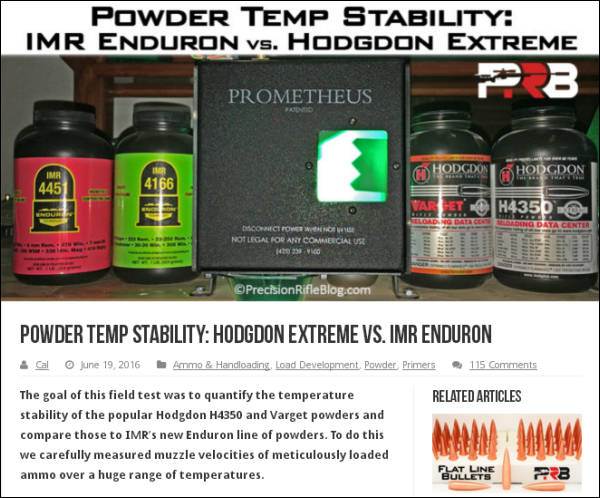
Our friend Cal Zant of the Precision Rifle Blog has published a fascinating comparison test of four powders: Hodgdon H4350, Hodgdon Varget, IMR 4451, and IMR 4166. The first two are Hodgdon Extreme powders, while the latter two are part of IMR’s Enduron line of propellants.
The testers measured the velocity of the powders over a wide temperature range, from 25° F to 140° F. Hodgdon H4350 proved to be the most temp stable of the four powders tested. [NOTE: New Alliant Reloder TS 15.5 has also proved very temp stable in AccurateShooter’s range tests.]




 RMAC features four distinct events designed to test diverse shooting skills. The 100-Yard Benchrest event focuses on precision and wind-reading — most other airgun BR matches are at 50 yards or 50m max, so this is tough by comparison.



 In the archives of
 Gary Anderson served as the Director of the Civilian Marksmanship Program (CMP) from 1999-2009, and is now DCM Emeritus. As a Nebraska farmboy, Gary grew up hunting and shooting. Dreams of winning an Olympic Gold Medal in shooting led Gary to the U.S. Army. In 1959, he joined the elite U.S. Army Marksmanship Unit. Just two years later, he won his first national championship.

 The way ambient temperatures, barrel heating, and powder warming can affect cartridge pressures (and hence velocities) was covered in a study Pressure Factors: How Temperature, Powder, and Primer Affect Pressure by Denton Bramwell. In that article, the author used a pressure trace instrument to analyze how temperature affects ammo performance. Bramwell’s tests yielded some fascinating results.