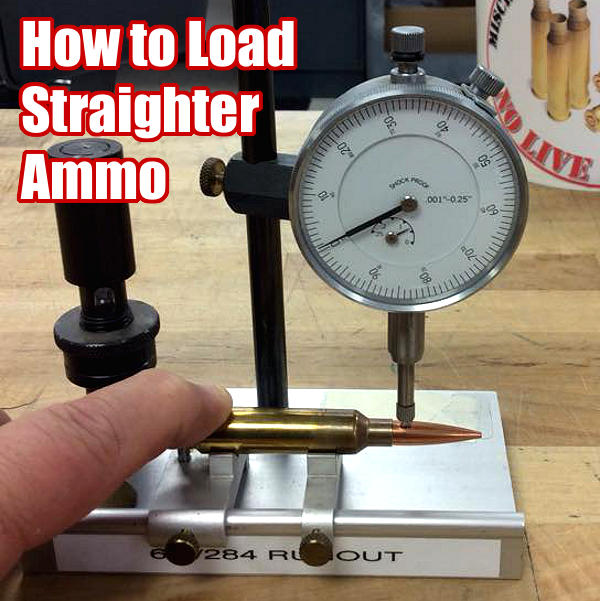
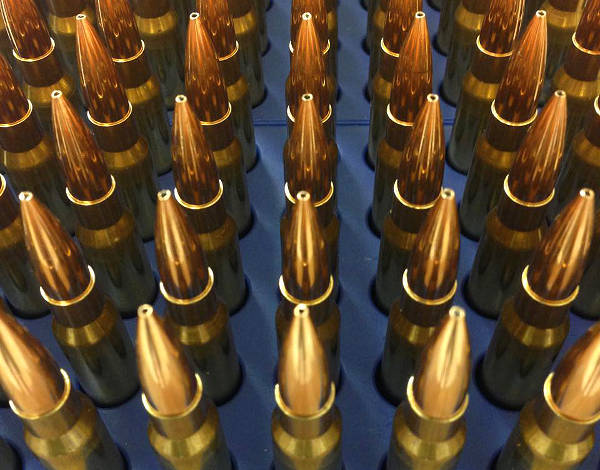
Each Wednesday, the U.S. Army Marksmanship Unit publishes a reloading “how-to” article on the USAMU Facebook page. A while back the USAMU’s reloading gurus looked at the subject of cartridge run-out and what can be done to produce straighter ammo. Tasked with producing thousands of rounds of ammo for team members, the USAMU’s reloading staff has developed smart methods for improving concentricity, even with budget=price dies. For other hand-loading tips, visit the USAMU Facebook page.
Minimizing Runout with Standard Seating Dies
This USAMU article explains how to set up standard bullet seating dies dies to minimize Total Indicated Run-out (TIR). The loading process is described using a single-stage press since most handloaders have one. A high-quality run-out gauge is essential for obtaining consistent, accurate results.
Having sized, primed, and charged our brass, the next step is bullet seating. Many approaches are possible; one that works well follows. When setting up a standard seating die, insert a sized, trimmed case into the shellholder and fully raise the press ram. Next, back the seating stem out and screw the die down until the internal crimping shoulder touches the case mouth.
Back the die out ¼ turn from this setting to prevent cartridge crimping. Next, lower the press ram and remove the case. Place a piece of flat steel (or window glass, which is quite flat) on the shellholder and carefully raise the ram.
Place tension on the die bottom with the flat steel on the shellholder. This helps center the die in the press threads. Check this by gently moving the die until it is well-centered. Keeping light tension on the die via the press ram, secure the die lock ring. If one were using a match style, micrometer-type seating die, the next step would be simple: run a charged case with bullet on top into the die and screw the seating stem down to obtain correct cartridge OAL.
However, with standard dies, an additional step can be helpful. When the die has a loosely-threaded seating stem, set the correct seating depth but don’t tighten the stem’s lock nut. Leave a loaded cartridge fully raised into the die to center the seating stem in the die. Then, secure the stem’s lock nut. Next, load sample cartridges and check them to verify good concentricity.
One can also experiment with variations such as letting the seating stem float slightly in the die to self-center, while keeping correct OAL. The run-out gauge will show any effects of changes upon concentricity. However, this method has produced excellent, practical results as evidenced by the experiment cited previously. These results (TIR Study 2) will reproduced below for the reader’s convenience.
First, however, let’s examine run-out figures of some factory-loaded match ammunition. This should give readers who are new to TIR gauges some perspective about the TIR ranges one might encounter.
TIR Study 1: 50 rounds Lake City M852 Match 7.62mm
(168 gr. Sierra MatchKings)
0.000” – 0.001” = 2%
0.001” – 0.002” = 30%
0.002” – 0.003” = 16%
0.003” – 0.004” = 22%
0.004” – 0.005” = 14%
0.005” – 0.006” = 14%
0.006” – 0.007” = 0%
0.007” – 0.008” = 2%
TIR Study 2: 50 rounds of .308 match ammo loaded using carefully-adjusted standard dies, vs. 50 using expensive “Match” dies from the same maker.
Standard dies, TIR:
0.000” — 0.001” = 52%;
0.001”– 0.002” = 40%;
0.002”– 0.003” = 8%.
None greater than 0.003”.
Note: both samples were loaded using the O-Ring method, i.e. with a rubber O-Ring placed under the locking ring of the Full-length sizing die to allow that die to float.
These tips are intended to help shooters obtain the best results from inexpensive, standard loading dies. Especially when using cases previously fired in a concentric chamber, as was done above, top-quality match dies and brass can easily yield ammo with virtually *no* runout, given careful handloading.
We’re told the 6.5 Creedmoor is now the best-selling chambering in new bolt-action rifles sold in the USA. Accurate, versatile, with moderate recoil, the 6.5 Creedmoor serves hunters, paper punchers, and PRS shooters equally well.
As part of its online Load Data Center, Nosler offers very complete load data for the popular 6.5 Creedmoor cartridge. This medium-sized cartridge has become one of the most popular chamberings for tactical and PRS shooters. The 6.5 Creedmoor combines excellent accuracy, good mag-feeding, good barrel life, moderate recoil, and reasonable component cost. That’s why this cartridge has caught on quickly. GET ALL 6.5 Creedmoor Load Data.
How does barrel length affect 6.5 Creedmoor Muzzle Velocity? CLICK HERE for RifleShooter.com barrel cut-down velocity test.
According to the Sierra Load Manual: “Developed in 2007 by Dennis DeMille and Dave Emary, the 6.5 Creedmoor is a shortened and improved 30 TC cartridge case that was inspired by the .308 Winchester design. This short action design was created to maximize case capacity and a wide range of loading lengths, while still fitting in standard short action magazines. With the correct twist barrel, the versatile 6.5 Creedmoor can take advantage of the wide range of bullet weights available in 6.5 mm (i.e. .264 caliber). Reloaders should keep in mind that the 6.5 Creedmoor works best with medium to medium-slow powders such as H4350, Varget, Win 760, and RE-17.”
Click Each Image to Load PDF File for Listed Bullet Weights
The inaugural Hornady Precision Hunter Steel Challenge took place in Colorado August 8 and 9. This unique competition involved lots of hiking with various shooting positions in challenging natural terrain. The unique match was hosted at the Cameo Shooting Complex near Grand Junction, CO.
There were 135 registered competitors — quite a turn-out for a physically demanding match in a fairly remote location. Congrats to Heavy Class and Overall Winner Brian Black who topped the field with 140 Match points (100% of possible). Brian shot a 6.5×47 Lapua with Berger 6.5mm 140gr Hybrids. Brian’s winning rig featured a Lone Peak Arms Fuzion action, Benchmark barrel, and XLR Element chassis. Behind Brian was Serger Ducourneau in second with 134 points (95.71%). Eric Anderson finished third overall with 129 points (92.14%).
Overall and Heavy Class winner Brian Black (center) with trophy.
The Hornady Precision Hunter Steel Challenge tests a rifleman’s fitness and skills as marksman and hunter. The stages were blind with a 4-minute time limit to move to the shooting area, locate, range, and engage targets. Shooters could choose between two rifle weight classes (light or heavy) and had to meet a minimum power factor cartridge requirement that helped even the playing field. The match featured a diverse course of fire with a good mix of prone and natural terrain shooting positions. Look at the images — this was no ordinary shooting match, and natural terrain features were employed much more than at any PRS match.
Hornady wanted to thank Match Director, Scott Satterlee, the Cameo Shooting Complex and all of the volunteers and sponsors that made this match possible.
Every serious, long-range shooter needs a modern, accurate wind meter. And the higher-level Kestrel Wind Meters include a sophisticated ballistics engine that can calculate drops and wind-holds at any distance. These “smart” Kestrels can communicate (via Bluetooth) with a powerful App on your mobile device(s). For this exclusive review, our Editor F-Class John field tests the Kestrel 5700 Elite Weather Meter with Applied Ballistics, and explains its many impressive features. This unit offers great functionality for a $699.00 MSRP. Shop at KestrelBallistics.com or Amazon.com. For this article, F-Class John has created THREE (3) videos which are well worth watching.
Kestrel 5700 Elite Ballistics Review, Video Part 1
Kestrel 5700 Elite — Field Test and Evaluation
by F-Class John
In order to make accurate shots at long range, whether in the desert knocking down steel at a mile or shooting paper at 1000 yards, you need to know and understand the effects of your environment (wind, temperature etc.), along with your bullet’s ballistics. Traditionally, shooters gauge wind speed/angle with a wind meter and then input the data into a ballistic program on a mobile device. That program then produces a firing solution after calculating bullet drop and wind drift. While this method works, it can be time-consuming and cumbersome, and there’s always the potential for error when transposing the information from wind meter to mobile device.
Enter the Kestrel 5700 Elite Applied Ballistics with Kestrel LiNK. This all-in-one unit allows for incredibly accurate firing solutions by using a variety of measurements such as average, head, and cross winds as well as other atmospheric conditions which are then analyzed by built-in Applied Ballistics software. This yields ultra-accurate results from a handheld unit that easily fits in your pocket. Describing the 5700 Elite can be a little difficult. Yes, it is an anemometer at its core, but it is also a complete weather station, a ballistic calculator, and a target card creator.
The Kestrel 5700 Elite’s own menu has three Mode options: Weather, Easy, and Ballistics. The Weather Mode option (great on its own) features the ability to measure altitude, barometric pressure, crosswind, density altitude, dew point temperature, headwind/tailwind, heat stress index, relative humidity, station pressure, temperature, wet bulb temperature, wind chill, wind direction and wind speed/air speed. These readings are available both on the screen by themselves or grouped three at a time. Access is quick and easy with readings updating constantly so you always have the most accurate information at hand.
In addition to Weather Mode, the Kestrel 5700 Elite Ballistics boasts two other Modes, EASY and BALLISTICS. NOTE — before using Easy Mode or Ballistic Mode I recommend creating gun profiles and bullet profiles in the Kestrel directly or through the Kestrel App. This is easy, as the Kestrel Ballistics App connects directly to any LiNK-enabled Kestrel unit. After the initial startup you’ll want to begin with Gun Profile Management tab. This tab allows you to enter both your gun information as well as your loads. The Elite allows up to 30 gun profiles to be created. Notably, the Elite’s included Applied Ballistics software constantly updates bullet profiles. In fact, during my testing, new bullet profiles were added twice. So I was assured I had the most up-to-date bullet choices when creating load profiles.
Kestrel 5700 Elite Ballitics Review, Video Part 2
Along with gun profiles, the Kestrel 5700 Elite Ballistics allows you to create 10 separate Target Profiles. This can be done a couple different ways. The first is Easy Mode — a great option for those want to get a firing solution but don’t need or want to enter a lot of information. It allows you to set up your target range (distance), target data (wind, direction, etc), and choose your rifle profile. Other variables are muzzle velocity, compass, and latitude. Easy Mode allows you to enter the most vital information without feeling overwhelmed, yet Easy Mode still provides for a very accurate solution.
Kestrel 5700 Elite Ballistics Review, Video Part 3
Switching from Easy Mode to Ballistics Mode provides even more options. These include setting up your target (target angle, target speed, wind direction, and more), wind input, gun profile, environment (temp, barometric pressure, altimeter humidity, etc.), target cards, and range cards (with fixed distances). You also get full access to the Applied Ballistics calculator as well as your ability to manage gun profiles. The target card is a really great feature for multi-target disciplines such as PRS where you may be able to range targets ahead of time. The target card allows you to enter any 10 exact distances and the Applied Ballistics software will calculate solutions for all of them in an easy-to-access chart. This is a great feature that can save you time and improve scores.
The Kestrel 5700 Elite’s associated Applied Ballistics software offers additional advanced functionality. For example you can calculate the actual BC of your bullet and adjust for transonic bullet flight. Once you get the hang of how to use these additional features, they really make you realize how powerful this tiny unit is. The App is configured for easy data entry and it even has the classic Snake game as a fun hidden feature in the “About” section of the menu.
SUMMARY — Outstanding Handheld Device with Full Ballistics Functionality
The Kestrel 5700 Elite with Applied Ballistics demonstrated that it is truly the most feature-packed handheld weather meter/ballistic calculator available on the market today. In fact, after several weeks of testing I feel there were still more minor features that I could have used to get even more information about my ammo, firing solutions, and environment. If you’re a technology-driven shooter looking for the ultimate Weather/Ballistics tool at the range, the Kestrel 5700 Elite is for you. This is an outstanding product.
Our friend Bill Marr of Rifleshooter.com has done it again — conducted a fascinating 6mm Creedmoor barrel cut-down test that reveals how velocity changes with barrel length. This time Bill started with a 24″ Proof Research stainless steel barrel on a Howa action. Bill says this was a well-used barrel, with over 1800 rounds through it. So, the velocities might be a bit different than a new barrel of similar length. Bill cut the barrel down in one-inch increments. Here are some results from the test:
For this latest test, Rifleshooter cut the barrel in one-inch increments from 24″ to 16.1″ (just over legal minimum). Velocities were measured with a MagnetoSpeed V3 chronograph mounted on arm attached to the stock. This allowed the chrono to be adjusted inwards as the barrel was cut shorter, inch by inch.
For the 6mm Creedmoor cartridge, Bill loaded Hornady 108gr ELD Match bullets over 41.5 grains of Hodgdon H4350 with CCI 200 primers in new Starline brass.
The results were interesting to say the least. Bill reports: “Muzzle velocities ranged from 2,893 ft/sec at 24″ to 2,598 ft/sec at 16″ for a decrease in muzzle velocity of 295 ft/sec. Muzzle velocity changes per inch of barrel length ranged from 6 ft/sec per inch between 20 and 19 inches to 63 ft/sec per inch between 19 and 18 inches. Average velocity change per inch of barrel length was 37.9 ft/sec.”
Bill concludes: “An average drop of 37.9 ft/sec/inch of barrel is fairly significant and is what would be expected with a fast moving 6mm cartridge like the 6mm Creedmoor. While I’m used to seeing 6mm Creedmoors with slightly longer barrel lengths than 24″, when coupled with a sound suppressor the additional length can make moving the rifle quickly more difficult.
I’d suggest staying with longer barrel lengths wherever possible with this cartridge. At shorter lengths, it does give up more performance than its big brother the 6.5 Creedmoor.”
More 6mm Creedmoor Velocity Data from 2017 Cut-Down Test
If you’re curious about 6mm Creedmoor velocities at longer barrel lengths, back in 2017 Rifleshooter completed a 6mm Creedmoor barrel cut-down test from 31 inches all the way down to 17 inches. The test included four bullet types from 95 grains to 110 grains. With the 110gr Sierra MK, velocity at 31″ was an impressive 3110 fps. Surprisingly the velocity didn’t decrease that much for the first few inches. Even at 26″ (a five-inch reduction), measured velocity with the 110s was 3073 fps, a loss of 7.4 fps per inch on average. With a barrel shortened all the way to 20″ however, velocity had dropped down to 2949 fps, a significant (161 fps) loss. CLICK HERE for complete results from that 31″-17″ Barrel Cut-Down Test.
The 2020 NRA Annual Meetings, originally set for June in Nashville, TN, and then rescheduled for September in Springfield, MO, has been moved yet again. This week the NRA announced that the 2020 NRA Annual meeting will be held in Tucson, Arizona, on October 24, 2020, at the Loews Ventana Canyon Resort hotel. Here is the NRA’s official announcement of the venue change:
The National Rifle Association is pleased to announce that the 149th Annual Meeting of Members, previously scheduled for Saturday, September 5, 2020 in Springfield, Missouri, has been rescheduled for Saturday, October 24, at the Loews Ventana Canyon Resort hotel located at 7000 N. Resort Drive, Tucson, Arizona.
The NRA Annual Meeting will take place in the Kiva Ballroom and commence at 9:00 am local time. All members are invited to attend. Please visit nraam.org/membersmeeting for further details and updates on pre-registering.
The NRA has not yet released a full schedule of events. But this will be a meeting of members only — not a multi-day gathering with entertainment and celebrity guests. And there will be no large trade show with hundreds of exhibitors. This is a basic meeting of members only, being held to comply with the NRA’s charter. All NRA members are invited to attend.
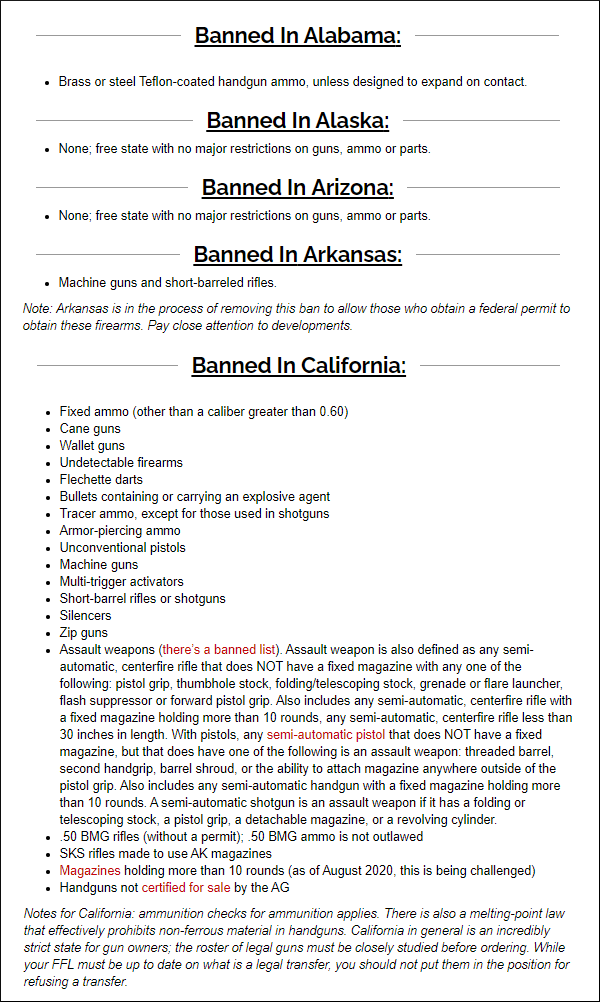
Cheaper Than Dirt (CTD), a Texas-based gun product retailer, has compiled a great resource that can benefit gun owners. CTD has created a “BANNED LIST” which catalogs firearms, ammo, and gun-related products (such as magazines) that are banned in particular states. This Overview of Restricted Guns, Ammo and Parts in Each State is searchable by state, so you can quickly identify the guns, ammo, and gun-related products banned in your location.
Wilburn Roberts, CTD Blog editor, explains: “You must be aware of local laws. I have authored more than 6,000 firearm-related articles, written 14 books on the topic of firearms and served as a peace officer and security professional for decades. I’m still learning new things related to laws every day.
Why read up on this topic? For starters, some things you would never have guessed are illegal. As an example, did you know that some states ban ‘wallet holsters?’ These are holsters that allow you to carry a handgun like a Beretta .25 ACP (or sometimes a small revolver) in the back pocket.
Be careful, as many things you are able to purchase easily online could be illegal in your home state. Some are patently illegal, others are illegal only if you carry them.
That being said, this is a report on certain items that are banned in one state or another. Feel free to use it as a reference for your own research. It contains pertinent gun laws nationwide and is separated on a state-by-state basis. It is ultimately your responsibility to study your own state laws and those of the states you travel in. Lawws might be … more complex than they first appear. Double-check the laws for your state. Also, remember that these laws are subject to change. At the end of the day, you should never order anything that is illegal in your state.”
DISCLAIMER: This is not intended to be a comprehensive or complete list of gun laws. The information provided is not intended as legal advice or a restatement of law. For any particular situation, it is highly recommended that a licensed local attorney be consulted for an accurate interpretation. The opinions and statements expressed in this article belong to the author and do not necessarily represent Cheaper Than Dirt, nor is the company at fault for any gun-related legal decisions you make.
Look carefully at the photo above. That stylish black rear bag doesn’t look anything like an Edgewood or Protektor — it’s a Lenzi bag from Italy. The front Bag-holder on the SEB Neo Rest is also a Lenzi product.
Lenzi Rear Sand Bag
Pat Reagin of PMA Tool offers a really superb rear bag that comes from Italy. Pat tells us: “We are now carrying rear bags made by Italian benchrester Alberto Lenzi. Made in Italy, these Lenzi bags are AWESOME! They are available for short range and one that is slighty taller for long range.” The Lenzi rear bags feature a big, 8″ x 6″ footprint with a thick, slightly concave base that sits very flat on the bench top. Lenzi bags are very stable with a reassuring “dead” feel on the bench. Guys who have tried this bag really like it. Pat says: “I can’t explain it, but the bag seems to absorb energy/recoil better than other bags — the gun tracks a little better and I get back on target really well.” CLICK HERE for more information: Lenzi Long Range Rear Bag | Lenzi Standard Rear Bag.
– Black leather with Cordura at stock contact points with blue stitching.
– 1/2″ flat between medium ears.
– Heavy 8″x6″ base with built-in “donut”.
– Weight about 15.5 lbs filled with heavy sand in bottom & white sand in ears.
Lenzi Replacement Top for SEB NEO Front Rest
A common complaint about the SEB NEO rest is the rest top, specifically the three-piece bag. This rest top made by Alberto Lenzi addresses the issue by replacing the entire rest top. The rest top features a more conventional design and includes a traditional style front bag that conforms to IBS and NBRSA rules.
The Gun Digest 2021 Annual, 75th Edition, is available now for $32.99. This 592-page resource covers rifles, shotguns, handguns, muzzleloaders, airguns, optics and more. We like the print edition, but there is also an eBook PDF version you can read on your tablet or computer. Both provide hundreds of photos with new product roundups, in-depth product tests, and scores of articles and stories. The Gun Digest 2021 Annual, paperback edition, is also available for $31.76 at Amazon.com with free shipping. Gun Digest 2021 is also available in digital PDF format for $31.99 at Gundigeststore.com. In the future there will also be an Amazon Kindle edition, but it is not available yet.
Gun Digest 2021 debuts Phil Massaro as its editor-in-chief. Massaro, the seventh editor in the book’s history, has assembled a wide and varied roster of leading industry authors for the new book, including Craig Boddington, Joe Coogan, Ron Spomer, Terry Wieland, Rick Hacker, Jim Wilson, Larry Weishuhn, Wayne van Zwoll, Bryce Towsley and many more.
Gun Digest 2021 covers hunting, personal defense, target shooting, gunsmithing, and collecting. Historical articles look at the role played by firearms in our country. There are Updated Ballistics Tables, and the catalog section shows off the industry’s newest offerings in rifles, handguns, shotguns, muzzleloaders and air rifles.
Reports from the Field cover the newest firearms and accessories. A Testfire section brings readers up to date on product performance. And the annual photo essay, spotlights the finest custom and engraved guns.
Other Good Books from Gun Digest Media
Gun Digest Media produces numerous other quality books for rifle, pistol, and shotgun owners. Here are four volumes we recommend. These are offered in both paperback and eBook versions:
Here’s a way some smart shooters are dealing with Pandemic Social Distancing requirements. At the Manatee Gun Club in Florida, match organizers devised tall, portable plexiglass barriers between the benches. These barriers shield each shooter from his neighboring competitor. And shooters say there is an added benefit — there is less perceived noise and muzzle blast from nearby fellow competitors.
AccurateShooter Forum member CaptainMal reports: “We just finished a steel shoot at Manatee using ALL the benches with dividers attached to each. Prior to today we were not allowed to use all the benches as they are five feet, not six feet apart [as required by social distancing regulations]. Now we can take more shooters per relay and we found some positive unintended consequences.” READ Forum Thread.
Each divider attaches to a bench. The divider can be easily removed for storage by folding up the legs so it is flat to carry/store. These dividers are relatively light-weight making them easy to put in place. In addition, because the dividers are transparent, Range Safety Officers (and spectators) can view the shooters. Notably, the Manatee competitors also reported that the dividers offered a “dramatic reduction in muzzle blast and some noise reduction also”.
CaptainMal explains: “Most all of us have experienced magnum explosions next to us on the bench and/or muzzle brakes directing a concussion at us as we shoot. GONE. We built all these because of the virus restrictions we had to deal with. Well now we can use all the benches, put on a normal program and reap the benefits of full visibility and no muzzle blast distractions.”
Al Benarroch (Forum member “Alibaba”) designed and built these dividers. Al is happy to share his design with anyone else wanting or needing to have something like this for their range. Here is Al last season BEFORE the COVID-19 range restrictions. To see him now you just look through the divider.
The Southpaw Challenge — How to Position Left-handed Shooters
These dividers were designed for right-handed shooters, but the Manatee group has some thoughts about adapting the system for lefties: “We will work on that at the IBS-style shoot next Saturday. The deal is we have 16 benches. Let us say we have 25 shooters next Saturday. There may be four left-handers. We can put 12 -14 shooters on each relay and just leave open a single bench next to them.” Also with Manatee’s five-foot spacing between benches, there is actually six-foot-plus spacing if the left-hand shooter is always situated on a bench to the RIGHT side of a right-handed shooter’s bench. That provides maximum spacing based on their actual sitting positions.
Credit Boyd Allen for finding this story in our Shooter’s Forum.





 For this latest test, Rifleshooter cut the barrel in one-inch increments from 24″ to 16.1″ (just over legal minimum). Velocities were measured with a




 Gun Digest 2021 debuts Phil Massaro as its editor-in-chief. Massaro, the seventh editor in the book’s history, has assembled a wide and varied roster of leading industry authors for the new book, including Craig Boddington, Joe Coogan, Ron Spomer, Terry Wieland, Rick Hacker, Jim Wilson, Larry Weishuhn, Wayne van Zwoll, Bryce Towsley and many more.


