.009” Group Record Stood for 40 Years
In 1973 Mac McMillan shot an amazing 100-yard, .009″ five-shot group in a benchrest match. The .009″ group was measured with a 60x microscope for verification. Mac McMillan shot the group using a handbuilt prototype McMillan rifle with an early McMillan stock.
Mac’s .009″ group was the “Holy Grail” of rifle accuracy. This .009″ record was considered by many to be unbreakable, a record that would “stand for all time”. Well, it took 40 years, but someone finally broke Mac’s record with an even smaller group. In 2013, Mike Stinnett shot a .0077″ five-shot group using a 30 Stewart, a .30 caliber wildcat based on the 6.5 Grendel. Stinnett’s NBRSA record .0077″ group now stands as the smallest 100-yard group ever shot in registered benchrest competition.*
Read About .0077″ group HERE.
Stinnett’s success doesn’t diminish the significance of Mac McMillan’s .009″ group in the history of benchrest competition. For four decades Mac’s group stood as the ultimate standard of rifle accuracy*. For those of you who have never seen Mac McMillan’s .009″ group, here it is, along with the NBRSA World Record certificate. The target now hangs in the McMillan Family Museum.
*Somebody else might claim a smaller group, but unless moving backers or electronic targets were used, it cannot be verified. Moving target backers are used at registered benchrest matches to ensure that five (5) shots are actually fired in each group. That eliminates any doubt.
Review by F-Class John
Walk the line at any F-Class or Benchrest match and you’ll see plenty of SEB rests — for good reason. SEB produces some of the most popular competition shooting rests available today. With their ease of use and smart design, it is no wonder why SEB rests are so popular. But as good as they are, there are ways SEB rests can be made even better — such as making them easier to align precisely to the target during set-up. It was while shooting with his SEB NEO one day that inventor, fabricator, and competitive F-Class shooter Rod Brakhage decided to make a better mouse trap — to improve the SEB series of rests. He identified aspects of the NEO/MAX rests and SEB Mini tripod rest that could be enhanced and he then set out to improve their already great performance.
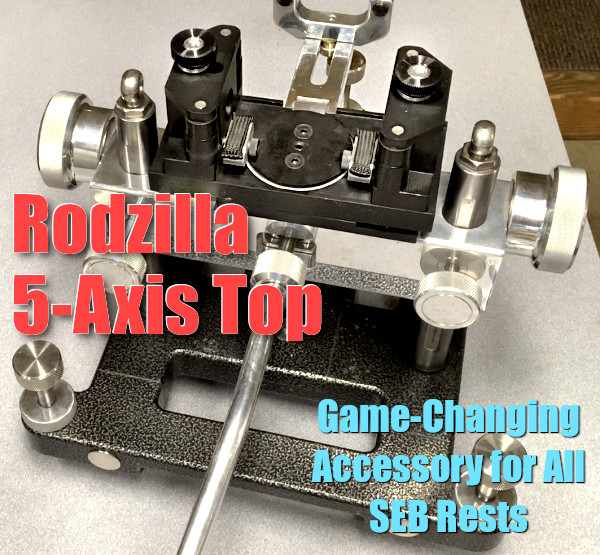
This photo shows the new Rodzilla 5-Axis top installed on a SEB Mini tripod rest. There are also Rodzilla tops for the SEB NEO and MAX two-column front rests.
Nearly a year and countless prototypes later, Rod unveiled his new Rodzilla 5-Axis Top to a select group of shooters to test and it’s been a wild ride ever since. Best of all, his top is drilled and tapped so that it can be fitted to a SEB NEO, MAX, or Mini front rest without altering the rest base in any way. To make things easy, if you don’t want to install it yourself, you can send just the bridge from your NEO/MAX or top from a Mini and Rod will install the 5-Axis unit. You pay for the Rodzilla top, and Rod will install it for free. The Rodzilla NE0/MAX tops currently sell for $549.00, while the Rodzilla Mini top is $584.00.
Watch Video to See All Features of Rodzilla 5-Axis Rest Top:
Rodzilla Top Swivels Independently of Rest Base
The first thing Rod did was allow the top to swivel independently of the base. On a NEO this makes a HUGE difference because you can now set your rest down in the general direction of your target and make final adjustments once you’re down behind the gun. This is a huge departure from the normal procedure where you find yourself moving your NEO repeatedly until it’s just right. You can do the same thing on a Mini which is actually a nice feature despite the head already swiveling because you can now lock down the Mini head and make your final adjustments behind the gun as well. This is probably the feature that stood out the most to me when I first set it up. Being able to lock the front end down and get comfortable immediately behind the gun without having to get up again was a time-saver. This also left me feeling very confident in my gun alignment to the target.
Delrin Rollers on Side Guide Stock during Recoil
The second major innovation is the addition of Delrin rollers along the side. The unit has two easily adjustable jaws that each contain a set of rollers. These rollers allow for as much or little contact as you want along the sides of your stock and provide a smooth if not near frictionless experience whether during recoil (breakaway) or when returning the gun to battery. the departure from traditional sandbags on the side quite revolutionary, and yes it is legal under NRA rules. Current NRA High Power F-Class rules have no limits on what material contacts the sides of the stock. As someone who has owned a number of front rests and filled countless small sandbags this comes as a welcome relief! The Rodzilla’s rollers give me confidence that I’ll have consistent contact with the stock without the side bags constantly shifting and needing my attention during a match.
Small, Separate Sandbags Provide Consistent Contact at Any Gun Angle
Another major Rodzilla advancement is the design of the left and right sandbags. Conventional sandbags are stationary and oriented to the rest itself meaning that if you’re shooting uphill or downhill then you may not have stock contact with the full bag surface or the stock may be at a weird angle to the sandbag. Plus, with time, conventional front sand bags can form crowns or lumps that require attention. Those problems are solved with the Rodzilla’s tilting mini-sandbags. Rod’s sandbags are very small yet still meet NRA High Power guidelines as they are filled with sand and can be visibly deformed when pushed. But otherwise, they are unlike anything you’ve seen before. Each bag is mounted on a pivoting arm allowing the gun to always keep consistent contact with each bag regardless of the angle of your rest. This provides confidence that your stock is always riding on the same amount of sandbag no matter how the rest has been placed, or the ground angle relative to target.
CONCLUSION: The Rodzilla 5-Axis Top is a Game-Changer If you have a SEB Rest you will definitely want this…
The innovative design features of the Rodzilla 5-Axis Top make SEB rests work even better. The Rodzilla Top delivers an incredibly smooth and repeatable shooting experience. Recoil seems smoother, and it is easier to align the rest on target during set-up. If you own a SEB rest and are looking to make your set-up on the line easier and faster, have near-zero breakaway force on each shot, and have consistent follow-up shots to your point of aim, then give the Rodzilla 5-Axis Top a try.
This Video shows how to install the Rodzilla 5-Axis Top on SEB Mini tripod rest:
This Video shows how to install the Rodzilla 5-Axis Top on SEB NEO or MAX Rest
Sellier & Bellot is one of Europe’s older ammunition manufacturers, producing a wide variety of rifle and pistol ammo. The video below shows ammunition being made from start to finish, starting with raw materials. This is a fascinating video that is well worth watching. It shows some amazing machines in operation.
EDITOR: Guys, this really is an exceptional video that shows every aspect of production. I have watched dozens of videos about ammo making. This is definitely one of the BEST. Take the time to watch.
Based in Vlasim, Czech Republic, Sellier & Bellot was founded in August 5, 1825 by Louis Sellier, a German businessman of French lineage. His family were royalists who fled France during the French Revolution. Louis Sellier began manufacturing percussion caps for infantry firearms in a factory in Prague, Bohemia on the request of Francis I, the Emperor of Austria. Sellier was later joined by his countryman Jean Bellot.
Sellier & Bellot has also produced an interesting CGI video that shows what happens inside a rifle chamber and barrel when a cartridge fires can’t be seen by the naked eye (unless you are a Super-Hero with X-Ray vision). But now, with the help of 3D-style computer animation, you can see every stage in the process of a rifle round being fired.
In this X-Ray-style 3D animation illustrates the primer igniting, the propellant burning, and the bullet moving through the barrel. The video then shows how the bullet spins as it flies along its trajectory. Finally, this animation shows the bullet impacting ballistic gelatin. Watch the bullet mushroom and deform as it creates a “wound channel” in the gelatin.
Watch Video – Cartridge Ignition Sequence Starts at 1:45 Time-Mark
This month American Outdoor Brands Corporation (NASDAQ: AOBC) will officially split into two separate companies, with the Smith & Wesson gun business becoming a stand-alone enterprise again. This action will create two independent, publicly-traded companies: Smith & Wesson Brands, Inc. (encompassing the firearm business) and American Outdoor Brands, Inc. (encompassing the outdoor products and accessories business). AOBC’s board of directors previously approved the separation of its outdoor products and accessories business into an independent, publicly-traded company.
Smith & Wesson Brands will effect the separation through a spin-off whereby it will distribute 100 percent of the shares of American Outdoor Brands common stock to Smith & Wesson Brands’ stockholders of record as of the close of business on the record date of August 10, 2020 on a pro rata basis. The distribution of American Outdoor Brands’ shares is expected to be completed effective as of 12:01 a.m. Eastern Time on August 24, 2020, with Smith & Wesson Brands stockholders receiving one share of American Outdoor Brands common stock for every four shares of Smith & Wesson Brands stock.
Following the spin-off, American Outdoor Brands will be a separate publicly-traded company independent from Smith & Wesson Brands. Smith & Wesson Brands will not retain any American Outdoor Brands common stock. Smith & Wesson Brands will continue to be listed on NASDAQ under the symbol SWBI. American Outdoor Brands has received approval for the listing of its common stock on NASDAQ under the symbol AOUT.
Background of the American Outdoor Brands Conglomerate
In August 2016, Smith & Wesson Holding Corporation bought Crimson Trace, a laser-sight manufacturer, for $95 million and Taylor Brands, a tool and knife maker, for $85 million. In November of that same year, the company bought UST Brands, a survival equipment maker, for $32.3 million. And Smith & Wesson acquired Battenfeld Technologies in 2015 for $130.3 million. Smith & Wesson diversified from firearms into sporting goods and accessories in hopes of insulating Smith & Wesson from the stock price volatility caused by the unpredictability of the gun business. This culminated in the decision to change the company’s name to American Outdoor Brands Corporation. However, despite the diversification, in 2017, firearms still accounted for 86% of American Outdoor Brands’s revenues.
Post-Spinoff Brand Line-Ups for SWBI and AOUT
Smith & Wesson Brands (SWBI) will now become firearm-centric, selling guns under the Smith & Wesson, M&P, Thompson/Center, and Performance Center brands. In addition, we believe SWBI will continue to make and sell Gemtech suppressors.
American Outdoor Brands markets a large number of product brands, including Bog (bipods/tripods), Caldwell (shooting accessories), Crimson Trace (weapons lights), Frankford Arsenal (reloading tools). Listed below are the product lines American Outdoor Brands Inc. will continue to sell as the new, separate AOUT company. A significant percentage of these brands remain gun-centric:
Bog — Manufactures tripods and shooting rests
Caldwell — Manufactures targets and shooting rests
Crimson Trace — Flashlight, Weapon light, and aiming device manufacturer
Frankford Arsenal — Manufactures reloading tools
Golden Rod — Manufactures dehumidifiers and moisture sensors for safes and lock boxes
Hooyman — Manufactures Landscaping tools and portable power saws
Imperial — Manufactures fixed and folding blade knives
Lockdown — Manufactures gun safes, lock boxes, gun locks, and accessories
M&P Accessories — Manufactures firearm accessories
Old Timer — Manufactures fixed and folding blade knives as well as accessories
Schrade — Manufactures fixed and folding blade knives as well as accessories
Tipton — Manufactures firearm cleaning accessories
Uncle Henry — Manufactures fixed and folding blade knives as well as accessories
Wheeler Engineering — Manufactures gunsmithing tools
Bubba — Manufactures knives, tools, and accessories for fishing
Mark Smith Will Lead Smith & Wesson After Spin-Off
Upon successful completion of the spin-off, Mark Smith will become CEO of Smith & Wesson Brands, Inc.; Smith is currently the President of the Manufacturing Services Division of AOBC and supports all of its businesses. James Debney, current AOBC President and CEO, will lead the outdoor products and accessories company as CEO after the spin-off.
The Future of Smith & Wesson Brands, Inc. (Projections)
Headquartered in Springfield, Massachusetts, Smith & Wesson Brands, Inc. will continue its 168-year-old heritage of producing firearms (S&W was founded in 1852). This business’s handgun, long gun, and suppressor products are marketed under the Smith & Wesson®, M&P®, Performance Center®, Thompson/Center Arms™, and Gemtech® brands. Following the spin-off this month, Smith & Wesson Brands, Inc. is expected to generate revenue between $450 million and $500 million and adjusted EBITDAS between $90 million and $105 million in its first 12 months as an independent company.
* It is not clear whether Smith & Wesson Accessories and Thompson Center Accessories will be marketed under the same name after American Outdoor brands splits into two publicly-traded companies.
The state of New York, through NY Atty. General Letitia James, has filed suit against the NRA attacking actions by its leadership, claiming that funds were spent improperly. The purpose of the suit, said James, is “to dissolve the organization in its entirety”. This lawsuit originates from New York because the NRA is a New York-chartered organization. In a coordinated legal action, likewise motivated by partisan politics, District of Columbia Attorney General Karl Racine brought suit against the NRA Foundation, claiming the Foundation gave money to the NRA without proper oversight.
About the New York Lawsuit: The NY suit claims NRA CEO Wayne LaPierre, Wilson “Woody” Phillips (former NRA treasurer/CFO), Joshua Powell (former chief of staff) and John Frazer (corporate secretary/general counsel) diverted tens of millions of dollars for their personal benefit and enrichment. NY alleges that the “The NRA was serving as a personal piggy bank” for these four men.
About the DC Lawsuit: “Key to the D.C. complaint are a pair of $5 million loans in 2017 and 2018 from the Foundation to the Association. In addition to those loans, the suit alleges the Foundation paid millions in fees to the NRA with no oversight, essentially placing the NRA’s interests above its own. That is a violation of the Foundation’s articles of incorporation.” Source: The Shooting Wire, 8/7/2020.
The NRA Responds — And Files Suit for First Amendment Violations
LaPierre stated that the action by New York is “an unconstitutional, premeditated attack aiming to dismantle and destroy the NRA”. Immediately the NRA began to fight back, filing a countersuit on 8/6/2020 stated that the NY AG’s lawsuit has violated the NRA’s First Amendment rights. NRA President Carolyn Meadows called the NY lawsuit a “baseless, premeditated attack on our organization and the Second Amendment freedoms it fights to defend”.
Lawsuits filed against the NRA will be the major issue at the NRA Annual Meeting next month.
The National Shooting Sports Foundation issued a statement condemning the NY Atty. General’s politically-motivated scheme to dissolve the NRA:
“NSSF, the trade association for the firearm industry, is troubled by the politically-driven decision of New York Attorney General Letitia James to seek to dissolve the National Rifle Association, America’s oldest civil rights organization.
The lawsuit filed today by Attorney General James seeks to punish the over five million members of the National Rifle Association based on mere allegations of possible wrongdoing by a few individuals.
NSSF is deeply concerned about the apparent political agenda to silence the strongest voice in support of the Second Amendment ahead of the election in November.
This lawsuit, and one filed today by the District of Columbia Attorney General, should concern all Americans who cherish both the First and Second Amendments to our Constitution regardless of their views on what laws and regulations are appropriate to address the criminal misuse of firearms.”
If you’ve been thinking about a big purchase at Brownells, here are some money-saving codes. Now through the end of August, Brownells is offering $50 Off a $500+ purchase or $25 Off a $250+ purchase. That’s a great deal, effectively a 10% savings. Use Code VTH to save $50 on $500+, or use Code VTG to save $25 on the purchase of $250 or more.
Coupon Code: VTH — $50 Off $500 or more
Expiration date: August 31, 2020 at 11:59 PM CDT
Coupon Code: MFX — $25 Off $250 or more
Expiration date: August 31, 2020 at 11:59 PM CDT
More Brownells Discount Codes
If you miss these deals listed above, Brownells is still running some discounts for $99-$200 purchases. With a purchase of $200 and up, save $20 with Code M8Y. Or, with a purchase of $99 or more, you can save $10 with Code MDX. You can also get free Shipping/Handling for all purchases over $49 with Code VB5. That free shipping/handling could save you another $10-$20 easy. NOTE: These codes have no listed expiration date, but Brownells could terminate them at any time, so you should still act soon.
Check out that bolt assembly. It features a fluted stainless bolt body, laser-engraved Titanium shroud, and Titanium dragon-scale bolt knob with polished stainless handle.
You haven’t seen a Ruger Precision Rifle (RPR) like this before. Forum member TerryH has customized his Second-Gen 6.5 Creedmoor RPR with a wicked purple finish, snazzy stainless/titanium bolt, and slick HDPE (polymer) bag-riders front and rear. The mods on this Hot Rod Ruger don’t stop there. Terry added a Seekins hand rail, Timney trigger, ergonomic grip, and more…
For his Hot Rod Ruger, Terry has the right skill set, learned on the job: “I work in a body shop and have pretty much custom-painted all my stuff for many years. For this 6.5 CM RPR, colors of choice are House of Kolor PBC-65 Passion Purple and black covered with Cerakote MC-161 matte clear.” Terry even painted his Bald Eagle rest purple to match his Hot Rod RPR.
Terry reports: “I’m shooting an RPR in 6.5 CM. It has a Patriot Valley Arms 26″ barrel. Josh at PVA is making a thread protector for me so I can remove the Mad Scientist brake. The butt stock has a V-Tab adjustable butt plate and Wiebad check rest pad. Glass is a currently a Vortex Gen I PST 6-24x50mm but I have a Golden Eagle on layaway”. To learn more about this rifle or ask TerryH questions about the build, visit this Shooters’ FORUM THREAD.
Ruger Precision Rifle Modifications: Chassis and Handguards Painted Passion Purple
Patriot Valley Arms 26″ Barrel with Brake
Timney Trigger with Ambi Safety
Custom HDPE (Polymer) Bag-Riders front and Rear
V-Tab adjustable butt plate and Wiebad cheek-pad
Seekins Rail
Good Accuracy with Factory Ammunition
Terry reports: “The RPR is shooting .3 MOA @ 100 with factory Fed American Eagle 140s.” Terry plans to start handloading for the rifle with the goal of shooting F-Class matches next year: “I’ve successfully shot steel out to 1140 yards on the range but [I don’t know] if that will actually translate well in a match. I’m committed to practicing as much as I can and starting to shoot some matches in 2018.”
Front and Rear Bag-Riders with Protektor Rear Bag and Upgraded Bald Eagle Rest
Terry has engineered a slick set-up for F-Open competition and load testing. Up front is a Bald Eagle rest upgraded with windage knob mod, stainless F-Class feet, and longer adjusters. Terry also “changed the hardware to all stainless and added a couple of levels”. In the rear, Terry runs a Protektor Doctor rear bag with 1″ ear spacing.
Impressive additions are the custom HDPE bag-riders Terry crafted himself: “I realized that the butt stock wasn’t going to cut it on the rear bag and even though I got the 2 1/4″ front bag and the Seekins rail is 2″ wide and flat that it wasn’t as stable or smooth as I’d like.” So Terry made his own front and rear bag-riders from HDPE, a material similar to Delrin. Currently the front unit is 2.25″ wide, but Terry will be changing that to a 3″-wide front sled: “I decided that I’d get a 3″-wide front bag and mill a new front bag-rider. I’m going to recess the center to fit around the hand guard and I’ll mill a recess on the bottom of that one.”
Shown below is the Hot Rod Ruger before Terry added the HPDE Bag-Riders front and rear. Terry says the rifle now handles much better with the bag riders, and he plans to upsize the front sled to 3″ width.
Bling’s the Thing. Below is the Hot Rod Ruger’s bolt assembly. It features a custom flat-fluted bolt shaft, laser-engraved Titanium shroud and Titanium dragon-scale knob with polished stainless handle. Terry confesses: “I simply can’t resist anything shiny!”
NOAA photo of flooding after Hurricane Floyd in 1999. The Colt Python Revolver once belonged to Elvis Presley (Rock Island Auction).
This past week, Tropical Storm Isaias has hammered the East Coast of the USA. The BBC reported: “From North Carolina up to New York, Isaias left more than 3.4 million residents without power. It spawned tornadoes, uprooted trees, damaged homes and caused floods and fires.” This article explains what to do if you have experienced flooding.
Firearms owners who have seen their guns and stored ammunition submerged by flood waters in storm-wracked areas are probably wondering if their firearms and ammunition can be salvaged and safely used. To answer these questions, the NSSF and the Sporting Arms and Ammunition Manufacturers’ Institute (SAAMI®) created two documents outlining the proper response to submersion of guns and ammo. If you’ve got wet guns and/or ammo, download these two PDF files and read them carefully.
The SAAMI document “Guidance on Firearms That Have Been Submerged or Exposed to Extensive Amounts of Water” points out two major concerns about firearms that have been exposed to water: parts susceptible to moisture and rust damage such as metal parts, wood stocks and grips, and optics; and, secondly, infiltration of the action, barrel and safety systems by grit, silt and other foreign debris.
#1 Always unload firearms before beginning any treatment process.
It’s important to limit moisture and corrosion damage to the component parts of the firearm. This can be accomplished by disassembling the component parts and using up to two coats of a moisture-displacing lubricant such as Hoppes #9 MDL or WD-40 to clean and stabilize the parts while, importantly, following the product’s directions so as not to damage, for instance, plastic or synthetic parts. Another tip is to allow wood stocks and grips to air-dry and not be force dried by exposure to heat.
The document emphasizes that once the firearm has been thoroughly dried, consideration must be given to having the firearm inspected and serviced by the manufacturer, an authorized service center, or a qualified gunsmith before putting the firearm back in service.
Dealing with Ammunition That Was Submerged
Bottom Line, if your ammo has been submerged — DON’T USE IT. SAAMI explains why…
To help firearms owners determine what to do with ammunition that has been affected by water and moisture, SAAMI offers another helpful document, “Guidance on Ammunition That Has Been Submerged in Water.” This document covers differences in moisture resistance between centerfire, rimfire and shotshell ammunition, and potential hazards associated with “drying out” cartridges, including possible deterioration and damage to cartridges due to drying methods.
Another serious hazard that could result from using compromised ammunition is the potential for a bore obstruction due to partial ignition of either the priming compound or the propellant powder charge, or both. Firing a subsequent round through an obstructed barrel can result in bodily injury, death and property damage.
SAAMI provides the following cautionary conclusion: “It would be impossible to ascertain for certain the extent of the deteriorating affect, if any, the water may have had on each individual cartridge. Therefore, the safe answer is that no attempt be made to salvage or use submerged ammunition. The ammunition should be disposed of in a safe and responsible manner. Contact your local law enforcement agency for disposal instructions in your area.”
If you wonder how ammo is made, starting with raw metal, check out this video from Hornady. It shows how bullet jackets are formed from copper, followed by insertion of a lead core. The jacket is then closed up over the core with the bullet taking its final shape in a die (a cannelure is applied on some bullet types). Next the video shows how cartridge brass is formed, starting with small cups of brass. The last part of the video shows how cases are primed and filled with powder, and how bullets are seated into the cases, using an automated process on a giant assembly-line. CLICK Link below to watch video:
Hornady’s New 150,000-sq-ft Ammo Production Center
In 2018, Hornady opened a new, state-of-the-art factory. The 150,000-sq-ft Hornady West Facility, featured in the video below, handles ammunition production and product distribution — Hornady produces millions of rounds annually. Hornady cartridge brass and bullets will continue to be produced at Hornady’s 100,000+ square foot factory in Grand Island, Nebraska. The Grand Island factory is open for tours Monday through Thursday. Hornady Manufacturing was founded by Joyce Hornady in 1949, so 2019 marked the company’s 70th anniversary.
Here is an article Glen Zediker wrote for the Midsouth Blog. In this article Glen gives important advice on selecting, handling, seating, and testing primers. The right primer choice can and will affect your load’s performance and accuracy. And proper primer handling is essential for safety.
by Glen Zediker
The primer is one component in the collection that might not get all the attention it warrants. That’s because it is the one thing, above all other components, that you don’t want to just swap and switch around. We’ve all heard cautions about testing new lots of every component, especially propellant, but primers not only change lot to lot, they vary greatly in their influence on any one load, brand to brand.
The difference in one brand to the next can equal a good deal more or less pressure, for instance. While there are “general” tendencies respecting the “power” of various-brand primers, always (always) reduce the load (propellant quantity) when switching primers.
This has become more of an issue over the past few years as we’ve faced component shortages. I can tell you without a doubt that going from a WW to a CCI, or from a Remington to a Federal, can have a major influence on a load. I establish that from chronograph readings. No doubt, it’s best to have a good supply of one primer brand and lot that produces good results, and when that’s not possible, it’s a hard sell to convince someone to stop loading ammo and get back to testing. But. It is important. I can tell you that from (bad) experience. How I, and we all, learn most things…
When I switch primers, whether as a test or a necessity, I reduce my load ONE FULL GRAIN. There can be that much effect.
The Elements of a Primer
A primer is made up of a brass cup filled with explosive compound (lead styphate). Lead styphate detonates on impact. Primers don’t burn – they explode! In the manufacturing process, this compound starts as a liquid. After it’s laid into the cup, and while it’s still wet, a triangular piece or metal (the “anvil”) is set in. When the cup surface is struck by the firing pin, the center collapses, squeezing the explosive compound between the interior of the cup and the anvil. That ignites the compound and sends a flame through the case flash hole, which in turn lights up the propellant.
Primers Can be Dangerous — Particularly When Stacked
Don’t underestimate that. I’ve had one experience that fortunately only created a huge start, but I know others who have had bigger more startling mishaps. These (almost always) come from primer reservoirs, such fill-tubes. Pay close attention when charging up a tube and make sure all the primers are facing the right way, and that you’re not trying to put in “one more” when it’s full! That’s when “it” usually happens. What will happen, by the way, is akin to a small grenade. Static electricity has also been blamed, so keep that in mind.
Sizes and Types of Primers
Primers come in two sizes and four types. “Large” and “small”: for example, .223 Rem. takes small, .308 Win. takes large. Then there are pistol and rifle in each size.
Rifle primers and pistol primers are not the same, even though they share common diameters! Rifle primers [normally] have a tougher cup, and, usually, a hotter flash. Never swap rifle for pistol. Now, some practical-style competitive pistol shooters using their very high-pressure loads (like .38 Super Comp) sometimes substitute rifle primers because they’ll “handle” more pressure, but they’ve also tricked up striker power. That’s a specialized need.
Further, some primer brands are available with a “magnum” option. Some aren’t. My experience has been that depends on the “level” of their standard primer. A magnum primer, as you might guess, has a more intense, stouter flash that travels more “deeply” to ignite the larger and more dense powder column. It reaches further, faster.
Flash Consistency Counts Flash Consistency is very important, shot to shot. The consistency of every component is important: bullet weights, diameters, case wall thicknesses, and all the way down the list. We’re hoping to get more consistent behavior from a “match” or “benchrest” primer, and we’re paying more for it. I can tell you that some brands that aren’t touted as “match” are already consistent. That all comes from experience: try different primers, just respect the need to initially reduce the load for each test.
Primer Dimensional Differences and Primer Tools
One last thing — there are small variations in primer dimensions (heights, diameters) among various brands. These variations are not influential to performance. However — small diameter variations can influence feeding through priming tools. This can be a hitch especially in some progressive loading machines. Manufacturers usually offer insight (aka: “warnings”) as to which are or aren’t compatible, so find out.
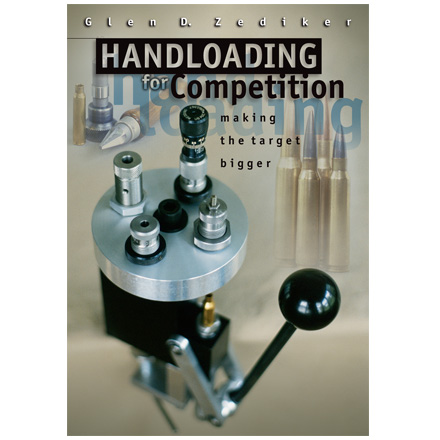
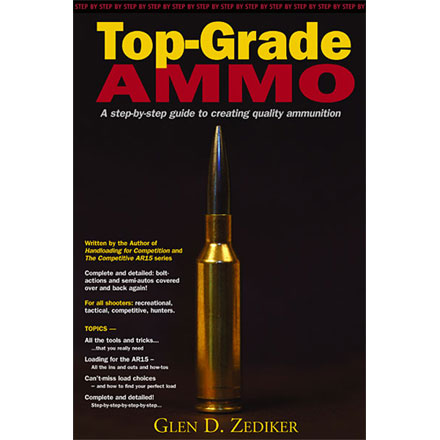
This article is adapted from Glen’s books, Handloading For Competition and Top-Grade Ammo, available at Midsouth HERE. Learn more about Glen’s books at ZedikerPublishing.com.


 .009” Group Record Stood for 40 Years


 “NSSF, the trade association for the firearm industry, is troubled by the politically-driven decision of New York Attorney General Letitia James to seek to dissolve the National Rifle Association, America’s oldest civil rights organization.


 If you wonder how ammo is made, starting with raw metal, check out this video from


 Flash Consistency is very important, shot to shot. The consistency of every component is important: bullet weights, diameters, case wall thicknesses, and all the way down the list. We’re hoping to get more consistent behavior from a “match” or “benchrest” primer, and we’re paying more for it. I can tell you that some brands that aren’t touted as “match” are already consistent. That all comes from experience: try different primers, just respect the need to initially reduce the load for each test.
 Get Midsouth products


