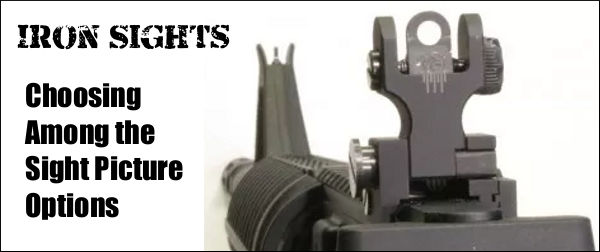
In an article for the CMP Online Magazine, SSG Tobie Tomlinson of the USAMU Service Rifle Team explains the various sight alignments employed by iron sights shooters. Tobie writes: “There are a myriad of sight picture options that shooters have used to great effect over the years. The sight picture that allows you to consistently shoot the smallest group, with a minimal shift in zeros, is the correct one. Remember, for any shooter to be successful, consistent sight picture must be complemented by front sight focus and sight alignment.” CLICK HERE to read FULL ARTICLE
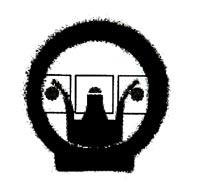
Center Hold
The front sight is placed directly in the center of the target. A center hold is great in different light conditions. On a bright day the target appears small. On a dark day the target appears large. In [any] light conditions the center of the target is always in the center. A shooter who has problems with elevation shots in various light conditions may benefit from a center hold.
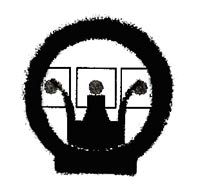
6 O’Clock Hold
With the 6 O’Clock hold the front sight is placed at the bottom of the aiming black. For many shooters, this hold allows precision placement of the front sight. The ability to accurately call your shots will come with time and experience. Light changes, which alter the appearance of the target, may affect shooters who utilize the 6 O’Clock hold.
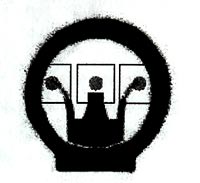
Sub 6 Hold
The sub 6 is just like the 6 O’Clock hold, only there is a small line of white between the front sight and the aiming black. Many shooters have a problem determining the exact 6 O’Clock position with their front sight, but by using a sub 6 or line of white they may be able to better estimate their hold.
Frame Hold
With the frame hold, just like with the other holds, the front sight is in the center of the rear sight. The front sight can then be placed at the 6 or 12 O’Clock position on the frame when there is no visible aiming point. This hold is typically reserved for foul weather and poor light conditions. By placing the front sight at the top or bottom of the frame, a shooter may hold better when there is little target to see. It can be difficult to hold a tight group this way, but it may add more hits in bad conditions. This technique is normally applied when shooting longer ranges such 600 or 1000 yards.
It’s July 4th, that means fireworks displays. What better time to order up some gunpowder? We’re pleased to report that Midsouth Shooters Supply has received some big shipments from the major powder makers. In stock now at Midsouth are many of the most popular accuracy powders, including: Hodgdon H4350, Hodgdon 4831/4831SC, IMR 4166, Vihtavuori N133, Accurate LT30 and LT32, Norma 203B, CFE223 and many more. Powder Valley also has Hodgdon H4350 right now.
Meanwhile at Precision Reloading you will find Alliant Reloder 16, Reloder 23, Reloder 17, IMR 4166, IMR 8208 XBR, Vihtavuori N133, Accurate LT30 and LT32, Norma 203B, and many more.
H4350 and Reloder 16 are superb, temp-stable powders for medium-sized cartridges. Reloder 23 is a slower version of RL16 that works great in magnum cartridges. LT30 is great for the 30BR, CFE 223 is excellent for Service Rifle shooters, and VV N133 is a top choice for the 6PPC. Norma 203B (nearly identical to Reloder 15) works well in the 6mmBR, 6BRA and Dasher. And Hodgdon H4831SC is an excellent choice for the .284 Winchester and 7mm WSM.
Sorry we could not find Hodgdon Varget at these two vendors. However, Bruno Shooters Supply does have Varget in stock today in both 1-lb and 8-lb sizes. Varget fans may also want to try IMR 8208 XBR. It has a slightly faster burn rate, but our tests found it worked very well in the .308 Win with medium-weight bullets, offering excellent accuracy and good velocity.
All these popular Powders (and many more) are in stock:
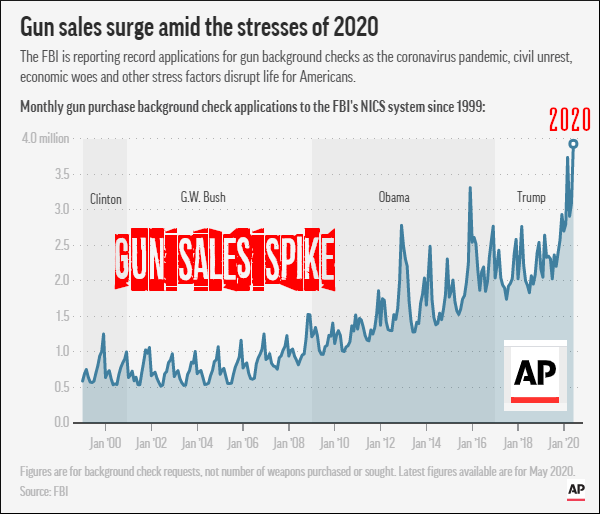
The riots and civil unrest are driving sales, which were already spiking because of concerns over the COVID-19 Pandemic.
According to the NSSF: “June 2020’s adjusted National Instant Criminal Background Check System (NICS) figures were nearly off the chart. It was the highest figure ever recorded in June and the second highest on record since instant background checks began more than 20 years ago. The June 2020 NSSF-adjusted NICS figure of 2,177,586 is an increase of 135.7% compared to June 2019.
“The eye-popping numbers began at the beginning of the year and continued to crush records amid the nation’s crises. So far, this year has seen half of the 10 busiest days on record and seven of the 10 busiest weeks — half of them in June.” — AP News
“These figures aren’t push polls,” said NSSF’s Mark Oliva to media. “They are representative of Americans from all walks of life who are taking action and taking responsibility for their rights and their safety.” Total background checks for 2020 now exceed 10 million. The strongest year recorded for adjusted NICS figures was 2016, when checks topped 15 million.
APNews.com has provide more details on the remarkable rise in gun sales, as logged via FBI background checks. AP News Reporter Julie Pane writes:
“Historic numbers of background checks to purchase or possess a firearm were done in June, a trend in a year marked by uncertainty over the Coronavirus pandemic, a subsequent economic recession, protests over racial injustice and calls to reduce police funding.
FBI numbers released Wednesday show that 3.9 million background checks were conducted last month, the most since the system was created in November 1998 [NOTE: these are non-adjusted figures.] The previous monthly record came in March, when 3.7 million checks were done. Each week in June is now in the top 10 weeks for background checks.
Halfway through 2020, just over 19 million checks have been done, more than all of 2012 and each of the years before that.” (Emphasis added.)
Today, July 4th, we are celebrating a special birthday — the launching of a new nation that would become the world’s greatest exemplar of freedom and democracy. In our modern world, it is easy to lose sight of the challenges that faced our fore-fathers, and the continuing burdens we all share, as Americans, to maintain the struggle for freedeom, both at home and abroad. It is more important than ever that we remember the ideals on which the nation was founded, and remember that our nation became great through the efforts and talents of a free citizenry, not through an all-powerful central government.
In the Beginning — Overcoming Great Odds
In a July 4th speech, Navy Lt. Ellen Connors wrote: “Our nation declared its independence in order for our families to live free –- not just for one generation but for future generations. And what odds [the founding fathers] faced. It must have seemed impossible. Our forefathers went up against the world’s most colossal empire since ancient Rome. No colony had ever successfully left a mother country to set up a self-governing state.”
The Price of Freedom… The Pride of A Nation
Here is a selection from Daniel Webster’s July 4th, 1851 Oration. His words ring true even now:
On the 4th of July, 1776, the assembled Representatives of the United States of America in Congress declared that these United Colonies are, and of right ought to be, FREE and INDEPENDENT States. This Declaration, made by most patriotic and resolute men, trusting in the justice of their cause and the protection of Heaven, and yet made not without deep solicitude and anxeity, has now stood for seventy-five years, and still stands. It was sealed in blood. It has met dangers, and overcome them; it has had enemies, and conquered them; it has had detractors, and abashed them all….
Every mans’ heart swells within him… as he remembers that seventy-five years have rolled away, and that the great inheritance of liberty is still his — his, undiminished and unimpaired, his in all its original glory; his to enjoy; his to protect; and his to transmit to future generations.
You can download a high-resolution version of the above image from Fireworks.com.
Adam Scepaniak, of The Guns and Gear Store, has written an interesting story about Prairie Dog Hunting in North Dakota. If a P-Dog safari is on your “bucket list”, you’ll want to read the full story in the Sierra Bullets Blog. Adam provides many tips that can help you plan a successful prairie dog adventure.
Prairie Dog Hunting in North Dakota with Sierra Bullets
It’s that time of year where lots of men and women point their vehicles westward and try to push the limits of their rifles on prairie dogs. [A few seasons back] I was a part of this group of people… while in northwestern North Dakota. CLICK HERE to Read Full Story.
Little Missouri National Grassland
Once my hunting party arrived at the Little Missouri National Grassland in North Dakota we immediately began scouting for prime prairie dog towns. There is a certain amount of strategy involved in choosing a prairie dog town … for several reasons. For one, you should try to always stay “above” the prairie dogs.
Small objects like rocks, cactuses, and prairie vegetation can easily obstruct your view if you’re shooting prone on a level plane. We encountered this in the first small prairie dog town we stopped and shot at. The prairie dog town was very visible while walking and standing, but once we laid down with our rifles on bipods the two-foot prairie grass became a severe obstruction. We shortly moved on because the small town became quick-studies to our shooting.
The second prairie dog town we hunted was at the base of a small ridge with a dried, cattle creek at the bottom. This area offered better shooting opportunities because we were above most of the prairie dog holes, and if we were not above them, a deep ravine separated us from the prairie dogs removing any obstructions from our rifle scopes which was our previous problem. This area had its own disadvantage though because of some other wildlife present. There were approximately fifty head of cattle in our close vicinity grazing, which was to no surprise because many ranchers utilize the National Grassland for grazing. We had to wait for the cattle to leave our area as to not have an incidental hit due to a rare ricochet. As the sun passed over the horizon we decided to return to this spot the next morning, but would change our shooting position to increase our advantage.
This Location Offered a Nice Overlook.
Zoomed Image Shows Individual Prairie Dog Mounds.
My previous varminting best was a 275-yard shot near Mobridge, South Dakota on a separate prairie dog hunting trip. With more experience and better reloading, Here in North Dakota I was able to make a solid hit on a prairie dog just over 400 yards which made me ecstatic! For a central Minnesota, shotgun-raised guy, I was pretty happy that my bullet selection and hand-loading ability produced a 125-yard improvement.
Once we cleaned and cased our rifles for the journey home we had shot a little over 200 rounds of my Sierra® reloads. This was a lot less than previous prairie dog trips I have been a part of, but our hit percentage was substantially higher as well. Traveling into a new area meant a lot more scouting and experimentation for us as a group. In future trips or hunts of your own, it can be very beneficial to schedule an extra day just for scouting[.]
Little Missouri National Grassland is a National Grassland located in western North Dakota. At 1,033,271 acres, it is the largest grassland in the country. Within its borders is Theodore Roosevelt National Park. The Little Missouri National Grasslands was once a part of the Custer National Forest, but is now a part of the Dakota Prairie Grasslands, a National Forest unit consisting entirely of National Grasslands. A predominant feature of the grassland is colorful and beautiful badlands, a rugged terrain extensively eroded by wind and water. It is a mixed grass prairie, meaning it has both long and short grass.
The boundaries of the grasslands on certain maps can be misleading. Within the boundaries of the national grassland are significant portions of state-owned and privately-owned land, much of it leased by cattle ranchers for grazing.
The grassland is administered by the Forest Service as part of the Dakota Prairie Grasslands from offices in Bismarck, ND. There are ranger district offices in Dickinson and Watford City.
The NRA remains a vital voice for American gun owners. There have been controversies, but the NRA still remains the largest organization supporting gun rights in the United States. We think that all persons who value the Second Amendment should consider joining the NRA. And if you are already a members, consider extending your membership or getting a Life Membership.
Right now you can SAVE $900 on an NRA Life Membership. And NRAStore is also offering 1-year, 3-year, and 5-year memberships with significant savings — up to 33% Off the regular price. NOTE: These discounts will only be offered for a limited time, so don’t delay.
Here Are Savings Offers on NRA Memberships:
NRA Life Membership discounted from $1500 to $600 — Save $900 (60%)
NRA 5-Year Membership discounted from $150 to $100 — Save $50 (33%)
NRA 3-Year Membership discounted from $100 to $85 — Save $15 (15%)
NRA 1-Year Membership discounted from $45 to $30 — Save $15 (33%)
All memberships include your selection of a monthly print magazine: American Rifleman, American Hunter, Shooting Illustrated, or America’s Freedom.
As the November 2020 election quickly approaches, many of the candidates’ platforms include proposals that severely threaten your Second Amendment rights. Presumptive Democratic Nominee Joe Biden endorses a broad ban on semi-automatic rifles and further restrictions on handguns. From proposed bans on popular modern sporting rifles and ammunition to mandates for federal licensing and registration, these ill-informed proposals would strip away the rights of law-abiding citizens while doing nothing to protect public safety. It is time you make a choice and take a stand.
As target shooters, hunters, and gun owners, we must not risk our rights! On Election Day 2020, vote to protect America’s firearms freedoms: #GUNVOTE.
Even between elections, target shooters, hunters, and gun owners would do well to stay informed about the issues that affect us. Becoming educated about the views, votes, and decisions of officeholders and those positioning themselves to run for office should be an ongoing concern. #GUNVOTE is here to help you to protect America’s firearms freedoms. Don’t wait until election time. Become educated and keep yourself informed before it’s time to #GUNVOTE.
Protecting your rights has never been more important than it is today. Our national crisis has exposed the politicians who want to strip away our constitutional freedoms. Send them a message! Be a voter in the 2020 elections to protect your rights!
Help Drive Pro-Second Amendment Voter Registration
NSSF is urging all industry businesses and activist-minded individuals to download and display NSSF’s #GUNVOTE Banners on their company websites and incorporate #GUNVOTE messages in their social media campaigns. You can link to Gunvote.org, where visitors can find voter-registration information for their states and other helpful resources.
This message is provided by the National Shooting Sports Foundation, the trade association for the firearms, ammunition, hunting and shooting sports industry.
This article comes from the Criterion Barrels website. It provides good, conservative advice about barrel cleaning. Understand that cleaning methods may need to be adapted to fit the amount and type of fouling (and the particular barrel). In general, we do try to minimize brushing, and we follow the procedures Criterion recommends respecting the crown/muzzle. We have also had very good success using wet patches followed by Wipe-Out bore foam. Along with the practices outlined by Criterion below, you may want to try Wipe-Out foam. Just be sure to use a fitted cleaning rod bore guide, to keep foam out of the action recesses and trigger assembly.
The above video shows how to apply Wipe-Out or other bore-cleaning foam. We use a slightly different method. First, we use 3-4 wet patches to remove loose carbon fouling. Then we apply the foam as shown, but usually from the muzzle end (with bore guide in chamber). Here’s the important point — after 20-30 minutes, once the bubbles have dissipated, we apply the foam a second time, getting more of the active ingredients into the barrel. We then patch out, as shown, after 3-4 hours.
What is the Best Way to Clean a Rifle Barrel?
We are asked this question quite frequently alongside requests for recommended break-in procedures. Improper barrel cleaning methods can damage or destroy a barrel, leading to diminished accuracy or even cause a catastrophic failure. When it comes to barrel maintenance, there are a number of useful techniques that we have not listed. Some techniques may work better with different barrel types. This series of recommendations is designed to incorporate a number of methods that the Criterion Barrels staff has used successfully both in the shop and on their personal rifles. Please feel free to to list your own recommendations in the below comments section.
We recommend the use of the following components during rifle cleaning:
• Cloth patches (sized for the appropriate caliber)
• Brass jag sized properly for your bore
• One-piece coated cleaning rod
• General bore cleaner/solvent (Example: Hoppes #9)
• Copper solvent of your choosing (Example: Sweets/KG 12)
• Fitted cleaning rod bore guide
• Plastic AP brush or toothbrush
• Q-Tips
• Plastic dental picks
• CLP or rust preventative type cleaner
There are a number of schools of thought relating to the frequency in which a barrel should be cleaned. At minimum we recommend cleaning a barrel after each shooting session to remove condensation, copper, and carbon build-up. Condensation is the greatest immediate threat, as it can cause the barrel to rust while the rifle sits in storage. Copper and carbon build-up may negatively impact future barrel performance, increasing the possibility of a failure in feed or function. Fouling should be removed whenever possible.
The below tips will help limit the wear of different parts of your barrel during routine maintenance, helping extend the life of the barrel and improving its performance.
The Crown
The crown is the portion of the barrel where the bullet loses contact with the lands and grooves and proceeds to exit the firearm. The area most critical to accuracy potential is the angle where the bullet last touches the bore of the barrel.
Avoid damage to this area by using a plastic toothbrush and CLP type cleaner to scrub the crown from the exterior of the barrel. Even the most minimal variation in wear to the crown will negatively impact barrel performance, so be careful to avoid nicking or wearing away this part of the barrel.
Reducing Cleaning Rod Wear to the Crown
When running a patch through the barrel, place the muzzle about a ¼” from a hard surface that runs flat at a perpendicular angle to the cleaning rod’s direction of travel, like a wall or the edge of a work bench (pictured). When the jag impacts the hard surface, retract the cleaning rod and remove the patch.
By withdrawing the jag prior to its exit from the barrel, you are limiting the possibility of the brass dragging upon the crown if the rod is at all bent or misaligned. The soft cloth patch will continue to serve as the point of contact between the jag and the barrel, minimizing potential wear.
If possible, insert the rod through the chamber, pushing it forward toward the muzzle. Some rifles, such as the M1 Garand or M14, will require you to insert the cleaning rod through the muzzle. In these situations the use of a cleaning rod guide is recommended to limit the friction placed upon the crown.
Avoid using cleaning rod segments for scraping carbon from the recessed muzzle of an AR-15 barrel. We used this trick in the Marine Corps to impress the armorers and NCO’s with the cleanliness of our muzzles, but it likely played a significant role in reducing the service life of the rifle barrel in question.
Use a Q-Tip soaked in solvent to remove any copper or carbon residue from the recessed muzzle of an AR-15 barrel. A little bit of remaining carbon on the face of the muzzle will not negatively affect bullet travel so long as the crown edge remains consistent around the circumference of the bore.
The Lands and Grooves
This portion of the barrel may experience reduced efficiency due to copper fouling and cleaning rod damage. If copper fouling takes place during the initial break-in of the rifle, make sure to check our barrel break-in article.
For many riflemen, reading the wind is the toughest challenge in long-range shooting. Wind speeds and directions can change rapidly, mirage can be misleading, and terrain features can cause hard-to-predict effects. To become a competent wind reader, you need range-time and expert mentoring. In the latter department, Frank Galli, founder of Sniper’s Hide, offers a detailed digital resource: Wind Reading Basics for the Tactical Shooter.
Wind Reading Basics is much more than a 47-page eBook — it has charts, instructions for ballistic calculators, and even embedded videos. Galli explains: “We break down the formulas, walk you through using a ballistic computer, and give you all the information in one place. From videos, to useful charts, we make it simple to get started. It’s all about having a plan, and we give you that plan.”
Galli’s Wind Reading Basics, priced at $7.99, can be downloaded from iTunes for iPads, iPhones and iOS compatible devices. Here are sample sections from the eBook (which includes videos):
How accurate can a .45 ACP pistol be, in the hands of an expert marksman? Take a look at that target. This was shot off-hand (no rest) with ONE HAND at FIFTY (50) Yards. That’s TEN shots at 50 yards all inside the 3.36″ 10-Ring with eight shots in the 1.695″ diameter X-Ring.* We bet most folks would have trouble matching that with a scoped rifle shot standing.
Amazing Handgun Accuracy at 50 yards
This remarkable feat of precision pistol shooting — a 100-8X group at 50 yards — was accomplished this week by PFC Jason Gregoire, a talented young USAMU pistol marksman. And yes, that was done shooting one-handed!
On its Facebook Page the USAMU posted: “Check out this impressive target by PFC Jason Gregoire of the USAMU Service Pistol Team! This was shot one-handed, with a .45 pistol, and at 50 yards during the Centerfire Match in Columbus, Ohio [on 7/1/2020]. The score was 100-8X. Now that is some marksmanship!”.
How to Improve Your Pistol Skills
Want to improve your bullseye pistol shooting skills? Then watch a series of videos hosted by Brian “Gunny” Zins, a 12-time National Pistol champion, and retired U.S.M.C. Gunnery Sergeant. Here is one the Fundamentals of Bullseye Pistol Shooting videos that Zins produced with the NRA and Shooting Sports USA.
12-time National Pistol Champion Brian Zins Explains Aiming and Trigger Control.
Pistol Competitors (.45 ACP) at 2019 NTT Match at Camp Perry, Ohio.
* This 10-shot group was shot on the NRA B-6 50-yard Pistol Target. Here are the ring dimensions as stated in the NRA Precision Pistol Rules (p. 15):


 In an article for the CMP Online Magazine, SSG Tobie Tomlinson of the USAMU Service Rifle Team explains the various sight alignments employed by iron sights shooters. Tobie writes: “There are a myriad of sight picture options that shooters have used to great effect over the years. The sight picture that allows you to consistently shoot the smallest group, with a minimal shift in zeros, is the correct one. Remember, for any shooter to be successful, consistent sight picture must be complemented by front sight focus and sight alignment.” CLICK HERE to read FULL ARTICLE
 Center Hold
 6 O’Clock Hold
 Sub 6 Hold
 Frame Hold




 Today, July 4th, we are celebrating a special birthday — the launching of a new nation that would become the world’s greatest exemplar of freedom and democracy. In our modern world, it is easy to lose sight of the challenges that faced our fore-fathers, and the continuing burdens we all share, as Americans, to maintain the struggle for freedeom, both at home and abroad. It is more important than ever that we remember the ideals on which the nation was founded, and remember that our nation became great through the efforts and talents of a free citizenry, not through an all-powerful central government.

 Little Missouri National Grassland


 Protecting your rights has never been more important than it is today. Our national crisis has exposed the politicians who want to strip away our constitutional freedoms. Send them a message! Be a voter in the 2020 elections to protect your rights!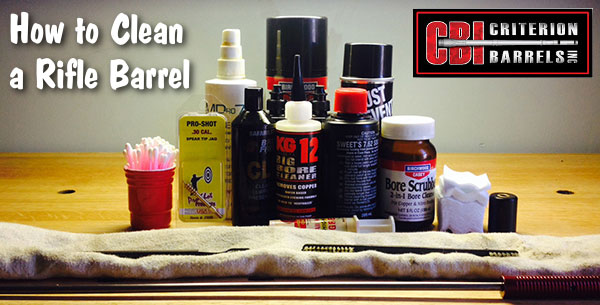


 Amazing Handgun Accuracy at 50 yards


