Put the same load in a variety of barrels (with the same length and chamberings) and you’ll see a wide variance in muzzle velocity. In fact, it’s not unusual to see up to 100 fps difference from one barrel to the next. We demonstrated this with a comparison test of Lapua factory ammo.
Chron Testing Lapua Factory Ammo
At our Southern California test range some years ago, we chronographed Lapua 105gr 6mmBR factory ammo in three different 8-twist barrels of similar length. The results were fascinating. Lapua specs this ammo at 2790 fps, based on Lapua’s testing with its own 26″ test barrel. We observed a speed variance of 67 fps based on tests with three aftermarket barrels.
Barrel Velocity Variance
Brand ‘S’ and Brand ‘PN’ were pre-fit barrels shot on Savage actions. Brand ‘K’ was fitted to a custom action. All test barrels were throated for the 100-108 grain bullets, though there may have been some slight variances in barrel freebore. With a COAL of 2.330″, the rounds were “jumping” to the rifling in all barrels.
Among the four barrels, Brand ‘PN’ was the fastest at 2824 fps average — 67 fps faster than the slowest barrel. Roughly 10 fps can be attributed to the slightly longer length (27″ vs. 26″), but otherwise this particular barrel was simply faster than the rest. (Click Here for results of 6mmBR Barrel Length Velocity Test).
IMPORTANT: Results Are Barrel-Specific, Not Brand-Specific
These tests demonstrate that the exact same load can perform very differently in different barrels. We aren’t publishing the barrel-makers’ names, because it would be wrong to assume that ‘Brand X’ is always going to be faster than ‘Brand Y’ based on test results from a single barrel. In fact, velocities can vary up to 100 fps with two identical-spec barrels from the SAME manufacturer. That’s right, you can have two 8-twist, 26″ barrels, with the same land-groove configuration and contour, from the same manufacturer, and one can be much faster than another.
Don’t Demand More Than Your Barrel Can Deliver
We often hear guys lament, “I don’t get it… how can you guys get 2900 fps with your 6BRs and I can only get 2840?” The answer may simply be that the barrel is slower than average. If you have a slow barrel, you can try using more powder, but there is a good chance it may never run as fast as an inherently fast barrel. You shouldn’t knock yourself out (and over-stress your brass) trying to duplicate the velocities someone else may be getting. You need to work within the limits of your barrel.
Factory Ammo Provides a Benchmark
If you have a .223 Rem, 6mmBR, .243 Win, 6.5×47 Lapua, 6.5 Creedmoor, 6.5×55, .308 Win, .30-06 Springfield, or .338 LM Rifle, we recommend you buy a box of Lapua factory-loaded ammo. This stuff will shoot great (typically around half-MOA), and it can give you a baseline to determine how your barrel stacks up speedwise. [Editor’s NOTE: The original test was conducted in 2008. The velocity of current-production Lapua factory ammo might be higher or lower, so your results may vary.]
When you complete a new 6mmBR rifle, it’s definitely smart to get a box of Lapua factory ammo and chronograph it. That will immediately give you a good idea whether you have a slow, average, or fast barrel. Then you can set your velocity goals accordingly. For example, if the factory 105gr 6BR ammo runs about 2780-2790 fps in your gun, it has an average barrel. If it runs 2820+ in a 26″ barrel (or 2835 fps in a 28″), you’ve got a fast tube.
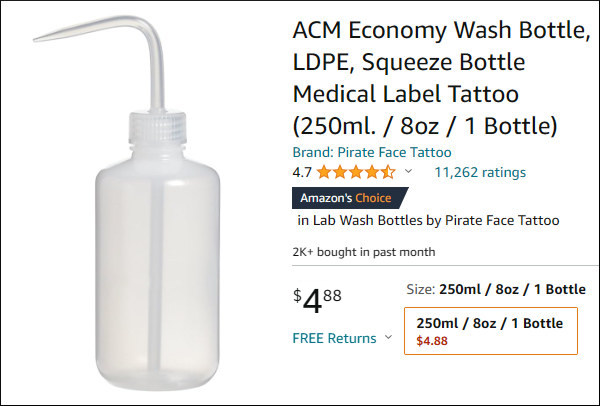
Small patches are not very efficient at distributing bore cleaning liquids inside your bore. The problem with a tight-fitting patch is that the solvent gets squeezed off in the first few inches. You can switch to a smaller jag, or a bore mop, but there is an even better way to get an ample amount of solvent in your bore. Just spray directly into the bore with a wash bottle, an inexpensive plastic bottle with an L-shaped dispensing neck, tapered at the end.
When using the wash bottle, you can either just plug the breech and spray from the muzzle end (where most copper fouling is), or, alternately, put the wash bottle neck directly in the chamber and spray forward. When spraying from the chamber forward, you may need to use a rubber O-Ring to seal off the action… depending on the bore size and the particular wash bottle’s neck spout diameter. We prefer to plug the breech and squirt from the muzzle.
Bottle Solvent Application Method Works Great for Smaller Bores
Using wet patches or wet brushes is an inefficient way to really saturate the tight bores of 17s, 20s, and 22s. Even with a cotton bore mop, most of the solvent will be squeezed out before it gets to the end of the bore, where most copper fouling occurs. For these smaller 17, 20, and 22-caliber bores, you can just take the wash bottle and stick the tapered nozzle right in the chamber. The tapered end will press fit in the throat, sealing off the chamber. With the barrel slightly nose-down, give the bottle a couple good squirts until the solvent mists out the muzzle. In just a few seconds, this will put more solvent in the bore than a half-dozen wet patches.
A solvent-filled wash bottle is also handy for wetting your brushes. It’s much easier to saturate a bore brush (without spilling solvent on your stock), by using the wash bottle. You can get wash bottles from USPlastic.com, Amazon.com, or lab supply stores. CLICK HERE to get a pair of wash bottles for just $5.99.
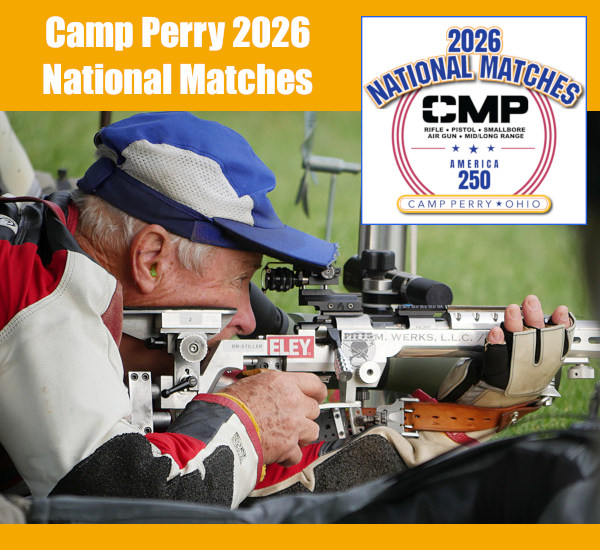
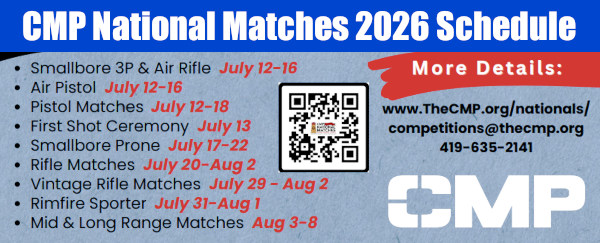
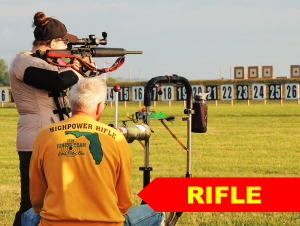
The CMP 2026 National Matches will take place at Camp Perry from July 12 through August 8, 2026, with the First Shot Ceremony on Monday, July 13, 2026. Camp Perry is a National Guard facility located on the shore of Lake Erie in northern Ohio near Port Clinton. The shooting ranges have been modernized in recent years, with the installation of advanced electronic targets for many disciplines. SEE Full Camp Perry NM Calendar.
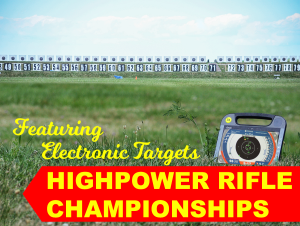
The National Matches will begin with Smallbore (rimfire) and Air Rifle events, followed by Air Pistol. The National Smallbore rifle series will utilize electronic targets, and the CMP Highpower Rifle Championships will now also be fired on electronic targets, with three 80-shot matches, followed by a 4-Man team event.
The National Matches are open to the public and have offered a wide range of events and matches since 1907. These matches are conducted by a partnership of the CMP and Ohio National Guard. Since their inception, the National Matches have become a huge, national shooting sports festival with well over 4,500 annual participants. The 2026 National Matches include the events listed below. Click on each discipline below for registration information, detailed match programs, and schedules.
Additionally, there will be multiple Garand/Springfield/Vintage/Modern Military (GSMM) Matches at the CMP Camp Perry National Matches this year. After the Rimfire Sporter match, the National Match Series concludes with Mid-Range (600-yard) and Long Range Matches.
The John C. Garand match is a Camp Perry classic. Note the signature Garand clip in the air.
Registration for the 2026 National Trophy Pistol and Rifle Matches is still OPEN. CLICK HERE to Sign up and review all the 2026 National Matches event info on the CMP website.
It is estimated that nearly 21.5 million Americans are currently licensed/permitted to carry concealed weapons. And with the 2022 U.S. Supreme Court decision in NYSRPA v. Bruen, we can expect that number to increase significantly. That landmark case stated that the Second Amendment guarantees citizens the right to bear arms outside their homes.
According to the Crime Prevention Research Center (CPRC), in 2024 8.2% of American adults had permits. That means nearly 21.5 million Americans are licensed to carry a firearm in the United States. Outside of the restrictive states of California and New York, about 9.8% of adults have a permit. Four states currently have over one million active permit holders: Florida, Georgia, Pennsylvania, and Texas. And interestingly, about 47% of Americans (over 157.6 million people) reside in “Constitutional Carry” states that allow handgun carry without a specific license.
There are now seven (7) major business entities which provide insurance coverage and legal services for CCW holders. These providers are listed below. We suggest, BEFORE you commit to any particular policy/membership, you comparison shop at least three different options. We also recommend you read the full 3400-word GunDigest Article that examines, in detail, the coverage offered by these seven companies:
Factors to Consider When Choosing a Gun Insurance Program:
Attorney Fees and Expert Fees
The key benefit of any CCW insurance plan is coverage for attorneys fees. If you need a lawyer for a civil case or criminal defense, the fees pile up very fast. Good lawyers can charge $400-$500 per hour, and a trial can go on for many days. GunDigest explains: “If your case goes to trial you might find a bill that runs up to six figures.” You should check to see if a policy covers lawyer retainer, hourly fees, expert fees, AND potential damages.
Bail Bond Coverage
If you are involved in an incident, and an arrest is made, you want to avoid spending time in a jail cell. That’s why it’s important to have a CCW insurance plan that will quickly provide funding for bail bonds. As GunDigest notes: “bail-bond coverage is typically part of a sound concealed carry insurance policy”.
Multi-State Coverage
Gun laws vary among states, and state insurance laws vary as well. This affects the coverage an insurance program can and will provide. When choosing a policy, ask questions to determine how coverage may vary from state to state. With some programs you can purchase additional coverage for trips outside your home state. These can be time-limited for cost savings.
Policy Limits (Dollar Amounts)
When considering a CCW insurance program you need to look at the policy limits — the amount the program might pay to provide legal assistance and potentially settle a claim. You need to read the fine print here, just as you would with an automobile or home policy.
The detailed GunDigest article on CCW Insurance Coverage, notes that there are some additional factors to consider when choosing CCW Insurance:
“You’ll find there are other areas covered by some concealed carry insurance plans worth contemplating. Many of them fall within the policies themselves, however, some cost extra. In many cases, CCW policies go well beyond legal expenses and cover some other aspects you might not have considered:”
Crime Scene Clean Up
Negligent Discharge
Spouse And Family Self-Defense
Property Damage
Firearms Replacement
Work Loss Coverage
Personal Use Of Firearm (non-defensive)
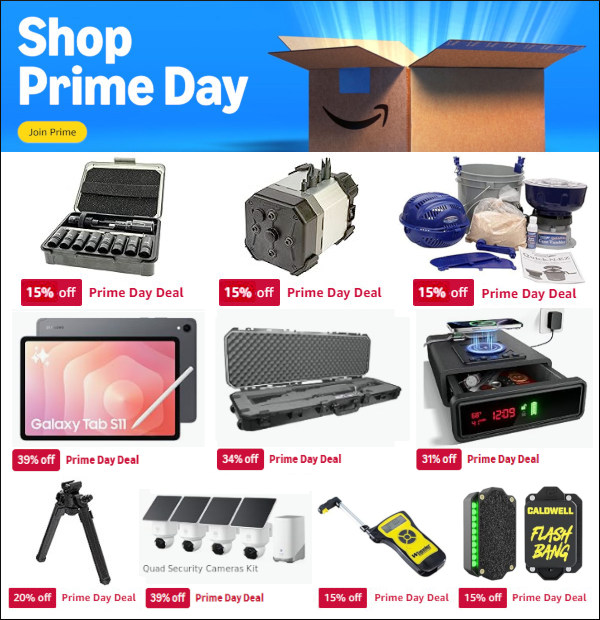
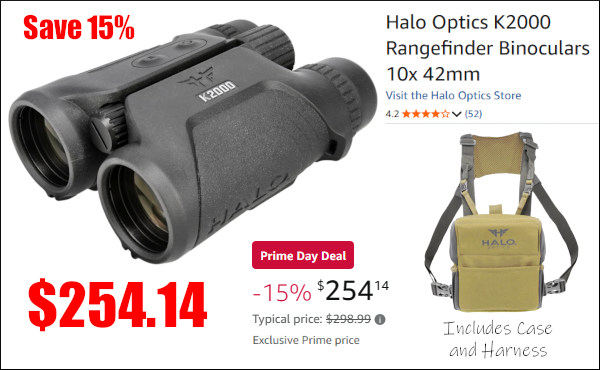
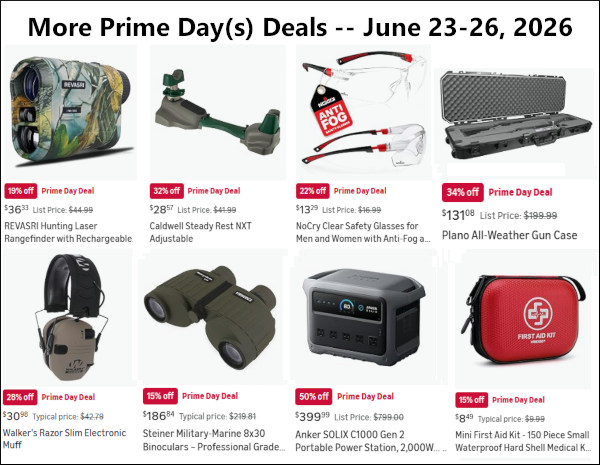
Amazon’s Prime Day sale event commences today with major savings for Amazon Prime members. In years past, “Prime Day” was a 24-hour sale. In 2026, there are major bargains over a 4-day span: June 23, 24, 25, and 26. There are thousands of great bargains — with savings up to 40% — on a vast selection of products. And Prime Day bargains include great deals on reloading tools, rifle accessories, optics, hunting gear, and gun maintenance supplies. Plus you can save on electronics, laptops, even car/truck parts.
Here are five special bargains we found today, on products we’ve used and can recommend. If you are an Amazon Prime member you should definitely do some shopping today — there are literally thousands of bargains, with many great deals for shooters, handloaders, and hunters.
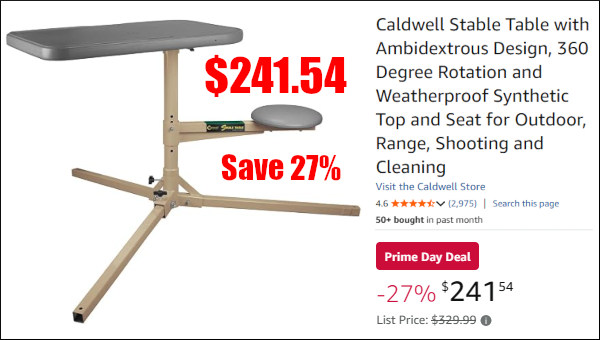
Amazon — Caldwell Stable Table, $241.54, Save 27%
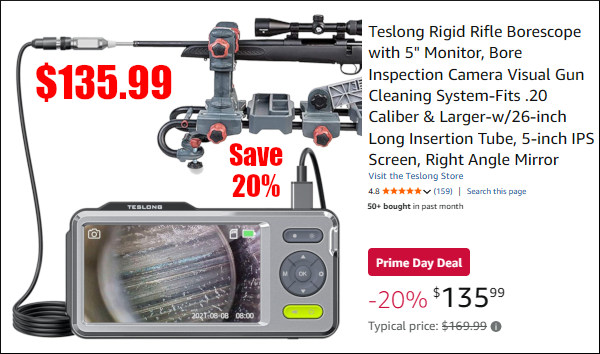
Amazon — Teslong Borescope with Monitor, $135.99, Save 20%
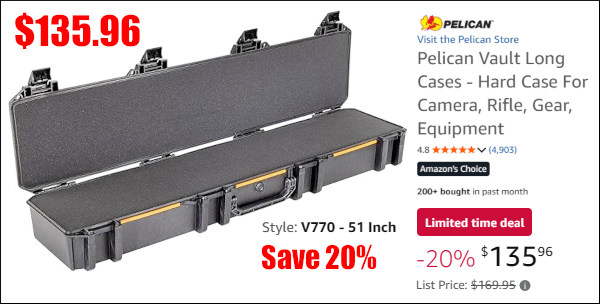
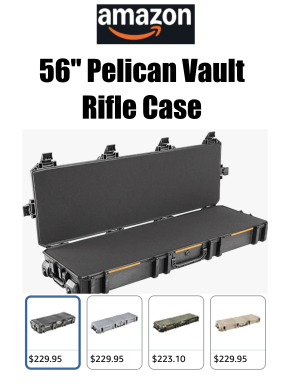
Amazon — Pelican 51″ Rifle Vault, $135.96, Save 20%
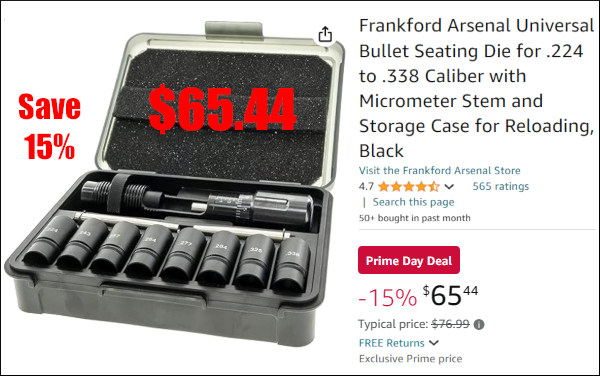
Amazon — Frankford Arsenal Universal Bullet Seating Kit, $59.98
BONUS: Eight More Prime Day Deals
IMPORTANT — This is just a small sample of the thousands of significant bargains offered today for Amazon Prime Members. We recommend you head over to Amazon and check out the deals. You can save enough today to pay for a monthly Prime membership many times over.
AccurateShooter.com offers a dozens of free, printable targets in our Target Collection. However, we know that sometimes shooters may prefer a commercially-printed specialty target. These may offer unique designs, hi-viz colors, splatter effect, or special functions (such as scope checking). Here are a variety of excellent commercial grid targets you can buy via Amazon or the target-maker’s website.
EZ-AIM 12″x12″ Grid with Orange Bullseyes — $3.29 for 13-pack
We like this EZ-Aim Sight-in Grid Target for sighting-in, load development. and general practice. The full 12″x12″ target is covered with a precise black-lined grid on white background. There is a large center orange bullseye, plus four additional bulls, one in each corner. Right now this target is a bargain. You can get a 13-pack of targets for just $3.29 (#ad) on Amazon.
Freedom Targets — Bullseye Sight-In Grid Target, 25 for $13.89
Here’s a great Bullseye Sight-in Grid Target. This target provides a central bull on a 1″ grid pattern. There 8 additional small orange dot aim points, plus helpful numbers on the central vertical and horizontal lines. The outer four orange aim points are set inside heavier black lines to help align your scope crosshairs. This target is nicely printed, with sharp lines and bright orange circles. You get a pack of 25 targets for $13.89 — that’s $0.56 per target.
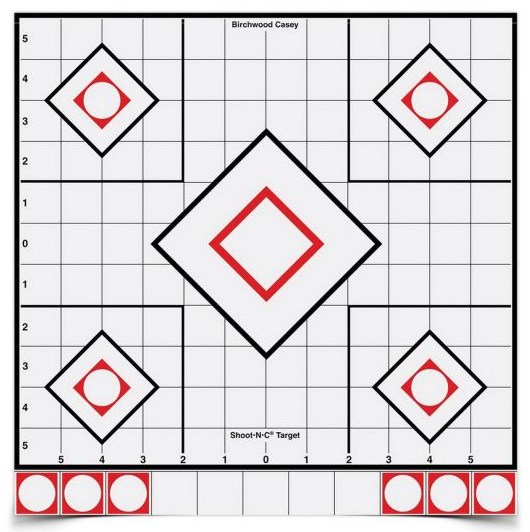
Birchwood Casey Grid — Black on White Splatter, 5 for $8.69
We’ve all seen conventional splatter targets with a black bullseye or grid. When a shot hits the target, a halo (usually neon yellow) appears around the bullet hole. Here is another kind of splatter target that creates a black circle on a white background. This can be very effective for spotting your hits at long range. Capture the same Shoot-N-C experience in white and black — the black “halo” can easily be seen at many distances. This Birchwood-Casey White Grid Target is $8.69 for a 5-pack. These Shoot-N-C Sight-In Targets have a self-adhesive backing, making for easy put up and take down. In addition, the target pack comes with corner pasters to cover holes or use as additional aim points.
High-Viz Option — Yellow on Black Grid with Yellow Halos
If you prefer seeing ultra-high-contrast yellow/green “halos” for your hits, Birchwood Casey also makes adhesive grid targets with five yellow-edged diamonds. Red circles provide precise aiming points in the middle of each box. You can quickly estimate group size or dial-in your zero using the hi-viz yellow 1″ grid lines. These yellow-on-black targets are available in three sizes: 8″ square, 12″ square, and 17.5″ square. These yellow-on-black grid targets start at $5.99 for an 8″ six-pack (#ad) on Amazon.
As an Amazon affiliate, this site can earn revenues through sales commissions.
This content Copyright 2026. Any republication on any other site is a violation of Federal Copyright laws and gives rise to penalties and damages.
At the request of our readers, we provide select “Deals of the Week”. Every Sunday afternoon or Monday morning we offer our Best Bargain selections. Here are some of the best deals on firearms, hardware, reloading components, optics, and shooting accessories. Be aware that sale prices are subject to change, and once clearance inventory is sold, it’s gone for good. You snooze you lose.
NOTE: All listed products are for sale to persons 18 years of age or older. No products are intended for use by minors.
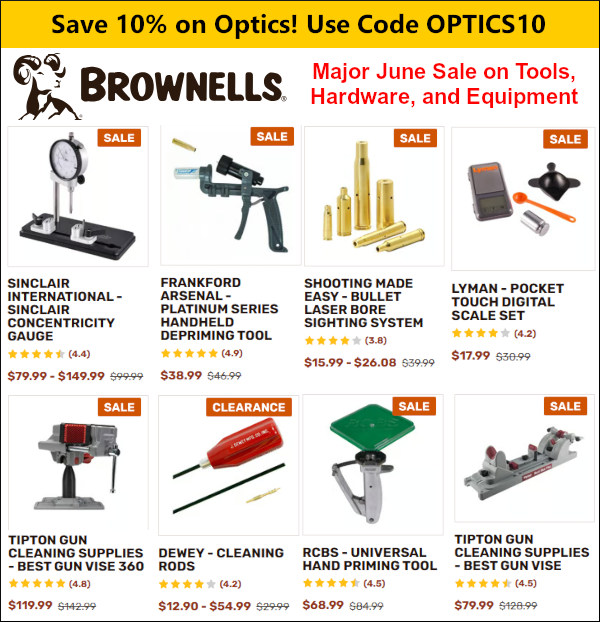
Brownells — June Tools Sale & Father’s Day 10% OFF
⏺️ » Great selection of reloading and shop tools at major discounts
This week Brownells is offering big discounts on a host of popular tools including priming tools, dies, case measurement tools, presses, scales, gauges, gun vises, and more. There are really some great deals right now. Plus, for a limited time, you can save 10% on nearly all Optics products in stock at Brownells with Discount CODE OPTICS10.
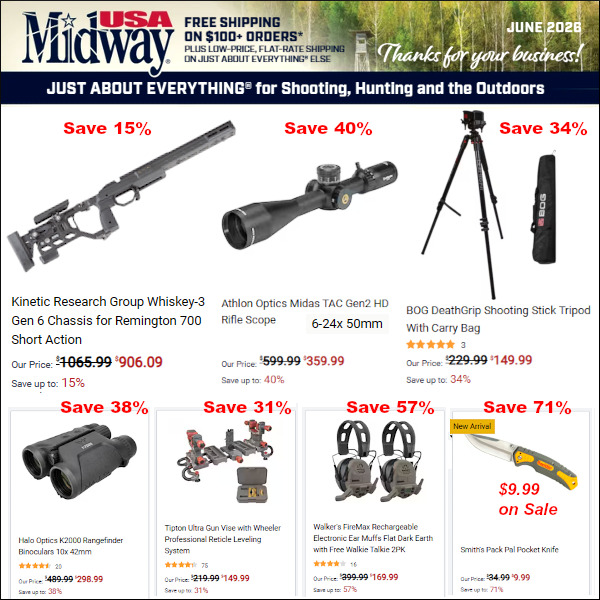
MidwayUSA — Hot Deals with Savings up to 75%
⏺️ » Great selection of tools, optics, accessories 25-75% Off MSRP
Yesterday, June 21, 2026 was officially Summer Solstice, the longest day of the year (which interestingly coincided with Father’s Day). Many USA weather services are predicting above average temps this summer in many areas. And “peak heat” summer conditions have arrived already in some parts of the country (e.g. Phoenix was 106°F yesterday, 6/21/26). It’s vitally important to keep your ammo at “normal” temps during the hot summer months. Even if you use “temp-insensitive” powders, studies suggest that pressures can still rise dramatically when the entire cartridge gets hot, possibly because of primer heating.
It’s smart to keep your loaded ammo in an insulated storage unit, possibly with a sealed Blue Ice Cool Pak if you expect it to get quite hot. Don’t leave your ammo in the car or truck — temps can exceed 140° in a vehicle parked in the sun.
The way ambient temperatures, barrel heating, and powder warming can affect cartridge pressures (and hence velocities) was covered in a study Pressure Factors: How Temperature, Powder, and Primer Affect Pressure by Denton Bramwell. In that article, the author used a pressure trace instrument to analyze how temperature affects ammo performance. Bramwell’s tests yielded some fascinating results.
For example, barrel temperature was a key factor: “Both barrel temperature and powder temperature are important variables, and they are not the same variable. If you fail to take barrel temperature into account while doing pressure testing, your test results will be very significantly affected. The effect of barrel temperature is around 204 PSI per F° for the Varget load. If you’re not controlling barrel temperature, you about as well might not bother controlling powder temperature, either. In the cases investigated, barrel temperature is a much stronger variable than powder temperature.”
This Editor had the personal experience of 6mmBR hand-loaded ammo that was allowed to sit in the hot sun for 45 minutes while steel targets were reset. The brass became quite warm to the touch, meaning the casings were well over 120° on the outside. When I then shot this ammo, the bullets impacted well high at 600 yards (compared to earlier in the day). Using a Magnetospeed, I then chron-tested the sun-heated ammo. The hot ammo’s velocity FPS had increased very significantly — all because I had left the ammo out in the hot sun uncovered for 3/4 of an hour.
LESSON: Keep your ammo cool! Keep loaded ammo in the shade, preferably under cover or in an insulated container. You can use a SEALED cool pack inside the container, but we do NOT recommend just bags of H2O ice. And don’t have the container do double duty for food and beverages.
Powder Heat Sensitivity Comparison Test
Our friend Cal Zant of the Precision Rifle Blog has published a fascinating comparison test of four powders: Hodgdon H4350, Hodgdon Varget, IMR 4451, and IMR 4166. The first two are Hodgdon Extreme powders, while the latter two are part of IMR’s Enduron line of propellants.
The testers measured the velocity of the powders over a wide temperature range, from 25° F to 140° F. Hodgdon H4350 proved to be the most temp stable of the four powders tested. [NOTE: New Alliant Reloder TS 15.5 has also proved very temp stable in AccurateShooter’s range tests.]
The 30 BR is an amazing little cartridge. However, 30 BR shooters do have to neck-up 6mmBR or 7mmBR brass and then deal with some issues that can arise from the expansion process. One of our Forum members was concerned about the donut that can form at the new (expanded) neck-shoulder junction. Respected bullet-maker Randy Robinett offers tips on how to deal with the “dreaded donut”.
The Forum member was concerned about thinning the brass if he turned his 30 BR necks after expansion: “Everything I have found on 30 BR case-forming says to simply turn off the bulge at the base of the neck caused by the old 6BR shoulder. I expanded my first case and measured the neck at 0.329″ except on the donut, where it measures 0.335″. Looking inside the case… reveals a groove inside the case under the donut. Now, it is a fact that when I turn that neck and remove the donut, the groove is still going to be there on the inside? That means there is now a thin-spot ring at the base of the neck that is .005 thinner than the rest of the neck. Has anyone experienced a neck cracking on this ring?”
Randy Robinett, who runs BIB Bullet Co., is one of the “founding fathers” of the 30 BR who help prove and popularize the 30 BR for benchrest score shooting. Randy offers this advice on 30 BR case-forming:
While the thinner neck-base was one of our original concerns, unless one cuts too deeply INTO the shoulder, it is not a problem. For my original 30BR chamber, thirty (30) cases were used to fire 6,400 rounds through the barrel. The cases were never annealed, yet there were ZERO case failures, neck separations, or splits. The case-necks were turned for a loaded-round neck diameter of .328″, and, from the beginning, sized with a .324″ neck-bushing.
The best method for avoiding the ‘bulge’ is to fire-form prior to neck-turning (several methods are successfully employed). Cutting too deeply into the shoulder can result in case-neck separations. I have witnessed this, but, with several barrels and thousands to shots fired, have not [personally] experienced it. The last registered BR event fired using that original barrel produced a 500-27x score and a second-place finish. [That’s] not bad for 6K plus shots, at something over 200 firings per case.
Check Out the 30 BR Cartridge Guide on AccurateShooter.com
You’ll find more information on 30 BR Case-forming in our 30 BR Cartridge Guide. Here’s a short excerpt from that page — some tips provided by benchrest for score and HBR shooter Al Nyhus:
30 BR Case-Forming Procedure by Al Nyhus
The 30 BR cartridge is formed by necking-up 6mmBR or 7mmBR brass. You can do this in multiple stages or in one pass. You can use either an expander mandrel (like Joe Entrekin does), or a tapered button in a regular dies. Personally, I use a Redding tapered expander button, part number 16307. This expands the necks from 6mm to .30 cal in one pass. It works well as long as you lube the mandrel and the inside of the necks. I’ve also used the Sinclair expander body with a succession of larger mandrels, but this is a lot more work and the necks stay straighter with the Redding tapered button. This button can be used in any Redding die that has a large enough inside diameter to accept the BR case without any case-to-die contact.
Don’t be concerned about how straight the necks are before firing them the first time. When you whap them with around 50,000 psi, they will straighten out just fine! I recommend not seating the bullets into the lands for the first firing, provided there is an adequate light crush-fit of the case in the chamber. The Lapua cases will shorten from approx. 1.550″ to around 1.520″ after being necked up to 30-caliber I trim to 1.500″ with the (suggested) 1.520 length chambers. I don’t deburr the flash holes or uniform the primer pockets until after the first firing. I use a Ron Hoehn flash hole deburring tool that indexes on the primer pocket, not through
Photo shows Joseph (“Skeet”) Borden, with match rifle built by his son, Jim Borden.
On this Father’s Day 2025, we celebrate three pairs of fathers and sons who enjoyed competitive shooting together. This story can remind us how shooting together can help build life-long bonds between fathers and sons.
Joseph Borden and Jim Borden
A while back, Jim Borden made a post on his Facebook Page that made us think about how shooting can build important connections between father and son. Jim recalled how he would go to Piedmont, North Carolina with his father every year for a shooting match: “17 years ago this weekend was the last time dad was able to make the trek to North Carolina for the annual Groundhog contest and the match at Piedmont. Loved the time we spent together. Dad shot competitive benchrest with me from 1980 until June 2001. He passed in August 2001.”
This prompted others shooters to respond with cherished memories of their own fathers:
“I’d give a year’s pay to have my Dad back for an hour, let alone a day. Spend all the time you can with them while they’re here”. — Kerry S.
“I think how lucky some folks are to look back in life and have fond memories of doing things with their parents that both enjoyed. I have missed my dad for 44 years and think of him every time I hunt, fish, trap or work on a household project. We did it all together.” — Bill McC.
Another poster explained how he now attends matches with his own young son:
“The time you spent with your father meant as much or more to him. Always cherish [those memories], as I know you will. Last year, I spent … over 400 hours with my then 10-year-old son going to rifle matches. This year will be similar. This photo was from today of my 11-year-old son.” — John C.
So here’s a message to all dads — take some time to introduce your sons (and daughters) to the joys of shooting. Spend quality time with your youngsters while you can. Time passes quickly, boys grow up into men. Ensure you enjoy a life outdoors together whenever you can.
About Jim Borden and Borden Accuracy
Jim began shooting high power silhouette and benchrest matches in the mid 1970s while working for a Fortune 500 company as an engineer. In the early 1980s he began building rifles for himself and then for others. Jim has a background as a gunsmith, machinist, registered mechanical engineer, engineering instructor, project manager, hunter, and benchrest competitor. In benchrest competitions he has set ten world records and won 11 National Championships thereby earning induction into the Benchrest Hall of Fame. Jim also served six terms as President of the International Benchrest Shooters (IBS).
Jim operates Borden Rifles/Borden Accuracy with his wife Joan, sons Jim Junior and John, daughter Andrea Mecca and son-in-law John (Mike) Mecca. Jim is also an outstanding photographer.
Another Father/Son Duo — Sam Hall and Hunter Hall
Sam Hall is a multi-time IBS 600-yard Shooter of the Year, who holds many IBS mid-range records. It’s tough to beat Sam when he’s on his game. But it looks like Sam has a worthy challenger — his own son Hunter Hall, now 15. At age 12, Hunter won the North Carolina State 1000-yard Light Gun Group Title.
At a very young age, Hunter Hall showed an interest in his father’s shooting hobby. It turns out Hunter has the God-given talent for hitting the target. Yes there would be another champion in the Hall family. Here is Hunter, at age 12, winning the NC 1000-Yard Group title. Not bad for a kid not even in High School yet!
Even at just 6 years of age, Hunter showed a keen interest in shooting. Back in 2012 Sam reported: “This weekend we practiced freehand shooting with his BB gun at cans. After that I was needing to zero my Light Gun and get started with a few loads at 100 yards. To my amazement my 6-year-old wanted to accompany me. I could not believe it when he wanted to shoot my competition rifle. I had just put a new barrel and scope on it and needed to zero it. After two shots to get it zeroed he hit a .25 inch dot at 100 yards. I let him do everything — loading it, ejecting rounds, and even working my Farley joystick rest.”
Ken Klemm and Ian Klemm — Father and Son F-TR Aces
Over the last 30 years, a family saga has been playing out in rural Wisconsin: a father fosters within his son the joy of competitive target shooting. It started in a basement shooting range of a small-town elementary school, shooting single-shot rimfire target rifles while cementing the fundamentals of sight alignment, breathing, trigger control, and safety. With a background of competitive smallbore shooting in school and the U.S. Navy, Ken Klemm coached his son, Ian, in a father/son indoor winter shooting league. Ian was determined to shoot as well or better than his Dad and would pursue that goal for the next 30 years. Even after his engineering career took him to the Washington DC area for defense-related work, Ian continued to compete with his Dad by mailing “postal match” targets back and forth for many years.
Father and son shooting together. Her Ian spots for his father Ken Klemm, who is shooting.
Ian has now risen to the pinnacle of his F-TR discipline. Ian Klemm has now won three National F-TR Championships in four years. Ian captured back-to-back titles in 2017 and 2018, winning at Lodi, WI in 2017, and Raton, NM in 2018. Ian also finished second at the 2019 Nationals. Ian put on another great performance to win the F-TR National title in 2020 under very challenging conditions.
Here is Ian with proud parents Karen and Ken Klemm after Ian won his Second Straight F-TR National Championship in 2018. Father Ken also competed at the 2018 F-Class Nationals, shooting great in both individual and team events.


 Barrel Velocity Variance

 Small patches are not very efficient at distributing bore cleaning liquids inside your bore. The problem with a tight-fitting patch is that the solvent gets squeezed off in the first few inches. You can switch to a smaller jag, or a bore mop, but there is an even better way to get an ample amount of solvent in your bore. Just spray directly into the bore with a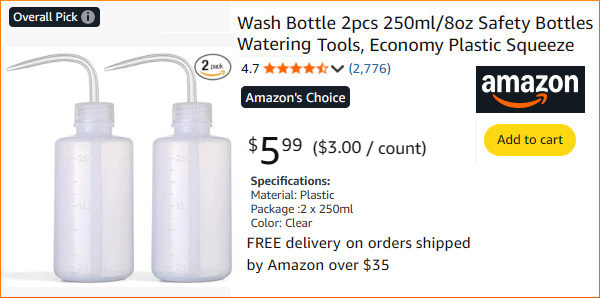









 The way ambient temperatures, barrel heating, and powder warming can affect cartridge pressures (and hence velocities) was covered in a study Pressure Factors: How Temperature, Powder, and Primer Affect Pressure by Denton Bramwell. In that article, the author used a pressure trace instrument to analyze how temperature affects ammo performance. Bramwell’s tests yielded some fascinating results.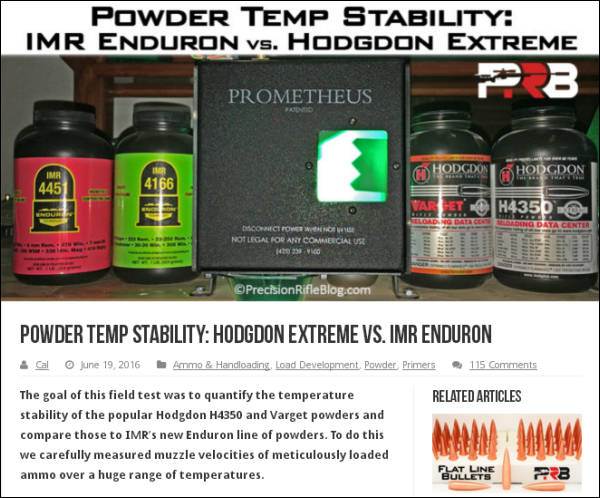

 The 30 BR is an amazing little cartridge. However, 30 BR shooters do have to neck-up 6mmBR or 7mmBR brass and then deal with some issues that can arise from the expansion process. One of our Forum members was concerned about the donut that can form at the new (expanded) neck-shoulder junction. Respected bullet-maker Randy Robinett offers tips on how to deal with the “dreaded donut”.
 Joseph Borden and Jim Borden