BAT .50 BMG Model EX– Now That’s an Action!, by GS Arizona
A few seasons ago, I stopped into Bruno Shooters Supply for a jug of powder and looked into the display case where the new actions are kept. Amid the usual array of BAT Machine, Kelbly and other actions, there was something unlike any action I’d seen before — all I can call it is the BIG BAT (It’s officially the BAT Model EX 2.5). I wasn’t too surprised at the weight (a beefy 13.7 lbs.), but until you lift it it’s hard to appreciate how solid, chunky, hefty, massive (pick your favorite adjective) this thing really is.
The action is a 2.5″-diameter, 12″-long BAT for the .50 BMG cartridge. It is simply the biggest, slickest custom action on the planet. In order to give you some sense of scale, I photographed the action alongside a conventional BAT action for short-range Benchrest shooting and I put a .220 Russian case and a .30-06 case into the picture. I’ve handled and fired other .50 BMG actions/rifles before, but this BAT puts them all to shame, as far as fit and finish go.
The action is actually quite conventional in design and execution. The bolt is fluted and has two front lugs with a conventional, although super-sized, firing pin assembly. Any Remington-style trigger will mount by way of a normal trigger hanger, allowing for simplified maintenance or replacement in the field. The loading port is 5.5″ long and the barrel threads are 1.5″ x 16 tpi — nothing about this beast is small! There is a conventional rocker-type bolt release on the left side of the receiver body and a recoil lug is built into the bottom of the receiver. In reality, the action is very similar to any other BAT except for the size and it adheres to all of BAT’s high standards for quality of design, manufacture, fit, finish and just plain good looks. Slide that bolt back and it feels as tight as a small Benchrest action!
BAT Machine states: “Our model EX is our largest action we make. It was designed to work with the .50 BMG cartridges. This action is 12.00″ long and has two exterior shape options. Starting weight is 128 oz. and varies with options chosen. This action requires a 1.75 inch diameter barrel.”
Given the BIG BAT’s $3,200.00+ sticker price (before options), not many of us will ever have the opportunity to own or shoot one of these beauties (I certainly won’t). However, it is nice to know they exist and can be bought and enjoyed in many places. CLICK HERE for BAT EX configuration options and purchase details.
We like “outside of the box” thinking. And in the world of competitive shooting, it can’t get more unconventional than this. But this radical liquid-cooled benchrest rig wasn’t just a crazy experiment — it actually delivered the goods. This IBS Heavy Gun, built by Joel Pendergraft, produced a superb 10-shot, 3.044″ group that stood as an International Benchrest Shooters (IBS) 1000-Yard Heavy Gun record for seven years, not being broken until 2016.*
Using this water-cooled wondergun, Joel shot the record-breaking group in April 2009 at Hawks Ridge, NC. This monster features a .30-Caliber 12-twist, 4-groove Krieger barrel inside a water-filled sleeve (like on a liquid-cooled machine gun). Joel shot BIB 187gr flat-based bullets in Norma brass, pushed by a “generous amount” of Alliant Reloder 25 and Federal 210M primers. The cartridge was a big custom wildcat Joel listed as “.300 Ackley Improved”. That traditionally has been based on the .300 H&H Magnum parent case**. READ Forum Thread on .300 Ackley.
This 3.044″ 10-shot group was a remarkable accomplishment, breaking one of the longest-standing, 1000-yard IBS World Records. And Joel’s 3.044″ record stood for 10 years.
This 3.048″ 10-shot group was a remarkable accomplishment, breaking one of the longest standing 1000-yard World Records. Bill Shehane commented: “This tops the NBRSA, IBS, and Original Williamsport Clubs’ all-time 10-shot Heavy Gun group records. Took a long time to do it and I for one know Joel did not back into it — he worked harder than most… to break this record. And just like John Voneida of the Original Williamsport Club who held this most prestigous record for so long, Joel is a super nice guy and a great competitor.”
Pendergraft was modest after his notable achievement: “What makes this so very special is to be able to celebrate the accomplishment with all of my shooting friends[.] A good friend once said that records are shot when preparation and opportunity meet. I feel blessed to have personally had the opportunity. The preparation we can individually work on and achieve but the opportunity only comes to a few. Those of you that compete in long range competition will know what I mean.”
*On July 24, 2016, Michael Gaizauskas shot a 2.871″ ten-shot group that bettered Pendergraft’s record by 0.171″ (less than a quarter inch). Michael’s group was also all in the 10 ring, for a perfect 100 score. CLICK HERE for IBS Long-Range Records.
** Back in 2008, the .300 Ackley was the #1 Cartridge in 1000-yard competition at Hawks Ridge. SEE Results Chart. Forum member Cheechako explains: “The .300 Ackley Magnum is actually the .300 H&H case improved. Many shooters will start with the Weatherby brass because it is higher quality. There are several versions of the Ackley but the differences are minor until you get into the few, like the 300 Hart, that actually do increase the capacity. There is also a .300 Weatherby Improved which is sort of a misnomer because it’s almost impossible to improve that case except to eliminate the rounded corners.”
22Plinkster Tours CCI/Speer Idaho Factory
Trickshot artist and YouTube host 22Plinkster recently got a chance to tour the CCI/Speer production facility in Lewiston, Idaho. This large plant produces both rimfire and centerfire ammunition. While touring the plant, 22Plinkster was allowed to capture video showing the creation of .22 LR rounds from start to finish. This is a fascinating video, well worth watching.
This revealing video shows all phases of .22 LR ammo production including cupping, drawing, annealing, washing, drying, head-stamping, priming, powder charging, bullet seating, crimping, waxing, inspection, and final packaging. If you’ve got ten minutes to spare, we really recommend you watch the video from start to finish. You’ll definitely learn some new things about rimfire ammo.
Field & Stream Tours Federal Ammo Plant in Minnesota
Note to Viewers — After Starting Video, Click Speaker Icon to HEAR audio!
Last year a Field & Stream writer toured the Federal ammunition production facility in Anoka, Minnesota. This large plant produces both rimfire and centerfire ammunition. While touring the plant, the reporter was allowed to capture video showing the creation of .22 LR rounds from start to finish. This is a fascinating video, well worth watching. Click speaker icon for sound.
The Manufacturing Process for .22 LR Rimfire Ammunition Shooting Sports USA explains: “Rimfire cartridge cases are the oldest self-contained cartridge in existence, having been in continuous production since the mid-1850s. Rimfire cases are drawn from a thin piece of brass and formed with a hollow rim. A priming compound is then forced into the case using centrifugal force, where it is charged with powder and a bullet is seated in the mouth of the case. The case is then crimped around the bullet to ensure sufficient push and pull when the round is fired. When the firing pin strikes the thin brass rim of the case, the hollow rim is crushed and the primer is ignited.” Source: SSUSA.org 9/2/2017.
Buried in CCI Rimfire Ammo
22Plinkster was literally up to his neck in ammo while touring the CCI/Speer Idaho ammo plant. He says: “This was truly a dream come true for me. I can’t thank the people at CCI and Speer enough for allowing me to do this. I couldn’t possibly show everything that went on at the factory. However, hopefully I showed you enough for you to grasp the concept of how rimfire [ammo] is made.”
History — Speer Brothers Brought Ammo Production to Lewiston
Here is an interesting historical footnote. Today’s large CCI/Speer operation in Idaho can be traced back to the companies founded by the Speer brothers. After settling in Lewiston in 1944, Vernon Speer started Speer Bullets. A few years later, in 1951, Vernon’s brother Dick (with partner Arvid Nelson) started Cascade Cartridges Inc., a producer of small-arms ammunition and primers. Yes, as you may suspect, Cascade Cartridges Inc. is now CCI, a Vista Outdoor company, and one of the largest manufacturers of primers and loaded ammunition. Today, the CCI/Speer Lewiston plant produces both Speer bullets and CCI-branded ammunition and primers. Vista Outdoor’s predecessor, ATK, acquired the plant in 2001. Vernon Speer died in 1979, and Dick Speer died in 1994.
We like to use the Birchwood Casey 2″ and 3″ orange “Target Spots” stick-on circles (with diamond centers) for shooting at 300 yards and beyond (photo right). These give you a very precise aiming point if you align your cross-hairs with the corners of the diamond. However, we know that some guys, particularly those whose scopes have “target-dot” reticles, prefer to have a small box for an aim point. In addition, the orange Target Spots are not a true “Day-Glo” color, so they may seem a little dull (low-contrast) when the target is in shadow.
For guys who want an ultra-high contrast target with a square box in the center, Birchwood Casey offers a series of neon green targets with box centers and spike-style extended vertical and horizontal lines (like on a compass). The manufacturer explains: “These adhesive Target Spots come in highly-visible Atomic Green. The crosshair design fulfills the needs of open-sight shooters along with scope users. Easily line up your open sights on the center square or lay the crosshairs along the vertical and horizontal diminishing lines.” You can also rotate the Atomic Green Target Spots 45° to create a diamond center with the crosshairs in an “X” pattern.
We’ve sampled these targets. The Atomic Green background is a true “Day-Glo” color (like safety signs) so these circles appear very bright on a target backer. These work well in low light. We won’t throw away our orange Target Spots, but these Atomic Green circles are a nice option. NOTE: Atomic Green spots are NOT “splatter” targets — a contrasting bright color does NOT appear around your bullet holes.
Multiple Sizes Offered
Birchwood Casey sells the new Atomic green circles in various sizes. You can order a Combo Pack with sixty 1″-diameter spots, thirty 2″-diameter spots, and twenty 3″-diameter circles.
In the world of F-Class, PRS and other precision rifle disciplines, scope manufactures such as Nightforce, Kahles, and Vortex currently dominate the firing lines. However, Oregon-based Leupold has set out to change all that. Long known for premier hunting and military scopes, Leupold has set its sights squarely on the long-range competition market with the Mark 5HD series scopes. With these scopes (available in both MIL and MOA versions), Leupold now has a clear, repeatable, versatile scope in a wide range of magnifications, all the way up to 7-35X. We tested the Leupold Mark 5HD 7-35x56mm MOA second focal plane (SFP) optic. Though it features a very large 35mm (yes thirty-FIVE mm) main tube, it is one of the lightest scopes in its class — a bonus for guys struggling to make weight with their comp rifles.
Leupold Mark 5HD 7-35x56mm Field Test Report by F-Class John
The Mark 5HD is a beast of a scope packed into a great-looking and sturdy form factor. While mounting and bore-sighting the scope, I immediately like the size, shape and feel of the elevation and windage knobs. The knobs have a solid, positive feel with distinct, lovely clicks every time they were turned. I was happy to see that Leupold designed the elevation to actually go under zero which can be helpful in some situations.
Scope Box Test in Tunnel
I ran a box test while shooting in a 100-yard tunnel going clockwise then counterclockwise around the corners. I found that the repeatability to be “spot on” with each 5 MOA adjustment landing me basically back on top of the previous shots. After five passes back and forth I was left with four ragged holes in each corner. That’s impressive.
The power ring became one of my favorite features, with its incredibly functional throw lever. Actually more of a throw knob, this allows for quick and smooth change of power. Combine these features with 100 MOA of vertical adjustment and 50 MOA of windage and you have just about everything need to achieve your goals.
Reticle Options for Mark 5HD 7-35x56mm — TMOA Plus on Test Scope
Leupold currently offers two reticle options for its second focal plane (SFP) Mark 5HD 7-35X scope: the TMOA Plus (above) and the Impact-60 (right). The Impact-60 reticle features Xmas Tree-type vertical and horizontal hold-offs. My test scope had the TMOA Plus reticle, a much simpler design with an open aiming point in the center of the reticle for precise shot placement.
The TMOA Plus takes a little getting used to especially if you’re coming from a center dot or crosshair like I did. This is because there’s nothing dead center in your reticle, only four small hold squares at 3, 6, 9, 12 o’clock around center. You can use the aiming center to center up on a bullseye or any of the points around the center as hold off points. A side benefit is that the center set of squares are designed to perfectly fill the X ring at 1000 yards for easy aiming. I will say that once you get used to the reticle configuration it starts to become more intuitive and you can find different ways to use it when holding off for different conditions.
Leupold Mark 5HD Delivers Outstanding Brightness and Clarity
As I got behind the scope, I was surprised by the amount of light coming in through the large 35mm main tube. I tested the scope in the early morning just after dawn, during mid-day, and also at night. Where I shoot there is often a good amount of head-on light coming over the hills in the morning. With my current premium scope, I often see a faint glare (often seen as a haze or whiteness) that will ultimately resolve itself by mid-day but nonetheless bothers me in those early relays. The Mark 5 had NONE of this. The first time I thought it was a fluke but after countless mornings without the annoying haze I was convinced it was the glass. Leupold told me that the Mark 5HD’s superior haze- and glare-free morning performance was a function of how the lens coatings are applied.
While many top-end scopes have quality coatings, the method of applying coatings can produce micro flaws. Leupold explained that such flaws, under certain light conditions, can create a hazy view through the lens. Leupold has clearly mastered this process, achieving a visually clear scope no matter what direction the light comes from, even head-on.
HD Glass Eliminates Chromatic Aberration
Optical performance during mid-day was bright and clear. Importantly, I did notice the absence of chromatic aberration which I have experienced with some other popular-brand scopes. Chromatic aberration usually manifests as fringes of color around hard edges and can be seen even in some of the better scopes. This can affect your ability to see mirage, or to see details on a long-range target. With the Leupold Mark 5HD, chromatic aberration was noticeably absent.
The Leupold Mark 5HD also worked great during an evening shooting session. My club has night shooting for our 600-yard matches. We do it every Tuesday night, so I had lots of time to test the scope in the evening. Our club has lit targets, and even with the rest of the range dark, the targets were clear and bright, making it easy to aim precisely.
SUMMARY — Great Sharp, Clear Scope — More Magnification Would be Welcome
The majority of my testing was in F-Class and while I found nearly every aspect of the scope enjoyable, I did find myself wanting just a little more magnification. I have no doubt that in other disciplines such as PRS and ELR the 7-35X is more than enough and in fact perfectly suited. However, in the current F-Class world, 35X max magnification is on the low end, as other leading optics-makers offer scopes in the 50-60x range.
Overall, I really enjoyed this scope and think it’s going to become the favorite for a lot of shooters. It is easy to use and incredibly clear. Despite its beefy look it actually weighs less than many scopes in this category. Leupold says the Mark 5HD is “up to 20 ounces lighter than other scopes in its class”. That’s great for disciplines with tight weight limits. If you’re in the market for a new competition optic you should give one of the new Mark 5HD scopes a try.
Box to Bench Precision (B2B) has developed an oversize (23.5″ x 30″) precisely-scaled target designed for Load Development and Scope Testing. This waterproof target is very innovative. On the target you’ll find clusters of aim points for various tasks. Upper left are orange aiming spots for testing various powder charges. In the upper right quadrant are more red aim points to be used when testing bullet seating depth. Running down the center of the target is a vertical line with horizontal marks showing precise MOA and Mil heights at 100 yards — use this feature to verify your click values. ORDER HERE.
And there’s more. In the lower right quadrant (far right) are three black targets to be used for chrono work. With these you can record cold velocity, hot barrel velocity and a “Final Velocity”. Over in the lower left quadrant, in the left-most column, are three dot targets for zeroing and recording group size with load data. Finally, four more black/white targets can be used for a scope box test (aka “shooting the square”). With a box test, you move from target to target, clicking in sequence to each corner of the square in sequence, eventually returning to your original aim point. If your scope tracks correctly, the last box test shot should end up right on top of the first shot.
Record the Entire Load Development Process on One Target
For those used to shooting at conventional bulleyes or benchrest targets, this target may seem confusing, but it can really help organize and simplify the process of load development. We like the idea of having a single, durable target that performs double-duty — serving for load development as well as scope checking. And we like the fact that the target is pretty strong — the maker says: “The target is Tear-Resistant and Water-Proof”. We’d expect a maker based in the Pacific NW to design a target that can handle wet weather.
Previous version of target shown in photo. Current version has a larger and centered box test, and Tracking lines that are labeled in IPHY/MOA/MIL.
How to Order
So how much does all this target technology cost? A single, 23.5″ x 30″ target costs $5.00. A pack of three targets costs $14.25, while a five-target pack runs $22.50 (which works out to $4.50 per target). There is also a 100 meter version of this target for $4.25 each or $20 for five. Targets ship in a durable cardboard tube. To order these targets, visit the Box To Box Precision Online Store.
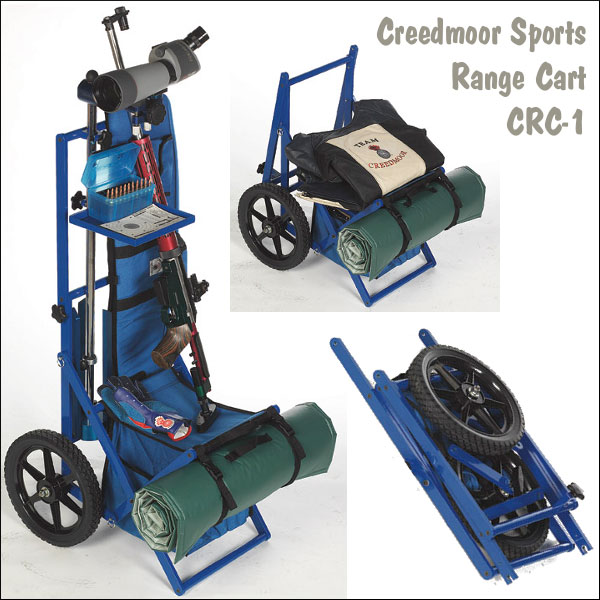
The Berger Southwest Nationals is coming up next month. That means you want to upgrade your hauling capabilities. SWN F-Class and High Power shooters have a ton of gear they need to carry out to the firing lines. To do the hauling, you can certainly purchase a factory-made, purpose-built cart that folds up and has all the bells and whistles. The Creedmoor Sports CRC-1 (photo right) is a proven, quality product that works great. You’ll find these used by top shooters at Camp Perry. But the Creedmoor CRC-1 cart costs $475.00, even on sale.
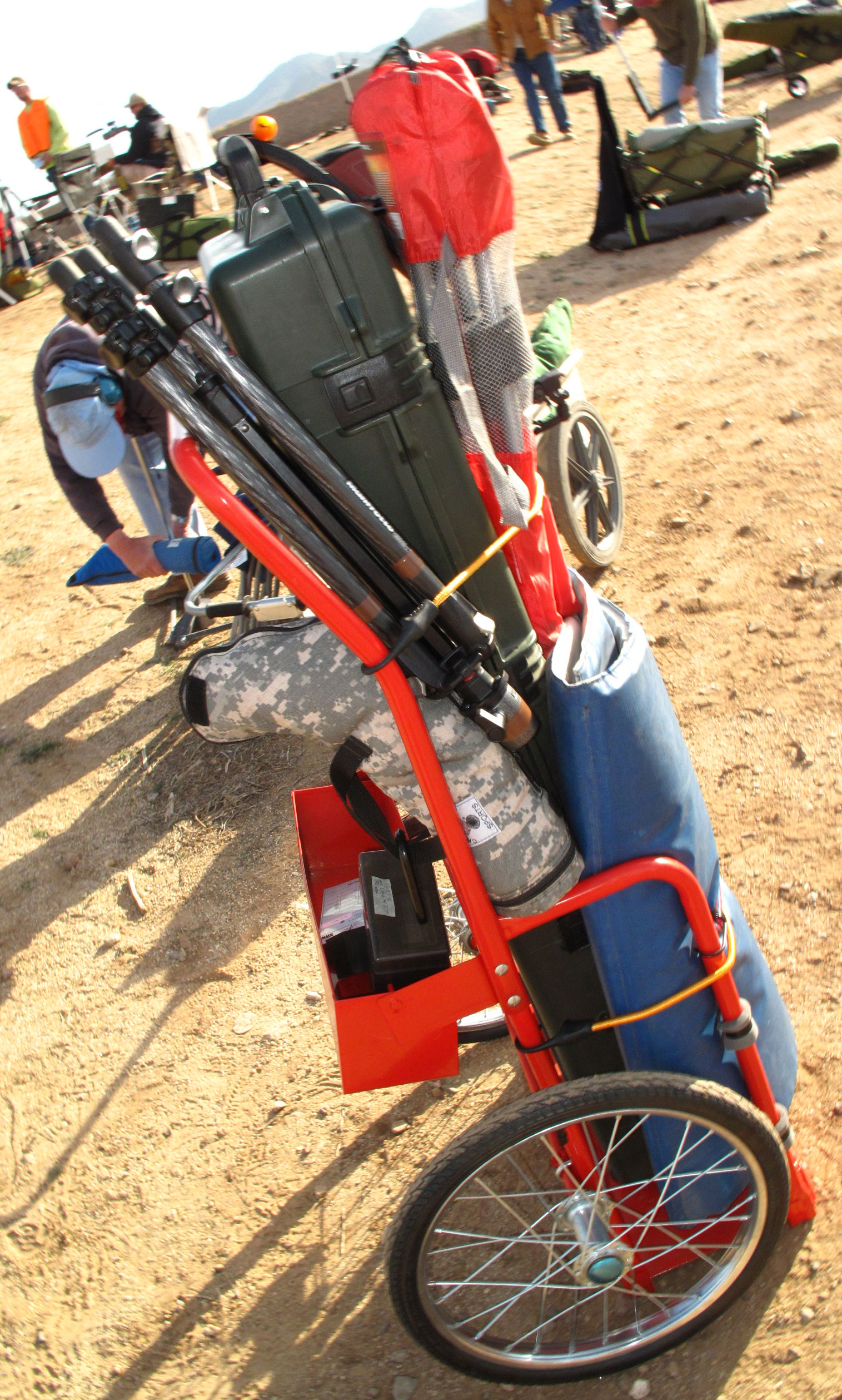
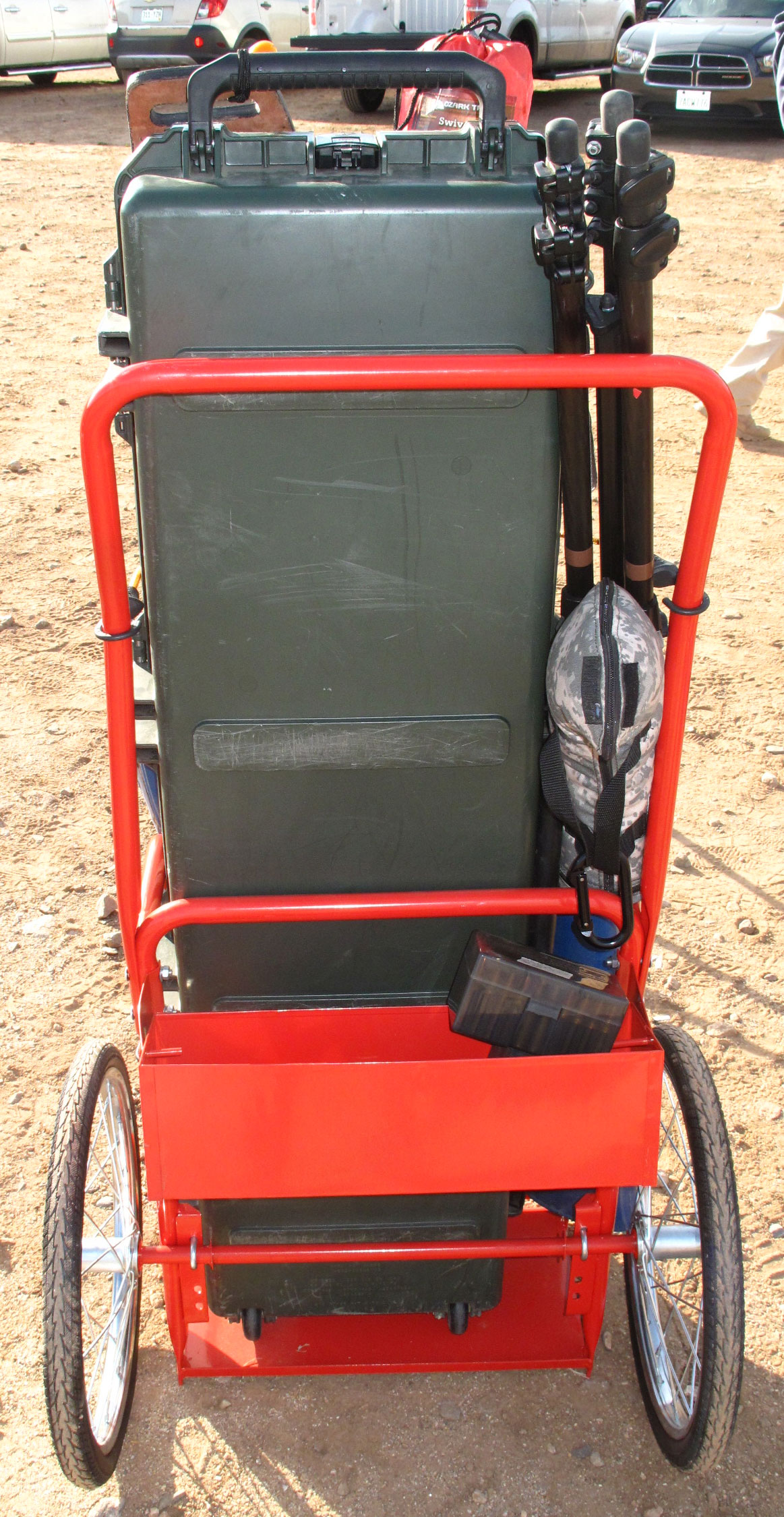
For a fraction of that price ($59.99), plus a few dollars more for do-it-yourself enhancements, you can have a heavy-duty cart that will haul all your gear just fine, though it doesn’t fold up. In the top photo is a Harbor Freight Welding Cart we saw at the Berger Southwest Nationals. This rig is carrying a rifle in hard gun case, bipod, folding chair, shooting mat, tripod, spotting scope, rear sand-bag, and ammo box — that’s a lot of gear!
Check out the Harbor Freight Welding Cart, item #65939. This cart is ON SALE right now for just $59.99. Overall size is 29-1/2″ L x 20″ W x 49″ H, and width between side rails is 18″. The wheels (with tires) are 20 3/4″ in diameter for smooth rolling. Consider that, if you made your own cart from scratch you could easily pay $30.00 or more just for the large-diameter wheels and axle. Do note — this cart has air-filled tires. Be sure to inflate before you go to the Range!
As sold, the Harbor Freight Welding Cart can benefit from upgrades for range use. But with a few bungee cords (and some creativity), the cart can be adapted pretty easily to hauling your gun gear. If you want to enhance the basic cart, it’s easy to add plastic side-panels on the bottom unit, and fit a barrel-holding system on the cross-tube. This ensures rifles and gear won’t flop forward. (A small piece of wood under the bottom panel provides a bit of extra lift that will keep the bottom plate out of the dirt and gravel.)
The Snake is back baby! For 2020, Colt’s Manufacturing Co. LLC will offer a refined and upgraded Colt Python with a hefty $1499.00 MSRP. The legendary double-action revolver, which originally debuted in 1955, returns in stainless steel in 4.25″ and 6″ barrel lengths. It is designed to be stronger than before. Numerous improvements were made to reinforce the revolver, including the use of stronger stainless steel alloys and a re-designed rear sight which allows for a 30% increase in the cross-sectional area of the top strap — meaning more steel for a stronger revolver.
Important Colt Python Enhancements:
— More Steel in Top-Strap for Enhanced Strength
— Recessed Muzzle Crown (protects rifling during cleaning)
— Reduced Number of Parts in Trigger Mechanism for Greater Durability
Colt doesn’t want these to be safe queens, they’re meant to be shot. Along with the stronger frame, these Colt Pythons have recessed target crowns for improved accuracy[.] Chambered for .357 Magnum they can withstand a lifetime of full-power loads[.] — Max Slowick, GunsAmerica.com.
GunsAmerica Review of New Colt Python
The new Colt Python is offered with a high-polish stainless steel finish and either a 4.25-inch or 6-inch barrel. Both come with walnut grips that bear the Colt medallion. These updated versions of the Colt Python have a few changes to differentiate them from the old snake guns but they maintain the classic looks and operation of the originals.
The classic grip pattern, boxy frame, generous trigger, ribbed topstrap, and full-length underlug are all just as they should be. Both models are double- and single-action with a spurred hammer.
Colt modified the sights. The rear sight is still a fully adjustable target sight, which is standard for full-size revolvers, and the front sight can be changed by the user like on the new Colt Cobras.
The classic grip pattern, boxy frame, generous trigger, ribbed topstrap, and full-length underlug are all just as they should be. Both models are double- and single-action with a spurred hammer.
The 4.25″ barrel Python is 9.75″ long and 42 ounces. The 6″ model is 11.5″ long and 46 ounces.
Factory Video Shows New Python’s Features
This Colt-produced video explains features of the new Colt Pythons (4″ and 6″) in detail. If you are interested in this wheelgun, definitely watch this video — it will answer most technical questions. Double action pull-weight is 7 to 9.5 pounds while the single action pull is 3 to 4 pounds out of the box. The new Colt Python .357 Magnum is available now through Colt stocking dealers for $1499.00 MSRP.
This is a tougher, stronger Python — durability tests included over 40,000 trigger pulls on a single Python. Trigger pull scans show lighter trigger pull weights, less friction, and increased consistency.
“We know the Colt Python is one of the most beloved and collected firearms in American history, and its re-release has long been demanded by enthusiasts,” said Justin Baldini, Product Director at Colt. “We took our time on R&D – we needed to be sure the look and performance of this redesign lived up to its legendary name and kept its impeccable reputation for quality and accuracy. This new Python lives up to the legend in every way.”
The U.S. Army Marksmanship Unit (USAMU), in cooperation with Shooting USA TV, has created a series of instructional Pro Tip pages covering a wide range of shooting disciplines. All totaled, there are more than 50 USAMU Pro Tips. Most relate to rifle marksmanship but there are also numerous tips for shotgunners and pistol shooters. Each Pro Tip entry includes multiple photos and 6-15 paragraphs, in an easy-to-follow format. Many Pro Tips also include an instructional video produced by Shooting USA. Here are three Pro Tip videos, and links to seven more Pro Tip web pages.
USAMU TOP TEN PRO TIPS
1. Reading the Wind with SGT Sherri Gallagher.
Apart from gravity, wind has the most pull on the bullet as it travels down range. Being able to accurately read the wind and mirage will greatly enhance your performance on the rifle range. National Champion, SGT Gallagher gives you some of her tips.
2. Angle Shooting with SFC (Ret.) Emil Praslick.
SFC Praslick shows you how to determine the angle to your target, and then how to include that to change your data necessary to hit your target on the first shot.
3. Rifle Grip, Stance and Body Position for 3-Gun with SFC Daniel Horner.
Professional 3-gun marksman SFC Daniel Horner, U.S. Army Marksmanship Unit (USAMU), give tips on how to properly handle a semi-automatic rifle, including grip, stance and body position.
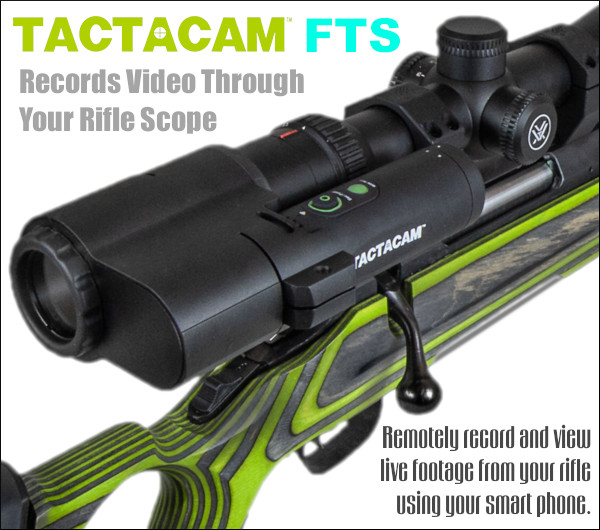
Would you like to record what your eyes are seeing through your scope, during a practice session or hunt. Here is a very highly-reviewed product that will do the job superbly for under $430.00 on Amazon. The impressive Tactacam FTS 5.0, that allows you to film directly through your rifle scope. The FTS 5.0 unit, produced by Tactacam in Minnesota, has earned high praise from users. In September 2019, reviewer Joe Rhea declared: “This Tactacam 5.0 is the best scope cam system I have seen or used”. Likewise reviewer Scott Gregg states: “This is THE BEST Action Camera for hunting.”
Tactacam Live Streaming AND Recording
What you see through your riflescope can be recorded to your mobile device as well as viewed live. We think this is an important technology for marksmanship training. In addition, this is great for hunters who may want to record a successful hunt sequence.
The Tactacam FTS combines high definition capture with the high-power zoom of a rifle scope. This lets you remotely view and record live footage from your rifle on your smartphone or mobile device. Simply couple your scope and your camera together with the Tactacam FTS components. Then sync the camera to the Tactacam APP on your smart phone for live viewing.
You continue to watch your target through the normal optical axis of the rifle scope. The camera records via the offset FTS camera mount. The output of the FTS camera system can then be viewed, in real time, via a live feed to a smartphone. After setup, the Tactacam FTS allows the riflescope to operate normally with no additional adjustment or modification.
4K Resolution, Remote Control, Slo-Mo, Wifi Viewing and More
Tactacam’s innovative camera systems allow easy, in-the-field recording of hunts and shooting sessions. The latest Tactacam 5.0 unit provides 4K resolution with outstanding image quality. Other features include WiFi and APP viewing options, remote control activation, slow motion, and live-streaming capabilities. Camera output can be viewed both in the App and on external WiFi-capable devices.
The Tactacam FTS system can attach to nearly all conventional rifle scopes. This system is less expensive and easier-to-mount that most other through-the-scope viewing systems. Importantly, your valuable smartphone remains separate, i.e. NOT attached to the rifle. Hence it cannot be harmed by recoil or muzzle blast. That’s important.


 This 3.048″ 10-shot group was a remarkable accomplishment, breaking one of the longest standing 1000-yard World Records. Bill Shehane commented: “This tops the NBRSA, IBS, and Original Williamsport Clubs’ all-time 10-shot Heavy Gun group records. Took a long time to do it and I for one know Joel did not back into it — he worked harder than most… to break this record. And just like John Voneida of the Original Williamsport Club who held this most prestigous record for so long, Joel is a super nice guy and a great competitor.”


 We like to use the Birchwood Casey 2″ and 3″ orange “Target Spots” stick-on circles (with diamond centers) for shooting at 300 yards and beyond (photo right). These give you a very precise aiming point if you align your cross-hairs with the corners of the diamond. However, we know that some guys, particularly those whose scopes have “target-dot” reticles, prefer to have a small box for an aim point. In addition, the orange Target Spots are not a true “Day-Glo” color, so they may seem a little dull (low-contrast) when the target is in shadow.


 The Berger Southwest Nationals is coming up next month. That means you want to upgrade your hauling capabilities. SWN F-Class and High Power shooters have a ton of gear they need to carry out to the firing lines. To do the hauling, you can certainly purchase a factory-made, purpose-built cart that folds up and has all the bells and whistles. The