The New 6GT Cartridge for Precision Rifle Competition
Report by Vu Pham
Earlier this year I was ready to build a 6 Dasher when I saw a lot of buzz on the interwebs about a new caliber George Gardner (Owner of GA Precision) and Tom Jacobs (Owner of Vapor Trail Bullets) designed, the 6GT. After some research and talking to George, I ditched the 6mm Dasher build and had GA Precision build me a 6GT on a GAP Templar action I already had in the safe. The reasons to try the 6GT in a new PRS-style rig were as follows:
1. Push a 110-115 grain class bullet at 2880-2930 FPS safely in the Sacramento heat.
2. Achieve a load that is reliable and predictable. The caliber must be easy-to-tune and predictable from barrel to barrel. I don’t want to spend weeks developing a new load each time I spin on a fresh barrel.
3. Be able to run the same mag in all my guns without having to tweak or use mag kits. The round must feed from AICS and AW magazines without major tweaking or hiccups.
4. Get good barrel life. The barrel needs to go 2200-2500 rounds with match-grade reliability and accuracy.
5. Have a competitive cartridge with the least possible recoil without sacrificing too much performance down range, compared to bigger options like the 6mm Creedmoor.
6GT feeding from un-modified magazines has been flawless in all the rifles we tested. The 6GT feeds so well, I sometimes have to do a press check to ensure there is a round in the chamber.
On paper the 6GT seemed like the perfect cartridge for PRS- and NRL-style competition. It has the low recoil of a 6 Dasher, with good feeding and mag compatibility. With the 6GT, a competitor can push 105gr bullets at 3000+ FPS or run heavier bullets at 2800-2900+ FPS.
Knowing that I would initially have to make my own 6GT brass and do quite a bit of load development, I enlisted the help of Dan Bertocchini with CS Tactical. Dan has a lot more experience with wildcats and is the man when it comes to this type of data gathering. He has been running a 6 Dasher for a few years so I was curious how he would compare the 6GT to his 6 Dasher.
Quick Summary: “I am really digging the 6GT and the capabilities it offers. It can launch 103gr Vapor Trails at 3000+ FPS or lob heavy 115gr DTACs in the low-to-mid 2900s comfortably. I think we will see this cartridge go mainstream in PRS/NRL-style competition in 2020.” — Vu Pham
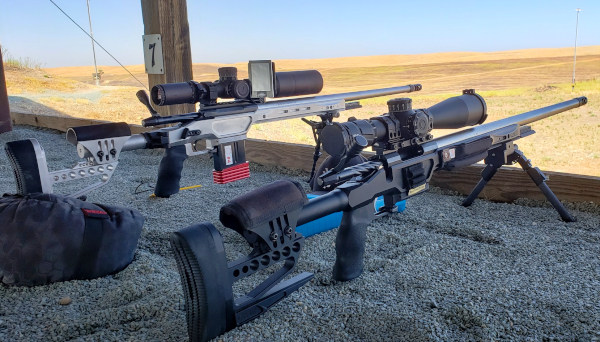
The new 6GT Cartridge Was Tested in Three (3) Tactical Rifles:
Rifle 1: Vu’s 6GT 1.0
Builder: GA Precision
Action: Left Hand GAP Templar (large firing pin)
Barrel: Bartlein 7.7 Twist finished at 26″ with a 419 Hellfire Brake
Stock: KMW Sentinel
Optic: Vortex Razor Gen II 4.5-27x56mm EBR-7C MRAD
Bi-Pod: Harris
Trigger: Timney Calvin Elite
Magazines: AICS and AW
Support Bag: Wiebad Fortune Cookie
Rifle 2: Vu’s 6GT 2.0
Builder: Rubicon Precision
Action: Impact Precision 737
Barrel: Bartlein 7.0 Twist finished at 27″ with a 419 Hellfire Brake
Stock: XLR Industries Envy Chassis
Optic: Vortex Razor Gen II 4.5-27x56mm EBR-7C MRAD
Bi-Pod: Harris with Henderson Arca adapter
Trigger: Trigger Tech Diamond
Magazines: AICS and AW
Support Bag: Wiebad Fortune Cookie
Rifle 3: Dan’s 6GT
Builder: CS Tactical
Chambered by: Rubicon Precision
Action: Lone Peak Arms Fusion
Barrel: Proof 7.0 Twist finished at 28″ with a Muzzle Brake and More Brake
Stock: XLR Industries Envy Chassis
Optic: Minox ZP5 5-25x56mm MR4
Bi-Pod: Arca Cyke Pod (PRS)
Trigger: Trigger Tech Diamond
Magazines: MDT
Support Bag: Armageddon Gear OG Game Changer, Waxed Canvas
Alpha Munitions Pre-Production 6GT Brass George Gardner was kind enough to send us 50 pieces of Pre-Production Alpha 6GT brass for preliminary testing. Like the cases I formed from 6.5×47 Lapua brass, the Alpha 6GT brass will use a small rifle primer. Price from Alpha Munitions should be $1.15 per case, which is on par with Alphan’s other product line.
The first 7000 pieces of Alpha 6GT brass sold before I could even get my hands on any! The bigger batch of production brass is due later this year. To pre-order the brass, CLICK HERE.
The major difference between 6.5×47 Lapua-formed brass and Alpha 6GT brass is the case capacity. Alpha 6GT brass has 1.5 to 1.7 grains more case capacity. When a piece of 6.5×47 Lapua brass is formed into a 6GT, the walls of the case now become the shoulder and part of the neck. In a normal piece of brass, the shoulder and neck are typically thinner because of the thickness of the brass tapering from the body to neck.
While the cartridge design was optimized for Hodgdon Varget, the extra case capacity of the Alpha 6GT brass opens the door to Hodgdon H4350 (my favorite powder) and Alliant Reloder 16.
Test Results with Alpha Munitions 6GT Brass
Initial test results were as expected from a premium brass-maker. Dan and I both got excellent Standard Deviations and Extreme Spreads over my MagnetoSpeed V3 and his LabRadar. This string below was with 112gr Barnes Match Burners and 33.8 grains of Varget. Can’t complain about a 3 FPS Extreme Spread!
Yes, H4350 Works with the Alpha Munitions Brass
Personally, I prefer running Alpha 6GT brass with H4350 rather than Varget pushing a heavier bullet. H4350 burns slower and cleaner which should equate to better barrel life. The Lapua-formed 6GT cases just do not have the capacity to reach the cartridge’s full capability with the slower burning powders.
Is the 6GT cartridge accurate? Definitely. Here is a 5-shot group at 600 yards shot by Dan. This was Alpha 6GT brass, with Hodgdon H4350 pushing Barnes 112gr Match Burner bullets.
And here is a 4-shot, 600-yard group with reformed 6.5×47 Lapua brass, using Varget powder under a Barnes 112gr Match Burner.
6GT Stress Test — Don’t Try this at Home!
Dan and I also did a “destruction test” to see how the Alpha 6GT brass would hold up when competitors push the cartridge to its limits. Please note that this is PRE-PRODUCTION brass and Dan and I probably exceeded max load for the majority of the duration of this test. Using Varget powder, we pushed 115gr DTACs at 2950+ FPS on a pretty hot day. We ran the charge weight up until the bolt was hard to lift.
Using this very hot charge, we were able to get 14 firings before the primer pocket failed. That is pretty solid considering that this brass was a pre-production sample that Alpha said did not meet its primer pocket design requirements. With these results, I think a shooter pushing 110-115 grain class bullets in the low 2900s will get 16 to 20 firings from a piece of brass.
Is the GT here to stay?
All signs are pointing to “Yes”. Dies are readily available from Hornady, RCBS, and Redding. Chamber reamers are being produced by PT&G and JGS that can be purchased through GA Precision.
Alpha Munitions is hard at work getting quality brass to the shooters. Quite a few people have already chambered up 6GT barrels before they even have brass in hand. I think we will see this cartridge go mainstream in PRS/NRL-style competition in 2020. With Alpha Munitions production brass almost ready to hit the shelves, I think we will see a lot more data come in from the field by the end of this year.
The Verdict — The 6GT Is Looking Great So Far
I am really digging the 6GT and the capabilities it offers. It can launch 103gr Vapor Trails at 3000+ FPS or lob heavy 115gr DTACs in the low to mid 2900s comfortably. George Gardner has texted me some pictures of very impressive groups pushing an 115gr DTAC at 3000 FPS with Alliant Reloder 16 (a very temp-stable powder with a burn rate close to H4350). That being said, if a guy wanted to push that type of speed and bullet weight, the 6mm Creedmoor is a better solution in my opinion. So far my “go to” 6GT load is a 112gr Barnes Match Burner at 2900 FPS. My other favorite load is a Hornady 108gr ELDM at 2970 FPS.
I think the down-range performance of the 6GT over a 6mmBR and the 6BR variants will be valuable on those days where shooting conditions are not as perfect. Recoil is about the same as the 6BR variants (6BRA, 6 Dasher etc.), but noticeably less than a 6mm Creedmoor. The extra energy down range will make a spotter’s job a bit easier when targets extend beyond 800 yards.
Forming GT Brass from Lapua 6.5×47
Before the new Alpha Munitions brass was available, I tested the cartridge using 6GT made from parent Lapua 6.5×47 Lapua brass necked-down and reformed. George Gardner walked me through the process of forming 6GT brass out of Lapua 6.5x47L. The process is time-consuming and is a huge PITA even with the correct tools. More detailed instructions can be found on my 6GT thread on the AccurateShooter Forum. READ Forum Thread HERE.
Here is a photo of what the brass looks like going through the forming/trimming process.
Left to right: 6.5×47 Lapua brass, sized with the 6GT bushing die with a .266 bushing, chopped/trimmed and turned, and fired-formed.
The formed-from-Lapua 6GT brass performed well and is a good option if one has the time and desire, but I’ll be moving over to factory Alpha Munitions brass once it is readily available.
6GT Tested at 1000 Yards
After seeing what Tom Jacobs is doing with his benchrest gun running Alpha Munitions brass, there is no doubt the 6GT is plenty capable out to 1000 yards and beyond. I have a feeling the Benchrest and F-Open guys are going to dig this new 6mm cartridge as well, at least for 600 yards. Note, in this photo it appears Shot #5 is under a paster, but that might just be a Ballistic-X software input error, meaning that this is actually a 4-shot group. Either way it is still impressive.
Our friend Sebastian “SEB” Lambang, creator of the great SEB Coaxial Rests, Joystick Bipods (“JoyPods”), and SEB MINI Coaxial tripod rests, is working on a new front bag design. He has released photos of his new, prototype front bag system for the top-of-the-line NEO Rest.
Seb notes: “We are experimenting with a new bag for our SEB NEO rest, particularly for F-Open Class with the heavy 22-lb rifles. This new bag is sewn down the middle, slick enough for the purpose, and made from a much tougher material. The bottom/horizontal bag has two separate compartments on the left and right sides to prevent sand migration. For the production version I think I will use black instead of silver.”
Do you like the new design? Do you have any suggestions on how it could be enhanced? Seb is looking to get shooters’ feedback on this new bag design. You can post comments on Seb’s Facebook page.
New F-Class and Benchrest Front Bags for SEB MINI
Seb will also be offering a new similar bag for his excellent (and very popular) SEB MINI tripod front rest. There will be a sewn-in-middle F-Class version (see right below), as well as a flat-top, conventional bag for registered benchrest matches. Due to differences in the equipment rules, Seb notes: “The sewn-in-middle front bag can be used for F-CLASS matches. However, be sure to not use the F-CLASS bag (sewn down in the middle) for official Benchrest matches.”
COMMENT: The advantage to the Stitched-in-Middle front bag design is that the bag will never develop a hump in the middle that can cause your stock to rock a little (or sit at a slight tilt). If you are not shooting in restricted competition, Seb’s new bag design could prove beneficial — providing a more optimal front support. We don’t have the dimensions of Seb’s center-sewn front bags, but we suspect a version might fit other brands of front rests, such as Sinclair or Bald Eagle (Grizzly).
“The overturning moment MW tends to rotate the bullet about an axis, which goes through the CG (center of gravity) and which is perpendicular to the plane of drag….
Ruprecht Nennstiel, a forensic ballistics expert from Wiesbaden, Germany, has authored a great resource about bullet behavior in flight. Nennstiel’s comprehensive article, How Do Bullets Fly, explains all the forces which affect bullet flight including gravity, wind, gyroscopic effects, aerodynamic drag, and lift. Nennstiel even explains the rather arcane Magnus Force and Coriolis Effect which come into play at long ranges. Nennstiel’s remarkable resource contains many useful illustrations plus new experimental observations of bullets fired from small arms, both at short and at long ranges.
Shadowgraph of .308 Winchester Bullet
A convenient index is provided so you can study each particular force in sequence. Writing with clear, precise prose, Nennstiel explains each key factor that affects external ballistics. For starters, we all know that bullets spin when launched from a rifled barrel. But Nennstiel explains in greater detail how this spinning creates gyroscopic stability:
“The overturning moment MW tends to rotate the bullet about an axis, which goes through the CG (center of gravity) and which is perpendicular to the plane of drag, the plane, formed by the velocity vector ‘v’ and the longitudinal axis of the bullet. In the absence of spin, the yaw angle ‘δ’ would grow and the bullet would tumble.
If the bullet has sufficient spin, saying if it rotates fast enough about its axis of form, the gyroscopic effect takes place: the bullet’s longitudinal axis moves into the direction of the overturning moment, perpendicular to the plane of drag. This axis shift however alters the plane of drag, which then rotates about the velocity vector. This movement is called precession or slow mode oscillation.”
Raise Your Ballistic IQ
Though comprehensible to the average reader with some grounding in basic physics, Nennstiel’s work is really the equivalent of a Ph.D thesis in external ballistics. You could easily spend hours reading (and re-reading) all the primary material as well as the detailed FAQ section. But we think it’s worth plowing into How Do Bullets Fly from start to finish. We suggest you bookmark the page for future reference. You can also download the complete article for future reference and offline reading.
Many online vendors are running sales this Labor Day Holiday weekend. You’ll find score of products marked way down, plus discount codes that can save you 20% or more on your purchases. Some sales run through end-of-day on Monday September 2nd, while other Labor Day sales extend through next week. Be sure to check the sale schedules.
1. Brownells Labor Day Sale — Guns, Ammo, Components
Brownells is running a huge Labor Day Sale, with savings up to 40%. You’ll find big discounts on AR uppers and lowers, triggers, bipods, magazines, optics, ammo and more. There are also “brand-wide” discounts on major brands listed below.
2. Bruno Shooters — Shipping Deals and Discounted Products
Bruno Shooters Supply has a variety of Labor Day Promotions. First you can get Free Shipping on all orders of $99.95 or more. Plus there is Free Shipping on scopes, stocks, BAT actions, LabRadars, and borescopes. Many items, including Lenzi and Protektor bags, have been discounted, and all Krieger barrels are $10 Off.
3. Creedmoor Sports — 10% Off and Free Ground Shipping
To celebrate the long, Labor Day weekend, Creedmoor Sports is offering 10% Off Creedmoor-branded products with Code LBD19. In addition, you can get FREE Ground Shipping on most items. This applies to normal ground shipping rates, but not HazMat charges, so you’ll still have to pay HazMat for primers and powder. NOTE: Some exclusions apply.
4. Natchez — 10% Discount or Free Ship/Hazmat
Natchez has many items on sale this weekend, plus three Promo Codes. Use CODE PO190829 to save 10% right off the price. Or, for heavy shipments, try CODE FR190829 — this provides $5.00 flat-rate shipping on orders over $99.99. If you need powder and/or primers, select CODE FH190829. This waives the HazMat fees for powder and primer orders $150.00 or more. Pick the Code that works best for you. Don’t hesitate — this deal expires 9/2/2019 at 11:59 pm CST.
5. Midsouth Shooters Supply — $5 Hazmat or $5 Shipping
Midsouth is running a tempting deal this Labor Day weekend. If you buy at least $49 worth of goods, you can get either $5 Hazmat or $5 Shipping for your entire order. In addition to this promotion, Midsouth has many great sale items this week including a Kestrel 2500 NV for $154.00, Hornady Powder dispenser for $179.95, and lots of discounted ammo offerings.
6. Witt Machine — 25% Off Brakes and Suppressor Gear
Witt Machine’s Labor Day Sale is easy to understand — save a full 25% on all items featured on the WittMachine.net home page. This includes clamp-on and screw-on muzzle brakes, suppressors, muzzle rise eliminators, plus integrally suppressed rifles and suppressed AR uppers. CLICK HERE for all sale items in stock. Witt sale tip from EdLongRange.
7. Cabela’s — Hunting Kick-Off Sale, Up to 40% Off
The discounts started August 26th at Cabelas.com. This major sporting goods dealer is running a Hunting Season “Kick-Off Sale” through September 8, 2019. There are big savings on shotguns, hunting boots, ammo, game cameras, GPS units, and more. Some items are 40% off.
8. Palmetto State Armory — Storewide Sale
Complete rifles, pistols, uppers, lowers, optics, ammo — Palmetto State Armory has a wide selection of products, many of which are deeply discounted for the next few days. If you are thinking of an AR project, or are looking for a great price on a carry pistol, check out Palmetto’s deals this week.
9. Primary Arms — Product Specials and Shipping Discounts
Primary Arms has a wide variety of products on sale including Glock parts, AR parts, tactical packs/cases, and Walker Ear Muffs. In addition Primary Arms has FREE Shipping on the entire order when you buy a riflescope or Red Dot optic.
10. Aero Precision — 20-25% Off Uppers and Lowers
Now through 9/3/2019, Aero Precision is offering 25% off Stripped Lowers, Stripped/Assembled Uppers, Scope Mounts, and VG6 Muzzle Devices. Or, get 20% off of Complete Uppers, Lowers, Handguards, and Combo Sets. Finally, pretty much everything else is 15% off. That makes it simple to save big.
4-Gun winner Wayne Campbell is arguably the best group benchrest shooter in the world right now.
IBS 100/200 Yard Group Benchrest National Championships
Story by IBS President Jeff Stover President based on report by Harley Baker
Western Michigan was the site of the 2019 IBS Group Nationals. This major event was held August 12-17, 2019 at the Holton Gun & Bow Club. This club hosts many quality group benchrest matches throughout the season, and this one was no exception. The Holton team, especially match director Nancy Scarbrough, made everything seem easy. The shooters, however, don’t find conditions easy at all.
Summer Sun, Mirage, and Switchy Winds
In the middle of August, Holton’s sandy soils can generate fierce mirage. It can get so bad that competitors may not be able to see bullet holes clearly and target rings can become indistinguishable. In Warren Page’s classic gun book, “The Accurate Rifle”, he speaks of mirage as “shooting through the swimming pool”. Well Warren Page must have shot Holton. When mirage was not the problem at Holton, switchy winds were the order of the day. CLICK HERE for 2019 IBS Group Nationals Results.
IBS Group Nationals Course of Fire
The IBS Group Nationals can be an endurance test as the event spans six days. The sequence of competition has 100-yard targets shot the first three days, followed by three days at 200 yards. It is done this way to require only one change of wind flags. Nationals competition requires “full rotation”. That means that every time a shooter goes to the line for the next match target, he or she must move a requisite number of benches to the right. At the end of the day a shooter will shoot across the full width of the line. Some ranges offer unique properties that render some parts of the range harder or easier to shoot small groups. Bench rotation is important to even out those factors.
Classes At the IBS Group Nationals
It takes thirty targets of 5-shot groups and ten targets of 10-shot groups to win a “4-Gun Nationals”. That covers FOUR classes: Light Varmint, Heavy Varmint, Sporter, and Heavy Bench. For all practical purposes, the first three are known as “bag guns” while the heavy bench rifles are “rail guns”. In fact, most competitors shooting a bag gun opt for a single rifle, which has been benchrest standard for decades: a 10.5-lb rifle chambered in 6PPC.
Day by Day Report — Group Nationals Highlights
The first day of competition was for the Heavy Bench class — the Rail Guns. That is what Heavy Bench is these days. Jeff Peinhardt had a handle on conditions for his five 10-shot groups. His largest group was only a .202″. The rest were small dark holes where the 10 bullets honed away any paper fuzz. His average for the five groups in this aggregate was .1710″. Really small, but only .0074″ behind was Paul Mitchell. Rounding out third place was Michigander Lee Hachigian with a .1866″.
The “bag guns” come out on Tuesday for the 100-yard competition for Light Varmint and Sporter rifles. These are the 10.5-lb rifles. The only difference is that in Sporter you must have your rifle chamber with at least a 6mm bore. Since virtually everyone shoots a 6PPC it really doesn’t matter. Wayne Campbell from Virginia nailed a tight .1556” aggregate in Sporter at 100. Tony Alexander (.1758”) and Jack Neary (.1792”) rounded out the top three.
For Light Varmint at 100 yards. Larry Costa led the way with a .2022” when conditions were a little harder to read. Jack Neary and Kevin Donalds Sr. were close behind.
Wednesday morning of Nationals Week is Heavy Varmint at 100. Ken Donalds Sr. still had his rifle tuned to perfection as he won this aggregate with a .1624. Jack Neary and Harley Baker shot well with five-target averages in the .18XX. Wednesday afternoon the shooters take a break and hold a Powder Puff competition for non-shooters, including children and spouses were allowed to shot a group with bench coaching from seasoned competitors.
On Thursday the targets get moved to 200 yards along with a expanding sea of wind flags. Eventual multi-gun winner Wayne Campbell smoked the field Light Varmint 200 with a .1674 MOA Aggregate. His average group size at 200 yards was O.334 inches but in short-range group competition the scores are converted to minute of angle (MOA). The only other shooter Agging under 0.2 MOA was upstate New York restaurateur Pando Vasilovski with a 0.1927.
It was time for Sporter at 200 and Don Rosette from Ohio was the only shooter in the “teens” with a .1997 MOA Agg. Pando still had it working and was second.
Here are some of the “Top Guns” from the 2019 IBS Group Nationals in Holton, MI.
Former Super Shoot winner Larry Costa won the Heavy Varmint 200 with a .2007 MOA Agg and he had room to spare to beat Kevin Donalds Jr. and Jeff Peinhardt with a .22 and .23 respectively.
The last day, Saturday, the rail guns were hauled out again for the Heavy Bench 200. Mark Buettgen topped the field with a .2572 MOA Agg. No need to check the equipment list to know what barrel brand Buettgen used. Mark works for Bartlein Barrels in Wisconsin. Wayne Campbell was just on Mark’s heels.
Grand Aggregate (100+200)
Winners (all MOA):
Light Varmint: Wayne Campbell, .1939
Sporter: Wayne Campbell, .2133
Heavy Varmint: Larry Costa, .2026
Heavy Bench: Don Powell, .2342
Multi-gun results:
2-Gun (HV+LV 20 targets): Larry Costa, .2197
3-Gun (LV+SP+HV 30 targets): Wayne Campbell, .2205
4-Gun (LV+SP+HV+HB 40 targets): Wayne Campbell, .2279
(in 4-gun Tony Alexander was second with .2404, followed by Larry Costa with .2451)
Hardware Choices: Actions, Stocks, Barrels, Optics and More Tech Talk by Jeff Stover
Let’s examine the Top Ten rifles from this year’s IBS Group Nationals in the 10.5-lb Light Varmint Class. We’ll focus on the most popular rifle components — the choices for Actions, Stocks, Barrels, and Scopes.
For some years now, BAT has been the predominant action. This year BAT actions held nearly 100% of the Top Ten places in all the Bag Gun equipment lists. Bruce Thom’s Idaho-crafted actions, except for a couple stray actions in Heavy Bench, swept the top rankings.
Next, look at barrels. Bartlein or Krieger seem to rule with upstate New York’s venerable Hart barrels as competitive. Shooters tend to go with winners, so Wayne Campbell and Jeff Peinhardt dominate as gunsmiths for the top benchrest shooters.
In stocks there seems to be variety, but there is some commonality. The Scoville and Scarbrough stocks, both Michigan-made, are laminated wood (balsa and other wood) with carbon fiber and wrapped in carbon fiber. The Scoville stock on my 10.5-lb rifle weighs 18 ounces but is full size with a nice long fore-end. Bob Scarbrough makes a very similar product. Both are winners — it’s a choice of Ferrari or Lamborghini. The Roy Hunter and Terry Leonard stocks among these top rifles take a different route to winner’s circle. Both are wood (cedar or other), but super high-tech as they are laminated with carbon fiber. They are beautiful to boot. High-magnification Leupold, March, and Nightforce scopes rule the roost among benchrest optics.
Bullets and Powder
Bullets are important. Really important. A hot bullet gives you “Teen Aggs” and lots of trophies. An average bullet does not. Most of these are 68 grain 6mm boattails. The Peinhardt (StaMoly Precision) bullet is well represented on this list, but some top shooters make their own as you can see. Bullet jackets are likely StaMoly or J4. For powder, nearly everyone shoots Vihtavouri N133 except a few guys running LT30/32 or surplus 8208.
Hunting season is right around the corner. We know many readers have acquired a new hunting rifles, or perhaps are using new ammo or a new optic. If you’ve got new gear, you’ll want to zero your hunting rig properly. Here’s how…
Here’s a simple procedure that lets you get a solid zero in just four shots. Of course you probably want to fire a few more rounds to confirm your zero before you head off to your hunting grounds, but this will let you get on-target with a minimum amount of time and ammo expended. (This assumes your scope is securely mounted, and the bases are not drastically out of alignment.)
QUICK-TIP: The Key to this procedure is Dialing to Shot One Point of Impact (POI). Re-aim at center of target after SHOT ONE. Then with the rifle motionless, use the turrets to put the middle of the cross-hair on the first shot location.
1. First, remove the bolt and boresight the rifle. Adjust the position of the rifle so that, looking through the bore, you can see the center of the target with your eyes. Secure the rifle in the rests to maintain its position as boresighted. Then, without moving the rifle, center the reticle. That should get you on paper. With the rifle solidly secured in front and rear rests or sandbags, aim at the center of a target placed at your zeroing distance (50 or 100 yards). Confirm there are no obstructions in the barrel! Then load and fire SHOT ONE. Then, return the gun to the exact position it was when you pulled the trigger, with the cross-hair centered on the target as before.
2. Locate, in the scope, where your first bullet landed on the target. Now, while you grip the rifle firmly so it doesn’t move, have a friend adjust the turrets on your scope. While you look through the scope, have your friend turn the windage and elevation turrets until the cross-hairs, as viewed through the scope, bisect the first bullet hole on the target. Use the turrets to move the center of the reticle to the actual position of shot number one. IMPORTANT: Dial the crosshairs to the hole — don’t move the rifle.
3. After you’ve adjusted the turrets, now re-aim the rifle so the cross-hairs are, once again, positioned on the target center. Keep the rifle firmly supported by your rest or sandbag. Take the SECOND SHOT. You should find that the bullet now strikes in the center of the target.
4. Take a THIRD SHOT with the cross-hairs aligned in the center of the target to confirm your zero. Make minor modifications to the windage and elevation as necessary.
5. Finally, shoot the rifle from a field rest (shooting sticks, bipod, or rucksack) as you would use when actually hunting. Confirm, with SHOT FOUR, that your zero is unchanged. You may need to make slight adjustments. Some rifles, particularly those with flexy fore-arms, exhibit a different POI (point of impact) when fired from a bipod or ruck vs. a sandbag rest.
This Video Shows the Process Described Above:
Fouling Shots and Cold Bore Condition
If you recently cleaned your rifle, you may want to fire two or three fouling shots before you start this procedure. But keep in mind that you want to duplicate the typical cold bore conditions that you’ll experience during the hunt. If you set your zero after three fouling shots, then make sure the bore is in a similar condition when you actually go out hunting.
Generation One Vortex Fury HD LRF300 10×42 laser rangefinder binoculars are on sale at a HUGE discount. These once sold for $1199.00. Now, with the introduction of the Gen Two Vortex Fury HD 5000 LRF binocs, the Gen One units are just $799.00 at EuroOptic.com. Save a full $400 with a unit that can range to 1600 yards and has excellent optics. If you need even more ranging capability (not likely for a typical hunt), Vortex’s Gen Two Fury HD 5000 model is available for $1199.00 on Amazon. The choice is up to you. We think most hunters will be more than happy with the $799.00 Gen One unit. The $400 you save can buy a quality scope for your hunting rifle.
The Vortex Fury has some very cool features. It offers angle compensation as well as line-of-site modes. Scan mode gives readings as you pan or track a moving animal. You can set the distance output to yards or meters. All the controls are on the right side so you can operate the Fury HD easily with one hand.
Here are two video reviews of Gen One Vortex Fury Laser RangeFinder (LRF) Binoculars:
Review Summary: This is more an infomercial than a field test, but the video does a very good job showing the features of the Gen One 10×42 Vortex Fury HD LRF300. In addition, the reviewer explains how hunters can best use the Vortex Fury LRF binoculars in the field.
Review Summary: This unboxing video covers the operation and controls of the Gen One Vortex Fury HD LRF300 rangefinding binoculars.
Why Use Rangefinding Binoculars?
With rangefinding binoculars, you can carry one less piece of gear, and a binocular optic is much more effective in the field than the monocular on a typical dedicated laser rangefinder (LRF). The stereo view gives better definition and depth perception, and the larger, binocular lenses give better low-light performance than the smaller-diameter monocular optic found in a conventional LRF.
What anti-corrosion products really fight rust effectively? You’ll hear many opinions, but what do actual field tests reveal? One rifle shooter, who posts on YouTube as BlueonGoldZ, wanted to separate myth (and marketing claims) from reality, so he completed his own long-term rust test using metal samples. First he used ordinary tap water spray, and then he did a second, longer-duration test with a salt-spray solution. Nine different products were tested: Break Free CLP, Corrosion-X, Frog Lube, M-Pro 7, Outers, Pro-Shot Zero Friction, Rem Oil, Slip 2000, and Tetra Gun Triple Action CLP.
BlueonGoldZ initially examined each product for its “beading” properties with a normal tap water spray. But the main test involved many multiple weeks of exposure after a “dense” salt-water spray. (No rust formed after two weeks tap water exposure, so the test was accelerated with salt-water exposure).
The clear winners in the test, as shown by the screen shot above, were Corrosion-X (Best), and Frog-Lube (Second Best). The photo shows the test samples two weeks after being sprayed with salt water. The results are pretty dramatic — you can see with your own eyes what happened. We think this is a very useful bit of real-world research.
Results from Similar Long-Term Salt Exposure Test
Unfortunately, BlueonGoldZ’s test did NOT include Eezox, which we have found to be extremely effective (on a par with Corrosion-X). In another long-term test of corrosion preventatives, the two best rust fighters were Eezox and Corrosion-X in that order. Since that test was completed, Corrosion-X, already an excellent product, has been enhanced. CLICK HERE for Long-Term Salt Exposure Test Report.
Shoot 101 Quiz
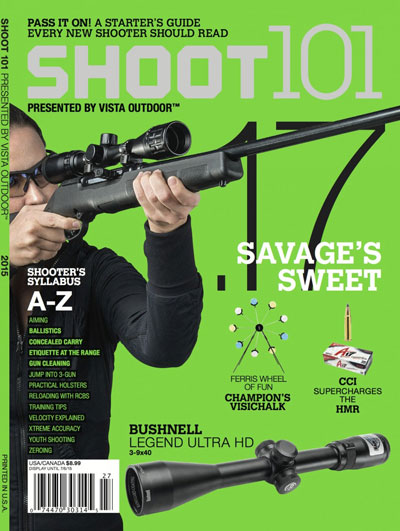
How much of an expert are you when it comes to firearms and ballistics? Test your knowledge with this interactive test. Guns & Ammo magazine created a series of features called Shoot 101. These articles provide “how to” information about shooting, optics, and outdoor gear.
On the Guns & Ammo website, you’ll find the Shoot 101 Ballistics Quiz. The 15 questions are pretty basic, but it’s still fun to see if you get all the answers correct.
You don’t need a lot of technical knowledge. And it’s not all about flight ballistics. Roughly a third of the questions are about projectile types and bullet construction. Note, for some reason the layout doesn’t show all the possible answers at first. So, for each question, be sure to scroll down using the blue scroll bar on the right.
This week’s Shooting USA episode has two great features. Part One covers the USPSA Multi-Gun Nationals, a 3-gun match with fast action. A lengthy second sequence covers new guns and gear at the 2019 NRA Convention in Indianapolis, Indiana. This Shooting USA Episode airs Wednesday August 28, 2019 on the Outdoor Channel, at 9:00 PM Eastern and Pacific, 8:00 pm Central.
USPSA Multi-Gun Nationals
If you are a fan of 3-Gun competition, tune in to Shooting USA this week. The latest episode features the 2019 USPSA Multi-Gun Nationals held in Florida. You can see many of the nation’s top 3-Gun shooters attacking some very challenging stages with pistols, rifles, and shotguns.
Multi-gun competition has evolved considerably since it started 30 years ago. The firearms are more sophisticated, the optics are better, and the stage times are much faster. Still, the challenge remains the same: How fast can you shoot multiple targets, with the score determined by speed and accuracy? For the best in the sport, the answer is very fast indeed…
New Products for 2019 — Guns, Optics, Electronics and More
Shooting USA was in Indianapolis for the 2019 NRA Annual Meetings and Exhibits. At the big event, Shooting USA’s teams found some interesting new products, such as Hornady’s pricey new A-Tip bullets ($80 to $90 per 100), and new handguns from Colt, Smith & Wesson, and Volquartsen. Hornady also displayed a new Kestrel 5700 Meter with advanced 4DOF Ballistic Solver.




 George Gardner was kind enough to send us 50 pieces of Pre-Production Alpha 6GT brass for preliminary testing. Like the cases I formed from 6.5×47 Lapua brass, the Alpha 6GT brass will use a small rifle primer. Price from Alpha Munitions should be $1.15 per case, which is on par with Alphan’s other product line.




 Shoot 101 Quiz


